REVIEW 1 major objections 7 minor 84 references
Untwinned YBa$_2$Cu$_3$O$_{7-\delta}$ thin films on MgO substrates: a platform to study strain effects on the local orders in cuprates
T0 review · 1 major / 7 minor · reviewed 2026-08-14 · deepseek-v4-flash
Pith's one-line read Pre-annealing (110) MgO at 790°C in oxygen forms faceted surfaces that untwin YBCO films, align the CuO chains, compress the b-axis, and preserve chain anisotropy down to 50 nm.
desk verdict Solid new platform paper: compressively strained, mostly untwinned YBCO on MgO, with a real structural twist, but the 'untwinned' label and the 82% figure need more care. read the letter →
The pith
A machine-rendered reading of the paper's core claim, the machinery that carries it, and where it could break.
The reading
What carries the argument
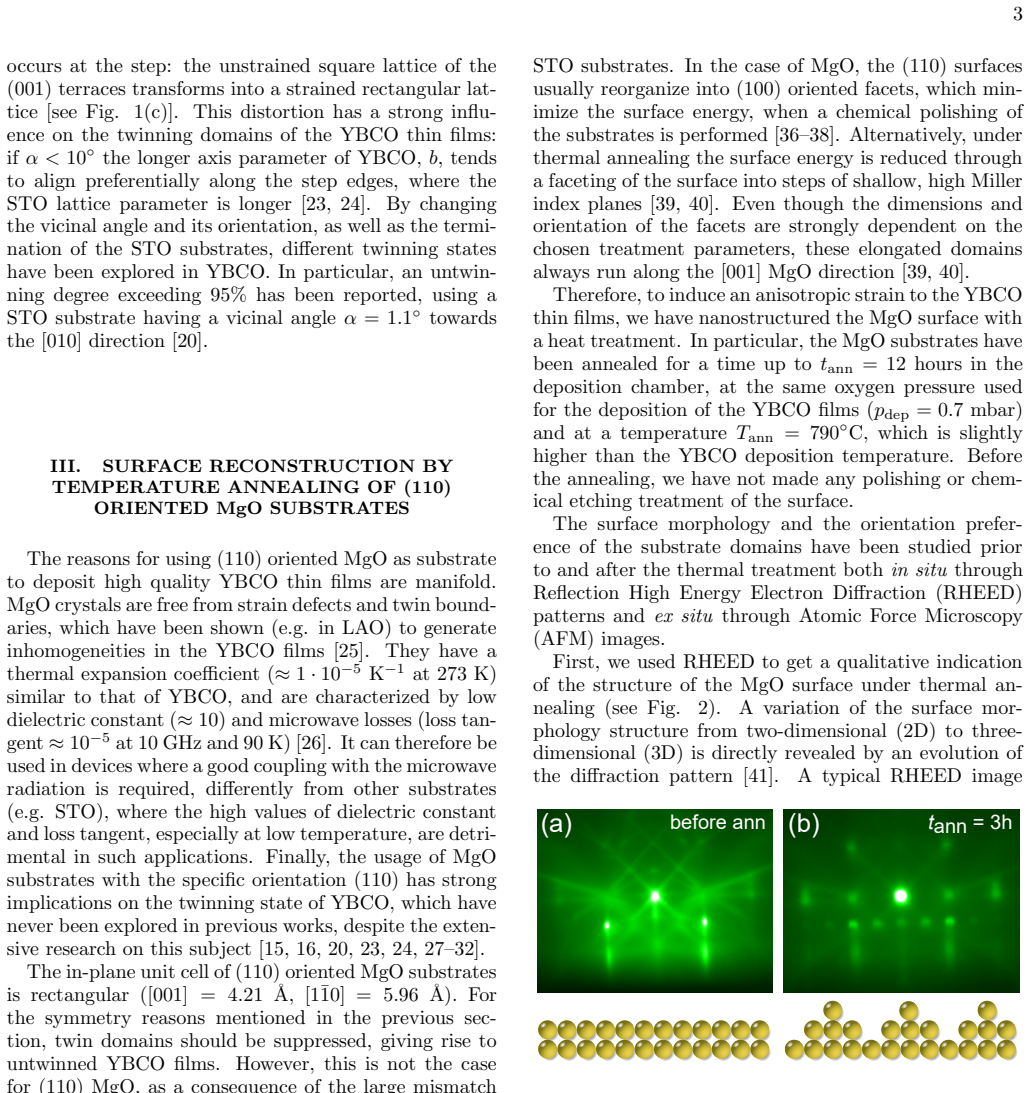
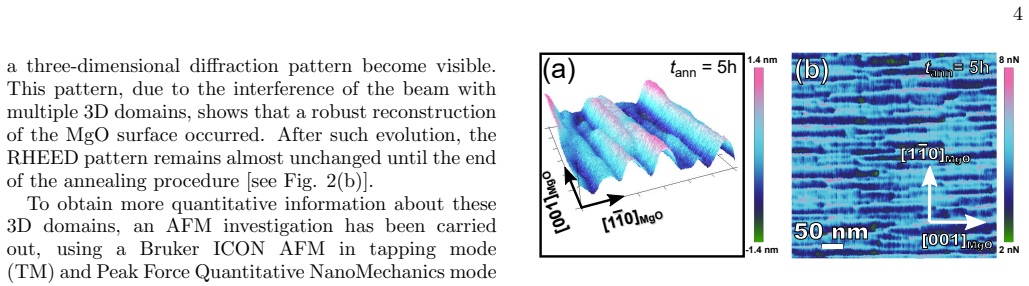
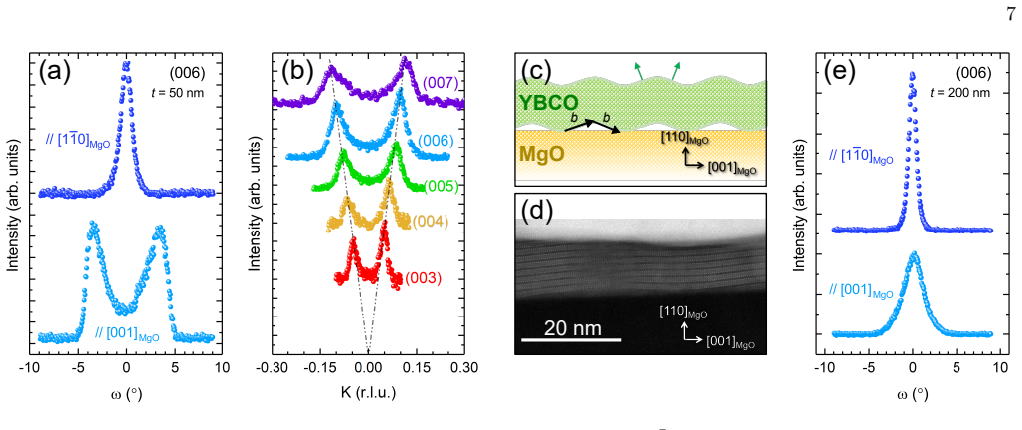
The mechanism that carries the argument is the faceted (110) MgO surface produced by the annealing: shallow, elongated (540)/(450) facets that run along the [001] MgO direction and expose under-coordinated edge atoms. Because those atoms strain more easily at the interface, YBCO nucleates with the a axis perpendicular to the facets and the CuO chains along them, in direct analogy to the step edges of vicinal (001) strontium titanate substrates. The same large lattice mismatch (about 9% and 35% along the two MgO directions) then compresses the b axis and tilts the copper-oxygen octahedra, producing the unidirectional buckling. Density-functional calculations support the faceting by showing that it lowers the surface energy relative to the flat (110) surface.
What would settle it
Grow YBCO on two identically annealed MgO substrates, then remove the facets from one, for example by gentle polishing or ion etching, before deposition; if that film still shows the same high untwinning degree, the facets are not the controlling cause. A complementary check is cross-sectional electron microscopy of the first unit cells to see whether the a/b orientation at the interface tracks the facet edges directly.
Extended reading notes
Core claim
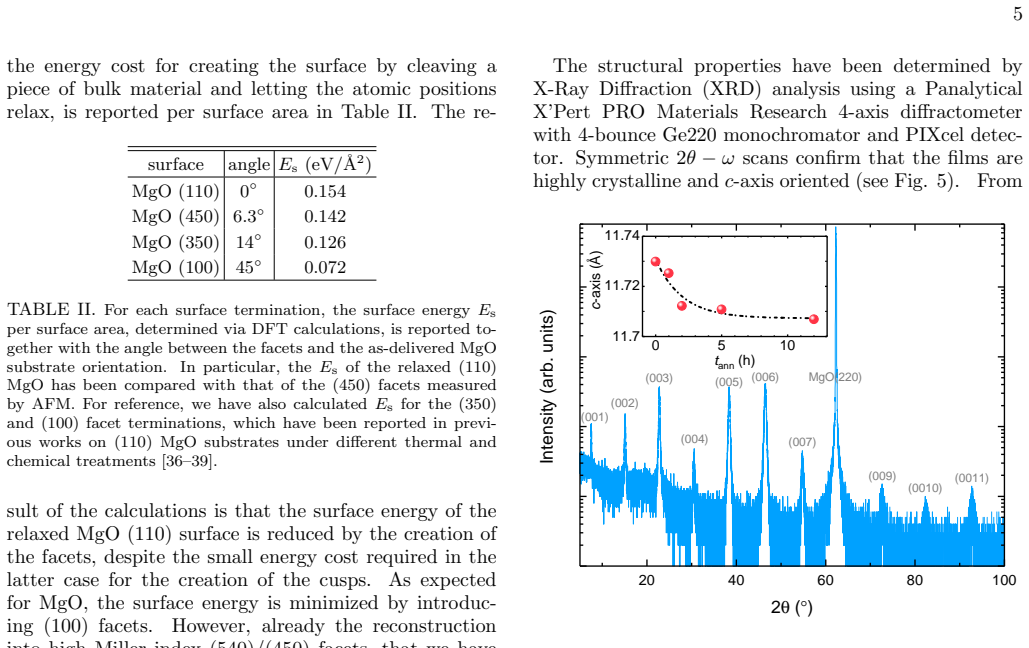
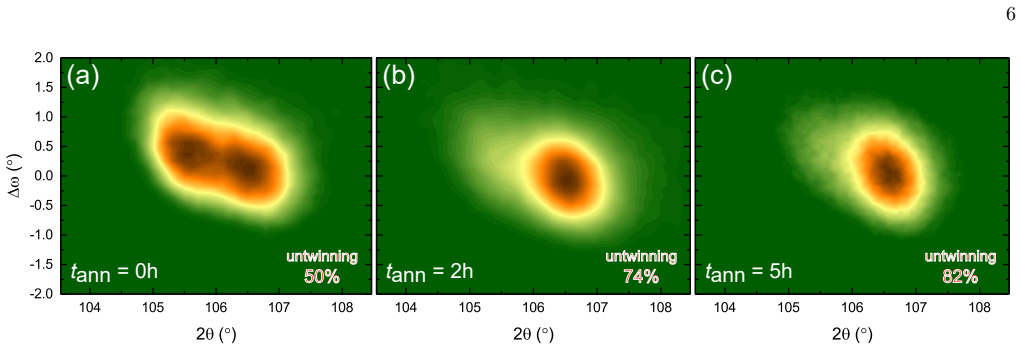
The central claim is that the usual twinning of YBCO films can be suppressed on a substrate that simultaneously compresses the film. Annealing (110) MgO creates (540)/(450) facets that run along the MgO [001] direction; YBCO deposited on this surface grows with its a axis perpendicular to the facet elongation and its b axis (the CuO chains) along it, so one twin orientation reaches 82% occupancy, against 50% on unannealed substrates. The same interface compresses the b axis from 3.89 to 3.87 Å while leaving a near its bulk value of 3.82 Å, elongates c to 11.71–11.73 Å, and tilts the (001) planes by about 3° in a unidirectional buckling along the chain direction, which electron microscopy shows as a waving of the planes with a roughly 30 nm period. This strain pattern is attributed to tilted copper-oxygen octahedra accommodating the large MgO–YBCO mismatch, and it relaxes by a film thickness of 200 nm. Transport on nanowires confirms the orthorhombic anisotropy survives at the nanoscale: critical current is 1.2 times larger along b than a, matching the chain-related penetration-depth anisotropy of untwinned single crystals, and the room-temperature resistivity anisotropy in underdoped 50 nm wires matches the single-crystal value while doubling in 10 nm wires.
Load-bearing premise
The load-bearing assumption is that the annealed facets themselves orient the YBCO film because their edge atoms are under-coordinated and therefore strain more easily; if another property produced by the annealing, such as surface stoichiometry, roughness, or contamination, actually controls the alignment, the mechanism would be wrong even if the growth recipe still works.
Editorial extensions
If this is right
- Chain-related anisotropy in critical current and resistivity survives in nanowires down to 50 nm, so nanoscale devices can be made that probe the intrinsic orthorhombicity of YBCO.
- The ~3° unidirectional buckling and the compressed b axis create a built-in uniaxial strain field along the CuO chains, which should modify charge order and electronic nematicity in a controlled way as thickness and doping are varied.
- Because the films can be grown down to a few unit cells and doped across most of the superconducting dome, the same platform can map strain effects over a wide region of the cuprate phase diagram.
- The disappearance of buckling by 200 nm film thickness provides a relaxation threshold, allowing comparisons between strained and bulk-like behavior on the same substrate.
Reading between the lines
- If the facet mechanism is correct, tuning the annealing conditions should raise the untwinning degree beyond the reported 82%, and the untwinning degree should track facet coverage rather than saturating at an arbitrary value.
- A testable extension of the strain picture is that the ~30 nm buckling period should leave an imprint on charge-density-wave correlations, with the CDW locked to the chain direction and strengthened in thinner, more strained films.
- The doubled resistivity anisotropy in 10 nm wires can be read as a strain-stabilized nematic signal; if so, its magnitude should scale with the b-axis compression and disappear in films thicker than the relaxation threshold.
- The same faceted-surface approach may transfer to other orthorhombic functional oxides and to microwave devices, where MgO's low dielectric loss gives it an advantage over strontium titanate substrates.
Signed reviews
Editorial analysis
A structured set of objections, weighed in public.
Referee Report
Summary. This manuscript reports a growth method for c-axis oriented YBCO thin films on (110)-oriented MgO substrates that are pre-annealed in oxygen. The pre-annealing produces a faceted surface, and the authors report that this favors a preferential alignment of the CuO chains, yielding films with an untwinning degree up to 82%, compressive strain along the b axis (3.89 to 3.87 Å), elongation of the c axis (11.71–11.73 Å), and a unidirectional buckling of the (001) planes. The authors further show that the chain-related transport anisotropy is preserved in nanowires down to 50 nm width and observe an additional resistivity anisotropy in 10 nm thick wires. The paper proposes these films as a platform for studying strain effects on local orders in cuprates.
Significance. If the claims are substantiated, this work would provide a valuable platform that combines compressive strain with untwinning in YBCO, which is not achieved on the commonly used STO substrates. The structural characterization is extensive, including XRD reciprocal-space maps, RHEED, AFM (tapping and PFQNM), and HAADF-STEM, and the transport data support preservation of chain-related anisotropy at the nanoscale. The DFT surface-energy calculations add independent support for the faceting interpretation. However, the central quantitative claim of 'untwinned' films rests on an uncalibrated intensity analysis that needs to be addressed before the platform claim is fully established.
major comments (1)
- [Section IV, Fig. 6] The untwinning degree is defined as the integrated intensity of the stronger (038) or (308) reflection divided by the sum of the two integrated intensities. These two reflections are not symmetry-equivalent in orthorhombic YBCO: their structure factors, Lorentz-polarization factors, and absorption corrections differ. Therefore the raw integrated-intensity ratio is not a direct measure of twin-domain volume fraction, and the reported values (74% at tann = 2 h, 82% at tann = 5 h) are not established as volume fractions. The paper does not report any calibration, background-subtraction or peak-fitting procedure, or uncertainties. The tann = 0 case (50%) cannot serve as a calibration because equal raw intensities in a fully twinned film imply equal volumes only if the corrected cross-sections of the two reflections happen to be equal. Please provide a quantitative conversion, for example by calculating the structure-factor ratio for equal twin volumes, using a reflection pair that is truly symmetry-related, or cross-calibrating with a known partially detwinned sample, and report confidence intervals for all untwinning degrees. This is load-bearing for the paper's central claim of having grown 'untwinned' films and for the quantitative comparison with single-crystal anisotropies in Section VI.
minor comments (7)
- [Section IV, Fig. 5 inset] The c-axis parameter is reported as a function of annealing time without error bars; please specify the uncertainty from the (00l) peak fitting, especially because the observed change (11.73 to 11.71 Å) is small.
- [Section IV, Fig. 6] The color scale of the XRD maps is not defined; please state how the intensities are normalized and how the background was treated.
- [Section VI, Fig. 8(c)] The resistivity ratio rho_a/rho_b for the 10 nm thick nanowires appears to be a single data point; please state the number of devices measured and provide the statistical uncertainty before claiming an additional strain-induced anisotropy.
- [Section VI, text after Eq. (12) (or near 'consirering')] The word 'consirering' is a typo and should be 'considering'.
- [Throughout] The term 'untwinned' is used for films with an untwinning degree of 82%; consider using 'highly untwinned' or 'predominantly untwinned' to avoid overstating the degree of detwinning.
- [Section III, Table II] The DFT calculations would benefit from explicit computational details (plane-wave cutoff, k-point mesh, slab thickness convergence, and the specific vdW-DF functional version) to be reproducible.
- [Section III, Fig. 4] The caption states the facets are 'compatible with (540)/(450) planes' while the text says 'or similar high Miller index planes'; please clarify how uniquely the facet orientation is determined from the AFM data.
Circularity Check
No significant circularity: the untwinning and strain claims are supported by direct XRD, AFM, STEM, and transport measurements, with external single-crystal benchmarks; self-citations are auxiliary rather than load-bearing.
full rationale
The paper's central result is an experimental growth outcome: pre-annealed (110) MgO substrates produce YBCO films with suppressed twinning and compressive strain. The untwinning degree is operationally defined as the integrated-intensity ratio of the (038)/(308) reflections (Section IV), and the quoted 82% is that measured ratio, not a value produced by a fitted model. Whether the raw intensity ratio should be corrected for the different structure factors or absorption of the two non-equivalent reflections is a legitimate metrology question, but it does not make the derivation circular: no parameter is fitted to a subset of the data and then renamed as a prediction. The compressive-strain and buckling claims rest on independent measurements: the c-axis elongation from symmetric XRD, the splitting of (00l) rocking curves, and HAADF-STEM images. The transport anisotropies in Section VI are compared with external untwinned single-crystal data (Refs. 70, 75, 76), providing outside benchmarks. The paper cites its own prior work extensively (e.g., Refs. 49, 51-53, 62-69, 77), especially for growth parameters, nanopatterning, hole-doping calibration, and observation of charge order, but these citations are auxiliary to the main untwinning and strain claims and do not themselves supply the load-bearing evidence. No step in the claimed derivation chain reduces by construction to its own inputs, so the circularity score is 0.
Assumptions & free parameters
free parameters (2)
- Hole doping p of slightly overdoped nanowires =
0.17
- Hole doping p of underdoped nanowires =
0.125
assumptions (5)
- domain assumption Upon cooling in oxygen, YBCO transforms from tetragonal to orthorhombic, and the in-plane a/b orientation is set by substrate symmetry and interfacial strain.
- domain assumption Anisotropic strain from vicinal or faceted surfaces suppresses twinning by favoring alignment of the longer b axis along the less strained direction.
- domain assumption (110) surfaces of fcc ionic crystals such as MgO are unstable and facet into elongated domains under annealing.
- ad hoc to paper The shallow (540)/(450) facets cause the preferential YBCO orientation through under-coordinated edge atoms, analogous to STO step edges.
- domain assumption Buckling of the (001) planes is the strain-relaxation mechanism in perovskite films via oxygen-octahedra distortion.
Cite this review
Pith. "Pith review of Untwinned YBa$_2$Cu$_3$O$_{7-\delta}$ thin films on MgO substrates: a platform to study strain effects on the local orders in cuprates." pith.science (2026). https://pith.science/paper/WD3Q4OFL
@misc{pith2026190802637,
  author       = {Pith},
  title        = {Pith review of: Untwinned YBa$_2$Cu$_3$O$_7-\delta$ thin films on MgO substrates: a platform to study strain effects on the local orders in cuprates},
  year         = {2026},
  howpublished = {\url{https://pith.science/paper/WD3Q4OFL}},
  note         = {Machine review of arXiv:1908.02637}
}
abstract
We have grown untwinned YBa$_2$Cu$_3$O$_{7-\delta}$ (YBCO) films on (110) MgO substrates that were pre-annealed at high temperature in oxygen atmosphere. The annealing results in surface reconstruction with shallow facets, which induce the suppression of the YBCO twinning domains, and the preferential alignment of the CuO chains along one of the in-plane directions of the substrate. Because of the large mismatch between the in-plane lattice parameters of film and substrate, the strain induced by the MgO into the YBCO layer is strong and very peculiar. The YBCO film is compressed, with respect to the bulk, and presents a unidirectional buckling of the atomic planes, along the chains' direction, due to a deformation of the copper-oxygen octahedra. The YBCO films, which can be grown with thicknesses down to few unit cells and oxygen doping levels spanning most of the superconducting dome, are patterned into nanowires with dimensions down to 50 nm. The anisotropies due to the untwinning state are preserved in these structures; moreover, additional anisotropies appear, in ultrathin structures where strain effects become more pronounced. Such untwinned and compressively strained films can therefore be used as a platform to study the interplay between strain and the various local orders in the normal state of YBCO.
Figures

Figures from the paper (5 more)


Reference graph
Works this paper leans on
-
[1]
Keimer, S
B. Keimer, S. A. Kivelson, M. R. Norman, S. Uchida, and J. Zaanen, Nature 518, 179 (2015)
2015
-
[2]
(b) Cross section of the (001) terraces on the STO surface, after a YBCO film is deposited: a compressive strain occurs, perpendicular to the step edges
STO direction leads to (001) terraces with width wT and height hT. (b) Cross section of the (001) terraces on the STO surface, after a YBCO film is deposited: a compressive strain occurs, perpendicular to the step edges. (c) Top view of a (001) terrace of the STO surface (in the region close to the step), both in its unstrained condition ( left) and after ...
-
[3]
J. Wu, A. Bollinger, X. He, and I. Boˇ zovi´ c, Nature547, 432 (2017)
work page 2017
-
[4]
O. Ivashko, M. Horio, W. Wan, N. Christensen, D. Mc- Nally, E. Paris, Y. Tseng, N. Shaik, H. Rønnow, H. Wei, C. Adamo, C. Lichtensteiger, M. Gibert, M. Beasley, K. Shen, J. Tomczak, T. Schmitt, and J. Chang, Nat. Commun. 10, 786 (2019)
work page 2019
- [5]
- [6]
-
[7]
H.-H. Kim, S. Souliou, M. Barber, E. Lefran¸ cois, M. Mi- nola, M. Tortora, R. Heid, N. Nandi, R. Borzi, G. Gar- barino, A. Bosak, J. Porras, T. Loew, M. K¨ onig, P. Moll, A. Mackenzie, B. Keimer, C. Hicks, and M. Le Tacon, Science 362, 1040 (2018)
work page 2018
-
[8]
M. Bluschke, A. Frano, E. Schierle, D. Putzky, F. Ghor- bani, R. Ortiz, H. Suzuki, G. Christiani, G. Logvenov, E. Weschke, R. Birgeneau, E. da Silva Neto, M. Minola, S. Blanco-Canosa, and B. Keimer, Nat. Commun. 9, 2978 (2018)
work page 2018
Show all 84 references
-
[9]
Chang, E
J. Chang, E. Blackburn, A. Holmes, N. B. Christensen, J. Larsen, J. Mesot, R. Liang, D. Bonn, W. Hardy, A. Watenphul, M. Zimmermann, E. Forgan, and S. Hay- den, Nat. Phys. 8, 871 (2012)
2012
-
[10]
(or the [100]) direction exhibits a periodic sequence of steps, with very straight edges and a heighthT, spaced by (001) terraces, whose widthwT decreases with increas- ingα [see Fig. 1(a)]. When a thin film is deposited on top (a) (b) (c) [100] [001] [010] n [001] [010] [010]w...
-
[11]
Ghiringhelli, M
G. Ghiringhelli, M. Le Tacon, M. Minola, S. Blanco- Canosa, C. Mazzoli, N. Brookes, G. De Luca, A. Frano, D. Hawthorn, F. He, T. Loew, M. Moretti Sala, D. Peets, M. Salluzzo, E. Schierle, R. Sutarto, G. Sawatzky, E. Weschke, B. Keimer, and L. Braicovich, Science 337, 821 (2012)
2012
-
[12]
Loret, N
B. Loret, N. Auvray, Y. Gallais, M. Cazayous, A. For- get, D. Colson, M.-H. Julien, I. Paul, M. Civelli, and A. Sacuto, Nat. Phys. 15, 771 (2019)
2019
-
[13]
Gerber, H
S. Gerber, H. Jang, H. Nojiri, S. Matsuzawa, H. Ya- sumura, D. Bonn, R. Liang, W. Hardy, Z. Islam, A. Mehta, S. Song, M. Sikorski, D. Stefanescu, Y. Feng, S. Kivelson, T. Devereaux, Z.-X. Shen, C.-C. Kao, W.-S. Lee, D. Zhu, and J.-S. Lee, Science 350, 949 (2015)
2015
-
[14]
Comin and A
R. Comin and A. Damascelli, Annu. Rev. Condens. Mat- ter Phys. 7, 369 (2016)
2016
-
[15]
Steinborn, G
T. Steinborn, G. Miehe, J. Wiesner, E. Brecht, H. Fuess, G. Wirth, B. Schulte, M. Speckmann, H. Adrian, M. Maul, K. Petersen, W. Blau, and M. McConnel, Physica C 220, 219 (1994)
1994
-
[16]
Sadewasser, J
S. Sadewasser, J. Schilling, A. Paulikas, and B. Veal, Phys. Rev. B 61, 741 (2000)
2000
-
[17]
Cyr-Choini` ere, D
O. Cyr-Choini` ere, D. LeBoeuf, S. Badoux, S. Dufour- Beaus´ ejour, D. Bonn, W. Hardy, R. Liang, D. Graf, N. Doiron-Leyraud, and L. Taillefer, Phys. Rev. B 98, 064513 (2018)
2018
-
[18]
Frano, S
A. Frano, S. Blanco-Canosa, E. Schierle, Y. Lu, M. Wu, M. Bluschke, M. Minola, G. Christiani, H. Habermeier, G. Logvenov, et al. , Nat. Mater. 15, 831 (2016)
2016
-
[19]
Schweitzer, T
D. Schweitzer, T. Bollmeier, B. Stritzker, and B. Rauschenbach, Thin Solid Films 280, 147 (1996)
1996
-
[20]
Bernstein and J
P. Bernstein and J. Hamet, J. Appl. Phys. 95, 2569 (2004)
2004
-
[21]
W. K. Kwok, U. Welp, V. M. Vinokur, S. Fleshler, J. Downey, and G. W. Crabtree, Phys. Rev. Lett. 67, 390 (1991)
1991
-
[22]
H. J. H. Smilde, A. A. Golubov, Ariando, G. Rijnders, J. M. Dekkers, S. Harkema, D. H. A. Blank, H. Rogalla, and H. Hilgenkamp, Phys. Rev. Lett. 95, 257001 (2005)
2005
-
[23]
J. M. Dekkers, G. Rijnders, S. Harkema, H. J. H. Smilde, H. Hilgenkamp, H. Rogalla, and D. H. A. Blank, Appl. 10 Phys. Lett. 83, 5199 (2003)
2003
-
[24]
Zegenhagen, T
J. Zegenhagen, T. Haage, and Q. Jiang, Appl. Phys. A 67, 711 (1998)
1998
-
[25]
However, the strain induced in YBCO is tensile, as on vicinal angle (001) ori- ented STO substrates [28]
Partially detwinned films have also been achieved on (001) oriented NdGaO 3 substrates. However, the strain induced in YBCO is tensile, as on vicinal angle (001) ori- ented STO substrates [28]. Moreover, 45 ◦ grain bound- aries and defects, influencing the transport properties, ...
-
[26]
Br¨ otz and H
J. Br¨ otz and H. Fuess, Physica C339, 75 (2000)
2000
-
[27]
H. J. Scheel, M. Berkowski, and B. Chabot, Physica C 185, 2095 (1991)
1991
-
[28]
Zhuravel, S
A. Zhuravel, S. M. Anlage, S. K. Remillard, A. Lukashenko, and A. Ustinov, J. Appl. Phys. 108, 033920 (2010)
2010
-
[29]
Mazierska, D
J. Mazierska, D. Ledenyov, M. V. Jacob, and J. Krupka, Supercond. Sci. Technol. 18, 18 (2005)
2005
-
[30]
Bdikin, P
I. Bdikin, P. Mozhaev, G. Ovsyannikov, P. Komissinski, and I. Kotelyanskii, Physica C 377, 26 (2002)
2002
-
[31]
Villard, G
C. Villard, G. Koren, D. Cohen, E. Polturak, B. Thrane, and D. Chateignier, Phys. Rev. Lett. 77, 3913 (1996)
1996
-
[32]
Dubourdieu, J
C. Dubourdieu, J. Senateur, O. Thomas, F. Weiss, B. Thrane, and M. Brunel, Appl. Phys. Lett. 69, 1942 (1996)
1996
-
[33]
Ho and K
K.-M. Ho and K. Bohnen, Phys. Rev. Lett. 59, 1833 (1987)
1987
-
[34]
J. Nam, R. Hughes, J. Castellan, B. Gaulin, J. Britten, and J. Preston, J. Appl. Phys. 97, 123906 (2005)
2005
-
[35]
Salluzzo, G
M. Salluzzo, G. De Luca, D. Marr` e, M. Putti, M. Tro- peano, U. S. Di Uccio, and R. Vaglio, Phys. Rev. B 72, 134521 (2005)
2005
-
[36]
V. E. Henrich, Surf. Sci. 57, 385 (1976)
1976
-
[37]
Gritsch, D
T. Gritsch, D. Coulman, R. Behm, and G. Ertl, Phys. Rev. Lett. 63, 1086 (1989)
1989
-
[38]
R. Koch, M. Borbonus, O. Haase, and K. Rieder, Phys. Rev. Lett. 67, 3416 (1991)
1991
-
[39]
Chern, J
G. Chern, J. Huang, and T. Leung, J. Vac. Sci. Technol. A 16, 964 (1998)
1998
-
[40]
De Leeuw, G
N. De Leeuw, G. Watson, and S. Parker, J. Phys. Chem. 99, 17219 (1995)
1995
-
[41]
Giese, F
D. Giese, F. Lamelas, H. Owen, R. Plass, and M. Gajdardziska-Josifovska, Surf. Sci. 457, 326 (2000)
2000
-
[42]
M. Dion, H. Rydberg, E. Schr¨ oder, D. C. Langreth, and B. I. Lundqvist, Phys. Rev. Lett. 92, 246401 (2004)
2004
-
[43]
Sugawara and K
A. Sugawara and K. Mae, Surf. Sci. 558, 211 (2004)
2004
-
[44]
Ciancio, A
R. Ciancio, A. Vittadini, A. Selloni, R. Arpaia, C. Aruta, F. M. Granozio, U. S. Di Uccio, G. Rossi, and E. Carlino, J. Nanoparticle Res. 15, 1735 (2013)
2013
-
[45]
Berland, V
K. Berland, V. R. Cooper, K. Lee, E. Schr¨ oder, T. Thon- hauser, P. Hyldgaard, and B. I. Lundqvist, Rep. Prog. Phys. 78, 066501 (2015)
2015
-
[46]
Thonhauser, V
T. Thonhauser, V. R. Cooper, S. Li, A. Puzder, P. Hyldgaard, and D. C. Langreth, Phys. Rev. B 76, 125112 (2007)
2007
-
[47]
K. Lee, ´E. D. Murray, L. Kong, B. I. Lundqvist, and D. C. Langreth, Phys. Rev. B 82, 081101(R) (2010)
2010
-
[48]
Rom´ an-P´ erez and J
G. Rom´ an-P´ erez and J. M. Soler, Phys. Rev. Lett.103, 096102 (2009)
2009
-
[49]
Berland and P
K. Berland and P. Hyldgaard, Phys. Rev. B 89, 035412 (2014)
2014
-
[50]
Giannozzi, S
P. Giannozzi, S. Baroni, N. Bonini, M. Calandra, R. Car, C. Cavazzoni, D. Ceresoli, G. L. Chiarotti, M. Cococ- cioni, I. Dabo, et al. , J. Phys.: Condens. Matter 21, 395502 (2009)
2009
-
[51]
Baghdadi, R
R. Baghdadi, R. Arpaia, T. Bauch, and F. Lombardi, IEEE Trans. Appl. Supercond. 25, 1100104 (2015)
2015
-
[52]
R. Arpaia, YBa2Cu3O7−δ Nanowires to Study Nanoscale Ordering in High-T C Superconductors (PhD thesis, De- partment of Microtechnology and Nanoscience, Chalmers University of Technology, 2016)
2016
-
[53]
the difference in length between the a and the b axes, is strongest [81]
Slightly overdoped films are the best systems where to study the twinning state, since at this oxygen doping level the in-plane orthorhombicity of the YBCO unit cell, i.e. the difference in length between the a and the b axes, is strongest [81]
-
[54]
P. M. Woodward, Acta Crystallogr. Sect. B53, 32 (1997)
1997
-
[55]
Arpaia, D
R. Arpaia, D. Golubev, R. Baghdadi, R. Ciancio, G. Draˇ zi´ c, P. Orgiani, D. Montemurro, T. Bauch, and F. Lombardi, Phys. Rev. B 96, 064525 (2017)
2017
-
[56]
Arpaia, E
R. Arpaia, E. Andersson, E. Trabaldo, T. Bauch, and F. Lombardi, Phys. Rev. Materials 2, 024804 (2018)
2018
-
[57]
Vailionis, H
A. Vailionis, H. Boschker, E. Houwman, G. Koster, G. Rijnders, and D. H. Blank, Appl. Phys. Lett. 95, 152508 (2009)
2009
-
[58]
P. M. Woodward, Acta Crystallogr. Sect. B53, 44 (1997)
1997
-
[59]
films the distortion of the oxygen octahedra repre- sents the main strain relaxation mechanism, requiring a lower energy cost than the compression/stretching of the in-plane bond lengths. In particular, by plotting in the reciprocal space the rocking curves of the different (00𝓁...
2017
-
[60]
Gebhardt, N
U. Gebhardt, N. Kasper, A. Vigliante, P. Wochner, H. Dosch, F. Razavi, and H.-U. Habermeier, Phys. Rev. Lett. 98, 096101 (2007)
2007
-
[61]
Vailionis, H
A. Vailionis, H. Boschker, W. Siemons, E. P. Houwman, D. H. Blank, G. Rijnders, and G. Koster, Phys. Rev. B 83, 064101 (2011)
2011
-
[62]
Weber, M
M. Weber, M. Guennou, N. Dix, D. Pesquera, F. S´ anchez, G. Herranz, J. Fontcuberta, L. L´ opez-Conesa, S. Estrad´ e, F. Peir´ o, , J. I˜ niguez, and J. Kreisel, Phys. Rev. B94, 014118 (2016)
2016
-
[63]
Chisholm and S
M. Chisholm and S. Pennycook, Nature 351, 47 (1991)
1991
-
[64]
Lombardi, Z
F. Lombardi, Z. Ivanov, G. Fischer, E. Olsson, and T. Claeson, Appl. Phys. Lett. 72, 249 (1998)
1998
-
[65]
Arpaia, S
R. Arpaia, S. Nawaz, F. Lombardi, and T. Bauch, IEEE Trans. Appl. Supercond. 23, 1101505 (2013)
2013
-
[66]
Baghdadi, R
R. Baghdadi, R. Arpaia, S. Charpentier, D. Golubev, T. Bauch, and F. Lombardi, Phys. Rev. Applied 4, 014022 (2015)
2015
-
[67]
Nawaz, R
S. Nawaz, R. Arpaia, F. Lombardi, and T. Bauch, Phys. Rev. Lett. 110, 167004 (2013)
2013
-
[68]
Arpaia, M
R. Arpaia, M. Arzeo, S. Nawaz, S. Charpentier, F. Lom- bardi, and T. Bauch, Appl. Phys. Lett. 104, 072603 (2014)
2014
-
[69]
Arzeo, R
M. Arzeo, R. Arpaia, R. Baghdadi, F. Lombardi, and T. Bauch, J. Appl. Phys. 119, 174501 (2016)
2016
-
[70]
Arpaia, M
R. Arpaia, M. Arzeo, R. Baghdadi, E. Trabaldo, F. Lom- bardi, and T. Bauch, Supercond. Sci. Technol. 30, 014008 (2016)
2016
-
[71]
Trabaldo, R
E. Trabaldo, R. Arpaia, M. Arzeo, E. Andersson, D. Gol- ubev, F. Lombardi, and T. Bauch, Supercond. Sci. Tech- nol. 32, 073001 (2019)
2019
-
[72]
Arpaia, S
R. Arpaia, S. Charpentier, R. Toskovic, T. Bauch, and F. Lombardi, Physica C 506, 184 (2014). 11
2014
-
[73]
Y. Ando, K. Segawa, S. Komiya, and A. Lavrov, Phys. Rev. Lett. 88, 137005 (2002)
2002
-
[74]
A detailed description of the analysis we have applied is presented in Ref
The hole doping p, number of holes for planar copper atom, has been determined in our films indirectly, com- bining the knowledge of the c-axis parameter, estimated via XRD with that of the critical temperature Tc, de- termined via resistance vs temperature measurements. A deta...
-
[75]
Arpaia, D
R. Arpaia, D. Golubev, R. Baghdadi, M. Arzeo, G. Ku- nakova, S. Charpentier, S. Nawaz, F. Lombardi, and T. Bauch, Physica C 506, 165 (2014)
2014
-
[76]
Charpentier, R
S. Charpentier, R. Arpaia, J. Gaudet, D. Matte, R. Bagh- dadi, T. L¨ ofwander, D. Golubev, P. Fournier, T. Bauch, and F. Lombardi, Phys. Rev. B 94, 060503(R) (2016)
2016
-
[77]
Baghdadi, R
R. Baghdadi, R. Arpaia, E. Stepantsov, M. Arzeo, D. Golubev, D. Montemurro, E. Andersson, T. Bauch, and F. Lombardi, Phys. Rev. B 95, 184505 (2017)
2017
-
[78]
Basov, R
D. Basov, R. Liang, D. Bonn, W. Hardy, B. Dabrowski, M. Quijada, D. Tanner, J. Rice, D. Ginsberg, and T. Timusk, Phys. Rev. Lett. 74, 598 (1995)
1995
-
[79]
Ishida, K
T. Ishida, K. Okuda, H. Asaoka, Y. Kazumata, K. Noda, and H. Takei, Phys. Rev. B 56, 11897 (1997)
1997
-
[80]
Arpaia, S
R. Arpaia, S. Caprara, R. Fumagalli, G. De Vec- chi, Y. Peng, E. Andersson, D. Betto, G. De Luca, N. Brookes, F. Lombardi, M. Salluzzo, L. Braicovich, C. Di Castro, M. Grilli, and G. Ghiringhelli, Science 365, 906 (2019)
2019
-
[81]
Scherer, P
T. Scherer, P. Marienhoff, R. Herwig, M. Neuhaus, and W. Jutzi, Physica C 197, 79 (1992)
1992
-
[82]
Klemenz, I
C. Klemenz, I. Utke, and H. Scheel, J. Cryst. Growth 207, 62 (1999)
1999
-
[83]
Khanof, J
S. Khanof, J. Mannhart, and H. Boschker, Appl. Phys. Lett. 113, 022605 (2018)
2018
-
[84]
Ye and K
J. Ye and K. Nakamura, Phys. Rev. B 48, 7554 (1993)
1993
Reviewed August 14, 2026 · model on record in the stance chip above.
Discussion (0). Continue with ORCID to comment.