REVIEW 2 major objections 5 minor 59 references
A scanning resonator for probing quantum coherent devices
T0 review · 2 major / 5 minor · reviewed 2026-08-06 · deepseek-v4-flash
Pith's one-line read A high-quality superconducting resonator mounted on a scanning cantilever can be positioned over a transmon qubit and serve as its dispersive readout and control port, allowing the qubit's energy spectrum and coherence times to be…
desk verdict First credible demonstration of coherent transmon readout with a scanning resonator; the 'no extra tip loss' claim is softer than the text admits because it rests on an unvalidated simulated coupling. read the letter →
The pith
A machine-rendered reading of the paper's core claim, the machinery that carries it, and where it could break.
The reading
What carries the argument
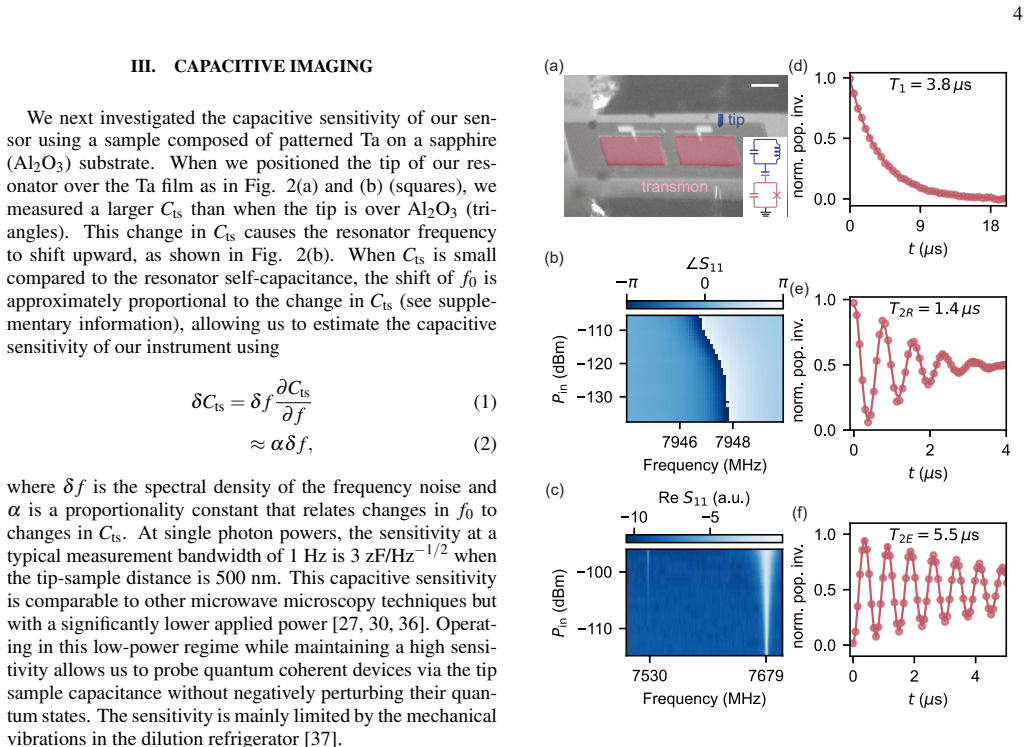
The central object is a lumped-element superconducting resonator, a 7.955 GHz NbTiN device on a SiN/Si cantilever, terminated in a 2-micron tip. The tip-sample capacitance $C_{ts}$ is the coupling port: changes in $C_{ts}$ shift the resonator frequency (the basis of capacitive imaging), and when the tip is over a transmon the same capacitance produces a qubit-resonator coupling $g$ that enables dispersive readout. The paper calibrates tip-sample distance by fitting measured frequency shifts to simulated $C_{ts}$ curves, and computes the induced qubit relaxation from the Purcell formula $\Gamma_{\text{Purcell}} = (g/\Delta)^2\kappa$, where $\Delta$ is the qubit-resonator detuning and $\kappa$ the resonator linewidth, to separate tip-induced loss from intrinsic qubit loss.
What would settle it
Measure the qubit-resonator coupling directly from an avoided-level crossing (vacuum Rabi splitting) at several tip-sample distances, and compare the Purcell-limited relaxation rate predicted by $(g/\Delta)^2\kappa$ with the measured $T_1$; agreement within uncertainty would confirm the calibration, while a systematic offset would show that the simulated coupling or capacitance is wrong.
Extended reading notes
Core claim
The central claim is that a single high-Q superconducting resonator on a scanning tip can be coherently coupled to a transmon qubit through the tip-sample capacitance and serve as both the readout and control port, so that the qubit's energy spectrum, $T_1$, Ramsey dephasing, and echo coherence can be measured with no on-chip readout circuitry. The authors demonstrate this by positioning the tip over individual transmons, observing the expected dispersive, power-dependent resonator response, resolving the $|g\rangle\to|e\rangle$ transition and a two-photon $|g\rangle\to|f\rangle$ transition, and measuring coherence times. The measured relaxation rate as the tip approaches the qubit matches the Purcell rate predicted from the simulated coupling, which the authors take as evidence that the scanning tip introduces no loss beyond the Purcell channel.
Load-bearing premise
The reported zeptoFarad sensitivity and the conclusion that the tip adds no loss beyond Purcell loss depend on simulated values of tip-sample capacitance and qubit-resonator coupling; if those simulations are wrong in absolute scale, both quantitative claims would need revision.
Editorial extensions
If this is right
- A single scanning resonator can characterize many qubits on one chip without fabricating readout resonators, which speeds up testing of qubit arrays and of chips where readout circuitry is impractical.
- Materials that cannot host high-quality on-chip resonators, such as those with large microwave loss, can still be probed at the single-photon level by bringing the resonator tip near them.
- Because the tip is positionable, the same resonator can map the spatial variation of qubit properties and local loss sources across a device.
- Adding a Purcell filter to the resonator tip should suppress the distance-dependent relaxation channel and lengthen qubit $T_1$.
- The demonstrated zF/Hz$^{1/2}$ capacitive sensitivity at single-photon powers extends scanning microwave microscopy into a regime suitable for probing quantum coherent systems.
Reading between the lines
- The same readout mechanism should extend to other quantum coherent systems whose energy scales overlap the resonator frequency, such as spin ensembles or magnons, where on-chip high-Q resonators are hard to fabricate.
- The sensitivity floor is set by mechanical vibration; a vibration-isolated or floated scanning stage could push the capacitance noise below the reported zF/Hz$^{1/2}$ and allow smaller tip-sample distances.
- The demonstration suggests a path toward spatially resolved noise spectroscopy: by rastering the tip, local two-level-system defects and quasiparticle traps could be located and correlated with qubit decoherence.
- A direct test of the method's generality would be to compare extracted coherence times for the same qubit measured both with the scanning resonator and with a conventional on-chip readout.
Editorial analysis
A structured set of objections, weighed in public.
Referee Report
Summary. The paper presents a scanning superconducting microwave resonator—a lumped-element NbTiN resonator on a cantilever—as a probe for quantum coherent devices. At 10 mK the authors measure an internal quality factor Qi>10^4 in the single-photon regime, demonstrate capacitive imaging with sensitivity of order 3 zF/Hz^{1/2} and about 2 μm spatial resolution, and then couple the tip to transmon qubits. Using power-dependent dispersive shifts, two-tone spectroscopy, T1, Ramsey, and Hahn-echo measurements, they extract qubit spectra and coherence times for multiple transmons without any on-chip readout circuitry. They also report a tip-sample-distance-dependent relaxation rate that they model as Purcell loss plus a distance-independent term, concluding that the tip introduces no additional loss. Finally, they map fge, T1, and T2E for an array of 17 transmons.
Significance. If correct, the results establish a new scanning-probe tool for circuit QED: a high-Q resonator that can be positioned over arbitrary devices and used for dispersive readout, spectroscopy, and coherence measurements without fabricating readout resonators on the sample chip. The central demonstration—coherent coupling to transmons and multi-qubit characterization with no on-chip readout—is supported by direct measurements. Strengths include the direct two-tone and time-domain data, the clear presentation of the setup, and the data-availability statement. The main caveat is that the quantitative 'no additional loss' conclusion depends on an unvalidated simulated coupling strength, and several quantitative results lack error bars.
major comments (2)
- [Section IV; Supplement Sec. VII, Eq. (11)] The conclusion that the tip adds no loss beyond Purcell rests entirely on the simulated qubit-resonator coupling g(d) from the AC Conduction solver and scQubits, inserted into Γ_Purcell = (g/Δ)^2 κ. No independent measurement of g is presented, and the tip-sample distance axis used in Fig. 4 is itself calibrated from the same simulation (Supplement Sec. V). Because the Purcell rate scales as g^2, a factor-of-2 simulation error changes the predicted rate by 4×, and a systematic error in the simulated distance dependence could be partly absorbed into the fit, misattributing distance-dependent tip-induced loss to Purcell or vice versa. To support the 'no additional loss' claim, the authors should either measure g independently (e.g., through an avoided crossing or ac-Stark shift) or provide a sensitivity analysis of the fit to g together with fit residuals. At minimum, the conclusion should be softened to state consistency with Purcell loss within the accuracy of the simulation.
- [Figures 3(d-f) and 4] The coherence times and relaxation rates are reported without error bars or confidence intervals, so the agreement between the Γ1 data and the Purcell model in Fig. 4, and the significance of the T2E increase in Fig. 3(f), cannot be quantitatively assessed. The authors should provide statistical uncertainties (from repeated measurements or fit covariance) for T1, T2R, T2E, and Γ1, and include residuals for the Fig. 4 model.
minor comments (5)
- [Section III and abstract] The abstract and text state 'zeptoFarad sensitivity' but the reported quantity is 3 zF/Hz^{1/2} at a 1 Hz bandwidth; please state the per-root-Hz units consistently in the abstract.
- [Section III and Supplement Sec. V] Because the capacitance-to-frequency conversion α and the tip-sample distance are calibrated using simulated Cts(d) with two fitted parameters (d0 and α), the absolute value of the quoted zF sensitivity is simulation-dependent; the main text should state this caveat explicitly and, if possible, provide an independent calibration.
- [Section IV] The sentence 'the qubit coherence is affect by pure dephasing processes' contains a typo ('affect' should be 'affected').
- [Supplement Table SI] The EC and EJ values are extracted using the measured fge together with simulations; the table should include a note that these energies are model-dependent and do not include uncertainties.
- [Section IV] The calibration of the π-pulse amplitude used in the T1 measurement is not described; a brief statement on pulse calibration would aid reproducibility.
Circularity Check
No significant circularity: the paper is an experimental demonstration whose quantitative calibrations and model comparisons rely on independent simulations and standard fits, not on claims that reduce to their own inputs.
full rationale
I walked the derivation chain of the paper. The central claims are experimental: a high-Q scanning resonator performs capacitive imaging with zeptoFarad sensitivity and reads out transmon qubits with no on-chip circuitry. These claims are supported by direct measurements (resonator spectroscopy, two-tone spectroscopy, T1/T2R/T2E measurements) and not derived from a fitted quantity renamed as a prediction. The capacitive sensitivity is obtained by converting measured frequency noise to capacitance noise via alpha = 1.12e-8 fF/Hz, a calibration constant determined by fitting the measured approach curve to an Ansys Maxwell simulation of Cts(d). This is a standard calibration, not a self-fulfilling prediction, and the underlying sensitivity is still measured in physical units. The transmon loss analysis compares measured Gamma_1(d) with a simulated Purcell rate Gamma_Purcell = (g/Delta)^2 kappa, plus a fitted distance-independent loss of 0.1 MHz. The Purcell contribution is simulated, not fit to the Gamma_1 data, so the statement that no additional tip-distance-dependent loss is found is a model-comparison inference. One could question the absolute accuracy of the simulated g or the lack of error bars on Fig. 4, but that is a correctness/validation concern, not circularity. The only self-citation (ref. [37] for refrigerator vibration noise) is peripheral and not load-bearing. No step in the paper exhibits a reduction of the claimed result to its own inputs, so the circularity score is 0.
Assumptions & free parameters
free parameters (7)
- alpha (capacitance-frequency conversion) =
1.12e-8 fF/Hz
- Distance-independent relaxation rate in Purcell model =
0.1 MHz
- TLS loss parameter delta0_TLS =
2.3e-5
- Saturated TLS quality factor Qsat =
18000
- Other loss quality factor Qother =
18000
- Superconducting critical temperature Tc =
10 K
- Reflection asymmetry parameter theta =
-0.16 rad
assumptions (5)
- domain assumption Standard circuit QED theory describes the dispersive resonator-transmon interaction.
- domain assumption Ansys Maxwell AC Conduction solver and scQubits accurately model tip-sample capacitance and qubit-resonator coupling in the experimental geometry.
- ad hoc to paper Kinetic inductance fraction alpha is approximately 1 in the frequency-shift fit.
- domain assumption Transmon relaxation is described by independent Purcell and constant loss channels.
- domain assumption The two observed transitions at 7.528 GHz and 7.679 GHz correspond to the two-photon |g>-to-|f> and single-photon |g>-to-|e> transitions of a standard transmon.
Cite this review
Pith. "Pith review of A scanning resonator for probing quantum coherent devices." pith.science (2026). https://pith.science/paper/WDHILFYO
@misc{pith2026250622620,
  author       = {Pith},
  title        = {Pith review of: A scanning resonator for probing quantum coherent devices},
  year         = {2026},
  howpublished = {\url{https://pith.science/paper/WDHILFYO}},
  note         = {Machine review of arXiv:2506.22620}
}
read the original abstract
Superconducting resonators with high quality factors are extremely sensitive detectors of the complex impedance of materials and devices coupled to them. This capability has been used to measure losses in multiple different materials and, in the case of circuit quantum electrodynamics (circuit QED), has been used to measure the coherent evolution of multiple different types of qubits. Here, we report on the implementation of a scanning resonator for probing quantum coherent devices. Our scanning setup enables tunable coherent coupling to systems of interest without the need for fabricating on-chip superconducting resonators. We measure the internal quality factor of our resonator sensor in the single-photon regime to be > 10000 and demonstrate capacitive imaging using our sensor with zeptoFarad sensitivity and micron spatial resolution at milliKelvin temperatures. We then use our setup to characterize the energy spectrum and coherence times of multiple transmon qubits with no on-chip readout circuitry. Our work introduces a new tool for using circuit QED to measure existing and proposed qubit platforms.
Figures


Figures from the paper (1 more)

Reference graph
Works this paper leans on
- [1]
-
[2]
A. A. Clerk, K. W. Lehnert, P . Bertet, J. R. Petta, and Y . Naka- mura, Nature Physics 16, 257 (2020)
work page 2020
-
[3]
Wallraff, D
A. Wallraff, D. I. Schuster, A. Blais, L. Frunzio, R.-S. Huang, J. Majer, S. Kumar, S. M. Girvin, and R. J. Schoelkopf, Nature 431, 162 (2004)
2004
-
[4]
The increase of Γ 1 with the decreasing tip-sample distance is consistent with Purcell loss [43], since the qubit-resonator coupling becomes stronger at smaller tip-sample distances (see details in the supplement). The measured loss is well- captured by a model including Purcell loss and a tip-sample distance-independent loss. Importantly, we do not find a...
-
[5]
M. D. Reed, L. DiCarlo, B. R. Johnson, L. Sun, D. I. Schuster, L. Frunzio, and R. J. Schoelkopf, Physical Review Letters 105, 173601 (2010)
work page 2010
-
[6]
K. J. Satzinger, Y . P . Zhong, H.-S. Chang, G. A. Peairs, A. Bi- enfait, M.-H. Chou, A. Y . Cleland, C. R. Conner, É. Dumur, J. Grebel, I. Gutierrez, B. H. November, R. G. Povey, S. J. Whiteley, D. D. Awschalom, D. I. Schuster, and A. N. Cleland, Nature 563, 661 (2018)
work page 2018
-
[7]
A. D. O’Connell, M. Hofheinz, M. Ansmann, R. C. Bialczak, M. Lenander, E. Lucero, M. Neeley, D. Sank, H. Wang, M. Wei- des, J. Wenner, J. M. Martinis, and A. N. Cleland, Nature 464, 697 (2010)
2010
-
[8]
Y . Chu, P . Kharel, T. Y oon, L. Frunzio, P . T. Rakich, and R. J. Schoelkopf, Nature 563, 666 (2018)
work page 2018
Show all 59 references
-
[9]
Arrangoiz-Arriola, E
P . Arrangoiz-Arriola, E. A. Wollack, Z. Wang, M. Pechal, W. Jiang, T. P . McKenna, J. D. Witmer, R. V an Laer, and A. H. Safavi-Naeini, Nature 571, 537 (2019)
2019
-
[10]
L. R. Sletten, B. A. Moores, J. J. Viennot, and K. W. Lehnert, Physical Review X 9, 021056 (2019)
2019
-
[11]
Lachance-Quirion, Y
D. Lachance-Quirion, Y . Tabuchi, S. Ishino, A. Noguchi, T. Ishikawa, R. Y amazaki, and Y . Nakamura, Science Advances 3, e1603150 (2017)
2017
-
[12]
Lachance-Quirion, S
D. Lachance-Quirion, S. P . Wolski, Y . Tabuchi, S. Kono, K. Us- ami, and Y . Nakamura, Science 367, 425 (2020). 7
2020
-
[13]
Xu, X.-K
D. Xu, X.-K. Gu, H.-K. Li, Y .-C. Weng, Y .-P . Wang, J. Li, H. Wang, S.-Y . Zhu, and J. Q. Y ou, Physical Review Letters 130, 193603 (2023)
2023
-
[14]
Bienfait, J
A. Bienfait, J. J. Pla, Y . Kubo, X. Zhou, M. Stern, C. C. Lo, C. D. Weis, T. Schenkel, D. Vion, D. Esteve, J. J. L. Morton, and P . Bertet, Nature531, 74 (2016)
2016
-
[15]
A. J. Sigillito, H. Malissa, A. M. Tyryshkin, H. Riemann, N. V . Abrosimov, P . Becker, H.-J. Pohl, M. L. W. Thewalt, K. M. Itoh, J. J. L. Morton, A. A. Houck, D. I. Schuster, and S. A. Lyon, Applied Physics Letters 104, 222407 (2014)
2014
-
[16]
Eichler, A
C. Eichler, A. J. Sigillito, S. A. Lyon, and J. R. Petta, Physical Review Letters 118, 037701 (2017)
2017
-
[17]
Probst, A
S. Probst, A. Bienfait, P . Campagne-Ibarcq, J. J. Pla, B. Al- banese, J. F. Da Silva Barbosa, T. Schenkel, D. Vion, D. Esteve, K. Mølmer, J. J. L. Morton, R. Heeres, and P . Bertet, Applied Physics Letters 111, 202604 (2017)
2017
-
[18]
Psaroudaki and C
C. Psaroudaki and C. Panagopoulos, Physical Review Letters 127, 067201 (2021)
2021
-
[19]
Hirosawa, A
T. Hirosawa, A. Mook, J. Klinovaja, and D. Loss, PRX Quan- tum 3, 040321 (2022)
2022
-
[20]
Müller, J
C. Müller, J. Bourassa, and A. Blais, Physical Review B 88, 235401 (2013)
2013
-
[21]
Y avilberg, E
K. Y avilberg, E. Ginossar, and E. Grosfeld, Physical Review B 92, 075143 (2015)
2015
-
[22]
J. G. C. Martinez, C. S. Chiu, B. M. Smitham, and A. A. Houck, Science Advances 9, eadj7195 (2023)
2023
-
[23]
Flat- band (de)localization emulated with a superconducting qubit array,
I. T. Rosen, S. Muschinske, C. N. Barrett, D. A. Rower, R. Das, D. K. Kim, B. M. Niedzielski, M. Schuldt, K. Serniak, M. E. Schwartz, J. L. Y oder, J. A. Grover, and W. D. Oliver, “Flat- band (de)localization emulated with a superconducting qubit array,” (2025), arXiv:2410.078...
2025 arXiv
-
[24]
Arute, K
F. Arute, K. Arya, R. Babbush, D. Bacon, J. C. Bardin, R. Barends, R. Biswas, S. Boixo, F. G. S. L. Brandao, D. A. Buell, B. Burkett, Y . Chen, Z. Chen, B. Chiaro, R. Collins, W. Courtney, A. Dunsworth, E. Farhi, B. Foxen, A. Fowler, C. Gidney, M. Giustina, R. Graff, K. Guerin...
2019
-
[25]
K. Lai, W. Kundhikanjana, M. Kelly, and Z. X. Shen, Review of Scientific Instruments 79, 063703 (2008)
2008
-
[26]
Jiang, S
Z. Jiang, S. K. Chong, P . Zhang, P . Deng, S. Chu, S. Jahanbani, K. L. Wang, and K. Lai, Review of Scientific Instruments 94, 053701 (2023)
2023
-
[27]
L. W. Cao, C. Wu, R. Bhattacharyya, R. Zhang, and M. T. Allen, Review of Scientific Instruments 94, 093705 (2023)
2023
-
[28]
J.-Y . Shan, N. Morrison, S.-D. Chen, F. Wang, and E. Y . Ma, Nature Communications 15, 5043 (2024)
2024
-
[29]
Z. Chu, L. Zheng, and K. Lai, Annual Review of Materials Research 50, 105 (2020)
2020
-
[30]
M. E. Barber, E. Y . Ma, and Z.-X. Shen, Nature Reviews Physics 4, 61 (2022)
2022
-
[31]
S. E. de Graaf, A. V . Danilov, A. Adamyan, and S. E. Kubatkin, Review of Scientific Instruments 84, 023706 (2013)
2013
-
[32]
Geaney, D
S. Geaney, D. Cox, T. Hönigl-Decrinis, R. Shaikhaidarov, S. E. Kubatkin, T. Lindström, A. V . Danilov, and S. E. de Graaf, Scientific Reports 9, 12539 (2019)
2019
-
[33]
J. Shan, N. Morrison, and E. Y . Ma, in 2024 IEEE/MTT-S In- ternational Microwave Symposium - IMS 2024 (2024) pp. 994– 997
2024
-
[34]
M. R. Vissers, J. Gao, D. S. Wisbey, D. A. Hite, C. C. Tsuei, A. D. Corcoles, M. Steffen, and D. P . Pappas, Applied Physics Letters 97, 232509 (2010)
2010
-
[35]
J. M. Martinis, K. B. Cooper, R. McDermott, M. Steffen, M. Ansmann, K. D. Osborn, K. Cicak, S. Oh, D. P . Pappas, R. W. Simmonds, and C. C. Y u, Physical Review Letters 95, 210503 (2005)
2005
-
[36]
Chistolini, K
T. Chistolini, K. Lee, A. Banerjee, M. Alghadeer, C. Jünger, M. V . P . Altoé, C. Song, S. Chen, F. Wang, D. I. Santiago, and I. Siddiqi, Applied Physics Letters 125, 204001 (2024)
2024
-
[37]
K. Lai, W. Kundhikanjana, M. A. Kelly, and Z.-X. Shen, Ap- plied Nanoscience 1, 13 (2011)
2011
-
[38]
M. E. Barber, Y . Li, J. Gibson, J. Y u, Z. Jiang, Y . Hu, Z. Ji, N. Nandi, J. C. Hoke, L. Bishop-V an Horn, G. R. Arias, D. J. V an Harlingen, K. A. Moler, Z.-X. Shen, A. Kou, and B. E. Feldman, Journal of Low Temperature Physics 215, 1 (2024)
2024
-
[39]
J. A. Schreier, A. A. Houck, J. Koch, D. I. Schuster, B. R. John- son, J. M. Chow, J. M. Gambetta, J. Majer, L. Frunzio, M. H. Devoret, S. M. Girvin, and R. J. Schoelkopf, Physical Review B 77, 180502 (2008)
2008
-
[40]
Blais, R.-S
A. Blais, R.-S. Huang, A. Wallraff, S. M. Girvin, and R. J. Schoelkopf, Physical Review A 69, 062320 (2004)
2004
-
[41]
L. S. Bishop, E. Ginossar, and S. M. Girvin, Physical Review Letters 105, 100505 (2010)
2010
-
[42]
Boissonneault, J
M. Boissonneault, J. M. Gambetta, and A. Blais, Physical Re- view Letters 105, 100504 (2010)
2010
-
[43]
Blais, J
A. Blais, J. Gambetta, A. Wallraff, D. I. Schuster, S. M. Girvin, M. H. Devoret, and R. J. Schoelkopf, Physical Review A 75, 032329 (2007)
2007
-
[44]
E. M. Purcell, H. C. Torrey, and R. V . Pound, Physical Review 69, 37 (1946)
1946
-
[45]
Jeffrey, D
E. Jeffrey, D. Sank, J. Y . Mutus, T. C. White, J. Kelly, R. Barends, Y . Chen, Z. Chen, B. Chiaro, A. Dunsworth, A. Megrant, P . J. J. O’Malley, C. Neill, P . Roushan, A. V ainsencher, J. Wenner, A. N. Cleland, and J. M. Martinis, Physical Review Letters 112, 190504 (2014)
2014
-
[46]
Rosenberg, D
D. Rosenberg, D. Kim, R. Das, D. Y ost, S. Gustavsson, D. Hover, P . Krantz, A. Melville, L. Racz, G. O. Samach, S. J. Weber, F. Y an, J. L. Y oder, A. J. Kerman, and W. D. Oliver, npj Quantum Information 3, 42 (2017)
2017
-
[47]
Holman, D
N. Holman, D. Rosenberg, D. Y ost, J. L. Y oder, R. Das, W. D. Oliver, R. McDermott, and M. A. Eriksson, npj Quantum In- formation 7, 137 (2021)
2021
-
[48]
Barends, J
R. Barends, J. Kelly, A. Megrant, D. Sank, E. Jeffrey, Y . Chen, Y . Yin, B. Chiaro, J. Mutus, C. Neill, P . O’Malley, P . Roushan, J. Wenner, T. C. White, A. N. Cleland, and J. M. Martinis, Physical Review Letters 111, 080502 (2013)
2013
-
[49]
H. Paik, D. I. Schuster, L. S. Bishop, G. Kirchmair, G. Cate- lani, A. P . Sears, B. R. Johnson, M. J. Reagor, L. Frunzio, L. I. Glazman, S. M. Girvin, M. H. Devoret, and R. J. Schoelkopf, Physical Review Letters 107, 240501 (2011)
2011
-
[50]
Quaglio, F
T. Quaglio, F. Dahlem, S. Martin, A. Gérardin, C. B. Winkel- mann, and H. Courtois, Review of Scientific Instruments 83, 123702 (2012)
2012
-
[51]
K. A. Moler, Nature Materials 16, 1049 (2017). Supplementary information for: A scanning resonator for probing quantum coherent devices I. RESONA TOR FABRICATION Our resonator chip was fabricated from a Si substrate with capping layers of 500 nm SiN x on both sides. A blanket ...
2017
-
[52]
Stefanazzi, K
L. Stefanazzi, K. Treptow, N. Wilcer, C. Stoughton, C. Brad- ford, S. Uemura, S. Zorzetti, S. Montella, G. Cancelo, S. Suss- man, A. Houck, S. Saxena, H. Arnaldi, A. Agrawal, H. Zhang, C. Ding, and D. I. Schuster, Review of Scientific Instruments 93, 044709 (2022)
2022
-
[53]
M. V . P . Altoé, A. Banerjee, C. Berk, A. Hajr, A. Schwartzberg, C. Song, M. Alghadeer, S. Aloni, M. J. Elowson, J. M. Kreike- baum, E. K. Wong, S. M. Griffin, S. Rao, A. Weber-Bargioni, A. M. Minor, D. I. Santiago, S. Cabrini, I. Siddiqi, and D. F. Ogletree, PRX Quantum 3, 02...
2022
-
[54]
C. R. H. McRae, H. Wang, J. Gao, M. R. Vissers, T. Brecht, A. Dunsworth, D. P . Pappas, and J. Mutus, Review of Scientific Instruments 91, 091101 (2020)
2020
-
[55]
Zmuidzinas, Annual Review of Condensed Matter Physics 3, 169 (2012)
J. Zmuidzinas, Annual Review of Condensed Matter Physics 3, 169 (2012)
2012
-
[56]
Tinkham, Introduction to Superconductivity (Dover Publica- tions, Inc., 2004)
M. Tinkham, Introduction to Superconductivity (Dover Publica- tions, Inc., 2004)
2004
-
[57]
Gao, The Physics of Superconducting Microwave Resonators , Ph.D
J. Gao, The Physics of Superconducting Microwave Resonators , Ph.D. thesis, California Institute of Technology, United States – California (2008)
2008
-
[58]
Shearrow, G
A. Shearrow, G. Koolstra, S. J. Whiteley, N. Earnest, P . S. Barry, F. J. Heremans, D. D. Awschalom, E. Shirokoff, and D. I. Schuster, Applied Physics Letters 113, 212601 (2018), arXiv:1808.06009 [cond-mat]
2018 arXiv
-
[59]
Groszkowski and J
P . Groszkowski and J. Koch, Quantum 5, 583 (2021)
2021
Reviewed August 6, 2026 · model on record in the stance chip above.
Discussion (0). Continue with ORCID to comment.