Born-rule statistical dynamical quantum phase transitions under measurement
Pith reviewed 2026-05-20 19:02 UTC · model grok-4.3
The pith
Statistical sampling of Born-rule measurement outcomes recovers dynamical quantum phase transitions in quenched Ising chains.
A machine-rendered reading of the paper's core claim, the machinery that carries it, and where it could break.
Core claim
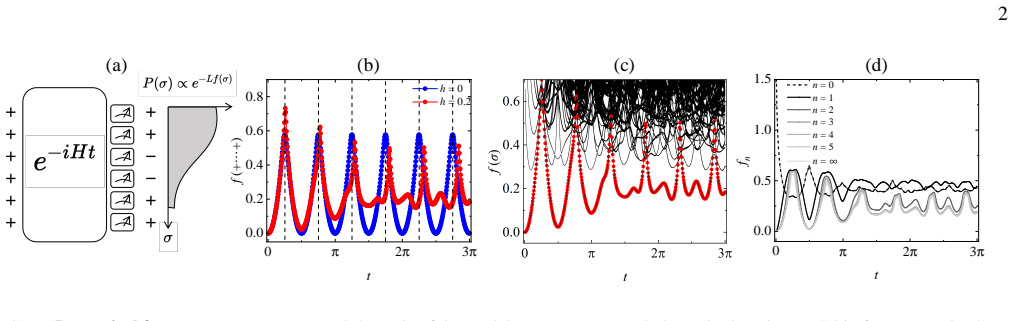
Dynamical quantum phase transitions occur at times when a quantum state exhibits a nonanalytic change in its return probability, viewed as the probability of collapsing the evolved state to the initial state by quantum measurement. We perform statistical characterization for all the possible post-measurement states distributed according to the Born's rule by sampling a one-dimensional quantum Ising chain after a quantum quench dynamics. The statistical ensemble can also be viewed as a mixed state when the time evolved state is subjected to maximally dephasing noise in a certain basis. We map the distribution to a statistical model and characterize its effective energy spectrum, and introduce
What carries the argument
The average dynamical free energy constructed from the effective energy spectrum of the statistical model that represents the Born-rule ensemble of post-measurement states under maximal dephasing.
If this is right
- Nonanalytic signatures of DQPTs reappear when the return probability is averaged over higher statistical moments of the Born-rule outcomes.
- The effective energy levels in the mapped statistical model spread out after the critical times.
- Yang-Lee-Fisher zeros vanish and level crossings appear when time is continued into the complex plane near the critical points.
- A protocol of single-qubit measurements on a two-dimensional cluster state can simulate the underlying unitary evolution for experimental study of these transitions.
Where Pith is reading between the lines
- The same statistical mapping could be tested with other forms of decoherence to see how mixed-state dynamics alter nonequilibrium transitions.
- The proposed cluster-state protocol indicates that existing quantum hardware could directly implement the required sampling without maintaining full coherence.
- Insights from the delocalized level distribution may inform structured sampling techniques in quantum circuits where measurement randomness plays a central role.
Load-bearing premise
The statistical ensemble of Born-rule sampled post-measurement states can be equivalently viewed as a mixed state produced by maximally dephasing noise in a certain basis, enabling the mapping to a statistical model with an effective energy spectrum.
What would settle it
Numerical sampling of post-measurement states in the quenched one-dimensional Ising chain to check whether high-moment averages of the return probability display nonanalyticities exactly at the predicted critical times and whether the effective energy levels become delocalized immediately afterward.
Figures


read the original abstract
Dynamical quantum phase transitions (DQPTs) occur at times when a quantum state exhibits a nonanalytic change in its return probability. This can be viewed as the probability of collapsing the evolved state to the initial state by quantum measurement. However, the initial wave function usually has exponentially small amplitude in the late time evolved state. Here we perform statistical characterization for all the possible post-measurement states distributed according to the Born's rule, by sampling a one-dimensional quantum Ising chain after a quantum quench dynamics. The statistical ensemble can also be viewed as a mixed state when the time evolved state is subjected to maximally dephasing noise in a certain basis. We map the distribution to a statistical model and characterize its effective "energy" spectrum, and introduce the average dynamical free energy, establishing a framework for the statistical DQPTs. We show the recovering of DQPT under high-moment average and a delocalized level distribution following critical times. Through analytic continuation into the complex time plane, we demonstrate the vanishing of Yang-Lee-Fisher zeros and the emergent level crossing near critical times. Finally, we propose a measurement-based quantum computation protocol to simulate the unitary evolution via single-qubit measurements on a two-dimensional cluster state. Our results provide a way for experimentally investigating statistical DQPTs in quantum devices, shedding light on the structured circuit sampling with insights from DQPT and generalizing the understanding of mixed state due to decoherence beyond equilibrium.
Editorial analysis
A structured set of objections, weighed in public.
Referee Report
Summary. The manuscript investigates statistical aspects of dynamical quantum phase transitions (DQPTs) by sampling post-measurement states according to Born's rule in a one-dimensional quantum Ising chain after a quench. It maps the ensemble to a mixed state under maximal dephasing, defines an average dynamical free energy from an effective statistical model, demonstrates recovery of DQPT non-analyticities via high-moment averages, shows delocalized level distributions and vanishing Yang-Lee-Fisher zeros through analytic continuation in complex time, and proposes a measurement-based quantum computation protocol for simulation.
Significance. If the central mapping and recovery hold, the work offers a novel statistical framework for DQPTs that could facilitate experimental studies in quantum devices under decoherence. It provides insights into mixed-state dynamics and structured circuit sampling. The analytic continuation results and the proposed protocol are potentially significant extensions, though their robustness depends on verifying the higher-moment equivalence.
major comments (2)
- [§4] §4 (Mapping to statistical model and definition of average dynamical free energy): The equivalence between the Born-rule sampled pure states and the maximally dephased mixed state ρ = ∑ p_n |n⟩⟨n| reproduces the first moment correctly, but the manuscript does not provide explicit verification that higher moments of the return probabilities are preserved when constructing the effective energy spectrum. This is load-bearing for the central claim that high-moment averages recover the original DQPT non-analyticities.
- [§5] §5 (Analytic continuation into complex time plane): The demonstration of vanishing Yang-Lee-Fisher zeros and emergent level crossings near critical times is based on the effective spectrum derived from the statistical model. Without direct numerical comparison to independent Born-rule sampling (e.g., via Monte Carlo benchmarks of the return amplitude distribution), the extrapolation risks circularity as noted in the definition of the average dynamical free energy from the sampled distribution itself.
minor comments (2)
- [Abstract] Abstract: The phrasing 'recovering of DQPT' is grammatically awkward and should be revised to 'recovery of DQPTs' for clarity.
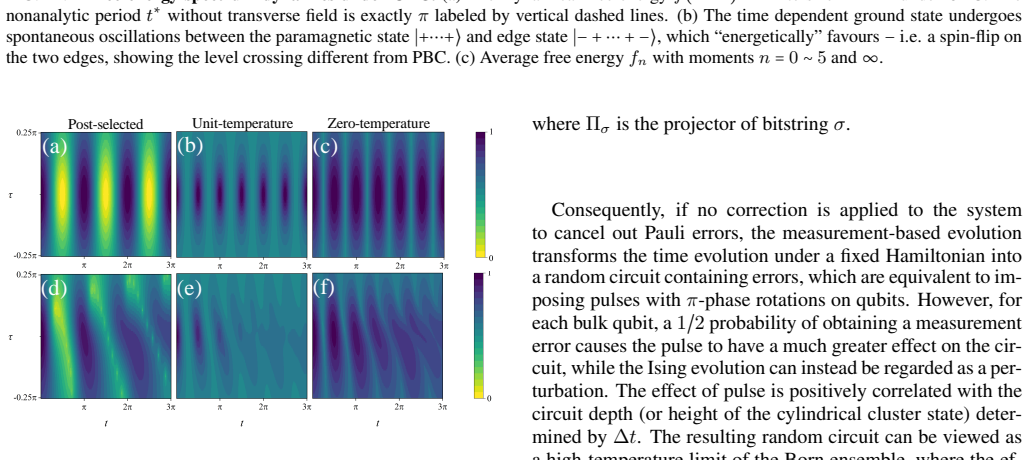
- [Figures] Figure captions (e.g., level distribution plots): Include sampling size, error bars, or convergence checks to support the delocalized distribution claim following critical times.
Simulated Author's Rebuttal
We thank the referee for their careful reading and constructive comments. We address the major comments point by point below and indicate revisions to the manuscript where the concerns are valid.
read point-by-point responses
-
Referee: [§4] §4 (Mapping to statistical model and definition of average dynamical free energy): The equivalence between the Born-rule sampled pure states and the maximally dephased mixed state ρ = ∑ p_n |n⟩⟨n| reproduces the first moment correctly, but the manuscript does not provide explicit verification that higher moments of the return probabilities are preserved when constructing the effective energy spectrum. This is load-bearing for the central claim that high-moment averages recover the original DQPT non-analyticities.
Authors: We agree that explicit verification of higher-moment preservation is necessary to support the central claim. The original manuscript establishes the first-moment equivalence via the dephased mixed state and shows recovery of DQPT features in high-moment averages of the effective statistical model, but does not include direct numerical checks comparing higher moments from independent Born-rule sampling against the effective spectrum. We will add such verification in the revised manuscript, including Monte Carlo sampling of post-measurement states and explicit comparison of moment distributions up to orders where non-analyticities appear. revision: yes
-
Referee: [§5] §5 (Analytic continuation into complex time plane): The demonstration of vanishing Yang-Lee-Fisher zeros and emergent level crossings near critical times is based on the effective spectrum derived from the statistical model. Without direct numerical comparison to independent Born-rule sampling (e.g., via Monte Carlo benchmarks of the return amplitude distribution), the extrapolation risks circularity as noted in the definition of the average dynamical free energy from the sampled distribution itself.
Authors: We acknowledge the risk of circularity in relying solely on the effective spectrum for the analytic continuation results. The effective model is constructed from the ensemble averages, so independent validation against raw Born-rule samples is warranted. In the revision we will include direct Monte Carlo benchmarks of the return amplitude distribution from sampled post-measurement states and compare the resulting zero locations and level-crossing features to those obtained via analytic continuation of the effective free energy, confirming that the qualitative behavior is preserved. revision: yes
Circularity Check
No significant circularity detected in derivation chain
full rationale
The paper starts from the Born-rule post-measurement ensemble after a quench, notes its equivalence to a maximally dephased mixed state ρ = ∑ p_n |n⟩⟨n|, maps the resulting distribution to a statistical model with an effective energy spectrum, and defines the average dynamical free energy within that model. It then reports recovery of DQPT non-analyticities under high-moment averages, vanishing Yang-Lee-Fisher zeros under analytic continuation, and emergent level crossings. None of these steps reduce by the paper's own equations to a redefinition of the input distribution or to a fitted parameter renamed as a prediction; the mapping supplies independent structure for the subsequent statistical characterization, and the reported results are presented as consequences rather than identities. No self-citations appear in the provided text as load-bearing premises.
Axiom & Free-Parameter Ledger
axioms (2)
- standard math Born's rule governs the probabilities of post-measurement states
- domain assumption The one-dimensional quantum Ising chain under sudden quench dynamics
invented entities (1)
-
average dynamical free energy
no independent evidence
Reference graph
Works this paper leans on
-
[1]
M. Heyl, A. Polkovnikov, and S. Kehrein, Dynamical quantum phase transitions in the transverse-field ising model, Phys. Rev. Lett.110, 135704 (2013)
work page 2013
-
[2]
M. Heyl, Dynamical quantum phase transitions: a review, Re- ports on Progress in Physics81, 054001 (2018)
work page 2018
-
[3]
C. N. Yang and T. D. Lee, Statistical theory of equations of state and phase transitions. i. theory of condensation, Phys. Rev.87, 404 (1952)
work page 1952
-
[4]
T. D. Lee and C. N. Yang, Statistical theory of equations of state and phase transitions. ii. lattice gas and ising model, Phys. Rev. 87, 410 (1952)
work page 1952
-
[5]
M. Fisher and W. Brittin, Statistical physics, weak interactions, field theory, Lectures in Theoretical Physics (Boulder: Univer- sity of Colorado Press) vol VIIC (1965)
work page 1965
-
[6]
C. Karrasch and D. Schuricht, Dynamical phase transitions af- ter quenches in nonintegrable models, Phys. Rev. B87, 195104 (2013)
work page 2013
-
[7]
F. Andraschko and J. Sirker, Dynamical quantum phase transi- tions and the loschmidt echo: A transfer matrix approach, Phys. Rev. B89, 125120 (2014)
work page 2014
-
[8]
S. Vajna and B. D ´ora, Disentangling dynamical phase tran- sitions from equilibrium phase transitions, Phys. Rev. B89, 161105 (2014)
work page 2014
-
[9]
Heyl, Scaling and universality at dynamical quantum phase transitions, Phys
M. Heyl, Scaling and universality at dynamical quantum phase transitions, Phys. Rev. Lett.115, 140602 (2015)
work page 2015
-
[10]
N. O. Abeling and S. Kehrein, Quantum quench dynamics in the transverse field ising model at nonzero temperatures, Phys. Rev. B93, 104302 (2016)
work page 2016
- [11]
-
[12]
J. C. Halimeh and V . Zauner-Stauber, Dynamical phase diagram of quantum spin chains with long-range interactions, Phys. Rev. B96, 134427 (2017)
work page 2017
-
[13]
B. ˇZunkoviˇc, M. Heyl, M. Knap, and A. Silva, Dynamical quan- tum phase transitions in spin chains with long-range interac- tions: Merging different concepts of nonequilibrium criticality, Phys. Rev. Lett.120, 130601 (2018)
work page 2018
-
[14]
R. Hamazaki, Exceptional dynamical quantum phase transi- tions in periodically driven systems, Nature Communications 12, 5108 (2021)
work page 2021
-
[15]
J. C. Halimeh, D. Trapin, M. Van Damme, and M. Heyl, Local measures of dynamical quantum phase transitions, Phys. Rev. B104, 075130 (2021)
work page 2021
-
[16]
S. De Nicola, A. A. Michailidis, and M. Serbyn, Entanglement view of dynamical quantum phase transitions, Phys. Rev. Lett. 126, 040602 (2021)
work page 2021
-
[17]
T. Hashizume, I. P. McCulloch, and J. C. Halimeh, Dynamical phase transitions in the two-dimensional transverse-field ising model, Phys. Rev. Res.4, 013250 (2022)
work page 2022
-
[18]
J. J. Osborne, I. P. McCulloch, and J. C. Halimeh, Probing con- finement through dynamical quantum phase transitions: From quantum spin models to lattice gauge theories, Phys. Rev. Res. 7, 043076 (2025)
work page 2025
-
[19]
A. Khatun and S. M. Bhattacharjee, Boundaries and unphysical fixed points in dynamical quantum phase transitions, Phys. Rev. Lett.123, 160603 (2019)
work page 2019
-
[20]
P. Jurcevic, H. Shen, P. Hauke, C. Maier, T. Brydges, C. Hempel, B. P. Lanyon, M. Heyl, R. Blatt, and C. F. Roos, Direct observation of dynamical quantum phase transitions in an interacting many-body system, Phys. Rev. Lett.119, 080501 (2017)
work page 2017
-
[21]
N. Fl ¨aschner, D. V ogel, M. Tarnowski, B. S. Rem, D.-S. L¨uhmann, M. Heyl, J. C. Budich, L. Mathey, K. Sengstock, and C. Weitenberg, Observation of dynamical vortices after quenches in a system with topology, Nature Physics14, 265 (2018)
work page 2018
-
[22]
X.-Y . Guo, C. Yang, Y . Zeng, Y . Peng, H.-K. Li, H. Deng, Y .- R. Jin, S. Chen, D. Zheng, and H. Fan, Observation of a dy- namical quantum phase transition by a superconducting qubit simulation, Phys. Rev. Appl.11, 044080 (2019)
work page 2019
-
[23]
Z. Chen, J.-M. Cui, M.-Z. Ai, R. He, Y .-F. Huang, Y .-J. Han, C.-F. Li, and G.-C. Guo, Experimentally detecting dynamical quantum phase transitions in a slowly quenched ising-chain model, Phys. Rev. A102, 042222 (2020)
work page 2020
-
[24]
Science Advances 6(25), 4935 (2020) https://doi.org/ 10.1126/sciadv.aba4935
K. Xu, Z.-H. Sun, W. Liu, Y .-R. Zhang, H. Li, H. Dong, W. Ren, P. Zhang, F. Nori, D. Zheng, H. Fan, and H. Wang, Probing dynamical phase transitions with a superconducting quantum simulator, Science Advances6, eaba4935 (2020), https://www.science.org/doi/pdf/10.1126/sciadv.aba4935
-
[25]
A. P. Lund, M. J. Bremner, and T. C. Ralph, Quantum sampling problems, bosonsampling and quantum supremacy, npj Quan- tum Information3, 15 (2017)
work page 2017
-
[26]
A. Bouland, B. Fefferman, C. Nirkhe, and U. Vazirani, On the 6 complexity and verification of quantum random circuit sam- pling, Nature Physics15, 159 (2019)
work page 2019
-
[27]
F. Arute, K. Arya, R. Babbush, D. Bacon, J. C. Bardin, R. Barends, R. Biswas, S. Boixo, F. G. S. L. Brandao, D. A. Buell, B. Burkett, Y . Chen, Z. Chen, B. Chiaro, R. Collins, W. Courtney, A. Dunsworth, E. Farhi, B. Foxen, A. Fowler, C. Gidney, M. Giustina, R. Graff, K. Guerin, S. Habegger, M. P. Harrigan, M. J. Hartmann, A. Ho, M. Hoffmann, T. Huang, T. ...
work page 2019
-
[28]
J. Y . Lee, C.-M. Jian, and C. Xu, Quantum Criticality Under Decoherence or Weak Measurement, PRX Quantum4, 030317 (2023)
work page 2023
-
[29]
R. Fan, Y . Bao, E. Altman, and A. Vishwanath, Diagnostics of Mixed-State Topological Order and Breakdown of Quantum Memory, PRX Quantum5, 020343 (2024)
work page 2024
-
[30]
P. Sala, S. Gopalakrishnan, M. Oshikawa, and Y . You, Sponta- neous strong symmetry breaking in open systems: Purification perspective, Phys. Rev. B110, 155150 (2024)
work page 2024
-
[31]
T. D. Ellison and M. Cheng, Toward a Classification of Mixed- State Topological Orders in Two Dimensions, PRX Quantum6, 010315 (2025)
work page 2025
-
[32]
Z. Wang, Z. Wu, and Z. Wang, Intrinsic Mixed-State Topologi- cal Order, PRX Quantum6, 010314 (2025)
work page 2025
-
[33]
Y .-H. Chen and T. Grover, Unconventional topological mixed- state transition and critical phase induced by self-dual coherent errors, Phys. Rev. B110, 125152 (2024)
work page 2024
-
[34]
Y .-H. Chen and T. Grover, Separability Transitions in Topologi- cal States Induced by Local Decoherence, Phys. Rev. Lett.132, 170602 (2024)
work page 2024
-
[35]
L. A. Lessa, R. Ma, J.-H. Zhang, Z. Bi, M. Cheng, and C. Wang, Strong-to-Weak Spontaneous Symmetry Breaking in Mixed Quantum States, PRX Quantum6, 010344 (2025)
work page 2025
-
[36]
S. Wang, T. G. Kiely, D. Tell, J. Obermeyer, M. Barendregt, P. Bojovi´c, P. M. Preiss, A. Sarma, T. Franz, M. P. A. Fisher, C. Xu, and I. Bloch, Observation of Strong-to-Weak Sponta- neous Symmetry Breaking in a Dephased Fermi Gas (2026), arXiv:2604.16137 [quant-ph]
work page internal anchor Pith review Pith/arXiv arXiv 2026
-
[37]
R. Sohal and A. Prem, Noisy Approach to Intrinsically Mixed- State Topological Order, PRX Quantum6, 010313 (2025)
work page 2025
-
[38]
K. Su, Z. Yang, and C.-M. Jian, Tapestry of dualities in de- cohered quantum error correction codes, Phys. Rev. B110, 085158 (2024)
work page 2024
-
[39]
J. Y . Lee, Exact Calculations of Coherent Information for Toric Codes under Decoherence: Identifying the Fundamental Error Threshold, Phys. Rev. Lett.134, 250601 (2025)
work page 2025
-
[40]
F. Eckstein, B. Han, S. Trebst, and G.-Y . Zhu, Robust Telepor- tation of a Surface Code and Cascade of Topological Quantum Phase Transitions, PRX Quantum5, 040313 (2024)
work page 2024
- [41]
-
[42]
F. Eckstein, B. Han, S. Trebst, and G.-Y . Zhu, Learning tran- sitions of topological surface codes (2025), arXiv:2512.19786 [quant-ph]
- [43]
-
[44]
Revisiting Nishimori multicriticality through the lens of information measures
Z.-Q. Wan, X.-D. Dai, and G.-Y . Zhu, Revisiting Nishi- mori multicriticality through the lens of information measures (2025), arXiv:2511.02907 [cond-mat.stat-mech]
work page internal anchor Pith review Pith/arXiv arXiv 2025
-
[45]
S. J. Garratt, Z. Weinstein, and E. Altman, Measurements Con- spire Nonlocally to Restructure Critical Quantum States, Phys. Rev. X13, 021026 (2023)
work page 2023
-
[46]
Z. Weinstein, R. Sajith, E. Altman, and S. J. Garratt, Nonlocal- ity and entanglement in measured critical quantum Ising chains, Phys. Rev. B107, 245132 (2023)
work page 2023
-
[47]
S. Murciano, P. Sala, Y . Liu, R. S. K. Mong, and J. Alicea, Measurement-Altered Ising Quantum Criticality, Phys. Rev. X 13, 041042 (2023)
work page 2023
-
[48]
P. Sala, S. Murciano, Y . Liu, and J. Alicea, Quantum Critical- ity Under Imperfect Teleportation, PRX Quantum5, 030307 (2024)
work page 2024
-
[49]
Z. Yang, D. Mao, and C.-M. Jian, Entanglement in a one- dimensional critical state after measurements, Phys. Rev. B108, 165120 (2023)
work page 2023
- [50]
-
[51]
Y . Liu, S. Murciano, D. F. Mross, and J. Alicea, Boundary tran- sitions from a single round of measurements on gapless quan- tum states, Phys. Rev. Res.7, 023293 (2025)
work page 2025
- [52]
-
[53]
M. Hoshino, M. Oshikawa, and Y . Ashida, Entanglement swap- ping in critical quantum spin chains, Phys. Rev. B111, 155143 (2025)
work page 2025
-
[54]
Q. Tang and X. Wen, A critical state under weak measurement is not critical, preprint (2024), arXiv:2411.13705
-
[55]
Learning transitions in classical Ising models and deformed toric codes
M. P ¨utz, S. J. Garratt, H. Nishimori, S. Trebst, and G.-Y . Zhu, Learning transitions in classical Ising models and deformed toric codes (2025), arXiv:2504.12385 [cond-mat.stat-mech]
work page internal anchor Pith review Pith/arXiv arXiv 2025
-
[56]
R. A. Patil, M. P¨utz, S. Trebst, G.-Y . Zhu, and A. W. W. Ludwig, Higher Nishimori Criticality and Exact Results at the Learning Transition of Deformed Toric Codes (2026), arXiv:2604.06324 [cond-mat.stat-mech]
work page internal anchor Pith review Pith/arXiv arXiv 2026
-
[57]
A. Polkovnikov, Microscopic diagonal entropy and its connec- tion to basic thermodynamic relations, Annals of Physics326, 486 (2011)
work page 2011
-
[58]
Y .-H. Chen and T. Grover, Zipping many-body quantum states: a scalable approach to diagonal entropy (2025), arXiv:2502.18898 [quant-ph]
-
[59]
M. Heyl and J. C. Budich, Dynamical topological quantum phase transitions for mixed states, Phys. Rev. B96, 180304 (2017)
work page 2017
-
[60]
U. Bhattacharya, S. Bandyopadhyay, and A. Dutta, Mixed state dynamical quantum phase transitions, Phys. Rev. B96, 180303 (2017)
work page 2017
-
[61]
H. Lang, Y . Chen, Q. Hong, and H. Fan, Dynamical quantum phase transition for mixed states in open systems, Phys. Rev. B 98, 134310 (2018)
work page 2018
-
[62]
M. Fishman, S. R. White, and E. M. Stoudenmire, The ITen- sor Software Library for Tensor Network Calculations, SciPost Phys. Codebases , 4 (2022)
work page 2022
- [63]
-
[64]
A comment on the numerical method: the probability can be viewed as the amplitude of a time evolved Gaussian fermion 7 state in the Fock space, by Jordan Wigner transforming the Ising Hamiltonian to the free fermion Hamiltonian in the parity even sector ∏j Xj =+1, which maps the periodic boundary condi- tion of the spin chain to the anti-periodic boundary...
-
[65]
C. Y . Wong and W. C. Yu, Loschmidt amplitude spectrum in dy- namical quantum phase transitions, Phys. Rev. B105, 174307 (2022)
work page 2022
- [66]
- [67]
-
[68]
F. Evers and A. D. Mirlin, Anderson transitions, Rev. Mod. Phys.80, 1355 (2008)
work page 2008
- [69]
-
[70]
Y . Liu, P. Sierant, P. Stornati, M. Lewenstein, and M. Płodzie´n, Quantum algorithms for inverse participation ratio estimation in multiqubit and multiqudit systems, Phys. Rev. A111, 052614 (2025)
work page 2025
-
[71]
C.-M. Jian, Y .-Z. You, R. Vasseur, and A. W. W. Ludwig, Measurement-induced criticality in random quantum circuits, Phys. Rev. B101, 104302 (2020)
work page 2020
-
[72]
A. Silva, Statistics of the work done on a quantum critical sys- tem by quenching a control parameter, Phys. Rev. Lett.101, 120603 (2008)
work page 2008
-
[73]
H. J. Briegel, D. E. Browne, W. D ¨ur, R. Raussendorf, and M. Van den Nest, Measurement-based quantum computation, Nature Physics5, 19 (2009)
work page 2009
-
[74]
R. Raussendorf and T.-C. Wei, Quantum computation by local measurement, Annual Review of Condensed Matter Physics3, 239 (2012)
work page 2012
-
[75]
H. Liu, T. Zhou, and X. Chen, Measurement-induced entangle- ment transition in a two-dimensional shallow circuit, Phys. Rev. B106, 144311 (2022)
work page 2022
- [76]
-
[77]
H. Liu, V . Ravindranath, and X. Chen, Quantum entanglement phase transitions and computational complexity: Insights from ising models, Phys. Rev. B111, 024312 (2025)
work page 2025
-
[78]
H. Sukeno and T. Okuda, Measurement-based quantum simu- lation of Abelian lattice gauge theories, SciPost Phys.14, 129 (2023)
work page 2023
- [79]
-
[80]
Y . Kuno, T. Orito, and I. Ichinose, Bulk-measurement-induced boundary phase transition in toric code and gauge higgs model, Phys. Rev. B109, 054432 (2024)
work page 2024
discussion (0)
Sign in with ORCID, Apple, or X to comment. Anyone can read and Pith papers without signing in.