REVIEW 8 cited by
Boosted Dark Matter Driven by Cosmic Rays and Diffuse Supernova Neutrinos
T0 review · reviewed 2026-08-12 · deepseek-v4-flash
Pith's one-line read Combining cosmic-ray and diffuse-supernova boosts sharpens dark matter cross-section bounds.
desk verdict Real but DSNB-normalization-dependent improvement; worth refereeing with a request for flux-sensitivity checks. read the letter →
The pith
A machine-rendered reading of the paper's core claim, the machinery that carries it, and where it could break.
The reading
What carries the argument
The carrying object is the boosted dark matter flux formula of Eq. (1), $d\Phi_\chi/dT_\chi = D_{\mathrm{eff}}(\rho_\chi/M_\chi)\int d\Phi_i^{\mathrm{LIS}}/dT_i\,(d\sigma_{\chi i}/dT_\chi)\,dT_i$, applied separately to cosmic-ray electrons and protons (with local interstellar spectra from Voyager, Fermi-LAT, PAMELA, and AMS-02) and to the DSNB neutrino flux of Eq. (8), then summed in Eq. (11). Its load-bearing feature is the cross-section structure: the DSNB contribution enters through the product $\sigma_{\chi e}\sigma_{\chi\nu}$ (or $\sigma_{\chi n}\sigma_{\chi\nu}$), which is what creates the tilted exclusion contours and the improved $\sigma_{\chi e}$ limit. Energy-dependent heavy-mediator cross-sections in Eqs. (5)–(6) and (15)–(16) modulate the flux and recoil rate, while detector response in XENONnT and Super-Kamiokande is folded in through Eq. (12) with a 40% nuisance parameter on the DSNB normalization.
What would settle it
A direct DSNB measurement from a future large neutrino detector that places the flux at the low end of the predicted band, combined with a re-derivation of the XENONnT and Super-K exclusion contours, would settle the claim: if the tilted $\sigma_{\chi e}$–$\sigma_{\chi\nu}$ contour region disappears and the limits return to the cosmic-ray-only curves, the central improvement claim is falsified.
Extended reading notes
Core claim
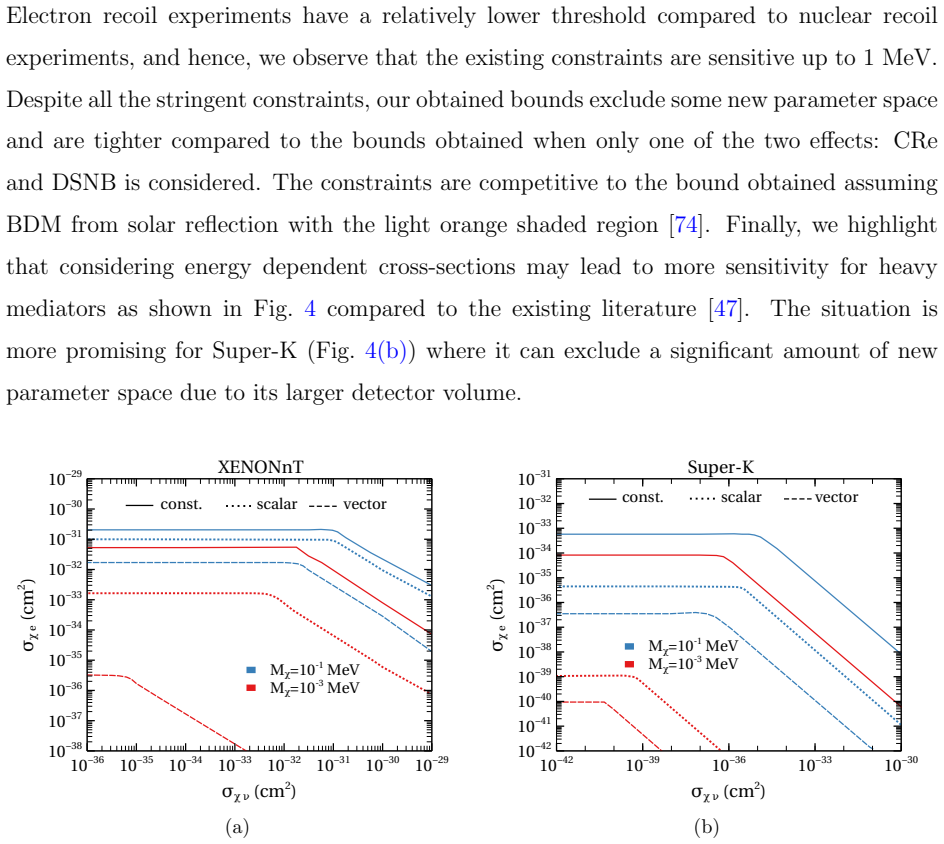
The central claim is that a non-zero dark-matter–neutrino interaction does not merely add an independent detection channel; it multiplies the reach of cosmic-ray-boosted dark matter searches. Because the DSNB flux exceeds the cosmic-ray-electron flux by only about a factor of ten in the MeV range, the recoil rate scales as $R \propto \Phi_{\mathrm{CRe}}\,\sigma_{\chi e}^2 + \Phi_{\mathrm{DSNB}}\,\sigma_{\chi e}\sigma_{\chi\nu}$ (Eq. 23), so the DSNB term dominates whenever $\sigma_{\chi\nu}$ is not tiny relative to $\sigma_{\chi e}$. With $\sigma_{\chi\nu} \approx 10\,\sigma_{\chi e}$, the combined signal rate stays competitive with cosmic-ray-only rates at an order-of-magnitude smaller $\sigma_{\chi e}$, and the 90% C.L. exclusion contours in the $(\sigma_{\chi\nu},\,\sigma_{\chi e})$ plane become tilted in the high-$\sigma_{\chi\nu}$ region, constraining the product of the two cross-sections. The same logic applies to nucleophilic dark matter with $\sigma_{\chi n}$, where the DSNB dominates the flux shape up to about 10 MeV and cosmic-ray protons take over at higher energies. Energy-dependent heavy scalar- and vector-mediated cross-sections sharpen the electrophilic bounds further, especially at low dark-matter mass.
Load-bearing premise
The load-bearing premise is that the diffuse supernova neutrino background has roughly the predicted flux: the DSNB has not yet been directly detected, and if the real supernova rate or neutrino temperatures give a lower flux than assumed, the advertised improvement over cosmic-ray-only limits weakens, with the paper folding this into a single 40% nuisance parameter.
Editorial extensions
If this is right
- A modest dark-matter–neutrino coupling, even one too small to be probed on its own, indirectly sharpens existing constraints on dark-matter–electron and dark-matter–nucleon scattering.
- Super-Kamiokande gives the strongest limits for electrophilic dark matter because of its target volume, while XENONnT covers lower recoil thresholds; together they extend sensitivity from sub-MeV to about 100 MeV dark matter.
- For electrophilic dark matter, heavy scalar- and vector-mediated cross-sections produce stronger bounds than a constant cross-section; for nucleophilic dark matter the DSNB contribution dominates the flux below about 10 MeV and cosmic-ray protons above it.
- Non-observation in current data excludes parameter combinations of $\sigma_{\chi\nu}$ and $\sigma_{\chi e}$ (or $\sigma_{\chi n}$) that were allowed when only cosmic-ray boosting was considered.
- The same combined-boost logic motivates proposed multi-ton detectors such as DUNE, Hyper-Kamiokande, and JUNO, which the paper expects to probe smaller cross-sections in the sub-MeV region.
Reading between the lines
- If the DSNB is directly detected with a flux near the low end of the predicted band, the advertised improvement over cosmic-ray-only limits will shrink; the single 40% nuisance parameter may understate this systematic sensitivity, since it folds a normalization uncertainty rather than separate supernova-rate and neutrino-temperature uncertainties.
- The two terms in Eq. (23) have different spectral shapes, so a joint fit to XENONnT's low-threshold and Super-K's high-threshold recoil spectra could break the degeneracy between $\sigma_{\chi e}$ and $\sigma_{\chi\nu}$.
- The same mechanism should apply to other ambient neutrino fluxes, such as atmospheric neutrinos, which would extend boosted dark matter to higher kinetic energies and could be tested in the same detectors.
- The authors do not model attenuation of boosted dark matter in the Earth; a detailed study of crust composition would refine the upper edge of the exclusion region, which the paper places near $\sigma \sim 10^{-28}\,\mathrm{cm}^2$.
Signed reviews
Editorial analysis
A structured set of objections, weighed in public.
Circularity Check
No significant circularity: the combined CR+DSNB constraints follow from external flux inputs and non-observation, not from fitting the predicted cross-sections.
full rationale
The derivation chain is self-contained with respect to the claimed result. The boosted DM flux in Eq. (1) uses the measured local interstellar CR spectra (Eq. (3) and ref. [28]) and the predicted DSNB spectrum of Eqs. (8)-(9), whose normalization is taken from the empirical core-collapse supernova rate [63] and neutrino temperatures from simulations [64]; these are external inputs with stated assumptions, not quantities fitted to the XENONnT or Super-K data used for the limits. The event rate in Eq. (12) is computed from these fluxes with standard scattering kinematics, and the constraints are obtained from non-observation via the chi-squared in Eq. (22), with the DSNB normalization nuisance parameter marginalized. The central scaling R ~ Phi_CRe sigma_chi_e^2 + Phi_DSNB sigma_chi_e sigma_chi_nu (Eq. (23)) is a derived consequence of the flux and rate integrals, not a relation imposed by construction. The paper explicitly acknowledges that the DSNB is undetected and that its parameters carry uncertainty (Section II.B), which is a robustness caveat about the external flux, not a circularity. The concern that a single 40% normalization nuisance may not capture spectral-shape uncertainty affects the robustness of the limits against DSNB model variations, but it is not circular because the analysis does not use the DSNB flux to define the cross-section bounds. Self-citations to refs. [38] and [47] provide standard cross-section formulas and DSNB-boost kinematics, but they are not invoked as uniqueness theorems, and the combined CR+DSNB constraints with energy-dependent cross-sections are new content not contained in those references. No circular step reduces a prediction to a fitted input or to an author-defined quantity.
Assumptions & free parameters
free parameters (6)
- Effective distance Deff =
1 kpc
- DSNB neutrino temperatures =
T_nu_e = 6.6 MeV, T_nu_bar_e = 7 MeV, T_nu_x = 10 MeV
- DSNB total neutrino energy =
10^53 erg
- Core-collapse supernova rate R_CCSN(z) =
empirical formula from ref. [63]
- Local dark matter density rho_chi =
0.3 GeV/cm^3
- DSNB flux uncertainty nuisance sigma_beta =
40%
assumptions (6)
- domain assumption DM halo velocity distribution is Maxwell-Boltzmann with sigma_v about 10^-3, and DM is at rest when computing CR scattering.
- domain assumption Heavy mediator limit m_med >> q for all computed cross sections.
- ad hoc to paper DM couples either to electrons (and neutrinos) or to nucleons (and neutrinos), never both.
- domain assumption Dipole nuclear form factor with Lambda_p = 770 MeV, Lambda_He = 410 MeV for DM-nucleus scattering.
- domain assumption DSNB flux is a real, isotropic flux of neutrinos from core-collapse supernovae with the predicted normalization.
- domain assumption Attenuation of boosted DM in Earth is negligible for the parameter space of interest.
Cite this review
Pith. "Pith review of Boosted Dark Matter Driven by Cosmic Rays and Diffuse Supernova Neutrinos." pith.science (2026). https://pith.science/paper/WETTKEUJ
@misc{pith2026241111973,
  author       = {Pith},
  title        = {Pith review of: Boosted Dark Matter Driven by Cosmic Rays and Diffuse Supernova Neutrinos},
  year         = {2026},
  howpublished = {\url{https://pith.science/paper/WETTKEUJ}},
  note         = {Machine review of arXiv:2411.11973}
}
read the original abstract
Direct detection of light dark matter can be significantly enhanced by up-scattering of dark matter with energetic particles in the cosmic ambient. This boosted dark matter flux can reach kinetic energies up to tens of MeV, while the typical kinetic energies of GeV mass dark matter particles in the Milky Way halo are of the order of keV. Dark matter boosted by energetic diffuse supernova background neutrinos can be detected only through nuclear or electron scattering in ground-based detectors requiring a non-zero interaction of dark matter with nucleon or electron, in addition to its interaction with neutrino. However, in the presence of dark matter-nucleon (electron) interaction, the scattering of dark matter with cosmic rays is unavoidable. Thus, we consider boosted dark matter resulting from diffuse supernova neutrinos as well as cosmic protons (electrons) considering both energy-dependent and energy-independent scattering cross-sections between dark matter and standard model particles. We explore this scenario in dark matter detectors such as XENONnT and neutrino detectors like Super-Kamiokande.
Figures


Figures from the paper (4 more)



Forward citations
Cited by 8 Pith papers
-
Primordial black holes as cosmic accelerators of light dark matter: Novel direct detection constraints
Primordial black hole evaporation generates light fermionic dark matter capable of producing electron recoils in XENONnT, LZ, and PandaX-4T, enabling new constraints on DM-electron interactions after including Earth a...
-
Probing Supernova Neutrino Boosted Dark Matter with Collective Excitation
Galactic supernova neutrino boosted dark matter can produce plasmon excitations in silicon detectors, improving sub-MeV dark matter sensitivity by 3 to 4 orders of magnitude over Super-K.
-
Inelastic Scattering Effects on Attenuation of Boosted Dark Matter
Resonant excitation of nucleons into Δ(1232) during Earth passage is a non-negligible attenuation channel for boosted dark matter at E_χ ≈ 1–2 GeV, lowering the PandaX-4T upper bound on σ̄_n in the heavy-mediator regime.
-
Dark Matter Heating of Compact Stars Beyond Capture: A Relativistic Framework for Energy Deposition by Particle Beams
A new relativistic formalism computes capture and energy deposition of directed particle beams in compact stars, applied to blazar-boosted dark matter heating of white dwarfs and neutron stars.
-
Detecting light dark matter with prompt-delayed events in neutrino experiments
The prompt-delayed knockout-neutron channel in KamLAND yields a sub-GeV dark matter-nucleon cross-section limit roughly one order of magnitude stronger than elastic nuclear recoil limits.
-
Supernova-Boosted Dark Matter at Large-Volume Neutrino Detectors
A sensitivity study shows large-volume neutrino detectors could discover supernova-boosted dark matter down to couplings of about 1e-22, with the Betelgeuse timing signal as a key multi-messenger signature.
-
Cosmic-ray-electron boosted light dark matter: Implications of LZ 2025 data
Using LZ 2025 data, cosmic-ray-electron boosted sub-MeV dark matter is constrained at levels at or below the previous XENONnT reach, with the strongest gains claimed for light mediators.
-
Searching for MeV-mass neutrinophilic Dark Matter with Large Scale Dark Matter Detectors
Xenon-based dark matter detectors, especially DARWIN, could detect neutrinos from MeV-mass dark matter that annihilates to the third neutrino mass eigenstate, with projected sensitivity competitive with Super-Kamiokande.
Reference graph
Works this paper leans on
-
[1]
Die Rotverschiebung von extragalaktischen Nebeln,
F. Zwicky, “Die Rotverschiebung von extragalaktischen Nebeln,” Helv. Phys. Acta6 (1933) 110–127
1933
-
[2]
Rotation of the Andromeda Nebula from a Spectroscopic Survey of Emission Regions,
V. C. Rubin and W. K. Ford, Jr., “Rotation of the Andromeda Nebula from a Spectroscopic Survey of Emission Regions,” Astrophys. J. 159 (1970) 379–403
1970
-
[3]
A direct empirical proof of the existence of dark matter,
D. Clowe, M. Bradac, A. H. Gonzalez, M. Markevitch, S. W. Randall, C. Jones, and D. Zaritsky, “A direct empirical proof of the existence of dark matter,” Astrophys. J. Lett. 648 (2006) L109–L113, arXiv:astro-ph/0608407
arXiv 2006
-
[4]
Planck 2018 results. VI. Cosmological parameters,
Planck Collaboration, N. Aghanim et al., “Planck 2018 results. VI. Cosmological parameters,” Astron. Astrophys.641 (2020) A6, arXiv:1807.06209 [astro-ph.CO]. 21 [Erratum: Astron.Astrophys. 652, C4 (2021)]
arXiv 2020
-
[5]
Cosmological Lower Bound on Heavy Neutrino Masses,
B. W. Lee and S. Weinberg, “Cosmological Lower Bound on Heavy Neutrino Masses,” Phys. Rev. Lett.39 (1977) 165–168
work page 1977
-
[6]
On the Relic, Cosmic Abundance of Stable Weakly Interacting Massive Particles,
R. J. Scherrer and M. S. Turner, “On the Relic, Cosmic Abundance of Stable Weakly Interacting Massive Particles,” Phys. Rev. D33 (1986) 1585. [Erratum: Phys.Rev.D 34, 3263 (1986)]
work page 1986
-
[7]
G. Jungman, M. Kamionkowski, and K. Griest, “Supersymmetric dark matter,” Phys. Rept. 267 (1996) 195–373, arXiv:hep-ph/9506380
arXiv 1996
-
[8]
Calculations of Relic Densities in the Early Universe,
M. Srednicki, R. Watkins, and K. A. Olive, “Calculations of Relic Densities in the Early Universe,” Nucl. Phys. B310 (1988) 693
work page 1988
Show all 83 references
-
[9]
The waning of the WIMP? A review of models, searches, and constraints,
G. Arcadi, M. Dutra, P. Ghosh, M. Lindner, Y. Mambrini, M. Pierre, S. Profumo, and F. S. Queiroz, “The waning of the WIMP? A review of models, searches, and constraints,” Eur. Phys. J. C78 no. 3, (2018) 203, arXiv:1703.07364 [hep-ph]
2018 arXiv
-
[10]
WIMP dark matter candidates and searches—current status and future prospects,
L. Roszkowski, E. M. Sessolo, and S. Trojanowski, “WIMP dark matter candidates and searches—current status and future prospects,” Rept. Prog. Phys.81 no. 6, (2018) 066201, arXiv:1707.06277 [hep-ph]
2018 arXiv
-
[11]
Particle dark matter: Evidence, candidates and constraints,
G. Bertone, D. Hooper, and J. Silk, “Particle dark matter: Evidence, candidates and constraints,” Phys. Rept. 405 (2005) 279–390, arXiv:hep-ph/0404175
2005 arXiv
-
[12]
Dark Matter Candidates from Particle Physics and Methods of Detection,
J. L. Feng, “Dark Matter Candidates from Particle Physics and Methods of Detection,” Ann. Rev. Astron. Astrophys.48 (2010) 495–545, arXiv:1003.0904 [astro-ph.CO]
2010 arXiv
-
[13]
Dark matter models and direct detection,
T. Lin, “Dark matter models and direct detection,” PoS 333 (2019) 009, arXiv:1904.07915 [hep-ph]
2019 arXiv
-
[14]
Direct detection of dark matter—APPEC committee report*,
J. Billard et al., “Direct detection of dark matter—APPEC committee report*,” Rept. Prog. Phys. 85 no. 5, (2022) 056201, arXiv:2104.07634 [hep-ex]
2022 arXiv
-
[15]
Search for Light Dark Matter Interactions Enhanced by the Migdal Effect or Bremsstrahlung in XENON1T,
XENON Collaboration, E. Aprile et al., “Search for Light Dark Matter Interactions Enhanced by the Migdal Effect or Bremsstrahlung in XENON1T,” Phys. Rev. Lett.123 no. 24, (2019) 241803, arXiv:1907.12771 [hep-ex]
2019 arXiv
-
[16]
Search for New Physics in Electronic Recoil Data from XENONnT,
XENON Collaboration, E. Aprile et al., “Search for New Physics in Electronic Recoil Data from XENONnT,” Phys. Rev. Lett.129 no. 16, (2022) 161805, arXiv:2207.11330 [hep-ex]
2022 arXiv
-
[17]
Consequently, the limit we obtain with this method is conservative
is very low compared to the electron recoil search. Consequently, the limit we obtain with this method is conservative. For DSNB and CRp BDM, we consider σχν = σχe = 1 × 10⁻³¹ cm2 for three plots in right panel. For DM boosted by CRp only (σχν = 0), we consider σχe = 7 × 10⁻³¹...
2020
-
[18]
First Dark Matter Search Results from the LUX-ZEPLIN (LZ) Experiment,
LZ Collaboration, J. Aalbers et al., “First Dark Matter Search Results from the LUX-ZEPLIN (LZ) Experiment,” Phys. Rev. Lett.131 no. 4, (2023) 041002, arXiv:2207.03764 [hep-ex]
2023 arXiv
-
[19]
First Dark Matter Search with Nuclear Recoils 22 from the XENONnT Experiment,
XENON Collaboration, E. Aprile et al., “First Dark Matter Search with Nuclear Recoils 22 from the XENONnT Experiment,” Phys. Rev. Lett.131 no. 4, (2023) 041003, arXiv:2303.14729 [hep-ex]
2023 arXiv
-
[20]
Dark Matter Search Results from 4.2 Tonne-Years of Exposure of the LUX-ZEPLIN (LZ) Experiment,
LZ Collaboration Collaboration, J. Aalbers et al., “Dark Matter Search Results from 4.2 Tonne-Years of Exposure of the LUX-ZEPLIN (LZ) Experiment,” arXiv:2410.17036 [hep-ex]
-
[21]
Search for new physics in low-energy electron recoils from the first LZ exposure,
LZ Collaboration, J. Aalbers et al., “Search for new physics in low-energy electron recoils from the first LZ exposure,” Phys. Rev. D108 no. 7, (2023) 072006, arXiv:2307.15753 [hep-ex]
2023 arXiv
-
[22]
Results from a search for dark matter in the complete LUX exposure,
LUX Collaboration, D. S. Akerib et al., “Results from a search for dark matter in the complete LUX exposure,” Phys. Rev. Lett.118 no. 2, (2017) 021303, arXiv:1608.07648 [astro-ph.CO]
2017 arXiv
-
[23]
Results of dark matter search using the full PandaX-II exposure,
PandaX-II Collaboration, Q. Wang et al., “Results of dark matter search using the full PandaX-II exposure,” Chin. Phys. C44 no. 12, (2020) 125001, arXiv:2007.15469 [astro-ph.CO]
2020 arXiv
-
[24]
DarkSide-50 532-day Dark Matter Search with Low-Radioactivity Argon,
DarkSide Collaboration, P. Agnes et al., “DarkSide-50 532-day Dark Matter Search with Low-Radioactivity Argon,” Phys. Rev. D98 no. 10, (2018) 102006, arXiv:1802.07198 [astro-ph.CO]
2018 arXiv
-
[25]
Search for dark matter with a 231-day exposure of liquid argon using DEAP-3600 at SNOLAB,
DEAP Collaboration, R. Ajaj et al., “Search for dark matter with a 231-day exposure of liquid argon using DEAP-3600 at SNOLAB,” Phys. Rev. D100 no. 2, (2019) 022004, arXiv:1902.04048 [astro-ph.CO]
2019 arXiv
-
[26]
First Dark Matter Constraints from a SuperCDMS Single-Charge Sensitive Detector,
SuperCDMS Collaboration, R. Agnese et al., “First Dark Matter Constraints from a SuperCDMS Single-Charge Sensitive Detector,” Phys. Rev. Lett.121 no. 5, (2018) 051301, arXiv:1804.10697 [hep-ex]. [Erratum: Phys.Rev.Lett. 122, 069901 (2019)]
2018 arXiv
-
[27]
Results from the Super Cryogenic Dark Matter Search Experiment at Soudan,
SuperCDMS Collaboration, R. Agnese et al., “Results from the Super Cryogenic Dark Matter Search Experiment at Soudan,” Phys. Rev. Lett.120 no. 6, (2018) 061802, arXiv:1708.08869 [hep-ex]
2018 arXiv
-
[28]
Solution of heliospheric propagation: unveiling the local interstellar spectra of cosmic ray species,
M. J. Boschini et al., “Solution of heliospheric propagation: unveiling the local interstellar spectra of cosmic ray species,” Astrophys. J. 840 no. 2, (2017) 115, arXiv:1704.06337 [astro-ph.HE]
2017 arXiv
-
[29]
First results from the CRESST-III low-mass dark matter program,
CRESST Collaboration, A. H. Abdelhameed et al., “First results from the CRESST-III low-mass dark matter program,” Phys. Rev. D100 no. 10, (2019) 102002, 23 arXiv:1904.00498 [astro-ph.CO]
2019 arXiv
-
[30]
Novel direct detection constraints on light dark matter,
T. Bringmann and M. Pospelov, “Novel direct detection constraints on light dark matter,” Phys. Rev. Lett.122 no. 17, (2019) 171801, arXiv:1810.10543 [hep-ph]
2019 arXiv
-
[31]
Highly-boosted dark matter and cutoff for cosmic-ray neutrinos through neutrino portal,
W. Yin, “Highly-boosted dark matter and cutoff for cosmic-ray neutrinos through neutrino portal,” EPJ Web Conf.208 (2019) 04003, arXiv:1809.08610 [hep-ph]
2019 arXiv
-
[32]
Light Dark Matter at Neutrino Experiments,
Y. Ema, F. Sala, and R. Sato, “Light Dark Matter at Neutrino Experiments,” Phys. Rev. Lett. 122 no. 18, (2019) 181802, arXiv:1811.00520 [hep-ph]
2019 arXiv
-
[33]
Detecting Light Dark Matter via Inelastic Cosmic Ray Collisions,
J. Alvey, M. Campos, M. Fairbairn, and T. You, “Detecting Light Dark Matter via Inelastic Cosmic Ray Collisions,” Phys. Rev. Lett.123 (2019) 261802, arXiv:1905.05776 [hep-ph]
2019 arXiv
-
[34]
Bounds on Cosmic Ray-Boosted Dark Matter in Simplified Models and its Corresponding Neutrino-Floor,
J. B. Dent, B. Dutta, J. L. Newstead, and I. M. Shoemaker, “Bounds on Cosmic Ray-Boosted Dark Matter in Simplified Models and its Corresponding Neutrino-Floor,” Phys. Rev. D101 no. 11, (2020) 116007, arXiv:1907.03782 [hep-ph]
2020 arXiv
-
[35]
Reverse Direct Detection: Cosmic Ray Scattering With Light Dark Matter,
C. V. Cappiello, K. C. Y. Ng, and J. F. Beacom, “Reverse Direct Detection: Cosmic Ray Scattering With Light Dark Matter,” Phys. Rev. D99 no. 6, (2019) 063004, arXiv:1810.07705 [hep-ph]
2019 arXiv
-
[36]
Leptonic New Force and Cosmic-ray Boosted Dark Matter for the XENON1T Excess,
Y. Jho, J.-C. Park, S. C. Park, and P.-Y. Tseng, “Leptonic New Force and Cosmic-ray Boosted Dark Matter for the XENON1T Excess,” Phys. Lett. B811 (2020) 135863, arXiv:2006.13910 [hep-ph]
2020 arXiv
-
[37]
Neutrino experiments probe hadrophilic light dark matter,
Y. Ema, F. Sala, and R. Sato, “Neutrino experiments probe hadrophilic light dark matter,” SciPost Phys. 10 no. 3, (2021) 072, arXiv:2011.01939 [hep-ph]
2021 arXiv
-
[38]
Bounds on boosted dark matter from direct detection: The role of energy-dependent cross sections,
D. Bardhan, S. Bhowmick, D. Ghosh, A. Guha, and D. Sachdeva, “Bounds on boosted dark matter from direct detection: The role of energy-dependent cross sections,” Phys. Rev. D 107 no. 1, (2023) 015010, arXiv:2208.09405 [hep-ph]
2023 arXiv
-
[39]
Present and future status of light dark matter models from cosmic-ray electron upscattering,
J. B. Dent, B. Dutta, J. L. Newstead, I. M. Shoemaker, and N. T. Arellano, “Present and future status of light dark matter models from cosmic-ray electron upscattering,” Phys. Rev. D 103 (2021) 095015, arXiv:2010.09749 [hep-ph]
2021 arXiv
-
[40]
No room to hide: implications of cosmic-ray upscattering for GeV-scale dark matter,
J. Alvey, T. Bringmann, and H. Kolesova, “No room to hide: implications of cosmic-ray upscattering for GeV-scale dark matter,” JHEP 01 (2023) 123, arXiv:2209.03360 [hep-ph]
2023 arXiv
-
[41]
Cosmic-ray boosted dark matter in Xe-based direct detection experiments,
T. N. Maity and R. Laha, “Cosmic-ray boosted dark matter in Xe-based direct detection experiments,” Eur. Phys. J. C84 no. 2, (2024) 117, arXiv:2210.01815 [hep-ph]. 24
2024 arXiv
-
[42]
Cosmic-ray boosted dark matter confronted by constraints on new light mediators,
N. F. Bell, J. L. Newstead, and I. Shaukat-Ali, “Cosmic-ray boosted dark matter confronted by constraints on new light mediators,” Phys. Rev. D109 no. 6, (2024) 063034, arXiv:2309.11003 [hep-ph]
2024 arXiv
-
[43]
Constraints on sub-GeV dark matter boosted by cosmic rays from the CDEX-10 experiment at the China Jinping Underground Laboratory,
CDEX Collaboration, R. Xu et al., “Constraints on sub-GeV dark matter boosted by cosmic rays from the CDEX-10 experiment at the China Jinping Underground Laboratory,” Phys. Rev. D106 no. 5, (2022) 052008, arXiv:2201.01704 [hep-ex]
2022 arXiv
-
[44]
Boosted Neutrinos and Relativistic Dark Particles as Messengers from Reheating,
J. Jaeckel and W. Yin, “Boosted Neutrinos and Relativistic Dark Particles as Messengers from Reheating,” JCAP 02 (2021) 044, arXiv:2007.15006 [hep-ph]
2021 arXiv
-
[45]
Prospects for Light Dark Matter Searches at Large-Volume Neutrino Detectors,
B. Dutta, W.-C. Huang, D. Kim, J. L. Newstead, J.-C. Park, and I. S. Ali, “Prospects for Light Dark Matter Searches at Large-Volume Neutrino Detectors,” Phys. Rev. Lett.133 no. 16, (2024) 161801, arXiv:2402.04184 [hep-ph]
2024 arXiv
-
[46]
Boosted dark matter from diffuse supernova neutrinos,
A. Das and M. Sen, “Boosted dark matter from diffuse supernova neutrinos,” Phys. Rev. D 104 no. 7, (2021) 075029, arXiv:2104.00027 [hep-ph]
2021 arXiv
-
[47]
Probing light dark matter through cosmic-ray cooling in active galactic nuclei,
G. Herrera and K. Murase, “Probing light dark matter through cosmic-ray cooling in active galactic nuclei,” Phys. Rev. D110 no. 1, (2024) L011701, arXiv:2307.09460 [hep-ph]
2024 arXiv
-
[48]
XENONnT and LUX-ZEPLIN constraints on DSNB-boosted dark matter,
V. De Romeri, A. Majumdar, D. K. Papoulias, and R. Srivastava, “XENONnT and LUX-ZEPLIN constraints on DSNB-boosted dark matter,” JCAP 03 (2024) 028, arXiv:2309.04117 [hep-ph]
2024 arXiv
-
[49]
Exclusion limits on dark matter-neutrino scattering cross section,
D. Ghosh, A. Guha, and D. Sachdeva, “Exclusion limits on dark matter-neutrino scattering cross section,” Phys. Rev. D105 no. 10, (2022) 103029, arXiv:2110.00025 [hep-ph]
2022 arXiv
-
[50]
The Neff at CMB challenges U (1)X light gauge boson scenarios,
D. K. Ghosh, P. Ghosh, S. Jeesun, and R. Srivastava, “The Neff at CMB challenges U (1)X light gauge boson scenarios,” arXiv:2404.10077 [hep-ph]
-
[51]
Energy-dependent boosted dark matter from diffuse supernova neutrino background,
A. Das, T. Herbermann, M. Sen, and V. Takhistov, “Energy-dependent boosted dark matter from diffuse supernova neutrino background,” JCAP 07 (2024) 045, arXiv:2403.15367 [hep-ph]
2024 arXiv
-
[52]
Neutrino Portals to Dark Matter,
M. Blennow, E. Fernandez-Martinez, A. Olivares-Del Campo, S. Pascoli, S. Rosauro-Alcaraz, 25 and A. V. Titov, “Neutrino Portals to Dark Matter,” Eur. Phys. J. C79 no. 7, (2019) 555, arXiv:1903.00006 [hep-ph]
2019 arXiv
-
[53]
Leptophilic Effective WIMPs,
S. Chang, R. Edezhath, J. Hutchinson, and M. Luty, “Leptophilic Effective WIMPs,” Phys. Rev. D90 no. 1, (2014) 015011, arXiv:1402.7358 [hep-ph]
2014 arXiv
-
[54]
Galactic Cosmic Rays in the Local Interstellar Medium: Voyager 1 Observations and Model Results,
A. C. Cummings, E. C. Stone, B. C. Heikkila, N. Lal, W. R. Webber, G. J´ ohannesson, I. V. Moskalenko, E. Orlando, and T. A. Porter, “Galactic Cosmic Rays in the Local Interstellar Medium: Voyager 1 Observations and Model Results,” Astrophys. J. 831 no. 1, (2016) 18
2016
-
[55]
A novel determination of the local dark matter density,
R. Catena and P. Ullio, “A novel determination of the local dark matter density,” JCAP 08 (2010) 004, arXiv:0907.0018 [astro-ph.CO]
2010 arXiv
-
[56]
The cosmic-ray electron flux measured by the PAMELA experiment between 1 and 625 GeV,
P AMELACollaboration, O. Adriani et al., “The cosmic-ray electron flux measured by the PAMELA experiment between 1 and 625 GeV,” Phys. Rev. Lett.106 (2011) 201101, arXiv:1103.2880 [astro-ph.HE]
2011 arXiv
-
[57]
3. For CRe, we use the parametrization used in [38] and the flux ( dΦe/dTedΩ) is given by, dΦe dTedΩ = 1.799 × 1044T −12.061 e 1 + 2.762 × 1036T −9.269 e + 3.853 × 1040T −10.697 e if Te < 6880 MeV 3.259 × 10¹⁰T −3.505 e + 3.204 × 10⁵T −2.620 e if Te ≥ 6880 MeV (3) 2 Si...
-
[58]
Measurement of separate cosmic-ray electron and positron spectra with the Fermi Large Area Telescope,
F ermi-LA TCollaboration, M. Ackermann et al., “Measurement of separate cosmic-ray electron and positron spectra with the Fermi Large Area Telescope,” Phys. Rev. Lett.108 (2012) 011103, arXiv:1109.0521 [astro-ph.HE]
2012 arXiv
-
[59]
Precision Measurement of the ( e+ + e−) Flux in Primary Cosmic Rays from 0.5 GeV to 1 TeV with the Alpha Magnetic Spectrometer on the International Space Station,
AMS Collaboration, M. Aguilar et al., “Precision Measurement of the ( e+ + e−) Flux in Primary Cosmic Rays from 0.5 GeV to 1 TeV with the Alpha Magnetic Spectrometer on the International Space Station,” Phys. Rev. Lett.113 (2014) 221102
2014
-
[60]
From Observations near the Earth to the Local Interstellar Spectra,
S. Della Torre et al., “From Observations near the Earth to the Local Interstellar Spectra,” in 25th European Cosmic Ray Symposium. 12, 2016. arXiv:1701.02363 [astro-ph.HE]
2016 arXiv
-
[61]
A consistent set of nuclear rms charge radii: properties of the radius surface R(N,Z),
I. Angeli, “A consistent set of nuclear rms charge radii: properties of the radius surface R(N,Z),” Atom. Data Nucl. Data Tabl.87 no. 2, (2004) 185–206
2004
-
[62]
Dark matter detectors as a novel probe for light new physics,
A. Majumdar, D. K. Papoulias, and R. Srivastava, “Dark matter detectors as a novel probe for light new physics,” Phys. Rev. D106 no. 1, (2022) 013001, arXiv:2112.03309 [hep-ph]
2022 arXiv
-
[63]
Fundamental physics with the diffuse supernova background neutrinos,
A. De Gouvˆ ea, I. Martinez-Soler, Y. F. Perez-Gonzalez, and M. Sen, “Fundamental physics with the diffuse supernova background neutrinos,” Phys. Rev. D102 (2020) 123012, arXiv:2007.13748 [hep-ph]
2020 arXiv
-
[64]
The Diffuse Supernova Neutrino Background,
J. F. Beacom, “The Diffuse Supernova Neutrino Background,” Ann. Rev. Nucl. Part. Sci. 60 (2010) 439–462, arXiv:1004.3311 [astro-ph.HE]
2010 arXiv
-
[65]
The Diffuse Supernova Neutrino Background is detectable in Super-Kamiokande,
S. Horiuchi, J. F. Beacom, and E. Dwek, “The Diffuse Supernova Neutrino Background is detectable in Super-Kamiokande,” Phys. Rev. D79 (2009) 083013, arXiv:0812.3157 [astro-ph]. 26
2009 arXiv
-
[66]
Diffuse supernova neutrino background from extensive core-collapse simulations of 8-100M ⊙ progenitors,
S. Horiuchi, K. Sumiyoshi, K. Nakamura, T. Fischer, A. Summa, T. Takiwaki, H.-T. Janka, and K. Kotake, “Diffuse supernova neutrino background from extensive core-collapse simulations of 8-100M ⊙ progenitors,” Mon. Not. Roy. Astron. Soc.475 no. 1, (2018) 1363–1374, arXiv:1709.0...
2018 arXiv
-
[67]
Supernova Relic Neutrino Search with Neutron Tagging at Super-Kamiokande-IV,
Super-Kamiokande Collaboration, H. Zhang et al., “Supernova Relic Neutrino Search with Neutron Tagging at Super-Kamiokande-IV,” Astropart. Phys.60 (2015) 41–46, arXiv:1311.3738 [hep-ex]
2015 arXiv
-
[68]
Low-energy electronic recoil in xenon detectors by solar neutrinos,
J.-W. Chen, H.-C. Chi, C. P. Liu, and C.-P. Wu, “Low-energy electronic recoil in xenon detectors by solar neutrinos,” Phys. Lett. B774 (2017) 656–661, arXiv:1610.04177 [hep-ex]
2017 arXiv
-
[69]
Supernova Relic Neutrino Search at Super-Kamiokande,
Super-Kamiokande Collaboration, K. Bays et al., “Supernova Relic Neutrino Search at Super-Kamiokande,” Phys. Rev. D85 (2012) 052007, arXiv:1111.5031 [hep-ex]
2012 arXiv
-
[70]
Solar Neutrinos as a Signal and Background in Direct-Detection Experiments Searching for Sub-GeV Dark Matter With Electron Recoils,
R. Essig, M. Sholapurkar, and T.-T. Yu, “Solar Neutrinos as a Signal and Background in Direct-Detection Experiments Searching for Sub-GeV Dark Matter With Electron Recoils,” Phys. Rev. D97 no. 9, (2018) 095029, arXiv:1801.10159 [hep-ph]
2018 arXiv
-
[71]
Integral equations governing radiation effects. (notes on atomic collisions, iii),
J. Lindhard, V. Nielsen, M. Scharff, and P. V. Thomsen, “Integral equations governing radiation effects. (notes on atomic collisions, iii),” Kgl. Danske Videnskab., Selskab. Mat. Fys. Medd. 33 no. 10, (1, 1963) . https://www.osti.gov/biblio/4701226
1963
-
[72]
A Proposal for a different chi square function for Poisson distributions,
F. M. L. Almeida, Jr., M. Barbi, and M. A. B. do Vale, “A Proposal for a different chi square function for Poisson distributions,” Nucl. Instrum. Meth. A449 (2000) 383–395, arXiv:hep-ex/9911042
2000 arXiv
-
[73]
Chi-squared distribution table with sigma values,
R. Reid, “Chi-squared distribution table with sigma values,” www.reid.ai/2012/09/chi-squared-distribution-table-with.html
2012
-
[74]
SENSEI: First Direct-Detection Constraints on sub-GeV Dark Matter from a Surface Run,
SENSEI Collaboration, M. Crisler, R. Essig, J. Estrada, G. Fernandez, J. Tiffenberg, M. Sofo haro, T. Volansky, and T.-T. Yu, “SENSEI: First Direct-Detection Constraints on sub-GeV Dark Matter from a Surface Run,” Phys. Rev. Lett.121 no. 6, (2018) 061803, arXiv:1804.00088 [hep-ex]
2018 arXiv
-
[75]
First Direct Detection Limits on sub-GeV Dark Matter from XENON10,
R. Essig, A. Manalaysay, J. Mardon, P. Sorensen, and T. Volansky, “First Direct Detection Limits on sub-GeV Dark Matter from XENON10,” Phys. Rev. Lett.109 (2012) 021301, arXiv:1206.2644 [astro-ph.CO]
2012 arXiv
-
[76]
Directly Detecting MeV-scale Dark Matter 27 via Solar Reflection,
H. An, M. Pospelov, J. Pradler, and A. Ritz, “Directly Detecting MeV-scale Dark Matter 27 via Solar Reflection,” Phys. Rev. Lett.120 no. 14, (2018) 141801, arXiv:1708.03642 [hep-ph]. [Erratum: Phys.Rev.Lett. 121, 259903 (2018)]
2018 arXiv
-
[77]
Search for low-mass WIMPs in a 0.6 kg day exposure of the DAMIC experiment at SNOLAB,
DAMIC Collaboration, A. Aguilar-Arevalo et al., “Search for low-mass WIMPs in a 0.6 kg day exposure of the DAMIC experiment at SNOLAB,” Phys. Rev. D94 no. 8, (2016) 082006, arXiv:1607.07410 [astro-ph.CO]
2016 arXiv
-
[78]
First results from the NEWS-G direct dark matter search experiment at the LSM,
NEWS-G Collaboration, Q. Arnaud et al., “First results from the NEWS-G direct dark matter search experiment at the LSM,” Astropart. Phys.97 (2018) 54–62, arXiv:1706.04934 [astro-ph.IM]
2018 arXiv
-
[79]
CDEX Collaboration, Z. Z. Liu et al., “Constraints on Spin-Independent Nucleus Scattering with sub-GeV Weakly Interacting Massive Particle Dark Matter from the CDEX-1B Experiment at the China Jinping Underground Laboratory,” Phys. Rev. Lett.123 no. 16, (2019) 161301, arXiv:190...
2019 arXiv
-
[80]
Search for sub-gev dark matter via the migdal effect with an edelweiss germanium detector with nbsi transition-edge sensors,
EDEL WEISSCollaboration, E. Armengaud et al., “Search for sub-gev dark matter via the migdal effect with an edelweiss germanium detector with nbsi transition-edge sensors,” Physical Review D106 no. 6, (Sept., 2022)
2022
-
[81]
Search for Dark-Matter–Nucleon Interactions via Migdal Effect with DarkSide-50,
DarkSide Collaboration, P. Agnes et al., “Search for Dark-Matter–Nucleon Interactions via Migdal Effect with DarkSide-50,” Phys. Rev. Lett.130 no. 10, (2023) 101001, arXiv:2207.11967 [hep-ex]
2023
-
[82]
Constraints on Dark Matter with a moderately large and velocity-dependent DM-nucleon cross-section,
M. S. Mahdawi and G. R. Farrar, “Constraints on Dark Matter with a moderately large and velocity-dependent DM-nucleon cross-section,” JCAP 10 (2018) 007, arXiv:1804.03073 [hep-ph]
2018 arXiv
-
[83]
Search for Cosmic-Ray Boosted Sub-GeV Dark Matter at the PandaX-II Experiment,
PandaX-II Collaboration, X. Cui et al., “Search for Cosmic-Ray Boosted Sub-GeV Dark Matter at the PandaX-II Experiment,” Phys. Rev. Lett.128 no. 17, (2022) 171801, arXiv:2112.08957 [hep-ex]. 28
2022 arXiv
Reviewed August 12, 2026 · model on record in the stance chip above.
Discussion (0). Continue with ORCID to comment.