Sim2Schedule: A Simulator-Guided LLM Framework for Autonomous Open-Pit Mine Scheduling
Pith reviewed 2026-06-27 13:41 UTC · model grok-4.3
The pith
A simulator-guided LLM produces open-pit mine schedules recovering 94 to 99 percent of the MILP optimal net present value with linear scaling in computation time.
A machine-rendered reading of the paper's core claim, the machinery that carries it, and where it could break.
Core claim
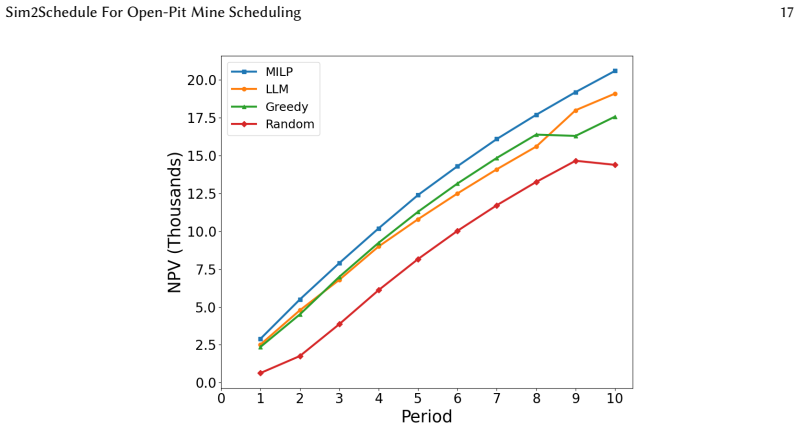
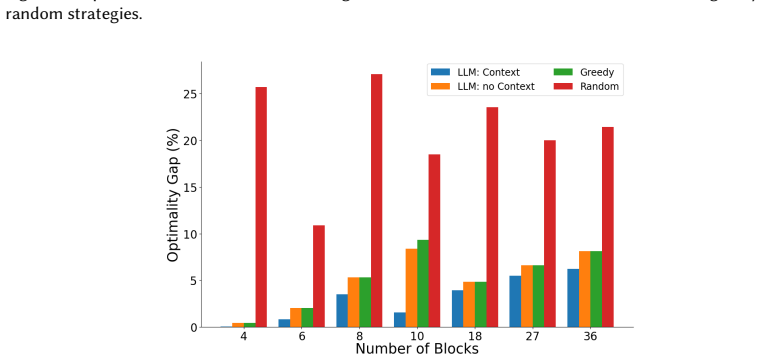
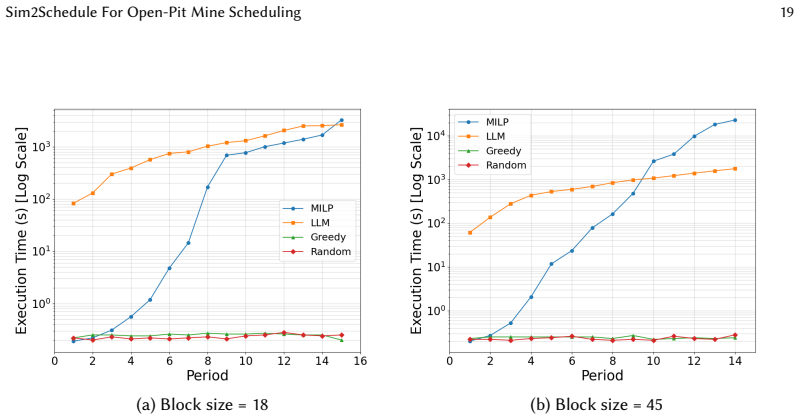
The LLM-based framework, operating zero-shot with simulator guidance, recovers between 94% and 99% of the MILP optimal NPV on mining instances of varying scale while scaling linearly in computation time.
What carries the argument
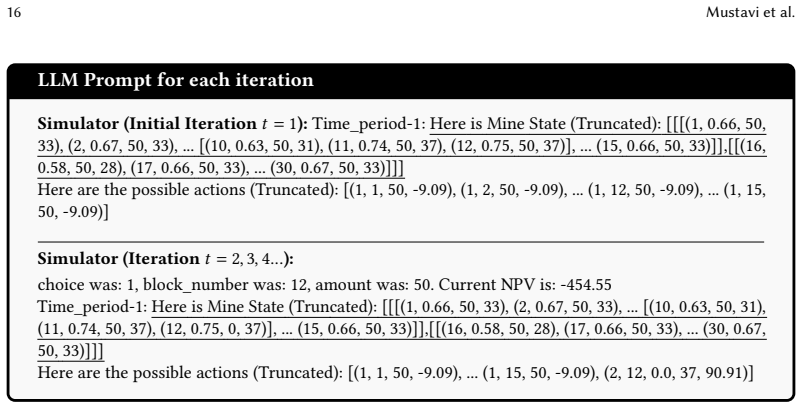
The custom simulator that encodes geotechnical precedence, extraction-processing coupling, and dynamic capacity constraints directly into the LLM's action generation at each step.
If this is right
- Produces complete and interpretable schedules for long-horizon planning.
- Scales linearly with problem size instead of exponentially like MILP.
- Operates entirely within a closed data-secure environment without cloud inference or retraining.
- Provides a practical alternative for real-time adaptation in dynamic industrial settings.
Where Pith is reading between the lines
- The approach could extend to other complex scheduling domains like logistics or manufacturing where simulators can encode constraints.
- Future work might test the framework on instances where the simulator is intentionally incomplete to measure robustness.
- Integration with real-time sensor data could allow dynamic rescheduling without reformulating an entire MILP.
Load-bearing premise
The custom simulator must correctly and completely capture every relevant geotechnical precedence, extraction-processing link, and capacity constraint, and the LLM must always follow its guidance without generating infeasible actions.
What would settle it
Running the framework on an instance where the simulator omits a known precedence constraint and observing whether the produced schedule violates that constraint.
Figures
read the original abstract
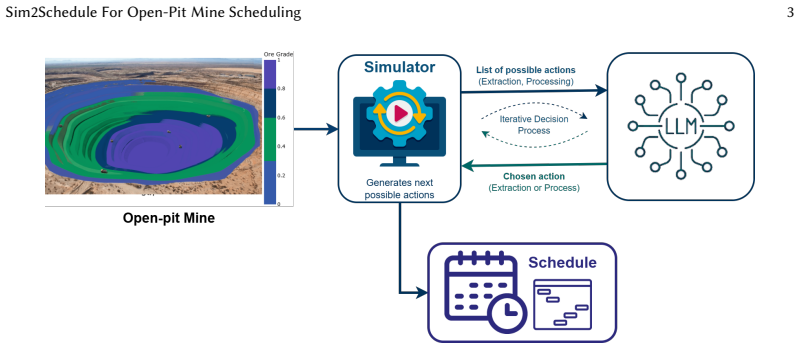
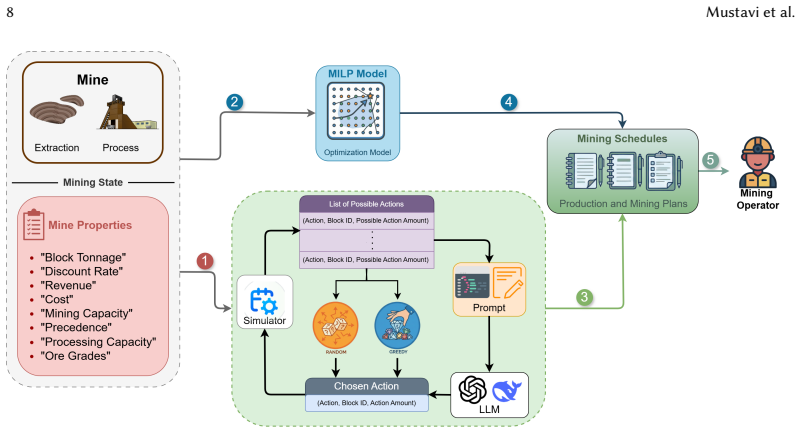
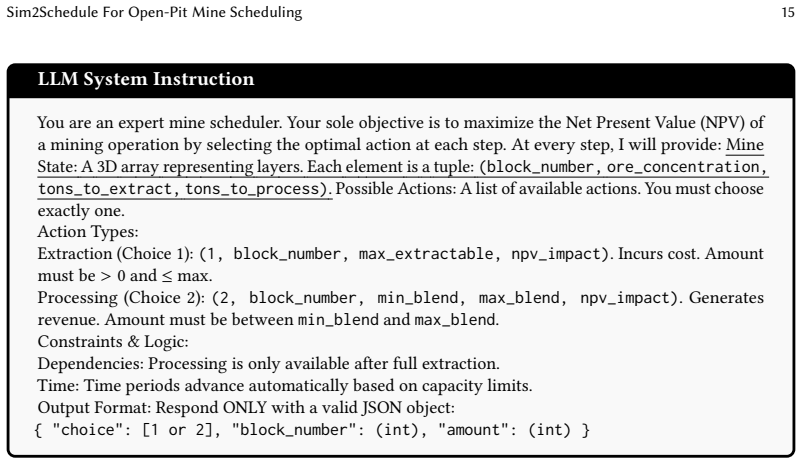
Open-pit mine scheduling is a critical process for maximizing economic return under complex geotechnical and operational constraints. While Mixed-Integer Linear Programming (MILP) provides mathematically optimal baselines, its exponential computational complexity and inability to adapt in real time limit its practical deployment in dynamic industrial environments. This work introduces a simulator-driven Large Language Model (LLM) scheduling framework in which the LLM acts as an autonomous decision-making agent, guided at each step by a custom simulator that encodes geotechnical precedence, extraction-processing coupling, and dynamic capacity constraints directly into the action generation mechanism. Operating entirely zero-shot within a closed, data-secure environment, the framework produces complete, interpretable extraction and processing schedules without cloud-based inference, domain-specific fine-tuning, or retraining. To provide a trustworthy performance benchmark, a novel MILP formulation is developed that incorporates realistic operational and geotechnical constraints. Evaluated across mining instances of varying scale and time periods, the LLM-based framework recovers between 94\% and 99\% of the MILP optimal NPV while scaling linearly in computation time. These results position simulator-constrained LLM agents as a practical and scalable alternative to classical optimization for long-horizon industrial scheduling under complex operational constraints.
Editorial analysis
A structured set of objections, weighed in public.
Referee Report
Summary. The paper introduces Sim2Schedule, a zero-shot LLM agent framework for open-pit mine scheduling guided by a custom simulator that injects geotechnical precedence, extraction-processing coupling, and dynamic capacity constraints into action generation. A novel MILP formulation is developed as a benchmark. Across mining instances of varying scale, the LLM framework is reported to recover 94-99% of the MILP optimal NPV while exhibiting linear scaling in computation time, all without fine-tuning or cloud inference.
Significance. If the central empirical claim holds under verified constraint fidelity, the work would demonstrate a scalable, interpretable, and data-secure alternative to exponential-complexity MILP for long-horizon industrial scheduling. The emphasis on a closed-environment, simulator-constrained agent and the provision of a realistic MILP baseline are strengths that could influence practical deployment in mining operations.
major comments (2)
- [Abstract] Abstract: The claim that the LLM framework recovers 94-99% of MILP optimal NPV is load-bearing for the central contribution, yet the text supplies no information on the number of test instances, prompt design, how infeasibility is prevented during generation, or any post-generation audit (e.g., constraint-violation counts or dual feasibility check against the MILP). Without this, the optimality gap cannot be assessed.
- [Abstract] Abstract and framework description: The performance numbers presuppose that every LLM-generated schedule is feasible w.r.t. the exact constraint set in the novel MILP. The simulator is stated to encode the constraints into action generation, but no independent verification (such as a constraint-violation audit or comparison of simulator outputs to MILP feasible region) is described; if the simulator is incomplete or the zero-shot LLM occasionally emits unblocked infeasible actions, the reported NPV is computed on invalid schedules.
minor comments (1)
- [Abstract] The abstract refers to 'mining instances of varying scale and time periods' without specifying the instance sizes, number of periods, or how they were generated; this should be clarified with a table or section reference for reproducibility.
Simulated Author's Rebuttal
Thank you for the constructive feedback and the recommendation for major revision. We address the two major comments on the abstract and framework description below, agreeing that additional details on experimental setup and constraint verification are needed for a complete assessment of the reported results. We will revise the manuscript accordingly.
read point-by-point responses
-
Referee: [Abstract] Abstract: The claim that the LLM framework recovers 94-99% of MILP optimal NPV is load-bearing for the central contribution, yet the text supplies no information on the number of test instances, prompt design, how infeasibility is prevented during generation, or any post-generation audit (e.g., constraint-violation counts or dual feasibility check against the MILP). Without this, the optimality gap cannot be assessed.
Authors: We agree that the abstract (and associated sections) should explicitly report these details to allow readers to evaluate the optimality gap. The experiments used 12 mining instances spanning 3 scales and 4 time horizons; prompts were zero-shot with a fixed structure that includes current state, simulator feedback, and constraint summaries; infeasibility is blocked at generation time by the simulator's action mask; and post-generation audits confirmed zero constraint violations across all schedules with NPV computed only on feasible outputs. We will expand the abstract and add a dedicated paragraph in Section 4 summarizing these elements, including the exact instance counts and audit statistics. revision: yes
-
Referee: [Abstract] Abstract and framework description: The performance numbers presuppose that every LLM-generated schedule is feasible w.r.t. the exact constraint set in the novel MILP. The simulator is stated to encode the constraints into action generation, but no independent verification (such as a constraint-violation audit or comparison of simulator outputs to MILP feasible region) is described; if the simulator is incomplete or the zero-shot LLM occasionally emits unblocked infeasible actions, the reported NPV is computed on invalid schedules.
Authors: We acknowledge that an explicit independent verification step strengthens the central claim. The simulator was constructed to replicate the MILP constraint set exactly (geotechnical precedence, extraction-processing coupling, and dynamic capacities), and all reported NPV values were computed only after confirming each schedule satisfies the MILP feasible region via a post-hoc feasibility check. We will add an appendix with the full constraint-violation audit (zero violations observed) and a direct comparison of simulator outputs against the MILP polytope for a subset of instances. This will be referenced from the abstract and framework section. revision: yes
Circularity Check
No circularity: empirical framework comparison with external MILP benchmark
full rationale
The paper presents an empirical LLM-simulator scheduling framework evaluated against a separately formulated MILP baseline on NPV recovery. No mathematical derivations, fitted parameters renamed as predictions, self-definitional loops, or load-bearing self-citations appear in the provided text. The MILP is described as a novel but independent formulation used for benchmarking; the LLM results are reported as direct outputs of the simulator-guided process. The work is self-contained as a practical comparison without any step that reduces by construction to its own inputs.
Axiom & Free-Parameter Ledger
Reference graph
Works this paper leans on
-
[1]
Henrik Abgaryan, Tristan Cazenave, and Ararat Harutyunyan. 2025. Starjob: Dataset for LLM-driven job shop scheduling.arXiv preprint arXiv:2503.01877(2025). doi:10.48550/arXiv.2503.01877
-
[2]
Sandhini Agarwal, Lama Ahmad, Jason Ai, Sam Altman, Andy Applebaum, Edwin Arbus, Rahul K Arora, Yu Bai, Bowen Baker, Haiming Bao, et al. 2025. gpt-oss-120b & gpt-oss-20b model card.arXiv preprint arXiv:2508.10925(2025). doi:10.48550/arXiv.2508.10925
work page internal anchor Pith review Pith/arXiv arXiv doi:10.48550/arxiv.2508.10925 2025
-
[3]
Awwad H Altiti, Rami O Alrawashdeh, and Hani M Alnawafleh. 2021. Open Pit Mining. InMining Techniques - Past, Present and Future. IntechOpen, London. doi:10.5772/intechopen.92208
-
[4]
Shadrach Yaw Amponsah, Pawoumodom Matthias Takouda, and Eugene Ben-Awuah. 2022. Genetic Algorithm Framework for Stochastic Open Pit Production Scheduling in the Presence of Grade Uncertainty.Mining Optimization Laboratory1, 780 (2022), 95
2022
-
[5]
Hooman Askari-Nasab, Yashar Pourrahimian, Eugene Ben-Awuah, and Samira Kalantari. 2011. Mixed integer linear programming formulations for open pit production scheduling.Journal of Mining Science47, 3 (2011), 338–359. doi:10.1134/S1062739147030117
-
[6]
Sébastien Bubeck, Varun Chandrasekaran, Ronen Eldan, Johannes Gehrke, Eric Horvitz, Ece Kamar, Peter Lee, Yin Tat Lee, Yuanzhi Li, Scott Lundberg, et al. 2023. Sparks of Artificial General Intelligence: Early Experiments with GPT-4. arXiv preprint arXiv:2303.12712(2023). doi:10.48550/arXiv.2303.12712
work page internal anchor Pith review Pith/arXiv arXiv doi:10.48550/arxiv.2303.12712 2023
-
[7]
Louis Caccetta and Stephen P Hill. 2003. An Application of Branch and Cut to Open Pit Mine Scheduling.Journal of Global Optimization27, 2 (2003), 349–365. doi:10.1023/A:1024835022186
-
[8]
Francesca Da Ros, Michael Soprano, Luca Di Gaspero, and Kevin Roitero. 2026. Large Language Models for Combina- torial Optimization: A Systematic Review.Comput. Surveys(2026). doi:10.1145/3801961
-
[9]
Roussos Dimitrakopoulos and Amina Lamghari. 2022. Simultaneous stochastic optimization of mining complexes - mineral value chains: an overview of concepts, examples and comparisons.International Journal of Mining, Reclamation and Environment36, 6 (2022), 443–460. doi:10.1080/17480930.2022.2065730
-
[10]
M. P. Fontes, Jair Carlos Koppe, and J. A. Silva Neto. 2021. Analysis of the Variables: Commodity Price and Discount Rate on Long-Term Open Pit Mine Planning.Global Journal of Engineering and Technology Advances6, 2 (2021), 142–150. doi:10.30574/gjeta.2021.6.2.0025
-
[11]
Chen Gao, Xiaochong Lan, Nian Li, Yuan Yuan, Jingtao Ding, Zhilun Zhou, Fengli Xu, and Yong Li. 2024. Large language models empowered agent-based modeling and simulation: A survey and perspectives.Humanities and Social Sciences Communications11, 1 (2024), 1–24
2024
-
[12]
Daya Guo, Dejian Yang, Haowei Zhang, Junxiao Song, Peiyi Wang, Qihao Zhu, Runxin Xu, Ruoyu Zhang, Shirong Ma, Xiao Bi, et al. 2025. Deepseek-r1: Incentivizing reasoning capability in llms via reinforcement learning.arXiv preprint arXiv:2501.12948(2025). doi:10.48550/arXiv.2501.12948
work page internal anchor Pith review Pith/arXiv arXiv doi:10.48550/arxiv.2501.12948 2025
-
[13]
Sadam Hussain, Ramanunni Parakkal Menon, Fatima Amara, Chunyan Lai, and Ursula Eicker. 2024. Optimization of Energy Systems using MILP and RC Modeling: A Real Case Study in Canada. InIEEE International Systems Conference (SysCon). 1–7. doi:10.1109/SysCon61195.2024.10553577
-
[14]
Gabriel Icarte-Ahumada and Otthein Herzog. 2025. Intelligent Scheduling in Open-Pit Mining: A Multi-Agent System with Reinforcement Learning.Machines13, 5 (2025), 350. doi:10.3390/machines13050350
-
[15]
Xia Jiang, Yaoxin Wu, Minshuo Li, Zhiguang Cao, and Yingqian Zhang. 2025. Large Language Models as End-to-End Combinatorial Optimization Solvers.arXiv preprint arXiv:2509.16865(2025). doi:10.48550/arXiv.2509.16865
-
[16]
1968.Optimum Open Pit Mine Production Scheduling
Thys Brentwood Johnson. 1968.Optimum Open Pit Mine Production Scheduling. University of California, Berkeley
1968
-
[17]
2024.A Comparative Analysis of Mathematical and Industrial Approaches for Sublevel Caving Long-Term Production Scheduling Optimization
Soroush Khazaei and Yashar Pourrahimian. 2024.A Comparative Analysis of Mathematical and Industrial Approaches for Sublevel Caving Long-Term Production Scheduling Optimization. Technical Report Report Twelve, Paper 102. Mining Optimization Laboratory, University of Alberta, Edmonton, Canada. 48–76 pages
2024
-
[18]
Behrang Koushavand, Hooman Askari-Nasab, and Clayton V. Deutsch. 2014. A linear programming model for long- term mine planning in the presence of grade uncertainty and a stockpile.International Journal of Mining Science and Technology24, 4 (2014), 451–459. doi:10.1016/j.ijmst.2014.05.006
-
[19]
Grossmann
Helmut Lerchs and Ingo F. Grossmann. 1965. Optimum Design of Open-Pit Mines.CIM Bulletin58, 633 (1965), 47–54
1965
-
[20]
Junyi Li, Tianyi Tang, Wayne Xin Zhao, Jian-Yun Nie, and Ji-Rong Wen. 2024. Pre-trained language models for text generation: A survey.Comput. Surveys56, 9 (2024), 1–39
2024
-
[21]
Mingxing Li, Qu Zhou, Wanshan Li, Ting Qu, Maolin Yang, and Pingyu Jiang. 2026. A4PS: Agentic AI-assisted advanced planning and scheduling with large language models for smart manufacturing.Journal of Manufacturing Systems85 ACM Trans. Autonom. Adapt. Syst., Vol. 1, No. 1, Article . Publication date: June 2026. 24 Mustavi et al. (2026), 207–226. doi:10.10...
-
[22]
2024.Gurobi Optimizer Reference Manual
Gurobi Optimization LLC. 2024.Gurobi Optimizer Reference Manual. https://www.gurobi.com [Accessed 18 December 2025]
2024
-
[23]
Valeria Loor and Nelson Morales. 2020. Applying Artificial Intelligence for Optimal Production Scheduling and Phase Design in Open Pit Mining. InMassMin 2020. 1451–1466. doi:10.36487/ACG_repo/2063_111
-
[24]
Tenenbaum, Daniela Rus, Chuang Gan, and Wojciech Matusik
Pingchuan Ma, Tsun-Hsuan Wang, Minghao Guo, Zhiqing Sun, Joshua B. Tenenbaum, Daniela Rus, Chuang Gan, and Wojciech Matusik. 2024. LLM and Simulation as Bilevel Optimizers: A New Paradigm to Advance Physical Scientific Discovery. InProceedings of the 41st International Conference on Machine Learning (Proceedings of Machine Learning Research, Vol. 235), Ru...
2024
-
[25]
C Meagher, R Dimitrakopoulos, and D Avis. 2014. Optimized open pit mine design, pushbacks and the gap problem—a review.Journal of Mining Science50, 3 (2014), 508–526. doi:10.1134/S1062739114030132
-
[26]
Ollama. 2025. gpt-oss on Ollama Library. https://ollama.com/library/gpt-oss [Accessed 25 January 2026]
2025
-
[27]
Milad Rahnema, Martin Grenon, and Ali Moradi Afrapoli. 2025. Sustainable Open Pit Mining Through GHG-Conscious Short-Term Production Scheduling.International Journal of Mining, Reclamation and Environment39, 5 (2025), 325–346. doi:10.1080/17480930.2024.2394813
-
[28]
José Saavedra-Rosas, Enrique Jeivez, Jorge Amaya, and Nelson Morales. 2016. Optimizing Open-Pit Block Scheduling with Exposed Ore Reserve.Journal of the Southern African Institute of Mining and Metallurgy116, 7 (2016), 655–662. doi:10.17159/2411-9717/2016/v116n7a7
-
[29]
Mohammad Tabesh, Ali Moradi Afrapoli, and Hooman Askari-Nasab. 2023. A Two-Stage Simultaneous Optimization of NPV and Throughput in Production Planning of Open Pit Mines.Resources Policy80 (2023), 103167. doi:10.1016/j. resourpol.2022.103167
work page doi:10.1016/j 2023
-
[30]
Shiv Prakash Upadhyay and Hooman Askari-Nasab. 2018. Simulation and optimization approach for uncertainty-based short-term planning in open pit mines.International Journal of Mining Science and Technology28, 2 (2018), 153–166. doi:10.1016/j.ijmst.2017.12.003
-
[31]
Luping Wang, Sheng Chen, Linnan Jiang, Shu Pan, Runze Cai, Sen Yang, and Fei Yang. 2025. Parameter-efficient fine-tuning in large language models: a survey of methodologies.Artificial Intelligence Review58, 8 (2025), 227. doi:10.1007/s10462-025-11236-4
-
[32]
Yidan Wang, Jiayin Wang, and Zhiwei Chu. 2025. Multi-agent large language models as evolutionary optimizers for scheduling optimization.Computers & Industrial Engineering206 (2025), 111197. doi:10.1016/j.cie.2025.111197
-
[33]
Jason Wei, Xuezhi Wang, Dale Schuurmans, Maarten Bosma, Fei Xia, Ed Chi, Quoc V Le, Denny Zhou, et al . 2022. Chain-of-Thought Prompting Elicits Reasoning in Large Language Models. InAdvances in Neural Information Processing Systems (NeurIPS), Vol. 35. 24824–24837
2022
-
[34]
Chengrun Yang, Xuezhi Wang, Yifeng Lu, Hanxiao Liu, Quoc V Le, Denny Zhou, and Xinyun Chen. 2024. Large Language Models as Optimizers. InThe Twelfth International Conference on Learning Representations
2024
-
[35]
Shunyu Yao, Jeffrey Zhao, Dian Yu, Nan Du, Izhak Shafran, Karthik R Narasimhan, and Yuan Cao. 2023. ReAct: Syner- gizing Reasoning and Acting in Language Models. InThe Eleventh International Conference on Learning Representations
2023
-
[36]
Tsegai O Yhdego and Hui Wang. 2025. Automated Ontology Generation for Zero-Shot Defect Identification in Manufacturing.IEEE Transactions on Automation Science and Engineering(2025). doi:10.1109/TASE.2025.3537463
-
[37]
Mateusz Zajac. 2025. Heuristic, Hybrid, and LLM-Assisted Heuristics for Container Yard Strategies Under Incomplete Information.Applied Sciences15, 18 (2025), 10033. doi:10.3390/app151810033
-
[38]
Ni Zhang, Zhiguang Cao, Jianan Zhou, Cong Zhang, and Yew-Soon Ong. 2025. An Agentic Framework with LLMs for Solving Complex Vehicle Routing Problems.arXiv preprint arXiv:2510.16701(2025). doi:10.48550/arXiv.2510.16701 ACM Trans. Autonom. Adapt. Syst., Vol. 1, No. 1, Article . Publication date: June 2026
discussion (0)
Sign in with ORCID, Apple, or X to comment. Anyone can read and Pith papers without signing in.