REVIEW 3 major objections 4 minor 37 references
OTM work values are exactly conditional averages of TTM work, so coherence hidden in standard two-time measurement data can be recovered by classical post-processing without changing the experiment.
Reviewed by Pith at T0; open to challenge. T0 means a machine referee read the full paper against a public rubric. the ladder, T0–T4 →
T0 review · deepseek-v4-flash
2026-08-01 19:28 UTC pith:WGAECY22
load-bearing objection The TTM-to-OTM identity is correct and the transition analysis is a genuine fold-catastrophe result, but the unbiased-meter assumption is a calibration requirement and the 'coherence from TTM' claim is oversold. the 3 major comments →
Operational Relation Between One-Time and Two-Time Work Protocols and Measurement-Resolution-Induced Transitions in Quantum Work Statistics
The pith
A machine-rendered reading of the paper's core claim, the machinery that carries it, and where it could break.
Core claim
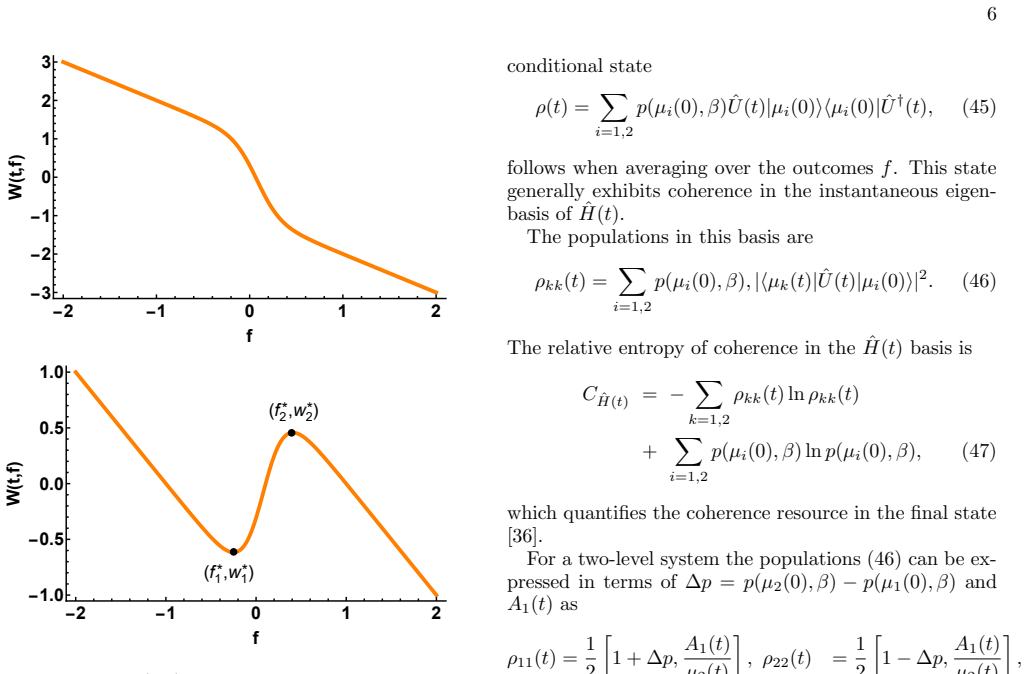
The central claim is Eq. (12): W^(1)(f1,t) = ∫ df2 W^(2)(f2,f1) P_F(f2|f1). In words, the one-time measurement work associated with a first outcome f1 is the average of the two-time measurement work over the distribution of second outcomes f2. This follows because the conditional mean of the second meter outcome is the true energy expectation at time t, provided the meter is unbiased. Consequently, standard TTM runs — which already record pairs (f1,f2) — contain enough statistics to reconstruct OTM work values and, for two-level systems, the relative entropy of coherence of the driven state. For a Gaussian meter and a two-level system with A1(t) < 0, the conditional work function W(t,f) beco
What carries the argument
The load-bearing identity is Eq. (12), which converts TTM data into OTM work values by a conditional average over the second outcome; it relies on the meter being unbiased. The statistical transition is carried by the conditional work function W(t,f), whose extrema coalesce at σc; near such a cubic inflection point, extrema separate as ε^{1/2} and work values as ε^{3/2}, giving the universal scaling. Coherence enters through the populations of the final state, which for a two-level system are fixed by the products A1(t)Δp and μ²(t), both extractable from the work distribution.
Load-bearing premise
The load-bearing premise is that the energy meter is unbiased — for every eigenstate, the mean readout equals its energy eigenvalue; the quantitative exponents additionally assume the meter's response is Gaussian.
What would settle it
Use a meter with a known, controllable offset in its readout (mean outcome μ+δ for an eigenstate of energy μ) and compare direct OTM work values with those reconstructed from TTM via Eq. (12); the two would disagree, exposing the bias assumption. Alternatively, for A1(t) > 0 the work distribution should stay smooth — observing square-root peaks there would refute the transition criterion.
If this is right
- Standard TTM experimental runs already contain OTM work statistics and coherence information; no modification to the measurement apparatus is required.
- OTM work distributions can be reconstructed offline from TTM histograms by binning f2 and averaging per f1.
- At intermediate meter resolution, the OTM work distribution of a driven two-level system can develop non-analytic square-root peaks, not just smooth Gaussians.
- Peak separation near the critical resolution obeys a universal 3/2 power law, giving a parameter-free experimental signature.
- The relative entropy of coherence in the final energy basis can be extracted from energy measurements alone for two-level systems.
Where Pith is reading between the lines
- Inference: The mechanism — non-monotonic conditional work causing Jacobian singularities — is generic, so multilevel systems should show analogous non-analytic features whenever W(t,f) develops extrema; the exponents should remain 3/2 and 1/2, though the locus of critical points will be richer.
- Inference: The same post-processing could make TTM data useful for coherence metrology in settings where ancilla-based schemes are impractical; a natural test is to compare coherence inferred from TTM post-processing against direct interferometric measurements.
- Inference: If a meter has known bias, the discrepancy in Eq. (12) could be used as an in-situ calibration of the meter's response.
- Inference: The coherence-dependent Jarzynski correction implies that the post-processed data also yields estimates of the coherence contribution to fluctuation relations, which might be used to witness non-equilibrium coherence.
Editorial analysis
A structured set of objections, weighed in public.
Referee Report
Summary. The paper derives an operational identity between the one-time measurement (OTM) and two-time measurement (TTM) work protocols, Eq. (12), showing that OTM work values can be reconstructed from TTM data by classical post-processing under an unbiased-meter condition. For a driven two-level system with a Gaussian energy meter, the paper then identifies a resolution-driven statistical transition when A_1(t)<0: at σ_c = sqrt(−A_1 μ) the conditional work function W(t,f) becomes multivalued, leading to square-root divergent peaks in P_W(w), with ΔW ~ ε^{3/2} and P_W(w) ~ (σ_c−σ)^{−1/4}|w−w_i|^{−1/2}. The paper further claims that these same work statistics determine the relative entropy of coherence, and it proposes an NV-center experiment where both sides of the transition are observable.
Significance. If correct, the central identity and the transition analysis are significant: they unify two standard work-probability definitions, show that TTM data contain coherence information that is latent but extractable, and provide concrete, measurable signatures with a claimed universal exponent. The derivation of Eq. (12) is transparent, the exact closed-form expression Eq. (36) is consistent with the subsequent expansion, and the numerical verification in Fig. 5 supports the ε^{3/2} scaling. The NV-center parameter estimates make the predictions experimentally relevant. The main weaknesses are that the operational claim relies on an unbiased-meter condition that is not flagged as a calibration requirement, and the coherence-extraction procedure is not fully operationalized.
major comments (3)
- [§II, Eqs. (11)–(12)] The central identity W^{(1)}(f_1,t)=∫df_2 W^{(2)}(f_2,f_1)P_F(f_2|f_1) is derived by using ∫df f G_σ(f|μ)=μ for each energy eigenvalue. This is a strong, resolution-dependent calibration condition. If a real meter has a bias b(μ,σ), then ∫df f G_σ(f|μ)=μ+b(μ,σ), and the reconstructed quantity becomes Tr[(Ĥ(t)+B_σ(t))ρ(t|f_1)] − f_1, which is not the OTM work. All downstream results — σ_c, the peak positions, the ε^{3/2} scaling, and the coherence extraction — inherit this error. The manuscript does not state this unbiasedness as a testable requirement nor discuss how to calibrate the meter. The abstract's claim 'without any modification of the experimental setup' is therefore stronger than the derivation supports. Please add an explicit statement of the condition, a calibration/bias-correction discussion, or restrict the scope of the claim.
- [§IV.C–D, Eqs. (33) and (39)] The claim that the exponent 3/2 is 'universal' is established only for a Gaussian meter and a thermal two-level initial state. The heuristic argument that the exponent follows from a cubic inflection point is plausible for a generic meter, but it is not a proof. If the universality claim is meant to apply beyond the Gaussian model, a robustness argument or an explicit derivation for a wider class of POVMs is needed; otherwise the statement should be restricted to the Gaussian-meter case analyzed in the paper.
- [§V, Eqs. (46)–(48)] The coherence-extraction claim requires determining A_1(t) and Δp from P_W(w). The text says these are 'determined from the work distribution' but does not provide an explicit inversion or identification procedure, nor an analysis of which regimes make this determination possible. In the weak-measurement limit, for example, the first two moments give ⟨w⟩=(A_1+μ)Δp and Var(w)=σ², so A_1 and Δp are not separately identifiable from the Gaussian envelope alone. Please specify the reconstruction protocol and the regimes in which C_H(t) is identifiable.
minor comments (4)
- [§V, Eq. (48)] There is a typographical comma: '1/2 (1 + ∆p, A1(t)/µ2(t))' should be '1/2 (1 + ∆p A1(t)/µ2(t))'. Also, the notation µ2(t) for the largest eigenvalue is confusing because µ_2 already denotes an eigenvalue; please use a clearer symbol such as μ_+(t).
- [§IV.D] The text contains a typo: 'non-analitic' should be 'non-analytic'.
- [§IV.C] The visibility condition for the non-analytic peaks is discussed qualitatively ('the visibility of the peaks depends on the interplay...'), but a quantitative condition or an explicit formula for |T_c| is not given. Since this is used to determine when the peaks are observable, please provide the precise condition or state where it is derived.
- [§III, Eq. (15)] The definitions of ΔC and ΔD_KL refer to objects such as ρ̂(t,f) and ρ̂_D(t,f) that are not explicitly defined in the text. Please define these states or point to the exact equation in Ref. [30] where they are introduced.
Circularity Check
No significant circularity: the central TTM–OTM identity is derived from stated meter assumptions, and the transition/coherence results are explicit model calculations.
full rationale
The central relation, Eq. (12), is not an input or a fitted prediction. It is derived in Eq. (11) by directly integrating the TTM work over the second measurement outcome and using the spectral decomposition of H(t) together with the explicitly stated unbiased-meter condition ∫ df f G_σ(f|μ)=μ for each eigenvalue μ. The OTM work in Eq. (10) is defined independently as Tr[H(t)ρ(t|f_1)]−f_1, so the equality is an exact algebraic consequence of the stated assumptions, not a definitional renaming. The unbiased-meter condition is a modeling/calibration assumption, and a real meter with bias would indeed break the reconstruction, but that is a correctness/robustness caveat, not circularity. The subsequent transition analysis begins from the explicit two-level expression W(t,f)=A_1(t) tanh(βμ−μf/σ²)−f; the extrema, critical resolution σ_c=√(−A_1μ), and the exponents 3/2 and −1/2 are obtained by direct calculus and local Taylor expansion around a fold, with no parameter fitted to the predicted quantity. The coherence extraction in Sec. V is an inversion of the work–distribution map onto (Δp, A_1), not an assumed input. Self-citations, notably Ref. [30] for the generalized Jarzynski relation, appear only as background and are not load-bearing for the TTM–OTM identity, the statistical transition, or the coherence reconstruction. Under the stated assumptions the paper is self-contained and non-circular.
Axiom & Free-Parameter Ledger
axioms (6)
- domain assumption The POVM meter satisfies ∫ df f G_σ(f|μ) = μ for each eigenvalue μ (unbiased meter)
- domain assumption The meter is modeled by a Gaussian pointer (Eq. 22), G_σ(f|μ) = (2πσ²)^{-1/2} exp[-(f-μ)²/(2σ²)]
- domain assumption Initial state is diagonal in the H(0) eigenbasis and represents a (possibly negative-temperature) thermal state (Eq. 18)
- domain assumption The two-level Hamiltonian is traceless, so μ1=-μ, μ2=μ, and μ2(t) is the largest eigenvalue of H(t)
- standard math Unitary evolution preserves the spectrum of the density operator, so S(ρ(t)) = S(ρ(0))
- domain assumption The NV-center electronic spin can be modeled as a driven two-level system with the Rabi Hamiltonian (49)-(50), with parameters from Ref. [11]
read the original abstract
We establish a direct operational connection between the one-time measurement (OTM) and two-time measurement (TTM) protocols for quantum work statistics, showing that OTM work values, including coherence signatures, can be reconstructed from standard TTM data through classical post-processing without any modification of the experimental setup. This reveals that coherence information commonly attributed to OTM schemes is already latent within TTM data and becomes explicit upon a natural post-processing step. For a driven two-level system subject to finite-resolution energy measurements, this reconstruction unveils a resolution-driven statistical transition in the work distribution: whereas projective and weak measurements yield smooth distributions, intermediate resolutions produce non-analytic structures whose character is determined by the dynamics and a critical meter resolution. We show that the non-analyticity of the OTM work distribution takes the form of square-root divergent peaks at specific work values, and that the separation between these singular points is an experimentally accessible quantity that vanishes at the critical resolution with a universal exponent. The same dynamical quantities that govern the transition also encode the relative entropy of coherence of the driven state, enabling coherence quantification from energy measurements alone. We demonstrate experimental accessibility in a nitrogen-vacancy center platform with parameters drawn from current experiments, where both sides of the transition and the coherence signatures are within reach of existing technology.
Figures


Reference graph
Works this paper leans on
-
[1]
D. J. Evans, E. G. D. Cohen, and G. P. Morriss, Physical Review Letters71, 2401 (1993)
1993
-
[2]
Gallavotti and E
G. Gallavotti and E. G. D. Cohen, Journal of Statistical Physics80, 931 (1995). 10
1995
-
[3]
Gallavotti and E
G. Gallavotti and E. G. D. Cohen, Physical Review Let- ters74, 2694 (1995)
1995
-
[4]
Jarzynski, Physical Review Letters78, 2690 (1997)
C. Jarzynski, Physical Review Letters78, 2690 (1997)
1997
-
[5]
G. E. Crooks, Phys. Rev. E60, 2721 (1999)
1999
-
[6]
Jarzynski, Annual Review of Condensed Matter Physics2, 329 (2011)
C. Jarzynski, Annual Review of Condensed Matter Physics2, 329 (2011)
2011
-
[7]
Andrieux and P
D. Andrieux and P. Gaspard, Phys. Rev. Lett.100, 230404 (2008)
2008
-
[8]
Andrieux, P
D. Andrieux, P. Gaspard, T. Monnai, and S. Tasaki, New Journal of Physics11, 043014 (2009)
2009
-
[9]
Gaspard,The Statistical Mechanics of Irreversible Phenomena(Cambridge University Press, 2022)
P. Gaspard,The Statistical Mechanics of Irreversible Phenomena(Cambridge University Press, 2022)
2022
-
[10]
T. B. Batalh˜ ao, A. M. Souza, L. Mazzola, R. Auccaise, R. S. Sarthour, I. S. Oliveira, J. Goold, G. De Chiara, M. Paternostro, and R. M. Serra, Phys. Rev. Lett.113, 140601 (2014)
2014
-
[11]
Hern´ andez-G´ omez, S
S. Hern´ andez-G´ omez, S. Gherardini, F. Poggiali, F. S. Cataliotti, A. Trombettoni, P. Cappellaro, and N. Fabbri, Physical Review Research2, 023327 (2020)
2020
-
[12]
Esposito, U
M. Esposito, U. Harbola, and S. Mukamel, Reviews of modern physics81, 1665 (2009)
2009
-
[13]
Campisi, P
M. Campisi, P. H¨ anggi, and P. Talkner, Rev. Mod. Phys. 83, 771 (2011)
2011
-
[14]
Kurchan, arXivcond-mat/0007360(2000), arXiv:cond-mat/0007360 [cond-mat.stat-mech]
J. Kurchan, arXivcond-mat/0007360(2000), arXiv:cond-mat/0007360 [cond-mat.stat-mech]
arXiv 2000
-
[15]
Tasaki, arXivcond-mat/0009244v2(2000), http://arxiv.org/abs/cond-mat/0009244v2
H. Tasaki, arXivcond-mat/0009244v2(2000), http://arxiv.org/abs/cond-mat/0009244v2
arXiv 2000
-
[16]
Deffner, J
S. Deffner, J. P. Paz, and W. H. Zurek, Phys. Rev. E94, 010103 (2016)
2016
-
[17]
A. Sone and S. Deffner, Journal of Statistical Physics 183, 10.1007/s10955-021-02720-6 (2021)
-
[18]
Maeda, T
K. Maeda, T. Holdsworth, S. Deffner, and A. Sone, Phys- ical Review A108, l050203 (2023)
2023
-
[19]
Sone, Y.-X
A. Sone, Y.-X. Liu, and P. Cappellaro, Physical Review Letters125, 060602 (2020)
2020
-
[20]
L. B. Oftelie and M. Campisi, Quantum Science and Technology10, 025045 (2025)
2025
-
[21]
A. J. Roncaglia, F. Cerisola, and J. P. Paz, Physi- cal Review Letters113, 10.1103/physrevlett.113.250601 (2014)
-
[22]
G. D. Chiara, P. Solinas, F. Cerisola, and A. J. Roncaglia, inFundamental Theories of Physics(Springer Interna- tional Publishing, 2018) pp. 337–362
2018
-
[23]
Perarnau-Llobet, E
M. Perarnau-Llobet, E. B¨ aumer, K. V. Hovhannisyan, M. Huber, and A. Acin, Physical Review Letters118, 070601 (2017)
2017
-
[24]
Seifert, Reports on Progress in Physics75, 126001 (2012)
U. Seifert, Reports on Progress in Physics75, 126001 (2012)
2012
-
[25]
Elouard, D
C. Elouard, D. A. Herrera-Mart ´ ı, M. Clusel, and A. Auff` eves, npj Quantum Information3, 9 (2017)
2017
-
[26]
G. Watanabe, B. P. Venkatesh, and P. Talkner, Physical Review E89, 10.1103/physreve.89.052116 (2014)
-
[27]
K. Ito, P. Talkner, B. P. Venkatesh, and G. Watan- abe, Physical Review A99, 10.1103/physreva.99.032117 (2019)
-
[28]
S. L. Jacob, G. T. Landi, M. Esposito, and F. Barra, Physical Review Research5, 043160 (2023)
2023
-
[29]
S. L. Jacob, J. Goold, G. T. Landi, and F. Barra, Physical Review Letters133, 207101 (2024)
2024
-
[30]
Alonso and A
D. Alonso and A. R. Garc ´ ıa, Physical Review E108, 024126 (2023)
2023
-
[31]
C. Han, D. Cohen, and E. Sela, Physical Review B110, 115153 (2024)
2024
-
[32]
A. V. Varma and D. Cohen, arxiv2507.09977 (2025), arXiv:2507.09977 [quant-ph]
Pith/arXiv arXiv 2025
-
[33]
V. B. Braginsky, F. Y. Khalili, and K. S. Thorne,Quan- tum Measurement(Cambridge University Press, 1995) p. 211
1995
-
[34]
Kosloff, Entropy15, 2100 (2013)
R. Kosloff, Entropy15, 2100 (2013)
2013
-
[35]
Deffner and S
S. Deffner and S. Campbell,Quantum Thermodynamics An Introduction to the Thermodynamics of Quantum In- formation(Morgan and Claypool Publishers, 2019)
2019
-
[36]
A. Streltsov, G. Adesso, and M. B. Plenio, Reviews of Modern Physics89, 10.1103/revmodphys.89.041003 (2017)
-
[37]
W. L. Ribeiro, G. T. Landi, and F. L. Semi˜ ao, American Journal of Physics84, 948 (2016)
2016
discussion (0)
Sign in with ORCID, Apple, or X to comment. Anyone can read and Pith papers without signing in.