REVIEW 4 major objections 5 minor 51 references
Transitional patterns on a spherical surface: from scars to domain defects of mixed lattices
T0 review · 4 major / 5 minor · reviewed 2026-08-04 · deepseek-v4-flash
Pith's one-line read On a sphere, mixed square and hexagonal lattices produce four ordered defect patterns, two of them new: bridged cubic domains and open scars.
desk verdict A solid mapping of new defect morphologies in the Sq-rich regime, but the elastic-energy 'confirmation' of the bridged state is weakened by an extra variational DOF; the simulation findings stand. read the letter →
The pith
A machine-rendered reading of the paper's core claim, the machinery that carries it, and where it could break.
The reading
What carries the argument
The load-bearing object is the sphere's topological charge budget: the total disclination winding number must equal +2 (the Euler characteristic), and in a mixed lattice this budget is expressed through ±1/12 quarter-turn defects, either paired into scars or concentrated in triangular hexagonal domain defects. The energy comparison is carried by the Bowick–Nelson–Travesset (BNT) pair interaction chi(beta) between unit-strength point disclinations, minimized under geometric constraints that encode the unbridged and bridged arrangements. In the bridged construction, triangular domains can rotate and area can be redistributed between triangles and parallelogram bridges, giving the defect points
What would settle it
Run the same annealing protocol on a different soft-core model with known square–hexagonal coexistence (or an experimental colloidal sphere system) at f_Sq ≈ 0.7, N ≈ 2000, and count parallelogram bridges N_p: if ≈12 parallelograms do not appear, the claim that the bridged state is the generic ground state fails. Alternatively, minimize the BNT energy with the bridged state restricted to the same single degree of freedom as the unbridged state; if the bridged energy is no longer lower, the elastic model's support is an artifact of the extra variational freedom.
Extended reading notes
Core claim
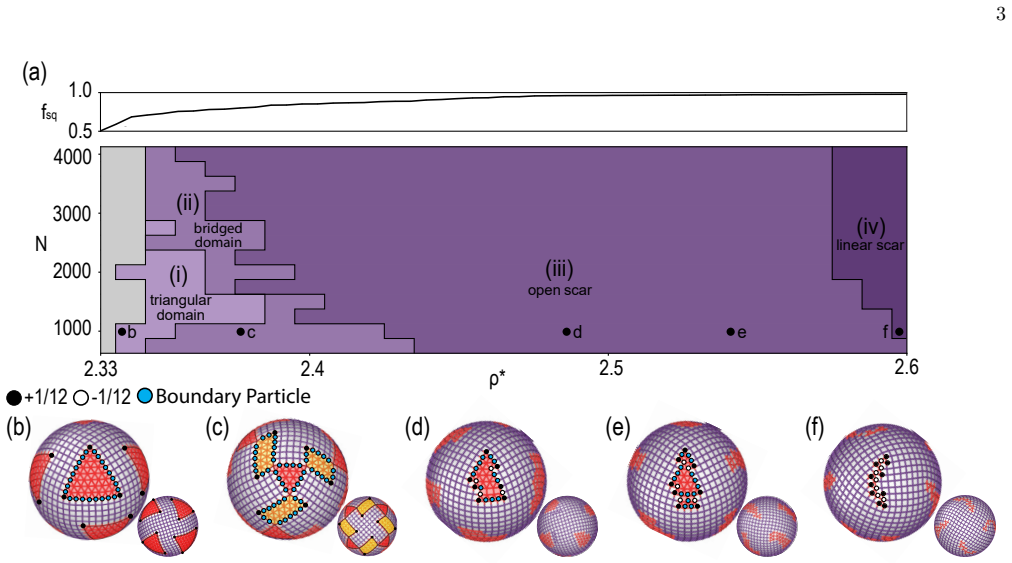
The paper claims that on a spherical monolayer of Hertzian particles at reduced densities rho* ≳ 2.33, the square-lattice background hosts at least four ordered defect morphologies: eight triangular hexagonal domains arranged with cubic (octahedral-like) symmetry; a bridged state in which those triangles are connected by twelve hexagonal parallelograms; open scars, where a ±1/12 disclination chain opens into a corridor of hexagonal lattice; and conventional linear scars made only of paired disclinations. The bridged and open-scar states are new. The bridged state is shown by 20-run molecular-dynamics annealing to be the low-energy morphology for hexagonal area fraction f_Sq between about 0.6
Load-bearing premise
The elastic-energy comparison hinges on the assumption that the idealized point-defect constructions faithfully represent the two real morphologies, and it gives the bridged state one extra variational degree of freedom (redistributing area between triangles and bridges) that the unbridged state does not have; with that extra freedom, a lower minimized energy is almost inevitable, so the agreement with molecular dynamics stands only if the extra freedom is physically intrinsi
Editorial extensions
If this is right
- In the square-rich regime with f_Sq between ~0.6 and ~0.8, the ground state is a bridged cubic complex of eight triangular and twelve parallelogram hexagonal domains, not a plain cubic arrangement; this is confirmed by two independent methods.
- The open-scar state occupies f_Sq roughly 0.8–0.97 and connects continuously to linear scars as the hexagonal content decreases, with N_{-1/12} and N_b both scaling as a + b*sqrt(N) at fixed f_Sq.
- An elastic model that treats only defect-point interactions, with no knowledge of the underlying lattice types, reproduces the MD result that the bridged state is preferred, indicating the preference is a curvature-driven, generic effect rather than a finite-size artifact.
- The state diagram for N = 750 to 4000 and rho* >= 2.33 shows that as density increases the morphology passes from bridged (or unbridged) cubic states through open scars to linear scars, with the bridged regime expanding at larger N.
- Taking this together with the previously mapped Hex-rich regime, the defect repertoire of mixed-lattice spheres includes enclaved domain defects, bridged domain defects, and open scars in addition to point and line disclinations.
Reading between the lines
- If the bridged state is the generic Sq-rich ground state, it should appear in any soft-matter or colloid system with square–hexagonal coexistence on a curved substrate; a direct test is to count parallelogram bridges (N_p ≈ 12) in such a system at f_Sq ≈ 0.7.
- Because the BNT comparison gives the bridged state an extra variational degree of freedom (area redistribution) that the unbridged state is not allowed, the elastic support is only as strong as the physical necessity of that freedom; constraining both states to the same DOF count would provide a sharper confirmation.
- The open scar may be a generic intermediate state between linear scars and domain-defect arrays on any curved surface where two incommensurate lattice orders compete, suggesting that analogous 'open' defects should exist on ellipsoids, tori, and hyperbolic surfaces.
- The fitted coefficients b_{-1/12} and b_b carry physical meaning as disclination line density and interface perimeter density; measuring these in experiments would test whether the scar-to-open-scar transition is universal across interaction potentials.
Editorial analysis
A structured set of objections, weighed in public.
Referee Report
Summary. The paper reports molecular dynamics simulations of Hertzian particles confined to a spherical surface in the square-rich regime (N=750–4000, rho*>=2.33), and identifies four disclination morphologies: unbridged cubic domain defects, a newly identified bridged cubic state, open scars, and linear scars. A state diagram is constructed, order parameters are introduced (e.g., the number of parallelogram bridges N_p, the number of -1/12 disclinations, and the number of Hex–Sq boundary particles), and finite-size scaling of scar properties is analyzed. The authors further use a Bowick–Nelson–Travesset (BNT) elastic model to argue that the bridged cubic state is energetically preferred over the unbridged cubic state in the range f_Sq < 0.8.
Significance. If the central claims hold, the paper substantially extends the taxonomy of topological defect morphologies on curved surfaces: it reports two previously unidentified morphologies, the bridged cubic state and the open scar, that arise specifically in mixed Hex–Sq lattices rather than in single-lattice systems. The order parameters and the finite-size scaling analysis provide useful quantitative handles for future studies and for experimental comparison. A particular strength is that the MD simulation protocol is described in enough detail that the observations are reproducible in principle, and the paper is transparent about the heuristic nature of the state-diagram boundaries. However, the quantitative support for the central energetic-preference claim is currently not independent: the BNT comparison as constructed does not by itself confirm the MD observation, and no direct MD energy comparison is provided.
major comments (4)
- [BNT elastic energy for the bridged state; Appendix E, Eq. (E3), Fig. 3(b)] The BNT comparison is not an independent confirmation of the energetic preference claimed in the abstract. As the paper states in Appendix E, the bridged state possesses 'one extra DOF compared to unbridged cubic states': the unbridged ansatz is minimized over one rotational angle, while the bridged ansatz is minimized over both the rotational angle and the area redistribution between triangles and parallelograms. Minimizing over a strictly larger variational space guarantees a lower or equal minimized energy, regardless of the physical merit of the bridged morphology. The extra DOF is plausible, but the paper does not demonstrate that it is intrinsic to the bridged state rather than an ad hoc flexibility added to the ansatz. The claim that BNT 'confirms' the MD prevalence is therefore not supported as written.
- [Abstract and 'Bridged domain defects' section; Fig. 3] The text states that 'the bridged morphology has a lower system energy' and the abstract claims energetic preference, but no direct comparison of minimized MD potential energies of the bridged and unbridged states at the same (rho*, N) is shown. The only quantitative energy comparison in Fig. 3(b) is the BNT variational calculation discussed above. Without MD energy curves or at least tabulated energy differences with error bars, the claim that the bridged state is the ground-state morphology in the f_Sq < 0.8 regime rests on a biased model comparison and on the observed prevalence in annealed runs, which could in principle reflect kinetic trapping. I request direct MD energy comparison (or, failing that, a carefully justified removal of the extra DOF in the BNT model and a sensitivity study).
- [State diagram, Fig. 1(a)] The state diagram is the empirical backbone of the paper, but its boundaries are identified by a majority-pattern rule with no error bars and no quantitative measure of coexistence or pattern purity. The paper acknowledges that energy differences along boundaries are small and that different defect types may coexist, but the resulting boundary locations are then used to locate the bridged state regime and the transition to open scars. Given the central role of these boundaries, the authors should provide a more quantitative determination, e.g., fractions of each morphology among the 20 independent runs, error estimates in rho* and N for each boundary, or a robustness analysis against the majority-rule criterion.
- [Appendix D, Eq. (D1)] The BNT comparison uses a single-modulus approximation, K_ij=K, meaning defect interactions through Hex and Sq media are treated identically. Since the bridged and unbridged states contain different spatial arrangements and relative amounts of Hex and Sq domains, a single modulus may bias the energy comparison and the crossover location f_Sq < 0.8. At minimum, a sensitivity analysis with a modestly anisotropic or state-dependent K should be reported. This is not a fatal flaw, but it further weakens the claim that the BNT model independently confirms the MD result.
minor comments (5)
- [Linear and open scars, paragraph following Fig. 2] The text says 'whereas the perimeter coefficient b_{-1/12} increases' in the open-scar regime; from context and Fig. 2(d), this should be b_b (the boundary-particle coefficient), not b_{-1/12}.
- [Fig. A1 caption] Typo: 'Hertizan' should be 'Hertzian'.
- [Fig. 2 caption] The caption uses 'insert' where 'inset' is intended, and the reference '[cyan particles in Fig. 1(b)-(e)]' should be checked because Fig. 1 has panels (b)–(f).
- [Appendix C and Fig. 2] The OLS scaling fits are presented without confidence intervals or goodness-of-fit measures. Since the extracted slopes b_{-1/12} and b_b are given physical interpretations and used to support the open-scar/linear-scar description, reporting standard errors would strengthen the analysis.
- [Throughout] The area fraction notation is inconsistent (f, fSq, f_Sq are all used). Please unify.
Circularity Check
No significant circularity: the MD phase diagram is the primary result, and the BNT elastic-energy comparison is a separate continuum model rather than a fit of MD energies.
full rationale
The paper's central claims are the MD-identified morphologies (bridged cubic state, open scar, etc.) and the state diagram in Fig. 1(a), which are direct simulation outputs. The BNT elastic-energy calculation is a separate continuum estimate: it does not fit parameters to MD energy data, and the phase boundaries in Fig. 1(a) are determined from MD structural parameters and visual inspection, not from the BNT curves. The scaling coefficients in Fig. 2 are OLS descriptors of the same MD data, not predictions masquerading as independent results. The only notable caveat is Appendix E: the bridged BNT ansatz is minimized over two geometric DOFs versus one for the unbridged state, so the lower minimized elastic energy partly reflects greater variational freedom. However, this is a model-design limitation, not a circularity, because the extra DOF is motivated by the observed parallelogram bridges and the MD observation of prevalence is independent of the BNT calculation. There is no load-bearing self-citation, no fitted parameter renamed as a prediction, and no derivation that reduces by construction to its own inputs.
Assumptions & free parameters
free parameters (3)
- OLS scaling intercepts a_{-1/12}, a_b =
values from OLS fits (Fig. 2, Appendix C)
- OLS scaling slopes b_{-1/12}, b_b =
plotted in Fig. 2(c),(d)
- Bridged-state variational DOFs (triangle rotation angle and theta_1 area redistribution) =
minimized for each fSq (e.g., bridged reaches snub cube at fSq=0.787)
assumptions (5)
- standard math Gauss-Bonnet theorem and Poincare-Hopf theorem: total disclination winding number equals 2 on the sphere
- domain assumption Hertzian potential U(r)=epsilon(1-r/sigma)^{5/2} supports coexistent Hex and Sq lattices at densities 2.2 < rho* < 2.4
- domain assumption BNT point-disclination model with interaction chi(beta) from Eq. D2 is a valid continuum limit of the lattice distortion energy for mixed lattices
- ad hoc to paper The bridged and unbridged configurations are exactly represented by the constructed point-defect geometries (equilateral spherical triangles, parallelograms with 2pi/3 angles, n=24 defects of w=+1/12)
- domain assumption The simulated annealing protocol with 20 runs finds near-ground-state configurations
Cite this review
Pith. "Pith review of Transitional patterns on a spherical surface: from scars to domain defects of mixed lattices." pith.science (2026). https://pith.science/paper/WI4GUHAH
@misc{pith2026250906755,
  author       = {Pith},
  title        = {Pith review of: Transitional patterns on a spherical surface: from scars to domain defects of mixed lattices},
  year         = {2026},
  howpublished = {\url{https://pith.science/paper/WI4GUHAH}},
  note         = {Machine review of arXiv:2509.06755}
}
read the original abstract
The system of mixed hexagonal and square lattices on a spherical surface is examined, with an emphasis on the exploration of the disclination patterns that form in the square-rich regime. To demonstrate the possible outcomes, the Hertzian potential energy is used as a model for pairwise molecular interactions, which is known to support coexistent hexagonal and square lattices. Through molecular dynamics simulations, we show that at least four different disclination morphologies arise in a square-rich background: triangular defect domains composed of hexagonal lattices arranged in a cubic formation, bridged cubic state, linear scar disclinations with no hexagon content, and open scar disclinations containing a significant amount of hexagonal lattice in the open regions. Order parameters are also introduced to highlight the significance of the bridged and open-scar disclinations, both being the new morphologies reported in this study. The fact that the bridged state is an energetically preferred one is further demonstrated by a separate elastic energy model, which confirms its prevalence over the unbridged cubic state.
Figures


Reference graph
Works this paper leans on
-
[1]
Poincaré,Analysis situs(Gauthier-Villars Paris, France, 1895)
H. Poincaré,Analysis situs(Gauthier-Villars Paris, France, 1895)
-
[2]
D. L. D. Caspar and A. Klug, Physical principles in the construction of regular viruses, Cold Spring Harb. Symp. Quant. Biol.27, 1 (1962)
work page 1962
-
[3]
U. B. Sleytr, B. Schuster, E. M. Egelseer, and D. Pum, S-layers: Principles and applications, FEMS Microbiol. Rev.38, 823 (2014)
work page 2014
-
[4]
T. G. Laughlin, A. Deep, A. M. Prichard, C. Seitz, Y. Gu, E. Enustun, S. Suslov, K. Khanna, E. A. Birkholz, E. Armbruster, J. A. McCammon, R. E. Amaro, J. Pogliano, K. D. Corbett, and E. Villa, Ar- chitecture and self-assembly of the jumbo bacteriophage nuclear shell, Nature608, 429 (2022)
work page 2022
-
[5]
W. T. M. Irvine, V. Vitelli, and P. M. Chaikin, Pleats in crystals on curved surfaces, Nature468, 947 (2010)
work page 2010
-
[6]
W. T. M. Irvine, M. J. Bowick, and P. M. Chaikin, Frac- tionalization of interstitials in curved colloidal crystals, Nat. Mater.11, 948 (2012)
work page 2012
-
[7]
G. Meng, J. Paulose, D. R. Nelson, and V. N. Manoha- ran, Elastic instability of a crystal growing on a curved surface, Science343, 634 (2014)
work page 2014
-
[8]
R. E. Guerra, C. P. Kelleher, A. D. Hollingsworth, and P. M. Chaikin, Freezing on a sphere, Nature554, 346 (2018)
2018
Show all 51 references
-
[9]
S. Das, A. V. Butenko, Y. Mastai, M. Deutsch, and E.Sloutskin,Topology-drivensurfacepatterningofliquid spheres, Nat. Phys.18, 1177 (2022)
2022
-
[10]
Lopez-Leon, V
T. Lopez-Leon, V. Koning, K. B. S. Devaiah, V. Vitelli, and A. Fernandez-Nieves, Frustrated nematic order in spherical geometries, Nat. Phys.7, 391 (2011)
2011
-
[11]
Lopez-Leon, A
T. Lopez-Leon, A. Fernandez-Nieves, M. Nobili, and C. Blanc, Nematic-smectic transition in spherical shells, Phys. Rev. Lett.106, 247802 (2011)
2011
-
[12]
Y. Li, J. Jun-Yan Suen, E. Prince, E. M. Larin, A. Klinkova, H. Thérien-Aubin, S. Zhu, B. Yang, A. S. Helmy, O. D. Lavrentovich,et al., Colloidal cholesteric liquid crystal in spherical confinement, Nat. Commun.7, 12520 (2016)
2016
-
[13]
T. C. Lubensky and J. Prost, Orientational order and vesicle shape, J. Phys. II2, 371 (1992)
1992
-
[14]
D. R. Nelson,Defects and geometry in condensed matter physics(Cambridge University Press, 2002)
2002
-
[15]
M. J. Bowick and L. Giomi, Two-dimensional matter: 7 order, curvature and defects, Adv. Phys.58, 449 (2009)
2009
-
[16]
M. J. Bowick, D. R. Nelson, and A. Travesset, Interacting topological defects on frozen topographies, Phys. Rev. B 62, 8738 (2000)
2000
-
[17]
A. R. Bausch, M. J. Bowick, A. Cacciuto, A. D. Dins- more, M. F. Hsu, D. R. Nelson, M. G. Nikolaides, A. Travesset, and D. A. Weitz, Grain boundary scars and spherical crystallography, Science299, 1716 (2003)
2003
-
[18]
Van Workum and J
K. Van Workum and J. F. Douglas, Symmetry, equiv- alence, and molecular self-assembly, Phys. Rev. E73, 031502 (2006)
2006
-
[19]
Plevka, K
P. Plevka, K. Tars, and L. Liljas, Crystal packing of a bacteriophage ms2 coat protein mutant corresponds to octahedral particles, Protein Sci.17, 1731 (2008)
2008
-
[20]
V. N. Manoharan, Colloidal matter: Packing, geometry, and entropy, Science349, 1253751 (2015)
2015
-
[21]
Domonkos and A
M. Domonkos and A. Kromka, Nanosphere lithography- based fabrication of spherical nanostructures and verifi- cation of their hexagonal symmetries by image analysis, Symmetry14, 2642 (2022)
2022
-
[22]
L.GiomiandM.Bowick,Crystallineorderonriemannian manifolds with variable gaussian curvature and bound- ary, Phys. Rev. B76, 054106 (2007)
2007
-
[23]
M. J. Bowick, L. Giomi, H. Shin, and C. K. Thomas, Bubble-raft model for a paraboloidal crystal, Phys. Rev. E77, 021602 (2008)
2008
-
[24]
G. Zhu, L. Gao, Y. Wang, T. Tlusty, and L.-T. Yan, Pro- grammable potentials choreograph defects in a colloidal crystal shell, Phys. Rev. Lett.132, 048201 (2024)
2024
-
[25]
H. Xie, W. Liu, Z. Lu, J. Z. Y. Chen, and Y. Li, Compet- ing hexagonal and square lattices on a spherical surface, Nano Lett.25, 1193 (2025)
2025
-
[26]
W. L. Miller and A. Cacciuto, Two-dimensional packing of soft particles and the soft generalized thomson prob- lem, Soft Matter7, 7552 (2011)
2011
-
[27]
M. Zu, J. Liu, H. Tong, and N. Xu, Density affects the nature of the hexatic-liquid transition in two-dimensional melting of soft-core systems, Phys. Rev. Lett.117, 85702 (2016)
2016
-
[28]
Xu, Phase behaviors of soft-core particle systems, Chi- nese J
N. Xu, Phase behaviors of soft-core particle systems, Chi- nese J. Polym. Sci.37, 1065 (2019)
2019
-
[29]
Abbaschian, L
R. Abbaschian, L. Abbaschian, and R. E. Reed-Hill, Physical metallurgy principles, 4th ed. (Cengage Learn- ing, 2009)
2009
-
[30]
Perim, D
E. Perim, D. Lee, Y. Liu, C. Toher, P. Gong, Y. Li, W. N. Simmons, O. Levy, J. J. Vlassak, J. Schroers, et al., Spectral descriptors for bulk metallic glasses based on the thermodynamics of competing crystalline phases, Nat. Commun.7, 12315 (2016)
2016
-
[31]
Huang, L
X. Huang, L. Wang, K. Liu, L. Liao, H. Sun, J. Wang, X. Tian, Z. Xu, W. Wang, L. Liu,et al., Tracking cubic ice at molecular resolution, Nature617, 86 (2023)
2023
-
[32]
D. A. Knopf and P. A. Alpert, Atmospheric ice nucle- ation, Nat. Rev. Phys.5, 203 (2023)
2023
-
[33]
Frenkel, Colloidal systems: Playing tricks with de- signer "atoms", Science296, 65 (2002)
D. Frenkel, Colloidal systems: Playing tricks with de- signer "atoms", Science296, 65 (2002)
2002
-
[34]
Frenkel, Materials science: Colloidal encounters: A matter of attraction, Science314, 768 (2006)
D. Frenkel, Materials science: Colloidal encounters: A matter of attraction, Science314, 768 (2006)
2006
-
[35]
K. Zhao, R. Bruinsma, and T. G. Mason, Entropic crystal-crystal transitions of brownian squares, Proc. Natl. Acad. Sci.108, 2684 (2011)
2011
-
[36]
Y. Peng, F. Wang, Z. Wang, A. M. Alsayed, Z. Zhang, A. G. Yodh, and Y. Han, Two-step nucleation mecha- nism in solid–solid phase transitions, Nat. Mater.14, 101 (2015)
2015
-
[37]
Rossi, V
L. Rossi, V. Soni, D. J. Ashton, D. J. Pine, A. P. Philipse, P. M. Chaikin, M. Dijkstra, S. Sacanna, and W. T. M. Irvine, Shape-sensitive crystallization in colloidal super- ball fluids, Proc. Natl. Acad. Sci.112, 5286 (2015)
2015
-
[38]
B. Li, D. Zhou, and Y. Han, Assembly and phase tran- sitions of colloidal crystals, Nat. Rev. Mater.1, 15011 (2016)
2016
-
[39]
M. Rey, A. D. Law, D. M. A. Buzza, and N. Vogel, Anisotropic self-assembly from isotropic colloidal build- ing blocks, J. Am. Chem. Soc.139, 17464 (2017)
2017
-
[40]
Singh, P
S. Singh, P. Bandyopadhyay, K. Kumar, and A. Sen, Square lattice formation in a monodisperse complex plasma, Phys. Rev. Lett.129, 115003 (2022)
2022
-
[41]
Bowick, A
M. Bowick, A. Cacciuto, D. R. Nelson, and A. Travesset, Crystalline order on a sphere and the generalized thom- son problem, Phys. Rev. Lett.89, 185502 (2002)
2002
-
[42]
H. Xie, Y. Li, and J. Z. Y. Chen, Filling spherical surfaces by mixed triangle and square tiles, Phys. Rev. E111, 045408 (2025)
2025
-
[43]
A. P. Thompson, H. M. Aktulga, R. Berger, D. S. Bolin- tineanu, W. M. Brown, P. S. Crozier, P. J. in ’t Veld, A. Kohlmeyer, S. G. Moore, T. D. Nguyen, R. Shan, M. J. Stevens, J. Tranchida, C. Trott, and S. J. Plimpton, LAMMPS - a flexible simulation tool for particle-based mat...
2022
-
[44]
L. D. Landau and E. M. Lifshitz,Theory of Elasticity (Pergamon, 1970)
1970
-
[45]
K. L. Johnson,Contact Mechanics(Cambridge Univer- sity Press, 1985)
1985
-
[46]
Yao, Stress-induced ordering of two-dimensional pack- ings of elastic spheres, Phys
Z. Yao, Stress-induced ordering of two-dimensional pack- ings of elastic spheres, Phys. Rev. E101, 62904 (2020)
2020
-
[47]
M. Zu, P. Tan, and N. Xu, Sm: Forming quasicrystals by monodisperse soft core particles, Nat. Commun.8, 2089 (2017)
-
[48]
Tsiok, Y
E. Tsiok, Y. D. Fomin, E. Gaiduk, and V. Ryzhov, Struc- tural transition in two-dimensional hertzian spheres in the presence of random pinning, Physical Review E103, 062612 (2021)
2021
-
[49]
Lee and D
D. Lee and D. A. Weitz, Double emulsion-templated nanoparticle colloidosomes with selective permeability, Adv. Mater20, 3498 (2008)
2008
-
[50]
M. Pang, A. J. Cairns, Y. Liu, Y. Belmabkhout, H. C. Zeng, and M. Eddaoudi, Synthesis and integration of fe-soc-mof cubes into colloidosomes via a single-step emulsion-based approach, J. Am. Chem. Soc135, 10234 (2013)
2013
-
[51]
L. D. Zarzar, V. Sresht, E. M. Sletten, J. A. Kalow, D. Blankschtein, and T. M. Swager, Dynamically recon- figurable complex emulsions via tunable interfacial ten- sions, Nature518, 520 (2015). 8 Appendix A: Simulation method and Sq area fraction The MD simulation method was u...
2015
Reviewed August 4, 2026 · model on record in the stance chip above.
Discussion (0). Sign in to comment.