REVIEW 1 major objections 5 minor 156 references
Charged AdS black holes in Gauss-Bonnet gravity and nonlinear electrodynamics
T0 review · 1 major / 5 minor · reviewed 2026-08-14 · deepseek-v4-flash
Pith's one-line read This paper finds a family of five-dimensional charged AdS black holes in Gauss-Bonnet gravity with nonlinear electrodynamics, including regular black holes with a smooth AdS core.
desk verdict The new GB-AdS black hole family is real and the math holds up, but the paper needs a careful referee pass to fix typos and the missing energy-condition analysis. read the letter →
The pith
A machine-rendered reading of the paper's core claim, the machinery that carries it, and where it could break.
The reading
What carries the argument
The machinery that carries the argument is the Legendre-transformed nonlinear electromagnetic Hamiltonian $H(P)=P e^{-k_0(-P)^{1/3}}$ combined with the Gauss-Bonnet term. The exponential form is chosen so the integrated metric function acquires the term $q^2/(3k)(e^{-k/r^2}-1)$; the exponential damping cancels the would-be $1/r^2$ divergence at short distances exactly when $m=q^2/(3k)$, replacing the singular center by an AdS core. The metric function (22) is the central formula: it reduces to the known Gauss-Bonnet Schwarzschild-AdS solution as $q\to0$, to the Maxwell-Gauss-Bonnet charged AdS solution as $k\to0$, and to the corresponding no-cosmological-constant and Einstein-gravity limits as further parameters vanish. All later thermodynamic identities are derivatives of this single metric function.
What would settle it
Compute the energy-momentum tensor from Eq. (11) for this $H(P)$ and test whether any timelike observer measures negative energy density outside the horizon for positive $k_0$ and $q$; a violation there would make the matter source unphysical and would undercut the regular solution. Alternatively, evaluate the Kretschmann scalar for the metric at $m=q^2/(3k)$ numerically down to very small $r$: it should approach the constant AdS value rather than grow without bound.
Extended reading notes
Core claim
The central claim is that the five-dimensional action with Gauss-Bonnet term and the nonlinear electrodynamics $H(P)=P e^{-k_0(-P)^{1/3}}$ admits a static spherically symmetric charged AdS black hole family with metric function given by Eq. (22). For generic mass the solution has the usual curvature singularity at $r=0$; when the reduced mass saturates the bound $m=q^2/(3k)$, the metric function tends to $f(r)\to 1+r^2/l_{\rm eff}^2$ at short distances and the curvature invariants approach the constant AdS values (33), so the black hole is regular. The same family contains extremal black holes whenever the horizon mass function has a minimum, and the paper argues that this opens distinct possible endpoints for evaporation: an extremal singular black hole, a regular extremal black hole, or a regular black hole that continues to radiate. The paper also claims the extended first law $dM=T\,dS+\Phi\,dQ+V\,dP$ holds with Wald entropy $S=S_3 r_+^3(1+12\alpha/r_+^2)/4$ and thermodynamic volume $V=V_4 r_+^4$, and that the equation of state exhibits Van der Waals-like critical behavior with critical exponents $(0,1/2,1,3)$.
Load-bearing premise
The load-bearing premise is that the specific nonlinear electromagnetic action $H(P)=P e^{-k_0(-P)^{1/3}}$ is a physically admissible matter source; if it fails a reasonable energy condition or cannot be seen as a sensible deformation of Maxwell theory, the regular and extremal endpoints and the phase-transition results are model artifacts rather than robust predictions.
Editorial extensions
If this is right
- A regular endpoint at $m=q^2/(3k)$ means Hawking evaporation need not end in a curvature singularity; depending on charge loss it can end at a regular extremal black hole or at a regular black hole that keeps radiating.
- With the cosmological constant as pressure, the mass is an enthalpy and the first law $dM=T\,dS+\Phi\,dQ+V\,dP$ holds with Wald entropy and thermodynamic volume $V=V_4 r_+^4$.
- Below a critical pressure the isotherms develop an unstable branch, so a Maxwell-construction first-order transition between small and large black holes appears; above the critical pressure the black holes behave like an ideal gas.
- The critical ratio $P_c v_c/T_c$ connects the uncharged Gauss-Bonnet value $1/3$ and the Maxwell value $5/12$, so the solution family interpolates continuously between known limits.
- The critical exponents $(0,1/2,1,3)$ are the same as those of the Van der Waals fluid, so the mean-field critical behavior survives the nonlinear electrodynamics correction.
Reading between the lines
- A natural extension not pursued here is that the Legendre-plus-exponential construction is transferable: the same cancellation mechanism that removes the $1/r^2$ divergence could generate regular black hole families in other dimensions or with other Lovelock terms.
- A top-down origin for $H(P)=P e^{-k_0(-P)^{1/3}}$ is not established; if such an origin were found, the regular endpoint would become a dynamical prediction rather than an imposed model.
- The $\alpha\to0$ limit (29) is presented as a side case, but it deserves independent study as a pure Einstein-gravity family with the same exponential electrodynamics; comparing its phase structure to the Gauss-Bonnet case would isolate the role of higher-curvature corrections.
- Observational signatures of the AdS core have not been developed; computing quasinormal-mode frequencies or photon deflection for the regular endpoint could reveal whether the smooth interior is distinguishable from a singular one.
Signed reviews
Editorial analysis
A structured set of objections, weighed in public.
Referee Report
Summary. The paper presents new five-dimensional static, spherically symmetric charged AdS black hole solutions in Einstein-Gauss-Bonnet gravity coupled to a specific nonlinear electrodynamics H(P) = P exp(-k0(-P)^{1/3}) (Eq. 13). The metric function f(r) is given explicitly in Eq. (22). The authors show that when the mass parameter saturates the bound m = q^2/(3k), the curvature singularity disappears and the interior approaches an AdS core, with all curvature invariants finite (Eqs. 31-33). The known limits q→0, k→0, and α→0 reproduce the standard Schwarzschild-AdS-GB, Maxwell-GB, and Einstein-higher-derivative electrodynamics solutions. The paper then investigates thermodynamics in the extended phase space: temperature, entropy, chemical potential, thermodynamic volume, heat capacity, Gibbs free energy, and P-V criticality, claiming that the extended first law is confirmed and that the critical exponents coincide with those of a Van der Waals fluid.
Significance. The main contribution is a new exact regular black hole solution family in a higher-curvature theory, with a smooth AdS-like core. The metric is derived from the field equations and passes all standard limits, so the central construction appears sound. The regularity claim is supported by explicit finiteness of the curvature scalars. The thermodynamic analysis is standard but the critical exponents are derived via a Landau expansion with a Maxwell construction, giving a falsifiable prediction of universality. The paper would benefit from showing the explicit first-law verification and addressing the small defects listed below.
major comments (1)
- [Section IV, Eqs. (39)-(47)] The abstract and Section IV claim that the extended first law dM = T dS + Φ dQ + V dP is 'confirmed,' but the paper does not show the verification. Equation (45) only demonstrates that the entropy expression follows from integrating ∂M/∂r_+; it does not check the full differential relation with M treated as a function of S, Q, and P. Please add an explicit computation: starting from M = (3S3/16π) [r_+^2 + 2α + r_+^4/l^2 - (q^2/3k)(e^{-k/r_+^2} - 1)] with r_+ expressed through S from Eq. (44), Q = (S3/4π) q, and P = 3/(4π l^2), show that ∂M/∂S, ∂M/∂Q, and ∂M/∂P reproduce Eqs. (41), (46), and (47), respectively. Without this, the 'confirmation' is an assertion rather than a demonstrated result.
minor comments (5)
- [Appendix I, Eq. (83)] The entropy formula in Eq. (83) is missing the Gauss-Bonnet coupling α; it should read S = (S3 r_+^3/4)(1 + 12α/r_+^2), consistent with Eq. (44). In the computation leading to Eq. (82), the term δL_GB/δR... should be multiplied by α in the variation of the action.
- [Eq. (35)] The expression for q_c, defined by the inflection condition on m(r_+), appears to have an incorrect exponential factor. Please check the derivation; according to the stress-test note, a factor 1/2 should appear in the exponent.
- [Section III and Appendix I] The paper does not discuss the energy conditions for the nonlinear electromagnetic source. From the stress-energy components in Eq. (76), the sum ρ + p_t changes sign for r^2 < k/3, indicating NEC violation in the core region. This is expected for regular black holes, but the authors should state it explicitly and discuss its consistency with the regularity claim.
- [Appendix II] The weak-deflection angle result in Eq. (93) is presented with only a sketch of the derivation. I recommend either providing the full integration or citing the standard reference for the method used.
- [References and typos] There are several minor typographical errors, e.g., 'Shutz' in Ref. [153] should be 'Schutz', and a missing space in the definition of q_c in Eq. (35).
Circularity Check
No significant circularity: the solution family is obtained by direct integration of the field equations, and the thermodynamic identities are internal consistency checks rather than fitted predictions.
full rationale
The central construction is self-contained. The metric function (22) is obtained by integrating the (tt) component of the field equations, Eq. (21), with the explicitly chosen nonlinear electrodynamics Lagrangian H(P)=P exp(-k0(-P)^(1/3)) given in Eq. (13); the charge q is carried through the ansatz (17)-(19) and the mass m arises as the integration constant, so no output quantity is used to set an input parameter. The regular endpoint at m=q^2/(3k) follows from requiring the branch-point condition (26) to coincide with the absence of a curvature singularity; the limit f(r) -> 1 + r^2/l_eff^2 and the curvature invariants (33) are mathematical consequences, not imposed conditions. The thermodynamic 'confirmation' of the first law is a standard consistency check: the temperature T in Eq. (41) comes from surface gravity, the entropy S in Eq. (44) from the Wald formula, and the chemical potential Phi in Eq. (46) is explicitly identified as 'nothing but the electrostatic potential given in Eqs. (20)', an independent gauge-field integration result. The thermodynamic volume V in Eq. (47) is the conjugate variable defined by the first law, so its derivation is definitional rather than a fitted prediction. The critical exponents are obtained from the Landau-type expansion of the equation of state, Eq. (65), together with Maxwell's equal-area law; the values alpha=0, beta=1/2, gamma=1, delta=3 follow from the analytic structure of that expansion and are not used to fix any free constant. The self-citations that appear (e.g. Refs. [49], [51], [106], [107]) are contextual references to other black-hole studies and are not load-bearing for the new solution or its thermodynamics. Some printed formulas contain typographical or interpretive defects, such as the apparent missing Gauss-Bonnet coupling in the appendix Wald-entropy expression (83) and the q_c expression (35), but these are correctness issues rather than circular derivations. No step in the paper reduces by construction to its own inputs, and no fitted parameter is renamed as a prediction.
Assumptions & free parameters
free parameters (1)
- k0
assumptions (5)
- ad hoc to paper The nonlinear electrodynamics Lagrangian H(P)=P e^{-k0(-P)^{1/3}} (Eq. 13) is a valid matter source.
- domain assumption The spacetime is static and spherically symmetric with P_{tr}=phi(r) (Eq. 17).
- domain assumption The '+' branch of the AdS vacuum (Eq. 16) is selected for a smooth alpha to 0 limit.
- domain assumption The cosmological constant is treated as thermodynamic pressure P=3/(4*pi*l^2) (Eq. 38).
- domain assumption The specific volume is identified with v=4*r_+/3 (Eq. 55).
Cite this review
Pith. "Pith review of Charged AdS black holes in Gauss-Bonnet gravity and nonlinear electrodynamics." pith.science (2026). https://pith.science/paper/WIZ7FLPX
@misc{pith2026190809294,
  author       = {Pith},
  title        = {Pith review of: Charged AdS black holes in Gauss-Bonnet gravity and nonlinear electrodynamics},
  year         = {2026},
  howpublished = {\url{https://pith.science/paper/WIZ7FLPX}},
  note         = {Machine review of arXiv:1908.09294}
}
abstract
New five-dimensional charged AdS black hole solutions are found in Einstein-Gauss-Bonnet gravity and the nonlinear electrodynamics. These solutions include regular black holes as well as extremal black holes. The first law of the black hole thermodynamics is confirmed in the extended phase space where the cosmological constant is treated as the pressure. The first and second order phase transitions are investigated by observing the behavior of the heat capacity at constant pressure and the Gibbs free energy. In addition, the equation of state for the black holes and their $P-V$ criticality are studied. Finally, the critical exponents are found to be the same as those of the Van der Waals fluid.
Figures


Figures from the paper (5 more)



Reference graph
Works this paper leans on
-
[1]
J. D. Bekenstein, Lett. Nuovo Cim. 4, 737 (1972)
1972
-
[2]
From now on, we consider the theory with 0 ≤ α≤ l2 8 and choose the vacuum solution with the effective curvature radius l2 eff = l2 2 ( 1 + √ 1− 8α l2 ) (16) which has smooth α→ 0 limit. 6 Now we would like to find a static and spherically symmetric black hole solution of the total mass M and the total electric charge Q, given by the following ansatz: ds2 = ...
-
[3]
hole m = q2 3k
The blue, red, and green curves correspond to k = 0.3, 0.35, 0.4, respectively. hole m = q2 3k. In this case the regular black hole solution may never be reached by the Hawking radiation and the extremal black hole would be the end point of the radiation. It is depicted in the middle panel of Fig. 2 and will be called the case II. On the other hand, if th...
-
[4]
We give the numerical results of the equation F2(rex) = 0 in Table I
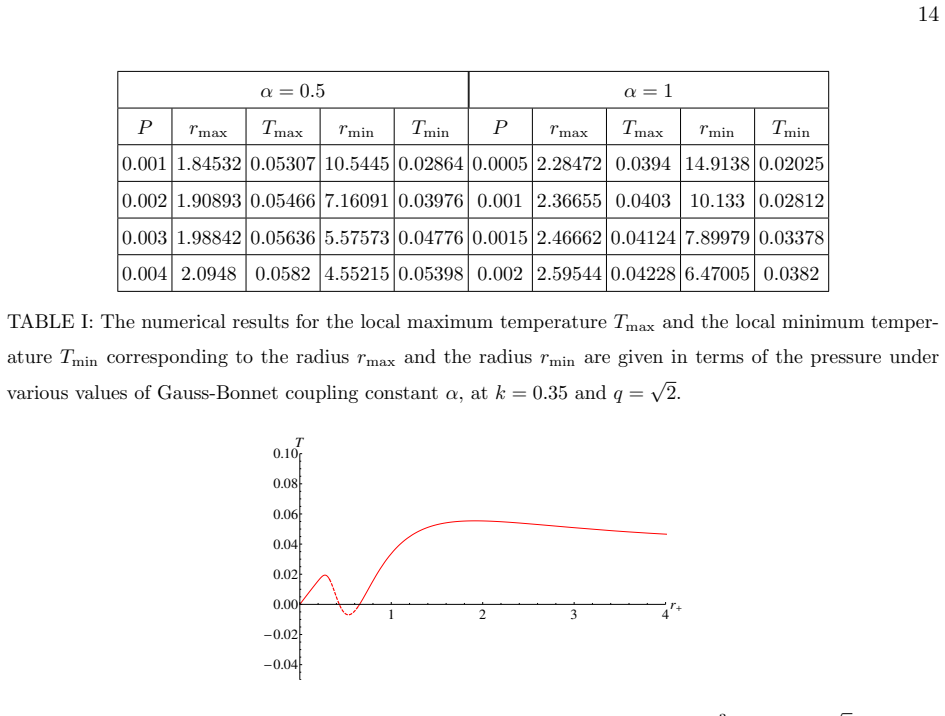
There is no the black hole solution in the dashed part. We give the numerical results of the equation F2(rex) = 0 in Table I. It is worthwhile to note that, in the case II, the curve of the black hole temperature has, for some range of parameters, two allowed regions separated by a forbidden region, in which there is no corresponding black hole solution, ...
2000
-
[5]
(72) Finally, we find the critical exponentδ by computing|P−Pc| ⏐⏐⏐ Tc
(71) In order to compute the critical exponent γ, let us calculate the isothermal compressibility κT =− 1 V ∂V ∂P ⏐⏐⏐ T = 4 Pc(1 +ω) (∂p ∂ϵ ⏐⏐⏐ t )−1 ∝ 1 Bt⇒ γ = 1. (72) Finally, we find the critical exponentδ by computing|P−Pc| ⏐⏐⏐ Tc . The critical isotherm corresponds to T =Tc or t = 0, hence we have P ⏐⏐⏐ Tc =Pc(1−Cϵ3). (73) As a result, the critical e...
2017
-
[6]
Hut, Mon
P. Hut, Mon. Not. R. Astr. Soc. 180, 379 (1977)
1977
-
[7]
J. D. Bekenstein, Phys. Rev. D 7, 949 (1973)
1973
-
[8]
J. D. Bekenstein, Phys. Rev. D 9, 3292 (1974). 26
1974
Show all 156 references
-
[9]
J. M. Bardeen, B. Carter, and S. W. Hawking, Commun. Math. Phys 31, 161 (1973)
1973
-
[10]
S. W. Hawking, Commun. Math. Phys 43, 199 (1975)
1975
-
[11]
J. M. Maldacena, Adv. Theor. Math. Phys. 2, 231 (1998)
1998
-
[12]
In this limit, the exponential term in the Eq
(61) Another interesting limit is the limit of strong nonlinear coupling,k≫ 1, which shows the effect of the nonlinear electrodynamics most clearly. In this limit, the exponential term in the Eq. (57) is dominant and the critical radius becomes rc≃ 2 √ 3α. In this situation, th...
-
[13]
P. C. W. Davies, Rep. Prog. Phys. 41, 1313 (1978)
1978
-
[14]
L. M. Sokolowski and P. Mazur, J. Phys. A: Math. Gen. 13, 1113 (1980)
1980
-
[15]
Pav´ on, Phys
D. Pav´ on, Phys. Rev. D43, 2495 (1991)
1991
-
[16]
S. W. Hawking and D. N. Page, Commun. Math. Phys. 87, 577 (1983)
1983
-
[17]
Witten, Adv
E. Witten, Adv. Theor. Math. Phys. 2, 253 (1998)
1998
-
[18]
S. S. Gubser, I. R. Klebanov, and A. M. Polyakov, Phys. Lett. B 428, 105 (1998)
1998
-
[19]
Aharony, S
O. Aharony, S. S. Gubser, J. M. Maldacena, H. Ooguri and Y. Oz, Phys. Rept. 323, 183 (2000)
2000
-
[20]
Chamblin, R
A. Chamblin, R. Emparan, C. Johnson, and R. Myers, Phys. Rev. D 60, 064018 (1999)
1999
-
[21]
Chamblin, R
A. Chamblin, R. Emparan, C. Johnson, and R. Myers, Phys. Rev. D 60, 104026 (1999)
1999
-
[22]
Wang, S.-Q
S. Wang, S.-Q. Wu, F. Xie, and L. Dan, Chin. Phys. Lett. 23, 1096 (2006)
2006
-
[23]
Kastor, S
D. Kastor, S. Ray, and J. Traschena, Class. Quant. Grav. 26, 195011 (2009)
2009
-
[24]
Kastor, S
D. Kastor, S. Ray, and J. Traschen, Class. Quant. Grav. 27, 235014 (2010)
2010
-
[25]
B. P. Dolan, Class. Quant. Grav. 28, 125020 (2011)
2011
-
[26]
B. P. Dolan, Class. Quant. Grav. 28, 235017 (2011)
2011
-
[27]
Kubizˇ n´ ak, R
D. Kubizˇ n´ ak, R. B. Mann, and M. Teo, Class. Quant. Grav.34, 063001 (2017)
2017
-
[28]
Kubizˇ n´ ak and R
D. Kubizˇ n´ ak and R. B. Mann, JHEP1207, 033 (2012)
2012
-
[29]
Gunasekaran, D
S. Gunasekaran, D. Kubizˇ n´ ak, and R. B. Mann, JHEP1211, 110 (2012)
2012
-
[30]
Belhaj, M
A. Belhaj, M. Chabab, H. El Moumni, and M. B. Sedra, Chin. Phys. Lett. 29, 100401 (2012)
2012
-
[32]
Cai, L.-M
R.-G. Cai, L.-M. Cao, L. Li, and R.-Q. Yang, JHEP 1309, 005 (2013)
2013
-
[33]
Mo and W-B
J.-X. Mo and W-B. Liu, Phys. Lett. B 727, 336 (2013)
2013
-
[34]
S. H. Hendi and M. H. Vahidinia, Phys. Rev. D 88, 084045 (2013)
2013
-
[35]
Mo and W.-B
J.-X. Mo and W.-B. Liu, Eur. Phys. J. C 74, 2836 (2014)
2014
-
[36]
Mo, G.-Q
J.-X. Mo, G.-Q. Li, and W.-B. Liu, Phys. Lett. B 730, 111 (2014)
2014
-
[37]
Li, Phys
G.-Q. Li, Phys. Lett. B 735, 256 (2014)
2014
-
[38]
Zhao, L.-C
H.-H. Zhao, L.-C. Zhang, M.-S. Ma, and R. Zhao, Phys. Rev. D 90, 064018 (2014)
2014
-
[39]
M. H. Dehghani, S. Kamrani, and A. Sheykhi, Phys. Rev. D 90, 104020 (2014)
2014
-
[40]
R. A. Hennigar, W. G. Brenna, and R. B. Mann, JHEP 1507, 077 (2015)
2015
-
[41]
S. H. Hendi, S. Panahiyan, and B. E. Panah, Int. J. Mod. Phys. D 25, 1650010 (2015)
2015
-
[42]
J. Xu, L. M. Cao, and Y. P. Hu, Phys. Rev. D 91, 124033 (2015)
2015
-
[43]
S. H. Hendi, R. M. Tad, Z. Armanfard, and M. S. Talezadeh, Eur. Phys. J. C 76, 263 (2016)
2016
-
[44]
Sadeghi, Int
J. Sadeghi, Int. J. Theor. Phys. 55, 2455 (2016)
2016
-
[45]
Liang, C.-B
J. Liang, C.-B. Sun, and H.-T. Feng, Europhys. Lett. 113, 30008 (2016). 27
2016
-
[46]
Fernando, Phys
S. Fernando, Phys. Rev. D 94, 124049 (2016)
2016
-
[47]
Fan, Eur
Z.-Y. Fan, Eur. Phys. J. C 77, 266 (2016)
2016
-
[48]
Sadeghi, B
J. Sadeghi, B. Pourhassan, and M. Rostami, Phys. Rev. D 94, 064006 (2016)
2016
-
[49]
Hansen, D
D. Hansen, D. Kubiznak, and R. B. Mann, JHEP 1701, 047 (2017)
2017
-
[50]
B. R. Majhi and S. Samanta, Phys. Lett. B 773, 203(2017)
2017
-
[51]
Hendi, B
S .H. Hendi, B. E. Panah, S. Panahiyan, and M. S. Talezadeh, Eur. Phys. J. C 77, 133 (2017)
2017
-
[52]
Upadhyay, B
S. Upadhyay, B. Pourhassan, and H. Farahani, Phys. Rev. D 95, 106014 (2017)
2017
-
[53]
Dayyani, A
Z. Dayyani, A. Sheykhi, M. H. Dehghani, and S. Hajkhalili, Eur. Phys. J. C 78, 152 (2018)
2018
-
[54]
C. H. Nam, Eur. Phys. J. C 78, 581 (2018)
2018
-
[55]
Pradhan, Mod
P. Pradhan, Mod. Phys. Lett. A 32, 1850030 (2018)
2018
-
[56]
C. H. Nam, Eur. Phys. J. C 78, 1016 (2018)
2018
-
[57]
Altamirano, D
N. Altamirano, D. Kubizˇ n´ ak, and R. B. Mann, Phys. Rev. D88, 101502 (2013)
2013
-
[58]
A. M. Frassino, D. Kubizˇ n´ ak, R. B. Mann, and F. Simovic, JHEP1409, 080 (2014)
2014
-
[59]
R. A. Henninger and R. B. Mann, Entropy 17, 8056 (2015)
2015
-
[60]
C. V. Johnson, Class. Quant. Grav. 31, 205002 (2014)
2014
-
[61]
Belhaj, M
A. Belhaj, M. Chabab, H. E. Moumni, K. Masmar, M. B. Sedra, and A. Segui, JHEP 1505, 149 (2015)
2015
-
[62]
M. R. Setare and H. Adami, Gen. Rel. Grav. 47, 133 (2015)
2015
-
[63]
C. V. Johnson, Class. Quant. Grav. 33, 135001 (2016)
2016
-
[64]
C. V. Johnson, Class. Quant. Grav. 33, 215009 (2016)
2016
-
[65]
Zhang and W.-B
M. Zhang and W.-B. Liu, Int. J. Theor. Phys. 55, 5136 (2016)
2016
-
[66]
Bhamidipati and P
C. Bhamidipati and P. K. Yerra, Eur. Phys. J. C 77, 534 (2017)
2017
-
[67]
Hennigar, F
R.A. Hennigar, F. McCarthy, A. Ballon, and R.B. Mann, Class. Quant. Grav. 34, 175005 (2017)
2017
-
[68]
J.-X. Mo, F. Liang, and G.-Q. Li, JHEP 2017, 10 (2017)
2017
-
[69]
S. H. Hendi, B. E. Panah, S. Panahiyan, H. Liu, and X.-H. Meng, Phys. Lett. B 781, 40 (2018)
2018
-
[70]
C. H. Nam, arXiv: 1906.05557
1906 arXiv
-
[71]
¨Okc¨ u and E
¨O. ¨Okc¨ u and E. Aydner, Eur. Phys. J. C77, 24 (2017)
2017
-
[72]
¨Okc¨ u and E
¨O. ¨Okc¨ u and E. Aydner, Eur. Phys. J. C78, 123 (2018)
2018
-
[73]
Mo, G.-Q
J.-X. Mo, G.-Q. Li, S.-Q. Lan, and X.-B. Xu, Phys. Rev. D 98 , 124032 (2018)
2018
-
[74]
Chabab, H
M. Chabab, H. E. Moumni, S. Iraoui, K. Masmar, and S. Zhizeh, LHEP 02, 05 (2018)
2018
- [75]
-
[76]
Lan, Phys
S.-Q. Lan, Phys. Rev. D 98, 084014 (2018)
2018
-
[77]
Lovelock, J
D. Lovelock, J. Math. Phys. 12, 498 (1971)
1971
-
[78]
Zwiebach, Phys
B. Zwiebach, Phys. Lett. B 156, 315 (1985)
1985
-
[79]
D. J. Gross and E. Witten, Nucl. Phys. B 277, 1 (1986)
1986
-
[80]
D. J. Gross and J. H Sloan, Nucl. Phys. B 291, 41 (1987)
1987
-
[81]
R. R. Metsaev and A. A. Tseytlin, Phys. Lett. B 185, 52 (1987); 191, 354 (1987); Nucl. Phys. B 293, 28 385 (1987)
1987
-
[82]
M. C. Bento and O. Bertolami, Phys. Lett. B 368, 198 (1996)
1996
-
[83]
Zumino, Phys
B. Zumino, Phys. Rept. 137, 109 (1986)
1986
-
[84]
R. C. Myers, Nucl. Phys. B 289, 701 (1987)
1987
-
[85]
C. G. Callan, R.C. Myers, and M.J. Perry, Nucl. Phys. B 311, 673 (1989)
1989
-
[86]
Y. M. Cho, I. P. Neupane, and P. S. Wesson, Nucl. Phys. B 621, 388 (2002)
2002
-
[87]
D. G. Boulware and S. Deser, Phys. Rev. Lett. 55, 2656 (1985)
1985
-
[88]
Wiltshire, Phys
D. Wiltshire, Phys. Rev. D 38, 2445 (1988)
1988
-
[89]
Cai, Phys
R.-G. Cai, Phys. Rev. D 65, 084014 (2002)
2002
-
[90]
Cai and Q
R.-G. Cai and Q. Guo, Phys. Rev. D 69, 104025 (2004)
2004
-
[91]
Barrau, J
A. Barrau, J. Grain, and S. O. Alexeyev, Phys. Lett. B 584, 114 (2004)
2004
-
[92]
Dotti, J
G. Dotti, J. Oliva, and R. Troncoso, Phys. Rev. D 76, 064038 (2007)
2007
-
[93]
Charmousis, Lect
C. Charmousis, Lect. Notes Phys. 769, 299 (2009)
2009
-
[94]
S. H. Hendi and B. E. Panah, Phys. Lett. B 684, 77 (2010)
2010
-
[95]
Cai, L.-M
R.-G. Cai, L.-M. Cao, L. Li, and R.-Q. Yang, JHEP 09, 005 (2013)
2013
-
[96]
S. H. Hendi, S. Panahiyan, and E. Mahmoudi, Eur. Phys. J. C 74, 3079 (2014)
2014
-
[97]
Maselli, P
A. Maselli, P. Pani, L. Gualtieri, and V. Ferrari, Phys. Rev. D 92, 083014 (2015)
2015
-
[98]
S. H. Hendi, S. Panahiyan, and B. E. Panah, JHEP 01, 129 (2016)
2016
-
[99]
S. W. Hawking and G. F. R. Ellis, The large scale structure of spacetime , Cambridge University Press, Cambridge (1973)
1973
-
[100]
J. M. Bardeen, in: Conference Proceedings of GR5, Tbilisi, USSR, p. 174 (1968)
1968
-
[101]
Ay´ on-Beato and A
E. Ay´ on-Beato and A. Garc´ ıa, Phys. Lett. B493, 149 (2000)
2000
-
[102]
Ay´ on-Beato and A
E. Ay´ on-Beato and A. Garc´ ıa, Phys. Lett. B464, 25 (1999)
1999
-
[103]
Ay´ on-Beato and A
E. Ay´ on-Beato and A. Garc´ ıa, Gen. Rel. Grav.31, 629 (1999)
1999
-
[104]
K. A. Bronnikov, Phys. Rev. D 63, 044005 (2001)
2001
-
[105]
Ay´ on-Beato and A
E. Ay´ on-Beato and A. Garc´ ıa, Phys. Rev. Lett.80, 5056 (1998)
1998
-
[106]
Dymnikova, Class
I. Dymnikova, Class. Quant. Grav 21, 4417 (2004)
2004
-
[108]
Gan, J.-H
Q.-S. Gan, J.-H. Chen, and Y.-J Wang, Chin. Phys. B 25, 120401 (2016)
2016
-
[109]
Burinskii and S
A. Burinskii and S. R. Hildebrandt, Phys. Rev. D 65, 104017 (2002)
2002
-
[110]
Cataldo and A
M. Cataldo and A. Garcia, Phys. Rev. D 61, 084003 (2000)
2000
-
[111]
C. H. Nam, Gen. Rel. Grav. 50, 57 (2018)
2018
-
[112]
C. H. Nam, Eur. Phys. J. C 78, 418 (2018)
2018
-
[113]
Toshmatov, B
B. Toshmatov, B. Ahmedov, A. Abdujabbarov, and Z. Stuchlik, Phys. Rev. D 89, 104017 (2014)
2014
-
[114]
S. G. Ghosh and S. D. Maharaj, Eur. Phys. J. C 75, 7 (2015)
2015
-
[115]
Matyjasek, Phys
J. Matyjasek, Phys. Rev. D 70, 047504 (2004)
2004
-
[116]
S. G. Ghosh, D. V. Singh, and S. D. Maharaj, Phys. Rev. D 97, 104050 (2018). 29
2018
-
[117]
Kumar, D
A. Kumar, D. Veer Singh, and S. G. Ghosh, Eur. Phys. J. C 79, 275 (2019)
2019
-
[118]
Berej, J
W. Berej, J. Matyjasek, D. Tryniecki, and M. Woronowicz, Gen. Rel. Grav. 38, 885 (2006)
2006
-
[119]
Nojiri and S
S. Nojiri and S. D. Odintsov, Phys. Rev. D 96, 104008 (2017)
2017
-
[120]
E. L. B. Junior, M. E. Rodrigues, and M. J. S. Houndjo, JCAP 1510, 060 (2015)
2015
-
[121]
Salazar, A
H. Salazar, A. Garc´ ıa, and J. Pleba´ nski, J. Math. Phys.28, 2171 (1987)
1987
-
[122]
Miˇ skovi´ c and R
O. Miˇ skovi´ c and R. Olea, Phys. Rev. D83, 024011 (2011)
2011
-
[123]
Dymnikova, Gen
I. Dymnikova, Gen. Rel. Grav. 24, 235 (1992)
1992
-
[124]
Dymnikova, Int
I. Dymnikova, Int. J. Mod. Phys. D 12, 1015 (2003)
2003
-
[125]
Dymnikova1 and A
I. Dymnikova1 and A. Poszwa, Class. Quant. Grav. 36, 105002 (2019)
2019
-
[126]
H. A. Gonzalez and M. Hassaine, Phys. Rev. D 80, 104008 (2009)
2009
-
[127]
M. K. Zangeneh, A. Sheykhi, and M. H. Dehghani, Phys. Rev. D 92, 024050 (2015)
2015
-
[128]
Dehghani and S
M. Dehghani and S. F. Hamidi, Phys. Rev. D 96, 044025 (2017)
2017
-
[129]
Rinc´ on, B
´A. Rinc´ on, B. Koch, P. Bargue˜ no, G. Panotopoulos, and A. H. Arboleda, Eur. Phys. J. C 77, 494 (2017)
2017
-
[130]
S. H. Hendi and M. Faizal, Phys. Rev. D 92, 044027 (2015)
2015
-
[131]
S. H. Hendi, S. Panahiyan, B. E. Panah, M. Faizal, and M. Momennia, Phys. Rev. D 94, 024028 (2016)
2016
-
[132]
S. H. Hendi, Phys. Lett. B 677, 123 (2009)
2009
-
[133]
S. H. Hendi, B. Eslam Panah, S. Panahiyan, Fortschr. Phys. 66, 1800005 (2018)
2018
-
[134]
S. H. Hendi, S. Panahiyan, and M. Momennia, Int. J. Mod. Phys. D 25, 1650063 (2016)
2016
-
[135]
S. H. Hendi and A. Dehghani, Phys. Rev. D 91, 064045 (2015)
2015
-
[136]
Ghanaatian, F
M. Ghanaatian, F. Naeimipour, A. Bazrafshan, M. Eftekharian, and A. Ahmadi, Phys. Rev. D 99, 024006 (2019)
2019
-
[137]
Farhangkhah, Phys
N. Farhangkhah, Phys. Rev. D 97, 084031 (2018)
2018
-
[138]
Bueno and P
P. Bueno and P. A. Cano, Phys. Rev. D D 94, 124051 (2016)
2016
-
[139]
G. J. Olmo and D. Rubiera-Garcia, Phys. Rev. D 84, 124059 (2011)
2011
-
[140]
Sheykhi, Phys
A. Sheykhi, Phys. Rev. D 86, 024013 (2012)
2012
-
[141]
Toshmatov, Zdenˇ ek Stuchl´ ık, and B
B. Toshmatov, Zdenˇ ek Stuchl´ ık, and B. Ahmedov, Phys. Rev. D98, 028501 (2018)
2018
-
[142]
Fan and X
Z.-Y. Fan and X. Wang, Phys. Rev. D 94, 124027 (2016)
2016
-
[143]
M. E. Rodrigues and E. L. B. Junior, Phys. Rev. D 96, 128502 (2017)
2017
-
[144]
Toshmatov, Zdenˇ ek Stuchl´ ık, and B
B. Toshmatov, Zdenˇ ek Stuchl´ ık, and B. Ahmedov, Phys. Rev. D95, 084037 (2017)
2017
-
[145]
Toshmatov, Zdenˇ ek Stuchl´ ık, B
B. Toshmatov, Zdenˇ ek Stuchl´ ık, B. Ahmedov, and D. Malafarina, Phys. Rev. D99, 064043 (2019)
2019
-
[146]
G. W. Gibbons and S. W. Hawking, Phys. Rev. D 15, 2738 (1977)
1977
-
[147]
G. W. Gibbons and S. W. Hawking, Phys. Rev. D 15, 2752 (1977)
1977
-
[148]
Novello, V
M. Novello, V. A. De Lorenci, J. M. Salim, and R. Klippert, Phys. Rev. D 61, 045001 (2000)
2000
-
[149]
Novello, J
M. Novello, J. M. Salim, V. A. De Lorenci, and E. Elbaz, Phys. Rev. D 63, 103516 (2001)
2001
-
[150]
Y. N. Obukhov and G. F. Rubilar, Phys. Rev. D 66, 024042 (2002). 30
2002
-
[151]
´E. G. de O. Costa and S. E. P. Bergliaffa, Class. Quant. Grav. 26, 135015 (2009)
2009
-
[152]
Stuchl´ ık and J
Z. Stuchl´ ık and J. Schee, Int. J. Mod. Phys. D 24, 1550020 (2015)
2015
-
[153]
Schee and Z
J. Schee and Z. Stuchl´ ık, J. Cosmol. Astropart. Phys. 06, 048 (2015)
2015
-
[154]
Schee and Z
J. Schee and Z. Stuchl´ ık, Class. Quant. Grav. 33, 085004 (2016)
2016
-
[155]
Toshmatov, Z
B. Toshmatov, Z. Stuchl´ ık, B. Ahmedov, and D. Malafarina, Phys. Rev. D 99, 064043 (2019)
2019
-
[156]
Stuchl´ ık and J
Z. Stuchl´ ık and J. Schee, Eur. Phys. J. C 79, 44 (2019)
2019
-
[157]
Schee and Z
J. Schee and Z. Stuchl´ ık, Astrophys. J. 874, 12 (2019)
2019
-
[158]
Shutz, A First Course in General Relativity , Cambridge University Press, New York (2009)
B. Shutz, A First Course in General Relativity , Cambridge University Press, New York (2009)
2009
Reviewed August 14, 2026 · model on record in the stance chip above.
Discussion (0). Continue with ORCID to comment.