REVIEW 3 major objections 4 minor 37 references
Deep Meta Functionals for Shape Representation
T0 review · 3 major / 4 minor · reviewed 2026-08-14 · deepseek-v4-flash
Pith's one-line read This paper reports that a hypernetwork which maps a single image to the weights of a point-classifying MLP reconstructs 3D shapes more accurately than voxel-, silhouette-, and mesh-based baselines, while providing unlimited output…
desk verdict The paper's core idea—turning an image directly into the weights of a per-shape occupancy MLP—is genuinely novel and well tested, but its headline accuracy claim rests on borrowed baseline numbers and its smooth-manifold guarantee is overstated. read the letter →
The pith
A machine-rendered reading of the paper's core claim, the machinery that carries it, and where it could break.
The reading
What carries the argument
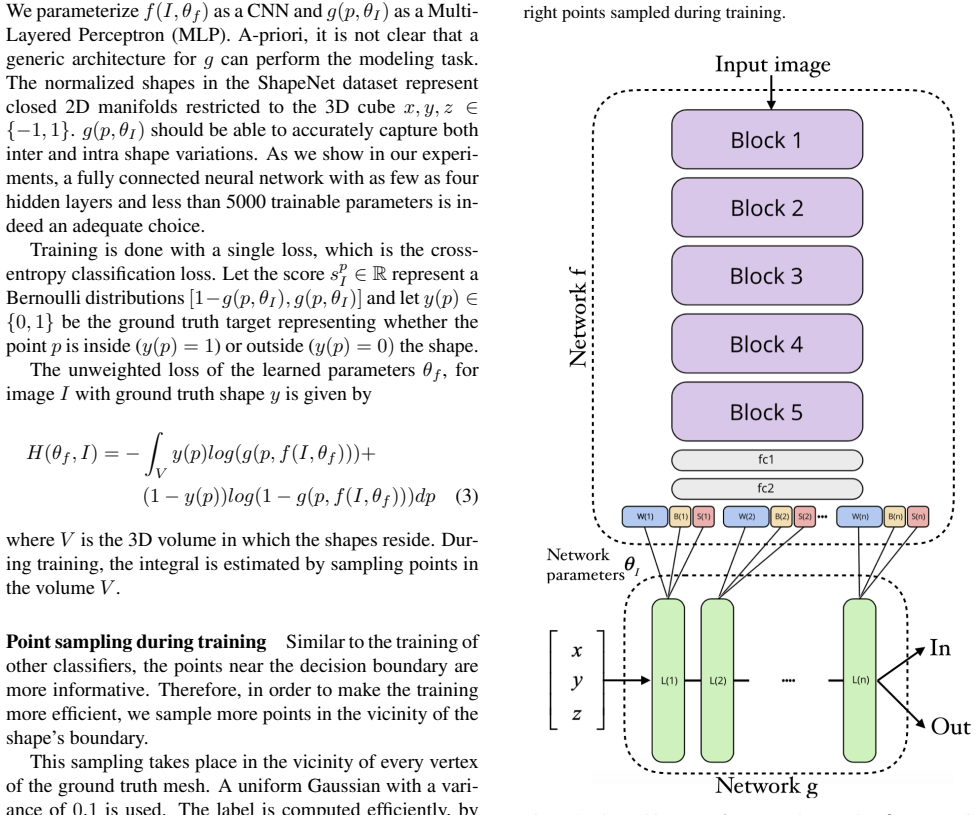
The machinery is a hypernetwork $f$ that outputs all parameters of a per-shape occupancy network $g$, including per-layer scale vectors $\theta_s^{(n)}$ that multiply the pre-activation output of each layer. Because $g$ is an ELU-activated MLP, it is differentiable, and the paper invokes the implicit function theorem to claim the $0.5$ level set is a smooth manifold. The capacity argument transplants the linear-regions bound for ReLU networks (see [30]) to $g$: for the tested architectures the number of linear regions lies between $10^4$ and $8.6\times10^{19}$, which is the concrete sense in which the shape representation has high capacity — the field can be sampled at any density and polygonized with marching cubes [27].
What would settle it
Take the released model, scan the $0.5$ level set of $g$ for points where the gradient with respect to $p$ vanishes or where the field is locally constant across the threshold, and count how often this occurs over the ShapeNet test set. If degenerate points appear in a nontrivial fraction of shapes, the smooth-manifold guarantee is false as stated, even if the IoU numbers still stand.
Extended reading notes
Core claim
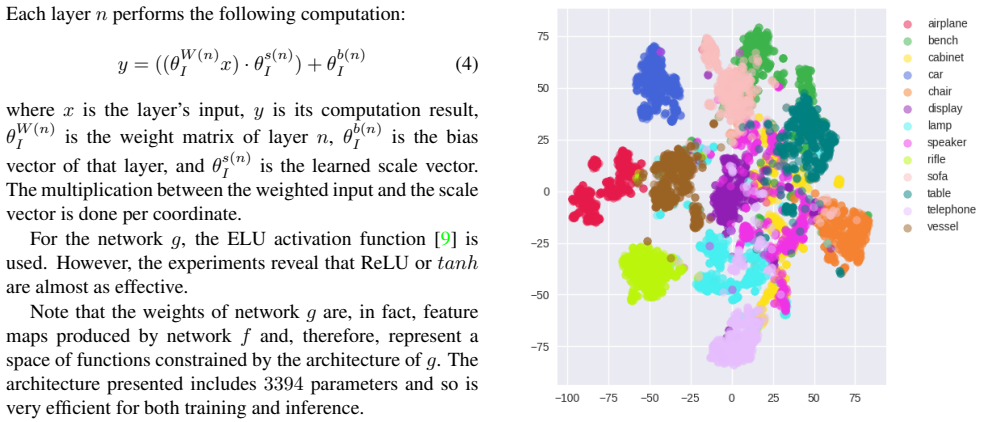
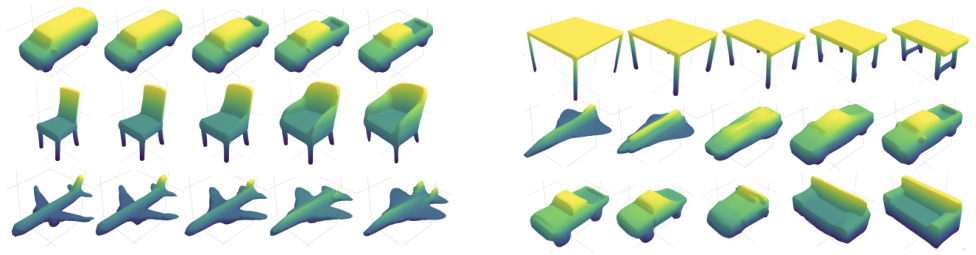
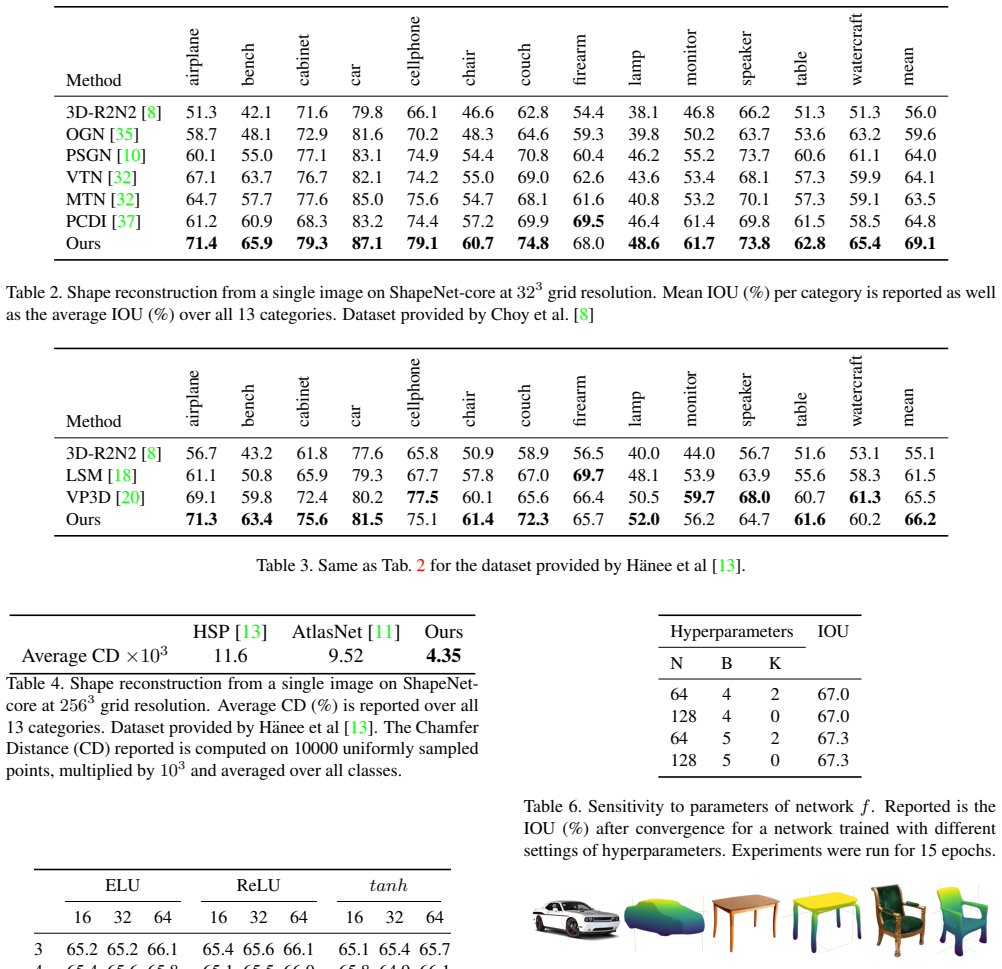
The paper's central claim is that a shape can be represented as the decision boundary of a classifier whose weights are generated on the fly from an image. Concretely, $f(I,\theta_f)=\theta_I$ and $s_p^I=g(p,\theta_I)$, where $g$ is a four-hidden-layer MLP with about 3394 parameters and $f$ is a ResNet-style CNN with multiple linear heads, one per layer of $g$. Training uses a single cross-entropy loss evaluated on sampled points, with extra Gaussian samples near ground-truth mesh vertices to concentrate effort near the boundary. The reported results are mean IoU 69.1 versus 64.8 for the best prior method at $32^3$ resolution, 66.2 versus 65.5 at $256^3$ resolution, and average Chamfer distance $4.35\times10^{-3}$ versus $9.52\times10^{-3}$ for AtlasNet on the same protocol. The paper also shows that averaging the embedding over multiple test views improves accuracy, and that linearly interpolating embeddings produces smooth cross-class shape blends.
Load-bearing premise
The load-bearing premise is that $0.5$ is a regular value of the trained point classifier, which the paper asserts from differentiability but never verifies; if the field flattens at the threshold, the extracted surface need not be a smooth manifold.
Editorial extensions
If this is right
- A single model trained without class labels beats prior baselines on 12 of 13 categories at $32^3$ resolution and on 8 of 13 at $256^3$, so the representation itself, not a class prior, drives the accuracy.
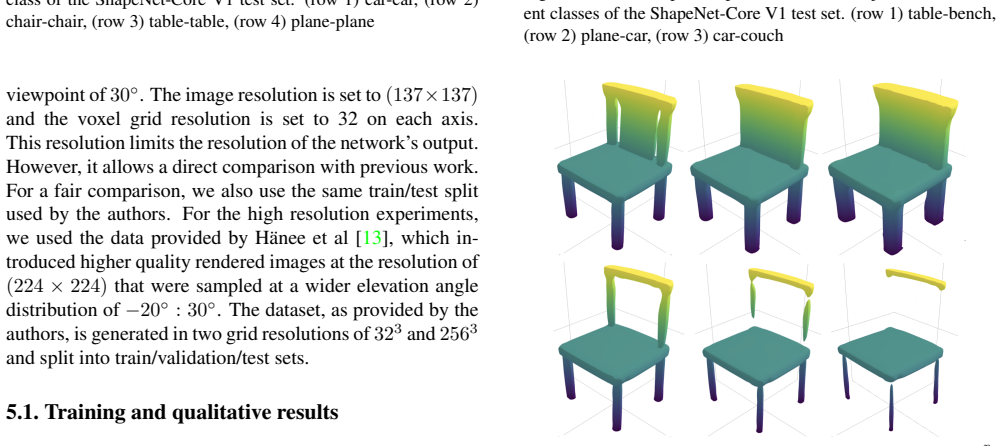
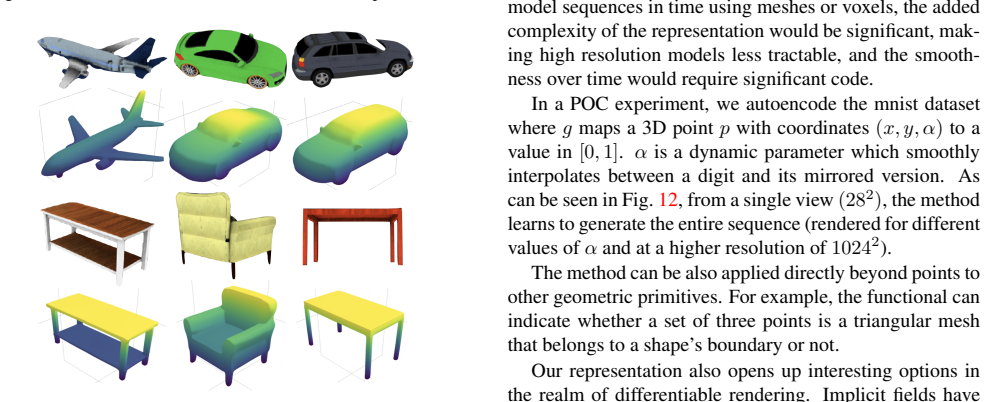
- Because the output is a continuous scalar field, the same trained network can be rendered at any grid density; the paper renders at $128^3$ for display, but the field can be sampled at finer or coarser resolution at test time.
- Boundary-focused sampling improves mean IoU from 63.5 to 65.8 over uniform sampling, confirming that the differentiable field benefits from gradient information concentrated near the surface.
- Averaging the embedding over multiple views at test time improves IoU monotonically and outperforms the multi-view-trained 3D-R2N2 baseline without any retraining for the multi-view setting.
- The representation extends to dynamic shapes by adding a time coordinate to $g$'s input, with a proof-of-concept showing a single digit image generating an entire temporal sequence.
Reading between the lines
- Beyond the paper, the smooth-manifold guarantee should be read as conditional: it holds only where $0.5$ is a regular value, and the paper never checks that, so a more cautious claim is that the surface is a manifold except at degenerate threshold points.
- One testable extension, not in the paper, is to count distinct connected components or handle holes in the predicted surface across ShapeNet classes; if the topology is genuinely arbitrary, the method should reconstruct objects with holes (e.g., mugs, stools) without template restrictions.
- Another extension is to compare weight-prediction against embedding-conditioned implicit decoders (e.g., DeepSDF or Occupancy Networks) with matched decoder sizes and training budgets; the paper argues weight prediction is more parameter-efficient, but does not run that controlled comparison.
- A practical check of the resolution claim: train on low-resolution voxel supervision, then render at $512^3$ and measure whether IoU against a high-resolution ground truth stays flat; if it degrades, the 'unlimited resolution' claim is bounded by what the hypernetwork learns.
Editorial analysis
A structured set of objections, weighed in public.
Referee Report
Summary. The paper introduces a hypernetwork-based representation for single-view 3D reconstruction. A convolutional network f maps an input image to the weights of a small MLP g; the reconstructed shape is the 0.5 level set of g, so each shape is represented by a per-instance implicit classifier. Training uses a single cross-entropy loss with importance sampling near the ground-truth mesh surface, and rendering is performed by evaluating g on a grid followed by marching cubes. Experiments on ShapeNet-core compare the method with voxel-, point-cloud-, and mesh-based baselines at 32^3 and 256^3 resolutions, reporting improvements in mean IoU in most categories, a large improvement in Chamfer distance over two baselines, ablations over the architectures of f and g, a comparison of boundary sampling with uniform sampling, multi-view embedding averaging, and qualitative results including linear interpolations between shape embeddings.
Significance. If the empirical claims hold, this is a conceptually clean and influential idea: rather than conditioning a fixed implicit decoder on a latent code, the image directly produces the decoder weights, yielding a per-shape network with effectively unlimited output resolution and no template-topology restriction. The paper explicitly ships code, provides a substantial set of ablations (activation, width, depth, encoder size, sampling scheme), and demonstrates attractive qualitative properties such as multi-view fusion and smooth interpolation. The central limitation is that the main quantitative conclusion is built on comparisons with baseline numbers taken from prior papers without a shared evaluation harness or variance estimates, and the most closely related concurrent implicit-function baselines are discussed but not evaluated. The theoretical smoothness claim also depends on an unverified regularity condition. These issues are fixable within the scope of the paper, so the work is potentially publishable after a major revision that re-grounds the empirical comparison and sharpens the theoretical statements.
major comments (3)
- [Section 5.2, Tables 2 and 3] The central superiority claim is supported only by point estimates taken from prior publications for the baselines, with no reported per-seed variance and no unified evaluation harness. In Table 3 the mean-IoU lead over VP3D is 66.2 versus 65.5, which is smaller than typical seed-to-seed variation for this type of reconstruction, so the claimed margin may not survive re-running the baselines with identical preprocessing and an identical IoU script. Please re-evaluate the baselines under the same protocol, report multiple seeds, and provide error bars or confidence intervals for all quantitative comparisons.
- [Section 2 and Tables 2-4] The paper discusses Occupancy Networks [29], DeepSDF [31], and IM-Net [7] as concurrent implicit-function methods, and Section 2 criticizes their training cost and generalization, but none of these methods appears in the quantitative tables even though [29] reports multi-class ShapeNet results. Because the abstract claims superiority over existing methods, the quantitative comparison must include at least one of these directly related baselines under the same split and evaluation protocol; otherwise the reader cannot distinguish representation gains from dataset or evaluation differences.
- [Section 4] The smooth-manifold guarantee invoked from the implicit function theorem requires 0.5 to be a regular value of the trained network g; this condition is assumed but never checked, and a trained classifier can have flat regions or degenerate critical points at the threshold. Please either verify regularity empirically (e.g., by computing the Jacobian norm on the extracted surface and checking that it does not vanish) or state the claim as conditional. In addition, the capacity argument uses an upper bound on the number of linear regions, not a lower bound on representable decision boundaries, so the phrase that the surface capacity is exponential in the network size overstates what the cited bound establishes.
minor comments (4)
- [Section 3, Eq. (4)] The indexing of the generated parameters, e.g., θW(n)_I, θs(n)_I, and θb(n)_I, is hard to parse; please define the exact shapes of all tensors and make the layer indexing consistent throughout.
- [Section 5.1 and Section 5.6] There are several typos: 'H¨anee et al' should be 'H¨ane et al', 'Ths obtained norm' should be 'The obtained norm', and Reference [4] is duplicated with an inconsistent author spelling.
- [Section 3, Architecture] The text states that the default g has 3394 parameters, but the configuration is described as four hidden layers of 32 units; please show the parameter count computation or specify which layer types (weights, bias, scale) are included, as the count is not obvious from the description.
- [Section 6, Differentiable rendering proof of concept] The silhouette-based proof-of-concept reports IoU 64.4 versus 60.0 for [20] but immediately notes that the three views are different; this comparison should either be removed or clearly labeled as non-comparable, since it currently reads as a quantitative advantage.
Circularity Check
No significant circularity: the empirical claim is an independent benchmark comparison and the theoretical statements are quoted standard results, not definitions of the reported outcomes.
full rationale
The paper's central claim is empirical: a hypernetwork that predicts the weights of a per-shape occupancy MLP outperforms prior voxel-, silhouette-, and mesh-based methods on ShapeNet single-view reconstruction. This claim is supported by quantitative comparisons in Tables 2-4 against externally published baselines on standard train/test splits (Choy et al. and Hane et al. datasets). No equation in the paper is fitted to those reported IoU or Chamfer numbers, and the reported method is trained with a standard cross-entropy loss (Eq. 3) against ground-truth occupancy. The capacity statement is quoted from Montufar et al. and is not used to define the accuracy results. The smooth-manifold claim in Section 4 relies on the implicit function theorem, conditional on the unverified regular-value assumption; this is a correctness gap, not a circular reduction. The only self-citation (Ref. 23, a dynamic convolutional layer) is historical background for hypernetworks and does not carry any load-bearing argument. Therefore no prediction or first-principles result reduces by construction to its own inputs.
Assumptions & free parameters
free parameters (4)
- g hidden layers L and width =
L=4, 32 hidden units (default)
- boundary sampling variance =
0.1
- weight of uniform samples =
10%
- image encoder architecture =
N=64, B=5, K=2
assumptions (4)
- domain assumption Level set at threshold 0.5 is a regular value for the trained classifier
- domain assumption Ground-truth occupancy labels computed from 32^3 voxel grids are accurate enough to supervise the continuous field
- domain assumption Montufar et al. bound on linear regions is a valid proxy for shape-representation capacity
- domain assumption ShapeNet meshes are closed, watertight manifolds
Cite this review
Pith. "Pith review of Deep Meta Functionals for Shape Representation." pith.science (2026). https://pith.science/paper/WJ7DFWTZ
@misc{pith2026190806277,
  author       = {Pith},
  title        = {Pith review of: Deep Meta Functionals for Shape Representation},
  year         = {2026},
  howpublished = {\url{https://pith.science/paper/WJ7DFWTZ}},
  note         = {Machine review of arXiv:1908.06277}
}
read the original abstract
We present a new method for 3D shape reconstruction from a single image, in which a deep neural network directly maps an image to a vector of network weights. The network \textcolor{black}{parametrized by} these weights represents a 3D shape by classifying every point in the volume as either within or outside the shape. The new representation has virtually unlimited capacity and resolution, and can have an arbitrary topology. Our experiments show that it leads to more accurate shape inference from a 2D projection than the existing methods, including voxel-, silhouette-, and mesh-based methods. The code is available at: https://github.com/gidilittwin/Deep-Meta
Figures

Figures from the paper (6 more)


Reference graph
Works this paper leans on
-
[29]
Occupancy networks: Learning 3d reconstruction in function space, 2018
Lars Mescheder, Michael Oechsle, Michael Niemeyer, Se- bastian Nowozin, and Andreas Geiger. Occupancy networks: Learning 3d reconstruction in function space, 2018. 2
work page 2018
-
[31]
Deepsdf: Learning con- tinuous signed distance functions for shape representation,
Jeong Joon Park, Peter Florence, Julian Straub, Richard Newcombe, and Steven Lovegrove. Deepsdf: Learning con- tinuous signed distance functions for shape representation,
-
[7]
Learning implicit fields for generative shape modeling, 2018
Zhiqin Chen and Hao Zhang. Learning implicit fields for generative shape modeling, 2018. 2
work page 2018
-
[1]
Learning feed-forward one-shot learners
Luca Bertinetto, Jo ˜ao F Henriques, Jack Valmadre, Philip Torr, and Andrea Vedaldi. Learning feed-forward one-shot learners. In Advances in Neural Information Processing Sys- tems, pages 523–531, 2016. 2
work page 2016
-
[2]
Polygonization of implicit surfaces
Jules Bloomenthal. Polygonization of implicit surfaces. Computer Aided Geometric Design , 5(4):341–355, 1988. 8
work page 1988
-
[3]
A geometric model for active contours in image pro- cessing
Vicent Caselles, Francine Catt ´e, Tomeu Coll, and Franc ¸oise Dibos. A geometric model for active contours in image pro- cessing. Numerische mathematik, 66(1):1–31, 1993. 2
work page 1993
-
[4]
A geometric model for active contours in image pro- cessing
Vicent Caselles, Francine Catt, Bartomeu Coll, and Franoise Dibos. A geometric model for active contours in image pro- cessing. Numerische Mathematik, 66:1–31, 01 1993. 8
work page 1993
-
[5]
Vicent Caselles, Ron Kimmel, and Guillermo Sapiro. Geodesic active contours. International journal of computer vision, 22(1):61–79, 1997. 2
work page 1997
Show all 37 references
-
[6]
Chang, Thomas Funkhouser, Leonidas Guibas, Pat Hanrahan, Qixing Huang, Zimo Li, Silvio Savarese, Mano- lis Savva, Shuran Song, Hao Su, Jianxiong Xiao, Li Yi, and Fisher Yu
Angel X. Chang, Thomas Funkhouser, Leonidas Guibas, Pat Hanrahan, Qixing Huang, Zimo Li, Silvio Savarese, Mano- lis Savva, Shuran Song, Hao Su, Jianxiong Xiao, Li Yi, and Fisher Yu. Shapenet: An information-rich 3d model reposi- tory, 2015. 1
2015
-
[8]
3d-r2n2: A unified approach for single and multi-view 3d object reconstruction
Christopher B Choy, Danfei Xu, JunYoung Gwak, Kevin Chen, and Silvio Savarese. 3d-r2n2: A unified approach for single and multi-view 3d object reconstruction. In European conference on computer vision , pages 628–644. Springer,
-
[9]
Fast and accurate deep network learning by exponential linear units (elus)
Djork-Arn ´e Clevert, Thomas Unterthiner, and Sepp Hochre- iter. Fast and accurate deep network learning by exponential linear units (elus). arXiv preprint arXiv:1511.07289 , 2015. 4
2015 arXiv
-
[10]
Haoqiang Fan, Hao Su, and Leonidas J. Guibas. A point set generation network for 3d object reconstruction from a single image. In The IEEE Conference on Computer Vision and Pattern Recognition (CVPR), July 2017. 1, 7
2017
-
[11]
Kim, Bryan C
Thibault Groueix, Matthew Fisher, Vladimir G. Kim, Bryan C. Russell, and Mathieu Aubry. A papier-mache ap- proach to learning 3d surface generation. 2018 IEEE/CVF Conference on Computer Vision and Pattern Recognition , Jun 2018. 2, 6, 7
2018
-
[12]
Hypernetworks
David Ha, Andrew Dai, and Quoc V Le. Hypernetworks. arXiv preprint arXiv:1609.09106, 2016. 2
2016 arXiv
-
[13]
Hi- erarchical surface prediction for 3d object reconstruction
Christian H ¨ane, Shubham Tulsiani, and Jitendra Malik. Hi- erarchical surface prediction for 3d object reconstruction. In 2017 International Conference on 3D Vision (3DV) , pages 412–420. IEEE, 2017. 1, 5, 6, 7
2017
-
[14]
Ray tracing algebraic surfaces
Pat Hanrahan. Ray tracing algebraic surfaces. In ACM SIGGRAPH Computer Graphics , volume 17, pages 83–90. ACM, 1983. 8
1983
-
[15]
Delving deep into rectifiers: Surpassing human-level perfor- mance on imagenet classification
Kaiming He, Xiangyu Zhang, Shaoqing Ren, and Jian Sun. Delving deep into rectifiers: Surpassing human-level perfor- mance on imagenet classification. InProceedings of the 2015 IEEE International Conference on Computer Vision (ICCV), ICCV ’15, pages 1026–1034, Washington, DC, USA...
2015
-
[16]
Dynamic filter networks
Xu Jia, Bert De Brabandere, Tinne Tuytelaars, and Luc V Gool. Dynamic filter networks. In Advances in Neural In- formation Processing Systems, pages 667–675, 2016. 2
2016
-
[17]
Gal: Geometric adversarial loss for single-view 3d-object recon- struction
Li Jiang, Shaoshuai Shi, Xiaojuan Qi, and Jiaya Jia. Gal: Geometric adversarial loss for single-view 3d-object recon- struction. In The European Conference on Computer Vision (ECCV), September 2018. 1
2018
-
[18]
Learning a multi-view stereo machine, 2017
Abhishek Kar, Christian Hne, and Jitendra Malik. Learning a multi-view stereo machine, 2017. 6, 7
2017
-
[19]
Snakes: Active contour models
Michael Kass, Andrew Witkin, and Demetri Terzopoulos. Snakes: Active contour models. International journal of computer vision, 1(4):321–331, 1988. 2
1988
-
[20]
Learning view pri- ors for single-view 3d reconstruction
Hiroharu Kato and Tatsuya Harada. Learning view pri- ors for single-view 3d reconstruction. arXiv preprint arXiv:1811.10719, 2018. 6, 7, 8
2018 arXiv
-
[21]
Neu- ral 3d mesh renderer
Hiroharu Kato, Yoshitaka Ushiku, and Tatsuya Harada. Neu- ral 3d mesh renderer. InProceedings of the IEEE Conference on Computer Vision and Pattern Recognition , pages 3907– 3916, 2018. 1
2018
-
[22]
Gradient flows and ge- ometric active contour models
Satyanad Kichenassamy, Arun Kumar, Peter Olver, Allen Tannenbaum, and Anthony Yezzi. Gradient flows and ge- ometric active contour models. In Proceedings of IEEE In- ternational Conference on Computer Vision, pages 810–815. IEEE, 1995. 2
1995
-
[23]
A dynamic convolutional layer for short range weather prediction
Benjamin Klein, Lior Wolf, and Yehuda Afek. A dynamic convolutional layer for short range weather prediction. In Proceedings of the IEEE Conference on Computer Vision and Pattern Recognition, pages 4840–4848, 2015. 2
2015
-
[24]
Kosinski
A.A. Kosinski. Differential Manifolds. Dover Book on Math- ematics. Dover Publications, 2007. 4
2007
-
[25]
Active contour based segmentation of 3d surfaces
Matthias Krueger, Patrice Delmas, and Georgy Gimelfarb. Active contour based segmentation of 3d surfaces. In Eu- ropean Conference on Computer Vision , pages 350–363. Springer, 2008. 2
2008
-
[26]
Soft rasterizer: Differentiable rendering for unsupervised single- view mesh reconstruction
Shichen Liu, Weikai Chen, Tianye Li, and Hao Li. Soft rasterizer: Differentiable rendering for unsupervised single- view mesh reconstruction. arXiv preprint arXiv:1901.05567,
1901 arXiv
-
[27]
Lorensen and Harvey E
William E. Lorensen and Harvey E. Cline. Marching cubes: A high resolution 3d surface construction algorithm. SIG- GRAPH Comput. Graph., 21(4):163–169, Aug. 1987. 4
1987
-
[28]
Evolu- tionary fronts for topology-independent shape modeling and recovery
Ravi Malladi, James A Sethian, and Baba C Vemuri. Evolu- tionary fronts for topology-independent shape modeling and recovery. In European conference on Computer vision, pages 1–13. Springer, 1994. 2
1994
-
[30]
On the number of linear regions of deep neural networks
Guido F Montufar, Razvan Pascanu, Kyunghyun Cho, and Yoshua Bengio. On the number of linear regions of deep neural networks. In Advances in neural information process- ing systems, pages 2924–2932, 2014. 4
2014
-
[32]
Matryoshka networks: Predicting 3d geometry via nested shape layers
Stephan R Richter and Stefan Roth. Matryoshka networks: Predicting 3d geometry via nested shape layers. In Proceed- ings of the IEEE Conference on Computer Vision and Pattern Recognition, pages 1936–1944, 2018. 1, 7
1936
-
[33]
Riegler, S
G. Riegler, S. Schulter, M. Rther, and H. Bischof. Condi- tioned regression models for non-blind single image super- resolution. In 2015 IEEE International Conference on Com- puter Vision (ICCV), pages 522–530, Dec 2015. 2
2015
-
[34]
Octnet: Learning deep 3d representations at high resolu- tions
Gernot Riegler, Ali Osman Ulusoy, and Andreas Geiger. Octnet: Learning deep 3d representations at high resolu- tions. 2017 IEEE Conference on Computer Vision and Pat- tern Recognition (CVPR), Jul 2017. 1
2017
-
[35]
Octree generating networks: Efficient convolutional archi- tectures for high-resolution 3d outputs
Maxim Tatarchenko, Alexey Dosovitskiy, and Thomas Brox. Octree generating networks: Efficient convolutional archi- tectures for high-resolution 3d outputs. InProceedings of the IEEE International Conference on Computer Vision , pages 2088–2096, 2017. 1, 7
2017
-
[36]
Pixel2mesh: Generating 3d mesh models from single rgb images
Nanyang Wang, Yinda Zhang, Zhuwen Li, Yanwei Fu, Wei Liu, and Yu-Gang Jiang. Pixel2mesh: Generating 3d mesh models from single rgb images. In Proceedings of the Euro- pean Conference on Computer Vision (ECCV), pages 52–67,
-
[37]
Inferring point clouds from single monocular images by depth intermedia- tion, 2018
Wei Zeng, Sezer Karaoglu, and Theo Gevers. Inferring point clouds from single monocular images by depth intermedia- tion, 2018. 5, 7
2018
Reviewed August 14, 2026 · model on record in the stance chip above.
Discussion (0). Continue with ORCID to comment.