Bar-induced migration of ω Centauri away from Gaia Sausage-Enceladus
Pith reviewed 2026-06-27 09:13 UTC · model grok-4.3
The pith
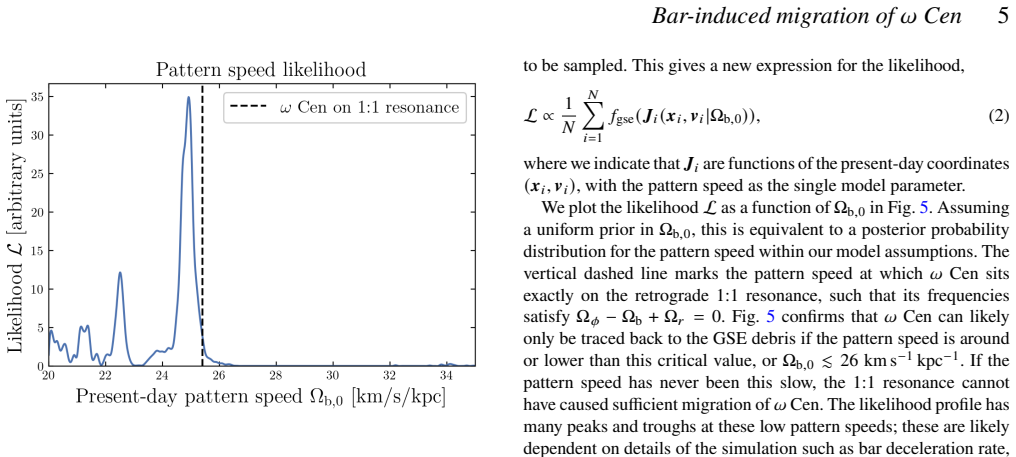
ω Centauri can be traced back to the Gaia Sausage-Enceladus debris through bar-induced migration, but only at a low bar pattern speed.
A machine-rendered reading of the paper's core claim, the machinery that carries it, and where it could break.
Core claim
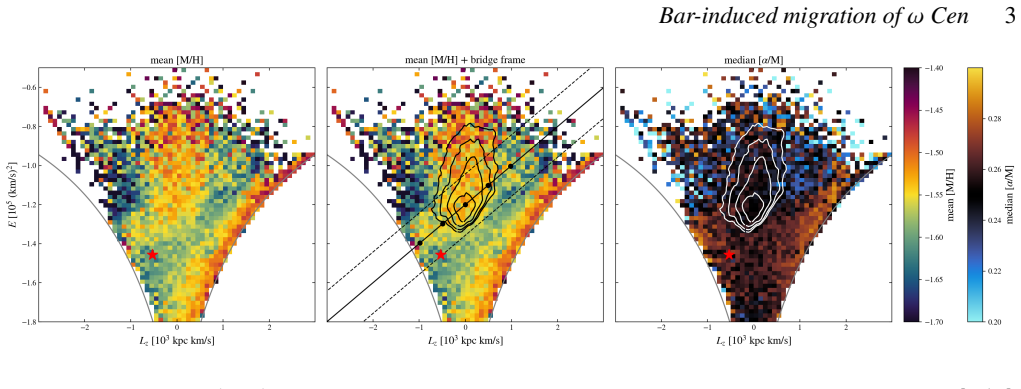
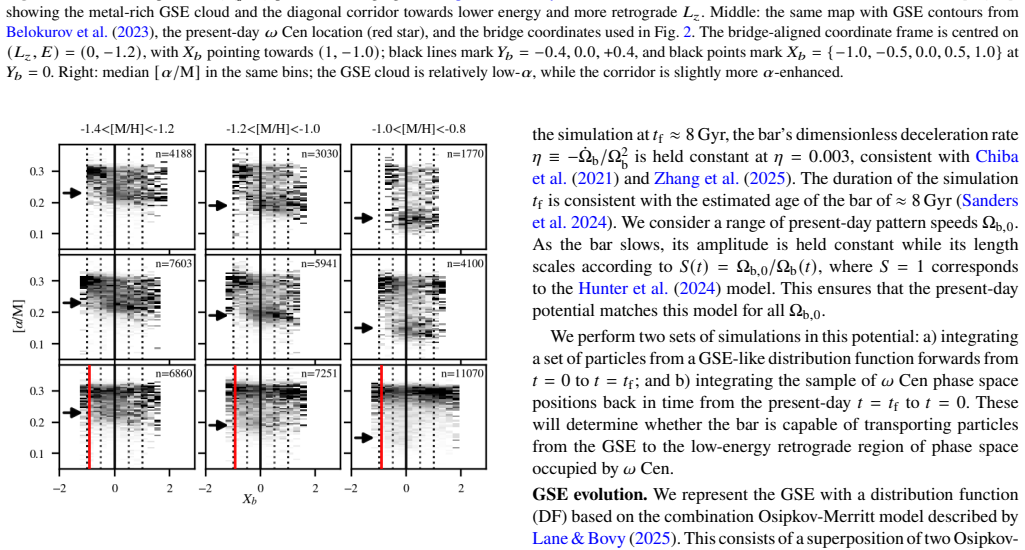
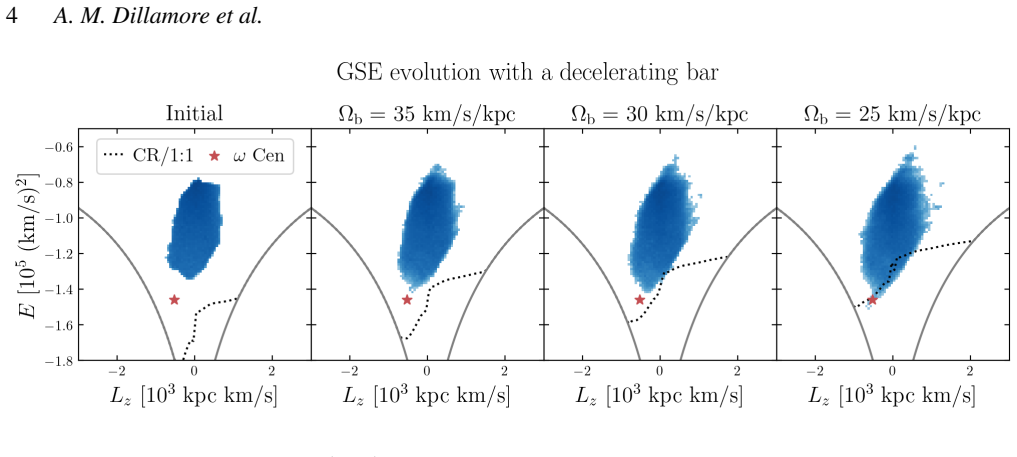
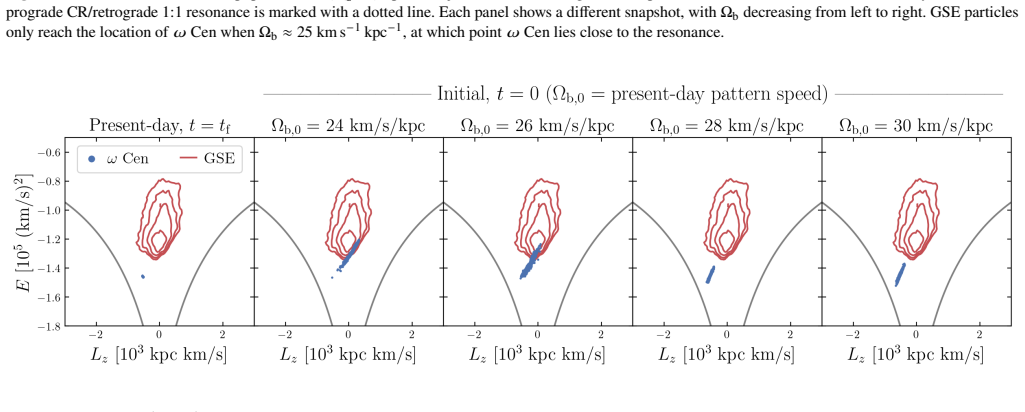
Simulations of the GSE debris and ω Cen inside a Milky Way potential containing a decelerating bar show that the cluster's orbit reaches the GSE phase-space region when the bar's present-day pattern speed is ≲26 km s^{-1} kpc^{-1}. The [α/M] abundance distributions of stars positioned between the GSE debris and ω Cen in (Lz, E) space are consistent with this migration pathway, although not conclusive. The authors therefore state that a GSE origin for ω Cen is both dynamically and chemically plausible provided the bar pattern speed is lower than most recent estimates.
What carries the argument
Perturbations from a decelerating Galactic bar that shift stellar orbits in (Lz, E) space, allowing ω Cen to migrate away from the GSE debris region.
If this is right
- A GSE origin for ω Cen becomes dynamically feasible when the bar rotates slowly enough.
- The current consensus value for the bar's pattern speed would require downward revision.
- The chemical abundance bridge between GSE debris and ω Cen is consistent with gradual migration.
- The same bar-driven mechanism could affect the present locations of other clusters once associated with the GSE event.
Where Pith is reading between the lines
- If the bar must be slow to explain ω Cen, then models of how the bar formed and slowed would need to incorporate earlier merger timing.
- More precise measurements of bar speed from gas kinematics or stellar streams could directly test whether the migration channel remains open.
- Similar orbital migration could reposition other globular clusters thought to have formed inside ancient mergers.
Load-bearing premise
The model assumes a specific Milky Way gravitational potential that includes a bar decelerating over time, with the present-day pattern speed treated as a free parameter.
What would settle it
A direct measurement of the bar pattern speed substantially above 26 km s^{-1} kpc^{-1} that cannot be reconciled with the required migration path in updated potentials.
Figures
read the original abstract
The globular cluster $\omega$ Cen has been suggested to have originated in the Gaia Sausage-Enceladus (GSE) merger event, possibly as its nuclear star cluster. However, the present-day orbits of $\omega$ Cen and the GSE debris are very different. We investigate the scenario in which $\omega$ Cen originated in the GSE and migrated to its current position due to perturbations from the Galactic bar. The [$\alpha$/M] distributions of stars located between the GSE debris and $\omega$ Cen in $(L_z,E)$ space tentatively support this scenario, but are not conclusive. We run simulations of the GSE debris and $\omega$ Cen in a realistic Milky Way potential with a decelerating bar at various present-day pattern speeds. We find that $\omega$ Cen can indeed be traced back to the phase space region occupied by the GSE debris. However, this likely requires a pattern speed of $\Omega_\mathrm{b}\lesssim26$ km s$^{-1}$ kpc$^{-1}$, which is much lower than most recent estimates. We conclude that a GSE origin for $\omega$ Cen is dynamically and chemically plausible, but this would require a re-evaluation of the current consensus on the bar's pattern speed.
Editorial analysis
A structured set of objections, weighed in public.
Referee Report
Summary. The paper claims that ω Centauri originated in the Gaia Sausage-Enceladus (GSE) merger and reached its present orbit via bar-induced migration. Forward N-body simulations in a Milky Way potential containing a decelerating bar show that ω Cen can be traced back to the GSE phase-space region, but only when the present-day bar pattern speed satisfies Ω_b ≲ 26 km s^{-1} kpc^{-1}. The [α/M] abundance distributions of stars lying between the GSE debris and ω Cen in (L_z, E) space are described as providing tentative chemical support for the scenario.
Significance. If the central dynamical result holds, the work would strengthen the case for a GSE origin of ω Cen and would require revision of the current consensus on the Milky Way bar pattern speed. The forward simulations test the migration hypothesis against independent orbital and chemical data rather than fitting to them, which is a methodological strength.
major comments (2)
- [Simulation section (methods)] The migration pathway and the Ω_b ≲ 26 km s^{-1} kpc^{-1} threshold are obtained exclusively inside one fixed Milky Way potential that includes one specific decelerating bar whose slowing history is held constant while only the present-day pattern speed is varied. No tests of alternative bar deceleration rates, bar strengths, or different underlying potentials are reported, yet these choices are load-bearing for the claim that the observed pattern speeds are incompatible with the GSE origin.
- [Abstract] The abstract states that the chemical distributions 'tentatively support' the scenario and 'are not conclusive,' yet the final sentence concludes that a GSE origin is 'dynamically and chemically plausible.' This tension between the strength of the chemical evidence and the strength of the conclusion is central to how the result should be interpreted.
minor comments (1)
- [Abstract] The abstract does not indicate that error bars or robustness checks on the pattern-speed threshold were performed; adding a brief statement on the scope of the explored parameter space would improve clarity.
Simulated Author's Rebuttal
We thank the referee for their careful reading and constructive feedback. We address each major comment below, acknowledging limitations where they exist and indicating planned revisions to improve clarity and balance.
read point-by-point responses
-
Referee: [Simulation section (methods)] The migration pathway and the Ω_b ≲ 26 km s^{-1} kpc^{-1} threshold are obtained exclusively inside one fixed Milky Way potential that includes one specific decelerating bar whose slowing history is held constant while only the present-day pattern speed is varied. No tests of alternative bar deceleration rates, bar strengths, or different underlying potentials are reported, yet these choices are load-bearing for the claim that the observed pattern speeds are incompatible with the GSE origin.
Authors: We agree this is a genuine limitation: the reported threshold is specific to the adopted potential and fixed bar deceleration history. Varying only the present-day pattern speed isolates its effect but does not explore how changes in bar strength or slowing rate would shift the migration boundary. The model follows recent literature on a decelerating bar, yet the incompatibility with higher observed speeds remains model-dependent. In revision we will add explicit discussion of this caveat in the methods and conclusions sections, stating that the result holds within the chosen framework. We will also attempt a limited set of additional runs with altered deceleration rates, resulting in a partial revision. revision: partial
-
Referee: [Abstract] The abstract states that the chemical distributions 'tentatively support' the scenario and 'are not conclusive,' yet the final sentence concludes that a GSE origin is 'dynamically and chemically plausible.' This tension between the strength of the chemical evidence and the strength of the conclusion is central to how the result should be interpreted.
Authors: The referee correctly notes an inconsistency in wording. The chemical evidence is described as tentative and inconclusive, yet the conclusion treats it as supporting plausibility on equal footing with the dynamical result. We will revise the abstract's final sentence to read 'dynamically plausible, with tentative chemical support' (or equivalent phrasing) so that the strength of each piece of evidence is stated consistently. This change will be implemented in the revised manuscript. revision: yes
Circularity Check
No circularity; forward simulations output parameter threshold from independent orbital evolution
full rationale
The paper's central result—that ω Cen can reach GSE phase space only for Ω_b ≲26 km s^{-1} kpc^{-1}—arises from forward simulations in which the present-day pattern speed is an explicit free parameter that is varied while the bar deceleration history and potential are held fixed. The threshold is therefore an output of the orbital integration, not a fitted input renamed as a prediction, nor a quantity defined in terms of itself. No load-bearing self-citation, uniqueness theorem, or ansatz imported from prior author work is used to justify the model or forbid alternatives; the chemical distributions are presented as tentative supporting evidence independent of the dynamical runs. The derivation chain is therefore self-contained against external benchmarks.
Axiom & Free-Parameter Ledger
free parameters (1)
- present-day bar pattern speed
axioms (1)
- domain assumption The Milky Way potential includes a decelerating bar whose effect on orbits can be modeled by standard galactic dynamics codes.
Reference graph
Works this paper leans on
-
[1]
Alvarez Garay D. A., Mucciarelli A., Bellazzini M., Lardo C., Ventura P., 2024, @doi [ ] 10.1051/0004-6361/202347834 , https://ui.adsabs.harvard.edu/abs/2024A&A...681A..54A 681, A54
-
[2]
Astropy Collaboration et al., 2013, @doi [ ] 10.1051/0004-6361/201322068 , http://adsabs.harvard.edu/abs/2013A
-
[3]
Astropy Collaboration et al., 2018, @doi [ ] 10.3847/1538-3881/aabc4f , https://ui.adsabs.harvard.edu/abs/2018AJ....156..123A 156, 123
-
[4]
Athanassoula E., 2003, @doi [ ] 10.1046/j.1365-8711.2003.06473.x , https://ui.adsabs.harvard.edu/abs/2003MNRAS.341.1179A 341, 1179
-
[5]
Baumgardt H., Vasiliev E., 2021, @doi [ ] 10.1093/mnras/stab1474 , https://ui.adsabs.harvard.edu/abs/2021MNRAS.505.5957B 505, 5957
-
[6]
Baumgardt H., Hilker M., Sollima A., Bellini A., 2019, @doi [ ] 10.1093/mnras/sty2997 , https://ui.adsabs.harvard.edu/abs/2019MNRAS.482.5138B 482, 5138
-
[7]
Bekki K., Freeman K. C., 2003, @doi [ ] 10.1046/j.1365-2966.2003.07275.x , 346, L11
-
[8]
Bellazzini M., et al., 2008, @doi [ ] 10.1088/0004-6256/136/3/1147 , 136, 1147
-
[9]
Belokurov V., Erkal D., Evans N. W., Koposov S. E., Deason A. J., 2018, @doi [ ] 10.1093/mnras/sty982 , https://ui.adsabs.harvard.edu/abs/2018MNRAS.478..611B 478, 611
-
[10]
Belokurov V., Vasiliev E., Deason A. J., Koposov S. E., Fattahi A., Dillamore A. M., Davies E. Y., Grand R. J. J., 2023, @doi [ ] 10.1093/mnras/stac3436 , https://ui.adsabs.harvard.edu/abs/2023MNRAS.518.6200B 518, 6200
-
[11]
Bennett M., Bovy J., 2019, @doi [ ] 10.1093/mnras/sty2813 , https://ui.adsabs.harvard.edu/abs/2019MNRAS.482.1417B 482, 1417
work page internal anchor Pith review doi:10.1093/mnras/sty2813 2019
-
[12]
Binney J., 2020, @doi [ ] 10.1093/mnras/staa1103 , https://ui.adsabs.harvard.edu/abs/2020MNRAS.495..895B 495, 895
-
[13]
Binney J., Tremaine S., 2008, Galactic Dynamics: Second Edition
2008
-
[14]
Bland-Hawthorn J., Gerhard O., 2016, @doi [ ] 10.1146/annurev-astro-081915-023441 , https://ui.adsabs.harvard.edu/abs/2016ARA&A..54..529B 54, 529
work page internal anchor Pith review doi:10.1146/annurev-astro-081915-023441 2016
-
[15]
Bovy J., Leung H. W., Hunt J. A. S., Mackereth J. T., Garc \' a-Hern \'a ndez D. A., Roman-Lopes A., 2019, @doi [ ] 10.1093/mnras/stz2891 , https://ui.adsabs.harvard.edu/abs/2019MNRAS.490.4740B 490, 4740
-
[16]
Chiba R., Sch \"o nrich R., 2021, @doi [ ] 10.1093/mnras/stab1094 , https://ui.adsabs.harvard.edu/abs/2021MNRAS.505.2412C 505, 2412
-
[17]
Chiba R., Friske J. K. S., Sch \"o nrich R., 2021, @doi [ ] 10.1093/mnras/staa3585 , https://ui.adsabs.harvard.edu/abs/2021MNRAS.500.4710C 500, 4710
-
[18]
Clarke J. P., Gerhard O., 2022, @doi [ ] 10.1093/mnras/stac603 , https://ui.adsabs.harvard.edu/abs/2022MNRAS.512.2171C 512, 2171
-
[19]
De Leo M., Massari D., Bellazzini M., Mucciarelli A., Acosta-Tripailao B., Nipoti C., 2026, @doi [ ] 10.1051/0004-6361/202556723 , https://ui.adsabs.harvard.edu/abs/2026A&A...707A.310D 707, A310
-
[20]
Deason A. J., Belokurov V., 2024, @doi [ ] 10.1016/j.newar.2024.101706 , https://ui.adsabs.harvard.edu/abs/2024NewAR..9901706D 99, 101706
-
[21]
Dillamore A. M., Sanders J. L., 2025, @doi [ ] 10.1093/mnras/staf1264 , https://ui.adsabs.harvard.edu/abs/2025MNRAS.542.1331D 542, 1331
-
[22]
Dillamore A. M., Belokurov V., Evans N. W., Davies E. Y., 2023, @doi [ ] 10.1093/mnras/stad2136 , https://ui.adsabs.harvard.edu/abs/2023MNRAS.524.3596D 524, 3596
-
[23]
Dillamore A. M., Belokurov V., Evans N. W., 2024a, @doi [ ] 10.1093/mnras/stae1789 , https://ui.adsabs.harvard.edu/abs/2024MNRAS.532.4389D 532, 4389
-
[24]
M., Monty S., Belokurov V., Evans N
Dillamore A. M., Monty S., Belokurov V., Evans N. W., 2024b, @doi [ ] 10.3847/2041-8213/ad60c8 , https://ui.adsabs.harvard.edu/abs/2024ApJ...971L...4D 971, L4
-
[25]
Dillamore A. M., Sanders J. L., Belokurov V., Zhang H., 2025, @doi [ ] 10.1093/mnras/staf965 , https://ui.adsabs.harvard.edu/abs/2025MNRAS.541..214D 541, 214
-
[26]
GRAVITY Collaboration et al., 2018, @doi [ ] 10.1051/0004-6361/201833718 , https://ui.adsabs.harvard.edu/abs/2018A&A...615L..15G 615, L15
-
[27]
Gaia Collaboration et al., 2021, @doi [ ] 10.1051/0004-6361/202039657 , https://ui.adsabs.harvard.edu/abs/2021A&A...649A...1G 649, A1
-
[28]
Gherghinescu P., Fragkoudi F., Deason A., 2026, arXiv e-prints
2026
-
[29]
Gratton R. G., Johnson C. I., Lucatello S., D'Orazi V., Pilachowski C., 2011, @doi [ ] 10.1051/0004-6361/201117093 , 534, A72
-
[30]
A New Catalog of Globular Clusters in the Milky Way
Harris W. E., 2010, @doi [arXiv e-prints] 10.48550/arXiv.1012.3224 , https://ui.adsabs.harvard.edu/abs/2010arXiv1012.3224H p. arXiv:1012.3224
work page internal anchor Pith review Pith/arXiv arXiv doi:10.48550/arxiv.1012.3224 2010
-
[31]
Helmi A., Babusiaux C., Koppelman H. H., Massari D., Veljanoski J., Brown A. G. A., 2018, @doi [ ] 10.1038/s41586-018-0625-x , https://ui.adsabs.harvard.edu/abs/2018Natur.563...85H 563, 85
-
[32]
Hilker M., Richtler T., 2000, , 362, 895
2000
-
[33]
Hilmi T., et al., 2020, @doi [ ] 10.1093/mnras/staa1934 , https://ui.adsabs.harvard.edu/abs/2020MNRAS.497..933H 497, 933
-
[34]
Horta D., Petersen M. S., Pe \ n arrubia J., 2024, @doi [arXiv e-prints] 10.48550/arXiv.2402.07986 , https://ui.adsabs.harvard.edu/abs/2024arXiv240207986H p. arXiv:2402.07986
-
[35]
Hunt J. A. S., Vasiliev E., 2025, @doi [ ] 10.1016/j.newar.2024.101721 , https://ui.adsabs.harvard.edu/abs/2025NewAR.10001721H 100, 101721
-
[36]
Hunter G. H., et al., 2024, @doi [ ] 10.1051/0004-6361/202450000 , https://ui.adsabs.harvard.edu/abs/2024A&A...692A.216H 692, A216
-
[37]
Ibata R. A., Gilmore G., Irwin M. J., 1994, @doi [ ] 10.1038/370194a0 , 370, 194
-
[38]
Johnson C. I., Pilachowski C. A., 2010, @doi [ ] 10.1088/0004-637X/722/2/1373 , 722, 1373
-
[39]
Kruijssen J. M. D., Pfeffer J. L., Reina-Campos M., Crain R. A., Bastian N., 2019, @doi [ ] 10.1093/mnras/sty1609 , 486, 3180
-
[40]
Lane J. M. M., Bovy J., 2025, @doi [arXiv e-prints] 10.48550/arXiv.2509.04557 , https://ui.adsabs.harvard.edu/abs/2025arXiv250904557L p. arXiv:2509.04557
work page internal anchor Pith review Pith/arXiv arXiv doi:10.48550/arxiv.2509.04557 2025
-
[41]
Laporte C. F. P., Orkney M. D. A., 2026, @doi [arXiv e-prints] 10.48550/arXiv.2604.14502 , p. arXiv:2604.14502
work page internal anchor Pith review Pith/arXiv arXiv doi:10.48550/arxiv.2604.14502 2026
-
[42]
Leung H. W., Bovy J., Mackereth J. T., Hunt J. A. S., Lane R. R., Wilson J. C., 2023, @doi [ ] 10.1093/mnras/stac3529 , https://ui.adsabs.harvard.edu/abs/2023MNRAS.519..948L 519, 948
-
[43]
Li Z., Shen J., Gerhard O., Clarke J. P., 2022, @doi [ ] 10.3847/1538-4357/ac3823 , https://ui.adsabs.harvard.edu/abs/2022ApJ...925...71L 925, 71
-
[44]
Li J., Wong K. W. K., Hogg D. W., Rix H.-W., Chandra V., 2024, @doi [ ] 10.3847/1538-4365/ad2b4d , 272, 2
-
[45]
O., P \'e rez-Villegas , A., et al
Limberg G., Souza S. O., P \'e rez-Villegas A., Rossi S., Perottoni H. D., Santucci R. M., 2022, @doi [ ] 10.3847/1538-4357/ac8159 , 935, 109
-
[46]
T., et al., 2019, @doi [ ] 10.1093/mnras/sty2955 , 482, 3426
Mackereth J. T., et al., 2019, @doi [ ] 10.1093/mnras/sty2955 , 482, 3426
-
[47]
Massari D., Koppelman H. H., Helmi A., 2019, @doi [ ] 10.1051/0004-6361/201936135 , https://ui.adsabs.harvard.edu/abs/2019A&A...630L...4M 630, L4
-
[48]
G., P \'e rez-Villegas A., Chaves-Velasquez L., Schuster W
Moreno E., Fern \'a ndez-Trincado J. G., P \'e rez-Villegas A., Chaves-Velasquez L., Schuster W. J., 2022, @doi [ ] 10.1093/mnras/stab3724 , https://ui.adsabs.harvard.edu/abs/2022MNRAS.510.5945M 510, 5945
-
[49]
Myeong G. C., Evans N. W., Belokurov V., Sanders J. L., Koposov S. E., 2018, @doi [ ] 10.3847/2041-8213/aad7f7 , https://ui.adsabs.harvard.edu/abs/2018ApJ...863L..28M 863, L28
-
[50]
C., Vasiliev E., Iorio G., Evans N
Myeong G. C., Vasiliev E., Iorio G., Evans N. W., Belokurov V., 2019, @doi [ ] 10.1093/mnras/stz1770 , https://ui.adsabs.harvard.edu/abs/2019MNRAS.488.1235M 488, 1235
-
[51]
P., Conroy C., Bonaca A., Johnson B
Naidu R. P., Conroy C., Bonaca A., Johnson B. D., Ting Y.-S., Caldwell N., Zaritsky D., Cargile P. A., 2020, @doi [ ] 10.3847/1538-4357/abaef4 , https://ui.adsabs.harvard.edu/abs/2020ApJ...901...48N 901, 48
-
[52]
Neumayer N., Seth A., B \"o ker T., 2020, @doi [ ] 10.1007/s00159-020-00125-0 , 28, 4
-
[53]
Nitschai M. S., et al., 2024, @doi [ ] 10.3847/1538-4357/ad5289 , https://ui.adsabs.harvard.edu/abs/2024ApJ...970..152N 970, 152
-
[54]
E., 2004, @doi [ ] 10.1086/423986 , 612, L25
Norris J. E., 2004, @doi [ ] 10.1086/423986 , 612, L25
-
[55]
Pfeffer J., Lardo C., Bastian N., Saracino S., Kamann S., 2021, @doi [ ] 10.1093/mnras/staa3407 , 500, 2514
-
[56]
Portail M., Gerhard O., Wegg C., Ness M., 2017, @doi [ ] 10.1093/mnras/stw2819 , https://ui.adsabs.harvard.edu/abs/2017MNRAS.465.1621P 465, 1621
-
[57]
Sanders J. L., Smith L., Evans N. W., 2019, @doi [ ] 10.1093/mnras/stz1827 , https://ui.adsabs.harvard.edu/abs/2019MNRAS.488.4552S 488, 4552
-
[58]
L., Kawata D., Matsunaga N., Sormani M
Sanders J. L., Kawata D., Matsunaga N., Sormani M. C., Smith L. C., Minniti D., Gerhard O., 2024, @doi [ ] 10.1093/mnras/stae711 , https://ui.adsabs.harvard.edu/abs/2024MNRAS.530.2972S 530, 2972
-
[59]
Sch \"o nrich R., Binney J., Dehnen W., 2010, @doi [ ] 10.1111/j.1365-2966.2010.16253.x , https://ui.adsabs.harvard.edu/abs/2010MNRAS.403.1829S 403, 1829
-
[60]
Tomlinson T., et al., 2026, @doi [ ] 10.1093/mnras/stag841 , https://ui.adsabs.harvard.edu/abs/2026MNRAS.tmp..794T
-
[61]
Tremaine S., Weinberg M. D., 1984, @doi [ ] 10.1093/mnras/209.4.729 , https://ui.adsabs.harvard.edu/abs/1984MNRAS.209..729T 209, 729
-
[62]
Vasiliev E., Baumgardt H., 2021, @doi [ ] 10.1093/mnras/stab1475 , https://ui.adsabs.harvard.edu/abs/2021MNRAS.505.5978V 505, 5978
-
[63]
G., Cassisi S., 2014, @doi [ ] 10.1088/0004-637X/791/2/107 , 791, 107
Villanova S., Geisler D., Gratton R. G., Cassisi S., 2014, @doi [ ] 10.1088/0004-637X/791/2/107 , 791, 107
-
[64]
Zhang H., Belokurov V., Evans N. W., Kane S. G., Sanders J. L., 2024, @doi [ ] 10.1093/mnras/stae2023 , https://ui.adsabs.harvard.edu/abs/2024MNRAS.533.3395Z 533, 3395
-
[65]
Zhang H., et al., 2025, @doi [ ] 10.3847/2041-8213/adc261 , https://ui.adsabs.harvard.edu/abs/2025ApJ...983L..10Z 983, L10
discussion (0)
Sign in with ORCID, Apple, or X to comment. Anyone can read and Pith papers without signing in.