SLeDGe: Semi-Supervised Learning on Data Streams with Graph Structure Learning
Pith reviewed 2026-06-26 14:47 UTC · model grok-4.3
The pith
SLeDGe jointly learns a predictive model and adaptive graph structure to improve semi-supervised learning on evolving data streams.
A machine-rendered reading of the paper's core claim, the machinery that carries it, and where it could break.
Core claim
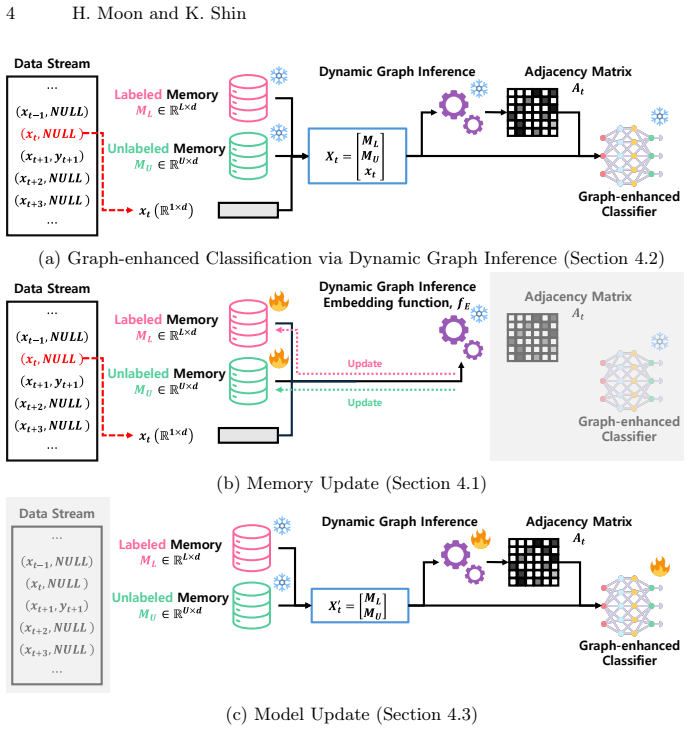
SLeDGe maintains compact labeled and unlabeled memories using distinct update strategies and learns an adaptive graph structure with encouraged sparsity to filter spurious connections, enabling effective label propagation in data streams under memory and label constraints.
What carries the argument
Joint learning of the predictive model and an adaptive graph structure under strict memory and label constraints
If this is right
- SLeDGe achieves average relative accuracy gains of 31.7% over competitors with only 0.1% labels across 12 datasets.
- It achieves 14.8% gains with 1% labels.
- The approach allows rapid adaptation to novel features while retaining historical consistency.
- Sparsity in the graph filters out spurious connections for better supervision propagation.
Where Pith is reading between the lines
- Such joint learning could be applied to other dynamic environments like online recommendation systems where user-item relationships change over time.
- The memory management strategies might help in resource-constrained settings beyond data streams.
- Testing on datasets with known concept drift could further validate the adaptation benefits.
Load-bearing premise
That jointly learning the model and graph structure can reliably capture the true evolving relationships among samples under the given memory and label constraints.
What would settle it
Running SLeDGe on a data stream where relationships change in a way that fixed graphs perform better would falsify the advantage of the adaptive approach.
Figures
read the original abstract
Semi-supervised learning (SSL) on data streams is challenging due to the continuous evolution of high-volume data and the scarcity of labels. Existing methods are limited in leveraging the intrinsic relationships among samples because they typically rely on fixed similarity measures or static graph structures, which cannot capture how relationships evolve over time. We propose SLeDGe, an SSL method for data streams that jointly learns a predictive model and an adaptive graph structure under strict memory and label constraints. SLeDGe maintains compact labeled and unlabeled memories using distinct update strategies, balancing rapid adaptation to novel features with the retention of historical consistency. In addition, by encouraging sparsity in the relational graph, SLeDGe filters out spurious connections and enables effective propagation of label supervision. Across 12 datasets, SLeDGe outperforms state-of-the-art competitors, achieving average relative accuracy gains of 31.7% with 0.1% labels and 14.8% with 1% labels.
Editorial analysis
A structured set of objections, weighed in public.
Referee Report
Summary. The paper proposes SLeDGe, a semi-supervised learning method for data streams that jointly learns a predictive model and an adaptive graph structure under memory and label constraints. It maintains compact labeled and unlabeled memories with distinct update strategies to balance adaptation and historical consistency, encourages sparsity in the relational graph to filter spurious connections, and reports outperforming state-of-the-art methods on 12 datasets with average relative accuracy gains of 31.7% at 0.1% labels and 14.8% at 1% labels.
Significance. If the empirical claims hold under rigorous validation, the work could be significant for SSL on evolving data streams by enabling dynamic graph adaptation without fixed similarities. The approach targets a relevant challenge with memory constraints and label scarcity. However, the abstract supplies no experimental details, baselines, error bars, or methodology, preventing assessment of whether the data or method supports the central performance claims.
major comments (1)
- [Abstract] Abstract: the central claim of outperforming SOTA competitors with specific relative accuracy gains (31.7% at 0.1% labels, 14.8% at 1% labels) across 12 datasets is presented without any experimental details, baselines, methodology, or error bars. This is load-bearing for the paper's contribution and makes it impossible to evaluate soundness.
Simulated Author's Rebuttal
We thank the referee for highlighting the need for greater transparency in the abstract. We address the comment below and propose a targeted revision to improve evaluability while preserving the abstract's conciseness.
read point-by-point responses
-
Referee: [Abstract] Abstract: the central claim of outperforming SOTA competitors with specific relative accuracy gains (31.7% at 0.1% labels, 14.8% at 1% labels) across 12 datasets is presented without any experimental details, baselines, methodology, or error bars. This is load-bearing for the paper's contribution and makes it impossible to evaluate soundness.
Authors: The abstract is intentionally concise and follows standard practice by summarizing key outcomes; the full experimental protocol (12 datasets with their characteristics, the complete set of baselines including both stream-specific and static SSL methods, the precise label ratios and memory budgets, the evaluation protocol with multiple random seeds, and all results with standard deviations/error bars) is provided in Section 4 (Experiments) and the associated tables/figures. The abstract does not repeat these details to remain within length limits. We agree this can be improved for standalone readability and will revise the abstract to add one sentence briefly indicating the evaluation scope (number of datasets, label regimes, and that results include error bars across runs) while retaining the performance numbers. revision: yes
Circularity Check
No significant circularity
full rationale
The provided abstract and context describe an empirical SSL method on streams that jointly learns a model and adaptive graph under memory constraints, with performance evaluated via relative accuracy gains on 12 datasets. No derivation chain, equations, fitted parameters renamed as predictions, or self-citation load-bearing steps are present. Claims rest on experimental comparisons rather than reducing to inputs by construction, making the work self-contained against external benchmarks.
Axiom & Free-Parameter Ledger
Reference graph
Works this paper leans on
-
[1]
In: SDM (2019)
Ashfahani, A., Pratama, M.: Autonomous deep learning: Continual learning ap- proach for dynamic environments. In: SDM (2019)
2019
-
[2]
Clanuwat, T., Bober-Irizar, M., Kitamoto, A., Lamb, A., Yamamoto, K., Ha, D.: Deep learning for classical japanese literature. arXiv:1812.01718 (2018) 18 H. Moon and K. Shin
Pith/arXiv arXiv 2018
-
[3]
IEEE signal processing magazine29(6) (2012)
Deng, L.: The mnist database of handwritten digit images for machine learning research. IEEE signal processing magazine29(6) (2012)
2012
-
[4]
IEEE Transactions on Cy- bernetics52(11) (2021)
Din, S.U., Kumar, J., Shao, J., Mawuli, C.B., Ndiaye, W.D.: Learning high- dimensional evolving data streams with limited labels. IEEE Transactions on Cy- bernetics52(11) (2021)
2021
-
[5]
Information Sciences525(2020)
Din, S.U., Shao, J., Kumar, J., Ali, W., Liu, J., Ye, Y.: Online reliable semi- supervised learning on evolving data streams. Information Sciences525(2020)
2020
-
[6]
Information Sciences (2024)
Din, S.U., Yang, Q., Shao, J., Mawuli, C.B., Ullah, A., Ali, W.: Synchronization- based semi-supervised data streams classification with label evolution and extreme verification delay. Information Sciences (2024)
2024
-
[7]
Group, C.T.L.: The 4 universities data set.https://www.cs.cmu.edu/afs/cs.cm u.edu/project/theo-20/www/data/(1998)
1998
-
[8]
In: WWW (2025)
Han, S., Zhou, Z., Chen, J., Hao, Z., Zhou, S., Wang, G., Feng, Y., Chen, C., Wang, C.: Uncertainty-aware graph structure learning. In: WWW (2025)
2025
-
[9]
In: AISTAT (2016)
Kalofolias, V.: How to learn a graph from smooth signals. In: AISTAT (2016)
2016
-
[10]
Applied Intelligence 50(5) (2020)
Khezri, S., Tanha, J., Ahmadi, A., Sharifi, A.: Stds: self-training data streams for mining limited labeled data in non-stationary environment. Applied Intelligence 50(5) (2020)
2020
-
[11]
In: ICLR (2017)
Kipf, T.N., Welling, M.: Semi-supervised classification with graph convolutional networks. In: ICLR (2017)
2017
-
[12]
Master’s thesis, University of Tront (2009)
Krizhevsky, A.: Learning multiple layers of features from tiny images. Master’s thesis, University of Tront (2009)
2009
-
[13]
In: Big Data (2019)
Le Nguyen, M.H., Gomes, H.M., Bifet, A.: Semi-supervised learning over streaming data using moa. In: Big Data (2019)
2019
-
[14]
In: WWW (2022)
Liu, Y., Zheng, Y., Zhang, D., Chen, H., Peng, H., Pan, S.: Towards unsupervised deep graph structure learning. In: WWW (2022)
2022
-
[15]
Data8(5) (2023)
Petukhova, A., Fachada, N.: Mn-ds: A multilabeled news dataset for news articles hierarchical classification. Data8(5) (2023)
2023
-
[16]
UCI Machine Learning Repository (2018)
Sakar, C., Kastro, Y.: Online shoppers purchasing intention dataset. UCI Machine Learning Repository (2018)
2018
-
[17]
In: IJCAI (2024)
Shen, X., Shi, L., Gong, X., Pan, S.: Unsupervised deep graph structure and em- bedding learning. In: IJCAI (2024)
2024
-
[18]
Machine learning109(2) (2020)
Van Engelen, J.E., Hoos, H.H.: A survey on semi-supervised learning. Machine learning109(2) (2020)
2020
-
[19]
In: ICML (2018)
Wagner, T., Guha, S., Kasiviswanathan, S., Mishra, N.: Semi-supervised learning on data streams via temporal label propagation. In: ICML (2018)
2018
-
[20]
In: ICCV (2023)
Wu, J.Z., Zhang, D.J., Hsu, W., Zhang, M., Shou, M.Z.: Label-efficient online continual object detection in streaming video. In: ICCV (2023)
2023
-
[21]
Xiao, H., Rasul, K., Vollgraf, R.: Fashion-mnist: a novel image dataset for bench- marking machine learning algorithms. arXiv:1708.07747 (2017)
Pith/arXiv arXiv 2017
-
[22]
IEEE Transactions on Knowledge and Data Engineering35(9) (2022)
Yang, X., Song, Z., King, I., Xu, Z.: A survey on deep semi-supervised learning. IEEE Transactions on Knowledge and Data Engineering35(9) (2022)
2022
-
[23]
Zhang, Z.Y., Qian, Y.Y., Zhang, Y.J., Jiang, Y., Zhou, Z.H.: Adaptive learning for weakly labeled streams. In: KDD (2022) Semi-Supervised Learning on Data Streams with Graph Structure Learning 1 Appendix A Implementation Details A.1 Experimental Environment We conduct all experiments with RTX A6000 GPUs (48GB VRAM), 512GB of RAM, and Intel Xeon Silver 421...
arXiv 2022
discussion (0)
Sign in with ORCID, Apple, or X to comment. Anyone can read and Pith papers without signing in.