From Detection to Mechanism: Cross-Attention Graph Neural Networks Enable Drug-Drug Interaction Type Prediction An Ablation Study with Acetylsalicylic Acid Validation
Pith reviewed 2026-06-29 14:36 UTC · model grok-4.3
The pith
Cross-attention between drug graphs improves mechanism-type prediction far more than binary detection of interactions.
A machine-rendered reading of the paper's core claim, the machinery that carries it, and where it could break.
Core claim
A dual MPNN equipped with four-head cross-attention improves multi-class F1-macro by +0.186 absolute (+45 %) over a siamese concatenation baseline while improving binary AUC by only +0.012 (+1.3 %), confirming that atom-level inter-molecular communication specifically enables mechanism-type classification; the ternary architecture fails on the same data and the cross-attention model predicts all ten held-out ASA pairs correctly.
What carries the argument
Four-head cross-attention applied between the atom embeddings of two separate MPNNs, allowing direct message passing from atoms of one drug to atoms of the other.
If this is right
- Mechanism classification requires atom-level cross-drug messages that binary detection does not.
- Adding an explicit ternary interaction graph does not substitute for learned cross-attention.
- The same architecture that succeeds on the benchmark also succeeds on the held-out ASA pairs.
- Two structural failure modes persist across all tested models.
Where Pith is reading between the lines
- The same cross-attention pattern could be tested on other pairwise molecular tasks such as protein-ligand or protein-protein interaction typing.
- The two persistent failure cases may indicate graph-representation limits that 3D coordinate or quantum features would need to address.
- If the training-instability hypothesis for the ternary model is correct, stabilization techniques could make the ternary route competitive again.
Load-bearing premise
The observed performance gap arises from the presence of cross-attention enabling atom-level communication rather than from unstated differences in model capacity, optimization, or data handling.
What would settle it
Re-train all three architectures with explicitly matched parameter counts and identical random seeds; if the 0.186 F1-macro gap disappears, the communication hypothesis does not hold.
Figures
read the original abstract
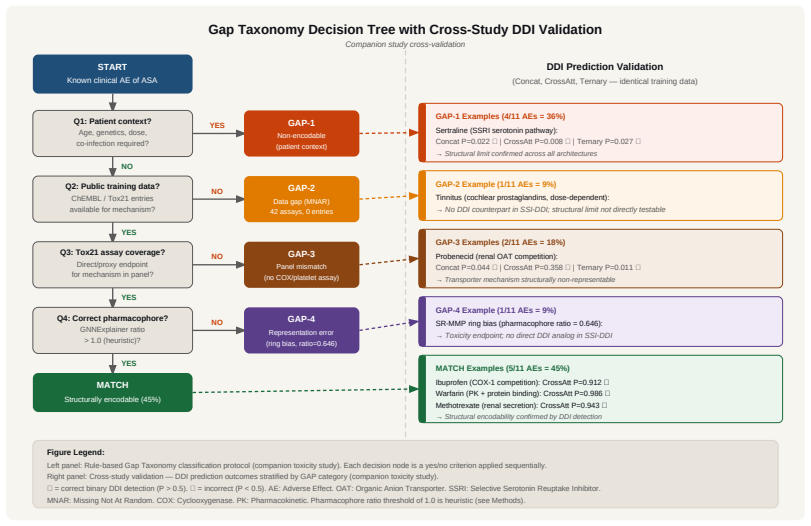
Predicting whether two drugs interact (binary detection) is a substantially dif- ferent task from predicting the mechanism type of that interaction (multi-class classification). This study presents a systematic ablation study of three Graph Neural Network (GNN) architectures for drug-drug interaction (DDI) prediction on a publicly available benchmark dataset comprising 38,337 positive pairs across 86 interaction types. Three architectures are compared under identical training conditions (n = 61,339 pairs): a siamese dual Message Passing Neural Network (MPNN) with concatenation (Concat), a dual MPNN with four-head cross-attention (CrossAtt), and a ternary MPNN incorporating an interaction graph (Ternary). CrossAtt improves multi-class F1-macro by +0.186 absolute (+45%) over Concat, while improving binary AUC by only +0.012 (+1.3%) - confirming that atom-level inter-molecular communication specifically enables mechanism-type classification. The ternary architecture underperforms despite equivalent training data, with its failure consistent with a training instability hypothesis. Validation on ten acetylsali- cylic acid (ASA) drug pairs, held out prior to training, demonstrates 10/10 correct DDI-type predictions for CrossAtt versus 0/10 for Ternary. Two consistent failure cases are identified across all architectures, linking to structural limits established in a companion toxicity study.
Editorial analysis
A structured set of objections, weighed in public.
Referee Report
Summary. The paper presents a systematic ablation of three GNN architectures for drug-drug interaction (DDI) type prediction on a benchmark of 38,337 positive pairs across 86 types: Concat (siamese dual MPNN with concatenation), CrossAtt (dual MPNN with four-head cross-attention), and Ternary (ternary MPNN with interaction graph). Under identical training conditions on 61,339 pairs, CrossAtt improves multi-class F1-macro by +0.186 absolute (+45%) over Concat while improving binary AUC by only +0.012 (+1.3%), which the authors attribute to atom-level inter-molecular communication. On ten held-out acetylsalicylic acid (ASA) pairs, CrossAtt achieves 10/10 correct type predictions versus 0/10 for Ternary. Two consistent failure cases are noted across architectures.
Significance. If the performance gap can be shown to arise specifically from the cross-attention mechanism rather than capacity differences, the work would provide evidence that inter-molecular atom communication is particularly important for multi-class mechanism prediction but less so for binary detection. The held-out ASA validation supplies a concrete, falsifiable test outside the training distribution. The paper receives credit for the controlled ablation design and the external validation set.
major comments (2)
- [Abstract] Abstract: The central claim that 'atom-level inter-molecular communication specifically enables mechanism-type classification' requires that the +0.186 F1-macro gain be attributable to cross-attention rather than model capacity. CrossAtt is described as a 'dual MPNN with four-head cross-attention' while Concat is a 'siamese dual MPNN with concatenation'; four attention heads introduce additional parameters and expressivity. 'Identical training conditions' does not establish matched parameter counts, hidden dimensions, or layer widths, leaving the mechanistic interpretation unsupported.
- [Abstract] Abstract: No error bars, standard deviations across runs, or statistical significance tests accompany the reported deltas (+0.186 F1-macro, +0.012 AUC). Without these, it is impossible to determine whether the differential improvement between multi-class and binary tasks is robust or could arise from optimization variability.
minor comments (1)
- [Abstract] Abstract contains line-break artifacts: 'dif- ferent' and 'acetylsali- cylic'.
Simulated Author's Rebuttal
We thank the referee for the constructive comments on our manuscript. We address each major comment point by point below and indicate the revisions we will make.
read point-by-point responses
-
Referee: [Abstract] Abstract: The central claim that 'atom-level inter-molecular communication specifically enables mechanism-type classification' requires that the +0.186 F1-macro gain be attributable to cross-attention rather than model capacity. CrossAtt is described as a 'dual MPNN with four-head cross-attention' while Concat is a 'siamese dual MPNN with concatenation'; four attention heads introduce additional parameters and expressivity. 'Identical training conditions' does not establish matched parameter counts, hidden dimensions, or layer widths, leaving the mechanistic interpretation unsupported.
Authors: We acknowledge the referee's point that the manuscript does not explicitly compare parameter counts or layer widths between Concat and CrossAtt, which leaves open the possibility that capacity differences contribute to the observed gap. The ablation was designed to isolate the effect of the cross-attention mechanism for inter-molecular communication, and the Ternary model provides an additional control that underperforms despite its own structural differences. To directly address this concern, we will add a table reporting parameter counts, hidden dimensions, and layer widths for all three architectures in the revised manuscript. revision: yes
-
Referee: [Abstract] Abstract: No error bars, standard deviations across runs, or statistical significance tests accompany the reported deltas (+0.186 F1-macro, +0.012 AUC). Without these, it is impossible to determine whether the differential improvement between multi-class and binary tasks is robust or could arise from optimization variability.
Authors: We agree that the absence of error bars and statistical tests limits the ability to assess robustness of the reported deltas. In the revised manuscript we will report means and standard deviations from at least five independent runs with different random seeds for all metrics and will include paired statistical significance tests on the key performance differences between architectures. revision: yes
Circularity Check
No significant circularity; empirical ablation results are independent of fitted inputs.
full rationale
The paper reports direct empirical measurements (F1-macro, AUC, and held-out ASA pair accuracy) on a public benchmark and pre-training held-out set. These quantities are computed from model outputs on external data rather than being algebraically equivalent to any fitted parameter or self-defined quantity. No equations, uniqueness theorems, or self-citations are invoked to derive the performance deltas; the attribution to cross-attention is an interpretive claim about the ablation design, not a reduction by construction. The companion toxicity study is referenced only for post-hoc failure-case interpretation and is not load-bearing for the primary results.
Axiom & Free-Parameter Ledger
axioms (1)
- domain assumption The publicly available benchmark of 38,337 positive pairs across 86 interaction types is representative of real-world drug-drug interaction mechanisms.
Forward citations
Cited by 1 Pith paper
-
What Molecular Structure Cannot Tell Us: A Taxonomy of Explainability Gaps in GNN-Based Drug Toxicity Prediction
Introduces a four-category taxonomy of structural explainability gaps in GNN drug toxicity prediction, with a case study on Aspirin indicating molecular structure accounts for 5 of 11 known adverse effects.
Reference graph
Works this paper leans on
-
[1]
Pirmohamed et al
M. Pirmohamed et al. Adverse drug reactions as cause of admission to hospital.BMJ, 329(7456):15–19, 2004
2004
-
[2]
Bronstein, J
M.M. Bronstein, J. Bruna, Y. LeCun, A. Szlam, and P. Vandergheynst. Geometric deep learning: Going beyond Euclidean data.IEEE Signal Processing Magazine, 34(4):18–42, 2017
2017
-
[3]
Gilmer, S.S
J. Gilmer, S.S. Schütt, G.E. Dahl, O. Vinyals, and P. Riley. Neural message passing for quantum chemistry. InProc. 34th ICML, pages 1263–1272, 2017
2017
-
[4]
Feng et al
Y.H. Feng et al. DPDDI: a deep predictor for drug–drug interactions.BMC Bioinformatics, 23:1–14, 2022
2022
-
[5]
Chen et al
Y. Chen et al. DSN-DDI: an accurate and generalized framework for drug–drug interaction prediction by dual-view representation learning.Briefings in Bioinformatics, 24(1):bbac597, 2023
2023
-
[6]
Lin et al
X. Lin et al. Multimodal network for drug–drug interaction prediction using multi-source drug information.BMC Bioinformatics, 23:1–15, 2022
2022
-
[7]
J. Dietrich. What molecular structure cannot tell us: A taxonomy of explainability gaps in GNN-based drug toxicity prediction.arXiv preprint arXiv:2605.26183, 2026
work page internal anchor Pith review Pith/arXiv arXiv 2026
-
[8]
Nyamabo, H
A.K. Nyamabo, H. Yu, and J.Y. Shi. SSI-DDI: substructure–substructure interactions for drug–drug interaction prediction.Briefings in Bioinformatics, 22(6):bbab133, 2021
2021
-
[9]
Wishart et al
D.S. Wishart et al. DrugBank 5.0: A major update to the DrugBank database for 2018. Nucleic Acids Research, 46(D1):D1074–D1082, 2018
2018
-
[10]
D.B. Rubin. Inference and missing data.Biometrika, 63(3):581–592, 1976
1976
-
[11]
G. Landrum. RDKit: Open-source cheminformatics.https://www.rdkit.org, 2006. Ac- cessed: 24 May 2026
2006
-
[12]
Kingma and J
D.P. Kingma and J. Ba. Adam: A method for stochastic optimization. InICLR, 2015. 12
2015
discussion (0)
Sign in with ORCID, Apple, or X to comment. Anyone can read and Pith papers without signing in.