REVIEW 4 major objections 5 minor 35 references
Web agents stay on track longer when every plan step states what would prove it wrong.
Reviewed by Pith at T0; open to challenge. T0 means a machine referee read the full paper against a public rubric. the ladder, T0–T4 →
T0 review · grok-4.5
2026-07-31 22:04 UTC pith:WKETHSKT
load-bearing objection Solid systems paper: FCUs with explicit falsifiers plus plan–test–repair deliver a real WebArena gain; mechanism evidence is thinner than the headline but not hollow. the 4 major comments →
Falsifiable Commitment Planning for Self-Correcting Web Agents
The pith
A machine-rendered reading of the paper's core claim, the machinery that carries it, and where it could break.
Core claim
Stable long-horizon web agents need plans that know when they are wrong. Representing each step as a Falsifiable Commitment Unit and executing it under online hybrid testing plus scope-aware repair raises WebArena average success from 57.4% to 65.3% (13.8% relative), with especially large gains on long Shopping and GitLab tasks and a 9.6% relative zero-shot gain on WebChoreArena.
What carries the argument
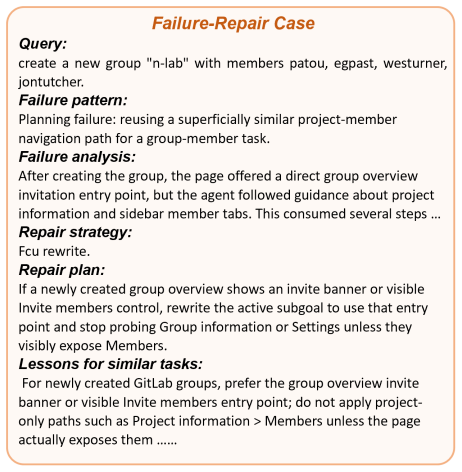
Falsifiable Commitment Unit (FCU): a plan step as (subgoal, optional skill, confirming evidence, falsifying evidence, confidence), run inside a plan–test–repair loop whose hybrid tester checks actions and observations and whose repair localizes contradictions to execution, skill, or planning scope.
Load-bearing premise
The confirming and falsifying evidence the planner writes, plus the fixed hybrid routing thresholds, must be accurate enough at test time to catch real drift without constant false alarms.
What would settle it
If ablating falsifying evidence or online commitment testing erases the long-horizon gains on WebArena (or drift detection on held-out trajectories falls near chance), the claim that explicit falsifiable commitments drive the improvement fails.
If this is right
- Long web tasks benefit more from explicit progress and falsification criteria than from more planning or memory alone.
- Drift should be attributed to action, skill, or plan so recovery revises the smallest adequate part.
- Hybrid fast evidence matching plus selective LLM diagnosis can cut verification cost without losing success.
- Skills from successes and failure-repair memories from failures both sharpen future commitments and recoveries.
- Cross-benchmark reuse of fixed experience libraries remains useful when commitments carry their own validity tests.
Where Pith is reading between the lines
- The same commitment-testing interface could transfer to other partially observed tool environments (desktop GUIs, multi-app workflows) where local actions look fine after the plan has already failed.
- Early-detection benchmarks—measuring how soon recoverable drift is caught, not only final success—would pressure-test the method where the authors say evaluation is still thin.
- Learned or calibrated falsifiers could relax dependence on one-shot planner-written evidence and fixed score gates.
Editorial analysis
A structured set of objections, weighed in public.
Referee Report
Summary. The paper proposes FCPAgent, a web-agent framework in which each plan step is a Falsifiable Commitment Unit (FCU): a subgoal, an optional retrieved skill, staged confirming evidence, hierarchical falsifying evidence (execution/skill/planning level), and a confidence score. Execution proceeds as a plan–test–repair loop: a hybrid tester (lightweight NLI/ITM evidence matching plus an LLM verifier for escalated cases) checks candidate actions and post-action states against the active FCU, and a scope-aware repairer revises the smallest implicated component using a frozen failure-repair library. Skill and failure-repair libraries are distilled offline from 191 WebArena training tasks and frozen for the 621-task test split; all methods share the Qwen3.5-397B-A17B backbone. On WebArena, FCPAgent reaches 65.3% average success vs 57.4% for the strongest baseline (ColorBrowserAgent), a 13.8% relative gain concentrated in long-horizon Shopping/GitLab buckets, plus a 9.6% relative zero-shot gain on WebChoreArena. Ablations attribute gains to planning, testing, and repair; Table 10 reports 80% F1 drift detection on 30 annotated trajectories. The central claim is that the FCU-based testing loop causes the gains via drift detection and scoped repair.
Significance. If the attribution questions are resolved, this is a solid contribution to reliable long-horizon web agents. Strengths worth naming: (i) clean experimental controls — one backbone across all methods, experience libraries frozen at test time, three runs per method, equal data budgets for memory-based baselines; (ii) external, non-circular success metrics (WebArena/WebChoreArena validators); (iii) a rare zero-shot cross-benchmark transfer result (Table 3); (iv) component and fine-grained ablations (Tables 4, 8) plus honest runtime instrumentation (Tables 9, 10, Figure 10) that most agent papers omit; (v) an efficiency accounting showing the hybrid design trades ~20% LLM time for nothing lost in success; (vi) the paper itself attempts a falsifiable, task-level diagnostic of its own mechanism rather than resting on final success alone — the right instinct, even though the execution (Table 10) is currently underpowered. The FCU formulation (subgoal + skill + staged confirming evidence + hierarchical falsifiers + confidence) is a genuinely reusable representation.
major comments (4)
- [§C.4, Table 10] Table 10 is the only direct validation of the claimed mechanism (hybrid commitment testing detects drift), and it is too weak to carry that weight. (a) The sample is described as "randomly sampled" but is stratified 20/30 successful; drift detection matters most on failing trajectories, where recall determines whether the loop rescues runs the baseline loses, so this sample cannot measure the mechanism where the claimed gain is earned. (b) Annotation appears single-annotator with no adjudication or inter-rater statistic, and the counting rule is lenient (any one confirmed diagnosis per trajectory = detected). (c) With n=13 drift cases, recall 76.9% has a binomial CI of roughly 46–95% — statistically compatible with a mediocre detector. Please expand the annotated set, oversample failing trajectories, add a second annotator with an agreement statistic, and report CIs.
- [§B.5, Eq. (5)–(6)] The fast-tester routing decision (Eq. 6) depends on at least eight fixed constants: τ0+=0.65, τ0−=0.55, δ+=0.18, δ−=0.25, η=0.1, πlow=0.5, margin 0.08, and λ=0.8. No sensitivity sweep is reported anywhere. This is load-bearing because the textual scorer, nli-deberta-v3-base, is MNLI-trained and here scores entailment between accessibility-tree serializations and planner-written evidence strings — far outside its training distribution — while λ=0.8 weights this channel heavily. If the main results are fragile to modest perturbations of these gates, the contribution is the thresholds, not the architecture. A sweep over the base gates and λ (reporting success and escalation rate) is needed; ideally also state how the constants were chosen.
- [§6.5, Tables 4, 5, 9] Two results complicate the causal attribution to FCU evidence matching. First, Table 9 shows the state-level fast tester escalates 72–77% of states to the slow verifier; the lightweight layer therefore skips the LLM call only about a quarter of the time, and Table 5 shows slow-only testing matches full success (66.9 vs 67.6; 68.8 vs 68.8) while saving only ~20% time. The drift detection itself thus appears to be done almost entirely by the slow LLM verifier, with the FCU evidence/scoring layer contributing efficiency rather than detection quality. Second, in Table 4 the "w/o falsifiable plan" variant (skills+repair, no FCUs) still reaches 60.4/61.7/71.2 — above ColorBrowserAgent on all three domains — so a substantial part of the 13.8% gain comes from the memory machinery, not the falsifiable-commitment mechanism. The abstract's framing should be revised to attribute gains accordingly, o
- [§6.2–6.3, Tables 2–3] Table 2 reports averages over three runs but no per-run variance or significance assessment. The headline 65.3% vs 57.4% is a ~7.9pp gap over 621 tasks; whether this exceeds run-to-run variance under temperature-1 decoding is not established. This matters most for the smaller domains (Cross, n=37, where the relative gain is largest at 23%) and for WebChoreArena (Table 3, 9.6% relative, absolute gap 2.8pp, no repetition protocol stated). Please report per-run standard deviations and a paired significance test over tasks or runs.
minor comments (5)
- [§6.4, Figure 3] Bucketing by the baseline's trajectory length as a horizon proxy introduces a selection effect: tasks on which the baseline fails often have longer (looping) trajectories, which can mechanically inflate the relative-gain numbers in the long buckets. A length proxy independent of the evaluated systems (e.g., human demonstration length or minimum steps) would be more convincing.
- [Table 5] The per-domain numbers (219s vs 281s Shopping; 529s vs 648s Admin) don't obviously map to the stated "464.5s to 374.0s, 19.5%" average; please clarify the averaging. Also note the 19.5% saving coexists with 72–77% escalation in Table 9 — worth reconciling in the text.
- [Figure 2] "Sever drift" should be "Severe drift". The abstract and §1 describe WebArena gains well, but the paper would benefit from a short limitations paragraph on Map-domain validator instability (currently only in §6.2).
- [§A.1, Table 6] The absence of numerical comparison with SkillTracer and ContractSkill is justified by implementation availability, but since Table 6 positions them as the closest methods (EDD+AGR), a qualitative discussion of expected overlap — e.g., what FCUs add beyond contract-based skills — would strengthen the novelty positioning.
- [§C.4] Table 10's sampling is described as "randomly sampled" but is stratified by outcome (20/30 successful). Please relabel and describe the sampling frame (which of the 621×3 runs were eligible).
Circularity Check
No significant circularity: external WebArena validators and frozen train-only experience libraries keep the reported gains independent of the FCU machinery.
full rationale
FCPAgent is an empirical systems paper, not a first-principles derivation. The central claim is a measured success-rate lift on WebArena (57.4% → 65.3%) and zero-shot WebChoreArena under the benchmarks’ own functional validators V(q, τ), which are independent of FCU confirming/falsifying evidence. Skill and failure-repair libraries are built only from the 191-task training split and frozen at test time; ablations remove planning, testing, or repair rather than refitting the metric to the method. Hybrid-routing thresholds (τ⁰₊, τ⁰₋, λ, etc.) are fixed design hyperparameters, not parameters fitted to the reported test success and then re-presented as predictions. Related-work citations (WebDART, ColorBrowserAgent, ContractSkill, etc.) are used for comparison, not as load-bearing uniqueness theorems that force the result. No equation equates the claimed gain to an input by construction. Weaknesses in mechanistic evidence (small author-annotated Table 10, threshold sensitivity) are correctness/robustness concerns, not circularity.
Axiom & Free-Parameter Ledger
free parameters (4)
- Hybrid tester base gates τ⁰₊, τ⁰₋, margins δ⁺/δ⁻, π_low, η, uncertainty margin =
τ⁰₊=0.65, τ⁰₋=0.55, δ⁺=0.18, δ⁻=0.25, π_low=0.5, η=0.1
- Evidence fusion weight λ =
0.8
- Retrieval depths K skills and P failure cases; BM25/embedding mix =
K=3, P=2; σ_S=0.4/0.6; σ_F=0.5/0.5
- Max interaction length and decoding temperature =
B=20, temperature=1
axioms (6)
- domain assumption Final task feedback is delayed/sparse, so intermediate confirming and falsifying evidence is necessary to judge plan validity online.
- domain assumption LLM planners can generate useful task-specific E⁺/E⁻ and confidences κ from query, state, skills, and failure memories.
- domain assumption Violations can be attributed to execution-, skill-, or planning-level scopes, and the smallest adequate revision is preferable.
- domain assumption Offline skills and failure-repair cases distilled from a fixed 191-task training split remain valid and non-leaking for the 621-task test split and zero-shot WebChoreArena.
- domain assumption Lightweight NLI (DeBERTa) and ITM (SigLIP2) scores are informative routing signals for commitment support/contradiction on accessibility trees and screenshots.
- ad hoc to paper TOTE/goal-directed testing (Miller, Galanter, Pribram 1960) is an appropriate conceptual model for web plan steps.
invented entities (4)
-
Falsifiable Commitment Unit (FCU)
independent evidence
-
Hybrid commitment tester (fast evidence matching + slow LLM diagnosis)
independent evidence
-
Scope-aware repairer with failure-repair library
independent evidence
-
Skill library and failure-repair library distilled from trajectories
independent evidence
read the original abstract
Long-horizon web agents often go off track before final failure: a trajectory can remain locally plausible even after the current state, reused skill, or plan assumption no longer supports the user instruction. Existing agents can plan, reflect, or reuse experience, but their plans rarely specify the evidence under which an active step should still be trusted. We propose FCPAgent, a falsifiable commitment planning framework for robust long-horizon web agents. FCPAgent represents each plan step as a Falsifiable Commitment Unit (FCU): a subgoal grounded in a reusable skill, together with confirming evidence, falsifying evidence, and a confidence score. Execution is organized as a plan-test-repair loop. The hybrid commitment testing module checks candidate actions before they modify the browser and checks observations after execution; for efficiency, it combines lightweight evidence matching with LLM-based diagnostic verification. When evidence falsifies a commitment, scope-aware repair localizes the contradiction to the execution, skill, or planning level and revises the smallest adequate part. On WebArena, FCPAgent achieves a 13.8% relative improvement in average success over the strongest baseline, with especially large gains on long-horizon tasks.
Figures




Reference graph
Works this paper leans on
-
[1]
Zhou, Shuyan and Xu, Frank F. and Zhu, Hao and Zhou, Xuhui and Lo, Robert and Sridhar, Abishek and Cheng, Xianyi and Ou, Tianyue and Bisk, Yonatan and Fried, Daniel and Alon, Uri and Neubig, Graham , booktitle =. 2024 , url =
2024
-
[2]
Le Sellier De Chezelles, Thibault and Gasse, Maxime and Drouin, Alexandre and Caccia, Massimo and Boisvert, L. The. arXiv preprint arXiv:2412.05467 , year =
-
[3]
Set-of-Mark Prompting Unleashes Extraordinary Visual Grounding in
Yang, Jianwei and Zhang, Hao and Li, Feng and Zou, Xueyan and Li, Chunyuan and Gao, Jianfeng , journal =. Set-of-Mark Prompting Unleashes Extraordinary Visual Grounding in. 2023 , url =
2023
-
[4]
2023 , url =
Yao, Shunyu and Zhao, Jeffrey and Yu, Dian and Du, Nan and Shafran, Izhak and Narasimhan, Karthik and Cao, Yuan , booktitle =. 2023 , url =
2023
-
[5]
2023 , url =
Deng, Xiang and Gu, Yu and Zheng, Boyuan and Chen, Shijie and Stevens, Samuel and Wang, Boshi and Sun, Huan and Su, Yu , booktitle =. 2023 , url =
2023
-
[6]
2022 , url =
Yao, Shunyu and Chen, Howard and Yang, John and Narasimhan, Karthik , booktitle =. 2022 , url =
2022
-
[7]
2024 , url =
Koh, Jing Yu and Lo, Robert and Jang, Lawrence and Duvvur, Vikram and Lim, Ming Chong and Huang, Po-Yu and Neubig, Graham and Zhou, Shuyan and Salakhutdinov, Ruslan and Fried, Daniel , booktitle =. 2024 , url =
2024
-
[8]
International Conference on Machine Learning , year =
Agent Workflow Memory , author =. International Conference on Machine Learning , year =
-
[9]
2025 , url =
Yang, Ke and Liu, Yao and Chaudhary, Sapana and Fakoor, Rasool and Chaudhari, Pratik and Karypis, George and Rangwala, Huzefa , booktitle =. 2025 , url =
2025
-
[10]
International Conference on Learning Representations , year =
Web Agents with World Models: Learning and Leveraging Environment Dynamics in Web Navigation , author =. International Conference on Learning Representations , year =
-
[11]
2026 , url =
Prabhu, Viraj and Dai, Yutong and Fernandez, Matthew and Ramakrishnan, Krithika and Gu, Jing and Luo, Yanqi and Savarese, Silvio and Xiong, Caiming and Li, Junnan and Chen, Zeyuan and Xu, Ran , booktitle =. 2026 , url =
2026
-
[12]
2026 , url =
Zhou, Jiamu and Wang, Jihong and Zhang, Weiming and Liu, Weiwen and Zhang, Zhuosheng and Lou, Xingyu and Zhang, Weinan and Deng, Huarong and Wang, Jun , journal =. 2026 , url =
2026
-
[13]
2026 , url =
Wang, Hanyu and Cao, Yuanpu and Lin, Lu and Chen, Jinghui , journal =. 2026 , url =
2026
-
[14]
2025 , url =
Yang, Jingbo and Hou, Bairu and Wei, Wei and Chang, Shiyu and Bao, Yujia , journal =. 2025 , url =
2025
-
[15]
2026 , url =
Lu, Zijian and Zuo, Yiping and Nie, Yupeng and He, Xin and Fan, Weibei and Dai, Chen , journal =. 2026 , url =
2026
-
[16]
arXiv preprint arXiv:2603.07024 , year =
Enhancing Web Agents with a Hierarchical Memory Tree , author =. arXiv preprint arXiv:2603.07024 , year =
-
[17]
Advances in Neural Information Processing Systems , year =
Reflexion: Language Agents with Verbal Reinforcement Learning , author =. Advances in Neural Information Processing Systems , year =
-
[18]
Advances in Neural Information Processing Systems , year =
Self-Refine: Iterative Refinement with Self-Feedback , author =. Advances in Neural Information Processing Systems , year =
-
[19]
Advances in Neural Information Processing Systems , year =
Tree of Thoughts: Deliberate Problem Solving with Large Language Models , author =. Advances in Neural Information Processing Systems , year =
-
[20]
Transactions on Machine Learning Research , year =
Voyager: An Open-Ended Embodied Agent with Large Language Models , author =. Transactions on Machine Learning Research , year =
-
[21]
International Conference on Machine Learning , year =
Learning Transferable Visual Models From Natural Language Supervision , author =. International Conference on Machine Learning , year =
-
[22]
Proceedings of the 2018 Conference of the North American Chapter of the Association for Computational Linguistics , year =
A Broad-Coverage Challenge Corpus for Sentence Understanding through Inference , author =. Proceedings of the 2018 Conference of the North American Chapter of the Association for Computational Linguistics , year =
2018
-
[23]
2026 , howpublished =
2026
-
[24]
2024 , url =
He, Hongliang and Yao, Wenlin and Ma, Kaixin and Yu, Wenhao and Dai, Yong and Zhang, Hongming and Lan, Zhenzhong and Yu, Dong , booktitle =. 2024 , url =
2024
-
[25]
2024 , series =
Zheng, Boyuan and Gou, Boyu and Kil, Jihyung and Sun, Huan and Su, Yu , booktitle =. 2024 , series =
2024
-
[26]
2024 , url =
Lai, Hanyu and Liu, Xiao and Iong, Iat Long and Yao, Shuntian and Chen, Yuxuan and Shen, Pengbo and Yu, Hao and Zhang, Hanchen and Zhang, Xiaohan and Dong, Yuxiao and Tang, Jie , booktitle =. 2024 , url =
2024
-
[27]
2025 , url =
Qi, Zehan and Liu, Xiao and Iong, Iat Long and Lai, Hanyu and Sun, Xueqiao and Sun, Jiadai and Yang, Xinyue and Yang, Yu and Yao, Shuntian and Xu, Wei and Tang, Jie and Dong, Yuxiao , booktitle =. 2025 , url =
2025
-
[28]
Findings of the Association for Computational Linguistics: ACL 2025 , pages =
Explorer: Scaling Exploration-driven Web Trajectory Synthesis for Multimodal Web Agents , author =. Findings of the Association for Computational Linguistics: ACL 2025 , pages =. 2025 , url =
2025
-
[29]
2026 , url =
Li, Yuyang and Dou, Yiran and Shao, Jie-Jing and Lyu, Yueming and Tsang, Ivor and Yin, Haiyan , booktitle =. 2026 , url =
2026
-
[30]
and Jin, Xiaolong and Wang, Zora Zhiruo and Gandhi, Apurva and Song, Yueqi and Gu, Yu and Srinivasa, Jayanth and Liu, Gaowen and Neubig, Graham and Su, Yu , journal =
Zheng, Boyuan and Fatemi, Michael Y. and Jin, Xiaolong and Wang, Zora Zhiruo and Gandhi, Apurva and Song, Yueqi and Gu, Yu and Srinivasa, Jayanth and Liu, Gaowen and Neubig, Graham and Su, Yu , journal =. 2025 , url =
2025
-
[31]
arXiv preprint arXiv:2504.06821 , year =
Inducing Programmatic Skills for Agentic Tasks , author =. arXiv preprint arXiv:2504.06821 , year =
-
[32]
, author =
The empirical case for two systems of reasoning. , author =. Psychological bulletin , volume =. 1996 , publisher =
1996
-
[33]
1960 , publisher =
Plans and the Structure of Behavior , author =. 1960 , publisher =
1960
-
[34]
2025 , url =
Miyai, Atsuyuki and Zhao, Zaiying and Egashira, Kazuki and Sato, Atsuki and Sunada, Tatsumi and Onohara, Shota and Yamanishi, Hiromasa and Toyooka, Mashiro and Nishina, Kunato and Maeda, Ryoma and Aizawa, Kiyoharu and Yamasaki, Toshihiko , journal =. 2025 , url =
2025
-
[35]
Findings of the Association for Computational Linguistics: EMNLP 2024 , pages =
Devil’s advocate: Anticipatory reflection for llm agents , author =. Findings of the Association for Computational Linguistics: EMNLP 2024 , pages =
2024
discussion (0)
Sign in with ORCID, Apple, or X to comment. Anyone can read and Pith papers without signing in.