Paying to Know: Micro-Transaction Markets for Verified Product Information in Agentic E-Commerce
Pith reviewed 2026-06-25 23:47 UTC · model grok-4.3
The pith
Buyer agents pay fractions of a cent to unlock verified product data in a freemium market.
A machine-rendered reading of the paper's core claim, the machinery that carries it, and where it could break.
Core claim
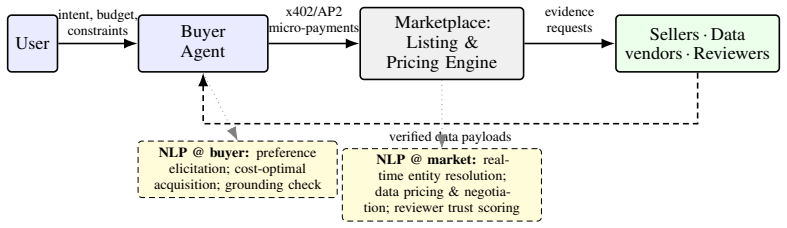
We envision agentic e-commerce as a micro-transaction market for verified information: buyer agents spend fractions of a cent to progressively unlock seller- and reviewer-supplied data -- service histories, third-party test reports, bills of materials, audited sales and support metrics -- paid for a la carte under a freemium model, with reviewer trust scored reputationally.
What carries the argument
Micro-transaction market for verified information, in which buyer agents progressively purchase decision-relevant data under a freemium model.
If this is right
- Genuine product quality receives direct financial reward through information purchases rather than marketing spend.
- Competition becomes based on verifiable metrics instead of ranking algorithms.
- NLP research priority moves to cost-optimal information acquisition, data pricing and negotiation, real-time entity resolution, grounded value exchange, and privacy-preserving persona modelling.
Where Pith is reading between the lines
- Existing e-commerce platforms could add optional paid data layers without replacing their current free interfaces.
- Agents would need new strategies for deciding when the marginal value of additional paid data exceeds its cost.
- Reputation scoring for reviewers creates an incentive for sustained accuracy that free review systems lack.
Load-bearing premise
The arrival of agent-native micro-payment rails will fundamentally change scarcity from product matching to acquisition of trustworthy information, and autonomous agents will engage in such paid information markets at scale.
What would settle it
Large-scale deployment of buyer agents that continue to rely exclusively on free public data sources without initiating micro-payments for additional verified records.
Figures
read the original abstract
Commercial NLP treats the shopping chatbot as a recommender or a conversion tool: its job is to match a user to a catalogue entry and close a sale. We argue that the arrival of agent-native micro-payment rails (e.g., x402, AP2) changes what is scarce. When the buyer is an autonomous agent that can investigate exhaustively, the bottleneck is no longer matching products but acquiring trustworthy, decision-relevant information about them. We envision agentic e-commerce as a micro-transaction market for verified information: buyer agents spend fractions of a cent to progressively unlock seller- and reviewer-supplied data -- service histories, third-party test reports, bills of materials, audited sales and support metrics -- paid for a la carte under a freemium model, with reviewer trust scored reputationally. We sketch the architecture of such a market and argue that it rewards genuine product quality and yields truer competition than ranking-based storefronts. We then translate the vision into concrete NLP problems -- cost-optimal information acquisition, data pricing and negotiation, real-time entity resolution, grounded value exchange, and privacy-preserving persona modelling -- and argue that these, not chat fluency, deserve the field's attention.
Editorial analysis
A structured set of objections, weighed in public.
Referee Report
Summary. The paper argues that agent-native micro-payment rails (e.g., x402, AP2) will shift scarcity in e-commerce from product matching to acquisition of trustworthy information. It proposes a micro-transaction market in which buyer agents pay fractions of a cent a la carte for seller- and reviewer-supplied verified data (service histories, test reports, bills of materials, audited metrics) under a freemium model with reputational reviewer trust scoring. The architecture is sketched and mapped to open NLP problems including cost-optimal information acquisition, data pricing/negotiation, real-time entity resolution, grounded value exchange, and privacy-preserving persona modelling, with the claim that these deserve priority over chat fluency.
Significance. If the proposed market architecture proves viable, the work could usefully redirect NLP attention toward agent-mediated information markets and away from pure conversational fluency. The explicit enumeration of five concrete research problems is a strength, as is the linkage between economic incentives and verifiable data supply. However, the significance remains conditional on untested assumptions about micro-payment adoption and agent-scale participation.
major comments (3)
- [Abstract] Abstract and opening paragraphs: the central claim that micro-payment rails will make 'acquiring trustworthy, decision-relevant information' the new bottleneck rests entirely on the unexamined assumption that autonomous agents will transact at scale for information; no analysis of adoption barriers, transaction costs, or agent utility functions is supplied to support this shift.
- [Abstract] The assertion that the proposed market 'rewards genuine product quality and yields truer competition than ranking-based storefronts' is load-bearing for the vision yet is stated without any mechanism, incentive analysis, or comparison to existing reputation systems (e.g., verified purchase badges or third-party certification platforms).
- [Abstract] The translation of the vision into five specific NLP problems is presented as a direct consequence, but the paper supplies no argument or example showing why these problems are newly tractable or uniquely enabled by micro-transaction rails rather than by existing data marketplaces or APIs.
minor comments (1)
- The manuscript is a short position piece; if retained for journal publication, the authors should add at least one worked example or pseudocode sketch illustrating how one of the listed NLP problems (e.g., cost-optimal acquisition) would be formulated under the proposed market.
Simulated Author's Rebuttal
We thank the referee for the detailed feedback. This is a concise vision paper whose primary aim is to map an emerging economic infrastructure to open NLP problems; we do not claim to have performed the economic analyses the referee correctly notes are absent. We respond to each major comment below and indicate where revisions will be made.
read point-by-point responses
-
Referee: [Abstract] Abstract and opening paragraphs: the central claim that micro-payment rails will make 'acquiring trustworthy, decision-relevant information' the new bottleneck rests entirely on the unexamined assumption that autonomous agents will transact at scale for information; no analysis of adoption barriers, transaction costs, or agent utility functions is supplied to support this shift.
Authors: We agree the manuscript supplies no adoption analysis or utility modeling. As a position paper, its contribution is the identification of resulting NLP problems rather than a forecast of market uptake. We will insert a short paragraph in the introduction that explicitly lists the key assumptions (agent-scale participation, negligible per-transaction overhead) and notes that viability remains conditional on infrastructure adoption. revision: partial
-
Referee: [Abstract] The assertion that the proposed market 'rewards genuine product quality and yields truer competition than ranking-based storefronts' is load-bearing for the vision yet is stated without any mechanism, incentive analysis, or comparison to existing reputation systems (e.g., verified purchase badges or third-party certification platforms).
Authors: The architecture section does describe a la carte payments plus reputational reviewer scoring, which we argue aligns seller and reviewer incentives more directly with data veracity than ranking or badge systems. However, the referee is correct that an explicit comparison and incentive sketch are missing from the abstract and early sections. We will add a concise comparison paragraph and a one-paragraph incentive analysis in the architecture section. revision: yes
-
Referee: [Abstract] The translation of the vision into five specific NLP problems is presented as a direct consequence, but the paper supplies no argument or example showing why these problems are newly tractable or uniquely enabled by micro-transaction rails rather than by existing data marketplaces or APIs.
Authors: The manuscript argues that micro-transaction rails enable per-query, real-time, agent-mediated purchases at sub-cent granularity, which changes the cost structure and therefore the optimization target for the listed problems. We will add one concrete example (cost-optimal acquisition under per-token pricing versus bulk API access) to the discussion section to make the distinction explicit. revision: yes
Circularity Check
No circularity: conceptual vision without derivations or self-referential steps
full rationale
The paper is a high-level position piece that sketches an architecture for micro-transaction markets in agentic e-commerce and maps it to open NLP problems. It contains no equations, fitted parameters, derivations, or modeling steps that could reduce to their own inputs. Central claims are presented as explicit assumptions (e.g., arrival of micro-payment rails changing scarcity) rather than results derived from internal data or self-citations. No load-bearing argument relies on self-definition, fitted-input predictions, or uniqueness theorems imported from the authors' prior work. The argument is therefore self-contained as a forward-looking proposal.
Axiom & Free-Parameter Ledger
axioms (2)
- domain assumption Agent-native micro-payment rails such as x402 and AP2 will become available and usable by autonomous buyer agents at scale.
- domain assumption Sellers and reviewers will supply verified data in exchange for micro-payments under a freemium model with reputational trust scoring.
invented entities (1)
-
Micro-transaction market for verified product information
no independent evidence
Reference graph
Works this paper leans on
-
[1]
2025 , howpublished =
Agent Payments Protocol (. 2025 , howpublished =
2025
-
[2]
Towards Multi-Agent Economies: Enhancing the
Awid Vaziry and Sandro Rodriguez Garzon and Axel K. Towards Multi-Agent Economies: Enhancing the. 2025 , eprint =
2025
-
[3]
Advances in Neural Information Processing Systems (NeurIPS) , year =
Toolformer: Language Models Can Teach Themselves to Use Tools , author =. Advances in Neural Information Processing Systems (NeurIPS) , year =
-
[4]
2026 , eprint =
Rethinking the Role of Entropy in Optimizing Tool-Use Behaviors for Large Language Model Agents , author =. 2026 , eprint =
2026
-
[5]
Geoffrey Irving and Paul Christiano and Dario Amodei , year =. 1805.00899 , archivePrefix=
-
[6]
Bowman and Tim Rockt
Akbir Khan and John Hughes and Dan Valentine and Laura Ruis and Kshitij Sachan and Ansh Radhakrishnan and Edward Grefenstette and Samuel R. Bowman and Tim Rockt. Debating with More Persuasive. Proceedings of the 41st International Conference on Machine Learning (ICML) , year =
-
[7]
Deal or No Deal? End-to-End Learning of Negotiation Dialogues
Lewis, Mike and Yarats, Denis and Dauphin, Yann and Parikh, Devi and Batra, Dhruv. Deal or No Deal? End-to-End Learning of Negotiation Dialogues. Proceedings of the 2017 Conference on Empirical Methods in Natural Language Processing (EMNLP). 2017. doi:10.18653/v1/D17-1259
-
[8]
Decoupling Strategy and Generation in Negotiation Dialogues
He, He and Chen, Derek and Balakrishnan, Anusha and Liang, Percy. Decoupling Strategy and Generation in Negotiation Dialogues. Proceedings of the 2018 Conference on Empirical Methods in Natural Language Processing (EMNLP). 2018. doi:10.18653/v1/D18-1256
-
[9]
Erica Zhang and Fangzhao Zhang and Aneesh Pappu and Batu El and Jose Blanchet and Susan Athey and Jiashuo Liu and James Zou , year =. 2605.13909 , archivePrefix=
-
[10]
Xianyang Liu and Shangding Gu and Dawn Song , year =. 2602.06008 , archivePrefix=
-
[11]
Sara Fish and Julia Shephard and Minkai Li and Ran I. Shorrer and Yannai A. Gonczarowski , year =. 2503.18825 , archivePrefix=
-
[12]
Shopping Companion: Benchmarking and Training
Zijian Yu and Kejun Xiao and Huaipeng Zhao and Tao Luo and Xiaoyi Zeng , year =. Shopping Companion: Benchmarking and Training. 2603.14864 , archivePrefix=
-
[13]
Cite Before You Speak: Enhancing Context-Response Grounding in E-commerce Conversational
Jingying Zeng and Hui Liu and Zhenwei Dai and Xianfeng Tang and Chen Luo and Samarth Varshney and Zhen Li and Qi He , year =. Cite Before You Speak: Enhancing Context-Response Grounding in E-commerce Conversational. 2503.04830 , archivePrefix=
-
[14]
Francesco Salvi and Alejandro Cuevas and Manoel Horta Ribeiro , year =. Commercial Persuasion in. 2604.04263 , archivePrefix=
-
[15]
Proceedings of the 2018 Conference on Empirical Methods in Natural Language Processing (EMNLP) , pages =
Pawe. Proceedings of the 2018 Conference on Empirical Methods in Natural Language Processing (EMNLP) , pages =. 2018 , url =
2018
-
[16]
2023 , eprint =
User Simulation with Large Language Models for Evaluating Task-Oriented Dialogue , author =. 2023 , eprint =
2023
-
[17]
Reliable
Ivan Sekuli. Reliable. Proceedings of the 1st Workshop on Simulating Conversational Intelligence in Chat (SCI-CHAT 2024) at EACL , pages =. 2024 , url =
2024
-
[18]
2020 , eprint =
Augur: A Decentralized Oracle and Prediction Market Platform , author =. 2020 , eprint =
2020
-
[19]
2026 , eprint =
On the Scaling of. 2026 , eprint =
2026
-
[20]
and Wang, Xi and Fu, Xiao and Lipani, Aldo
Ramos, Jerome and Rahmani, Hossein A. and Wang, Xi and Fu, Xiao and Lipani, Aldo. Transparent and Scrutable Recommendations Using Natural Language User Profiles. Proceedings of the 62nd Annual Meeting of the Association for Computational Linguistics (Volume 1: Long Papers). 2024. doi:10.18653/v1/2024.acl-long.753
-
[21]
Scientific American , volume=
The Semantic Web , author=. Scientific American , volume=. 2001 , doi=
2001
-
[22]
2015 , howpublished=
Blockchain: The Solution for Transparency in Product Supply Chains , author=. 2015 , howpublished=
2015
-
[23]
2023 , howpublished=
Blockchain Protocol for Responsible Mineral Sourcing , author=. 2023 , howpublished=
2023
-
[24]
2026 , eprint =
A Solicit-Then-Suggest Model of Agentic Purchasing , author =. 2026 , eprint =
2026
-
[25]
Amine Allouah and Omar Besbes and Josu. What Is Your. Proceedings of the ACM Web Conference 2026 (WWW) , year =. doi:10.1145/3774904.3792943 , url =
-
[26]
When Agents Shop for You: Role Coherence in
Soogand Alavi and Salar Nozari , year =. When Agents Shop for You: Role Coherence in. 2604.26220 , archivePrefix=
-
[27]
Zhiyuan Peng and Xuyang Wu and Huaixiao Tou and Yi Fang and Yu Gong , year =. 2603.29247 , archivePrefix=
-
[28]
Proceedings of the 43rd International Conference on Machine Learning (ICML) , year =
Position: Agent Should Invoke External Tools ONLY When Epistemically Necessary , author =. Proceedings of the 43rd International Conference on Machine Learning (ICML) , year =
-
[29]
The Tool-Overuse Illusion: Why Does
Yirong Zeng and Shen You and Yufei Liu and Qunyao Du and Xiao Ding and Yutai Hou and Yuxian Wang and Wu Ning and Haonan Song and Dandan Tu and Bibo Cai and Ting Liu , year =. The Tool-Overuse Illusion: Why Does. 2604.19749 , archivePrefix=
-
[30]
Zabir Al Nazi and Shubhashis Roy Dipta , year =. 2605.13414 , archivePrefix=
-
[31]
2026 , eprint =
Learning to Interrupt in Language-based Multi-agent Communication , author =. 2026 , eprint =
2026
-
[32]
The Saturation Trap and the Subjectivity of Intervention Timing: Why Affect-Based Triggers and
Manvendra Modgil , year =. The Saturation Trap and the Subjectivity of Intervention Timing: Why Affect-Based Triggers and. 2606.04296 , archivePrefix=
-
[33]
Proceedings of the Twenty-Fourth
Toward an Architecture for Never-Ending Language Learning , author =. Proceedings of the Twenty-Fourth. 2010 , url =
2010
-
[34]
Proceedings of the 16th Conference of the European Chapter of the Association for Computational Linguistics (EACL) , pages =
Jonas Pfeiffer and Aishwarya Kamath and Andreas R. Proceedings of the 16th Conference of the European Chapter of the Association for Computational Linguistics (EACL) , pages =. 2021 , publisher =
2021
discussion (0)
Sign in with ORCID, Apple, or X to comment. Anyone can read and Pith papers without signing in.