REVIEW 4 major objections 5 minor 43 references
SynDec: A Synthesize-then-Decode Approach for Arbitrary Textual Style Transfer via Large Language Models
T0 review · 4 major / 5 minor · reviewed 2026-08-15 · deepseek-v4-flash
Pith's one-line read SYNDEC claims that automatically synthesized prompts plus contrastive decoding outperform existing LLM-based style-transfer methods on five of six benchmarks.
desk verdict A plausible and clearly written two-stage style-transfer method whose central reproducibility gap—an undefined de-embedding step and an untrained DGCN encoder—must be fixed before the empirical claims can be taken seriously. read the letter →
The pith
A machine-rendered reading of the paper's core claim, the machinery that carries it, and where it could break.
The reading
What carries the argument
The machinery has two coupled parts. The synthesizer embeds source-target sentence pairs with a dependency-graph graph convolutional network so that syntactic structure and semantics occupy one space, then runs a modified k-means++ clustering and maps cluster centers back to representative sentence pairs. For each selected pair, an LLM writes a four-dimensional analysis covering lexis, syntax, tone, and semantics; the analyses are attached to the samples as analysis chains, and the chains are sorted by cosine similarity to the input to form the final prompt. The decoder then uses contrastive decoding: instead of sampling from the prompt-conditioned distribution, it samples from a reweighted distribution that raises the probability of tokens the prompt favors and lowers the probability of tokens favored by the no-prompt condition and by a negative context, with the balance set by tuning parameters $\alpha$ and $\beta$.
What would settle it
On a fresh style pair with a held-out sampling pool, replace the cluster-center-to-sentence de-embedding with random selection of one actual sentence from each cluster; if style-transfer accuracy does not drop, the claimed representativeness of the synthesized few-shots is not what carries the result.
Extended reading notes
Core claim
The central claim is that the two blocks to LLM-based arbitrary style transfer, hand-crafted prompts and the model's own stylistic priors, can both be handled by a synthesize-then-decode recipe. SYNDEC constructs the prompt from the corpus itself: representative few-shot pairs are selected by clustering in an embedding space that mixes syntax and semantics, analyzed on four style dimensions, and reranked for each input. During generation, output probabilities are reweighted so the synthesized prompt's influence is amplified relative to both a no-prompt pass and an unrelated negative sample. According to the paper, this outperforms the compared LLM-based baselines on five of the six benchmark tasks, with style accuracy reaching 0.99 for Elizabethan-to-modern English and 0.97 for sentiment transfer, and ablations show both stages contribute.
Load-bearing premise
The whole pipeline depends on the dependency-graph encoder producing an embedding space in which a cluster center can be mapped back to a real, representative sentence pair, and the paper never specifies how that inverse mapping is done.
Editorial extensions
If this is right
- On five of the six evaluated benchmarks, the synthesized-prompt-plus-contrastive-decoding combination reaches the highest reported style-transfer accuracy, with a 9-point gain on modern-to-Elizabethan English and 0.99 accuracy on Elizabethan-to-modern English.
- Style-transfer prompts no longer need to be written by hand: the synthesis pipeline selects few-shots, analyzes them on four style dimensions, and reranks them for each input sentence.
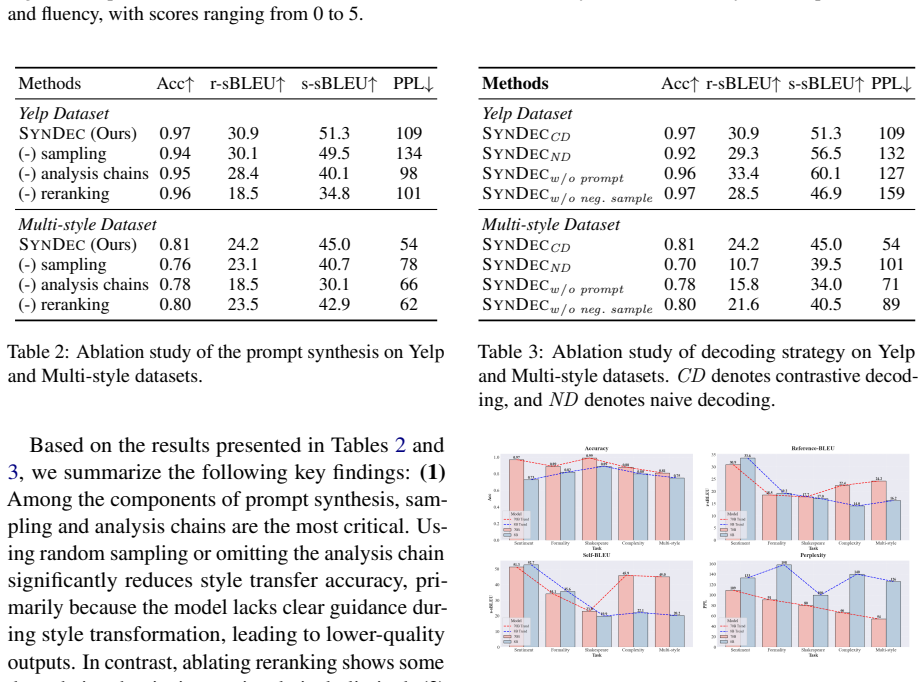
- The decoding stage is essential to the claimed result: swapping contrastive decoding for naive decoding drops style accuracy from 0.97 to 0.92 on Yelp and from 0.81 to 0.70 on the multi-style task.
- The method is not zero-shot: it requires a pool of source-target examples to sample from, and the paper names zero-shot operation as an explicit limitation.
- The newly constructed multi-style benchmark, negative Elizabethan English to positive modern English, is a harder test where the reported margin over the best baseline is largest (0.81 versus 0.71).
Reading between the lines
- The same synthesizing stage could be applied to any conditional text-generation task that has a corpus of input-output pairs, such as simplification, politeness rewriting, or persona-consistent dialogue; the paper only demonstrates style transfer.
- Because cluster centers are de-embedded into sentence pairs, the method's representativeness actually rests on how tight each cluster is, so a nearest-neighbor-to-center implementation would let the sampling step be tested independently of the rest of the pipeline.
- The contrastive-decoding objective is a general way to force a language model to follow instructions over its prior knowledge, so the decoding half may be reusable beyond style transfer even if the prompt-synthesis half is task-specific.
- A testable extension would be to generate synthetic few-shot examples with an LLM to bootstrap the sampling pool, which would remove the paper's stated zero-shot limitation.
Signed reviews
Editorial analysis
A structured set of objections, weighed in public.
Referee Report
Summary. The paper proposes SYNDEC, a two-stage approach for arbitrary textual style transfer with LLMs. In the synthesizing stage, it selects representative few-shot samples via clustering in a DGCN-based semantic-structural embedding space, analyzes those samples with an LLM across four dimensions (lexis, syntax, tone, semantics), and reranks the resulting analysis chains by similarity to the input. In the decoding stage, it applies a contrastive decoding objective that reweights the output distribution to amplify the influence of the synthesized prompt relative to a no-prompt condition and a negative sample. The method is evaluated on five existing benchmarks and a new multi-style dataset, reporting improvements over LLaMA-3, PEGF, and APR on most tasks. Ablation studies probe the contributions of the sampling, analysis chains, reranking, and contrastive decoding components.
Significance. If fully specified and reproducible, SYNDEC would be a useful contribution to automated prompt synthesis for textual style transfer and provides a new human-refined multi-style benchmark. The decoding equation (Eq. 5) is a valid reweighted probability distribution, and the ablation studies give informative evidence about the relative importance of the proposed components. The paper also benefits from clear problem definitions, a rigorous expert evaluation protocol with high inter-annotator agreement, and the release of a new multi-style dataset. However, the central performance claim is currently not verifiable because the sampling stage—which generates the few-shot prompts that drive the entire method—is critically underspecified. The DGCN encoder has trainable parameters with no described training procedure, and the mapping from cluster centroids back to natural language sentence pairs is undefined. Until these are resolved, the reported improvements cannot be attributed to the method as described.
major comments (4)
- [Section 3.3.1, Algorithm 1] The sampling stage is not executable as written. The DGCN encoder has trainable parameters (W, b, etc.) but no training loss, training data, or pretrained initialization is described; the text says the encoder is 'inspired by' prior GCN work, which does not specify whether a pretrained model is reused or learned. In addition, Algorithm 1 initializes cluster centers as data points, but the text states that 'centroids are iteratively updated until convergence' and line 12 then says 'De-embed cluster means {mu_k} into Q*' without defining the inverse of the DGCN embedding. Since the final centroids after iterative updates are arithmetic means in the embedding space, they are not original sentence pairs, and no mapping from centroids back to natural language is given. This gap is load-bearing: the synthesized prompt p, the reranking step (Section 3.3.3), and the negative-sample selection (Section 3.4.1) all depend on this embedding, so the entire experimental evaluation rests on an underspecified component. Please specify the DGCN training procedure (loss, data, initialization) and the exact de-embedding operation (e.g., nearest original pair to each centroid), and reconcile the pseudocode with the text.
- [Section 3.4.2] The trade-off parameters alpha and beta are tuned per dataset with Bayesian optimization, but their optimal values are not reported anywhere. Because Eq. (5) depends on these values, and the claimed improvements could be sensitive to them, the paper should report the selected hyperparameters (e.g., in a table or the supplementary) so that the experiments are reproducible.
- [Abstract and Section 4.2, Table 1] The claim that 'SYNDEC outperforms existing SOTA LLM-based methods on five out of six benchmarks' is ambiguous because each benchmark has two transfer directions and four metrics. From Table 1, in the S1→S2 direction SYNDEC has the highest or tied-highest accuracy on all six datasets (with a tie on Yelp), whereas in the S2→S1 direction it has the highest accuracy on five of six (Yelp is the exception). The claim should specify the direction and metric, and should note when a difference is not an improvement (e.g., Yelp S1→S2 accuracy ties APR, and PPL is worse on several rows).
- [Section 3.4.1] The construction of the negative sample s⁻ is also dependent on the underspecified semantic-structural joint embedding, and the source of the 'irrelevant context' is not described (only that it is pre-segmented with langchain). Please specify where this context comes from, how the similarity is computed, and how this selection interacts with the DGCN embedding.
minor comments (5)
- [Abstract and Section 1] The phrase 'up to 9% increase' should be phrased as '9 percentage points' to avoid confusion between relative and absolute improvement.
- [Equation (4) and surrounding text] The text after Eq. (4) refers to 'p+' but the equation uses 'p'; please unify the notation.
- [Section 3.4] The phrase 'response to x based solely on internal parameters' should clarify that this is the model's prediction without the prompt p.
- [Figure 2] The claim that SYNDEC's few-shots are 'closer' to manual ones than random sampling is not quantified; consider reporting a distance metric.
- [Section 4.1] The baseline descriptions state that all LLM-based methods use LLaMA3-70B, but it is not explicit that PEGF and APR are run with this backbone; please state this clearly.
Circularity Check
No circularity: SynDec is a constructive pipeline tested on external benchmarks; its underspecified de-embedding step is a correctness gap, not a circular reduction.
full rationale
SYNDEC does not derive its central claim from a fitted quantity. The decoding objective (Eq. 4) is introduced as a normalized contrastive combination of three conditional probabilities; it is a decoding rule, not a quantity that is fitted to the data it later predicts, so it cannot be circular by construction. The prompt-synthesis components (DGCN embedding, k-means++ sampling, LLM analysis chains, cosine reranking) are all constructive operations, and the paper's ablations remove them one at a time, which presupposes they are separable rather than definitionally identical. Alpha and beta are tuned per dataset by Bayesian optimization on validation splits (Section 3.4.2); this weakens the strength of the reported test numbers but is standard hyperparameter selection, not a fitted-input-called-prediction step. The reference list contains no self-citations from the present authors; the DGCN is credited to Vashishth et al. (2019) and Kumar et al. (2020), and contrastive decoding to Shi et al. (2024) and Zhao et al. (2024), so no load-bearing uniqueness theorem is imported from the authors' prior work. The one serious flaw in the pipeline is Algorithm 1 line 12: 'De-embed cluster means {µ_k} into Q*' is undefined because the DGCN embedding uses average pooling and ReLU, so centroids cannot generally be inverted to sentence pairs; the DGCN also has trainable parameters with no described training procedure. These are underspecifications that make the sampling stage non-executable as written, but they are not reductions of a claimed prediction to the inputs. Benchmark evaluation uses held-out 8:1:1 splits and external classifiers/LMs (RoBERTa-Large, SacreBLEU, GPT2-Large), so the headline comparison is not statistically forced. Accordingly, no circular step is present; score 0.
Assumptions & free parameters
free parameters (3)
- alpha =
not reported; initialized at 5 and tuned per dataset by Bayesian optimization
- beta =
not reported; initialized at 5 and tuned per dataset by Bayesian optimization
- K, number of clusters =
5 in Figure 2
assumptions (4)
- ad hoc to paper A trained DGCN encoder is available that produces the semantic-structural embeddings used for clustering and reranking.
- ad hoc to paper Cluster centroids in the embedding space can be mapped back to concrete natural language sentence pairs.
- domain assumption The fine-tuned RoBERTa classifier is a valid and unbiased measure of style transfer accuracy.
- domain assumption The LLM provides valid token-level probability distributions for all decoding terms in Eq. 5.
Cite this review
Pith. "Pith review of SynDec: A Synthesize-then-Decode Approach for Arbitrary Textual Style Transfer via Large Language Models." pith.science (2026). https://pith.science/paper/WN2IQXUT
@misc{pith2026250512821,
  author       = {Pith},
  title        = {Pith review of: SynDec: A Synthesize-then-Decode Approach for Arbitrary Textual Style Transfer via Large Language Models},
  year         = {2026},
  howpublished = {\url{https://pith.science/paper/WN2IQXUT}},
  note         = {Machine review of arXiv:2505.12821}
}
read the original abstract
Large Language Models (LLMs) are emerging as dominant forces for textual style transfer. However, for arbitrary style transfer, LLMs face two key challenges: (1) considerable reliance on manually-constructed prompts and (2) rigid stylistic biases inherent in LLMs. In this paper, we propose a novel Synthesize-then-Decode (SynDec) approach, which automatically synthesizes high-quality prompts and amplifies their roles during decoding process. Specifically, our approach synthesizes prompts by selecting representative few-shot samples, conducting a four-dimensional style analysis, and reranking the candidates. At LLM decoding stage, the TST effect is amplified by maximizing the contrast in output probabilities between scenarios with and without the synthesized prompt, as well as between prompts and negative samples. We conduct extensive experiments and the results show that SynDec outperforms existing state-of-the-art LLM-based methods on five out of six benchmarks (e.g., achieving up to a 9\% increase in accuracy for modern-to-Elizabethan English transfer). Detailed ablation studies further validate the effectiveness of SynDec.
Figures


Figures from the paper (2 more)

Reference graph
Works this paper leans on
-
[1]
Abien Fred Agarap. 2019. https://arxiv.org/abs/1803.08375 Deep learning using rectified linear units (relu) . Preprint, arXiv:1803.08375
arXiv 2019
-
[2]
David Arthur and Sergei Vassilvitskii. 2007. k-means++: the advantages of careful seeding. In Proceedings of the Eighteenth Annual ACM-SIAM Symposium on Discrete Algorithms, SODA '07, page 1027–1035
work page 2007
-
[3]
Tom Brown, Benjamin Mann, Nick Ryder, and Subbiah et al. 2020. Language models are few-shot learners. In NIPS, pages 1877--1901
work page 2020
-
[4]
Yung-Sung Chuang, Yujia Xie, Hongyin Luo, Yoon Kim, James R. Glass, and Pengcheng He. 2024. Dola: Decoding by contrasting layers improves factuality in large language models. In ICLR
work page 2024
-
[5]
Qingxiu Dong, Lei Li, Damai Dai, Ce Zheng, Zhiyong Wu, Baobao Chang, Xu Sun, Jingjing Xu, Lei Li, and Zhifang Sui. 2023. https://arxiv.org/abs/2301.00234 A survey on in-context learning . arXiv preprint arXiv:2301.00234
arXiv 2023
-
[6]
Aaron Grattafiori, Abhimanyu Dubey, Abhinav Jauhri, Abhinav Pandey, Abhishek Kadian, et al. 2024. The llama 3 herd of models. arXiv preprint arXiv:2407.21783
arXiv 2024
-
[7]
Biyang Guo, He Wang, Wenyilin Xiao, Hong Chen, ZhuXin Lee, Songqiao Han, and Hailiang Huang. 2024. Sample design engineering: An empirical study on designing better fine-tuning samples for information extraction with LLM s. In EMNLP, pages 573--594
work page 2024
-
[8]
Jingxuan Han, Quan Wang, Zikang Guo, Benfeng Xu, Licheng Zhang, and Zhendong Mao. 2024. Disentangled learning with synthetic parallel data for text style transfer. In ACL, pages 15187--15201
work page 2024
Show all 43 references
-
[9]
Ashutosh Kumar, Kabir Ahuja, Raghuram Vadapalli, and Partha Talukdar. 2020. Syntax-guided controlled generation of paraphrases. TACL, pages 329--345
2020
-
[10]
Sawan Kumar and Partha Talukdar. 2021. Reordering examples helps during priming-based few-shot learning. In ACL Findings, pages 4507--4518
2021
-
[11]
Wen Lai, Viktor Hangya, and Alexander Fraser. 2024. Style-specific neurons for steering LLM s in text style transfer. In EMNLP, pages 13427--13443
2024
-
[12]
Juncen Li, Robin Jia, He He, and Percy Liang. 2018. https://doi.org/10.18653/v1/N18-1169 Delete, retrieve, generate: a simple approach to sentiment and style transfer . In NAACL, pages 1865--1874
2018 doi
-
[13]
Pengfei Liu, Weizhe Yuan, Jinlan Fu, Zhengbao Jiang, Hiroaki Hayashi, and Graham Neubig. 2023. Pre-train, prompt, and predict: A systematic survey of prompting methods in natural language processing. ACM Comput. Surv., 55(9)
2023
-
[14]
Pusheng Liu, Lianwei Wu, Linyong Wang, Sensen Guo, and Yang Liu. 2024 a . Step-by-step: Controlling arbitrary style in text with large language models. In LREC-COLING, pages 15285--15295
2024
-
[15]
Qingyi Liu, Jinghui Qin, Wenxuan Ye, Hao Mou, Yuxuan He, and Keze Wang. 2024 b . Adaptive prompt routing for arbitrary text style transfer with pre-trained language models. In AAAI
2024
-
[16]
Yinhan Liu, Myle Ott, Naman Goyal, Jingfei Du, Mandar Joshi, Danqi Chen, Omer Levy, Mike Lewis, Luke Zettlemoyer, and Veselin Stoyanov. 2019. Roberta: A robustly optimized bert pretraining approach. arXiv preprint arXiv:1907.11692
2019 arXiv
-
[17]
Shayne Longpre, Kartik Perisetla, Anthony Chen, Nikhil Ramesh, Chris DuBois, and Sameer Singh. 2021. Entity-based knowledge conflicts in question answering. In EMNLP, pages 7052--7063
2021
-
[18]
I Loshchilov. 2017. Decoupled weight decay regularization. arXiv preprint arXiv:1711.05101
2017 arXiv
-
[19]
Rada Mihalcea and Hugo Liu. 2006. A corpus-based approach to finding happiness. In AAAI
2006
-
[20]
Sewon Min, Xinxi Lyu, Ari Holtzman, Mikel Artetxe, Mike Lewis, Hannaneh Hajishirzi, and Luke Zettlemoyer. 2022. Rethinking the role of demonstrations: What makes in-context learning work? In EMNLP, pages 11048--11064
2022
-
[21]
Remi Mir, Bjarke Felbo, Nick Obradovich, and Iyad Rahwan. 2019. https://doi.org/10.18653/v1/N19-1049 Evaluating style transfer for text . In NAACL, pages 495--504
2019 doi
-
[22]
OpenAI, Josh Achiam, Steven Adler, Sandhini Agarwal, Lama Ahmad, and Ilge Akkaya et al. 2024. https://arxiv.org/abs/2303.08774 Gpt-4 technical report . Preprint, arXiv:2303.08774
2024 arXiv
-
[23]
Phil Ostheimer, Mayank Nagda, Marius Kloft, and Sophie Fellenz. 2023. https://arxiv.org/abs/2308.13577 Text style transfer evaluation using large language models . arXiv preprint arXiv:2109.03910
2023 arXiv
-
[24]
Bo Pang and Lillian Lee. 2008. Opinion mining and sentiment analysis. Found. Trends Inf. Retr., 2:1--135
2008
-
[25]
Matt Post. 2018. https://doi.org/10.18653/v1/W18-6319 A call for clarity in reporting BLEU scores . In WMT, pages 186--191
2018 doi
-
[26]
Alec Radford, Jeffrey Wu, Rewon Child, David Luan, Dario Amodei, Ilya Sutskever, et al. 2019. Language models are unsupervised multitask learners. OpenAI blog, 1(8):9
2019
-
[27]
Emily Reif, Daphne Ippolito, Ann Yuan, Andy Coenen, Chris Callison-Burch, and Jason Wei. 2022. A recipe for arbitrary text style transfer with large language models. In ACL (Volume 2: Short Papers), pages 837--848
2022
-
[28]
Laria Reynolds and Kyle McDonell. 2021. Prompt programming for large language models: Beyond the few-shot paradigm. In CHI, pages 1--7
2021
-
[29]
Shamik Roy, Raphael Shu, Nikolaos Pappas, Elman Mansimov, Yi Zhang, Saab Mansour, and Dan Roth. 2023. Conversation style transfer using few-shot learning. arXiv preprint arXiv:2302.08362
2023 arXiv
-
[30]
Weijia Shi, Xiaochuang Han, Mike Lewis, Yulia Tsvetkov, Luke Zettlemoyer, and Wen-tau Yih. 2024. Trusting your evidence: Hallucinate less with context-aware decoding. In NAACL (Volume 2: Short Papers), pages 783--791
2024
-
[31]
Logan IV, Eric Wallace, and Sameer Singh
Taylor Shin, Yasaman Razeghi, Robert L. Logan IV, Eric Wallace, and Sameer Singh. 2020. A uto P rompt: E liciting K nowledge from L anguage M odels with A utomatically G enerated P rompts. In EMNLP, pages 4222--4235
2020
-
[32]
Mirac Suzgun, Luke Melas-Kyriazi, and Dan Jurafsky. 2022. Prompt-and-rerank: A method for zero-shot and few-shot arbitrary textual style transfer with small language models. In EMNLP, pages 2195--2222
2022
-
[33]
Hexiang Tan, Fei Sun, Wanli Yang, Yuanzhuo Wang, Qi Cao, and Xueqi Cheng. 2024. Blinded by generated contexts: How language models merge generated and retrieved contexts when knowledge conflicts? In ACL, pages 6207--6227
2024
-
[34]
Shikhar Vashishth, Manik Bhandari, Prateek Yadav, Piyush Rai, Chiranjib Bhattacharyya, and Partha Talukdar. 2019. Incorporating syntactic and semantic information in word embeddings using graph convolutional networks. In ACL, pages 3308--3318
2019
-
[35]
Lean Wang, Lei Li, Damai Dai, Deli Chen, Hao Zhou, Fandong Meng, Jie Zhou, and Xu Sun. 2023. Label words are anchors: An information flow perspective for understanding in-context learning. In EMNLP, pages 9840--9855
2023
-
[36]
Xing Wu, Tao Zhang, Liangjun Zang, Jizhong Han, and Songlin Hu. 2019. https://doi.org/10.24963/ijcai.2019/732 Mask and infill: Applying masked language model for sentiment transfer . In IJCAI, pages 5271--5277
2019 doi
-
[37]
Wei Xu, Courtney Napoles, Ellie Pavlick, Quanze Chen, and Chris Callison-Burch. 2016. Optimizing statistical machine translation for text simplification. TACL, pages 401--415
2016
-
[38]
Wei Xu, Alan Ritter, Bill Dolan, Ralph Grishman, and Colin Cherry. 2012. https://aclanthology.org/C12-1177 Paraphrasing for style . In COLING, pages 2899--2914
2012
-
[39]
Le, Denny Zhou, and Xinyun Chen
Chengrun Yang, Xuezhi Wang, Yifeng Lu, Hanxiao Liu, Quoc V. Le, Denny Zhou, and Xinyun Chen. 2023. Large language models as optimizers. arXiv preprint arXiv:2309.03409
2023 arXiv
-
[40]
Xiang Zhang, Junbo Zhao, and Yann LeCun. 2015. Character-level convolutional networks for text classification. In NIPS, pages 649–--657
2015
-
[41]
Zheng Zhao, Emilio Monti, Jens Lehmann, and Haytham Assem. 2024. Enhancing contextual understanding in large language models through contrastive decoding. In NAACL, pages 4225--4237
2024
-
[42]
online" 'onlinestring :=
ENTRY address archivePrefix author booktitle chapter edition editor eid eprint eprinttype howpublished institution journal key month note number organization pages publisher school series title type volume year doi pubmed url lastchecked label extra.label sort.label short.list...
-
[43]
write newline
" write newline "" before.all 'output.state := FUNCTION n.dashify 't := "" t empty not t #1 #1 substring "-" = t #1 #2 substring "--" = not "--" * t #2 global.max substring 't := t #1 #1 substring "-" = "-" * t #2 global.max substring 't := while if t #1 #1 substring * t #2 gl...
Reviewed August 15, 2026 · model on record in the stance chip above.
Discussion (0). Continue with ORCID to comment.