Arbitrary manipulation of nuclear spins in hexagonal boron nitride
Reviewed by Pith T0 review T1 audit T2 compute T3 formal T4 kernel 2026-06-28 06:19 UTCgrok-4.3pith:WNJIM5YIrecord.jsonopen to challenge →
The pith
A background magnetic field and multi-tone drive on the electron spin allow Hahn echo suppression of unwanted couplings so RF pulses can enact arbitrary gates on neighboring nuclear spins.
A machine-rendered reading of the paper's core claim, the machinery that carries it, and where it could break.
Core claim
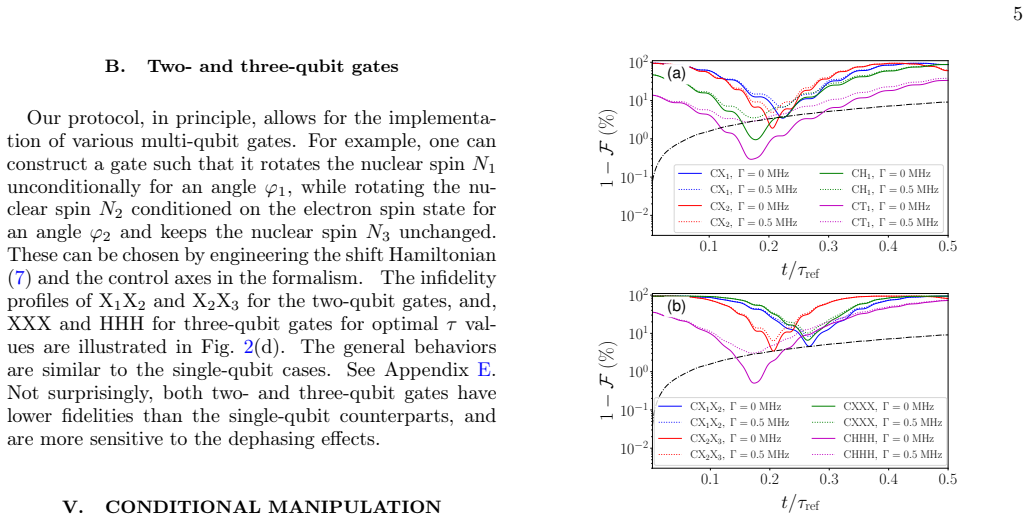
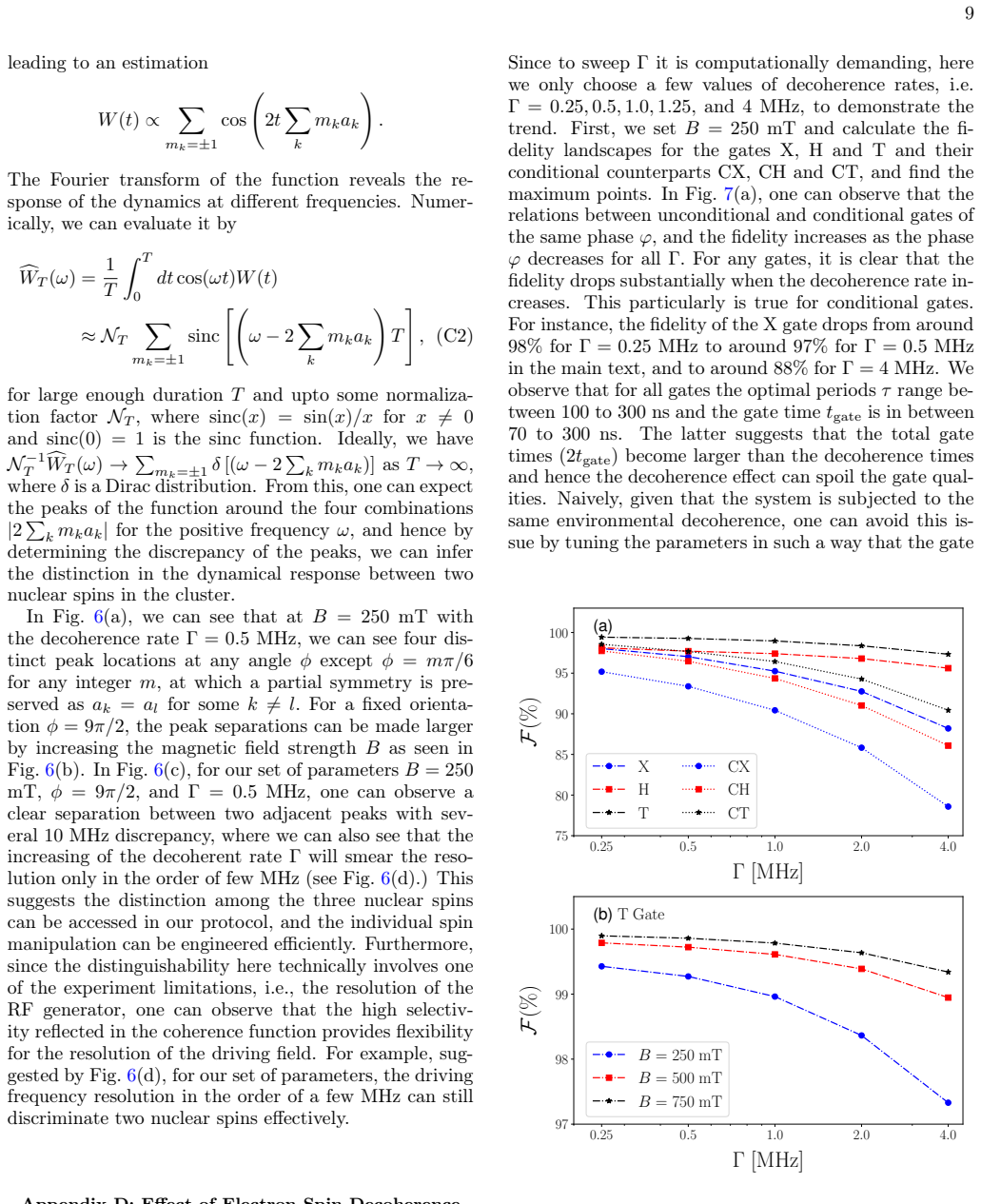
By applying a background magnetic field and a multi-tone continuous drive, the electron spin coupling to the nuclei can be efficiently engineered. This allows for suppressing the undesired electron-nuclear interactions through the Hahn echo pulse sequence. The target gates are then implemented by employing proper RF drives. Numerical results for realistic parameters show gate fidelities as high as 99% for single-qubit and 95% for multi-qubit gates, with execution durations less than 300 ns that evade electron spin decoherence effects.
What carries the argument
Multi-tone continuous drive on the electron spin, combined with a Hahn echo sequence, to engineer and selectively suppress couplings to neighboring nuclear spins.
If this is right
- Single-qubit nuclear spin gates reach fidelities as high as 99%.
- Multi-qubit nuclear spin gates reach fidelities as high as 95%.
- All gates finish in less than 300 ns, avoiding electron spin decoherence.
- The electron spin functions only as a temporary auxiliary and need not maintain coherence throughout the nuclear operations.
Where Pith is reading between the lines
- The same drive-engineering approach could be tested on other defect centers in two-dimensional materials to control their nuclear environments.
- Optical initialization and readout of the electron spin could be combined with these gates to create hybrid nuclear-electron quantum registers.
- If the drive stability holds at larger scales, the protocol might support small nuclear spin clusters for quantum sensing applications in van der Waals layers.
Load-bearing premise
The multi-tone continuous drive and Hahn echo sequence can be realized experimentally with the precision and stability assumed in the numerical model, without introducing unmodeled noise sources or deviations from the idealized spin Hamiltonian that would degrade the reported fidelities.
What would settle it
An experiment applying the multi-tone drive and Hahn echo to a V_B^- center in hBN and measuring nuclear spin gate fidelities substantially below 90% for single-qubit operations would show the protocol does not achieve the modeled performance.
Figures




read the original abstract
Due to its localized nature and controllability, the negatively charged boron vacancy centers (V$_\text{B}^-$) in hexagonal boron nitride (hBN) are a promising spin platform for accessing its neighboring nuclei with potential for performing quantum computational tasks. However, the methods of utilizing and manipulating the nuclear spins are still lacking. In this work, we propose a protocol for the preparation of single- and multi-qubit gates on the nuclear spins, utilizing the electron spin as an auxiliary qubit. By applying a background magnetic field and a multi-tone continuous drive, we show that the electron spin coupling to the nuclei can be efficiently engineered. This allows for suppressing the undesired electron-nuclear interactions through the Hahn echo pulse sequence. The target gates are then implemented by employing proper RF drives. Our numerical results for realistic parameters show gate fidelities as high as $99\%$ for single-qubit and $95\%$ for multi-qubit gates. With the gate execution durations being less than $300$ ns, our protocol evades electron spin decoherence effects. Therefore, our scheme sets the stage for the practical application of V$_\text{B}^-$ in hBN for quantum computation purposes.
Editorial analysis
A structured set of objections, weighed in public.
Referee Report
Summary. The manuscript proposes a protocol for arbitrary single- and multi-qubit gates on nuclear spins surrounding V_B^- centers in hBN. A background magnetic field combined with multi-tone continuous driving engineers the electron-nuclear couplings; a Hahn echo sequence then suppresses unwanted terms, after which RF drives implement the target gates. Numerical integration of the resulting effective Hamiltonian with realistic parameters is reported to yield gate fidelities up to 99% (single-qubit) and 95% (multi-qubit) with durations below 300 ns, thereby evading electron-spin decoherence.
Significance. If the numerical fidelities prove reproducible under the stated assumptions, the work would supply a concrete control method for nuclear spins in hBN, a platform whose localized defects are otherwise attractive for quantum information tasks. The protocol assembles standard elements (multi-tone driving, Hahn echo, RF gates) without introducing new ad-hoc entities, which is a modest strength; however, the absence of the explicit Hamiltonian, parameter values, and optimization details prevents assessment of whether the result is parameter-free or merely fitted.
major comments (1)
- [Abstract and numerical-results section] Abstract and numerical-results section: the central claims of 99% and 95% fidelities rest on numerical simulations, yet the manuscript supplies neither the explicit engineered Hamiltonian, the numerical values of the 'realistic parameters,' the optimization procedure for the multi-tone amplitudes/frequencies, nor any robustness analysis against drive amplitude/phase noise. Without these elements the quoted performance cannot be independently verified and the assertion that the protocol 'evades electron spin decoherence effects' remains untestable.
minor comments (1)
- [Abstract] The abstract states that 'our numerical results for realistic parameters show gate fidelities…' but does not reference the section or table containing those parameters or the simulation code.
Simulated Author's Rebuttal
We thank the referee for the careful reading of our manuscript and the constructive feedback. We address the single major comment below and will incorporate the requested details into a revised version.
read point-by-point responses
-
Referee: [Abstract and numerical-results section] Abstract and numerical-results section: the central claims of 99% and 95% fidelities rest on numerical simulations, yet the manuscript supplies neither the explicit engineered Hamiltonian, the numerical values of the 'realistic parameters,' the optimization procedure for the multi-tone amplitudes/frequencies, nor any robustness analysis against drive amplitude/phase noise. Without these elements the quoted performance cannot be independently verified and the assertion that the protocol 'evades electron spin decoherence effects' remains untestable.
Authors: We agree that the current manuscript lacks sufficient detail for independent verification of the numerical results. In the revised version we will add the explicit form of the effective Hamiltonian obtained after the multi-tone continuous drive and Hahn-echo suppression, tabulate all numerical values of the realistic parameters (magnetic field, hyperfine tensors, drive amplitudes, frequencies, and pulse timings), describe the numerical optimization procedure used to select the multi-tone components, and include a new subsection quantifying robustness against realistic drive-amplitude and phase noise. These additions will make the reported 99 % and 95 % fidelities reproducible and will explicitly demonstrate that the sub-300 ns gate times are much shorter than the electron coherence time, thereby supporting the claim that electron-spin decoherence is evaded under the stated assumptions. revision: yes
Circularity Check
No circularity: protocol uses standard control elements; fidelities from independent numerical integration
full rationale
The paper presents a protocol built from background field, multi-tone drive, Hahn echo, and RF gates applied to a known V_B^- spin system in hBN. Gate fidelities (99% single-qubit, 95% multi-qubit) and durations (<300 ns) are obtained by numerical integration of the engineered effective Hamiltonian using stated realistic parameters. No equation reduces an output fidelity to a quantity defined by the same fitted parameters used as input, no self-citation chain bears the central claim, and the derivation does not rename a known result or smuggle an ansatz. The modeling assumptions are explicit and externally falsifiable, so the result is self-contained against external benchmarks.
Axiom & Free-Parameter Ledger
free parameters (1)
- multi-tone drive amplitudes and frequencies
axioms (1)
- domain assumption The electron-nuclear spin system is accurately described by a time-dependent Hamiltonian under applied magnetic field and continuous drives.
Reference graph
Works this paper leans on
-
[1]
T. T. Tran, K. Bray, M. J. Ford, M. Toth, and I. Aharonovich, Quantum emission from hexagonal boron nitride monolayers, Nat. Nanotechnol.11, 37 (2015)
2015
-
[2]
Gottscholl, M
A. Gottscholl, M. Diez, V. Soltamov, C. Kasper, A. Sper- lich, M. Kianinia, C. Bradac, I. Aharonovich, and V. Dyakonov, Room temperature coherent control of spin defects in hexagonal boron nitride, Sci. Adv.7, eabf3630 (2021)
2021
-
[3]
H. L. Stern, Q. Gu, J. Jarman, S. Eizagirre Barker, N. Mendelson, D. Chugh, S. Schott, H. H. Tan, H. Sirringhaus, I. Aharonovich, and M. Atatüre, Room- temperature optically detected magnetic resonance of single defects in hexagonal boron nitride, Nat. Commun. 13, 618 (2022)
2022
-
[4]
Z. Mu, H. Cai, D. Chen, J. Kenny, Z. Jiang, S. Ru, X. Lyu, T. S. Koh, X. Liu, I. Aharonovich, and W. Gao, Excited-state optically detected magnetic resonance of spin defects in hexagonal boron nitride, Phys. Rev. Lett. 128, 216402 (2022)
2022
-
[5]
Abdi, J.-P
M. Abdi, J.-P. Chou, A. Gali, and M. B. Plenio, Color centers in hexagonal boron nitride monolayers: A group theory and ab initio analysis, ACS Photonics5, 1967 (2018)
1967
-
[6]
Sajid, M
A. Sajid, M. J. Ford, and J. R. Reimers, Single-photon emitters in hexagonal boron nitride: a review of progress, Rep. Prog. Phys.83, 044501 (2020)
2020
-
[7]
Gottscholl, M
A. Gottscholl, M. Kianinia, V. Soltamov, S. Orlin- skii, G. Mamin, C. Bradac, C. Kasper, K. Krambrock, A. Sperlich, M. Toth, I. Aharonovich, and V. Dyakonov, Initialization and read-out of intrinsic spin defects in a van der waals crystal at room temperature, Nat. Mater. 19, 540 (2020)
2020
-
[8]
Çakan, C
A. Çakan, C. Cholsuk, A. Gale, M. Kianinia, S. Paçal, S. Ateş, I. Aharonovich, M. Toth, and T. Vogl, Quantum optics applications of hexagonal boron nitride defects, Advanced Optical Materials13, 2402508 (2025)
2025
-
[9]
Ahmadi, S
N. Ahmadi, S. Schwertfeger, P. Werner, L. Wiese, J. Lester, E. Da Ros, J. Krause, S. Ritter, M. Abasi- fard, C.Cholsuk, R.G.Krämer, S.Atzeni, M.Gündoğan, S. Sachidananda, D. Pardo, S. Nolte, A. Lohrmann, A. Ling, J. Bartholomäus, G. Corrielli, M. Krutzik, and T. Vogl, Quick33 - design of a satellite-based quantum light source for quantum communication and...
2024
-
[10]
Cholsuk, S
C. Cholsuk, S. Suwanna, and T. Vogl, Tailoring the emis- sion wavelength of color centers in hexagonal boron ni- tride for quantum applications, Nanomaterials12, 2427 (2022)
2022
-
[11]
Wolfowicz, F
G. Wolfowicz, F. J. Heremans, C. P. Anderson, S. Kanai, H. Seo, A. Gali, G. Galli, and D. D. Awschalom, Quan- tum guidelines for solid-state spin defects, Nat. Rev. Mater.6, 906 (2021)
2021
-
[12]
Chejanovsky, M
N. Chejanovsky, M. Rezai, F. Paolucci, Y. Kim, T. Rendler, W. Rouabeh, F. Fávaro de Oliveira, P. Her- linger, A. Denisenko, S. Yang, I. Gerhardt, A. Finkler, J. H. Smet, and J. Wrachtrup, Structural attributes and photodynamics of visible spectrum quantum emitters in hexagonal boron nitride, Nano Lett.16, 7037 (2016)
2016
-
[13]
Dollar, A
N.V.Proscia, Z.Shotan, H.Jayakumar, P.Reddy, C.Co- hen, M. Dollar, A. Alkauskas, M. Doherty, C. A. Mer- iles, and V. M. Menon, Near-deterministic activation of room-temperature quantum emitters in hexagonal boron nitride, Optica5, 1128 (2018)
2018
-
[14]
A. L. Exarhos, D. A. Hopper, R. N. Patel, M. W. Do- herty, and L. C. Bassett, Magnetic-field-dependent quan- tum emission in hexagonal boron nitride at room temper- ature, Nat. Commun.10, 222 (2019)
2019
-
[15]
F. T. Tabesh, Q. Hassanzada, M. Hadian, A. Hashemi, I. Abdolhosseini Sarsari, and M. Abdi, Strain induced coupling and quantum information processing with hexagonalboronnitridequantumemitters,QuantumSci. Technol.7, 015002 (2021)
2021
-
[16]
Liu and M
X. Liu and M. C. Hersam, 2d materials for quantum in- formation science, Nat. Rev. Mater.4, 669 (2019)
2019
-
[17]
Abdi, Continuous-variable multipartite vibrational entanglement, Phys
M. Abdi, Continuous-variable multipartite vibrational entanglement, Phys. Rev. A103, 043520 (2021)
2021
-
[18]
Kianinia, S
M. Kianinia, S. White, J. E. Fröch, C. Bradac, and I. Aharonovich, Generation of spin defects in hexagonal boron nitride, ACS Photonics7, 2147 (2020)
2020
-
[19]
A. B. Shaik and P. Palla, Optical quantum technologies with hexagonal boron nitride single photon sources, Sci. Rep.11, 12285 (2021)
2021
-
[20]
X. Gao, B. Jiang, A. E. Llacsahuanga Allcca, K. Shen, M. A. Sadi, A. B. Solanki, P. Ju, Z. Xu, P. Upad- hyaya, Y. P. Chen, S. A. Bhave, and T. Li, High-contrast plasmonic-enhanced shallow spin defects in hexagonal boron nitride for quantum sensing, Nano Lett.21, 7708 (2021)
2021
-
[21]
Mendelson, R
N. Mendelson, R. Ritika, M. Kianinia, J. Scott, S. Kim, J. E. Fröch, C. Gazzana, M. Westerhausen, L. Xiao, S. S. Mohajerani, S. Strauf, M. Toth, I. Aharonovich, and Z. Xu, Coupling spin defects in a layered material to nanoscale plasmonic cavities, Adv. Mater.34, 2106046 (2021)
2021
-
[22]
N.-J. Guo, W. Liu, Z.-P. Li, Y.-Z. Yang, S. Yu, Y. Meng, Z.-A. Wang, X.-D. Zeng, F.-F. Yan, Q. Li, J.-F. Wang, J.-S. Xu, Y.-T. Wang, J.-S. Tang, C.-F. Li, and G.-C. Guo, Generation of spin defects by ion implantation in hexagonal boron nitride, ACS Omega7, 1733 (2022)
2022
-
[23]
Vaidya, X
S. Vaidya, X. Gao, S. Dikshit, I. Aharonovich, and T. Li, Quantumsensingandimagingwithspindefectsinhexag- onal boron nitride, Adv. Phys.: X8, 2206049 (2023)
2023
-
[24]
S. Das, A. L. Melendez, I.-H. Kao, J. A. García-Monge, 16 D. Russell, J. Li, K. Watanabe, T. Taniguchi, J. H. Edgar, J. Katoch, F. Yang, P. C. Hammel, and S. Singh, Quantum sensing of spin dynamics using boron-vacancy centers in hexagonal boron nitride, Phys. Rev. Lett.133, 166704 (2024)
2024
-
[25]
D. Wong, J. Velasco, L. Ju, J. Lee, S. Kahn, H.-Z. Tsai, C. Germany, T. Taniguchi, K. Watanabe, A. Zettl, F. Wang, and M. F. Crommie, Characterization and ma- nipulation of individual defects in insulating hexagonal boron nitride using scanning tunnelling microscopy, Nat. Nanotechnol.10, 949 (2015)
2015
-
[26]
X. Gao, S. Vaidya, K. Li, P. Ju, B. Jiang, Z. Xu, A. E. L. Allcca, K. Shen, T. Taniguchi, K. Watanabe, S. A. Bhave, Y. P. Chen, Y. Ping, and T. Li, Nuclear spin polarization and control in hexagonal boron nitride, Nat. Mater.21, 1024 (2022)
2022
-
[27]
F. T. Tabesh, M. Fani, J. S. Pedernales, M. B. Plenio, andM.Abdi,Activehyperpolarizationofthenuclearspin lattice: Application to hexagonal boron nitride color cen- ters, Phys. Rev. B107, 214307 (2023)
2023
-
[28]
Sakuldee and M
F. Sakuldee and M. Abdi, Synchronous manipulation of nuclear spins via boron-vacancy centers in hexagonal boron nitride, Phys. Rev. Appl.24, 024036 (2025)
2025
-
[29]
W. Lee, V. S. Liu, Z. Zhang, S. Kim, R. Gong, X. Du, K. Pham, T. Poirier, Z. Hao, J. H. Edgar, P. Kim, C. Zu, E. J. Davis, and N. Y. Yao, Intrinsic high-fidelity spin polarization of charged vacancies in hexagonal boron ni- tride, Phys. Rev. Lett.134, 096202 (2025)
2025
-
[30]
Z. Liu, R. Gong, B. Huang, Y. Jin, X. Du, G. He, E. Janzen, L. Yang, E. A. Henriksen, J. H. Edgar, G. Galli, and C. Zu, Temperature-dependent spin- phonon coupling of boron-vacancy centers in hexagonal boron nitride, Phys. Rev. B111, 024108 (2025)
2025
-
[31]
Ivády, G
V. Ivády, G. Barcza, G. Thiering, S. Li, H. Hamdi, J.- P. Chou, O. Legeza, and A. Gali, Ab initio theory of the negatively charged boron vacancy qubit in hexagonal boron nitride, npj Comput. Mater.6, 41 (2020)
2020
-
[32]
I. N. Gracheva, F. F. Murzakhanov, G. V. Mamin, M. A. Sadovnikova, B. F. Gabbasov, E. N. Mokhov, and M. R. Gafurov, Symmetry of the hyperfine and quadrupole in- teractions of boron vacancies in a hexagonal boron ni- tride, J. Phys. Chem. C127, 3634 (2023)
2023
-
[33]
Sakuldee and M
F. Sakuldee and M. Abdi, Arbitrary manipulation of nu- clear spins in hexagonal boron nitride: Supplemental ma- terial,URL_will_be_inserted_by_publisher
-
[34]
E. L. Hahn, Spin echoes, Phys. Rev.80, 580 (1950)
1950
-
[35]
M. A. Nielsen, A simple formula for the average gate fidelity of a quantum dynamical operation, Phys. Lett. A 303, 249 (2002)
2002
-
[36]
M. A. Nielsen and I. L. Chuang,Quantum Computa- tion and Quantum Information: 10th Anniversary Edi- tion(Cambridge University Press, 2010)
2010
-
[37]
Gilchrist, N
A. Gilchrist, N. K. Langford, and M. A. Nielsen, Distance measures to compare real and ideal quantum processes, Phys. Rev. A71, 062310 (2005)
2005
-
[38]
A. J. Ramsay, R. Hekmati, C. J. Patrickson, S. Baber, D. R. M. Arvidsson-Shukur, A. J. Bennett, and I. J. Lux- moore, Coherence protection of spin qubits in hexagonal boron nitride, Nat. Commun.14, 461 (2023)
2023
-
[39]
Johansson, P
J. Johansson, P. Nation, and F. Nori, Qutip: An open- source python framework for the dynamics of open quan- tumsystems,Comput.Phys.Commun.183,1760(2012)
2012
-
[40]
Johansson, P
J. Johansson, P. Nation, and F. Nori, Qutip 2: A python framework for the dynamics of open quantum systems, Comput. Phys. Commun.184, 1234 (2013)
2013
-
[41]
Shor, Fault-tolerant quantum computation, inPro- ceedings of 37th Conference on Foundations of Computer Science(1996) pp
P. Shor, Fault-tolerant quantum computation, inPro- ceedings of 37th Conference on Foundations of Computer Science(1996) pp. 56–65
1996
-
[42]
D. M. Greenberger, M. A. Horne, A. Shimony, and A. Zeilinger, Bell’s theorem without inequalities, Am. J. Phys.58, 1131 (1990)
1990
-
[43]
J. F. Haase, Z.-Y. Wang, J. Casanova, and M. B. Ple- nio, Soft quantum control for highly selective interac- tions among joint quantum systems, Phys. Rev. Lett. 121, 050402 (2018)
2018
-
[44]
Engineering Precise and Robust Effective Hamiltonians
J. Chen and D. Cory, Engineering precise and ro- bust effective hamiltonians, arXiv:2506.20730 [quant-ph] (2025)
work page internal anchor Pith review Pith/arXiv arXiv 2025
-
[45]
Jin and J
Z.-Y. Jin and J. Jing, Universal perspective on nonadia- batic quantum control, Phys. Rev. A111, 012406 (2025)
2025
-
[46]
F. F. Murzakhanov, G. V. Mamin, S. B. Orlin- skii, U. Gerstmann, W. G. Schmidt, T. Biktagirov, I. Aharonovich, A. Gottscholl, A. Sperlich, V. Dyakonov, and V. A. Soltamov, Electron–nuclear coherent coupling and nuclear spin readout through optically polarized vb– spin states in hbn, Nano Lett.22, 2718 (2022)
2022
-
[47]
Haase, D
J. Haase, D. Eckert, H. Siegel, H. Eschrig, K. Müller, and F. Steglich, High-field nmr in pulsed magnets, Solid State Nuclear Magnetic Resonance23, 263 (2003)
2003
-
[48]
Kühne and Y
H. Kühne and Y. Ihara, Nuclear magnetic resonance spectroscopy in pulsed magnetic fields, Contemporary Physics65, 40 (2024)
2024
-
[49]
V. F. T. J. Chacko, A. Louis-Joseph, and D. Abergel, Multimode masers of thermally polarized nuclear spins in solution nmr, Phys. Rev. Lett.133, 158001 (2024)
2024
-
[50]
maser-in-a-shoebox
W. Ng, Y. Wen, M. Attwood, D. C. Jones, M. Oxborrow, N. M. Alford, and D. M. Arroo, “maser-in-a-shoebox”: A portable plug-and-play maser device at room temper- ature and zero magnetic field, Applied Physics Letters 124, 044004 (2024)
2024
-
[51]
C. W. Zollitsch and J. D. Breeze, Quantum theory of the diamond maser: Stimulated and superradiant emission, Phys. Rev. A111, 053714 (2025)
2025
-
[52]
J. D. Breeze, E. Salvadori, J. Sathian, N. M. Alford, and C. W. M. Kay, Continuous-wave room-temperature dia- mond maser, Nature555, 493 (2018)
2018
-
[53]
S. Ru, L. An, H. Liang, Z. Jiang, Z. Li, X. Lyu, F. Zhou, H. Cai, Y. Yang, R. He, R. Cernansky, E. H. T. Teo, M. Mukherjee, A. A. Bettiol, J. Zúñiga Perez, F. Jelezko, and W. Gao, Room-temperature electrical readout of spin defects in van der waals materials, Phys. Rev. Lett. 135, 220802 (2025)
2025
discussion (0)
Sign in with ORCID, Apple, or X to comment. Anyone can read and Pith papers without signing in.