REVIEW 3 major objections 5 minor 23 references
A progressive checkerboard ordering makes serial step count the dominant factor in autoregressive image generation.
Reviewed by Pith at T0; open to challenge. T0 means a machine referee read the full paper against a public rubric. the ladder, T0–T4 →
T0 review · deepseek-v4-flash
2026-08-03 04:49 UTC pith:WNJWVJ5K
load-bearing objection A clean new sampling order and a useful empirical regularity, but the 'total steps dominate' claim is overinterpreted; worth citing with care. the 3 major comments →
Progressive Checkerboards for Autoregressive Multiscale Image Generation
The pith
A machine-rendered reading of the paper's core claim, the machinery that carries it, and where it could break.
Core claim
The paper's central claim is that for a balanced multiscale autoregressive model, the total number of steps in the conditional chain is the dominant performance factor. Evidence comes from training the same small model with scale-up factors sqrt(2), 2, 3, and 4, plus a single-scale baseline, then evaluating each at various step counts. When plotted against total steps, the FID curves for scale ratios 2, 3, and 4 overlap tightly, all outperforming the single-scale baseline; only the slow sqrt(2) ratio and the baseline lag behind. This indicates that a wide range of scale-up factors are interchangeable as long as the serial budget is fixed, with best performance near 17 total steps.
What carries the argument
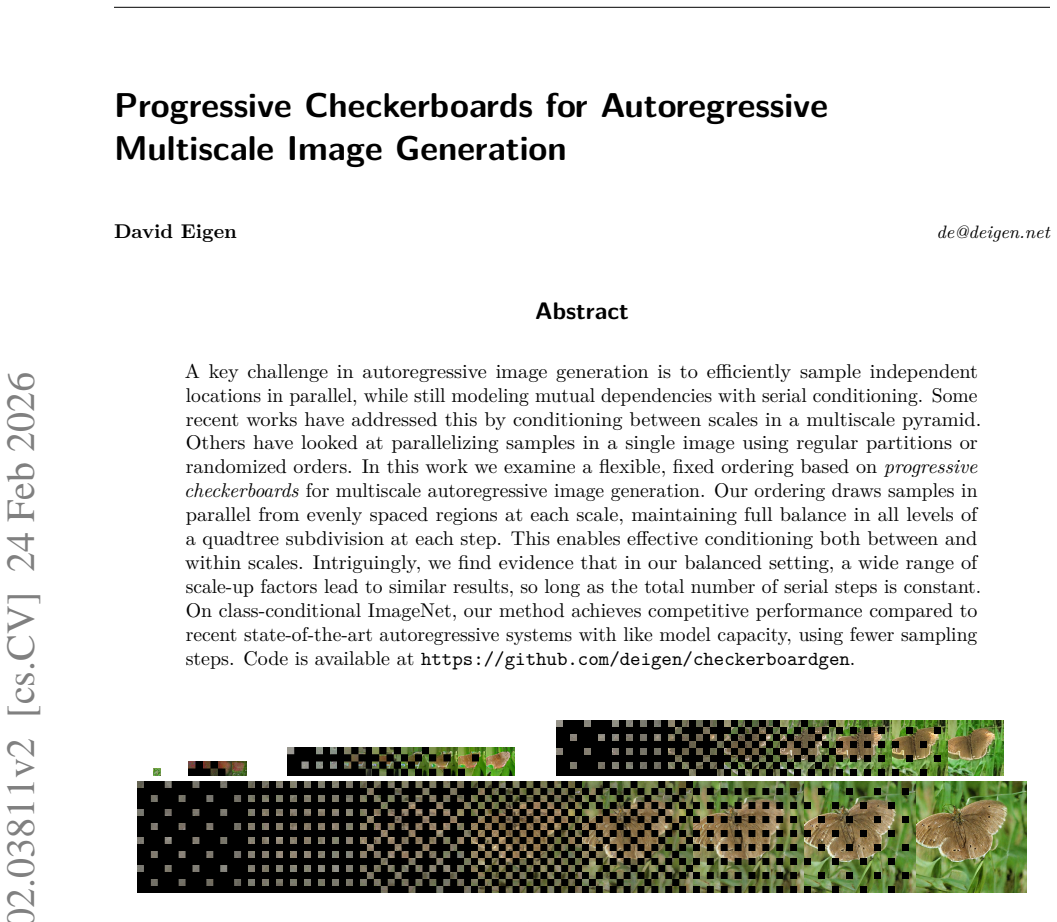
The progressive checkerboard scan order is built by recursively subdividing the image grid into quadrants and merging the quadrants' location lists round-robin with a diagonal skip pattern (top-left, bottom-right, top-right, bottom-left). This yields a spatial ordering where every prefix draws an evenly balanced set of locations across all quadtree levels. Dividing the order into contiguous blocks gives the sampling steps: tokens within a block are generated independently in parallel, while blocks are serialized and condition on all previous blocks and scales. This machinery turns the choice of scale-up factor and steps-per-scale into a single effective axis—total serial steps.
Load-bearing premise
The method assumes that briefly fine-tuning only the VAE quantizer codebook (with the encoder and decoder frozen, for one epoch on varied image sizes) yields per-scale latent codes that stay consistent with the frozen encoder and decoder; if this retraining misaligns scales, the multiscale conditioning—and the total-steps equivalence—could break.
What would settle it
Train the same checkerboard model with scale factors 2 and 4, but skip or extend the codebook fine-tuning (e.g., keep the original codebook or train for five epochs), then compare FID at identical total step counts under identical CFG sweeps. If the FID curves no longer overlap, the total-steps equivalence depends on that specific codebook retraining rather than on the ordering itself.
If this is right
- Practitioners can choose scale-up factors for computational convenience (e.g., 4x with fewer scale levels) without sacrificing FID, as long as the total step count stays near 17.
- At 17 steps the method reaches an ImageNet FID of 2.72, improving on earlier parallel-autoregressive baselines that used 88–147 steps, while running in 0.52 seconds per image.
- The result suggests the effective bottleneck in autoregressive visual generation is the number of serial conditioning steps, not the spatial granularity of the pyramid.
- Because the ordering inherently includes coarse-to-fine conditioning, it may allow aggressive scale-up factors that previously required slow scale ratios or additional correction models.
Where Pith is reading between the lines
- This finding hints at a general design principle: any sampling order that maintains spatial balance across scales should exhibit similar step-count scaling; other orderings could be tested by measuring FID versus total steps while varying the decomposition.
- The entropy analysis shows checkerboard patterns in token distributions, suggesting the model concentrates uncertainty at the next-to-be-sampled locations; this could inform adaptive step allocation strategies.
- If the total-step equivalence transfers across tokenizers and datasets, it would decouple pyramid design from sampling budget, potentially streamlining architectures for high-resolution generation.
Editorial analysis
A structured set of objections, weighed in public.
Referee Report
Summary. The paper proposes 'Progressive Checkerboards,' a multiscale autoregressive image generation method that uses a spatially balanced, fixed checkerboard ordering to sample tokens in parallel within scales while retaining serial conditioning between and within scales. The method is evaluated on class-conditional ImageNet 256x256 and reports competitive FID/IS with only 17 sampling steps. The central empirical claim is that, in this balanced setting, scale-up factors of 2, 3, and 4 yield similar performance when the total number of serial steps is held constant, implying that total step count is the dominant performance factor.
Significance. If the total-steps-invariance claim is correct, it is a practically useful design principle for multiscale autoregressive models, allowing large scale-up factors without requiring slow scaling. The paper also contributes a simple, clearly described progressive checkerboard ordering and demonstrates competitive results against recent AR-VQ baselines at fewer steps. The code release, ablations over scale ratios and step counts, and entropy analysis are valuable elements. However, the central claim is currently supported only by a confounded comparison, and one benchmark statement is inconsistent with the reported numbers.
major comments (3)
- [Sec 4.3 / Fig. 5] The claim that 'the total number of steps in the conditional chain is the dominant performance factor' is not directly established by the presented experiments. Each FID curve in Fig. 5 is generated by varying the uniform steps-per-scale for a fixed scale ratio, so total steps are varied simultaneously with the number of scales, the per-scale block counts, and the full-resolution block size. The overlap of the ratio-2, -3, and -4 curves is consistent with total-steps dominance, but it is also consistent with a trade-off between scale count and within-scale parallelism. To support the causal claim, the paper needs a within-ratio allocation control: for a fixed scale ratio and fixed total step budget, vary the number of steps allocated to each scale (nonuniform allocation) and show performance is unchanged; alternatively, compare ratios at multiple matched total-step counts while reporting
- [Sec 4.2 / Table 1] The text states: 'we achieve similar or better FID and IS' compared to PAR and RandAR. Table 1 reports Checkerboard-L 2x cfg=1.4 FID = 2.72 versus RandAR-L FID = 2.55, which is worse, not similar or better. Only the IS is higher (302.5 vs 288.8). This is a factual inconsistency in a direct comparison and should be corrected, for example by saying 'similar FID, higher IS, fewer steps and faster inference' or by rephrasing the comparison.
- [Sec 4.1] The VAE codebook retraining procedure (freezing all layers except the 4096-code quantizer, training one epoch on random sizes 16–256 with L2 loss) is a critical component of the method, but the paper provides no evidence that it preserves reconstruction quality or that the per-scale latent codes remain consistent with the frozen encoder and decoder. If this one-epoch retraining degrades reconstruction or causes scale misalignment, the multiscale conditioning and the absolute FID values in Table 1 would be affected. Please report reconstruction metrics (e.g., rFID or PSNR) before and after retraining, or provide an ablation that evaluates the model without this retraining step.
minor comments (5)
- [Sec 3.2 / Algorithm 1] The description 'round-robin selection with a diagonal skip-step pattern (i.e., TL, BR, TR, BL)' is ambiguous. Clarify whether the zip order is exactly [TL, BR, TR, BL] and how the algorithm handles non-power-of-two grid sizes (the current text says the order is generated on the next power of two, but the recursion in Algorithm 1 assumes size is a power of two).
- [Sec 4.2 / Table 1] The 4x L model is initialized from the 2x model and trained for 30 epochs, while the 2x model is trained from scratch for 200 epochs. This difference in training budget and initialization should be stated as a caveat when comparing the 2x and 4x rows, since the near-equal FID may partly reflect the different training protocols.
- [Sec 4.4 / Table 2] Specify the inference step configuration (scale ratio, steps per scale) used for the RoPE-mixing comparison. The FID values in Table 2 (around 5.3) are substantially higher than the S-model results in Fig 5, so the reader cannot directly relate this ablation to the main experiments.
- [Sec 3.1] The claim 'We randomize P during training to allow different degrees of parallelism at inference time' is not accompanied by any details on the distribution or range of P, nor by an ablation verifying that training with randomized P transfers to the specific P values used at inference. Please provide this information.
- [Throughout] Minor wording/notational issues: Sec 4.1 has 'retrain the just the codebook layer' (doubled article); Sec 2.1 uses '3√2' for the cube root of 2, which should be written \sqrt[3]{2}; and the footnote marker in Table 1 appears without a corresponding footnote in the text.
Circularity Check
No significant circularity: the central scaling claim is an empirical observation, not a derivation that reduces to its inputs.
full rationale
I walked the paper's claimed derivation chain. The central claim in Sec. 4.3—'the total number of steps in the conditional chain is the dominant performance factor'—is presented as an inductive reading of Fig. 5, where different scale-up factors (2, 3, 4) overlap when plotted against total sampling steps. This is an empirical pattern from experiments on ImageNet with external FID/IS evaluation, not a quantity derived from a fitted parameter or from an equation that defines total steps in terms of performance. No load-bearing self-citation exists: the paper is single-authored and its references are to prior external work; the method's progressive checkerboard ordering is introduced as a proposed algorithm. The VAE codebook fine-tuning in Sec. 4.1 is a training-setup premise, not a fitted input that is later renamed as a prediction. The RoPE-mixing section explicitly reports no performance gains, which is an honest null result rather than a circular justification. The strongest possible concern—that the across-ratio comparison in Sec. 4.3 confounds total steps with step allocation, number of scales, and block size—is a causal-inference or experimental-design limitation, not a circularity reduction in which Eq. X equals Eq. Y by construction. Under the hard rules, confounding without a demonstrated constructional equivalence is a correctness risk, not circularity. Therefore no circular step can be quoted, and the appropriate score is 0.
Axiom & Free-Parameter Ledger
free parameters (4)
- Classifier-free guidance (CFG) values =
1.4, 1.5, 1.7 for L model; swept in 0.1 increments for S model
- Number of first steps with CFG=0 =
5 steps (for 2x scale factor, corresponding to 1x1 and 2x2 scales)
- VAE codebook size =
4096
- 'Within 2% FID' threshold for plotting =
2% relative
axioms (3)
- domain assumption Per-scale VAE latents are directly interpretable and decodable from the RGB image (Sec 3.3)
- ad hoc to paper Randomizing the number of blocks P during training generalizes to arbitrary P at inference (Sec 3.1)
- ad hoc to paper Linear input combination of upsampled previous-scale latents and previous-block outputs (Eq. 1) is sufficient for effective conditioning
Cite this review
Pith. "Pith review of Progressive Checkerboards for Autoregressive Multiscale Image Generation." pith.science (2026). https://pith.science/paper/WNJWVJ5K
@misc{pith2026260203811,
  author       = {Pith},
  title        = {Pith review of: Progressive Checkerboards for Autoregressive Multiscale Image Generation},
  year         = {2026},
  howpublished = {\url{https://pith.science/paper/WNJWVJ5K}},
  note         = {Machine review of arXiv:2602.03811}
}
read the original abstract
A key challenge in autoregressive image generation is to efficiently sample independent locations in parallel, while still modeling mutual dependencies with serial conditioning. Some recent works have addressed this by conditioning between scales in a multiscale pyramid. Others have looked at parallelizing samples in a single image using regular partitions or randomized orders. In this work we examine a flexible, fixed ordering based on progressive checkerboards for multiscale autoregressive image generation. Our ordering draws samples in parallel from evenly spaced regions at each scale, maintaining full balance in all levels of a quadtree subdivision at each step. This enables effective conditioning both between and within scales. Intriguingly, we find evidence that in our balanced setting, a wide range of scale-up factors lead to similar results, so long as the total number of serial steps is constant. On class-conditional ImageNet, our method achieves competitive performance compared to recent state-of-the-art autoregressive systems with like model capacity, using fewer sampling steps.
Figures


Reference graph
Works this paper leans on
-
[4]
URLhttp://arxiv.org/abs/2503. 10696. arXiv:2503.10696 [cs]. Byeongho Heo, Song Park, Dongyoon Han, and Sangdoo Yun. Rotary position embedding for vision transformer. InEuropean Conference on Computer Vision (ECCV), pp. 289–305,
-
[8]
URLhttp://arxiv.org/abs/2505.23751. arXiv:2505.23751 [cs]. Anders Boesen Lindbo Larsen, Søren Kaae Sønderby, Hugo Larochelle, and Ole Winther. Autoencoding beyond pixels using a learned similarity metric. In Maria Florina Balcan and Kilian Q. Weinberger (eds.), Proceedings of The 33rd International Conference on Machine Learning, volume 48 ofProceedings o...
-
[9]
URLhttp://arxiv.org/abs/2503.10568. arXiv:2503.10568 [cs]. 11 Tianhong Li, Yonglong Tian, He Li, Mingyang Deng, and Kaiming He. Autoregressive image generation without vector quantization. InAdvances in Neural Information Processing Systems,
-
[10]
URLhttp://arxiv.org/abs/2210.02747. arXiv:2210.02747 [cs]. Xingchao Liu, Chengyue Gong, and Qiang Liu. Flow Straight and Fast: Learning to Generate and Transfer Data with Rectified Flow, September
-
[11]
URLhttp://arxiv.org/abs/2209.03003. arXiv:2209.03003 [cs]. Ilya Loshchilov and Frank Hutter. Decoupled weight decay regularization. InInternational Conference on Learning Representations (ICLR),
-
[12]
Xiaoxiao Ma, Mohan Zhou, Tao Liang, Yalong Bai, Tiejun Zhao, Biye Li, Huaian Chen, and Yi Jin
URLhttps://arxiv.org/abs/2206.00927. Xiaoxiao Ma, Mohan Zhou, Tao Liang, Yalong Bai, Tiejun Zhao, Biye Li, Huaian Chen, and Yi Jin. STAR: Scale-wise Text-conditioned AutoRegressive image generation, February
-
[13]
URLhttp://arxiv.org/ abs/2406.10797. arXiv:2406.10797 [cs]. Ziqi Pang, Tianyuan Zhang, Fujun Luan, Yunze Man, Hao Tan, Kai Zhang, William T. Freeman, and Yu-Xiong Wang. RandAR: Decoder-only Autoregressive Visual Generation in Random Orders, July
-
[14]
URLhttp://arxiv.org/abs/2412.01827. arXiv:2412.01827 [cs]. William Peebles and Saining Xie. Scalable diffusion models with transformers. InProceedings of the IEEE/CVF International Conference on Computer Vision (ICCV), pp. 4195–4205, October
-
[17]
URLhttps://arxiv.org/abs/2202.00512. Tim Salimans, Ian J. Goodfellow, Wojciech Zaremba, Vicki Cheung, Alec Radford, and Xi Chen. Improved techniques for training gans. InAdvances in Neural Information Processing Systems, volume 29, pp. 2226–2234,
-
[19]
Yang Song, Prafulla Dhariwal, Mark Chen, and Ilya Sutskever
URLhttps://arxiv.org/abs/2010.02502. Yang Song, Prafulla Dhariwal, Mark Chen, and Ilya Sutskever. Consistency models. InProceedings of the 40th International Conference on Machine Learning, volume 202 ofProceedings of Machine Learning Research, pp. 32211–32252. PMLR,
Pith/arXiv arXiv 2010
-
[20]
Jianlin Su, Yu Lu, Shengfeng Pan, Bo Wen, and Yunfeng Liu
URLhttps://arxiv.org/abs/2303.01469. Jianlin Su, Yu Lu, Shengfeng Pan, Bo Wen, and Yunfeng Liu. Roformer: Enhanced transformer with rotary position embedding,
-
[22]
URLhttp://arxiv.org/abs/2510.17171. arXiv:2510.17171 [cs]. 13 Lijun Yu, José Lezama, Nitesh B. Gundavarapu, Luca Versari, Kihyuk Sohn, David Minnen, Yong Cheng, Vighnesh Birodkar, Agrim Gupta, Xiuye Gu, Alexander G. Hauptmann, Boqing Gong, Ming-Hsuan Yang, Irfan Essa, David A. Ross, and Lu Jiang. Language model beats diffusion – tokenizer is key to visual...
-
[23]
URLhttp://arxiv. org/abs/2507.01957. arXiv:2507.01957 [cs]. Yue Zhao, Yuanjun Xiong, and Philipp Krähenbühl. Image and video tokenization with binary spherical quantization. InInternational Conference on Learning Representations (ICLR),
-
[2015]
Chitwan Saharia, William Chan, Saurabh Saxena, Lala Li, Jay Whang, Emily L
doi: 10.1007/s11263-015-0816-y. Chitwan Saharia, William Chan, Saurabh Saxena, Lala Li, Jay Whang, Emily L. Denton, Kamyar Ghasemipour, Raphael Gontijo Lopes, Burcu Karagol Ayan, Tim Salimans, Jonathan Ho, David J. Fleet, and Mohammad Norouzi. Photorealistic text-to-image diffusion models with deep language understanding. InAdvances in Neural Information ...
-
[2016]
Tim Salimans, Andrej Karpathy, Xi Chen, and Diederik P
URLhttps://arxiv.org/abs/1606.03498. Tim Salimans, Andrej Karpathy, Xi Chen, and Diederik P. Kingma. Pixelcnn++: Improving the pixelcnn with discretized logistic mixture likelihood and other modifications. InInternational Conference on Learning Representations (ICLR),
-
[2017]
URLhttps://arxiv.org/abs/1706.08500. Jonathan Ho and Tim Salimans. Classifier-Free Diffusion Guidance, July
-
[2019]
FlowAR: Scale-wise Autoregressive Image Generation Meets Flow Matching
Sucheng Ren, Qihang Yu, Ju He, Xiaohui Shen, Alan Yuille, and Liang-Chieh Chen. FlowAR: Scale-wise Autoregressive Image Generation Meets Flow Matching. InProceedings of the 42nd International Conference on Machine Learning (ICML), 2025a. URLhttps://icml.cc/virtual/2025/poster/45682. Sucheng Ren, Qihang Yu, Ju He, Xiaohui Shen, Alan Yuille, and Liang-Chieh...
Pith/arXiv arXiv 2025
-
[2020]
cc/paper_files/paper/2020/file/4c5bcfec8584af0d967f1ab10179ca4b-Paper.pdf
URLhttps://proceedings.neurips. cc/paper_files/paper/2020/file/4c5bcfec8584af0d967f1ab10179ca4b-Paper.pdf. Emiel Hoogeboom and Tim Salimans. Blurring diffusion models,
2020
-
[2021]
Patrick Esser, Robin Rombach, and Bjorn Ommer
URL https://proceedings.neurips.cc/paper_files/paper/2021/file/ 49ad23d1ec9fa4bd8d77d02681df5cfa-Paper.pdf. Patrick Esser, Robin Rombach, and Bjorn Ommer. Taming transformers for high-resolution image synthesis. InProceedings of the IEEE/CVF Conference on Computer Vision and Pattern Recognition (CVPR), pp. 12873–12883, June
2021
-
[2022]
URLhttp://arxiv.org/ abs/2207.12598. arXiv:2207.12598 [cs]. Jonathan Ho, Ajay Jain, and Pieter Abbeel. Denoising diffusion probabilistic models. In H. Larochelle, M. Ranzato, R. Hadsell, M.F. Balcan, and H. Lin (eds.),Advances in Neural Information Processing Systems, volume 33, pp. 6840–6851. Curran Associates, Inc.,
-
[2023]
URLhttps://arxiv.org/abs/2208.09392. Huiwen Chang, Han Zhang, Jarred Barber, Aaron Maschinot, Jose Lezama, Lu Jiang, Ming-Hsuan Yang, Kevin Patrick Murphy, William T. Freeman, Michael Rubinstein, Yuanzhen Li, and Dilip Krishnan. Muse: Text-to-image generation via masked generative transformers. In Andreas Krause, Emma Brunskill, Kyunghyun Cho, Barbara Eng...
-
[2024]
URLhttp://arxiv.org/abs/ 2406.06525. arXiv:2406.06525 [cs]. Keyu Tian, Yi Jiang, Zehuan Yuan, Bingyue Peng, and Liwei Wang. Visual autoregressive modeling: Scalable image generation via next-scale prediction. InAdvances in Neural Information Processing Systems,
-
[2025]
URL http://arxiv.org/abs/2412.04431. arXiv:2412.04431 [cs]. Yefei He, Yuanyu He, Shaoxuan He, Feng Chen, Hong Zhou, Kaipeng Zhang, and Bohan Zhuang. Neighboring Autoregressive Modeling for Efficient Visual Generation, March
discussion (0)
Sign in with ORCID, Apple, or X to comment. Anyone can read and Pith papers without signing in.