REVIEW 4 major objections 4 minor 28 references
QASA: Quality-Aware Semantic Augmentation for Robust Multimodal Sentiment Analysis
T0 review · 4 major / 4 minor · reviewed 2026-08-03 · deepseek-v4-flash
Pith's one-line read Diffusion-generated video and audio, filtered by a learned quality scorer, lift multimodal sentiment analysis to state-of-the-art accuracy without new human labels.
desk verdict The augmentation pipeline has real appeal, but the paper's own ablation kills the quality-scoring story on the metric it headlines. read the letter →
The pith
A machine-rendered reading of the paper's core claim, the machinery that carries it, and where it could break.
The reading
What carries the argument
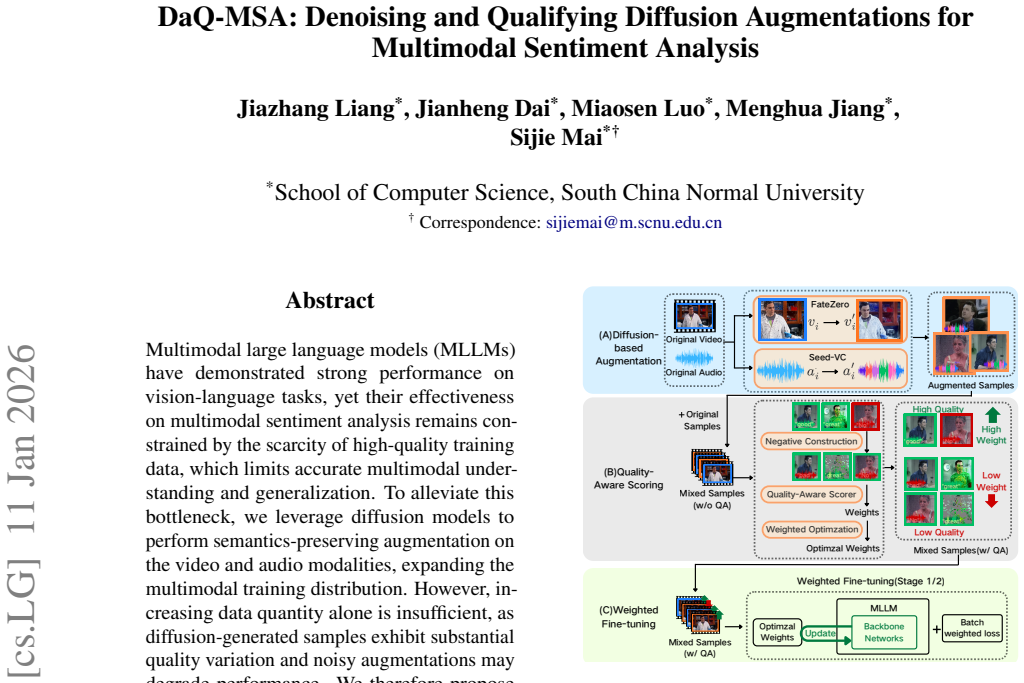
The quality-aware (QA) scoring module. It concatenates pooled features from frozen encoders (SigLIP for video, Whisper for audio, BERT for text) plus a label embedding, passes them through a two-layer MLP with a sigmoid output, and is trained with original samples as positives and hand-constructed negatives: polarity-inversed feature mixing (to simulate cross-modal mismatch), random masking (feature degradation), and label flipping (condition inconsistency). The resulting score s in (0,1) maps to a training weight w_i = w_min + s^gamma (w_max - w_min), which weights each sample's cross-entropy loss during MLLM fine-tuning.
What would settle it
Rerun the CH-SIMS experiment with QA weighting removed; the paper's own Table 3 shows Acc5 drops from 62.58 to 61.49 when QA is added, so a careful reader could check whether the headline 18% gain requires the quality module at all, or is driven by the diffusion data alone.
Extended reading notes
Core claim
The paper claims that explicit quality modeling turns untrusted synthetic data into a reliable training resource. Concretely, diffusion-based video style transfer and voice conversion expand the training distribution while preserving semantics; the quality-aware (QA) module scores each augmented sample by learned cross-modal consistency; and weighted fine-tuning suppresses low-fidelity samples. The reported results are state-of-the-art on three benchmarks: 90.15% Acc2 and 90.18% F1 on CH-SIMS (versus 85.10/85.00 for the strongest baseline), 92.37% Acc2 on CMU-MOSI, and 70.59% weighted F1 on MUStARD. The same pipeline also shows data-efficiency gains, reaching 85.34% Acc2 with only 10% of the
Load-bearing premise
The quality scores are meaningful for unseen diffusion-generated samples—the QA module was trained on original samples plus hand-corrupted versions, never on real augmented samples, and its score-to-weight mapping is manually calibrated.
Editorial extensions
If this is right
- MLLM-based sentiment models can be improved without any human annotation or manual filtering, lowering the cost of building robust sentiment systems.
- Training with only 10% labeled data plus generated samples reaches binary accuracy comparable to full-data training (85.34% vs 85.10%), pointing toward low-resource deployment.
- The same generate–score–reweight loop transfers across languages (Chinese CH-SIMS and English CMU-MOSI) and across tasks (sentiment and sarcasm detection on MUStARD).
- Quality-aware weighting also improves regression calibration: MAE drops from 0.523 to 0.498 on CMU-MOSI, a 4.8% improvement.
Reading between the lines
- Because the QA score is trained only on hand-corrupted negatives, its real-world calibration is untested; a natural check is whether scores predict human judgments of generation fidelity on held-out augmented samples.
- The pipeline's components are modular—any diffusion generator and any scorer could be swapped in—so the same generate–evaluate–reweight recipe might extend to other scarce multimodal tasks such as emotion recognition or multimodal translation.
- The reported QA benefit is not uniform: on CH-SIMS Acc5, adding QA lowered performance relative to unweighted mixing (62.58 vs 61.49), suggesting the weighting hyperparameters (w_min, w_max, gamma) are load-bearing and may need per-dataset tuning.
Editorial analysis
A structured set of objections, weighed in public.
Referee Report
Summary. The paper (internally titled DaQ-MSA, though the arXiv abstract calls it QASA) proposes a fully automated pipeline for multimodal sentiment analysis under limited data. Diffusion models (FateZero for video style transfer, Seed-VC for audio voice conversion) generate augmented video and audio samples; a decoupled quality-aware (QA) scorer, trained as a binary classifier on original samples versus three kinds of hand-corrupted negatives, assigns each augmented sample a quality score; Eq. (10) maps scores to training weights used in weighted fine-tuning of the HumanOmni MLLM. Experiments on CH-SIMS, CMU-MOSI, and MUStARD report state-of-the-art results, with the abstract highlighting an 18.0% relative Acc5 gain on CH-SIMS. Ablations show diffusion augmentation alone helps, but the paper attributes the gains to the QA mechanism.
Significance. If the generate-evaluate-reweight paradigm worked as claimed, it would be a useful, annotation-free way to improve multimodal sentiment analysis under data scarcity. The paper has some strengths: it reports three-seed means with small standard deviations, includes ablations and data-efficiency experiments, and the QA module is simple and decoupled from the backbone. However, the central claim—that quality-aware weighting is what makes diffusion augmentation reliable—is directly contradicted by the paper's own Table 3, where the QA variant scores lower on the headline Acc5 metric than the no-QA variant. This is a load-bearing inconsistency, not a presentation issue. As written, the evidence supports the conclusion that the reported Acc5 gain comes from diffusion augmentation itself, while the QA stage actively hurts fine-grained classification. The significance of the paper therefore hinges on a result its own ablation refutes.
major comments (4)
- [Section 4.2, Table 3] Table 3 shows Mixed (w/o QA) at Acc5=62.58 while Mixed (w/ QA) is Acc5=61.49, a 1.09-point drop on CH-SIMS. Section 4.1 and the abstract headline Acc5 as the main result, and Section 4.2 states the QA mechanism 'improves fine-grained discrimination.' The table directly contradicts this: quality-aware weighting reduces fine-grained accuracy. The paper only reports Acc2/F1 gains from QA, which is not the metric used to motivate the method. This internal inconsistency must be resolved; as it stands, the central claim that QA enables robust fine-grained augmentation is unsupported.
- [Section 3.3, Eq. (10), Figure 5] The QA module is trained with original samples as positives and hand-corrupted originals (feature mixing, random masking, label flipping) as negatives. Consequently, the learned 'quality' score measures proximity to the original training distribution, not the actual fidelity or semantic consistency of unseen diffusion-generated samples. Figure 5a confirms that augmented and original samples have almost identical score distributions (both centered about 0.65), with only a modest left tail for augmented data. The score-to-weight mapping of Eq. (10) then uses tuned hyperparameters (wmin, wmax, gamma) to decide training influence. Without any external quality benchmark or evidence that the scores separate real augmented-sample quality, the QA stage's contribution is not established.
- [Section 4.1 vs. Section 4.2] The paper claims in Section 4.1 that 'Our method achieves ... Acc5 (+9.39 points, reaching 61.49%)' and attributes the overall gain to the QA mechanism. However, the ablation in Table 3 shows that Mixed (w/o QA) reaches 62.58% Acc5—higher than the full method. The gain over HumanOmni (52.10%) is therefore entirely due to diffusion-based augmentation; the QA mechanism reduces Acc5. The narrative that 'The QA mechanism ensures that only augmented samples maintaining semantic consistency contribute to training' is not supported by the data. This is a fundamental mismatch between the reported headline result and the component analysis.
- [Section 4.2, Table 4] The data-efficiency discussion states that with 10% labels, Mixed (w/ QA) outperforms Mixed (w/o QA) by +3.35 Acc2, but Table 4 does not include a 10% no-QA row; it only compares QA.(10%) against Orig.(100%). The +3.35 figure appears to come from a comparison not present in the table, and the table lacks standard deviations. The claim that 'quality-aware weighting reliably ensures high-fidelity samples dominate gradient updates when supervision is limited' is therefore not demonstrable from the reported experiments.
minor comments (4)
- [Title/Abstract] The arXiv abstract uses the name 'QASA' while the full-text title and body use 'DaQ-MSA'. This inconsistency should be fixed.
- [Table 2] All four metrics for Mixed (w/ QA) are reported as exactly 70.59. This is suspicious and likely a copy/paste or rounding artifact; please verify.
- [Figure 5] The caption reports 'Pearson r=0.91' for the weight mapping, but no statistical significance or confidence interval is given. Also, the score distributions are described only qualitatively; provide quantitative separation statistics.
- [Section A.4] The reproducibility section says standard deviations are below 0.42% but they are omitted from all tables. Including error bars or std values in at least the main results would strengthen the claims.
Circularity Check
Minor circular artifact in QA weight-correlation plot; central pipeline is not circular.
-
self definitional
[Section 3.3 Eq. (10); Appendix A.2 Figure 5(b)]
"We map the quality score to a training weight: wi = wmin + s^gamma_i (wmax - wmin) (10) ... The weight mapping (Pearson r= 0.91) adaptively assigns high-quality samples (s>0.7) weights near 1.5 while down-weighting low-quality samples (s<0.5) below 0.5."
Equation (10) defines each weight wi as a deterministic monotone function of the score si (for gamma > 0 and wmax > wmin). Therefore the Pearson correlation between the scores and the weights is a property of the defining transformation, not an empirical validation of the QA mechanism. Reporting r=0.91 in Figure 5(b) as evidence of 'adaptive weight assignment' is self-correlation: any monotone transform of si would produce a high r. The figure does not independently show that the scores measure augmented-sample quality; it only restates Eq. (10).
full rationale
The paper's central generate-evaluate-reweight derivation is not circular: diffusion augmentation is performed by external models (FateZero, Seed-VC), the QA scores are empirical classifier outputs, the weighted fine-tuning is a standard loss modification, and the main claims are evaluated via task accuracy against external benchmarks. The baseline numbers are taken from Luo et al. (2025), a self-citation by co-authors, but they function as external comparative values rather than as premises that entail the method's success, so this is not load-bearing circularity. The one clear by-construction artifact is Appendix A.2: because Eq. (10) defines weights as a monotone transform of scores, the reported r=0.91 between scores and weights is a self-correlation, not independent evidence. A separate, non-circular concern is that Table 3 shows the QA stage lowers Acc5 on CH-SIMS (Mixed w/ QA 61.49 vs. Mixed w/o QA 62.58), which contradicts the paper's headline attribution of the Acc5 gain to the QA mechanism; this is an internal consistency and validity problem, not a circularity problem. Overall, the central claim retains independent empirical content, so the circularity score is low.
Assumptions & free parameters
free parameters (4)
- QA loss mixing weights alpha_k =
not reported
- Weight mapping bounds wmin, wmax and temperature gamma =
not reported
- FateZero guidance scale and attention blending coefficients =
guidance 9.0; alpha_cross=0.85; alpha_self=0.9
- Seed-VC training hyperparameters =
lr 1e-4 or 1e-5; batch 1/2; up to 1000 epochs
assumptions (4)
- domain assumption Diffusion-generated videos and audio preserve sentiment semantics while changing style or timbre.
- ad hoc to paper A QA module trained on original samples as positives and artificially corrupted originals as negatives can assign meaningful quality scores to unseen diffusion-generated samples.
- domain assumption The decoupled two-stage training (frozen QA then weighted fine-tuning) is stable and preferable to joint optimization.
- domain assumption Baseline numbers from the overlapping-author benchmark (Luo et al., 2025) are accurate and comparable.
Cite this review
Pith. "Pith review of QASA: Quality-Aware Semantic Augmentation for Robust Multimodal Sentiment Analysis." pith.science (2026). https://pith.science/paper/WNLQXZOI
@misc{pith2026260106870,
  author       = {Pith},
  title        = {Pith review of: QASA: Quality-Aware Semantic Augmentation for Robust Multimodal Sentiment Analysis},
  year         = {2026},
  howpublished = {\url{https://pith.science/paper/WNLQXZOI}},
  note         = {Machine review of arXiv:2601.06870}
}
read the original abstract
Multimodal large language models have demonstrated strong ability in capturing semantic representations for multimodal sentiment analysis. Their capacity to learn stable and generalizable multimodal features is limited, however, by the scarcity of high-quality training data. To address this, we propose QASA (Quality-Aware Semantic Augmentation), which uses diffusion models to generate augmented visual and auditory samples, thereby enlarging the training dataset and supporting multimodal learning. The generated samples can vary in quality and may exhibit cross-modal inconsistencies. To manage this, we introduce a decoupled quality-aware scoring module that assigns training weights based on the reliability of each augmented sample. This approach reduces the influence of low-quality data and contributes to more stable and robust model training. The framework combines the generative capabilities of diffusion models with the semantic reasoning of multimodal large models, providing an automated data augmentation strategy that does not require human annotation while improving generalization and robustness under limited high-quality data. Experiments on the CH-SIMS dataset show that QASA yields a relative increase of 18.0\% and 5.9\% in five-class accuracy (Acc5) and binary accuracy (Acc2), respectively, and it also outperforms existing methods on the CMU-MOSI and MUStARD benchmarks.
Figures


Figures from the paper (1 more)

Reference graph
Works this paper leans on
-
[1]
online" 'onlinestring :=
ENTRY address archivePrefix author booktitle chapter edition editor eid eprint eprinttype howpublished institution journal key month note number organization pages publisher school series title type volume year doi pubmed url lastchecked label extra.label sort.label short.list INTEGERS output.state before.all mid.sentence after.sentence after.block STRING...
-
[2]
write newline
" write newline "" before.all 'output.state := FUNCTION n.dashify 't := "" t empty not t #1 #1 substring "-" = t #1 #2 substring "--" = not "--" * t #2 global.max substring 't := t #1 #1 substring "-" = "-" * t #2 global.max substring 't := while if t #1 #1 substring * t #2 global.max substring 't := if while FUNCTION word.in bbl.in capitalize " " * FUNCT...
-
[3]
Jean-Baptiste Alayrac, Jeff Donahue, Pauline Luc, Antoine Miech, Iain Barr, Yana Hasson, Karel Lenc, Arthur Mensch, Katherine Millican, Malcolm Reynolds, Roman Ring, Eliza Rutherford, Serkan Cabi, Tengda Han, Zhitao Gong, Sina Samangooei, Marianne Monteiro, Jacob L Menick, Sebastian Borgeaud, and 8 others. 2022. https://proceedings.neurips.cc/paper_files/...
2022
-
[4]
AmirAli Bagher Zadeh, Paul Pu Liang, Soujanya Poria, Erik Cambria, and Louis-Philippe Morency. 2018. https://doi.org/10.18653/v1/P18-1208 Multimodal language analysis in the wild: CMU - MOSEI dataset and interpretable dynamic fusion graph . In Proceedings of the 56th Annual Meeting of the Association for Computational Linguistics (Volume 1: Long Papers), ...
-
[5]
Santiago Castro, Devamanyu Hazarika, Ver \'o nica P \'e rez-Rosas, Roger Zimmermann, Rada Mihalcea, and Soujanya Poria. 2019 a . https://doi.org/10.18653/v1/P19-1455 Towards multimodal sarcasm detection ) . In Proceedings of the 57th Annual Meeting of the Association for Computational Linguistics, pages 4619--4629, Florence, Italy. Association for Computa...
-
[6]
Santiago Castro, Devamanyu Hazarika, Verónica Pérez-Rosas, Roger Zimmermann, Rada Mihalcea, and Soujanya Poria. 2019 b . https://arxiv.org/abs/1906.01815 Towards multimodal sarcasm detection . Preprint, arXiv:1906.01815
arXiv 2019
-
[7]
Ringki Das and Thoudam Doren Singh. 2023. https://doi.org/10.1145/3586075 Multimodal sentiment analysis: A survey of methods, trends, and challenges . ACM Computing Surveys, 55(13s):270:1--270:38
-
[8]
Jonathan Ho, Ajay Jain, and Pieter Abbeel. 2020. https://proceedings.neurips.cc/paper_files/paper/2020/file/4c5bcfec8584af0d967f1ab10179ca4b-Paper.pdf Denoising diffusion probabilistic models . In Advances in Neural Information Processing Systems, volume 33, pages 6840--6851. Curran Associates, Inc
2020
Show all 28 references
-
[9]
Khawar Islam, Muhammad Zaigham Zaheer, Arif Mahmood, and Karthik Nandakumar. 2024. https://arxiv.org/abs/2405.14881 Diffusemix: Label-preserving data augmentation with diffusion models . In Proceedings of the IEEE/CVF Conference on Computer Vision and Pattern Recognition (CVPR...
2024 arXiv
-
[10]
Songning Lai, Xifeng Hu, Haoxuan Xu, Zhaoxia Ren, and Zhi Liu. 2023. https://doi.org/10.1016/j.displa.2023.102563 Multimodal sentiment analysis: A survey . Displays, 80:102563
2023
-
[11]
Ming Li, Keyu Chen, Ziqian Bi, Ming Liu, Xinyuan Song, Zekun Jiang, Tianyang Wang, Benji Peng, Qian Niu, Junyu Liu, Jinlang Wang, Sen Zhang, Xuanhe Pan, Jiawei Xu, and Pohsun Feng. 2025 a . https://arxiv.org/abs/2409.18991 Surveying the mllm landscape: A meta-review of current...
2025
-
[12]
Zhiteng Li, Lele Chen, Jerone Andrews, Yunhao Ba, Yulun Zhang, and Alice Xiang. 2025 b . https://openreview.net/forum?id=WoGnnggVCZ Gendataagent: On-the-fly dataset augmentation with synthetic data . In The Thirteenth International Conference on Learning Representations
2025
-
[13]
Haotian Liu, Chunyuan Li, Qingyang Wu, and Yong Jae Lee. 2023. https://proceedings.neurips.cc/paper_files/paper/2023/file/6dcf277ea32ce3288914faf369fe6de0-Paper-Conference.pdf Visual instruction tuning . In Advances in Neural Information Processing Systems, volume 36, pages 34...
2023
-
[14]
Songting Liu. 2024. https://arxiv.org/abs/2411.09943 Zero-shot voice conversion with diffusion transformers . arXiv preprint
2024 arXiv
-
[15]
Miaosen Luo, Jiesen Long, Zequn Li, Yunying Yang, Yuncheng Jiang, and Sijie Mai. 2025. https://arxiv.org/abs/2508.02429 Multimodal large language models for end-to-end affective computing: Benchmarking and boosting with generative knowledge prompting . Preprint, arXiv:2508.02429
2025 arXiv
-
[16]
Alhassan Mumuni and Fuseini Mumuni. 2022. https://doi.org/10.1016/j.array.2022.100258 Data augmentation: A comprehensive survey of modern approaches . Array, 16:100258
2022
-
[17]
Soujanya Poria, Erik Cambria, Rajiv Bajpai, and Amir Hussain. 2017. https://doi.org/10.1016/j.inffus.2017.02.003 A review of affective computing: From unimodal analysis to multimodal fusion . Information Fusion, 37:98--125
2017 doi
-
[18]
Chenyang QI, Xiaodong Cun, Yong Zhang, Chenyang Lei, Xintao Wang, Ying Shan, and Qifeng Chen. 2023. Fatezero: Fusing attentions for zero-shot text-based video editing. In Proceedings of the IEEE/CVF International Conference on Computer Vision (ICCV), pages 15932--15942
2023
-
[19]
Khoshgoftaar
Connor Shorten and Taghi M. Khoshgoftaar. 2019. https://doi.org/10.1186/s40537-019-0197-0 A survey on image data augmentation for deep learning . Journal of Big Data, 6(1):60
2019 doi
-
[20]
Brandon Trabucco, Kyle Doherty, Max Gurinas, and Ruslan Salakhutdinov. 2024. https://arxiv.org/abs/2302.07944 Effective data augmentation with diffusion models . In Proceedings of the 12th International Conference on Learning Representations (ICLR 2024). ArXiv preprint arXiv:2...
2024 arXiv
-
[21]
Rui Wang, Duyun Xu, Lucia Cascone, Yaoyang Wang, Hui Chen, Jianbo Zheng, and Xianxun Zhu. 2025. https://doi.org/10.1016/j.array.2025.100445 Raft: Robust adversarial fusion transformer for multimodal sentiment analysis . Array, 27:100445
2025
-
[22]
Yan Wang, Wei Song, Wei Tao, Antonio Liotta, Dawei Yang, Xinlei Li, Shuyong Gao, Yixuan Sun, Weifeng Ge, Wei Zhang, and Wenqiang Zhang. 2022. https://doi.org/10.1016/j.inffus.2022.03.009 A systematic review on affective computing: emotion models, databases, and recent advances...
2022 doi
-
[23]
Yanghao Wang and Long Chen. 2025. Inversion circle interpolation: Diffusion-based image augmentation for data-scarce classification. In Proceedings of the IEEE/CVF Conference on Computer Vision and Pattern Recognition (CVPR), pages 25560--25569
2025
-
[24]
Chengcheng Yang, Zhiyao Liang, Dashun Yan, Zeng Hu, and Ting Wu. 2025. https://doi.org/10.1109/ACCESS.2025.3560641 Hgtfm: Hierarchical gating-driven transformer fusion model for robust multimodal sentiment analysis . IEEE Access, 13:74430--74445
2025
-
[25]
Wenmeng Yu, Hua Xu, Fanyang Meng, Yilin Zhu, Yixiao Ma, Jiele Wu, Jiyun Zou, and Kaicheng Yang. 2020. https://doi.org/10.18653/v1/2020.acl-main.343 CH - SIMS : A C hinese multimodal sentiment analysis dataset with fine-grained annotation of modality . In Proceedings of the 58t...
2020 doi
-
[26]
Amir Zadeh, Rowan Zellers, Eli Pincus, and Louis-Philippe Morency. 2016. https://arxiv.org/abs/1606.06259 Mosi: Multimodal corpus of sentiment intensity and subjectivity analysis in online opinion videos . Preprint, arXiv:1606.06259
2016 arXiv
-
[27]
Qingyang Zhang, Haitao Wu, Changqing Zhang, Qinghua Hu, Huazhu Fu, Joey Tianyi Zhou, and Xi Peng. 2023. https://proceedings.mlr.press/v202/zhang23ar.html Provable dynamic fusion for low-quality multimodal data . In Proceedings of the 40th International Conference on Machine Le...
2023
-
[28]
Xianbing Zhao, Yixin Chen, Sicen Liu, Xuan Zang, Yang Xiang, and Buzhou Tang. 2023. https://doi.org/10.1145/3543507.3583406 Tmmda: A new token mixup multimodal data augmentation for multimodal sentiment analysis . In Proceedings of the ACM Web Conference 2023, WWW '23, page 17...
2023
Reviewed August 3, 2026 · model on record in the stance chip above.
Discussion (0). Sign in to comment.