REVIEW 4 major objections 5 minor 60 references
The paper claims that a three-stage agentic pipeline, AutoMindMap, reconstructs course-level knowledge hierarchies from raw lecture slides and outperforms all automated baselines on its own benchmark.
Reviewed by Pith at T0; open to challenge. T0 means a machine referee read the full paper against a public rubric. the ladder, T0–T4 →
T0 review · deepseek-v4-flash
2026-08-05 00:32 UTC pith:WO6CBMCL
load-bearing objection The benchmark is the real deliverable; the cognitive-efficiency claim outruns the evidence, but the method is credible and worth refereeing. the 4 major comments →
Slides2MindMap: Reconstructing Cognitively Efficient Knowledge Hierarchies from Lecture Slides
The pith
A machine-rendered reading of the paper's core claim, the machinery that carries it, and where it could break.
Core claim
The paper defines Slides2MindMap: given a course's slide decks, generate a mind map—a connected directed acyclic graph with a single root—that faithfully reflects the intrinsic knowledge hierarchy and presents it in a cognitively efficient way. To evaluate it, the authors construct S2M-Bench, 24 university courses spanning 267 decks and 12,774 pages with expert-annotated maps averaging 121 concepts per course, and a three-facet evaluation: ground-truth alignment (hierarchy-weighted node F1, edge-connectivity F1, and matched-edge connectivity F1), structural conformity (Pass@1 validity plus a Structural Load Factor penalizing shallow/deep leaves and high fan-out, grounded in the 7±2 working-m
What carries the argument
The central mechanism is the Structure Building Framework (SBF), a cognitive-psychology account of discourse comprehension in which a reader lays a foundation, maps coherent new information onto the emerging structure, and shifts to a new substructure when coherence breaks. AutoMindMap converts these three processes into: (1) Skeleton Laying—an LLM planner locks a level-2 backbone, a deck-to-branch bipartite assignment, expansion guidelines, and a prerequisite order, anchoring global structure before any detail is added; (2) Iterative Knowledge Integration—a dynamic reading-memory state bridges fragmented discourse units, a masked partial view keeps the model focused on the relevant branch,
Load-bearing premise
The load-bearing premise is that expert-annotated reference maps, the 7±2-based structural-load cutoffs, and a vision-language-model judge are valid proxies for what makes a hierarchy cognitively efficient; Appendix B concedes that no real classroom or learner-feedback experiments were run, so the pedagogical-value claim is only as strong as those proxies.
What would settle it
Give students the same course content as either an AutoMindMap map, a Direct-method map, or a human-expert map, then measure comprehension and self-reported cognitive load: if learner rankings deviate from the benchmark's ranking, the cognitive-efficiency claim fails even if the benchmark ordering holds. A cheaper check is to recompute method rankings with the SLF depth cutoff changed from 6 to 8 or the fan-out cutoff from 7 to 10 and see whether the ordering flips.
If this is right
- Students and instructors get a practical first-draft mind-map generator for an entire course's slide collection: the method produces structurally valid maps on every run and leaves a smaller gap to expert quality than any tested baseline.
- Retrieval-oriented document-hierarchy methods such as BookRAG and PageIndex are shown to be the wrong tool for this task—they yield valid trees but the worst knowledge-faithfulness and pedagogy scores, supporting the paper's claim that slide hierarchies need reasoning-based reconstruction, not formatting-cue extraction.
- The benchmark provides a reusable, multi-faceted yardstick—ground-truth alignment, structural conformity, and VLM judging—so future mind-map-generation methods can be ranked on a common scale rather than on ad hoc accuracy metrics.
- The framework's advantage persists across different backbone LLMs and across course categories, and it is largest on concept-heavy courses where direct generation collapses most visibly, suggesting the design addresses exactly the failure mode it targets.
Where Pith is reading between the lines
- The masked partial-view plus memory-state design implies that long-context hierarchy construction is inherently a stateful sequential process; this design likely transfers to other long-document structuring tasks such as textbook outlining or research-survey organization, though the paper only evaluates lecture slides.
- The Structural Load Factor's cutoffs (leaf depth 2–6, fan-out ≤7) come directly from Miller's 7±2 heuristic; if interactive mind-map tools relieve working-memory load through zooming and folding, the cutoffs may be miscalibrated, and a learner-behavior study could recalibrate them without changing the framework.
- The macro-refinement stage makes a testable auxiliary claim: rendered images carry structural information that text relation lists lose. Feeding the same critic graph-level imbalance statistics instead of the image would isolate whether the visual channel is truly load-bearing.
- Because the paper's Appendix B reports that no real educational scenarios were run, an immediate extension is a classroom experiment comparing learning outcomes from AutoMindMap maps versus baseline and expert maps; such a study would test the benchmark's central proxy directly.
Editorial analysis
A structured set of objections, weighed in public.
Referee Report
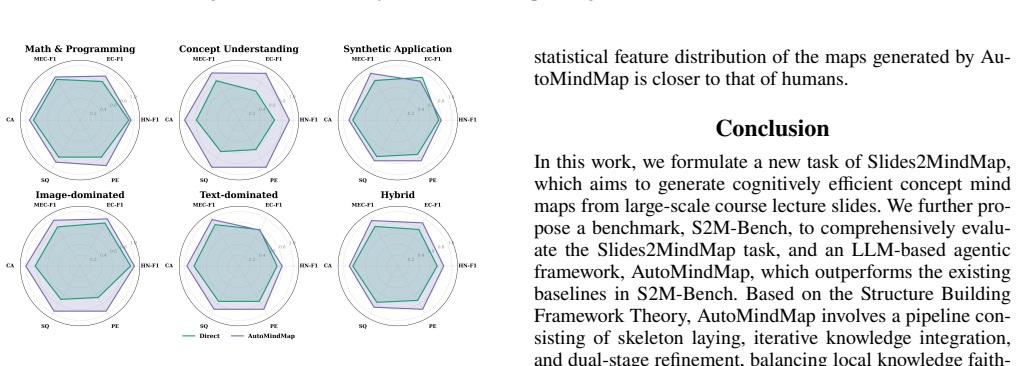
Summary. The paper introduces Slides2MindMap, a task of reconstructing a single mind map from an entire lecture-slide collection, along with S2M-Bench (12,774 slide pages, 24 courses, expert-annotated maps) and AutoMindMap, a training-free, LLM-agent pipeline with three stages: Skeleton Laying, Iterative Knowledge Integration, and Dual-Stage Refinement. The evaluation combines GT-based metrics (HN-F1, EC-F1, MEC-F1), a structural-load indicator (SLF), and a VLM-as-a-Judge with three Likert dimensions (CA, SQ, PE). The headline experiments report that AutoMindMap achieves Pass@1 = 100%, the lowest SLF among automated methods, and the best scores on all other metrics, with ablations and cross-model/cross-category robustness analyses in the appendix. The paper is explicit in Appendix B that no real educational-scenario experiments or learner feedback were collected.
Significance. If accepted at face value, the contribution is substantial: S2M-Bench is the first benchmark of its kind for slide-to-mindmap reconstruction, with non-trivial scale and expert annotation effort; AutoMindMap is a coherent, well-motivated system whose design is grounded in the Structure Building Framework; and the appendix includes valuable checks—human re-annotation, a Qwen3.5-Plus re-judging, human–model kappa, stability runs, and full prompts/tool specifications. The ranking claims are supported by converging evidence from multiple metrics rather than a single number. However, the cognitive-efficiency interpretation rests on unvalidated proxies, so the benchmark's pedagogical claim is stronger than the evidence. The absence of learner-outcome validation and the use of a same-family VLM for refinement and evaluation are the main risks; neither appears to be a fatal internal error, but both need to be confronted explicitly.
major comments (4)
- [§Evaluation Metrics (SLF, VLM-as-a-Judge) and Appendix B] The paper's central claim is that AutoMindMap produces 'cognitively efficient' hierarchies, but no learner-based validation is provided. SLF uses hand-set cutoffs (depth >7, fan-out >7, Eq. in 'Structural Load Factor'), and the CA/SQ/PE dimensions are scored by a VLM using rubric heuristics. Appendix B explicitly states that 'we don’t conduct experiments in real educational scenarios to collect human feedback.' As written, the evaluation establishes that AutoMindMap is best under these author-defined proxies; it does not establish that the maps reduce cognitive load or improve comprehension. I recommend either adding a small calibration study (e.g., human recall/complexity judgments on a subset) or, if that is out of scope, narrowing the title/abstract and task definition claims to 'proxy-based structural and semantic quality' and clearly labeling the cognitive-efficiency claim as a hypo
- [§VLM-as-a-Judge, Table 2, Appendix G.1–G.3] The main VLM-Judge scores come from GPT-5.4, while AutoMindMap's best variant uses GPT-5.4-mini for visual refinement. This creates a same-family preference confound for the magnitude of the CA/SQ/PE differences, even though Appendix G.2's Qwen3.5-Plus re-evaluation preserves the relative ranking. The paper should present the Qwen-based scores as a co-primary analysis or, at minimum, quantify the judge-model interaction. Additionally, Table 17 reports Pearson correlations up to 0.896 among CA, SQ, and PE; the claim that these are three distinct cognitive-efficiency dimensions is weakened. I suggest reporting a composite score and discussing redundancy, or providing discriminative validity evidence beyond kappa with humans.
- [Table 2 and Appendix F.4] The headline comparison reports a single run with no variance estimates over the 24-course test set. The stability analysis in Table 11 covers only 3 courses with temperature 0.5, which is not the setting of the main tables. Given that some margins are modest (e.g., EC-F1: 22.96 vs. 20.67; SLF: 1.82 vs. 5.26 is large, but head-to-head differences among variants in Table 12 are small), the paper should report means and standard deviations (or at least per-course score ranges) for the main comparison, or justify why the 24-course aggregate is stable enough for the ranking claim.
- [Appendix G.4, Table 18, and §Ground-Truth-based Comparison] The GT metrics are central to the claim that AutoMindMap is more faithful than baselines, but their ceiling is low and sensitive to annotator variation: human re-annotations against the original GT reach only HN-F1 61.64, EC-F1 54.73, MEC-F1 83.67 on the sampled courses. The matching procedure (Appendix E.1) also relies on LLM judgment with thresholds (τ=0.6, top-k=3) whose sensitivity is not reported. I am not claiming circularity—the matching is external to AutoMindMap—but the paper should provide a sensitivity analysis of the GT metrics to the matching thresholds and report inter-annotator variance for the re-annotation sample, otherwise the absolute GT numbers are hard to interpret.
minor comments (5)
- [Appendix G.1] The human–model and human–human kappa values in Table 15 are computed from a small sample (48 generated results for 8 courses). Report the 95% confidence intervals, and state how many human annotators scored each map.
- [Figure 4] The ablation figure's y-axis metric is not clearly labeled, and it would help to reference Table 12 directly in the main text for the 'slightly underperforms on MEC-F1 and SLF' sentence.
- [§Experiment Results] The phrase 'across every metric' in the main-results paragraph is too strong when the comparison is to Human; Human is excluded by the sentence 'except for Human', but the sentence could still be read as claiming strict Pareto dominance over all baselines on every row of Table 2. Clarify that the claim excludes the Human row and that SLF is lower-is-better.
- [Appendix F.3] Cost comparisons in Table 10 are single-run estimates with no variance; since cost is an explicit trade-off, report the range across courses.
- [References] PageIndex is cited via a blog URL (Zhang, Tang, and Team 2025). A peer-reviewed or archival reference would be preferable, or the paper should state clearly that the baseline reimplements the blog description.
Circularity Check
No significant circularity; AutoMindMap's evaluation is grounded in external checks, not in its own definitions.
full rationale
The claimed derivation chain is empirical rather than analytic. The task definition (Def. 2) does not fix the method's outputs; AutoMindMap's skeleton/integration/refinement stages are not defined in terms of the evaluation metrics. GT-based metrics (Appendix E.2) are fixed formulas over matched node sets, and the matching algorithm (Appendix E.1) is a uniform preprocessing step applied to all methods. VLM-Judge is not a rewrite of AutoMindMap: it is validated independently by human-model quadratic weighted kappa (Table 15: 0.807 average) and by a cross-model re-evaluation with Qwen3.5-Plus (Table 16), and the paper acknowledges same-family bias in Appendix G.1. SLF thresholds (depth>7, fan-out>7) are taken from external working-memory and rubric sources (Miller 1956; Kedaj et al. 2014), not fitted to AutoMindMap. Appendix B's admission that no real educational-scenario experiments were run is a limitation on the external validity of 'cognitive efficiency,' but it does not make the benchmark ranking circular. No equation is defined in terms of the model's outputs, and no parameter is fitted to the test set. The only concerns are author-designed benchmark and same-family judge; these are validity risks, not circular reductions.
Axiom & Free-Parameter Ledger
free parameters (5)
- cross-branch retrieval K =
3
- similarity threshold gamma_sim =
0.6
- refinement rounds =
2
- node matching thresholds tau and top-k =
tau=0.6, k=3
- SLF abnormality thresholds =
leaf depth 1 or >=7; non-leaf fan-out >7
axioms (6)
- domain assumption A mind map is a rooted connected DAG with one central root; Pass@1 requires exactly one root, no isolated nodes, and no cycles.
- domain assumption Cognitive efficiency can be operationalized by working-memory capacity (Miller 7 plus/minus 2) and progressive differentiation via simple depth and fan-out cutoffs.
- domain assumption Expert-annotated ground-truth maps are a faithful reference for the intrinsic knowledge hierarchy of a course.
- domain assumption VLM-as-a-Judge scores approximate human judgments of mind map quality.
- domain assumption MinerU parsing and VLM image summaries adequately represent slide content.
- domain assumption LLM agents can reliably execute atomic graph-editing tools so that structural constraints hold.
Cite this review
Pith. "Pith review of Slides2MindMap: Reconstructing Cognitively Efficient Knowledge Hierarchies from Lecture Slides." pith.science (2026). https://pith.science/paper/WO6CBMCL
@misc{pith2026260800610,
  author       = {Pith},
  title        = {Pith review of: Slides2MindMap: Reconstructing Cognitively Efficient Knowledge Hierarchies from Lecture Slides},
  year         = {2026},
  howpublished = {\url{https://pith.science/paper/WO6CBMCL}},
  note         = {Machine review of arXiv:2608.00610}
}
read the original abstract
Generating mind maps from lecture slides can help learners efficiently assimilate fragmented knowledge, promising substantial benefits for intelligent education. However, dedicated automatic generation and evaluation frameworks remain underexplored and challenging, requiring a global-local knowledge focus balance and handling large-scale, heterogeneous slides. We formulate the Slides2MindMap task, which aims to reconstruct cognitively efficient knowledge hierarchies from a course's slide deck collection. For systematic evaluation, we introduce S2M-Bench, a benchmark comprising 12,774 slide pages with expert-annotated mind maps spanning 24 university courses. S2M-Bench includes a cognitive-science-grounded evaluation framework that integrates ground-truth-based comparison, structure conformity analysis, and VLM-as-a-Judge. To address this task, we propose AutoMindMap, an agentic framework inspired by the Structure Building Framework. AutoMindMap comprises Skeleton Laying for global scaffold anchoring, Iterative Knowledge Integration augmented by context-aware summarization, and Dual-Stage Refinement with a local-global decoupling mechanism. The framework reconciles local knowledge faithfulness with global coherence, and adapts to slide-specific features. Experiments on S2M-Bench demonstrate that AutoMindMap outperforms baselines and achieves superior robustness across different models and scenarios, underscoring its pedagogical application value.
Figures




Reference graph
Works this paper leans on
- [1]
-
[2]
A systematic review of mind maps, STEM education, algorithmic and procedural learning , author=. Computers , volume=. 2025 , publisher=
work page 2025
- [3]
- [4]
-
[5]
Psychology of learning and motivation , volume=
Cognitive load theory , author=. Psychology of learning and motivation , volume=. 2011 , publisher=
2011
-
[6]
Concept mapping to facilitate teaching and learning , author=. Prospects , volume=. 1995 , publisher=
work page 1995
-
[7]
arXiv preprint arXiv:2407.05458 , year=
A survey of models for cognitive diagnosis: New developments and future directions , author=. arXiv preprint arXiv:2407.05458 , year=
-
[8]
International Workshop on Learning Technology for Education Challenges , pages=
BoomMapper: An Innovative Web-Based System for Transforming PowerPoint Presentations into Mind Maps , author=. International Workshop on Learning Technology for Education Challenges , pages=. 2025 , organization=
work page 2025
-
[9]
Proceedings of the AAAI Conference on Artificial Intelligence , volume=
Coreference graph guidance for mind-map generation , author=. Proceedings of the AAAI Conference on Artificial Intelligence , volume=
-
[10]
International Conference on Soft Computing and Data Mining , pages=
A Presentation Mining Framework: From Text Mining to to Mind Mapping , author=. International Conference on Soft Computing and Data Mining , pages=. 2024 , organization=
work page 2024
-
[11]
Proceedings of the AAAI Conference on Artificial Intelligence , volume=
Slidevqa: A dataset for document visual question answering on multiple images , author=. Proceedings of the AAAI Conference on Artificial Intelligence , volume=
-
[12]
Proceedings of the 2021 Conference on Empirical Methods in Natural Language Processing , pages=
Efficient mind-map generation via sequence-to-graph and reinforced graph refinement , author=. Proceedings of the 2021 Conference on Empirical Methods in Natural Language Processing , pages=
work page 2021
-
[13]
Llms for knowledge graph construction and reasoning: Recent capabilities and future opportunities , author=. World Wide Web , volume=. 2024 , publisher=
work page 2024
-
[14]
ACM Computing Surveys , volume=
A systematic survey of text summarization: From statistical methods to large language models , author=. ACM Computing Surveys , volume=. 2025 , publisher=
work page 2025
-
[15]
arXiv preprint arXiv:2501.13958 , year=
A survey of graph retrieval-augmented generation for customized large language models , author=. arXiv preprint arXiv:2501.13958 , year=
-
[16]
Evaluation and program planning , volume=
An introduction to concept mapping for planning and evaluation , author=. Evaluation and program planning , volume=. 1989 , publisher=
work page 1989
-
[17]
Concept mapping, mind mapping and argument mapping: what are the differences and do they matter? , author=. Higher education , volume=. 2011 , publisher=
work page 2011
-
[18]
Advances in Neural Information Processing Systems , volume=
Make your llm fully utilize the context , author=. Advances in Neural Information Processing Systems , volume=
-
[19]
Exploring the psychometric properties of the mind-map scoring rubric , author=. Behaviormetrika , volume=. 2019 , publisher=
work page 2019
-
[20]
Mingtian Zhang and Yu Tang and PageIndex Team , title =. PageIndex Blog , year =
-
[21]
arXiv preprint arXiv:2512.03413 , year=
BookRAG: A Hierarchical Structure-aware Index-based Approach for Retrieval-Augmented Generation on Complex Documents , author=. arXiv preprint arXiv:2512.03413 , year=
-
[22]
Language comprehension as structure building , author=. 2013 , publisher=
work page 2013
-
[23]
Vanderbilt University Center for Teaching , volume=
Bloom’s taxonomy , author=. Vanderbilt University Center for Teaching , volume=. 2010 , publisher=
work page 2010
- [24]
-
[25]
Acta Informatica Pragensia , volume=
Effective mind maps in e-learning , author=. Acta Informatica Pragensia , volume=
-
[26]
JALT 2013 conference proceedings , volume=
Likert-scale questionnaires , author=. JALT 2013 conference proceedings , volume=
work page 2013
-
[27]
International symposium on graph drawing , pages=
Graphviz—open source graph drawing tools , author=. International symposium on graph drawing , pages=. 2001 , organization=
work page 2001
-
[28]
arXiv preprint arXiv:2409.18839 , year=
Mineru: An open-source solution for precise document content extraction , author=. arXiv preprint arXiv:2409.18839 , year=
-
[29]
Approaches to specialized genres , pages=
Genre, pedagogy, and PowerPoint design: A multimodal move analysis of linguistics lecture slides , author=. Approaches to specialized genres , pages=. 2020 , publisher=
work page 2020
- [30]
-
[31]
Communications of the ACM , volume=
MapReduce: simplified data processing on large clusters , author=. Communications of the ACM , volume=. 2008 , publisher=
2008
-
[32]
arXiv preprint arXiv:2404.16130 , year=
From local to global: A graph rag approach to query-focused summarization , author=. arXiv preprint arXiv:2404.16130 , year=
-
[33]
Education and information technologies , volume=
A systematic literature review on educational recommender systems for teaching and learning: research trends, limitations and opportunities , author=. Education and information technologies , volume=. 2023 , publisher=
work page 2023
-
[34]
Tutorialbank: A manually-collected corpus for prerequisite chains, survey extraction and resource recommendation , author=. Proceedings of the 56th Annual Meeting of the Association for Computational Linguistics (Volume 1: Long Papers) , pages=
-
[35]
Beyond Linear Digital Reading: An LLM-Powered Concept Mapping Approach for Reducing Cognitive Load , author=. Proceedings of the 20th Workshop on Innovative Use of NLP for Building Educational Applications (BEA 2025) , pages=
work page 2025
-
[36]
Tree-KG: An expandable knowledge graph construction framework for knowledge-intensive domains , author=. Proceedings of the 63rd Annual Meeting of the Association for Computational Linguistics (Volume 1: Long Papers) , pages=
-
[37]
Proceedings of the AAAI Conference on Artificial Intelligence , volume=
What should i learn first: Introducing lecturebank for nlp education and prerequisite chain learning , author=. Proceedings of the AAAI Conference on Artificial Intelligence , volume=
-
[38]
International Journal of Information Technology , volume=
Logical concept mapping and social media analytics relating to cyber criminal activities for ontology creation , author=. International Journal of Information Technology , volume=. 2023 , publisher=
work page 2023
-
[39]
arXiv preprint arXiv:2404.19146 , year=
Automated construction of theme-specific knowledge graphs , author=. arXiv preprint arXiv:2404.19146 , year=
-
[40]
Alexandria Engineering Journal , volume=
EduVQA: A multimodal Visual Question Answering framework for smart education , author=. Alexandria Engineering Journal , volume=. 2025 , publisher=
work page 2025
-
[41]
Proceedings of the 31st ACM SIGKDD Conference on Knowledge Discovery and Data Mining V
Awaking the slides: a tuning-free and knowledge-regulated AI tutoring system via language model coordination , author=. Proceedings of the 31st ACM SIGKDD Conference on Knowledge Discovery and Data Mining V. 1 , pages=
-
[42]
Journal of Science Education and Technology , volume=
Constructivist-visual mind map teaching approach and the quality of students’ cognitive structures , author=. Journal of Science Education and Technology , volume=. 2011 , publisher=
work page 2011
-
[43]
Annual Meeting of the Association for Computational Linguistics , year=
MOOCCube: A Large-scale Data Repository for NLP Applications in MOOCs , author=. Annual Meeting of the Association for Computational Linguistics , year=
-
[44]
Course Concept Expansion in MOOCs with External Knowledge and Interactive Game , DOI=
Yu, Jifan and Wang, Chenyu and Luo, Gan and Hou, Lei and Li, Juanzi and Liu, Zhiyuan and Tang, Jie , year=. Course Concept Expansion in MOOCs with External Knowledge and Interactive Game , DOI=. Proceedings of the 57th Annual Meeting of the Association for Computational Linguistics , publisher=
-
[45]
LLM-Assisted Knowledge Graph Completion for Curriculum and Domain Modelling in Personalized Higher Education Recommendations , author=. 2025 , eprint=
work page 2025
-
[46]
WIREs Data Mining and Knowledge Discovery , volume =
Ferreira-Mello, Rafael and André, Máverick and Pinheiro, Anderson and Costa, Evandro and Romero, Cristobal , title =. WIREs Data Mining and Knowledge Discovery , volume =. doi:https://doi.org/10.1002/widm.1332 , year =
-
[47]
Towards Comprehensive Lecture Slides Understanding: Large-Scale Dataset and Effective Method , year=
Zhang, Enming and Li, Yuzhe and Liu, Yuliang and Zhu, Yingying and Bai, Xiang , booktitle=. Towards Comprehensive Lecture Slides Understanding: Large-Scale Dataset and Effective Method , year=
-
[48]
Zhe Chen and Heyang Liu and Wenyi Yu and Guangzhi Sun and Hongcheng Liu and Ji Wu and Chao Zhang and Yu Wang and Yanfeng Wang , booktitle =. M. 2024 , editor =
work page 2024
-
[49]
Lee, Dong Won and Ahuja, Chaitanya and Liang, Paul Pu and Natu, Sanika and Morency, Louis-Philippe , booktitle=. Lecture Presentations Multimodal Dataset: Towards Understanding Multimodality in Educational Videos , year=
- [50]
-
[51]
MLLM-as-a-Judge: Assessing Multimodal LLM-as-a-Judge with Vision-Language Benchmark , author=. 2024 , eprint=
work page 2024
-
[52]
Journal of the American Statistical Association , year=
Estimates of the Regression Coefficient Based on Kendall's Tau , author=. Journal of the American Statistical Association , year=
-
[53]
Johnson, B. and Shneiderman, B. , booktitle=. Tree-maps: a space-filling approach to the visualization of hierarchical information structures , year=
-
[54]
Educational Psychology Review , year=
Cognitive Architecture and Instructional Design: 20 Years Later , author=. Educational Psychology Review , year=
-
[55]
Cognitive flexibility theory : advanced knowledge acquisition in ill-structured domains , author=. 1988 , url=
work page 1988
-
[56]
Theories and practices of multimodal education: The instructional dynamics of picture books and primary classrooms , author=. The Reading Teacher , volume=. 2009 , publisher=
work page 2009
-
[57]
arXiv preprint arXiv:2602.12430 , year=
Agent skills for large language models: Architecture, acquisition, security, and the path forward , author=. arXiv preprint arXiv:2602.12430 , year=
-
[58]
Transactions of the association for computational linguistics , volume=
Lost in the middle: How language models use long contexts , author=. Transactions of the association for computational linguistics , volume=
-
[59]
LLM-Based Educational Simulation: Evaluating Temporal Student Persona Stability Across ADHD Profiles
LLM-Based Educational Simulation: Evaluating Temporal Student Persona Stability Across ADHD Profiles , author=. arXiv preprint arXiv:2605.06307 , year=
work page internal anchor Pith review Pith/arXiv arXiv
-
[60]
arXiv preprint arXiv:2410.17558 , year=
Clr-bench: Evaluating large language models in college-level reasoning , author=. arXiv preprint arXiv:2410.17558 , year=
discussion (0)
Sign in with ORCID, Apple, or X to comment. Anyone can read and Pith papers without signing in.