REVIEW 3 major objections 6 minor 27 references
Knowledge Query Network: How Knowledge Interacts with Skills
T0 review · 3 major / 6 minor · reviewed 2026-08-14 · deepseek-v4-flash
Pith's one-line read A single dot product between knowledge and skill vectors outperforms all existing knowledge tracing models and reveals a probabilistic skill similarity.
desk verdict KQN's dot-product query and positive-orthant skill vectors are a clean idea, but the 'outperforms all' claim rests on cited baselines and should be softened. read the letter →
The pith
A machine-rendered reading of the paper's core claim, the machinery that carries it, and where it could break.
The reading
What carries the argument
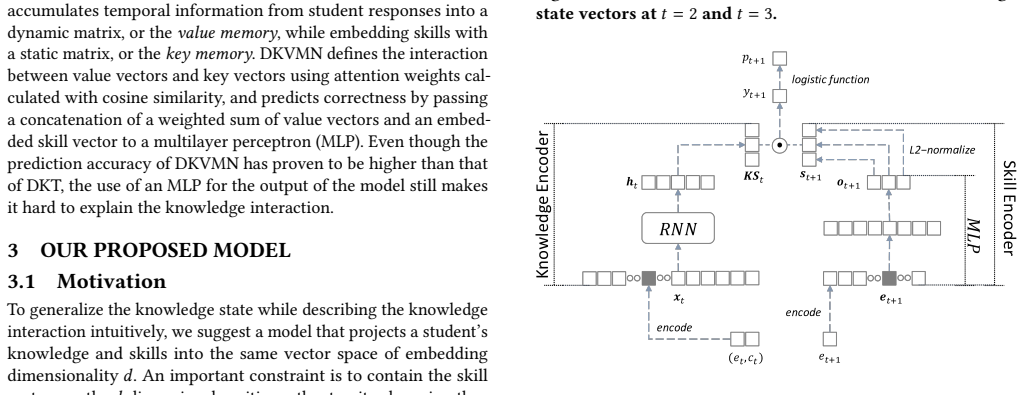
The load-bearing object is the knowledge state query: at each time step, a recurrent network encodes the student's response history into a knowledge-state vector $\mathrm{KS}_t \in \mathbb{R}^d$, a multi-layer perceptron embeds the next skill into a vector $s_{t+1}$ on the positive-orthant unit sphere $U_d = \{v \in \mathbb{R}^d : \|v\|=1, v_i \ge 0\}$, and the logit of a correct response is $y_{t+1} = \mathrm{KS}_t \cdot s_{t+1}$. This one inner product does three jobs: it defines the knowledge interaction, it guarantees (via the positive-orthant constraint) that learning one skill does not decrease the predicted probability for any other skill, and because all skill vectors have unit length, it makes the squared Euclidean distance between two skill vectors equal to twice their cosine distance. That identity plus the linearity of the dot product yields the paper's probabilistic skill similarity: the squared difference of log odds for two skills equals $\bigl(\mathrm{KS} \cdot \Delta_{1,2}\bigr)^2$ times their squared Euclidean distance, where $\Delta_{1,2}$ is the normalized difference vector. This is what makes the learned skill vectors interpretable and useful for domain analysis such as clustering.
What would settle it
Construct a synthetic dataset with two skills that are negatively correlated, so that answering one correctly makes answering the other less likely; because KQN's skill vectors are confined to the positive orthant, any increase in the knowledge state along one skill vector must weakly increase the dot product with every other skill vector, so the model cannot represent a learning-induced drop in the second skill's probability. If, on such data, KQN's predictions for the second skill remain near chance or the model compensates in ways that break the distance-to-odds-ratio identity, the claim of a descriptive knowledge interaction would be falsified.
Extended reading notes
Core claim
KQN's central claim is that a student's knowledge state and the skills being learned can be embedded in the same d-dimensional vector space, with the logit of the probability of a correct answer equal to the dot product of the knowledge-state vector and the skill vector. The skill vectors are constrained to the positive-orthant unit sphere, guaranteeing that learning one skill never decreases the predicted probability for another skill within the same subject area. The paper argues that this simple interaction both improves prediction accuracy over prior neural and non-neural knowledge tracing models on four datasets and yields interpretable skill representations, because the squared Euclidean distance between two skill vectors equals twice their cosine distance and the squared log-odds-ratio of two skills equals a projection-dependent factor times that distance. This makes pairwise skill distances meaningful for domain analysis, such as clustering skills into groups that preserve predictive information.
Load-bearing premise
The model assumes that each skill can be pinned down by a single fixed nonnegative unit vector and that a student's entire knowledge at each step can be summarized by one vector in that same space, so that the logit of correctness equals their dot product; if skills are not fixed in such a space or knowledge cannot be compressed to one vector, the accuracy and interpretability claims would not survive.
Editorial extensions
If this is right
- KQN's prediction accuracy exceeds that of all previously published knowledge tracing models on the four evaluated datasets, with the lowest standard deviations, indicating that the dot-product interaction yields stable predictions.
- The learned skill vectors are transferable: feeding them to DKT instead of one-hot encodings improves DKT's accuracy on most datasets, showing that the vectors capture reusable skill structure.
- The probabilistic skill similarity makes skill-domain analysis possible: clustering the skill vectors with average linkage and Euclidean distance recovers groups of related skills, and replacing skill IDs with cluster labels in DKT costs little prediction accuracy.
- KQN's output is robust to the embedding dimensionality: varying d between half and twice the optimal value changes test AUC by less than 0.05% on all datasets, and the Mantel correlation between the skill distance matrices stays above 0.5, confirming strong positive correlation.
Reading between the lines
- The distance-to-odds-ratio identity suggests a concrete diagnostic: by computing $(\mathrm{KS} \cdot \Delta_{1,2})^2$ for different students, one can check whether the relative order of skill distances depends on the knowledge state; the paper leaves this dependence implicit, but a dataset with diverse students could reveal whether skill geometry is truly fixed or student-dependent.
- The positive-orthant constraint is a substantive cognitive assumption: it rules out negative transfer between skills by construction. Applying KQN to a multi-domain dataset (e.g., math and reading) would put that assumption to the test; if the model needs to represent that learning one skill reduces another, the constraint would have to be relaxed.
- The paper's stability analysis suggests a practical rule of thumb: the skill distance matrix is roughly invariant over a wide range of $d$, so practitioners can choose a small embedding dimension for computational efficiency without losing much skill-structure information.
Signed reviews
Editorial analysis
A structured set of objections, weighed in public.
Referee Report
Summary. The paper introduces Knowledge Query Network (KQN), a knowledge tracing model in which a student's knowledge state vector and skill vectors are embedded into the same d-dimensional space, and the logit of a correct response at time t+1 is the dot product of the knowledge state and the skill vector (Section 3.5). The knowledge state is produced by an RNN encoder and a linear map, and the skill vectors by an MLP with L2 normalization onto the positive orthant unit sphere (Sections 3.6 and 3.7). The authors claim that KQN outperforms all existing KT models on four datasets (Section 6.1), that the learned skill vectors support a novel 'probabilistic skill similarity' relating cosine/Euclidean distances to odds ratios (Section 4), that the knowledge interaction can be visualized, and that the model is stable across embedding dimensionalities (Section 6.4).
Significance. If the claims were fully supported, KQN would offer a rare combination of state-of-the-art prediction and interpretable skill relationships in a single model. The core idea of placing knowledge states and skills in one vector space with a dot-product interaction is clean and pedagogically appealing, and the sensitivity analysis using Mantel tests is a thoughtful robustness check. The algebraic identity in Section 4.2 is correct as a manipulation, and the use of four public datasets with shared splits is a good starting point. However, the two central contributions—the accuracy superiority and the probabilistic skill similarity interpretation—are not established by the evidence presented. The baseline comparison is uncontrolled, and the distance–odds-ratio relation is shown to depend on the knowledge state vector in a way that undermines the paper's interpretive claim. The model may well be competitive, but the manuscript currently overstates what is demonstrated.
major comments (3)
- [Section 4.2] The derivation of the squared log odds ratio is algebraically correct, but the conclusion that 'two skills are probabilistically similar if they are close' does not follow from it. The displayed chain ends with (log o1/o2)^2 = (KS·Δ_{1,2})^2 × 2 d_cosine(s1,s2), where Δ_{1,2} is the unit vector along s1−s2. The factor (KS·Δ_{1,2})^2 depends on the knowledge state vector KS, which varies across students and time steps. For any fixed pair of skill vectors, the odds ratio can be made arbitrarily large by aligning KS with Δ, and zero by making KS orthogonal to Δ, regardless of how far apart s1 and s2 are. Thus the pairwise distance between skill vectors alone does not determine or even bound the odds ratio, and the phrase 'relates the pairwise cosine and Euclidean distances ... to the odds ratios' in the abstract is misleading. To support the probabilistic skill similarity interpretation, the authors need to either define a quantity that marginalizes over KS or explicitly state and test conditions under which the KS-dependent factor can be ignored. This issue is load-bearing for contribution (3) and for the interpretability claim, and it should be addressed before publication.
- [Section 6.1, Table 3] The headline claim that 'KQN outperforms all the existing KT models based on prediction accuracy' is not supported by the evidence. As stated in Section 5.2, the IRT, BKT, DKT, and DKVMN numbers are cited from other papers rather than produced by the same evaluation pipeline; no error bars are available for these baselines under the same preprocessing, no paired significance tests are reported, and the KQN advantages are roughly 0.34–0.75 AUC points, which is within typical run-to-run variability for KT benchmarks. Moreover, the paper's own DKT+KQN variant achieves 73.41% on ASSISTments 2015, slightly above KQN's 73.40%, so the unqualified 'outperforms all' phrasing is stronger than the paper's own results. To make the central accuracy claim credible, the authors should rerun the baselines with the same data splits, the same early-stopping and epoch protocols, and the same number of seeds, and report significance tests or confidence intervals. Without this, the empirical contribution is only 'competitive', not 'state-of-the-art'.
- [Sections 3.1 and 3.5] The motivation for the positive-orthant constraint on skill vectors is incomplete. The paper argues that this constraint 'assures that learning on one skill does not decrease learning on another', but this conclusion implicitly assumes that the knowledge state vector KS has nonnegative coordinates. In KQN, KS is computed as KS_t = W_h,KS h_t + b_h,KS (Section 3.6), with no positivity constraint, so its entries can be negative. With a negative coordinate in KS, an increase in one component of KS can decrease the dot product with a positive-orthant skill vector, causing the probability of a correct response for another skill to fall even when the skill vectors are orthogonal or similar in the cosine sense. The example in Section 3.1 uses only positive KS vectors and therefore does not establish the general claim. This affects the interpretability narrative that motivates the model architecture, and the authors should either constrain KS to the positive orthant as well, or modify the motivation to acknowledge that the monotonicity property is not guaranteed.
minor comments (6)
- [Section 5.2] In the sentence 'we used the same ones 1 used by DKVMN', there is a stray '1' that appears to be a typographical artifact; it should read 'the same ones used by DKVMN'.
- [Footnote 6] The text 'TensorFlow 1.56' should likely read 'TensorFlow 1.5', since the footnote references the TensorFlow 1.5 release page.
- [Section 6.1] For Statics2011, the text says 'higher than the previous highest by 0.34%', but 83.20 − 82.84 = 0.36 percentage points; the reported number should be corrected.
- [Section 6.3] The text says '30 Ordering Functions and 62 Ordering Real Numbers' were assigned to the fourth cluster, but Table 4 lists skill 30 as 'Ordering Fractions'; the skill name in the sentence should be corrected.
- [Table 9] The statement that p-values are omitted 'since they were 0.001 in all cases' is not a proper report of a permutation-based Mantel test. With 999 permutations, the minimum attainable p-value is 0.001, so reporting '0.001' for every test likely collapses different values. The authors should report the actual permutation p-values or use 'p < 0.001' if all are at the minimum.
- [Section 5.2.1] The optimal hyperparameters, including the optimal embedding dimensionality d_opt, are never reported. Since Section 6.4 defines d_opt and reports sensitivity results relative to it, omitting the actual values prevents independent reproduction of both the main accuracy results and the sensitivity analysis. Please include a table of the selected hyperparameters for each dataset.
Circularity Check
No significant circularity: the accuracy claim is empirical and the probabilistic-skill-similarity relation is a definitional identity, not a fitted prediction.
full rationale
KQN's central prediction claim is self-contained: the model is trained on fixed splits of four public datasets, and reported test AUCs are computed on held-out test data by the authors' own TensorFlow implementation (Section 5.2.1), so the accuracy numbers are not read off from a fitted parameter or from a citation. The baseline values in Table 3 are cited from prior papers, including the same group's DKVMN paper [26]; this weakens the comparison as evidence but is a reproducibility/evidence concern, not a circular derivation. The 'probabilistic skill similarity' derivation in Section 4.2 is an algebraic identity: with logit y=KS·s and skill vectors constrained to the positive orthant unit sphere, (log o1/o2)^2 = (KS·(s1-s2))^2 = (KS·Δ1,2)^2 × ||s1-s2||^2 = (KS·Δ1,2)^2 × 2 d_cosine(s1,s2). This relation follows from the model's definitions rather than from data, and the paper presents it as a definitional concept ('we say that two skills are probabilistically similar if they are close enough based on the distance'), not as a prediction validated against held-out outcomes. The jump from this identity to the interpretability claim is an interpretive assertion, and the ignored KS-dependent factor is a flaw in that interpretation, but it is not circularity under the technical definition used here. No uniqueness theorem, no load-bearing self-citation chain, and no fitted-input-called-prediction step appear in the derivation chain.
Assumptions & free parameters
free parameters (6)
- Embedding dimensionality d =
Not stated; grid search over 32, 64, 128
- RNN hidden size H_RNN =
Not stated; grid search over 32, 64, 128
- MLP hidden size H_MLP =
Not stated; grid search over 32, 64, 128
- RNN cell type =
LSTM or GRU, not reported per dataset
- All neural-network weights in the RNN encoder, knowledge-state linear map, and skill MLP =
Learned by Adam on training data; values not reported
- Cluster count n for domain analysis =
14 used for ASSIST2009 final table
assumptions (4)
- domain assumption Correctness is a Bernoulli variable whose logit equals the dot product KS_t dot s_{t+1}.
- domain assumption Skill vectors are constrained to the positive orthant unit sphere U_d.
- domain assumption Independent skills correspond to orthogonal vectors and similar skills to close vectors.
- ad hoc to paper The factor (KS dot Delta_{1,2})^2 in the odds-ratio identity can be ignored when declaring that close skill vectors imply similar skills.
invented entities (1)
-
Probabilistic skill similarity
Cite this review
Pith. "Pith review of Knowledge Query Network: How Knowledge Interacts with Skills." pith.science (2026). https://pith.science/paper/WOGRGX5Z
@misc{pith2026190802146,
  author       = {Pith},
  title        = {Pith review of: Knowledge Query Network: How Knowledge Interacts with Skills},
  year         = {2026},
  howpublished = {\url{https://pith.science/paper/WOGRGX5Z}},
  note         = {Machine review of arXiv:1908.02146}
}
read the original abstract
Knowledge Tracing (KT) is to trace the knowledge of students as they solve a sequence of problems represented by their related skills. This involves abstract concepts of students' states of knowledge and the interactions between those states and skills. Therefore, a KT model is designed to predict whether students will give correct answers and to describe such abstract concepts. However, existing methods either give relatively low prediction accuracy or fail to explain those concepts intuitively. In this paper, we propose a new model called Knowledge Query Network (KQN) to solve these problems. KQN uses neural networks to encode student learning activities into knowledge state and skill vectors, and models the interactions between the two types of vectors with the dot product. Through this, we introduce a novel concept called \textit{probabilistic skill similarity} that relates the pairwise cosine and Euclidean distances between skill vectors to the odds ratios of the corresponding skills, which makes KQN interpretable and intuitive. On four public datasets, we have carried out experiments to show the following: 1. KQN outperforms all the existing KT models based on prediction accuracy. 2. The interaction between the knowledge state and skills can be visualized for interpretation. 3. Based on probabilistic skill similarity, a skill domain can be analyzed with clustering using the distances between the skill vectors of KQN. 4. For different values of the vector space dimensionality, KQN consistently exhibits high prediction accuracy and a strong positive correlation between the distance matrices of the skill vectors.
Figures


Reference graph
Works this paper leans on
- [1]
-
[2]
Hao Cen, Kenneth Koedinger, and Brian Junker. 2006. Learning factors analysis–a general method for cognitive model evaluation and improvement. InInternational Conference on Intelligent Tutoring Systems . Springer, 164–175
work page 2006
-
[3]
Kyunghyun Cho, Bart van Merrienboer, Caglar Gulcehre, Dzmitry Bahdanau, Fethi Bougares, Holger Schwenk, and Yoshua Bengio. 2014. Learning Phrase Representations using RNN Encoder–Decoder for Statistical Machine Translation. In Proceedings of the 2014 Conference on Empirical Methods in Natural Language Processing (EMNLP). 1724–1734
2014
-
[4]
Mingyu Feng, Neil Heffernan, and Kenneth Koedinger. 2009. Addressing the assessment challenge with an online system that tutors as it assesses. User Modeling and User-Adapted Interaction 19, 3 (2009), 243–266
work page 2009
-
[5]
Alex Graves, Greg Wayne, and Ivo Danihelka. 2014. Neural Turing Machines. arXiv preprint arXiv:1410.5401 (2014)
arXiv 2014
-
[6]
Sepp Hochreiter and Jürgen Schmidhuber. 1997. Long short-term memory.Neural Computation 9, 8 (1997), 1735–1780
1997
-
[7]
Lawrence Hubert and Phipps Arabie. 1985. Comparing partitions. Journal of Classification 2, 1 (1985), 193–218
work page 1985
-
[8]
Charles Lee Hulin, Fritz Drasgow, and Charles K Parsons. 1983. Item response theory: Application to psychological measurement . Dorsey Press
work page 1983
Show all 27 references
-
[9]
Andreas M Kaplan and Michael Haenlein. 2016. Higher education and the digital revolution: About MOOCs, SPOCs, social media, and the Cookie Monster.Business Horizons 59, 4 (2016), 441–450
2016
-
[10]
Mohammad Khajah, Robert V Lindsey, and Michael C Mozer. 2016. How deep is knowledge tracing?. In Proceedings of the 9th International Conference on Educa- tional Data Mining. 94–101
2016
-
[11]
Diederik P Kingma and Jimmy Ba. 2014. Adam: A method for stochastic opti- mization. arXiv preprint arXiv:1412.6980 (2014)
2014 arXiv
-
[12]
Kenneth R Koedinger, Ryan SJd Baker, Kyle Cunningham, Alida Skogsholm, Brett Leber, and John Stamper. 2010. A data repository for the EDM community: The 9 PSLC DataShop. Handbook of educational data mining 43 (2010), 43–56
2010
-
[13]
Pierre Legendre and Louis Legendre. 1998. Numerical Ecology, Volume 24, (Developments in Environmental Modelling)
1998
-
[14]
Vinod Nair and Geoffrey E Hinton. 2010. Rectified linear units improve re- stricted boltzmann machines. In Proceedings of the 27th International Conference on Machine Learning (ICML-10) . 807–814
2010
-
[15]
Hyacinth S Nwana. 1990. Intelligent tutoring systems: an overview. Artificial Intelligence Review 4, 4 (1990), 251–277
1990
-
[16]
Philip I Pavlik, Hao Cen, and Kenneth R Koedinger. 2009. Performance Fac- tors Analysis–A New Alternative to Knowledge Tracing. In 14th International Conference on Artificial Intelligence in Education
2009
-
[17]
Radek Pelánek. 2017. Bayesian knowledge tracing, logistic models, and beyond: an overview of learner modeling techniques. User Modeling and User-Adapted Interaction 27, 3-5 (2017), 313–350
2017
-
[18]
Chris Piech, Jonathan Bassen, Jonathan Huang, Surya Ganguli, Mehran Sahami, Leonidas J Guibas, and Jascha Sohl-Dickstein. 2015. Deep knowledge tracing. In Advances in Neural Information Processing Systems . 505–513
2015
-
[19]
Nitish Srivastava, Geoffrey Hinton, Alex Krizhevsky, Ilya Sutskever, and Ruslan Salakhutdinov. 2014. Dropout: a simple way to prevent neural networks from overfitting. Journal of Machine Learning Research 15, 1 (2014), 1929–1958
2014
-
[20]
Jason Weston, Sumit Chopra, and Antoine Bordes. 2014. Memory networks. CoRR abs/1410.3916 (2014). arXiv:1410.3916 http://arxiv.org/abs/1410.3916
2014 arXiv
-
[21]
Kevin H Wilson, Yan Karklin, Bojian Han, and Chaitanya Ekanadham. 2016. Back to the basics: Bayesian extensions of IRT outperform neural networks for proficiency estimation. arXiv preprint arXiv:1604.02336 (2016)
2016 arXiv
-
[22]
Xiaolu Xiong, Siyuan Zhao, Eric Van Inwegen, and Joseph Beck. 2016. Going Deeper with Deep Knowledge Tracing.. In Proceedings of the 9th International Conference on Educational Data Mining . 545–550
2016
-
[23]
Chun-Kit Yeung and Dit-Yan Yeung. 2018. Addressing two problems in deep knowledge tracing via prediction-consistent regularization. In Proceedings of the Fifth Annual ACM Conference on Learning at Scale . ACM, 5
2018
-
[24]
Michael V Yudelson, Kenneth R Koedinger, and Geoffrey J Gordon. 2013. Indi- vidualized bayesian knowledge tracing models. In International Conference on Artificial Intelligence in Education. Springer, 171–180
2013
-
[25]
Wojciech Zaremba, Ilya Sutskever, and Oriol Vinyals. 2014. Recurrent neural network regularization. arXiv preprint arXiv:1409.2329 (2014)
2014 arXiv
-
[26]
Jiani Zhang, Xingjian Shi, Irwin King, and Dit-Yan Yeung. 2017. Dynamic key- value memory networks for knowledge tracing. In Proceedings of the 26th Inter- national Conference on World Wide Web. 765–774. 10
2017
-
[1990]
Cognitive Modeling and Intelligent Tutoring. Artif. Intell. 42, 1 (Feb. 1990), 7–49. https://doi.org/10.1016/0004-3702(90)90093-F
1990 doi
Reviewed August 14, 2026 · model on record in the stance chip above.
Discussion (0). Continue with ORCID to comment.