REVIEW 4 major objections 6 minor 28 references
Quantum Circuits for Quantum Convolutions: A Quantum Convolutional Autoencoder
T0 review · 4 major / 6 minor · reviewed 2026-08-05 · deepseek-v4-flash
Pith's one-line read Random quantum circuits can replace the first trainable convolution layer of an autoencoder with no loss in reconstruction quality, and with earlier loss stability on harder datasets.
desk verdict Essentially a preprint of the authors' own 2021 quanvolutional autoencoder with a new CIFAR-10 experiment, but that experiment has a load-bearing internal inconsistency that undercuts the only new empirical claim. read the letter →
The pith
A machine-rendered reading of the paper's core claim, the machinery that carries it, and where it could break.
The reading
What carries the argument
The central object is the quanvolutional layer: a 4x4 patch-wise filter implemented by a quantum circuit rather than learned weights. For each patch, 16 qubits are initialized in the ground state, rotated by Ry(theta) with pixel-derived angles scaled by pi, acted on by a random unitary circuit U, and then measured to produce a real-valued feature map. This layer is non-trainable and can be precomputed, so it acts as a fixed random feature extractor whose output feeds a trainable convolutional autoencoder.
What would settle it
Re-run the CIFAR-10 128-dimensional latent-space experiment across many independently sampled random circuits with varied depth and connectivity; if the early-training stability disappears for some circuit families, or if the same stability is achieved by a fixed random classical filter with no quantum structure, the claim that quantum convolutions are responsible for the effect is falsified.
Extended reading notes
Core claim
The paper's central claim is that a quanvolutional autoencoder—a convolutional autoencoder whose first layer is replaced by quantum circuits—produces image representations whose reconstruction quality is comparable to the classic all-trainable convolutional autoencoder, despite the quantum layer being fixed and random. The quantum filter feeds each 4x4 image patch into 16 qubits, encodes pixel intensities via Y rotations scaled by pi, applies a random circuit U, and reads out measurements that form the new feature maps; those features are then passed to an otherwise classic convolutional autoencoder. On MNIST, the two models reconstruct digits similarly in both a 2-dimensional and a 64-dimen
Load-bearing premise
The quantum filter is defined only as 'U is a random circuit'—with no specification of gate family, depth, or connectivity—and the pixel-to-angle encoding is fixed to rotations scaled by pi; if these unspecified choices fail to produce representative or useful quantum kernels, the observed comparability could be an artifact of the particular random circuits used.
Editorial extensions
If this is right
- The quantum convolution layer can be precomputed before training, so the added cost of a quantum layer is one-time and training proceeds on classical features.
- A fixed random quantum filter bank is sufficient to match a trained first convolutional layer on MNIST and CIFAR-10 reconstruction, suggesting the learned low-level filters can be replaced by quantum transformations.
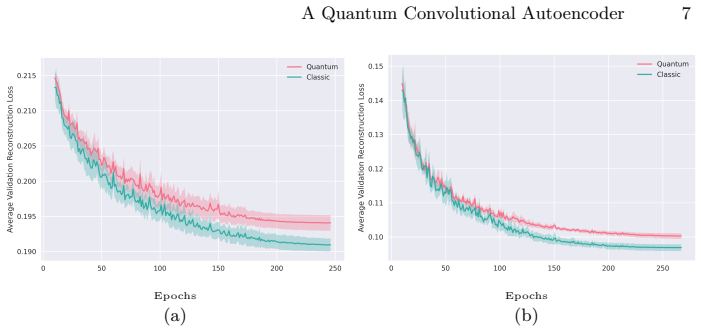
- In higher-dimensional latent spaces, the quantum variant reaches low loss more steadily early on, which could translate into fewer epochs before stable training on complex image datasets.
- Latent space projections appear discriminative even in two dimensions, indicating these representations could support downstream classification after fine-tuning.
Reading between the lines
- One testable extension: compare the fixed random quantum circuit against a fixed random classical filter bank (e.g., random convolutions with random nonlinearities) on the same autoencoder; if the quantum version's early stability persists, the effect would be due to the quantum kernel rather than randomness alone.
- The paper's angle encoding is fixed to Ry rotations scaled by pi; tuning this encoding or using multiple random circuits per channel might increase or reduce the gap, yielding a path toward data-dependent quantum filters.
- A direct continuation is to measure generalization on held-out classification from the latent space, using the quantum autoencoder as a pretrained representation extractor; the latent projections suggest this could work, but the paper does not report it.
Signed reviews
Editorial analysis
A structured set of objections, weighed in public.
Referee Report
Summary. The paper proposes a quanvolutional autoencoder in which the first convolutional layer of a classic convolutional autoencoder is replaced by fixed, randomized quantum circuits acting as quantum convolutions. The quantum layer embeds 4×4 pixel patches into 16 qubits via Ry rotations scaled by π, applies a random circuit U, and its output is fed to the remainder of the autoencoder. The authors compare this architecture with a fully trainable classic convolutional autoencoder on MNIST and CIFAR-10, reporting comparable reconstruction quality and, for CIFAR-10 with a 128-dimensional latent space, earlier learning stability for the quantum-based approach. The paper concludes that quantum convolutions can match classic convolutions in reconstruction and, in some settings, accelerate early convergence.
Significance. If the claims hold, the paper would provide an empirical demonstration that fixed random quantum feature extractors can substitute for learned convolutional filters in autoencoders without loss of reconstruction quality, with a possible early-convergence benefit on more complex image data. The comparison is direct and the quantum layer is explicitly non-trainable, so there is no derivation-to-fit circularity. The authors also report ten randomized runs for MNIST, which is a useful practice. However, the central empirical claims are currently undermined by an internally inconsistent CIFAR-10 setup, an underspecified random quantum circuit, and missing statistical details. The significance is therefore conditional: the idea is plausible and worth investigating, but the evidence as presented does not yet firmly establish the claimed comparability or acceleration.
major comments (4)
- [Section 4.2, Table 1] The CIFAR-10 experimental setup is internally inconsistent. Section 4.2 states that the quantum convolutions 'start with the same single input image of 28×28×1 and end up in multiple convolved images of size 7×7×16', but Table 1 specifies an input of 32×32×3 and, after the †-marked layers, an output of 8×8×48. These two descriptions cannot both describe the same experiment. If the runs actually used the MNIST-style 28×28×1 pipeline, then the results labeled 'CIFAR-10' are not for color 32×32 images, and the early-stability claim in Section 5 is unsubstantiated. If the Table 1 architecture was used, the paper must explain how the 16-qubit 4×4 circuit of Figure 3 handles three RGB channels and produces 48 output channels. This ambiguity is load-bearing for the CIFAR-10 conclusion.
- [Section 3, Eq. (1)] The quantum circuit is not sufficiently specified. The text says 'U is a random circuit' but does not state the gate family, circuit depth, connectivity, or random seed used. Since the quantum convolution is the only difference between the two compared architectures, the reported comparability could be an artifact of the particular random circuits selected rather than a general property of quantum convolutions. Without a precise definition of U, the experiments are not reproducible and the generality of the central claim cannot be assessed. Please specify the circuit construction and any PennyLane default choices.
- [Section 4.1, Fig. 6(b)] The claim that the gap between classic and quantum approaches is 'statistically significant' for the z∈R^64 MNIST experiment is not supported by any statistical test, direction, or definition of the error bars. The text mentions a '5×10⁻³ difference in magnitude of the loss' but does not report the standard deviations, the number of seeds used for this particular figure, or a test such as a paired t-test or Wilcoxon signed-rank test with a p-value. Without this information, the statistical-significance statement is unverifiable. The same issue applies to the CIFAR-10 curves in Figure 8, where no error bars or seed counts are reported at all.
- [Sections 4.1 and 4.2] The central claim of comparable reconstruction performance rests entirely on visual inspection of reconstructed images and on loss curves. No quantitative reconstruction metrics (e.g., SSIM, PSNR, or final reconstruction loss values) are reported. Since the paper's main conclusion is that the quantum approach is comparable to the classic approach, quantitative evaluation is required. In addition, the CIFAR-10 loss curves in Figure 8 appear to show a single trajectory or an unspecified aggregate; the 'early stability' claim in Section 5 would need multiple seeds and error bars to be distinguishable from a favorable single run.
minor comments (6)
- [Throughout] CIFAR-10 is consistently misspelled as 'CIF AR-10' in the text and figures. Please correct.
- [Table 1] The table contains a typo: the output size after the first convolution should likely be 32×32×48, not 32×32×46. Also 'Flatenning' should be 'Flattening'.
- [Section 4.1] The text mentions 'denoising abilities' of the reconstructed images, but no noise was added to the inputs. If denoising is claimed, the experimental protocol should include noisy inputs; otherwise the statement is misleading.
- [Section 3] Figure 3 would benefit from a fuller caption describing the initial state, the parameterized rotations, the random circuit U, and how measurement outcomes are mapped to output feature maps.
- [Section 4.1] The MNIST architecture is said to be 'the architecture described in [15]', which is the authors' own submitted manuscript. Since [15] may not be readily accessible, please include the architecture details in this paper or update the reference if it has been published.
- [Experiments] No hyperparameters (learning rate, batch size, number of epochs, optimizer settings) are reported. These are needed for reproducibility.
Circularity Check
No significant circularity: the quantum layer is a fixed random circuit, the comparisons are measured against an external baseline, and no fitted quantity is renamed as a prediction.
full rationale
The paper's quantum layer is a non-trainable random circuit (Section 3, 'U is a random circuit'), so there is no fitted parameter that is later renamed as a prediction. The main empirical claims—comparable reconstruction and faster early convergence on CIFAR-10—are measured against a classic trainable CNN and are not derived from the quantum circuit. The only self-citation is in Section 4.1: 'For this problem, we used the architecture described in [15]' (ref. 15 is the authors' own submitted quanvolutional-autoencoder paper). This is a genuine reproducibility gap—the MNIST network geometry is not specified in this paper—but it does not reduce the conclusion to the citation's content: the CIFAR-10 architecture is fully specified in Table 1 and the loss curves are measured, not bootstrapped from [15]. The reported dimension mismatch in §4.2 (Table 1's 32×32×3 input vs. 'the same single input image of 28×28×1') is an internal-consistency/correctness issue, not circularity. Thus the derivation chain is self-contained enough to score 1.
Assumptions & free parameters
free parameters (1)
- Pixel-angle scaling factor =
pi
assumptions (3)
- domain assumption Random quantum circuits act as effective convolution kernels for image patches.
- standard math Ry(theta) is the standard y-axis single-qubit rotation.
- domain assumption PennyLane and TensorFlow correctly simulate the described quantum and classical operations.
Cite this review
Pith. "Pith review of Quantum Circuits for Quantum Convolutions: A Quantum Convolutional Autoencoder." pith.science (2026). https://pith.science/paper/WP2RMJUB
@misc{pith2026250900637,
  author       = {Pith},
  title        = {Pith review of: Quantum Circuits for Quantum Convolutions: A Quantum Convolutional Autoencoder},
  year         = {2026},
  howpublished = {\url{https://pith.science/paper/WP2RMJUB}},
  note         = {Machine review of arXiv:2509.00637}
}
read the original abstract
Quantum machine learning deals with leveraging quantum theory with classic machine learning algorithms. Current research efforts study the advantages of using quantum mechanics or quantum information theory to accelerate learning time or convergence. Other efforts study data transformations in the quantum information space to evaluate robustness and performance boosts. This paper focuses on processing input data using randomized quantum circuits that act as quantum convolutions producing new representations that can be used in a convolutional network. Experimental results suggest that the performance is comparable to classic convolutional neural networks, and in some instances, using quantum convolutions can accelerate convergence.
Figures


Figures from the paper (5 more)




Reference graph
Works this paper leans on
- [15]
-
[1]
In: 2017 International Conference on Communication and Signal Processing (ICCSP), pp
Aloysius, N., Geetha, M.: A review on deep convolutional neural networks. In: 2017 International Conference on Communication and Signal Processing (ICCSP), pp. 0588–0592. IEEE (2017)
work page 2017
-
[2]
Bergholm, V., Izaac, J., Schuld, M., Gogolin, C., Alam, M.S., Ahmed, S., Arrazola, J.M., Blank, C., Delgado, A., Jahangiri, S., McKiernan, K., Meyer, J.J., Niu, Z., 10 J. Orduz et. al. Sz´ ava, A., Killoran, N.: Pennylane: Automatic differentiation of hybrid quantum- classical computations (2020)
work page 2020
-
[3]
Nature 549(7671), 195–202 (2017)
Biamonte, J., Wittek, P., Pancotti, N., Rebentrost, P., Wiebe, N., Lloyd, S.: Quan- tum machine learning. Nature 549(7671), 195–202 (2017)
work page 2017
-
[4]
IEEE Geoscience and Remote Sensing Magazine 6(3), 44–68 (2018)
Dong, G., Liao, G., Liu, H., Kuang, G.: A review of the autoencoder and its variants: A comparative perspective from target recognition in synthetic-aperture radar images. IEEE Geoscience and Remote Sensing Magazine 6(3), 44–68 (2018)
work page 2018
-
[5]
MIT Press (2016)
Goodfellow, I., Bengio, Y., Courville, A.: Deep Learning. MIT Press (2016). http://www.deeplearningbook.org
2016
-
[6]
Cambridge University Press (2018)
Griffiths, David J and Schroeter, Darrell F: Introduction to quantum mechanics. Cambridge University Press (2018)
work page 2018
-
[7]
In: International conference on neural information processing, pp
Guo, X., Liu, X., Zhu, E., Yin, J.: Deep clustering with convolutional autoencoders. In: International conference on neural information processing, pp. 373–382. Springer (2017)
work page 2017
Show all 28 references
-
[8]
Henderson, M., Shakya, S., Pradhan, S., Cook, T.: Quanvolutional neural networks: Powering image recognition with quantum circuits (2019)
2019
-
[9]
In: Image Analysis and Interpretation (SSIAI), 2014 IEEE Southwest Symposium on, pp
Henning, R., Rivas-Perea, P., Shaw, B., Hamerly, G.: A convolutional neural network approach for classifying leukocoria. In: Image Analysis and Interpretation (SSIAI), 2014 IEEE Southwest Symposium on, pp. 9–12 (2014)
2014
-
[10]
arXiv preprint arXiv:1412.6980 (2014)
Kingma, D.P., Ba, J.: Adam: A method for stochastic optimization. arXiv preprint arXiv:1412.6980 (2014)
2014 arXiv
-
[11]
Krizhevsky, A., Hinton, G., et al.: Learning multiple layers of features from tiny images (2009)
2009
-
[12]
ATT Labs [Online]
LeCun, Y., Cortes, C., Burges, C.: Mnist handwritten digit database. ATT Labs [Online]. Available: http://yann.lecun.com/exdb/mnist 2 (2010)
2010
-
[13]
arXiv preprint arXiv:1802.03426 (2018)
McInnes, L., Healy, J., Melville, J.: Umap: Uniform manifold approximation and projection for dimension reduction. arXiv preprint arXiv:1802.03426 (2018)
2018 arXiv
-
[14]
In: 2020 International Conference on Computational Science and Computational Intelligence, pp
Rai, M., Rivas, P.: A review of convolutional neural networks and gabor filters in object recognition. In: 2020 International Conference on Computational Science and Computational Intelligence, pp. 1–8 (2020)
2020
-
[16]
In: 21st International Conference on Artificial Intelligence (ICAI 2019) (2019)
Rivas, P., Rivas, E., Velarde, O., Gonzalez, S.: Deep sparse autoencoders for american sign language recognition using depth images. In: 21st International Conference on Artificial Intelligence (ICAI 2019) (2019)
2019
-
[17]
Quantum Science and Technology 2(4), 045,001 (2017)
Romero, J., Olson, J.P., Aspuru-Guzik, A.: Quantum autoencoders for efficient compression of quantum data. Quantum Science and Technology 2(4), 045,001 (2017)
2017
-
[18]
Wiley Interdisciplinary Reviews: Data Mining and Knowledge Discovery 7(5), e1212 (2017)
Sagha, H., Cummins, N., Schuller, B.: Stacked denoising autoencoders for sentiment analysis: a review. Wiley Interdisciplinary Reviews: Data Mining and Knowledge Discovery 7(5), e1212 (2017)
2017
-
[19]
arXiv preprint arXiv:2101.11020 (2021)
Schuld, M.: Quantum machine learning models are kernel methods. arXiv preprint arXiv:2101.11020 (2021)
2021 arXiv
-
[20]
Contemporary Physics 56(2), 172–185 (2014)
Schuld, Maria and Sinayskiy, Ilya and Petruccione, Francesco: An introduction to quantum machine learning. Contemporary Physics 56(2), 172–185 (2014)
2014
-
[21]
arXiv preprint arXiv:1703.00395 (2017)
Theis, L., Shi, W., Cunningham, A., Husz´ ar, F.: Lossy image compression with compressive autoencoders. arXiv preprint arXiv:1703.00395 (2017)
2017 arXiv
-
[22]
Computational intelligence and neuroscience 2018 (2018) A Quantum Convolutional Autoencoder 11
Voulodimos, A., Doulamis, N., Doulamis, A., Protopapadakis, E.: Deep learning for computer vision: A brief review. Computational intelligence and neuroscience 2018 (2018) A Quantum Convolutional Autoencoder 11
2018
-
[23]
Neuro- computing 184, 232–242 (2016)
Wang, Y., Yao, H., Zhao, S.: Auto-encoder based dimensionality reduction. Neuro- computing 184, 232–242 (2016)
2016
-
[24]
Physical Review E 96(2), 022,140 (2017)
Wetzel, S.J.: Unsupervised learning of phase transitions: From principal component analysis to variational autoencoders. Physical Review E 96(2), 022,140 (2017)
2017
-
[25]
Academic Press (2014)
Wittek, Peter: Quantum machine learning: what quantum computing means to data mining. Academic Press (2014)
2014
-
[26]
Expert Systems with Applications 68, 93–105 (2017)
Yousefi-Azar, M., Hamey, L.: Text summarization using unsupervised deep learning. Expert Systems with Applications 68, 93–105 (2017)
2017
-
[27]
Computational Social Networks 6(1), 1–23 (2019)
Zhang, S., Tong, H., Xu, J., Maciejewski, R.: Graph convolutional networks: a comprehensive review. Computational Social Networks 6(1), 1–23 (2019)
2019
-
[28]
In: 36th Chinese Control Conference, pp
Zhiqiang, W., Jun, L.: A review of object detection based on convolutional neural network. In: 36th Chinese Control Conference, pp. 11,104–11,109. IEEE (2017)
2017
Reviewed August 5, 2026 · model on record in the stance chip above.
Discussion (0). Continue with ORCID to comment.