REVIEW 3 major objections 5 minor 49 references
Recurrent Graph Syntax Encoder for Neural Machine Translation
T0 review · 3 major / 5 minor · reviewed 2026-08-14 · deepseek-v4-flash
Pith's one-line read The paper claims that a recurrent graph syntax encoder that wires RNN units together with dependency edges improves neural machine translation across language pairs and encoder architectures.
desk verdict A solid empirical architecture paper whose key interpretive claim—that syntax, not just added recurrence, drives the gains—is not actually tested by the ablations. read the letter →
The pith
A machine-rendered reading of the paper's core claim, the machinery that carries it, and where it could break.
The reading
What carries the argument
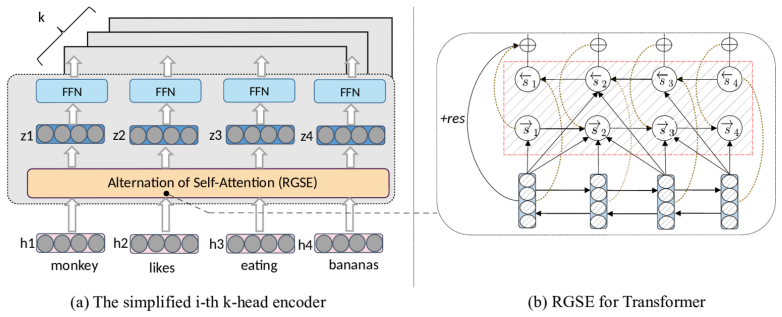
The load-bearing object is the RGSE layer itself: a graph whose vertices are RNN cells (GRUs) and whose edges are dependency arcs between words. For each node, incoming edge values are gathered from the original encoder's hidden states and combined by a function $\varphi(s_j)$ that is either sum, average, or gated; then two GRU passes run left-to-right and right-to-left so that each node's update uses both the aggregated dependency evidence and the adjacent word's recurrent state. The layer ends with a normal or gated residual connection to the original encoder hidden state. The gated residual and edge-wise integration are reported as the best choices. In the Transformer variant, RGSE replaces the self-attention sublayer in the lower layers, with a gate deciding how much of the original encoder representation is retained.
What would settle it
Take the same NC-v11 En-De setup and replace the predicted dependency edges with gold-standard treebank edges; if BLEU does not improve over BiRNN+GCN, or if randomizing even a small fraction of edges leaves BLEU unchanged, then the improvement comes from the parser's specific edge distribution rather than from syntax in general. A cheaper check is a corruption sweep: damage 10%, 30%, and 50% of edges by rewiring and observe whether BLEU drops monotonically.
Extended reading notes
Core claim
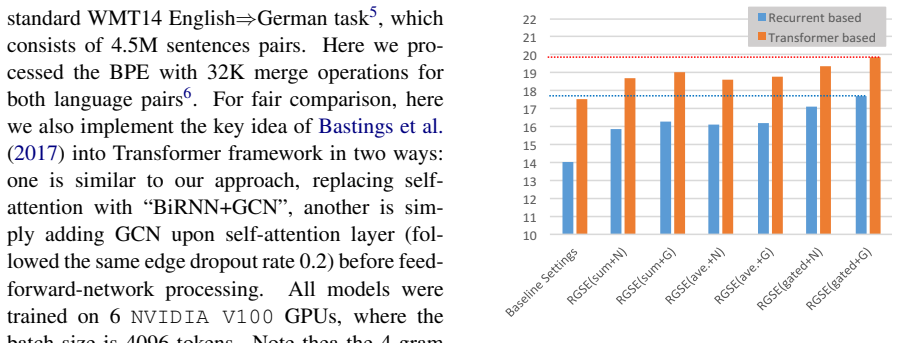
RGSE's central claim is that syntax and sequence are not separate channels: a node should receive both its dependency-neighbour states and its own previous hidden state in the same recurrence. The paper builds this by taking the hidden states of a standard encoder as node values, wiring directed dependency edges between nodes, aggregating incoming edges with sum, average, or learned gating, and running forward and backward recurrent passes over the graph. Bidirectional total RGSE, which uses both past and future dependency edges, is the best variant; it outperforms the BiRNN+GCN baseline by +1.6 BLEU on En-De (17.7 vs 16.1) and +1.5 on En-Cs (11.1 vs 9.6). On Transformer, placing RGSE in place of self-attention in the first three layers yields +0.9 BLEU on En-De and +0.8 on En-Cs over the base model, with only a few million extra parameters. The paper also reports that RGSE helps most on longer sentences, which supports the idea that explicit dependency edges improve long-distance modeling.
Load-bearing premise
The load-bearing assumption is that the automatically predicted dependency parses used to create the graph edges are accurate and carry usable information; the paper uses parser output without measuring its accuracy or how parse errors affect the reported BLEU gains.
Editorial extensions
If this is right
- On recurrent NMT, bi-total-RGSE outperforms BiRNN+GCN by +1.6 BLEU on En-De (17.7 vs 16.1) and +1.5 on En-Cs (11.1 vs 9.6), so the syntax encoder can replace existing graph syntax layers with a single component.
- On Transformer-base, adding RGSE gives +0.9 BLEU on En-De and +0.8 on En-Cs with fewer than three million extra parameters.
- Replacing the first three self-attention layers with RGSE works better than replacing all layers or none, suggesting that lower layers are where dependency information is most needed.
- Length-binned BLEU scores show that RGSE's advantage grows on longer sentences, indicating that explicit syntax edges help with long-distance dependencies.
- RGSE-equipped Transformer-big reaches 29.47 BLEU on WMT14 En-De, becoming competitive with the best published results at the time.
Reading between the lines
- Editorial inference: the direction asymmetry (future dependencies help more than past ones on English) is probably tied to head-initial English word order; in head-final languages like Japanese, the more useful direction may flip, which is a testable prediction the paper does not make.
- Editorial inference: since predicted parses were used throughout, a natural extension is to train with dependency-edge dropout or multi-task parse supervision to make the model robust to parser noise; the paper only applies edge dropout, not corruption-level sensitivity.
- Editorial inference: the gated residual connection that worked best suggests RGSE can be seen as a differentiable prior that interpolates between the original encoder state and syntax-aware state, which could transfer to other encoder-decoder tasks such as summarization or grammar correction.
Signed reviews
Editorial analysis
A structured set of objections, weighed in public.
Referee Report
Summary. The paper proposes the Recurrent Graph Syntax Encoder (RGSE), a syntax-aware encoder component that treats recurrent network units as graph nodes and injects syntactic dependency edges, so that word-order information (via recurrence) and syntactic dependencies (via edges) are modeled simultaneously. RGSE is applied on top of both an RNN-based encoder and the Transformer encoder, with a gated residual connection and a choice of integration functions for incoming edges. Experiments on NC-v11 En-De and En-Cs show consistent BLEU improvements over several syntax-aware baselines, e.g., bi-total-RGSE achieves 17.7 BLEU on En-De versus 16.1 for BiRNN+GCN, and RGSE-equipped Transformer-big reaches 29.47 BLEU on WMT14 En-De, close to DynamConv's 29.70. The authors also present ablations of integration functions, layer placement, and past/future edge directions.
Significance. If the reported gains are attributable to the proposed mechanism, RGSE is a simple, portable syntax-aware encoder component with modest parameter overhead, applicable to both recurrent and self-attentional NMT architectures. The paper is careful in several respects: it includes a two-layer BiRNN baseline with more parameters than the RGSE models to control for parameter count, it selects hyperparameters (integration function, residual connection, layer placement) on validation data rather than test data, and it reports significance markers for the main comparisons. The main weakness is that the experimental design does not isolate the contribution of the syntactic edges from the contribution of the added recurrent layer, and parser error is not analyzed. These gaps leave the central causal claim -- that the gains come from simultaneously modeling syntax and word order -- not fully supported.
major comments (3)
- [Section 3.1 and Table 2] The central claim that RGSE's gains stem from jointly modeling syntactic edges and word order is not established because no ablation removes the dependency edges while retaining the recurrent RGSE layer. The comparison in Table 2 between bi-total-RGSE (17.7 BLEU) and BiRNN+GCN (16.1 BLEU) conflates two modifications: adding a recurrent GRU layer on top of the original encoder and injecting dependency edges into that layer. The two-layer BiRNN baseline (15.5 BLEU, 62.3M parameters) is not an adequate control, since its second layer reads the same-position hidden state rather than the edge-aggregated input φ(ν_t); the input distributions differ by construction. An ablation with φ(ν_t) set to the original hidden state (or with all dependency edges zeroed) while keeping the recurrent update would isolate whether the +1.6 BLEU improvement is due to the syntax edges or simply to the added recurrence and capacity.
- [Section 4.1] The paper uses SyntaxNet to parse the English side (Section 4.1) but reports no parser accuracy, oracle analysis, or robustness experiments with respect to parser errors. If the predicted dependencies are noisy, the observed gains may reflect the generic benefit of adding edge connections rather than the injection of correct syntactic structure, and the method's sensitivity to parse quality is untested. This is particularly relevant because the paper attributes the improvements to 'syntactic dependencies' as the mechanism; without parser error analysis, the reader cannot tell whether the edges carry accurate syntax or merely additional connectivity.
- [Section 4.3 and Table 3] The WMT14 En-De comparison against state-of-the-art systems such as DynamConv, LightConv, and Localness (Table 3) relies on BLEU scores taken from the original publications rather than rerunning those models under identical data preprocessing, training, and decoding settings. The authors do reproduce several Transformer variants (Transformer-base, +GCN, +BiRNN+GCN), but the 'competitive result' claim (29.47 vs 29.70) against models from other papers is not a controlled comparison. This weakens the secondary claim in the abstract about achieving a competitive result with state-of-the-art models, though it does not affect the internal comparisons on NC-v11 where baselines are reimplemented.
minor comments (5)
- [Section 4.1] The setup section mentions 'Note thea ...' which appears to be a typo; please correct it.
- [Section 3.1] The notation for the edge representation hξ(~hi, sj) is not defined; the authors should clarify how an edge is mapped to a vector before being fed into the integration function φ(·).
- [Tables 2 and 3] The significance markers '↑/⇑' are used in the table captions but are not defined until the running text; please define them in each caption or in a general note.
- [Section 4.4.1] The explanation that future dependencies are more instructive for Subject-Verb-Object languages is speculative and not directly supported by the reported data; consider tempering the claim or providing an analysis of dependency types.
- [General] No code or trained models are released, and BLEU scores are reported from a single run without standard errors or confidence intervals, which limits reproducibility; the authors should at least release the code and ideally report multiple seeds.
Circularity Check
No significant circularity: RGSE's claims are empirical comparisons against external baselines, with no fitted input renamed as prediction and no load-bearing self-citation chain.
full rationale
The paper's central claims are empirical: RGSE is a new encoder component, and its effectiveness is measured by BLEU on standard WMT benchmarks against external and reimplemented baselines. No claimed result is derived by definition from its inputs. The integration function φ(·), residual connection τ(·), and layer placement are selected on validation sets (Section 4.2, Figure 5, Table 1), not on test sets, so they are hyperparameter choices rather than fitted values used to manufacture a test-set prediction. The comparison tables (Tables 2 and 3) report direct BLEU scores for multiple systems, including previously published results (Bastings et al., 2017; Beck et al., 2018; Wu et al., 2018; Vaswani et al., 2017; Shaw et al., 2018; Yang et al., 2018; Wu et al., 2019), and the paper's own ablations vary structural choices (forward, past, future, total RGSE) while keeping the base architecture fixed. There is no self-citation that carries a load-bearing argument, no uniqueness theorem imported from the authors' prior work, and no ansatz smuggled in via citation; the RGSE equations in Section 3.1 are explicitly defined and are not equivalent to the baselines by construction. The skeptical concern that the +1.6 BLEU gain over BiRNN+GCN might be due to added recurrence rather than syntactic edges is a possible experimental confound, but it is not circularity: the paper does not claim to prove via derivation that the edges are the cause, and the comparison is a genuine empirical outcome rather than a quantity determined by the model's definition. Therefore the appropriate finding is no significant circularity.
Assumptions & free parameters
free parameters (4)
- RGSE layer placement in Transformer =
[1-3]
- Integration function phi =
gated
- Residual connection tau =
gated residual
- RGSE directionality =
bi-total
assumptions (4)
- domain assumption SyntaxNet dependency parses provide useful syntactic signal for translation.
- domain assumption BLEU is a valid proxy for translation quality.
- domain assumption Higher Transformer layers exploit more structure than lower layers, motivating lower-layer RGSE placement.
- domain assumption Standard NMT training and preprocessing conventions from prior work are appropriate.
Cite this review
Pith. "Pith review of Recurrent Graph Syntax Encoder for Neural Machine Translation." pith.science (2026). https://pith.science/paper/WP7ZAI5T
@misc{pith2026190806559,
  author       = {Pith},
  title        = {Pith review of: Recurrent Graph Syntax Encoder for Neural Machine Translation},
  year         = {2026},
  howpublished = {\url{https://pith.science/paper/WP7ZAI5T}},
  note         = {Machine review of arXiv:1908.06559}
}
abstract
Syntax-incorporated machine translation models have been proven successful in improving the model's reasoning and meaning preservation ability. In this paper, we propose a simple yet effective graph-structured encoder, the Recurrent Graph Syntax Encoder, dubbed \textbf{RGSE}, which enhances the ability to capture useful syntactic information. The RGSE is done over a standard encoder (recurrent or self-attention encoder), regarding recurrent network units as graph nodes and injects syntactic dependencies as edges, such that RGSE models syntactic dependencies and sequential information (\textit{i.e.}, word order) simultaneously. Our approach achieves considerable improvements over several syntax-aware NMT models in English$\Rightarrow$German and English$\Rightarrow$Czech translation tasks. And RGSE-equipped big model obtains competitive result compared with the state-of-the-art model in WMT14 En-De task. Extensive analysis further verifies that RGSE could benefit long sentence modeling, and produces better translations.
Figures


Figures from the paper (3 more)

Reference graph
Works this paper leans on
-
[1]
URL: " 'urlintro :=
ENTRY address author booktitle chapter edition editor howpublished institution journal key month note number organization pages publisher school series title type volume year eprint doi pubmed url lastchecked label extra.label sort.label short.list INTEGERS output.state before.all mid.sentence after.sentence after.block STRINGS urlintro eprinturl eprintpr...
-
[2]
write newline
" write newline "" before.all 'output.state := FUNCTION n.dashify 't := "" t empty not t #1 #1 substring "-" = t #1 #2 substring "--" = not "--" * t #2 global.max substring 't := t #1 #1 substring "-" = "-" * t #2 global.max substring 't := while if t #1 #1 substring * t #2 global.max substring 't := if while FUNCTION word.in bbl.in capitalize " " * FUNCT...
-
[3]
Roee Aharoni and Yoav Goldberg. 2017. Towards string-to-tree neural machine translation. In Proceedings of the 55th Annual Meeting of the Association for Computational Linguistics (Volume 2: Short Papers), pages 132--140, Vancouver, Canada. Association for Computational Linguistics
work page 2017
-
[4]
Karim Ahmed, Nitish Shirish Keskar, and Richard Socher. 2018. Weighted transformer network for machine translation
work page 2018
-
[5]
Antonios Anastasopoulos and David Chiang. 2018. Tied multitask learning for neural speech translation. In Proceedings of the 2018 Conference of the North American Chapter of the Association for Computational Linguistics: Human Language Technologies, Volume 1 (Long Papers), pages 82--91
2018
-
[6]
Dzmitry Bahdanau, KyungHyun Cho, and Yoshua Bengio. 2015. Neural machine translation by jointly learning to align and translate. In Proceedings of ICLR 2015
work page 2015
-
[7]
Joost Bastings, Ivan Titov, Wilker Aziz, Diego Marcheggiani, and Khalil Simaan. 2017. Graph convolutional encoders for syntax-aware neural machine translation. In Proceedings of EMNLP 2017
work page 2017
-
[8]
Peter Battaglia, Razvan Pascanu, Matthew Lai, Danilo Jimenez Rezende, et al. 2016. Interaction networks for learning about objects, relations and physics. In Proceedings of NIPS 2016, pages 4502--4510
work page 2016
Show all 49 references
-
[9]
Daniel Beck, Gholamreza Haffari, and Trevor Cohn. 2018. Graph-to-sequence learning using gated graph neural networks. In Proceedings of ACL 2018
2018
-
[10]
Huadong Chen, Shujian Huang, David Chiang, and Jiajun Chen. 2017. Improved neural machine translation with a syntax-aware encoder and decoder. In Proceedings of ACL 2017, pages 1936--1945
2017
-
[11]
Tobias Domhan. 2018. How much attention do you need? a granular analysis of neural machine translation architectures. In Proceedings of ACL 2018
2018
-
[12]
Akiko Eriguchi, Kazuma Hashimoto, and Yoshimasa Tsuruoka. 2016. Tree-to-sequence attentional neural machine translation. In Proceedings of ACL 2016, pages 823--833
2016
-
[13]
Jonas Gehring, Michael Auli, David Grangier, Denis Yarats, and Yann N Dauphin. 2017. Convolutional sequence to sequence learning. In Proceedings of ICML 2017
2017
-
[14]
Hamilton, Rex Ying, and Jure Leskovec
William L. Hamilton, Rex Ying, and Jure Leskovec. 2017. Inductive representation learning on large graphs. In Proceedings of NIPS 2017
2017
-
[15]
Kaiming He, Xiangyu Zhang, Shaoqing Ren, and Jian Sun. 2016. Deep residual learning for image recognition. In Proceedings of CVPR 2016, pages 770--778
2016
-
[16]
Nal Kalchbrenner and Phil Blunsom. 2013. Recurrent continuous translation models. In Proceedings of EMNLP 2013, pages 1700--1709
2013
-
[17]
Thomas N Kipf and Max Welling. 2016. Semi-supervised classification with graph convolutional networks. arXiv preprint arXiv:1609.02907
2016 arXiv
-
[18]
Guillaume Klein, Yoon Kim, Yuntian Deng, Jean Senellart, and Alexander M. Rush. 2017. Open NMT : Open-source toolkit for neural machine translation. In Proc. ACL
2017
-
[19]
Adhiguna Kuncoro, Chris Dyer, John Hale, Dani Yogatama, Stephen Clark, and Phil Blunsom. 2018. Lstms can learn syntax-sensitive dependencies well, but modeling structure makes them better. In Proceedings of the 56th Annual Meeting of the Association for Computational Linguisti...
2018
-
[20]
Junhui Li, Deyi Xiong, Zhaopeng Tu, Muhua Zhu, Min Zhang, and Guodong Zhou. 2017. Modeling source syntax for neural machine translation. In Proceedings of ACL 2017, pages 688--697
2017
-
[21]
Tal Linzen, Emmanuel Dupoux, and Yoav Goldberg. 2016. Assessing the ability of lstms to learn syntax-sensitive dependencies. Transactions of the Association for Computational Linguistics, 4:521--535
2016
-
[22]
Le, Ilya Sutskever, Oriol Vinyals, and Lukasz Kaiser
Minh-Thang Luong, Quoc V. Le, Ilya Sutskever, Oriol Vinyals, and Lukasz Kaiser. 2016. Multi-task sequence to sequence learning. In Proceedings of ICLR 2016
2016
-
[23]
Chunpeng Ma, Akihiro Tamura, Masao Utiyama, Tiejun Zhao, and Eiichiro Sumita. 2018. Forest-based neural machine translation. In Proceedings of ACL 2018
2018
-
[24]
Diego Marcheggiani, Joost Bastings, and Ivan Titov. 2018. Exploiting semantics in neural machine translation with graph convolutional networks. In Proceedings of NAACL 2018
2018
-
[25]
Diego Marcheggiani and Ivan Titov. 2017. Encoding sentences with graph convolutional networks for semantic role labeling. In Proceedings of EMNLP 2017, pages 1506--1515
2017
-
[26]
Jan Niehues and Eunah Cho. 2017. Exploiting linguistic resources for neural machine translation using multi-task learning. In Proceedings of the WMT 2017
2017
-
[27]
Kishore Papineni, Salim Roukos, Todd Ward, and Wei-Jing Zhu. 2002. Bleu: A method for automatic evaluation of machine translation. In Proceedings of ACL 2002, pages 311--318
2002
-
[28]
Alessandro Raganato and J \"o rg Tiedemann. 2018. An analysis of encoder representations in transformer-based machine translation. In Proceedings of the 2018 EMNLP Workshop BlackboxNLP: Analyzing and Interpreting Neural Networks for NLP, pages 287--297
2018
-
[29]
Franco Scarselli, Marco Gori, Ah Chung Tsoi, Markus Hagenbuchner, and Gabriele Monfardini. 2009. The graph neural network model. IEEE Transactions on Neural Networks, 20(1):61--80
2009
-
[30]
Rico Sennrich and Barry Haddow. 2016. Linguistic input features improve neural machine translation. In Proceedings of the WMT 2016, pages 83--91
2016
-
[31]
Rico Sennrich, Barry Haddow, and Alexandra Birch. 2016. Neural machine translation of rare words with subword units. In Proceedings of the 54th Annual Meeting of the Association for Computational Linguistics (Volume 1: Long Papers), volume 1, pages 1715--1725
2016
-
[32]
Peter Shaw, Jakob Uszkoreit, and Ashish Vaswani. 2018. Self-attention with relative position representations. In Proceedings of the 2018 Conference of the North American Chapter of the Association for Computational Linguistics: Human Language Technologies, Volume 2 (Short Pape...
2018
-
[33]
Xing Shi, Inkit Padhi, and Kevin Knight. 2016. Does string-based neural mt learn source syntax? In Proceedings of the 2016 Conference on Empirical Methods in Natural Language Processing, pages 1526--1534
2016
-
[34]
Linfeng Song, Daniel Gildea, Yue Zhang, Zhiguo Wang, and Jinsong Su. 2019. Semantic neural machine translation using amr. arXiv preprint arXiv:1902.07282
2019 arXiv
-
[35]
Linfeng Song, Yue Zhang, Zhiguo Wang, and Daniel Gildea. 2018 a . A graph-to-sequence model for amr-to-text generation. In Proceedings of ACL 2018
2018
-
[36]
Linfeng Song, Yue Zhang, Zhiguo Wang, and Daniel Gildea. 2018 b . N-ary relation extraction using graph state lstm. In Proceedings of EMNLP 2018
2018
-
[37]
Felix Stahlberg, Eva Hasler, Aurelien Waite, and Bill Byrne. 2016. Syntactically guided neural machine translation. In Proceedings of the 54th Annual Meeting of the Association for Computational Linguistics (Volume 2: Short Papers), pages 299--305, Berlin, Germany. Association...
2016
-
[38]
Emma Strubell, Patrick Verga, Daniel Andor, David Weiss, and Andrew McCallum. 2018. Linguistically-informed self-attention for semantic role labeling. arXiv preprint arXiv:1804.08199
2018 arXiv
-
[39]
Ilya Sutskever, Oriol Vinyals, and Quoc V Le. 2014. Sequence to sequence learning with neural networks. In Proceedings of NIPS 2014, pages 3104--3112
2014
-
[40]
Kai Sheng Tai, Richard Socher, and Christopher D. Manning. 2015. Improved semantic representations from tree-structured long short-term memory networks. In Proceedings of ACL 2015
2015
-
[41]
Ashish Vaswani, Noam Shazeer, Niki Parmar, Jakob Uszkoreit, Llion Jones, Aidan N Gomez, Lukasz Kaiser, and Illia Polosukhin. 2017. Attention is all you need. In Proceedings of NIPS 2017
2017
-
[42]
Felix Wu, Angela Fan, Alexei Baevski, Yann N Dauphin, and Michael Auli. 2019. Pay less attention with lightweight and dynamic convolutions. arXiv preprint arXiv:1901.10430
2019 arXiv
-
[43]
Shuangzhi Wu, Dongdong Zhang, Zhirui Zhang, Nan Yang, Mu Li, and Ming Zhou. 2018. Dependency-to-dependency neural machine translation. IEEE/ACM Trans. Audio, Speech and Lang. Proc., 26(11):2132--2141
2018
-
[44]
Shuangzhi Wu, Ming Zhou, and Dongdong Zhang. 2017. Improved neural machine translation with source syntax. In IJCAI, pages 4179--4185
2017
-
[45]
Le, Mohammad Norouzi, Wolfgang Macherey, Maxim Krikun, Yuan Cao, Qin Gao, Klaus Macherey, Jeff Klingner, Apurva Shah, Melvin Johnson, et al
Yonghui Wu, Mike Schuster, Zhifeng Chen, Quoc V. Le, Mohammad Norouzi, Wolfgang Macherey, Maxim Krikun, Yuan Cao, Qin Gao, Klaus Macherey, Jeff Klingner, Apurva Shah, Melvin Johnson, et al. 2016. Google's neural machine translation system: Bridging the gap between human and ma...
2016
-
[46]
Baosong Yang, Zhaopeng Tu, Derek F Wong, Fandong Meng, Lidia S Chao, and Tong Zhang. 2018. Modeling localness for self-attention networks. In Proceedings of the 2018 Conference on Empirical Methods in Natural Language Processing, pages 4449--4458
2018
-
[47]
Poorya Zaremoodi and Gholamreza Haffari. 2018. Incorporating syntactic uncertainty in neural machine translation with a forest-to-sequence model. In Proceedings of COLING 2018, pages 1421--1429
2018
-
[48]
Meishan Zhang, Zhenghua Li, Guohong Fu, and Min Zhang. 2019. Syntax-enhanced neural machine translation with syntax-aware word representations. arXiv preprint arXiv:1905.02878
2019 arXiv
-
[49]
Yue Zhang, Qi Liu, and Linfeng Song. 2018. Sentence-state lstm for text representation. In Proceedings of the 56th Annual Meeting of the Association for Computational Linguistics (Volume 1: Long Papers), pages 317--327
2018
Reviewed August 14, 2026 · model on record in the stance chip above.
Discussion (0). Continue with ORCID to comment.