REVIEW 3 major objections 7 minor 96 references
Work and entropy of mixing in isolated quantum systems
T0 review · 3 major / 7 minor · reviewed 2026-08-06 · deepseek-v4-flash
Pith's one-line read In isolated gases, discovering a second particle type raises assigned entropy but delivers no additional extractable work, and the paper derives a Landauer-like formula for the difference between observers.
desk verdict Solid observer-dependent thermodynamics, but the paradox resolution is conditional on a non-generic color-blind Hamiltonian and the abstract oversells it. read the letter →
The pith
A machine-rendered reading of the paper's core claim, the machinery that carries it, and where it could break.
The reading
What carries the argument
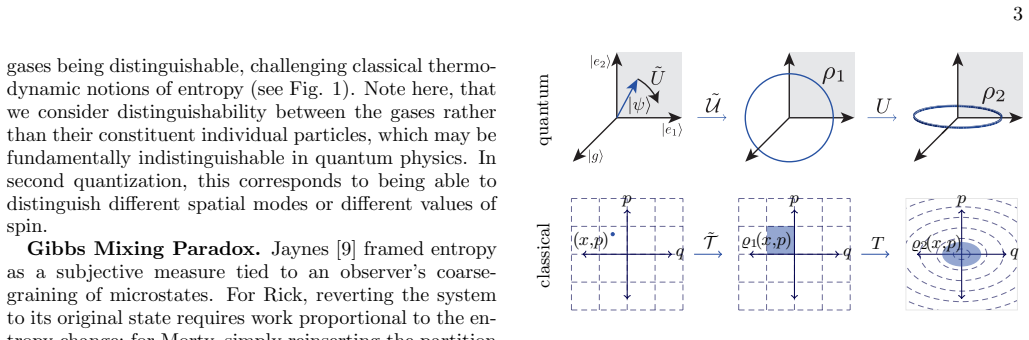
The carrying objects are observational entropy, $S_C = -\sum_i p_i\ln p_i + \sum_i p_i\ln V_i$, defined by a coarse-graining $C=\{P_i\}$ with macrostate volumes $V_i=\mathrm{tr}\,P_i$, and observational ergotropy, $W_C^\infty = \mathrm{tr}[H(\rho-\rho_\beta)]$, the average work extracted by first randomizing within each macrostate and then applying an optimized unitary. The identity that carries the quantitative argument is the expansion (7) relating $\Delta W$ to $\Delta S$, with the dimensionless heat capacity $\tilde C_E$ in the correction terms. For the fully ignorant observer, the proof machinery is a linear map $K$ that erases particle-color information together with consistency assumptions (a1)--(a8), which guarantee that his perceived measurements, states, unitaries, and energy assignments agree with reality at every resolution he can probe; this is what forces his actual extracted work to equal the amount he predicts.
What would settle it
Measure the extracted work of a color-blind observer on a two-species lattice gas whose hopping amplitude differs between species, e.g. $t_\uparrow\neq t_\downarrow$ in a fermionic Hubbard chain; whenever a configuration's energy then depends on which color sits at which site, assumption (a8) fails and the claimed equality between predicted and actual extracted work should break. A nonzero difference between the color-aware and color-blind observers' extracted work in that setting would settle the matter against the paper's resolution.
Extended reading notes
Core claim
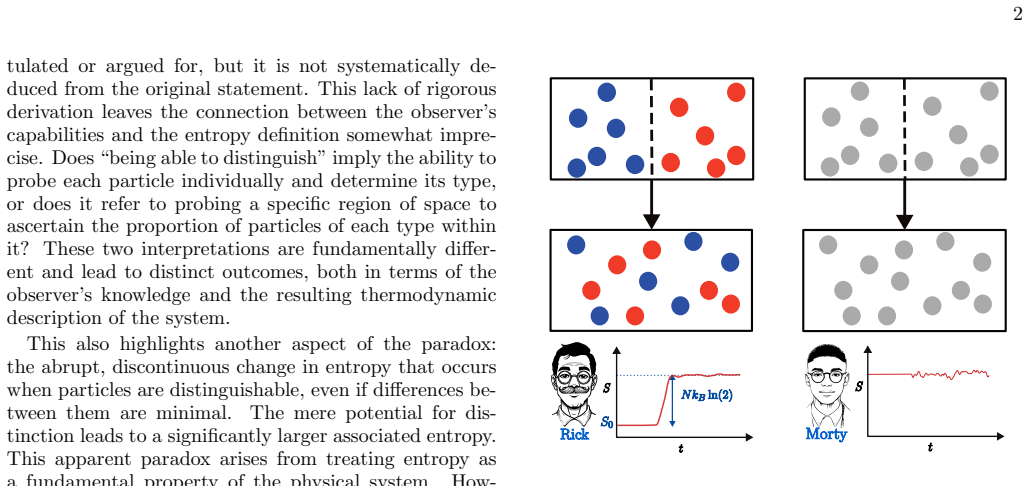
The central claim is that the difference in work extracted by two observers is governed only by the difference in their observational entropies, not by the absolute entropy either one assigns. For coarse-grainings $C_R$ and $C_M$, the work difference is $\Delta W = \mathrm{tr}[H(\rho_{\beta_M}-\rho_{\beta_R})]$, where each $\rho_\beta$ is a thermal state whose von Neumann entropy matches that observer's observational entropy; expanding this for small entropy differences gives Eq. (7), whose leading term $kT\,\Delta S$ resembles Landauer's bound but with an observational temperature. In the Gibbs mixing setup, Rick, who can see particle colors, and Morty, who cannot, assign entropies differing by $N\ln 2$ for the same macrostate, yet all Morty variants observe the same entropy increase during mixing, and under a Hamiltonian that depends only on particle configuration the fully ignorant Morty extracts exactly the same energy as the aware-but-color-blind observer. The paper concludes that the discontinuous entropy jump on discovering a second particle type is real in the entropy assignment but thermodynamically irrelevant for work extraction.
Load-bearing premise
The load-bearing premise is assumption (a8), that the actual Hamiltonian depends only on the particle configuration and not on particle color, so that the fully ignorant observer judges energies correctly; the paper itself says this 'will not be true for many systems.'
Editorial extensions
If this is right
- If the central claim is correct, an observer who cannot operationally distinguish particle types extracts the same work as one who can, provided the Hamiltonian depends only on the particle configuration, so the Gibbs mixing paradox is resolved without invoking hidden identities for the particles.
- The loss of extractable work caused by mixing gives a lower bound on the energy an observer must spend to unmix the gases, although the paper leaves a fully rigorous proof of that reversal bound to future work.
- The same Landauer-like expansion applies to one observer at two different times, so the work difference between before mixing and after mixing is governed by the same formula as the difference between two observers.
- Near critical points and at very low temperatures, where heat capacity diverges, the first correction term vanishes and $\Delta W$ approaches $kT\Delta S$, indicating a critical amount of information beyond which extractable work jumps discontinuously.
- Because observational entropy and canonical transformations have classical analogues, the derived bound applies also to classical isolated gases that are out of equilibrium.
Reading between the lines
- If the resolution extends beyond the paper's setup, any operationally invisible degree of freedom should add to an observer's assigned entropy but not to extractable work, making species knowledge thermodynamically free unless it also changes what operations the observer can perform.
- A testable extension is to relax assumption (a8): with a Hamiltonian whose hopping amplitudes depend on particle color, the fully ignorant observer would misjudge energies and should extract less work, and a cold-atom experiment with two hyperfine states and species-dependent tunnelling could look for this gap.
- The predicted threshold near a diverging heat capacity could be probed in quantum simulators of critical systems, where the extractable-work difference should show a sharp feature as the observational temperature crosses the critical temperature.
Editorial analysis
A structured set of objections, weighed in public.
Referee Report
Summary. The paper develops an observer-dependent thermodynamic framework for isolated quantum systems, combining observational entropy with observational ergotropy. It derives a Landauer-like expansion for the difference in extractable work between two observers, Eq. (7), in which an 'observational temperature' replaces the bath temperature. It then applies this framework to a lattice version of the Gibbs mixing paradox, considering an observer who can distinguish particle colors (Rick) and three observers with decreasing knowledge (Morty 1, 2, 3). The central claims are that all Morty variants observe the same entropy increase during mixing, that Morty 1 and 2 extract the same work, and that under explicit assumptions Morty 3 also extracts the same work as Morty 2, thereby resolving the paradox. The appendices contain detailed combinatorial volume calculations, the derivation of the work-difference expansion, and a formal proof of the Morty 3 work-extraction equivalence.
Significance. The framework is original and the paper contains substantial detailed derivations: the exact work-difference formula Eq. (4) is simple and general, the combinatorial volume calculations in Appendix B are careful, the expansion in Appendix A is algebraically explicit, and the assumptions underlying the Morty 3 theorem are stated transparently rather than hidden. The simulations in Figs. 4 and 5 compare exact and approximate results, which is a useful check. If the claims held, the paper would provide a quantitative, information-theoretic resolution of the Gibbs paradox and a new bound on mixing work in isolated systems. The two load-bearing concerns are (i) the perturbative expansion Eq. (7) is used in a regime where its small-parameter assumption is not satisfied, and (ii) the headline result for the fully ignorant observer is conditional on a non-generic color-independence assumption. Both issues are acknowledged in the text, but the abstract and conclusions do not carry the same caveats; the paper therefore needs substantial revision before the advertised claims are fully established.
major comments (3)
- [Section III A, Eq. (7), footnote [53]] The expansion Eq. (7) is derived by Taylor expanding the entropy and work differences in powers of Δβ, which requires ΔS to be small. In the standard Gibbs mixing scenario, however, ΔS = N ln 2 (Eq. (20)); for an ideal gas the expansion parameter is kΔS/CE = (2/3) ln 2 ≈ 0.46, and for several systems in Table I the corresponding parameter is not small or even diverges near critical temperatures. Footnote [53] explicitly concedes that the small-ΔS condition is not satisfied for the equal-sized, non-dilute mixing scenario. The paper compensates with heuristic 'average' and 'smart average' prescriptions in Fig. 4, but no error bound or convergence criterion is given. Consequently, Eq. (29) is not a rigorously established quantitative result for the standard mixing scenario; the authors should either provide a validity criterion for the expansion or present the exact formula Eq. (4) as the primary quantitative statement.
- [Section V and Appendix C, Eq. (C18)] The theorem that Morty 3 extracts exactly the same work as Morty 2 is proved only under assumption (a8), that the actual Hamiltonian is independent of particle color and depends only on the configuration. The text itself states that this assumption 'will not be true for many systems.' If (a8) fails, the projectors P_E in Eq. (C18) are not energy eigenspaces of the actual Hamiltonian, so the identity tr[Hρ] = tr[H_M ρ_M] in Eq. (C45) can fail, and the conclusion W_C = W_CM is unsupported. A concrete failure mode is a color-dependent onsite energy or hopping term, where states |+0> and |-0> that map to the same configuration have different energies. Because the abstract presents the resolution of the Gibbs paradox without this caveat, the headline claim is overstated. The theorem should be stated explicitly as conditional on (a8), and the authors should either characterize the failure when (a8) is violated or restrict the abstract and conclusion accordingly.
- [Section III A and Section VI (classical extension)] The paper repeatedly claims that the results 'extend beyond quantum systems' and apply identically to isolated classical gases, but the supporting argument is only a brief remark that canonical transformations preserve phase-space volume. No classical definition of observational ergotropy, no classical analogue of the extraction protocol, and no derivation of Eq. (3) or Eq. (7) in the classical setting is provided. Since the classical extension is advertised in the abstract and Conclusion, it should either be proved or explicitly labelled as a conjecture.
minor comments (7)
- [Figure 4 caption] The figure caption contains repeated '£' symbols that appear to be a rendering artifact; the axis labels and legend should be corrected.
- [Appendix B 2] The first sentence says 'Morty can observe only two macroscopic degrees of freedom,' but the main text (Section IV B) correctly states that Morty 1 observes three: N_A, N_B, and N_+. The appendix statement should be corrected.
- [Appendix B 3, Eq. (B16)] The text says 'Obtained by inserting r = 1/2 into Eq. (B16)', but this should refer to the preceding maximal-term expression, Eq. (B10); the self-reference appears to be a typographical error.
- [Section VI] The word 'distinguihguish' in the Conclusion is a typo for 'distinguish'.
- [Section III A] The phrase 'pase-space vectors' should read 'phase-space vectors'.
- [Table I] The comment that for liquid helium 'the second factor diverges' is ambiguous; it is the second-order coefficient in the expansion of ΔW that diverges as the observational temperature approaches T_c, and this should be stated precisely.
- [Section IV D] The text says that it 'would not be fair to compare Morty 3's entropy with Rick's,' but then immediately discusses the discrepancy; the logical connection could be clarified to avoid the appearance of contradiction.
Circularity Check
No significant circularity: the central equations are derived by definition and series expansion, and the Morty-3 resolution is conditional on explicitly stated assumptions.
full rationale
The paper's derivation chain is self-contained. Observational entropy is defined by Eq. (1), and observational ergotropy is imported as the theorem W_C∞ = tr[H(ρ − ρ_β)] from the authors' prior published work [49]. Eq. (4), ΔW = tr[H(ρ_βM − ρ_βR)], follows exactly from that formula, and Eq. (7) is a Taylor expansion in ΔS around the thermal family, with coefficients expressed through derivatives of the thermal energy in Appendix A. No parameter is fitted to the target result, and the 'observational temperature' is defined by the matching condition S_vN(ρ_β) = S_C; its appearance in the leading term kT ΔS is a consequence of the chain rule d⟨E⟩/dS = 1/β for that thermal family, not an independently assumed physical law. The Gibbs-mixing entropy differences are computed by counting macrostate dimensions (Eqs. (9), (12), (14), (16)), not assumed. The Morty-3 equality W_C = W_CM is proved in Appendix C under assumptions (a1)–(a8), and the authors explicitly flag the nontrivial scope limitation: 'we have one non-trivial assumption that will not be true for many systems' (Section V). That is a stated condition on the Hamiltonian, not a circular reuse of the conclusion. Self-citations to [49] and [72] supply the definition of observational ergotropy; these are published, parameter-free theorems with stated assumptions and do not smuggle in the present paper's conclusions. The proof that Morty 3 extracts the same work as Morty 2 is therefore a conditional theorem, not a circularity, and the main work-difference expansion is a mathematical consequence of the definitions rather than a fitted prediction.
Assumptions & free parameters
assumptions (6)
- domain assumption Observational ergotropy formula W_C = tr[H(ρ-ρβ)] from Safranek, Rosa, Binder (2023) is taken as the correct work-extraction amount for a coarse-grained observer.
- domain assumption The system's time evolution leads to uniform spreading over the accessible Hilbert space (probabilities proportional to macrostate volumes).
- domain assumption The entropy difference ΔS is sufficiently small for the perturbative expansion to converge.
- ad hoc to paper The Hamiltonian is independent of particle color (assumption a8) for the Morty 3 work-equivalence proof.
- domain assumption The total number of particles of each color is conserved.
- standard math Stirling approximation and Laplace method are valid in the dilute limit w >> N.
invented entities (1)
-
Observational temperature T
independent evidence
Cite this review
Pith. "Pith review of Work and entropy of mixing in isolated quantum systems." pith.science (2026). https://pith.science/paper/WPADZNZN
@misc{pith2026250705054,
  author       = {Pith},
  title        = {Pith review of: Work and entropy of mixing in isolated quantum systems},
  year         = {2026},
  howpublished = {\url{https://pith.science/paper/WPADZNZN}},
  note         = {Machine review of arXiv:2507.05054}
}
abstract
The mixing of two different gases is one of the most common natural phenomena, with applications ranging from CO$_2$ capture to water purification. Traditionally, mixing is analyzed in the context of local thermal equilibrium, where systems exchange energy with a heat bath. Here, we study mixing in an isolated system with potentially non-equilibrium initial states, characterized solely by macroscopic observables. We identify the entropy of mixing as a special case of observational entropy within an observer-dependent framework, where both entropy and extractable work depend on the resolution of measurement. This approach naturally resolves the Gibbs mixing paradox in quantum systems: while an observer experiences a discontinuous increase in entropy upon learning of the existence of two particle types, this knowledge does not provide an advantage in work extraction if the types of particles remain operationally indistinguishable in their measurements. Finally, we derive a Landauer-like bound on the difference in energy extracted by two observers, where an "observational temperature" emerges, determined by the accessible information. These results provide a foundation for rigorously determining the energy required to unmix in non-equilibrium settings and extend beyond quantum systems, offering insights into the thermodynamics of isolated classical gases.
Figures

Figures from the paper (1 more)

Reference graph
Works this paper leans on
-
[53]
T. Nagasawa, K. Kato, E. Wakakuwa, and F. Buscemi, Generic increase of observational entropy in isolated sys- tems, Phys. Rev. Res. 6, 043327 (2024)
work page 2024
-
[1]
Rick Rick can observe both the number and type of particle in each part. His macrostate is given by four numbers: i, denoting the number of blue particles on the left;N+, the total number of blue particles; NA, the total number of particles on the left; and N , the total number of particles. From these, the total number of red particles, N−, and the total...
-
[2]
We again haveN++N− = NA+NB = N
Morty 1 Morty can observe only two macroscopic degrees of freedom, that is, the total number of particles on the left NA, and the total number of particles on the right, which we denote as the total number of particles minus those on the left, N − NA. We again haveN++N− = NA+NB = N . Without loss of generatity we define NA and N+ to be the smaller of the ...
-
[3]
(B15) where f (i, N+) is a function identical to that of f (i) in Eq
Morty 2 The macrostate volume of Morty 2, parametrized by a couple (NA, N), is given by V M2 = 2 N/2X N+=0 min{N+,NA}X i=0 f (i, N+). (B15) where f (i, N+) is a function identical to that of f (i) in Eq. (B9) and equal to the Rick’s macrostate volume, Eq. (B1). The maximum of f (i, N+) is reached at imax = aN/2 and R+ max = N/2, and given by ln fmax = N (...
-
[4]
ignorant
Morty 3 Finally, we consider the case of “ignorant” Morty, who not only cannot distiguish the two colors of particles, but also is not aware that these two colors of particles even exist. As a result, he also does not know how many par- ticles of each type are in the system that he is observing. The only information he can obtain is how many particles are...
-
[5]
(B23) Using Eq
Rick - non-symmetric case Finally, let us consider a non-symmetric case of Rick, where the macrostate volume is given by V R = LA i LA NA −i LB N+ −i LB N −N+ −(NA −i) = LA piN LA (a−pi)N LB (r−pi)N LB (1−r−a+pi)N = LA q1N LA q2N LB q3N LB q4N . (B23) Using Eq. (B5), we find ln V R = q1N (ln LA − ln N − ln q1 + 1) − 1 2 ln 2πN q1 + q2N (ln LA − ln N − ln ...
-
[6]
(B29) We obtain fmax by inserting pi = ar into Eq
Morty 1 - non-symmetric case V M1 = min{N+,NA}X i=0 LA i LA NA −i LB N+ −i LB N −N+ −(NA −i) =: min{N+,NA}X i=0 f (i) ≈ fmax √ 2πσ 2 (B28) where fmax is given again by i = N+NA N = arN , and the variance is given again by σ2 = − d2 ln f di2 i=imax !−1 = N a(1 − a)r(1 − r). (B29) We obtain fmax by inserting pi = ar into Eq. (B24) and derive ln V M1 = N a l...
-
[7]
(C4) and (C5) below)
Consistency , assumptions, and the resulting structure Mathematically, we define consistency as follows: for all measurements accessible to him, the outcome proba- bilities before and after his unitary operation must coin- cide with those generated by the actual state under our model transformation (see Eqs. (C4) and (C5) below). Consider that ρ and U rep...
Show all 96 references
-
[8]
Extracted work by Morty 3 Now we have most of the ingredients for deriving Morty 3’s actual extracted work. We are interested in whether Morty 3’s estimate of the extracted work matches the actual extracted work, given the set of consistency assumptions (a1–a3), the su- persel...
-
[9]
A. A. Abd, S. Z. Naji, A. S. Hashim, and M. R. Othman, Carbon dioxide removal through physical adsorption us- ing carbonaceous and non-carbonaceous adsorbents: A review, Journal of Environmental Chemical Engineering 8, 104142 (2020)
2020
-
[10]
I. C. Karagiannis and P. G. Soldatos, Water desalination cost literature: review and assessment, Desalination 223, 448 (2008), european Desalination Society and Center for Research and Technology Hellas (CERTH), Sani Resort 22–25 April 2007, Halkidiki, Greece
2008
-
[11]
Chandra and K
S. Chandra and K. B. Walsh, Microplastics in water: Oc- currence, fate and removal, Journal of Contaminant Hy- drology 264, 104360 (2024)
2024
-
[12]
Gonsioroski, V
A. Gonsioroski, V. E. Mourikes, and J. A. Flaws, En- docrine disruptors in water and their effects on the re- productive system, International journal of molecular sci- ences 21, 1929 (2020)
2020
-
[13]
M. Gong, G. D. de Moraes Neto, C. Zha, Y. Wu, H. Rong, Y. Ye, S. Li, Q. Zhu, S. Wang, Y. Zhao, F. Liang, J. Lin, Y. Xu, C.-Z. Peng, H. Deng, A. Bayat, X. Zhu, and J.-W. Pan, Experimental characterization of the quan- tum many-body localization transition, Phys. Rev. Res. 3, 03...
2021
-
[14]
Bernon, H
S. Bernon, H. Hattermann, D. Bothner, M. Knufinke, P. Weiss, F. Jessen, D. Cano, M. Kemmler, R. Kleiner, D. Koelle, and J. Fort´ agh, Manipulation and coherence of ultra-cold atoms on a superconducting atom chip, Nature Communications 4, 2380 (2013)
2013
-
[15]
L´ eonard, S
J. L´ eonard, S. Kim, M. Rispoli, A. Lukin, R. Schittko, J. Kwan, E. Demler, D. Sels, and M. Greiner, Probing the onset of quantum avalanches in a many-body localized system, Nature Physics 19, 481 (2023)
2023
-
[16]
S. J. Blundell and K. M. Blundell, Concepts in thermal physics (Oup Oxford, 2010)
2010
-
[17]
E. T. Jaynes, The Gibbs Paradox, in Maximum Entropy and Bayesian Methods: Seattle, 1991, edited by C. R. Smith, G. J. Erickson, and P. O. Neudorfer (Springer Netherlands, Dordrecht, 1992) pp. 1–21
1991
-
[18]
Tatarin and O
V. Tatarin and O. Borodiouk, Entropy Calculation of Reversible Mixing of Ideal Gases Shows Absence of Gibbs Paradox, Entropy 1, 25 (1999)
1999
-
[19]
A. E. Allahverdyan and Th. M. Nieuwenhuizen, Explana- tion of the Gibbs paradox within the framework of quan- tum thermodynamics, Phys. Rev. E 73, 066119 (2006)
2006
-
[20]
Ben-Naim, On the So-Called Gibbs Paradox, and on the Real Paradox, Entropy 9, 132 (2007)
A. Ben-Naim, On the So-Called Gibbs Paradox, and on the Real Paradox, Entropy 9, 132 (2007)
2007
-
[21]
Lin, Gibbs Paradox and the Concepts of Informa- tion, Symmetry, Similarity and Their Relationship, En- tropy 10, 1 (2008)
S.-K. Lin, Gibbs Paradox and the Concepts of Informa- tion, Symmetry, Similarity and Their Relationship, En- tropy 10, 1 (2008)
2008
-
[22]
V. P. Maslov, Solution of the Gibbs paradox in the frame- work of classical mechanics (Statistical Physics) and crys- tallization of the gas C 60, Math Notes 83, 716 (2008)
2008
-
[23]
R. H. Swendsen, Gibbs’ Paradox and the Definition of Entropy, Entropy 10, 15 (2008)
2008
-
[24]
Cheng, Thermodynamics of the System of Distin- guishable Particles, Entropy 11, 326 (2009)
C.-H. Cheng, Thermodynamics of the System of Distin- guishable Particles, Entropy 11, 326 (2009)
2009
-
[25]
Enders, Gibbs’ Paradox in the Light of Newton’s No- tion of State, Entropy 11, 454 (2009)
P. Enders, Gibbs’ Paradox in the Light of Newton’s No- tion of State, Entropy 11, 454 (2009)
2009
-
[26]
J. F. Nagle, In Defense of Gibbs and the Traditional Def- inition of the Entropy of Distinguishable Particles, En- tropy 12, 1936 (2010)
2010
-
[27]
Peters, Demonstration and resolution of the Gibbs paradox of the first kind, Eur
H. Peters, Demonstration and resolution of the Gibbs paradox of the first kind, Eur. J. Phys.35, 015023 (2013)
2013
-
[28]
Saunders, The Gibbs Paradox, Entropy20, 552 (2018)
S. Saunders, The Gibbs Paradox, Entropy20, 552 (2018)
2018
-
[29]
Darrigol, The Gibbs Paradox: Early History and So- lutions, Entropy 20, 443 (2018)
O. Darrigol, The Gibbs Paradox: Early History and So- lutions, Entropy 20, 443 (2018)
2018
-
[30]
Dieks, The Gibbs Paradox and Particle Individuality, Entropy 20, 466 (2018)
D. Dieks, The Gibbs Paradox and Particle Individuality, Entropy 20, 466 (2018)
2018
-
[31]
R. H. Swendsen, Probability, Entropy, and Gibbs’ Para- dox(es), Entropy 20, 450 (2018)
2018
-
[32]
V. Ihnatovych, The Gibbs paradox in classical thermo- dynamics is a consequence of the erroneous attribution of the entropy of an ideal gas to additive quantities (2023), arXiv:2304.11132 [cond-mat, physics:physics]
2023 arXiv
-
[33]
J. E. Baker, How muscle solved the Gibbs paradox, Bio- physical Journal 123, 278a (2024)
2024
-
[34]
Lairez, Thermostatistics, Information, Subjectivity: Why Is This Association So Disturbing?, Mathematics 12, 1498 (2024)
D. Lairez, Thermostatistics, Information, Subjectivity: Why Is This Association So Disturbing?, Mathematics 12, 1498 (2024)
2024
-
[35]
Yadin, B
B. Yadin, B. Morris, and G. Adesso, Mixing indistin- guishable systems leads to a quantum Gibbs paradox, Nat Commun 12, 1471 (2021)
2021
-
[36]
Yoshida and N
A. Yoshida and N. Nakagawa, Work relation for deter- mining the mixing free energy of small-scale mixtures, Phys. Rev. Res. 4, 023119 (2022)
2022
-
[37]
Takakura, Entropy of mixing exists only for classi- cal and quantum-like theories among the regular polygon theories, J
R. Takakura, Entropy of mixing exists only for classi- cal and quantum-like theories among the regular polygon theories, J. Phys. A: Math. Theor. 52, 465302 (2019)
2019
-
[38]
S.-i. Sasa, K. Hiura, N. Nakagawa, and A. Yoshida, Quasi-static Decomposition and the Gibbs Factorial in Small Thermodynamic Systems, J Stat Phys 189, 31 (2022)
2022
-
[39]
von Neumann, Proof of the ergodic theorem and the H-theorem in quantum mechanics
J. von Neumann, Proof of the ergodic theorem and the H-theorem in quantum mechanics. Translation of: Be- weis des Ergodensatzes und des H-Theorems in der neuen Mechanik, European Physical Journal H 35, 201 (2010)
2010
-
[40]
von Neumann, Mathematical foundations of quantum mechanics (Princeton university press, 1955)
J. von Neumann, Mathematical foundations of quantum mechanics (Princeton university press, 1955). 24
1955
-
[41]
ˇSafr´ anek, J
D. ˇSafr´ anek, J. M. Deutsch, and A. Aguirre, Quantum coarse-grained entropy and thermodynamics, Phys. Rev. A 99, 010101 (2019), arXiv:1707.09722 [quant-ph]
2019 arXiv
-
[42]
ˇSafr´ anek, J
D. ˇSafr´ anek, J. M. Deutsch, and A. Aguirre, Quantum coarse-grained entropy and thermalization in closed sys- tems, Phys. Rev. A 99, 012103 (2019), arXiv:1803.00665 [quant-ph]
2019 arXiv
-
[43]
ˇSafr´ anek, A
D. ˇSafr´ anek, A. Aguirre, J. Schindler, and J. M. Deutsch, A Brief Introduction to Observational Entropy, Founda- tions of Physics 51, 101 (2021), arXiv:2008.04409 [quant- ph]
2021 arXiv
-
[44]
Strasberg and A
P. Strasberg and A. Winter, First and second law of quan- tum thermodynamics: A consistent derivation based on a microscopic definition of entropy, PRX Quantum 2, 030202 (2021)
2021
-
[45]
ˇSafr´ anek and J
D. ˇSafr´ anek and J. Thingna, Quantifying information ex- traction using generalized quantum measurements, Phys- ical Review A 108, 032413 (2023), arXiv:2007.07246
2023 arXiv
- [46]
-
[47]
G. Bai, D. ˇSafr´ anek, J. Schindler, F. Buscemi, and V. Scarani, Observational entropy with general quantum priors, Quantum 8, 1524 (2024)
2024
-
[48]
Riera-Campeny, A
A. Riera-Campeny, A. Sanpera, and P. Strasberg, Quan- tum systems correlated with a finite bath: Nonequilib- rium dynamics and thermodynamics, PRX Quantum 2, 010340 (2021), arXiv:2008.02184 [quant-ph]
2021 arXiv
-
[49]
Strasberg, M
P. Strasberg, M. G. D ´ ıaz, and A. Riera-Campeny, Clau- sius inequality for finite baths reveals universal effi- ciency improvements, Phys. Rev. E104, L022103 (2021), arXiv:2012.03262 [quant-ph]
2021 arXiv
-
[50]
S. PG, R. Modak, and S. Aravinda, Witnessing quan- tum chaos using observational entropy, Phys. Rev. E107, 064204 (2023)
2023
-
[51]
S. PG, J. Bharathi Kannan, S. Harshini Tekur, and M. S. Santhanam, Dichotomy in the effect of chaos on ergotropy, arXiv e-prints , arXiv:2409.16587 (2024), arXiv:2409.16587 [quant-ph]
2024 arXiv
-
[52]
Chakraborty, S
S. Chakraborty, S. Das, A. Ghorui, S. Hazra, and U. Singh, Sample Complexity of Black Box Work Extraction, arXiv e-prints , arXiv:2412.02673 (2024), arXiv:2412.02673 [quant-ph]
2024
-
[54]
Xuereb, A
J. Xuereb, A. d. O. Junior, F. Clivaz, P. Bakhshinezhad, and M. Huber, What resources do agents need to ac- quire knowledge in Quantum Thermodynamics?, arXiv e-prints , 2410.18167 (2024), arXiv:2410.18167
2024
-
[55]
Meier, T
F. Meier, T. Rivlin, T. Debarba, J. Xuereb, M. Huber, and M. P. Lock, Emergence of a second law of thermo- dynamics in isolated quantum systems, PRX Quantum 6, 010309 (2025)
2025
-
[56]
Schindler, P
J. Schindler, P. Strasberg, N. Galke, A. Winter, and M. G. Jabbour, Unification of observational entropy with maximum entropy principles, arXiv e-prints , arXiv:2503.15612 (2025), arXiv:2503.15612 [quant-ph]
2025 arXiv
-
[57]
ˇSafr´ anek, D
D. ˇSafr´ anek, D. Rosa, and F. C. Binder, Work extraction from unknown quantum sources, Phys. Rev. Lett. 130, 210401 (2023)
2023
-
[58]
S. D. Bartlett, T. Rudolph, and R. W. Spekkens, Ref- erence frames, superselection rules, and quantum in- formation, Reviews of Modern Physics 79, 555 (2007), arXiv:0610030v3 [arXiv:quant-ph]
2007
-
[59]
ˇSafr´ anek, Ergotropic interpretation of entangle- ment entropy, arXiv e-prints , arXiv:2306.08987 (2023), arXiv:2306.08987 [quant-ph]
D. ˇSafr´ anek, Ergotropic interpretation of entangle- ment entropy, arXiv e-prints , arXiv:2306.08987 (2023), arXiv:2306.08987 [quant-ph]
2023 arXiv
-
[60]
ˇSafr´ anek and D
D. ˇSafr´ anek and D. Rosa, Measuring energy by measuring any other observable, Phys. Rev. A 108, 022208 (2023)
2023
-
[61]
In- cluding higher order terms will yield better agreement with the exact formula, Eq
In the example of the mixing paradox below, in the ini- tial situation of the macroscopic non-equilibirum state with equal-sized boxes and non-dilute scenario, ∆ S is about a third of S, so this condition is not satisfied. In- cluding higher order terms will yield better agree...
-
[62]
See reviews [73–75] and papers for quantum [76–82] (Maxwell’s Demon, Szilard Engine and Landauer Princi- ple), classical [83–85], and active matter [86–88] systems
-
[63]
Yang and J.-Y
H. Yang and J.-Y. Lin, Low temperature specific heat studies on the pairing states of high-tc superconductors: a brief review, Journal of Physics and Chemistry of Solids 62, 1861 (2001)
2001
-
[64]
J. A. Lipa, J. A. Nissen, D. A. Stricker, D. R. Swanson, and T. C. P. Chui, Specific heat of liquid helium in zero gravity very near the lambda point, Phys. Rev. B 68, 174518 (2003)
2003
-
[65]
Lashley, M
J. Lashley, M. Hundley, A. Migliori, J. Sarrao, P. Pagliuso, T. Darling, M. Jaime, J. Cooley, W. Hults, L. Morales, D. Thoma, J. Smith, J. Boerio-Goates, B. Woodfield, G. Stewart, R. Fisher, and N. Phillips, Critical examination of heat capacity measurements made on a quantum ...
2003
-
[66]
Liang, S
T. Liang, S. M. Koohpayeh, J. W. Krizan, T. M. Mc- Queen, R. J. Cava, and N. P. Ong, Heat capacity peak at the quantum critical point of the transverse ising mag- net conb2o6, Nature Communications 6, 7611 (2015)
2015
-
[67]
Zhang, E
S.-S. Zhang, E. Berg, and A. V. Chubukov, Free energy and specific heat near a quantum critical point of a metal, Phys. Rev. B 107, 144507 (2023)
2023
-
[68]
ˇSafr´ anek, A
D. ˇSafr´ anek, A. Aguirre, and J. M. Deutsch, Classical dynamical coarse-grained entropy and comparison with the quantum version, Phys. Rev. E 102, 032106 (2020), arXiv:1905.03841 [cond-mat.stat-mech]
2020 arXiv
-
[69]
Teixid´ o-Bonfill, J
A. Teixid´ o-Bonfill, J. Schindler, and D. ˇSafr´ anek, En- tropic partial orderings of quantum measurements, Phys- ica Scripta 100, 015298 (2025), arXiv:2310.14086 [quant- ph]
2025 arXiv
-
[70]
Majidy, W
S. Majidy, W. F. Braasch, A. Lasek, T. Upadhyaya, A. Kalev, and N. Yunger Halpern, Noncommuting con- served charges in quantum thermodynamics and beyond, Nature Reviews Physics 5, 689 (2023), arXiv:2306.00054 [quant-ph]
2023 arXiv
-
[71]
Lasek, J
A. Lasek, J. D. Noh, J. LeSchack, and N. Yunger Halpern, Numerical evidence for the non-Abelian eigenstate thermalization hypothesis, arXiv e-prints , arXiv:2412.07838 (2024), arXiv:2412.07838 [quant-ph]
2024 arXiv
-
[72]
ˇSafr´ anek, A
D. ˇSafr´ anek, A. Aguirre, J. Schindler, and J. M. Deutsch, A Brief Introduction to Observational Entropy, Found Phys 51, 101 (2021)
2021
-
[73]
C. J. Myatt, E. A. Burt, R. W. Ghrist, E. A. Cor- nell, and C. E. Wieman, Production of Two Overlap- ping Bose-Einstein Condensates by Sympathetic Cooling, 25 Phys. Rev. Lett. 78, 586 (1997)
1997
-
[74]
D. S. Hall, M. R. Matthews, J. R. Ensher, C. E. Wieman, and E. A. Cornell, Dynamics of Component Separation in a Binary Mixture of Bose-Einstein Condensates, Phys. Rev. Lett. 81, 1539 (1998)
1998
-
[75]
M. H. Wheeler, K. M. Mertes, J. D. Erwin, and D. S. Hall, Spontaneous Macroscopic Spin Polarization in In- dependent Spinor Bose-Einstein Condensates, Phys. Rev. Lett. 93, 170402 (2004)
2004
-
[76]
Y.-J. Lin, K. Jim´ enez-Garc ´ ıa, and I. B. Spielman, Spin– orbit-coupled Bose–Einstein condensates, Nature 471, 83 (2011)
2011
-
[77]
Greif, M
D. Greif, M. F. Parsons, A. Mazurenko, C. S. Chiu, S. Blatt, F. Huber, G. Ji, and M. Greiner, Site-resolved imaging of a fermionic Mott insulator, Science 351, 953 (2016)
2016
-
[78]
M. F. Parsons, A. Mazurenko, C. S. Chiu, G. Ji, D. Greif, and M. Greiner, Site-resolved measurement of the spin- correlation function in the Fermi-Hubbard model, Sci- ence 353, 1253 (2016)
2016
-
[79]
We denote |0−⟩ to express that in the first position there are no particles, and in the second position there is a red particle and so on
-
[80]
ˇSafr´ anek, D
D. ˇSafr´ anek, D. Rosa, and F. C. Binder, Work Extraction from Unknown Quantum Sources, Phys. Rev. Lett. 130, 210401 (2023)
2023
-
[81]
Sagawa, Thermodynamics of Information Processing in Small Systems, Vol
T. Sagawa, Thermodynamics of Information Processing in Small Systems, Vol. 127 (2012) pp. 1–56
2012
-
[82]
J. M. R. Parrondo, J. M. Horowitz, and T. Sagawa, Thermodynamics of information, Nature Physics 11, 131 (2015)
2015
-
[83]
P. C. W. Davies, L. Thomas, and G. Za- hariade, The harmonic quantum szil´ ard en- gine, American Journal of Physics 89, 1123 (2021), https://pubs.aip.org/aapt/ajp/article- pdf/89/12/1123/20099417/1123 1 10.0005946.pdf
2021
-
[84]
B´ erut, A
A. B´ erut, A. Arakelyan, A. Petrosyan, S. Ciliberto, R. Dillenschneider, and E. Lutz, Experimental verifica- tion of landauer’s principle linking information and ther- modynamics, Nature 483, 187 (2012)
2012
-
[85]
J. V. Koski, V. F. Maisi, J. P. Pekola, and D. V. Averin, Experimental realization of a szilard en- gine with a single electron, Proceedings of the National Academy of Sciences 111, 13786 (2014), https://www.pnas.org/doi/pdf/10.1073/pnas.1406966111
2014 doi
-
[86]
J. P. S. Peterson, R. S. Sarthour, A. M. Souza, I. S. Oliveira, J. Goold, K. Modi, D. O. Soares-Pinto, and L. C. C´ eleri, Experimental demonstration of information to energy conversion in a quantum system at the landauer limit, Proceedings of the Royal Society A: Mathematical...
2016
-
[87]
A. B. Boyd and J. P. Crutchfield, Maxwell demon dy- namics: Deterministic chaos, the szilard map, and the intelligence of thermodynamic systems, Phys. Rev. Lett. 116, 190601 (2016)
2016
-
[88]
A. B. Boyd, D. Mandal, P. M. Riechers, and J. P. Crutchfield, Transient dissipation and structural costs of physical information transduction, Phys. Rev. Lett. 118, 220602 (2017)
2017
-
[89]
Masuyama, K
Y. Masuyama, K. Funo, Y. Murashita, A. Noguchi, S. Kono, Y. Tabuchi, R. Yamazaki, M. Ueda, and Y. Nakamura, Information-to-work conversion by maxwell’s demon in a superconducting circuit quan- tum electrodynamical system, Nature Communications 9, 1291 (2018)
2018
-
[90]
Van Horne, D
N. Van Horne, D. Yum, T. Dutta, P. H¨ anggi, J. Gong, D. Poletti, and M. Mukherjee, Single-atom energy- conversion device with a quantum load, npj Quantum Information 6, 37 (2020)
2020
-
[91]
Marathe and J
R. Marathe and J. M. R. Parrondo, Cooling classical par- ticles with a microcanonical szilard engine, Phys. Rev. Lett. 104, 245704 (2010)
2010
-
[92]
Admon, S
T. Admon, S. Rahav, and Y. Roichman, Experimental realization of an information machine with tunable tem- poral correlations, Phys. Rev. Lett. 121, 180601 (2018)
2018
-
[93]
Vaikuntanathan and C
S. Vaikuntanathan and C. Jarzynski, Modeling maxwell’s demon with a microcanonical szilard engine, Phys. Rev. E 83, 061120 (2011)
2011
-
[94]
Ito and T
S. Ito and T. Sagawa, Information thermodynamics on causal networks, Phys. Rev. Lett. 111, 180603 (2013)
2013
-
[95]
Malgaretti and H
P. Malgaretti and H. Stark, Szilard engines and information-based work extraction for active systems, Phys. Rev. Lett. 129, 228005 (2022)
2022
-
[96]
O. Chor, A. Sohachi, R. Goerlich, E. Rosen, S. Rahav, and Y. Roichman, Many-body szil´ ard engine with giant number fluctuations, Phys. Rev. Res. 5, 043193 (2023)
2023
Reviewed August 6, 2026 · model on record in the stance chip above.
Discussion (0). Sign in to comment.