REVIEW 2 major objections 4 minor 3 cited by
The NUCLEUS experiment projects that a 7 g CaWO4 target at Chooz can detect coherent elastic neutrino-nucleus scattering at 4.7σ in one year, provided the low-energy excess is suppressed to negligible levels.
Reviewed by Pith at T0; open to challenge. T0 means a machine referee read the full paper against a public rubric. the ladder, T0–T4 →
T0 review · deepseek-v4-flash
2026-08-04 05:39 UTC pith:WPNBIABF
load-bearing objection A solid, transparent sensitivity study whose technical-run BSM projections are worth taking seriously; the physics-run '4.7σ' is honestly conditioned on an unproven LEE suppression, so read the fine print before quoting it. the 2 major comments →
Prospect of the NUCLEUS Experiment at Chooz for Coherent Elastic Neutrino-Nucleus Scattering and New Physics Searches
The pith
A machine-rendered reading of the paper's core claim, the machinery that carries it, and where it could break.
Core claim
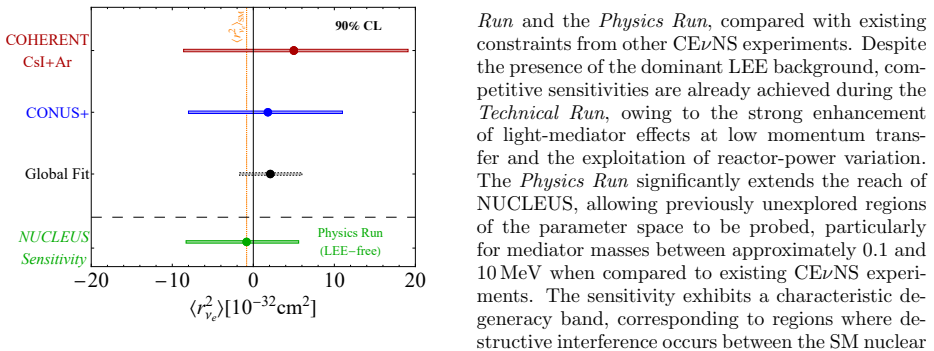
The central claim is that ultra-low recoil thresholds plus reactor-power variation can make a 7 g CaWO4 target competitive with much larger CEνNS detectors. Assuming complete suppression of the low-energy excess, the paper projects a median discovery significance of 4.7σ for the Standard Model CEνNS signal, corresponding to about 58 expected events and a statistical uncertainty near 20% on the cross section. The projected 1σ interval for the weak mixing angle is 0.187 < sin2θW(Q ≈ 5 MeV) < 0.286, the lowest-momentum-transfer CEνNS determination to date. The same framework yields a 90% CL range for the neutrino charge radius of (−8.3 to 5.6) × 10⁻³² cm², sensitivity to universal light mediato
What carries the argument
The central analysis tool is an unbinned profile likelihood in which the signal rate is proportional to the time-dependent effective reactor thermal power P(t), while the background has its own temporal behavior—a decaying low-energy excess during the technical run or a constant simulated particle background during the physics run. Each recorded event enters with both its arrival time and its recoil energy, so the signal is identified by its correlation with reactor power and by its predicted CEνNS spectral shape. The profile-likelihood ratio is validated on pseudo-experiments and used to derive discovery significances, confidence intervals, and upper limits.
Load-bearing premise
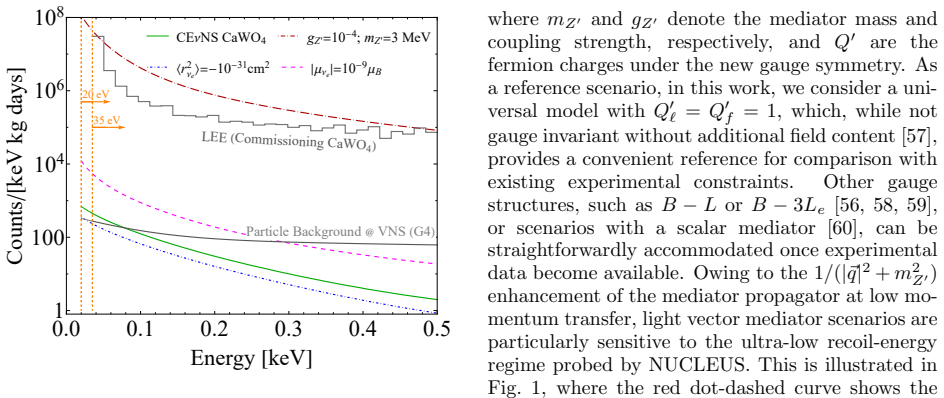
The physics-run projections assume the unexplained low-energy excess — a sub-keV background seen during commissioning — can be suppressed to a negligible level, and the paper explicitly labels this an optimistic scenario reliant on an instrumented holder that is still under development.
What would settle it
Take data during a several-week period when both reactors are off: under the paper's model the CEνNS signal disappears while the particle background stays constant, so the observed event-rate modulation with reactor power must track the predicted 85% duty cycle and the one-third/two-thirds power steps. If the measured low-energy rate above 20 eV does not drop to the simulated particle-background level once the instrumented holder is installed, the 4.7σ projection and the derived weak-mixing-angle and charge-radius intervals collapse.
If this is right
- If the low-energy excess is suppressed as assumed, a 7 g target can achieve a 4.7σ CEνNS observation in one year, demonstrating that extremely low thresholds can substitute for large target mass.
- The measurement would provide the lowest-momentum-transfer determination of the weak mixing angle from CEνNS, probing electroweak running at Q ≈ 5 MeV.
- The projected neutrino charge-radius constraint would be among the most stringent from CEνNS and is complementary to accelerator-source measurements because reactor fluxes are dominated by electron antineutrinos.
- The physics run would probe previously unexplored light-mediator parameter space, particularly for mediator masses between roughly 0.1 and 10 MeV.
- Even the technical run, without a CEνNS detection, could place a more stringent CEνNS-based limit on the neutrino magnetic moment than existing measurements, thanks to the 1/T enhancement at low recoil energies.
Where Pith is reading between the lines
- The same reactor-power-modulation likelihood could be applied to any low-threshold detector sited at a reactor with scheduled outages, effectively turning reactor downtime into a background-subtraction tool without dedicated reactor-off runs.
- The paper's most fragile phenomenological input is the assumption that the low-energy excess does not scale with target mass or with the shallow-site cosmic-ray flux; if that assumption fails, the technical-run BSM bounds would need to be recomputed.
- A natural extension is to fold the double-TES coincidence information directly into the likelihood as an additional discriminating observable, which could improve the technical-run sensitivity even before full low-energy-excess suppression.
- The projected 20% statistical precision is robust to the dominant systematics in this analysis, but the 25% energy-scale uncertainty assumed from commissioning data would shift the extracted CEνNS normalization by roughly +0.5/−4.0%, which could become important for any future higher-mass exposure.
Editorial analysis
A structured set of objections, weighed in public.
Referee Report
Summary. This paper presents sensitivity projections for the NUCLEUS experiment at the Chooz reactor, using a data-driven model of the low-energy excess (LEE) observed during the TUM commissioning run and an unbinned likelihood that exploits both reactor-power time variation and recoil-energy spectra. For the Technical Run (7 g CaWO4, LEE-dominated), the authors project a 90% CL sensitivity to the SM CEνNS rate of about 35 times the Standard Model prediction, and competitive BSM limits on light mediators and the neutrino magnetic moment without requiring a CEνNS observation. For the Physics Run, under an explicit assumption that the LEE is suppressed to a negligible level, they project a 4.7σ CEνNS discovery, a low-momentum-transfer weak-mixing-angle interval, a neutrino charge-radius constraint, and improved BSM sensitivities. The statistical framework is validated with large ensembles of pseudo-experiments, and the dominant systematics (energy scale, reactor flux, thermal power) are quantified.
Significance. If the physics-run premise is realized, this would be a substantial result: a gram-scale cryogenic detector would provide the first ultra-low-threshold reactor CEνNS measurement and competitive electroweak/BSM constraints. The paper has real strengths: the likelihood framework is carefully tested with 5,000–10,000 pseudo-experiments and asymptotic quantiles are checked; the technical-run projections are based on commissioning data and are explicitly independent of a CEνNS detection; and the dominant systematic uncertainties are treated quantitatively. However, the headline physics-run claims rest entirely on an unverified experimental premise — complete suppression of the LEE — for which the paper provides no completed measurement and no quantitative requirement. The technical-run results are credible and useful, but the physics-run claims need either substantial additional justification or an explicit demotion to an idealized sensitivity upper bound.
major comments (2)
- [Sec. III A 3 and Table I] The Physics Run projections — 4.7σ CEνNS, Eq. (17) for sin²θW, Eq. (18) for the charge radius, and the physics-run BSM bounds — depend entirely on the assumption that the LEE is reduced to a negligible level. The paper does not quantify what 'negligible' requires. From Eq. (13), with R0,LEE=3650 events/day per detector and k=0.59, the four-detector LEE rate after one year is ~4×3650×365^−0.59 ≈ 450 events/day, whereas the expected signal and particle background are 0.23 and 0.38 events/day (Table I). Keeping residual LEE below, say, 10% of the particle background therefore demands a suppression factor of ~10^4 relative to the initial commissioning rate. The only cited support is an inner veto 'currently under development' [35,36] and ongoing studies [34]; no completed measurement or prototype demonstration shows such suppression. The authors should either provide a quantitative suppressi
- [Sec. III A 2] The Technical Run sensitivity assumes the commissioning LEE initial rate of 3650 events/day applies unchanged to each 1.75 g detector, despite the commissioning detector having 0.76 g mass, and at the Chooz site with different overburden. The paper cites external observations supporting no mass scaling, but this remains a load-bearing assumption for the technical-run BSM limits (Figs. 5–6): if the LEE scales with target mass or surface area, the projected 90% CL limits weaken correspondingly. I recommend adding a sensitivity scan over a mass-scaling exponent, or at minimum a clear quantitative statement of how the limits change under a plausible range of scaling behaviors.
minor comments (4)
- [App. A 2] The text says the discovery significance uses q0 = q(α=0) from pseudo-experiments 'generated under the SM hypothesis'. This is correct for a median expected significance, but the wording is ambiguous; clarify that the signal+background hypothesis is used to compute the expected median, while a background-only ensemble would be needed for a p-value.
- [Sec. III B] The reactor-power schedule is assumed with an 85% duty cycle and a specific pattern of single- and double-reactor outages. The paper says this is representative of historical data, but no robustness scan over duty cycle or outage timing is shown. Since the time-modulation term is central to the likelihood, a brief sensitivity check would be useful.
- [Sec. III A 2] The LEE spectral parameters f, ε1, ε2 and the decay exponent k are quoted from fits to commissioning data without uncertainties. Given that they are profiled in the Technical Run fit, the paper should state whether the quoted values are central values of a fit and how the sensitivity changes if these parameters are varied within their uncertainties.
- [Sec. IV A] The statement that the weak-mixing-angle interval is a 'determination' at the lowest momentum transfer probed to date is technically true, but the interval 0.187 < sin²θW < 0.286 is wide. A sentence emphasizing the large uncertainty and the role of the neutron-dominated weak charge would help calibrate expectations.
Circularity Check
No significant circularity: the projections are conditional sensitivity forecasts built from measured background inputs and SM cross sections, not fitted to their own endpoints.
full rationale
The paper is a sensitivity projection, not a measurement claim. The CEνNS signal rate is computed from the SM differential cross section (Eq. 1) convolved with an external reactor flux model [23] and a detector response (Eqs. 10-11). No parameter is fitted to the claimed 4.7σ outcome or to the BSM limits. The LEE background model (Eqs. 12-13) is taken from the collaboration's commissioning data [29] and LEE characterization [34]; this is a data-driven background input, not a result derived from the SM or BSM hypotheses. The Technical Run ~35×SM sensitivity and Physics Run 4.7σ significance are obtained from pseudo-experiments generated from these assumed models and a standard profile-likelihood ratio, and the paper explicitly labels the Physics Run as an 'optimistic scenario' with 'complete suppression of the LEE' (Sec. III A 3 and abstract), so the central claim is a conditional projection rather than a postdiction. BSM sensitivities are benchmarked against external experiments (COHERENT, CONUS+, XENONnT, TEXONO, etc.), not against the paper's own fitted values. The unverified LEE suppression is an experimental premise and a stated limitation, but it is not a circular derivation. The self-citations are data/model inputs or ongoing-development references, and none serves as a uniqueness theorem or ansatz that forces the claimed result.
Axiom & Free-Parameter Ledger
free parameters (6)
- LEE spectral shape f, ε1, ε2 =
f≈0.99, ε1≈28 eV, ε2≈320 eV
- LEE initial rate R0,LEE =
3650 events/day per detector (35–500 eV)
- LEE decay exponent k =
≈0.59
- Overall analysis efficiency =
80%
- Energy resolution parameters η/e_ath, β, σ0 =
0.0045±0.0016 meV^-1, 0.013±0.0011, 4 eV
- Energy-scale systematic δ =
±25%
axioms (7)
- standard math Standard Model CEνNS cross section and weak couplings (Eqs. 1–4) are valid, with g_p^V(νe)=0.0379 and g_n^V=-0.5117.
- domain assumption Reactor antineutrino spectrum and fission fractions follow Ref. [23], with integrated flux (2.15±0.08)×10^12 cm^-2 s^-1 at full power.
- ad hoc to paper LEE rate does not scale with target mass and is the same at Chooz as during TUM commissioning.
- ad hoc to paper LEE can be suppressed to a negligible level in the Physics Run by inner veto and other strategies.
- domain assumption Particle background at VNS is correctly estimated by Geant4 simulations of the shielding/veto system [24] and is constant in time.
- standard math Nuclear form factors are negligible at sub-keV recoil; Helm parametrization with Lewin-Smith radii is adequate.
- domain assumption Detector response is Gaussian with energy-dependent width (Eq. 11) and no extra trigger efficiency beyond resolution folding.
read the original abstract
The NUCLEUS experiment aims to measure coherent elastic neutrino-nucleus scattering (CE$\nu$NS) at unprecedentedly low nuclear recoil energies using gram-scale cryogenic calorimeters operated at the Chooz nuclear power plant in France. Access to recoil energies at the $\mathcal{O}(10~\mathrm{eV})$ scale enables CE$\nu$NS studies at extremely low momentum transfer and provides enhanced sensitivity to new physics. In this work, we present sensitivity projections for the upcoming NUCLEUS technical and physics runs, incorporating a data-driven treatment of the low-energy excess (LEE) observed during commissioning. We develop a likelihood framework that exploits reactor-power variation to disentangle signal and background in a low signal-to-background regime and to assess the impact of the dominant systematic uncertainties. For the Technical Run with a 7 g CaWO$_4$ target, we find competitive sensitivity to several scenarios beyond the Standard Model, which do not require a CE$\nu$NS observation. For the Physics Run, assuming complete suppression of the LEE, we project a 4.7 $\sigma$ observation of CE$\nu$NS with a statistical precision of about 20 % in 1 year, enabling a determination of the weak mixing angle at the lowest momentum transfer probed to date with CE$\nu$NS and leading CE$\nu$NS-based constraints on the neutrino charge radius and new mediator models.
Figures




Forward citations
Cited by 3 Pith papers
-
Sub-keV energy calibration of CONUS+ via 71Ge M-shell neutron activation
Neutron activation resolves the 71Ge M-shell X-ray line at 158.7 eVee in a CONUS+ germanium detector, reducing CEvNS signal prediction uncertainty below 4%.
-
Phenomenological implications of the high-precision COHERENT germanium CE$\nu$NS data
High-precision COHERENT germanium CEνNS data yields state-of-the-art constraints on the weak mixing angle, neutrino charge radii, germanium neutron radius, and non-standard neutrino interactions via global analysis wi...
-
Phenomenological implications of the high-precision COHERENT germanium CE$\nu$NS data
Analysis of new COHERENT germanium CEνNS data yields updated constraints on the weak mixing angle, neutrino charge radii, germanium neutron rms radius, and bounds on neutrino non-standard interactions via global fits.
Reference graph
Works this paper leans on
-
[1]
CEνNS Signal Prediction The expected CEνNS recoil spectrum is obtained by convolving the differential cross section with the reactor antineutrino flux, integrating over all possi- ble neutrino energies, and folding in the detector en- ergy response. The resulting differential event rate is given by dR dTnr =NT X N Z T ′max nr 0 dT ′ nr R(Tnr, T′ nr) Z Ema...
-
[2]
Technical Run During theTechnical Runat Chooz, the detector module will consist of four CaWO 4 double-TES de- tectors, for a total target mass of 7 g. In this config- uration, the CEνNS region of interest is expected to be dominated by the LEE, while the particle-induced background estimated from simulations is negligible in comparison (see Figure 1). The...
-
[3]
NU-CLEUS
Physics Run (LEE-free) ThePhysics Runis expected to start immediately after theTechnical Runand will employ the same to- tal CaWO4 target mass of about 7 g. In this phase, the detectors will be integrated into an instrumented holder (inner veto) [35, 36], representing a key up- grade aimed at enhancing the rejection of the LEE background, in particular fo...
-
[4]
15, we use ensembles of pseudo- experiments generated from the nominal signal and background model
Fit Parameter Reconstruction To validate the fit procedure based on the likeli- hood defined in Eq. 15, we use ensembles of pseudo- experiments generated from the nominal signal and background model. For each pseudo-experiment, the full likelihood is maximized and the recon- structed best-fit parameters and their uncertainties are recorded. This procedure...
-
[5]
T est Statistic Distribution Confidence intervals in this work are derived from the profile-likelihood ratio test statistic defined in Eq. 16. Under regularity conditions and for suf- ficient large event counts, Wilks’ theorem predicts that the test statistic evaluated at the true parame- ter value follows aχ 2 distribution with one degree of freedom [78,...
-
[6]
D. Z. Freedman, Coherent effects of a weak neutral current, Phys. Rev. D9, 1389 (1974)
1974
-
[7]
V. B. Kopeliovich and L. L. Frankfurt, Isotopic and chiral structure of neutral current, JETP Lett.19, 145 (1974)
1974
-
[8]
Drukier and L
A. Drukier and L. Stodolsky, Principles and Appli- cations of a Neutral Current Detector for Neutrino Physics and Astronomy, Phys. Rev. D30, 2295 (1984)
1984
-
[9]
D. Akimov et al. (COHERENT), Observation of Coherent Elastic Neutrino-Nucleus Scattering, Sci- ence357, 1123 (2017), arXiv:1708.01294 [nucl-ex]
Pith/arXiv arXiv 2017
-
[10]
D. Akimov et al. (COHERENT), COHERENT Collaboration data release from the first detection of coherent elastic neutrino-nucleus scattering on argon (2020), arXiv:2006.12659 [nucl-ex]
Pith/arXiv arXiv 2020
-
[11]
D. Akimov et al. (COHERENT), First Measure- ment of Coherent Elastic Neutrino-Nucleus Scat- tering on Argon, Phys. Rev. Lett.126, 012002 (2021), arXiv:2003.10630 [nucl-ex]
Pith/arXiv arXiv 2021
-
[12]
Adamski et al
S. Adamski et al. (COHERENT), Evidence of Co- herent Elastic Neutrino-Nucleus Scattering with COHERENT’s Germanium Array, Phys. Rev. Lett.134, 231801 (2025)
2025
-
[13]
M. Adhikari et al., Measurement of coherent elas- tic neutrino nucleus scattering on germanium by COHERENT (2026), arXiv:2603.17951 [hep-ex]
arXiv 2026
-
[14]
Z. Bo et al. (PandaX), First Indication of Solar B8 Neutrinos through Coherent Elastic Neutrino- Nucleus Scattering in PandaX-4T, Phys. Rev. Lett. 133, 191001 (2024), arXiv:2407.10892 [hep-ex]
Pith/arXiv arXiv 2024
-
[15]
E. Aprile et al. (XENON), First Indication of So- lar B8 Neutrinos via Coherent Elastic Neutrino- Nucleus Scattering with XENONnT, Phys. Rev. Lett.133, 191002 (2024), arXiv:2408.02877 [nucl- ex]
arXiv 2024
-
[16]
D. S. Akerib et al. (LZ), Searches for Light Dark Matter and Evidence of Coherent Elastic Neutrino-Nucleus Scattering of Solar Neutrinos with the LUX-ZEPLIN (LZ) Experiment (2025), arXiv:2512.08065 [hep-ex]
Pith/arXiv arXiv 2025
-
[17]
N. Ackermann et al., Direct observation of coher- ent elastic antineutrino–nucleus scattering, Nature 643, 1229 (2025), arXiv:2501.05206 [hep-ex]
Pith/arXiv arXiv 2025
-
[18]
V. Belov et al. ((νGeN),), New constraints on co- herent elastic neutrino–nucleus scattering by the νGeN experiment*, Chin. Phys. C49, 053004 (2025), arXiv:2502.18502 [hep-ex]
Pith/arXiv arXiv 2025
-
[19]
S. Karmakar et al. (TEXONO), New Limits on the Coherent Neutrino-Nucleus Elastic Scattering Cross Section at the Kuo-Sheng Reactor-Neutrino Laboratory, Phys. Rev. Lett.134, 121802 (2025), arXiv:2411.18812 [nucl-ex]
arXiv 2025
-
[20]
A. Aguilar-Arevalo et al. (CONNIE), Search for co- herent elastic neutrino-nucleus scattering at a nu- clear reactor with CONNIE 2019 data, JHEP05, 017, arXiv:2110.13033 [hep-ex]
Pith/arXiv arXiv 2019
-
[21]
A. Armatol et al. (Ricochet), Characterization of mini-CryoCube detectors from the RICOCHET experiment commissioning at the Institut Laue- Langevin, Phys. Rev. D112, 112019 (2025), arXiv:2507.22751 [hep-ex]
arXiv 2025
-
[22]
D. Y. Akimov et al. (RED-100), First constraints on the coherent elastic scattering of reactor an- tineutrinos off xenon nuclei, Phys. Rev. D111, 072012 (2025), arXiv:2411.18641 [hep-ex]
Pith/arXiv arXiv 2025
-
[23]
D. Mondal et al., CEνNS Search with Cryogenic Sapphire Detectors at MINER: Results from the TRIGA reactor data and Future Sensitivity at HFIR (2025), arXiv:2510.15999 [nucl-ex]
arXiv 2025
-
[24]
G. Angloher et al. (NUCLEUS), Exploring CEνNS with NUCLEUS at the Chooz nuclear power plant, Eur. Phys. J. C79, 1018 (2019), arXiv:1905.10258 [physics.ins-det]
arXiv 2019
-
[25]
R. Strauss et al. (NUCLEUS), Gram-scale cryo- genic calorimeters for rare-event searches, Phys. Rev. D96, 022009 (2017), arXiv:1704.04317 [physics.ins-det]
Pith/arXiv arXiv 2017
-
[26]
A. H. Abdelhameed et al. (CRESST), First re- sults from the CRESST-III low-mass dark mat- ter program, Phys. Rev. D100, 102002 (2019), arXiv:1904.00498 [astro-ph.CO]
Pith/arXiv arXiv 2019
-
[27]
C. A. J. O’Hare, New Definition of the Neutrino Floor for Direct Dark Matter Searches, Phys. Rev. Lett.127, 251802 (2021), arXiv:2109.03116 [hep- ph]
Pith/arXiv arXiv 2021
-
[28]
L. Periss´ e, A. Onillon, X. Mougeot, M. Vivier, T. Lasserre, A. Letourneau, D. Lhuillier, and G. Mention, Comprehensive revision of the summa- tion method for the prediction of reactorν¯e fluxes and spectra, Phys. Rev. C108, 055501 (2023), arXiv:2304.14992 [nucl-ex]
Pith/arXiv arXiv 2023
-
[29]
H. Abele et al., Particle background characteri- zation and prediction for the NUCLEUS reactor CEνNS experiment, Eur. Phys. J. C86, 29 (2026), arXiv:2509.03559 [physics.ins-det]
Pith/arXiv arXiv 2026
-
[30]
V. Wagner et al. (NUCLEUS), Development of a compact muon veto for the Nucleus experi- ment, JINST17(05), T05020, arXiv:2202.03991 [physics.ins-det]
-
[31]
Erhart et al., A plastic scintillation muon veto for sub-Kelvin temperatures, Eur
A. Erhart et al., A plastic scintillation muon veto for sub-Kelvin temperatures, Eur. Phys. J. C84, 70 (2024), arXiv:2310.08457 [physics.ins-det]
Pith/arXiv arXiv 2024
-
[32]
Goupy, Background mitigation strategy for the detection of coherent elastic scattering of reactor antineutrinos on nuclei with the NUCLEUS exper- iment (2024)
C. Goupy, Background mitigation strategy for the detection of coherent elastic scattering of reactor antineutrinos on nuclei with the NUCLEUS exper- iment (2024)
2024
-
[33]
Wex, Background Suppression and Cryogenic Vibration Decoupling for the Coherent Elas- tic Neutrino Scattering Experiment NUCLEUS (2025)
A. Wex, Background Suppression and Cryogenic Vibration Decoupling for the Coherent Elas- tic Neutrino Scattering Experiment NUCLEUS (2025)
2025
-
[34]
H. Abele et al. (NUCLEUS), Commissioning of the 19 NUCLEUS Experiment at the Technical Univer- sity of Munich, Phys. Rev. D112, 072013 (2025), arXiv:2508.02488 [hep-ex]
arXiv 2025
-
[35]
Adari et al., EXCESS workshop: Descriptions of rising low-energy spectra, SciPost Phys
P. Adari et al., EXCESS workshop: Descriptions of rising low-energy spectra, SciPost Phys. Proc. 9, 001 (2022), arXiv:2202.05097 [astro-ph.IM]
Pith/arXiv arXiv 2022
-
[36]
Angloher et al., Latest observations on the low energy excess in CRESST-III, SciPost Phys
G. Angloher et al., Latest observations on the low energy excess in CRESST-III, SciPost Phys. Proc. 12, 013 (2023), arXiv:2207.09375 [astro-ph.CO]
Pith/arXiv arXiv 2023
-
[37]
G. Angloher et al. (CRESST), DoubleTES de- tectors to investigate the CRESST low energy background: results from above-ground proto- types, Eur. Phys. J. C84, 1001 (2024), [Erratum: Eur.Phys.J.C 84, 1227 (2024)], arXiv:2404.02607 [physics.ins-det]
Pith/arXiv arXiv 2024
-
[38]
R. Anthony-Petersen et al., Low energy back- grounds and excess noise in a two-channel low- threshold calorimeter, Appl. Phys. Lett.126, 102601 (2025), arXiv:2410.16510 [physics.ins-det]
Pith/arXiv arXiv 2025
-
[39]
H. Abele et al., Characterization of the Low Energy Excess using a NUCLEUSAl 2O3 detector (2026), arXiv:2603.07687 [physics.ins-det]
arXiv 2026
-
[40]
R. Strauss et al. (NUCLEUS), Theν-cleus exper- iment: A gram-scale fiducial-volume cryogenic de- tector for the first detection of coherent neutrino- nucleus scattering, Eur. Phys. J. C77, 506 (2017), arXiv:1704.04320 [physics.ins-det]
Pith/arXiv arXiv 2017
-
[41]
Rothe et al
J. Rothe et al. (NUCLEUS), NUCLEUS: Exploring Coherent Neutrino-Nucleus Scattering with Cryo- genic Detectors, J. Low Temp. Phys.199, 433 (2019)
2019
-
[42]
D. A. Sierra, Extraction of neutron density dis- tributions from high-statistics coherent elastic neutrino-nucleus scattering data, Phys. Lett. B 845, 138140 (2023), arXiv:2301.13249 [hep-ph]
Pith/arXiv arXiv 2023
-
[43]
M. Atzori Corona, M. Cadeddu, N. Cargioli, F. Dordei, C. Giunti, and G. Masia, Nuclear neu- tron radius and weak mixing angle measurements from latest COHERENT CsI and atomic parity vi- olation Cs data, Eur. Phys. J. C83, 683 (2023), arXiv:2303.09360 [nucl-ex]
Pith/arXiv arXiv 2023
-
[44]
Berglund and M
M. Berglund and M. E. Wieser, Isotopic composi- tions of the elements 2009 (iupac technical report), Pure and Applied Chemistry83, 397 (2011)
2009
-
[45]
ncbi.nlm.nih.gov/ptable/atomic-mass/, ac- cessed: 2026-01-08
National Center for Biotechnology Information, Periodic table – atomic mass,https://pubchem. ncbi.nlm.nih.gov/ptable/atomic-mass/, ac- cessed: 2026-01-08
2026
-
[46]
R. H. Helm, Inelastic and Elastic Scattering of 187- Mev Electrons from Selected Even-Even Nuclei, Phys. Rev.104, 1466 (1956)
1956
-
[47]
J. D. Lewin and P. F. Smith, Review of mathe- matics, numerical factors, and corrections for dark matter experiments based on elastic nuclear recoil, Astropart. Phys.6, 87 (1996)
1996
-
[48]
S. Fanchiotti, B. A. Kniehl, and A. Sirlin, Incor- poration of QCD effects in basic corrections of the electroweak theory, Phys. Rev. D48, 307 (1993), arXiv:hep-ph/9212285
Pith/arXiv arXiv 1993
-
[49]
M. Atzori Corona, M. Cadeddu, N. Cargioli, F. Dordei, and C. Giunti, Momentum depen- dent flavor radiative corrections to the coherent elastic neutrino-nucleus scattering for the neu- trino charge-radius determination, JHEP05, 271, arXiv:2402.16709 [hep-ph]
-
[50]
J. Erler and S. Su, The Weak Neutral Cur- rent, Prog. Part. Nucl. Phys.71, 119 (2013), arXiv:1303.5522 [hep-ph]
Pith/arXiv arXiv 2013
-
[51]
Navas et al
S. Navas et al. (Particle Data Group Collabora- tion), Review of particle physics, Phys. Rev. D 110, 030001 (2024)
2024
-
[52]
Navas et al
S. Navas et al. (Particle Data Group), Review of particle physics, Phys. Rev. D110, 030001 (2024)
2024
-
[53]
C. Giunti and A. Studenikin, Neutrino electromag- netic interactions: a window to new physics, Rev. Mod. Phys.87, 531 (2015), arXiv:1403.6344 [hep- ph]
Pith/arXiv arXiv 2015
-
[54]
M. Atzori Corona, M. Cadeddu, N. Cargioli, F. Dordei, C. Giunti, Y. F. Li, C. A. Ternes, and Y. Y. Zhang, Impact of the Dresden-II and COHERENT neutrino scattering data on neu- trino electromagnetic properties and electroweak physics, JHEP09, 164, arXiv:2205.09484 [hep-ph]
-
[55]
M. Cadeddu, F. Dordei, C. Giunti, Y. F. Li, and Y. Y. Zhang, Neutrino, electroweak, and nuclear physics from COHERENT elastic neutrino-nucleus scattering with refined quenching factor, Phys. Rev. D101, 033004 (2020), arXiv:1908.06045 [hep- ph]
Pith/arXiv arXiv 2020
-
[56]
M. Atzori Corona, M. Cadeddu, N. Cargioli, F. Dordei, C. Giunti, and C. A. Ternes, Standard Model Tested with Neutrinos, Phys. Rev. Lett. 135, 231803 (2025), arXiv:2504.05272 [hep-ph]
arXiv 2025
-
[57]
J. Barranco, O. G. Miranda, and T. I. Rashba, Probing new physics with coherent neutrino scat- tering off nuclei, JHEP12, 021, arXiv:hep- ph/0508299
-
[58]
Giunti, General COHERENT constraints on neutrino nonstandard interactions, Phys
C. Giunti, General COHERENT constraints on neutrino nonstandard interactions, Phys. Rev. D 101, 035039 (2020), arXiv:1909.00466 [hep-ph]
Pith/arXiv arXiv 2020
-
[59]
P. Coloma, M. C. Gonzalez-Garcia, M. Maltoni, J. P. Pinheiro, and S. Urrea, Global constraints on non-standard neutrino interactions with quarks and electrons, JHEP08, 032, arXiv:2305.07698 [hep-ph]
-
[60]
M. Cadeddu, N. Cargioli, F. Dordei, C. Giunti, Y. F. Li, E. Picciau, and Y. Y. Zhang, Constraints on light vector mediators through coherent elas- tic neutrino nucleus scattering data from COHER- ENT, JHEP01, 116, arXiv:2008.05022 [hep-ph]
Pith/arXiv arXiv 2008
-
[61]
M. Atzori Corona, M. Cadeddu, N. Cargioli, F. Dordei, C. Giunti, Y. F. Li, E. Picciau, C. A. Ternes, and Y. Y. Zhang, Probing light mediators and (g−2) µ through detection of coherent elastic neutrino nucleus scattering at COHERENT, JHEP 05, 109, arXiv:2202.11002 [hep-ph]
-
[62]
B. C. Allanach, J. Davighi, and S. Melville, An Anomaly-free Atlas: charting the space of flavour- 20 dependent gaugedU(1) extensions of the Standard Model, JHEP02, 082, [Erratum: JHEP 08, 064 (2019)], arXiv:1812.04602 [hep-ph]
Pith/arXiv arXiv 2019
-
[63]
V. De Romeri, O. G. Miranda, D. K. Papoulias, G. Sanchez Garcia, M. T´ ortola, and J. W. F. Valle, Physics implications of a combined analy- sis of COHERENT CsI and LAr data, JHEP04, 035, arXiv:2211.11905 [hep-ph]
-
[64]
M. Demirci and M. F. Mustamin, Solar neutrino constraints on light mediators through coherent elastic neutrino-nucleus scattering, Phys. Rev. D 109, 015021 (2024), arXiv:2312.17502 [hep-ph]
Pith/arXiv arXiv 2024
-
[65]
M. Lindner, W. Rodejohann, and X.-J. Xu, Coher- ent Neutrino-Nucleus Scattering and new Neutrino Interactions, JHEP03, 097, arXiv:1612.04150 [hep-ph]
-
[66]
C. Giunti, K. A. Kouzakov, Y.-F. Li, A. V. Lokhov, A. I. Studenikin, and S. Zhou, Elec- tromagnetic neutrinos in laboratory experiments and astrophysics, Annalen Phys.528, 198 (2016), arXiv:1506.05387 [hep-ph]
Pith/arXiv arXiv 2016
-
[67]
C. Giunti, K. Kouzakov, Y.-F. Li, and A. Stu- denikin, Neutrino Electromagnetic Properties, Ann. Rev. Nucl. Part. Sci.75, 1 (2025), arXiv:2411.03122 [hep-ph]
Pith/arXiv arXiv 2025
-
[68]
H. Bonet et al. (CONUS), First upper limits on neutrino electromagnetic properties from the CONUS experiment, Eur. Phys. J. C82, 813 (2022), arXiv:2201.12257 [hep-ex]
Pith/arXiv arXiv 2022
-
[69]
A. G. Beda, E. V. Demidova, A. S. Starostin, V. B. Brudanin, V. G. Egorov, D. V. Medvedev, M. V. Shirchenko, and T. Vylov, GEMMA experiment: Three years of the search for the neutrino magnetic moment, Phys. Part. Nucl. Lett.7, 406 (2010), arXiv:0906.1926 [hep-ex]
Pith/arXiv arXiv 2010
-
[70]
M. Atzori Corona, M. Cadeddu, N. Cargioli, F. Dordei, and C. Giunti, Reactor antineutrinos CEνNS on germanium: CONUS+ and TEXONO as a new gateway to SM and BSM physics, Phys. Rev. D112, 015007 (2025), arXiv:2501.18550 [hep- ph]
Pith/arXiv arXiv 2025
-
[71]
P. Coloma, I. Esteban, M. C. Gonzalez-Garcia, L. Larizgoitia, F. Monrabal, and S. Palomares- Ruiz, Bounds on new physics with data of the Dresden-II reactor experiment and COHERENT, JHEP05, 037, arXiv:2202.10829 [hep-ph]
-
[72]
H. B. Li et al. (TEXONO), Limit on the electron neutrino magnetic moment from the Kuo-Sheng re- actor neutrino experiment, Phys. Rev. Lett.90, 131802 (2003), arXiv:hep-ex/0212003
Pith/arXiv arXiv 2003
-
[73]
E. Aprile et al. (XENON), Search for New Physics in Electronic Recoil Data from XENONnT, Phys. Rev. Lett.129, 161805 (2022), arXiv:2207.11330 [hep-ex]
Pith/arXiv arXiv 2022
-
[74]
J. Aalbers et al. (LZ), Search for new physics in low-energy electron recoils from the first LZ exposure, Phys. Rev. D108, 072006 (2023), arXiv:2307.15753 [hep-ex]
Pith/arXiv arXiv 2023
-
[75]
K. A. Kouzakov and A. I. Studenikin, Electro- magnetic properties of massive neutrinos in low- energy elastic neutrino-electron scattering, Phys. Rev. D95, 055013 (2017), [Erratum: Phys.Rev.D 96, 099904 (2017)], arXiv:1703.00401 [hep-ph]
Pith/arXiv arXiv 2017
-
[76]
H. Abele et al., Sub-keV Electron Recoil Calibra- tion for Macroscopic Cryogenic Calorimeters Us- ing a Novel X-ray Fluorescence Source, J. Low Temp. Phys.221, 265 (2025), arXiv:2505.17686 [physics.ins-det]
Pith/arXiv arXiv 2025
-
[77]
S. Di Domizio, F. Orio, and M. Vignati, Lowering the energy threshold of large-mass bolometric de- tectors, JINST6, P02007, arXiv:1012.1263 [astro- ph.IM]
-
[78]
D. Baxter, R. Essig, Y. Hochberg, M. Kaz- nacheeva, B. von Krosigk, F. Reindl, R. K. Ro- mani, and F. Wagner, Low-Energy Backgrounds in Solid-State Phonon and Charge Detectors, Ann. Rev. Nucl. Part. Sci.75, 301 (2025), arXiv:2503.08859 [physics.ins-det]
Pith/arXiv arXiv 2025
-
[79]
and others (NUCLEUS), Sensitivity en- hancement techniques for cryogenic calorimeters in the NUCLEUS experiment (2026), [in prepara- tion]
Abele, H. and others (NUCLEUS), Sensitivity en- hancement techniques for cryogenic calorimeters in the NUCLEUS experiment (2026), [in prepara- tion]
2026
-
[80]
T. Abrah˜ aoet al. (Double Chooz), Reactor rate modulation oscillation analysis with two detectors in Double Chooz, JHEP01, 190, arXiv:2007.13431 [hep-ex]
Pith/arXiv arXiv 2007
discussion (0)
Sign in with ORCID, Apple, or X to comment. Anyone can read and Pith papers without signing in.