REVIEW 3 major objections 6 minor 1 cited by
GNN-Suite: a Graph Neural Network Benchmarking Framework for Biomedical Informatics
T0 review · 3 major / 6 minor · reviewed 2026-08-15 · deepseek-v4-flash
Pith's one-line read GNN-Suite standardizes GNN benchmarking with Nextflow and shows, on four cancer-driver network configurations, that every evaluated GNN outperforms a logistic regression baseline, with GCN2 reaching the highest balanced accuracy of 0.807…
desk verdict Useful Nextflow-based GNN benchmarking wrapper, but the headline model-comparison claims are inflated by selecting the best test-set epoch and lack significance tests. read the letter →
The pith
A machine-rendered reading of the paper's core claim, the machinery that carries it, and where it could break.
The reading
What carries the argument
The load-bearing object is GNN-Suite: a Nextflow workflow in which a fixed training recipe — two convolutional layers, dropout 0.2, Adam with learning rate 0.01, class-weighted binary cross-entropy, 80/20 split, 300 epochs, and 10 random seeds — is applied to every architecture, with balanced accuracy (the average of sensitivity and specificity) as the primary metric. The case study supplies four graph configurations: STRING or BioGRID interaction networks, node features from Fisher-combined PCAWG mutation p-values, and positive labels from PID or COSMIC cancer-gene panels. This design isolates architecture behaviour from implementation differences.
What would settle it
Re-run the same ten-seed protocol and apply a paired test between each GNN and logistic regression on each configuration, with multiple-comparison correction; if most GNN-versus-baseline differences become non-significant, or if a feature-only model with tuned hyperparameters closes the gap, the central claim that network structure helps would not survive.
Extended reading notes
Core claim
The paper claims that GNN-Suite enables fair, reproducible comparisons of GNN architectures and that, in its case study, network structure helps. Using standardized two-layer models with shared hyperparameters and ten seeded runs, all evaluated GNNs outperformed logistic regression on every combination of PPI network (STRING or BioGRID) and driver-gene panel (PID or COSMIC). GCN2 was the top model on STRING-PID (0.807 ± 0.035) and STRING-COSMIC (0.68 ± 0.03); HGCN led BioGRID-PID (0.786 ± 0.040) and GIN led BioGRID-COSMIC (0.677 ± 0.027). The paper also argues the driver-gene panel choice had a larger effect on performance than the PPI source, with PID-labelled networks consistently outperforming COSMIC-labelled ones.
Load-bearing premise
The conclusion that GNNs beat logistic regression rests on treating the ten-run mean balanced accuracies as stable; the paper reports no significance tests, confidence intervals on pairwise differences, or correction for multiple comparisons across the architectures and four datasets.
Editorial extensions
If this is right
- For cancer-driver prediction on STRING-like graphs, a residual GCN such as GCN2 is a strong default choice.
- Graph structure carries predictive signal: even a plain logistic regression on features is consistently beaten by every message-passing model.
- Driver-gene panel choice should be treated as part of model selection; PID-derived labels yield higher balanced accuracy than COSMIC-derived labels.
- A shared Nextflow protocol can serve as a neutral substrate for future GNN comparisons, making architecture rankings comparable across studies.
Reading between the lines
- An extension left implicit: the PID advantage may reflect alignment between pathway-derived labels and PPI topology; this could be tested by re-labelling the same networks with panels that vary in pathway content.
- Since hyperparameters were fixed across architectures, the reported ranking is a 'same-budget' comparison; per-architecture tuning could reorder the models.
- The workflow's modular config-file structure should transfer directly to other biomedical node-classification problems, such as gene-disease association or drug-target prediction, where the same four configuration files define the experiment.
Signed reviews
Editorial analysis
A structured set of objections, weighed in public.
Referee Report
Summary. The paper introduces GNN-Suite, a Nextflow-based benchmarking framework for graph neural networks aimed at biomedical applications, and demonstrates it on cancer-driver gene classification. Models are evaluated on four network-label configurations built from STRING/BioGRID PPI data and PCAWG-derived node features, with PID/COSMIC labels. Eight GNN architectures (GCN, GAT, GAT3H, GCN2, GIN, GTN, HGCN, PHGCN, GraphSAGE) are compared against logistic regression under standardized hyperparameters, ten seeds, and balanced accuracy as the primary metric. The paper reports that all GNNs outperform the LR baseline and identifies GCN2, HGCN, GIN, and GTN as top performers depending on the configuration. The main contribution claimed is reproducible, modular benchmarking; the case study is provided as a demonstration of the framework.
Significance. If the central claims are taken as stated, the framework is a useful, reproducible contribution: it provides a public GitHub repository, Docker image, uniform hyperparameter configuration, ten-seed evaluation, and modular Nextflow design, which are genuine strengths for the biomedical GNN community. However, the empirical claims of the case study—that all GNNs beat logistic regression and that specific architectures are best—rest on an evaluation protocol that selects each model's best test-set epoch, which introduces a systematic bias. The paper also does not provide significance testing, so the reported rankings and the GNN-over-baseline claim are not statistically supported. The framework's design is defensible and likely useful, but the case-study conclusions need reworking rather than just polishing.
major comments (3)
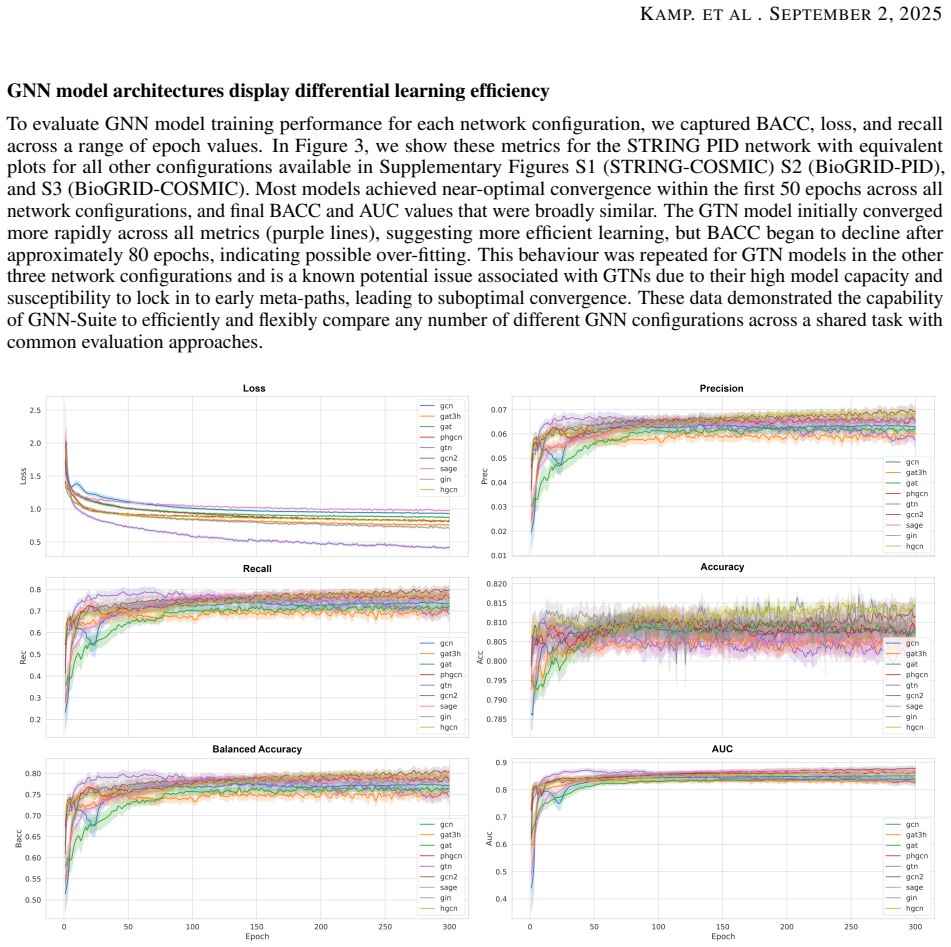
- [Figure 2 and Methods (Model Configuration & Training)] The reported BACC values are the maximum over test-set epochs, not the performance of a fixed training protocol. The Methods state an 80/20 train-test split with no held-out validation set, and Figure 2's table explicitly says 'The epoch corresponding to the highest mean balanced accuracy (BACC) is reported' while the caption says models were evaluated on held-out test nodes. Selecting the best test epoch per model inflates each GNN's apparent performance and mechanically advantages unstable models such as GTN, which peaks early and then declines. This bias directly affects the central claims that 'all GNN types outperformed the LR baseline' and that GCN2/HGCN/GIN are the best models, because logistic regression has no epoch-selection step. The evaluation must be changed to a fixed number of epochs or early stopping on a validation set, with test performance reported only once.
- [Results / Figure 2] No statistical significance testing accompanies the model comparisons. In the table, differences between the top models are frequently within one standard deviation (e.g., STRING-PID GCN2 0.807±0.035 vs HGCN 0.802±0.028 and GTN 0.798±0.036; STRING-COSMIC GCN2 0.680±0.030 vs PHGCN 0.678±0.024), so the ordering is consistent with chance. The abstract's phrase 'significant improvement' is unsupported. The authors should report confidence intervals on pairwise differences, use a paired test across the ten seeds or repeated cross-validation, and correct for multiple comparisons across eight architectures and four datasets. Without this, the ranking and the claim that all GNNs beat baseline are not established.
- [Results (Table in Figure 2)] The epoch column is described as the 'minimum epoch number needed for convergence', but the entries are the epochs at which the highest mean BACC occurred (e.g., GTN at epoch 63 with subsequent decline). These are different quantities, and the text in the Results section also conflates them ('the highest mean BACC values alongside the minimum epoch number needed for convergence'). The authors should define separately the convergence epoch (e.g., when BACC first reaches a plateau) and the reported test epoch, or eliminate the convergence claim.
minor comments (6)
- [Abstract / Introduction] The abstract uses 'significant improvement' and 'statistically robust performance metrics' without any statistical testing; this wording should be softened or supported by the significance analysis requested above.
- [Appendix S3.8] The architecture labeled GTN is described as a TransformerConv operator from Shi et al. (2021), but 'GTN' typically refers to Graph Transformer Networks. The naming should be clarified to avoid confusion, especially since Figure 2 refers to GTN.
- [Appendix S5] The text says 'By monitoring both the training and validation loss, we can select the optimal moment to stop training', but the described experiments do not use a validation set. This statement should be reconciled with the actual protocol or moved to the framework's future capabilities.
- [Figure S1 caption] The caption reads 'Evaluation metrics on the test set during training, including the (training) loss...' which is internally contradictory; the loss is presumably the training loss while the other curves are test-set metrics, and this should be stated clearly.
- [General notation] Equations (2) and (3) contain inconsistent index notation (e.g., tilde d subscripts in Eq. (3) are not defined in the same form as in Eq. (2)) and would benefit from a careful rewriting pass.
- [Discussion] The claim that the underlying PPI network source had a 'comparatively minor effect' is based on visual inspection of Table 1/Figure 2; a quantitative comparison of the distributions across the four configurations would be more appropriate.
Circularity Check
No circularity: the benchmark conclusions are measured from external data, and the test-epoch selection issue is a statistical bias rather than a circular reduction.
full rationale
The paper's central results are obtained empirically from external sources: PPI networks from STRING and BioGRID, labels from PID and COSMIC, and node features from PCAWG via the Fanfani et al. method. The claims that all GNNs outperform logistic regression and that GCN2 achieves the highest BACC on STRING-PID are measured outcomes of a training protocol, not consequences of the model equations or of the definitions of the metrics. No equation in the paper is simultaneously used as an input and as the claimed output. The Fanfani et al. feature-construction method is from a group overlapping with the present authors, but it is an input-preprocessing step and does not by itself force the ranking or the GNN-versus-LR comparison, since the labels and network topologies are external and the method could plausibly have produced features that did not favor GNNs. The reported protocol that 'the epoch corresponding to the highest mean balanced accuracy (BACC) is reported' is a statistical and experimental-design concern because test-set performance is used for epoch selection, so the reported values are maxima over test curves rather than unbiased estimates of a fixed training protocol. That is evaluation bias, not circular dependency: the reported BACC is not definitionally identical to an assumption built into the models or into the benchmark's derivation chain. There is no load-bearing self-citation chain, no imported uniqueness theorem, and no ansatz smuggled in via citation. The paper is therefore best assessed as self-contained against external benchmarks, with the noted epoch-selection issue belonging to correctness risk rather than to circularity.
Assumptions & free parameters
free parameters (7)
- Learning rate =
0.01
- Dropout rate =
0.2
- Weight decay =
1e-4
- Training epochs =
300
- Number of GNN layers =
2
- GCN2 alpha =
0.1
- PPI edge confidence threshold =
Not specified
assumptions (5)
- domain assumption STRING and BioGRID protein-protein interactions represent biologically meaningful relationships for cancer driver gene prediction
- domain assumption PCAWG mutation p-values combined by Fisher's method yield a valid gene-level cancer-association feature
- domain assumption PID and COSMIC-CGC gene lists are acceptable ground truth for cancer driver status
- standard math Fisher's combined probability test under a chi-squared distribution is applied correctly to the PCAWG p-values
- domain assumption The graph is treated as a single connected component after filtering, allowing message passing across the whole network
Cite this review
Pith. "Pith review of GNN-Suite: a Graph Neural Network Benchmarking Framework for Biomedical Informatics." pith.science (2026). https://pith.science/paper/WPTKR5G6
@misc{pith2026250510711,
  author       = {Pith},
  title        = {Pith review of: GNN-Suite: a Graph Neural Network Benchmarking Framework for Biomedical Informatics},
  year         = {2026},
  howpublished = {\url{https://pith.science/paper/WPTKR5G6}},
  note         = {Machine review of arXiv:2505.10711}
}
read the original abstract
We present GNN-Suite, a robust modular framework for constructing and benchmarking Graph Neural Network (GNN) architectures in computational biology. GNN-Suite standardises experimentation and reproducibility using the Nextflow workflow to evaluate GNN performance. We demonstrate its utility in identifying cancer-driver genes by constructing molecular networks from protein-protein interaction (PPI) data from STRING and BioGRID and annotating nodes with features from the PCAWG, PID, and COSMIC-CGC repositories. Our design enables fair comparisons among diverse GNN architectures including GAT, GAT3H, GCN, GCN2, GIN, GTN, HGCN, PHGCN, and GraphSAGE and a baseline Logistic Regression (LR) model. All GNNs were configured as standardised two-layer models and trained with uniform hyperparameters (dropout = 0.2; Adam optimiser with learning rate = 0.01; and an adjusted binary cross-entropy loss to address class imbalance) over an 80/20 train-test split for 300 epochs. Each model was evaluated over 10 independent runs with different random seeds to yield statistically robust performance metrics, with balanced accuracy (BACC) as the primary measure. Notably, GCN2 achieved the highest BACC (0.807 +/- 0.035) on a STRING-based network, although all GNN types outperformed the LR baseline, highlighting the advantage of network-based learning over feature-only approaches. Our results show that a common framework for implementing and evaluating GNN architectures aids in identifying not only the best model but also the most effective means of incorporating complementary data. By making GNN-Suite publicly available, we aim to foster reproducible research and promote improved benchmarking standards in computational biology. Future work will explore additional omics datasets and further refine network architectures to enhance predictive accuracy and interpretability in biomedical applications.
Figures


Forward citations
Cited by 1 Pith paper
-
EdgeRefine: Privacy-Utility Balance for Graphs via Jaccard Sampling under Edge Differential Privacy
EdgeRefine denoises randomized-response graphs by ranking edges with Jaccard similarity and sampling a fixed quota from observed and non-observed edges, reporting near-noise-free GNN accuracy under edge differential privacy.
Reference graph
Works this paper leans on
-
[1]
Aaltonen, Federico Abascal, Adam Abeshouse, Hiroyuki Aburatani, David J
Lauri A. Aaltonen, Federico Abascal, Adam Abeshouse, Hiroyuki Aburatani, David J. Adams, Nishant Agrawal, Keun Soo Ahn, Sung-Min Ahn, Hiroshi Aikata, Rehan Akbani, Kadir C. Akdemir, Hikmat Al-Ahmadie, Sultan T. Al-Sedairy, Fatima Al-Shahrour, Malik Alawi, Monique Albert, Kenneth Aldape, Ludmil B. Alexandrov, Adrian Ally, Kathryn Alsop, Eva G. Alvarez, Fer...
work page 2025
-
[2]
A survey on graph-based deep learning for computational histopathology
David Ahmedt-Aristizabal, Mohammad Ali Armin, Simon Denman, Clinton Fookes, and Lars Petersson. A survey on graph-based deep learning for computational histopathology. Computerized Medical Imaging and Graphics, 95:102027, January 2022
work page 2022
-
[3]
Performance Measures for Binary Classification
Daniel Berrar. Performance Measures for Binary Classification. In Shoba Ranganathan, Michael Gribskov, Kenta Nakai, and Christian Schönbach, editors, Encyclopedia of Bioinformatics and Computational Biology , pages 546–560. Academic Press, Oxford, January 2019
work page 2019
-
[4]
Bronstein, Joan Bruna, Taco Cohen, and Petar Veliˇckovi´c
Michael M. Bronstein, Joan Bruna, Taco Cohen, and Petar Veliˇckovi´c. Geometric Deep Learning: Grids, Groups, Graphs, Geodesics, and Gauges, May 2021. arXiv:2104.13478 [cs, stat]
arXiv 2021
-
[5]
Bronstein, Joan Bruna, Yann LeCun, Arthur Szlam, and Pierre Vandergheynst
Michael M. Bronstein, Joan Bruna, Yann LeCun, Arthur Szlam, and Pierre Vandergheynst. Geometric deep learn- ing: going beyond Euclidean data. IEEE Signal Processing Magazine, 34(4):18–42, July 2017. arXiv:1611.08097 [cs]
arXiv 2017
-
[6]
Simple and Deep Graph Convolutional Networks, July 2020
Ming Chen, Zhewei Wei, Zengfeng Huang, Bolin Ding, and Yaliang Li. Simple and Deep Graph Convolutional Networks, July 2020. arXiv:2007.02133 [cs, stat]
arXiv 2020
-
[7]
Ying Chen, Nadia M. Davidson, Yuk Kei Wan, Harshil Patel, Fei Yao, Hwee Meng Low, Christopher Hendra, Laura Watten, Andre Sim, Chelsea Sawyer, Viktoriia Iakovleva, Puay Leng Lee, Lixia Xin, Hui En Vanessa Ng, Jia Min Loo, Xuewen Ong, Hui Qi Amanda Ng, Jiaxu Wang, Wei Qian Casslynn Koh, Suk Yeah Polly Poon, Dominik Stanojevic, Hoang-Dai Tran, Kok Hao Edwin...
work page 2021
-
[8]
Floden, Pablo Prieto Barja, Emilio Palumbo, and Cedric Notredame
Paolo Di Tommaso, Maria Chatzou, Evan W. Floden, Pablo Prieto Barja, Emilio Palumbo, and Cedric Notredame. Nextflow enables reproducible computational workflows. Nature Biotechnology, 35(4):316–319, April 2017. Number: 4 Publisher: Nature Publishing Group
work page 2017
Show all 61 references
-
[9]
Jamasb, Jeff Guo, Tianfan Fu, Charles Harris, Yingheng Wang, Chenru Duan, Pietro Liò, Philippe Schwaller, and Tom L
Yuanqi Du, Arian R. Jamasb, Jeff Guo, Tianfan Fu, Charles Harris, Yingheng Wang, Chenru Duan, Pietro Liò, Philippe Schwaller, and Tom L. Blundell. Machine learning-aided generative molecular design. Nature Machine Intelligence, pages 1–16, June 2024. Publisher: Nature Publishing Group
2024
-
[10]
Joshi, Anh Tuan Luu, Thomas Laurent, Yoshua Bengio, and Xavier Bresson
Vijay Prakash Dwivedi, Chaitanya K. Joshi, Anh Tuan Luu, Thomas Laurent, Yoshua Bengio, and Xavier Bresson. Benchmarking Graph Neural Networks, December 2022. arXiv:2003.00982 [cs, stat]
2022 arXiv
-
[11]
Discovering cancer driver genes and pathways using stochastic block model graph neural networks, June 2021
Viola Fanfani, Ramon Vinas Torne, Pietro Lio’, and Giovanni Stracquadanio. Discovering cancer driver genes and pathways using stochastic block model graph neural networks, June 2021. Pages: 2021.06.29.450342 Section: New Results
2021
-
[12]
Fast Graph Representation Learning with PyTorch Geometric, April 2019
Matthias Fey and Jan Eric Lenssen. Fast Graph Representation Learning with PyTorch Geometric, April 2019. arXiv:1903.02428 [cs, stat]
2019 arXiv
-
[13]
Schoenholz, Patrick F
Justin Gilmer, Samuel S. Schoenholz, Patrick F. Riley, Oriol Vinyals, and George E. Dahl. Neural Message Passing for Quantum Chemistry, June 2017. arXiv:1704.01212 [cs]. 9 KAMP. ET AL . S EPTEMBER 2, 2025
2017 arXiv
-
[14]
GNNBENCH: Fair and Productive Benchmarking for Single-GPU GNN System, April 2024
Yidong Gong and Pradeep Kumar. GNNBENCH: Fair and Productive Benchmarking for Single-GPU GNN System, April 2024. arXiv:2404.04118 [cs]
2024 arXiv
-
[15]
Greener, Shaun M
Joe G. Greener, Shaun M. Kandathil, Lewis Moffat, and David T. Jones. A guide to machine learning for biologists. Nature Reviews Molecular Cell Biology, 23(1):40–55, January 2022. Publisher: Nature Publishing Group
2022
-
[16]
Hamilton, Rex Ying, and Jure Leskovec
William L. Hamilton, Rex Ying, and Jure Leskovec. Inductive Representation Learning on Large Graphs, September 2018. arXiv:1706.02216 [cs, stat]
2018 arXiv
-
[17]
Weinberg
Douglas Hanahan and Robert A. Weinberg. Hallmarks of Cancer: The Next Generation. Cell, 144(5):646–674, March 2011. Publisher: Elsevier
2011
-
[18]
Open Graph Benchmark: Datasets for Machine Learning on Graphs, February 2021
Weihua Hu, Matthias Fey, Marinka Zitnik, Yuxiao Dong, Hongyu Ren, Bowen Liu, Michele Catasta, and Jure Leskovec. Open Graph Benchmark: Datasets for Machine Learning on Graphs, February 2021. arXiv:2005.00687 [cs, stat]
2021 arXiv
-
[19]
Jackson, Edward Wallace, and Kostas Kavoussanakis
Michael J. Jackson, Edward Wallace, and Kostas Kavoussanakis. Using rapid prototyping to choose a bioinfor- matics workflow management system, August 2020. Pages: 2020.08.04.236208 Section: New Results
2020
-
[20]
Marjaneh, Alan E
Combiz Khozoie, Nurun Fancy, Mahdi M. Marjaneh, Alan E. Murphy, Paul M. Matthews, and Nathan Skene. scFlow: A Scalable and Reproducible Analysis Pipeline for Single-Cell RNA Sequencing Data, August 2021. Pages: 2021.08.16.456499 Section: New Results
2021
-
[21]
PubChem in 2021: new data content and improved web interfaces
Sunghwan Kim, Jie Chen, Tiejun Cheng, Asta Gindulyte, Jia He, Siqian He, Qingliang Li, Benjamin A Shoemaker, Paul A Thiessen, Bo Yu, Leonid Zaslavsky, Jian Zhang, and Evan E Bolton. PubChem in 2021: new data content and improved web interfaces. Nucleic Acids Research, 49(D1):D...
2021
-
[22]
Kipf and Max Welling
Thomas N. Kipf and Max Welling. Semi-Supervised Classification with Graph Convolutional Networks, February
-
[23]
Langer, Andreia Amaral, Marie-Odile Baudement, Franziska Bonath, Mathieu Charles, Praveen Krishna Chitneedi, Emily L
Björn E. Langer, Andreia Amaral, Marie-Odile Baudement, Franziska Bonath, Mathieu Charles, Praveen Krishna Chitneedi, Emily L. Clark, Paolo Di Tommaso, Sarah Djebali, Philip A. Ewels, Sonia Eynard, James A. Fellows Yates, Daniel Fischer, Evan W. Floden, Sylvain Foissac, Gisela...
2024
-
[24]
ChEMBL: towards direct deposition of bioassay data
David Mendez, Anna Gaulton, A Patrícia Bento, Jon Chambers, Marleen De Veij, Eloy Félix, María Paula Magariños, Juan F Mosquera, Prudence Mutowo, Michał Nowotka, María Gordillo-Marañón, Fiona Hunter, Laura Junco, Grace Mugumbate, Milagros Rodriguez-Lopez, Francis Atkinson, Nic...
2019
-
[25]
Munafò, Brian A
Marcus R. Munafò, Brian A. Nosek, Dorothy V . M. Bishop, Katherine S. Button, Christopher D. Chambers, Nathalie Percie du Sert, Uri Simonsohn, Eric-Jan Wagenmakers, Jennifer J. Ware, and John P. A. Ioannidis. A manifesto for reproducible science. Nature Human Behaviour, 1(1):1...
2017
-
[26]
Olson, William La Cava, Patryk Orzechowski, Ryan J
Randal S. Olson, William La Cava, Patryk Orzechowski, Ryan J. Urbanowicz, and Jason H. Moore. PMLB: a large benchmark suite for machine learning evaluation and comparison. BioData Mining, 10(1):36, December 2017
2017
-
[27]
Reflecting on ten years of Nextflow awesomeness
Noel Ortiz. Reflecting on ten years of Nextflow awesomeness. https://www.nextflow.io/blog/2023/ reflecting-on-ten-years-of-nextflow-awesomeness.html , 6 2023. Accessed: 2024-07-01
2023
-
[28]
The BioGRID database: A comprehensive biomedical resource of curated protein, genetic, and chemical interactions
Rose Oughtred, Jennifer Rust, Christie Chang, Bobby-Joe Breitkreutz, Chris Stark, Andrew Willems, Lorrie Boucher, Genie Leung, Nadine Kolas, Frederick Zhang, Sonam Dolma, Jasmin Coulombe-Huntington, Andrew Chatr-Aryamontri, Kara Dolinski, and Mike Tyers. The BioGRID database: ...
2021
-
[29]
PyTorch: An Imperative Style, High-Performance Deep Learning Library, December 2019
Adam Paszke, Sam Gross, Francisco Massa, Adam Lerer, James Bradbury, Gregory Chanan, Trevor Killeen, Zeming Lin, Natalia Gimelshein, Luca Antiga, Alban Desmaison, Andreas Köpf, Edward Yang, Zach DeVito, Martin Raison, Alykhan Tejani, Sasank Chilamkurthy, Benoit Steiner, Lu Fan...
2019 arXiv
-
[30]
Improving Reproducibility in Machine Learning Research(A Report from the NeurIPS 2019 Reproducibility Program)
Joelle Pineau, Philippe Vincent-Lamarre, Koustuv Sinha, Vincent Lariviere, Alina Beygelzimer, Florence d’Alche Buc, Emily Fox, and Hugo Larochelle. Improving Reproducibility in Machine Learning Research(A Report from the NeurIPS 2019 Reproducibility Program). Journal of Machin...
2019
-
[31]
Reyna, David Haan, Marta Paczkowska, Lieven P
Matthew A. Reyna, David Haan, Marta Paczkowska, Lieven P. C. Verbeke, Miguel Vazquez, Abdullah Kahraman, Sergio Pulido-Tamayo, Jonathan Barenboim, Lina Wadi, Priyanka Dhingra, Raunak Shrestha, Gad Getz, Michael S. Lawrence, Jakob Skou Pedersen, Mark A. Rubin, David A. Wheeler,...
2020
-
[32]
Y . Rong, Y . Bian, T. Xu, W. Xie, Y . Wei, W. Huang, and J. Huang. Self-supervised graph transformer on large-scale molecular data. volume 2020-December, 2020. ISSN: 1049-5258
2020
-
[33]
DeepRank-GNN: a graph neural network framework to learn patterns in protein–protein interfaces
Manon Réau, Nicolas Renaud, Li C Xue, and Alexandre M J J Bonvin. DeepRank-GNN: a graph neural network framework to learn patterns in protein–protein interfaces. Bioinformatics, 39(1):btac759, January 2023
2023
-
[34]
The Graph Neural Network Model
Franco Scarselli, Marco Gori, Ah Chung Tsoi, Markus Hagenbuchner, and Gabriele Monfardini. The Graph Neural Network Model. IEEE Transactions on Neural Networks, 20(1):61–80, January 2009. Conference Name: IEEE Transactions on Neural Networks
2009
-
[35]
Integration of multiomics data with graph convolutional networks to identify new cancer genes and their associated molecular mechanisms
Roman Schulte-Sasse, Stefan Budach, Denes Hnisz, and Annalisa Marsico. Integration of multiomics data with graph convolutional networks to identify new cancer genes and their associated molecular mechanisms. Nature Machine Intelligence, 3(6):513–526, June 2021
2021
-
[36]
Point-gnn: Graph neural network for 3d object detection in a point cloud
Weijing Shi and Raj Rajkumar. Point-gnn: Graph neural network for 3d object detection in a point cloud. In Proceedings of the IEEE/CVF Conference on Computer Vision and Pattern Recognition (CVPR), 6 2020
2020
-
[37]
Masked Label Prediction: Unified Message Passing Model for Semi-Supervised Classification, May 2021
Yunsheng Shi, Zhengjie Huang, Shikun Feng, Hui Zhong, Wenjin Wang, and Yu Sun. Masked Label Prediction: Unified Message Passing Model for Semi-Supervised Classification, May 2021. arXiv:2009.03509 [cs, stat]
2021 arXiv
-
[38]
Cole, Sari A
Zbyslaw Sondka, Sally Bamford, Charlotte G. Cole, Sari A. Ward, Ian Dunham, and Simon A. Forbes. The COSMIC Cancer Gene Census: describing genetic dysfunction across all human cancers. Nature Reviews Cancer, 18(11):696–705, November 2018. Number: 11 Publisher: Nature Publishing Group
2018
-
[39]
Stokes, Kevin Yang, Kyle Swanson, Wengong Jin, Andres Cubillos-Ruiz, Nina M
Jonathan M. Stokes, Kevin Yang, Kyle Swanson, Wengong Jin, Andres Cubillos-Ruiz, Nina M. Donghia, Craig R. MacNair, Shawn French, Lindsey A. Carfrae, Zohar Bloom-Ackermann, Victoria M. Tran, Anush Chiappino- Pepe, Ahmed H. Badran, Ian W. Andrews, Emma J. Chory, George M. Churc...
2020
-
[40]
Stratton, Peter J
Michael R. Stratton, Peter J. Campbell, and P. Andrew Futreal. The cancer genome. Nature, 458(7239):719–724, April 2009. Publisher: Nature Publishing Group
2009
-
[41]
Siegel, Mathieu Laversanne, Isabelle Soerjomataram, Ahmedin Jemal, and Freddie Bray
Hyuna Sung, Jacques Ferlay, Rebecca L. Siegel, Mathieu Laversanne, Isabelle Soerjomataram, Ahmedin Jemal, and Freddie Bray. Global Cancer Statistics 2020: GLOBOCAN Estimates of Incidence and Mortality Worldwide for 36 Cancers in 185 Countries. CA: a cancer journal for clinicia...
2020
-
[42]
Gable, Katerina C
Damian Szklarczyk, Annika L. Gable, Katerina C. Nastou, David Lyon, Rebecca Kirsch, Sampo Pyysalo, Nadezhda T. Doncheva, Marc Legeay, Tao Fang, Peer Bork, Lars J. Jensen, and Christian von Mering. The STRING database in 2021: customizable protein-protein networks, and function...
2021
-
[43]
Scientific machine learning benchmarks
Jeyan Thiyagalingam, Mallikarjun Shankar, Geoffrey Fox, and Tony Hey. Scientific machine learning benchmarks. Nature Reviews Physics, 4(6):413–420, June 2022. Publisher: Nature Publishing Group
2022
-
[44]
Characterisation of tumour microenvironment remodelling following oncogene inhibition in preclinical studies with imaging mass cytometry
Febe van Maldegem, Karishma Valand, Megan Cole, Harshil Patel, Mihaela Angelova, Sareena Rana, Emma Col- liver, Katey Enfield, Nourdine Bah, Gavin Kelly, Victoria Siu Kwan Tsang, Edurne Mugarza, Christopher Moore, Philip Hobson, Dina Levi, Miriam Molina-Arcas, Charles Swanton,...
2021
-
[45]
Gomez, Lukasz Kaiser, and Illia Polosukhin
Ashish Vaswani, Noam Shazeer, Niki Parmar, Jakob Uszkoreit, Llion Jones, Aidan N. Gomez, Lukasz Kaiser, and Illia Polosukhin. Attention Is All You Need, August 2023. arXiv:1706.03762 [cs]
2023 arXiv
-
[46]
MESSAGE PASSING ALL THE W AY UP
Petar Veli ˇckovi´c. MESSAGE PASSING ALL THE W AY UP. 2022
2022
-
[47]
Graph Attention Networks, February 2018
Petar Veliˇckovi´c, Guillem Cucurull, Arantxa Casanova, Adriana Romero, Pietro Liò, and Yoshua Bengio. Graph Attention Networks, February 2018. arXiv:1710.10903 [cs, stat]. 11 KAMP. ET AL . S EPTEMBER 2, 2025
2018 arXiv
-
[48]
Open Science now: A systematic literature review for an integrated definition
Ruben Vicente-Saez and Clara Martinez-Fuentes. Open Science now: A systematic literature review for an integrated definition. Journal of Business Research, 88:428–436, July 2018
2018
-
[49]
Velculescu, Shibin Zhou, Luis A
Bert V ogelstein, Nickolas Papadopoulos, Victor E. Velculescu, Shibin Zhou, Luis A. Diaz, and Kenneth W. Kinzler. Cancer Genome Landscapes. Science (New York, N.Y.), 339(6127):1546–1558, March 2013
2013
-
[50]
Deep Graph Library: A Graph-Centric, Highly-Performant Package for Graph Neural Networks, August 2020
Minjie Wang, Da Zheng, Zihao Ye, Quan Gan, Mufei Li, Xiang Song, Jinjing Zhou, Chao Ma, Lingfan Yu, Yu Gai, Tianjun Xiao, Tong He, George Karypis, Jinyang Li, and Zheng Zhang. Deep Graph Library: A Graph-Centric, Highly-Performant Package for Graph Neural Networks, August 2020...
2020 arXiv
-
[51]
Wilkinson, Michel Dumontier, IJsbrand Jan Aalbersberg, Gabrielle Appleton, Myles Axton, Arie Baak, Niklas Blomberg, Jan-Willem Boiten, Luiz Bonino da Silva Santos, Philip E
Mark D. Wilkinson, Michel Dumontier, IJsbrand Jan Aalbersberg, Gabrielle Appleton, Myles Axton, Arie Baak, Niklas Blomberg, Jan-Willem Boiten, Luiz Bonino da Silva Santos, Philip E. Bourne, Jildau Bouwman, Anthony J. Brookes, Tim Clark, Mercè Crosas, Ingrid Dillo, Olivier Dumo...
2016
-
[52]
Zonghan Wu, Shirui Pan, Fengwen Chen, Guodong Long, Chengqi Zhang, and Philip S. Yu. A Comprehensive Survey on Graph Neural Networks. IEEE Transactions on Neural Networks and Learning Systems, 32(1):4–24, January 2021. Conference Name: IEEE Transactions on Neural Networks and ...
2021
-
[53]
How Powerful are Graph Neural Networks?, February 2019
Keyulu Xu, Weihua Hu, Jure Leskovec, and Stefanie Jegelka. How Powerful are Graph Neural Networks?, February 2019. arXiv:1810.00826 [cs, stat]
2019 arXiv
-
[54]
Edelman, Howard Lightfoot, Simon Forbes, Nidhi Bindal, Dave Beare, James A
Wanjuan Yang, Jorge Soares, Patricia Greninger, Elena J. Edelman, Howard Lightfoot, Simon Forbes, Nidhi Bindal, Dave Beare, James A. Smith, I. Richard Thompson, Sridhar Ramaswamy, P. Andrew Futreal, Daniel A. Haber, Michael R. Stratton, Cyril Benes, Ultan McDermott, and Mathew...
2013
-
[55]
QA-GNN: Reasoning with Language Models and Knowledge Graphs for Question Answering, December 2022
Michihiro Yasunaga, Hongyu Ren, Antoine Bosselut, Percy Liang, and Jure Leskovec. QA-GNN: Reasoning with Language Models and Knowledge Graphs for Question Answering, December 2022. arXiv:2104.06378 [cs]
2022 arXiv
-
[56]
Inferring high-confidence human protein-protein interactions
Xueping Yu, Anders Wallqvist, and Jaques Reifman. Inferring high-confidence human protein-protein interactions. BMC Bioinformatics, 13(1):79, December 2012
2012
-
[57]
Analysis of Protein–Protein Functional Associations by Using Gene Ontology and KEGG Pathway
Fei Yuan, Xiaoyong Pan, Lei Chen, Yu-Hang Zhang, Tao Huang, and Yu-Dong Cai. Analysis of Protein–Protein Functional Associations by Using Gene Ontology and KEGG Pathway. BioMed Research International, 2019:1– 10, July 2019
2019
-
[58]
Graph Neural Networks and Their Current Applications in Bioinformatics
Xiao-Meng Zhang, Li Liang, Lin Liu, and Ming-Jing Tang. Graph Neural Networks and Their Current Applications in Bioinformatics. Frontiers in Genetics, 12:690049, July 2021
2021
-
[59]
GNNFlow: A Distributed Framework for Continuous Temporal GNN Learning on Dynamic Graphs, November 2023
Yuchen Zhong, Guangming Sheng, Tianzuo Qin, Minjie Wang, Quan Gan, and Chuan Wu. GNNFlow: A Distributed Framework for Continuous Temporal GNN Learning on Dynamic Graphs, November 2023. arXiv:2311.17410 [cs]
2023 arXiv
-
[60]
Masked Label Prediction: Unified Message Passing Model for Semi-Supervised Classification
Jie Zhou, Ganqu Cui, Shengding Hu, Zhengyan Zhang, Cheng Yang, Zhiyuan Liu, Lifeng Wang, Changcheng Li, and Maosong Sun. Graph neural networks: A review of methods and applications. AI Open, 1:57–81, January 2020. Acknowledgements This work was supported by the United Kingdom ...
2020
-
[2017]
arXiv:1609.02907 [cs, stat]
Reviewed August 15, 2026 · model on record in the stance chip above.
Discussion (0). Continue with ORCID to comment.