REVIEW 3 major objections 4 minor 80 references
A mesoscale phase-field model of intergranular liquid lithium corrosion of ferritic/martensitic steels
T0 review · 3 major / 4 minor · reviewed 2026-08-07 · deepseek-v4-flash
Pith's one-line read This paper establishes that a chromium-diffusion phase-field model reproduces measured liquid-lithium corrosion of a 9 wt% Cr steel and separates the roles of surface grain-boundary density and grain size in intergranular attack.
desk verdict A sensible phase-field model for liquid-lithium intergranular corrosion, but the validation claim is softer than the abstract suggests because the free-energy curvature A is fitted to the same data used for comparison. read the letter →
The pith
A machine-rendered reading of the paper's core claim, the machinery that carries it, and where it could break.
The reading
What carries the argument
The central object is a thermodynamically consistent phase-field model of a binary Fe–Cr alloy in contact with liquid lithium, with the phase field $\phi$ and normalized chromium concentration $c$ as the two variables; the corrosion front is not tracked but emerges from Allen–Cahn relaxation of a free-energy functional whose chemical driving force is the difference between $c$ and the equilibrium solid and liquid concentrations. Grain boundaries are encoded by an independent stationary field $\eta$, and the load-bearing identity is $D'_{\mathrm{gb}} = (\delta_{\mathrm{gb}}/l_p)D_{\mathrm{gb}}$, which rescales the physical grain-boundary diffusivity by the ratio of the physical Cr-depletion width to the numerical smearing thickness, so fast intergranular transport is captured without resolving nanometre-sized features. This machinery is what allows intergranular corrosion to appear naturally, with no special treatment of the moving interface.
What would settle it
Expose 9 wt% Cr ferritic/martensitic specimens with controlled near-surface grain densities and grain sizes to static lithium at 600 °C and compare the model's predicted scalings: weight loss rising about 15% per added surface grain, corrosion depth nearly independent of surface grain density, and deeper, more variable penetration for 40 µm grains; any clear violation of these scalings, or a diffusion measurement that contradicts the re-scaled grain-boundary diffusivity, would settle the claim.
Extended reading notes
Core claim
The paper's central claim is that intergranular corrosion by liquid lithium can be captured from chromium diffusion alone: with a stationary field $\eta$ marking grain boundaries and the constant-product identity $D'_{\mathrm{gb}} = (\delta_{\mathrm{gb}}/l_p)D_{\mathrm{gb}}$ relating the physical Cr-depletion width $\delta_{\mathrm{gb}}$ to the numerical smearing width $l_p$, the model reproduces the experimental weight-loss and corrosion-depth curves of a 9 wt% Cr ferritic/martensitic steel at 600 °C. The same framework then shows that weight loss scales with near-surface grain density—about 15% per additional surface grain—whereas corrosion depth responds mainly to grain size through the length and branching of the grain-boundary network. With static saturation, microstructures that corrode fastest also saturate the lithium soonest, so their penetration depth plateaus shallower; with a concentration sink, corrosion continues indefinitely and depth becomes nearly insensitive to microstructure.
Load-bearing premise
The quantitative validation rests on the constant-product treatment $D'_{\mathrm{gb}} = (\delta_{\mathrm{gb}}/l_p)D_{\mathrm{gb}}$, which rescales the grain-boundary chromium diffusivity by the ratio of a physical depletion width to a numerical smearing width chosen by the modeler; if that rescaling does not faithfully represent real grain-boundary transport, the claimed reproduction of the measured corrosion depth is not established.
Editorial extensions
If this is right
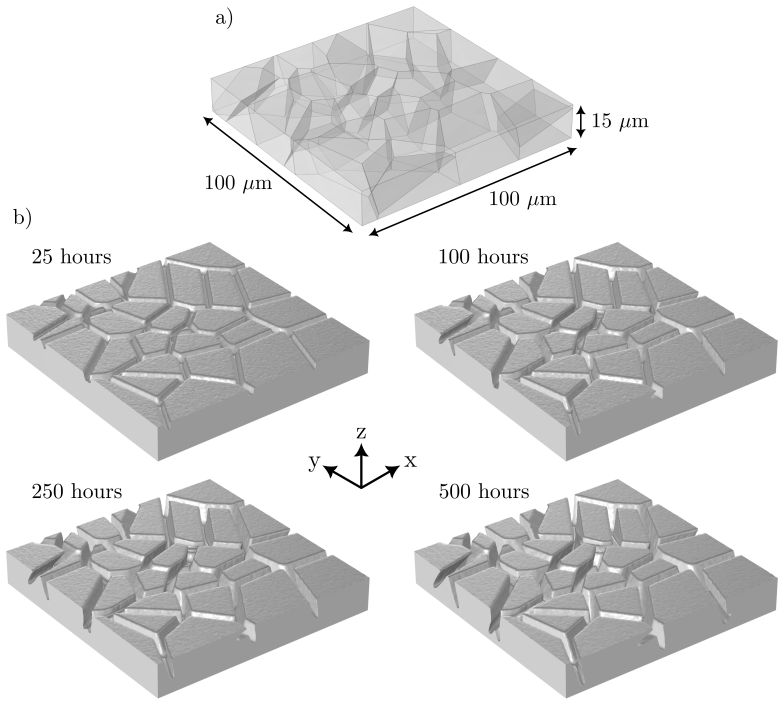
- Holding grain size at 20 µm, going from 5 to 6 to 7 exposed surface grain boundaries raises the 500-hour weight loss by roughly 15% per added grain, while average corrosion depth stays near 12 µm.
- Reducing average grain size from 40 µm to 10 µm dramatically increases intergranular attack, so that after 30,000 hours of sink-driven corrosion the fine-grained microstructure is largely engulfed by lithium-filled boundaries.
- Under static saturation, the 7-GB and 10 µm microstructures reach saturation first; the 5-GB and 40 µm microstructures corrode longer, with the 40 µm case still unsaturated at 6000 hours.
- The concentration-sink model, which mimics dynamic breeder-loop conditions, gives an average corrosion depth around 66 µm after 30,000 hours and implies that structural components would need routine replacement within about three years.
- The 3D simulation produces a much larger weight loss (80.93 g/m² vs 1.16 g/m² after 500 hours), indicating that the 2D-calibrated interface kinetics coefficient needs re-derivation before quantitative 3D use.
Reading between the lines
- A testable extension would be to prepare specimens with controlled surface grain-boundary densities but identical bulk grain sizes; the model predicts the 500-hour weight loss should rise about 15% per additional surface grain, which is a sharper fingerprint than a bulk grain-size effect.
- Because the paper itself reports that corrosion depth depends on the numerical smearing width $l_p$ in a way it calls purely artificial, the quantitative depth match may be partly tied to a non-physical parameter; measuring effective grain-boundary transport in the same steel would show whether the match reflects physical fidelity.
- The saturation calculations imply a scaling rule for static systems: time to saturation should increase with the lithium volume per exposed grain-boundary area, so varying the liquid-to-specimen volume ratio in experiments would test the mechanism directly.
- The 2D-to-3D weight-loss gap suggests the interface kinetics coefficient should be tied to material parameters rather than fitted to 2D data before the model is used to rank real 3D components.
Editorial analysis
A structured set of objections, weighed in public.
Referee Report
Summary. The paper presents a phase-field model of intergranular liquid lithium corrosion in ferritic/martensitic steels, using the chromium concentration as the transported species and a stationary grain-boundary field to enhance diffusion along grain boundaries. The model is calibrated and validated against experimental weight loss and corrosion depth data for a 9 wt% Cr steel exposed to static lithium at 600 °C, with additional sensitivity studies varying near-surface grain density, grain size, smeared grain-boundary thickness, and the effect of saturation versus a concentration sink. The central claims are that the framework reproduces the experimental measurements and that near-surface grain density dominates corrosion severity while grain size controls susceptibility to intergranular corrosion.
Significance. If the central validation claim is sound, the model would be a practically useful mesoscale tool for ranking microstructural features for liquid-lithium compatibility, and the saturation-versus-sink comparison is a valuable conceptual contribution. The paper has notable strengths: a thermodynamically consistent derivation from Eq. (2) onward, explicit treatment of grain-boundary diffusion through Eq. (11), a documented implementation in COMSOL with promised code availability, and a systematic set of sensitivity analyses over statistically sampled microstructures. However, the validation is weakened by the calibration of the chemical free energy curvature parameter A against the same experimental data used for Fig. 19, and by the acknowledged artificial dependence of corrosion depth on the numerical grain-boundary thickness l_p. These issues must be addressed before the predictive claims can be taken as established.
major comments (3)
- [§4.2, Table 1, and §3] The validation in Fig. 19 is partly circular. Section 4.2 says the chemical free energy curvature parameter A is chosen from similar studies, but the Discussion explicitly states that 'The chemical free energy density curvature parameter A is selected based on the accuracy of the phase-field predictions to the experimental data.' Since A appears in Eq. (5) and controls the chemical driving force, the abstract's claim that the framework 'reproduces experimental measurements' is at least in part a fitting outcome rather than an independent test. Please quantify the sensitivity of the predicted weight loss and corrosion depth in Fig. 19 to A (for example ±50% variation) and, if possible, provide an independent determination of A from CALPHAD or first-principles data, or identify an out-of-sample prediction that does not rely on the same Xu et al. [44] dataset.
- [§2.3, Eq. (11), and Fig. 11] The corrosion-depth validation is not robust to the numerical grain-boundary thickness l_p. The paper shows in Fig. 11(b) that corrosion depth varies strongly with l_p (50, 100, and 200 nm), and the Discussion states that the observed correlation is 'purely artificial and attributed to the constant product approach.' Because l_p is a computational smearing thickness rather than a physical quantity, the agreement between the predicted and experimental corrosion depth at 250 h in Fig. 19(b) may depend on the particular choice l_p = 100 nm. The authors should either demonstrate that the experimental depth match is insensitive to l_p within a physically reasonable range, or provide an independent justification for the chosen l_p that does not derive from the target experimental data.
- [§3, Fig. 16] The 3D demonstration reports a weight loss of 80.93 g/m² after 500 h, which is two orders of magnitude larger than the 2D result of 1.16 g/m². The paper attributes this to the interface kinetics coefficient L being tailored to 2D microstructures. Since the abstract claims the formulation applies to arbitrary 2D and 3D polycrystalline geometries, the 3D result should be clearly framed as a proof-of-concept only, and the abstract or conclusions should not imply quantitative 3D predictive capability without a 3D-calibrated L.
minor comments (4)
- [§4.1, Eq. (12)] The stationary grain-boundary field η(x) is introduced in Eq. (12) without a physical interpretation beyond interpolating diffusivity. It would improve clarity to state explicitly that η represents a smeared Cr-depletion zone and to discuss how this choice relates to the physical thickness δ_gb.
- [§2.4 and Fig. 14] The saturation analysis uses a 1 µm liquid layer chosen specifically to reach saturation within 6000 h, and the paper notes this conflicts with experimental behavior. This is an acknowledged limitation, but the wording in Section 2.4 could more clearly distinguish between a numerical convenience and a physically representative liquid volume.
- [Table 1] The value of A = 5 × 10^9 N/m² has no source reference in Table 1, unlike the other parameters; the table should indicate whether this value is fitted, taken from literature, or otherwise justified.
- [§5, Data and Code Availability] The data availability statement says data are available upon reasonable request, while code availability is promised only after article acceptance. For reproducibility, the authors should consider making the code available at the time of submission or at least provide a permanent repository DOI.
Circularity Check
Validation is partially circular: the chemical free-energy curvature A is fitted to the same Xu et al. weight-loss and corrosion-depth data that are later presented as experimental confirmation; the independent microstructure and saturation analyses do not cure this.
-
fitted input called prediction
[Section 4.2 (Model calibration and validation), Section 3 (Discussion), and Fig. 19 comparison to Xu et al. [44].]
"In §4.2: “The model developed is calibrated and validated against experimental data given in [44] … Experimental measurements in terms of weight loss and corrosion depth are used to calibrate the model.” In §3: “The chemical free energy density curvature parameter A is selected based on the accuracy of the phase-field predictions to the experimental data.”"
A appears directly in the chemical free energy f_chem(c, φ) = (1/2)A[c − h(φ)(c_s,eq − c_l,eq) − c_l,eq]^2 + ωg(φ) (Eq. 5), so it controls the dissolution driving force, the weight loss computed by Eq. (13), and the corrosion depth. The paper first uses the Xu et al. [44] weight-loss and corrosion-depth measurements as calibration targets, then compares the same model outputs against those same measurements in Fig. 19 and claims in the abstract that the framework “reproduces experimental measurements.” Because A was explicitly selected to make the phase-field predictions agree with those data, the headline numerical match is partly a fitting outcome rather than an independent test of the model. The corrosion depth, also governed by A, does not provide a parameter-free corroboration.
full rationale
The central circularity is confined to the calibration-validation loop for A. Other potentially concerning features are not, by themselves, circular: the l_p dependence of corrosion depth is explicitly called “purely artificial” by the authors and weakens the fidelity of the depth prediction, but no evidence shows that l_p was tuned to the validation data, so it is a robustness limitation rather than a constructed equivalence. Similarly, the 1 µm liquid layer used to study saturation conflicts with experiment (the authors state that a 6000 h saturation time conflicts with experimental data) and the 3D result uses a 2D-tuned L, but these are acknowledged simplifications, not input-output identities. There is no load-bearing self-citation chain or imported uniqueness theorem; the citations to the authors' earlier phase-field papers supply the form of the model but not the fitted value of A. The genuinely independent content—the near-surface-grain-density sensitivity, grain-size ranking, and static-versus-dynamic distinction—does not rescue the headline validation because that validation target was used to set A. Hence the paper is partially circular in its central claim but retains meaningful independent contributions.
Assumptions & free parameters
free parameters (4)
- A (chemical free energy density curvature) =
5 x 10^9 N/m^2
- l_p (computational GB thickness) =
100 nm
- L (interface kinetics coefficient) =
1 m^2/(N.s)
- l (interfacial thickness) =
4 microns
assumptions (5)
- domain assumption The primary degradation mechanism is bulk diffusion of Cr in the metal; other phases, precipitates, and the Li2C2 by-product are ignored.
- domain assumption The steel is a uniform binary Fe-9Cr alloy with equiaxed grains; only prior austenite grain boundaries are represented.
- domain assumption The liquid Li is represented by a concentration sink with c = 0 on the exposed boundary for the calibration runs.
- ad hoc to paper The constant-product approach preserves GB transport capacity through D'_gb times l_p equals D_gb times delta_gb.
- standard math The same diffusion potential (Kim-Kim-Suzuki) is assumed to derive the mixture chemical free energy in Eq. (5).
invented entities (1)
-
Stationary grain-boundary field eta(x)
Cite this review
Pith. "Pith review of A mesoscale phase-field model of intergranular liquid lithium corrosion of ferritic/martensitic steels." pith.science (2026). https://pith.science/paper/WPYBABBI
@misc{pith2026250602776,
  author       = {Pith},
  title        = {Pith review of: A mesoscale phase-field model of intergranular liquid lithium corrosion of ferritic/martensitic steels},
  year         = {2026},
  howpublished = {\url{https://pith.science/paper/WPYBABBI}},
  note         = {Machine review of arXiv:2506.02776}
}
abstract
A phase-field model is developed to simulate intergranular corrosion of ferritic/martensitic steels exposed to liquid lithium. The chromium concentration of the material is used to track the mass transport within the metal and liquid (corrosive) phase. The framework naturally captures intergranular corrosion by enhancing the diffusion of chromium along grain boundaries relative to the grain bulk with no special treatment for the corrosion front evolution. The formulation applies to arbitrary 2D and 3D polycrystalline geometries. The framework reproduces experimental measurements of weight loss and corrosion depth for a 9 wt\% Cr ferritic/martensitic steel exposed to static lithium at 600 $^\circ$C. A sensitivity analysis, varying near-surface grain density, grain size, and chromium depletion thickness, highlights the microstructural influence in the corrosion process. Moreover, the significance of saturation is considered and evaluated. Simulation results show that near-surface grain density is a deciding factor, whereas grain size dictates the susceptibility to intergranular corrosion.
Figures


Figures from the paper (16 more)




Reference graph
Works this paper leans on
-
[44]
Xu, Q. et al. Corrosion characteristics of low activation ferritic steel, JLF-1, in liquid lithium in static and thermal convection conditions. Fusion Engineering and Design83, 1477–1483 (2008)
work page 2008
-
[1]
Blanket materials for dt fusion reactors
Smith, D. Blanket materials for dt fusion reactors. Journal of Nuclear Materials103, 19–29 (1981)
work page 1981
-
[2]
Shanliang, Z. & Yican, W. Neutronic Comparison of Tritium-Breeding Performance of Candidate Tritium-Breeding Materials. Plasma Science and Technology5, 1995–2000 (2003)
work page 2003
-
[3]
Malang, S. & Mattas, R. Comparison of lithium and the eutectic lead-lithium alloy, two candidate liquid metal breeder materials for self-cooled blankets. Fusion Engineering and Design27, 399–406 (1995)
work page 1995
-
[4]
Kirillov, I., Shatalov, G. & Strebkov, Y. RF TBMs for ITER tests. Fusion Engineering and Design 81, 425–432 (2006). 24
work page 2006
-
[5]
Bloom, E. E. The challenge of developing structural materials for fusion power systems. Journal of Nuclear Materials 258-263, 7–17 (1998)
work page 1998
-
[6]
Giancarli, L. et al. Breeding Blanket Modules testing in ITER: An international program on the way to DEMO. Fusion Engineering and Design81, 393–405 (2006)
work page 2006
-
[7]
Smith, D., Billone, M., Majumdar, S., Mattas, R. & Sze, D.-K. Materials integration issues for high performance fusion power systems. Journal of Nuclear Materials258-263, 65–73 (1998)
work page 1998
Show all 80 references
-
[8]
Giancarli, L. M. et al. Overview of recent ITER TBM Program activities. Fusion Engineering and Design 158, 111674 (2020)
2020
-
[9]
Klueh, R. L. Elevated temperature ferritic and martensitic steels and their application to future nuclear reactors. International Materials Reviews50, 287–310 (2005)
2005
-
[10]
Chopra, O. K. & Tortorelli, P. F. Compatibility of materials for use in liquid-metal blankets of fusion reactors. Journal of Nuclear Materials123, 1201–1212 (1984)
1984
-
[11]
Tortorelli, P. F. & DeVan, J. H. Oak Ridge National Lab (ed.) Liquid metal corrosion considerations in alloy development. (ed.Oak Ridge National Lab) (Tennessee, United States, 1984)
1984
-
[12]
Tortorelli, P. F. Corrosion of ferritic steels by molten lithium: Influence of competing thermal gradient mass transfer and surface product reactions. Journal of Nuclear Materials155-157, 722–727 (1988)
1988
-
[13]
& Krasin, V
Lyublinski, I., Evtikhin, V., Pankratov, V. & Krasin, V. Numerical and experimental determination of metallic solubilities in liquid lithium, lithium-containing nonmetallic impurities, lead and lead- lithium eutectic. Journal of Nuclear Materials224, 288–292 (1995)
1995
-
[14]
Chopra, O. K. & Smith, D. L. Compatibility of ferritic steels in forced circulation lithium and Pb-17Li systems. Journal of Nuclear Materials155-157, 715–721 (1988)
1988
-
[15]
& Chopra, O
Tortorelli, P. & Chopra, O. Corrosion and compatibility considerations of liquid metals for fusion reactor applications. Journal of Nuclear Materials103, 621–632 (1981)
1981
-
[16]
& Kolbe, H
Ruedl, E., Coen, V., Sasaki, T. & Kolbe, H. Intergranular lithium penetration of low-Ni, Cr-Mn Austenitic stainless steels. Journal of Nuclear Materials110, 28–36 (1982)
1982
-
[17]
Bell, G. E. & Abdou, M. A. The Role of Carbides in the Corrosion Behavior of Fe-12Cr-1MoVW Steel in Liquid Lithium. Fusion Technology15, 315–320 (1989)
1989
-
[18]
& Nozawa, T
Hosaka, T., Kondo, M., Sato, S., Ando, M. & Nozawa, T. Chemical compatibility of F82H and 316L in liquid metal heat transfer mediums Li, Na and NaK. Journal of Nuclear Materials561, 153546 (2022)
2022
-
[19]
& Muroga, T
Xu, Q., Nagasaka, T. & Muroga, T. Compatibility of Low Activation Ferritic Steels with Liquid Lithium. Fusion Science and Technology52, 609–612 (2007)
2007
-
[20]
& Yeliseyeva, O
Tsisar, V., Kondo, M., Muroga, T., Nagasaka, T. & Yeliseyeva, O. Structural and compositional transformations in the near-surface layers of Fe–Cr based steels exposed to lithium – Effect of alloying and corrosion-assisted substructure coarsening. Corrosion Science 53, 441–447 (2011)
2011
-
[21]
Zhang, D. et al. Study on corrosion behavior of China low activation ferritic/martensitic steel in static liquid lithium. Nuclear Materials and Energy38, 101594 (2024). 25
2024
-
[22]
Sarkar, S., Warner, J. E. & Aquino, W. A numerical framework for the modeling of corrosive dissolution. Corrosion Science 65, 502–511 (2012)
2012
-
[23]
& Liu, G
Sun, W., Wang, L., Wu, T. & Liu, G. An arbitrary Lagrangian–Eulerian model for modelling the time-dependent evolution of crevice corrosion. Corrosion Science 78, 233–243 (2014)
2014
-
[24]
& Bobaru, F
Jafarzadeh, S., Chen, Z., Zhao, J. & Bobaru, F. Pitting, lacy covers, and pit merger in stainless steel: 3D peridynamic models. Corrosion Science 150, 17–31 (2019)
2019
-
[25]
& Bobaru, F
Chen, Z. & Bobaru, F. Peridynamic modeling of pitting corrosion damage. Journal of the Mechanics and Physics of Solids78, 352–381 (2015)
2015
-
[26]
& Liu, G
Gong, K., Wu, M., Liu, X. & Liu, G. Nucleation and propagation of stress corrosion cracks: Modeling by cellular automata and finite element analysis. Materials Today Communications 33, 104886 (2022)
2022
-
[27]
& Akid, R
Fatoba, O., Leiva-Garcia, R., Lishchuk, S., Larrosa, N. & Akid, R. Simulation of stress-assisted localised corrosion using a cellular automaton finite element approach. Corrosion Science 137, 83– 97 (2018)
2018
-
[28]
Phase-field simulations opening new horizons in corrosion research
Mart ´ ınez-Pa˜ neda, E. Phase-field simulations opening new horizons in corrosion research. MRS Bulletin 49, 603–612 (2024)
2024
-
[29]
& Mart ´ ınez-Pa˜ neda, E
Cui, C., Ma, R. & Mart ´ ınez-Pa˜ neda, E. Electro-chemo-mechanical phase field modeling of localized corrosion: theory and COMSOL implementation. Engineering with Computers39, 3877–3894 (2023)
2023
-
[30]
Makuch, M., Kovacevic, S., Wenman, M. R. & Mart ´ ınez-Pa˜ neda, E. A microstructure-sensitive electro-chemo-mechanical phase-field model of pitting and stress corrosion cracking. Corrosion Science 232, 112031 (2024)
2024
-
[31]
Q., Luo, J.-L
Ansari, T. Q., Luo, J.-L. & Shi, S.-Q. Modeling the effect of insoluble corrosion products on pitting corrosion kinetics of metals. npj Materials Degradation3, 28 (2019)
2019
-
[32]
& Ruan, H
Lin, C. & Ruan, H. Phase-field modeling of mechano–chemical-coupled stress-corrosion cracking. Electrochimica Acta395, 139196 (2021)
2021
-
[33]
& Chen, L
Tantratian, K., Yan, H. & Chen, L. Predicting pitting corrosion behavior in additive manufacturing: electro-chemo-mechanical phase-field model. Computational Materials Science213, 111640 (2022)
2022
-
[34]
Brewick, P. T. Simulating Pitting Corrosion in AM 316L Microstructures Through Phase Field Methods and Computational Modeling. Journal of The Electrochemical Society169, 011503 (2022)
2022
-
[35]
& Varas, F
Amador, J., Vega, J., Garc ´ ıa-Lecina, E. & Varas, F. Quantitative phase-field model to simulate low carbon steel aqueous corrosion phenomena. Corrosion Science 232, 112045 (2024)
2024
-
[36]
F., Stewart, J
Chadwick, A. F., Stewart, J. A., Enrique, R. A., Du, S. & Thornton, K. Numerical Modeling of Localized Corrosion Using Phase-Field and Smoothed Boundary Methods. Journal of The Electrochemical Society165, C633–C646 (2018)
2018
-
[37]
& Weber, W
Kandekar, C., Ravikumar, A., H¨ oche, D. & Weber, W. E. Mastering the complex time-scale interaction during Stress Corrosion Cracking phenomena through an advanced coupling scheme. Computer Methods in Applied Mechanics and Engineering428, 117101 (2024)
2024
-
[38]
& Jing, H
Li, B., Xing, H. & Jing, H. New diffusive interface model for pitting corrosion. npj Materials Degradation 7, 84 (2023). 26
2023
-
[39]
& Bobaru, F
Jafarzadeh, S., Chen, Z. & Bobaru, F. Peridynamic Modeling of Intergranular Corrosion Damage. Journal of The Electrochemical Society165, C362–C374 (2018)
2018
-
[40]
& Gwinner, B
Guiso, S., di Caprio, D., de Lamare, J. & Gwinner, B. Intergranular corrosion: Comparison between experiments and cellular automata. Corrosion Science 177, 108953 (2020)
2020
-
[41]
Guiso, S. et al. Intergranular corrosion in evolving media: Experiment and modeling by cellular automata. Corrosion Science 205, 110457 (2022)
2022
-
[42]
Q., Luo, J.-L
Ansari, T. Q., Luo, J.-L. & Shi, S.-Q. Multi-Phase-Field Model of Intergranular Corrosion Kinetics in Sensitized Metallic Materials. Journal of The Electrochemical Society167, 061508 (2020)
2020
-
[43]
& Tonks, M
Vivek Bhave, C., Zheng, G., Sridharan, K., Schwen, D. & Tonks, M. R. An electrochemical mesoscale tool for modeling the corrosion of structural alloys by molten salt. Journal of Nuclear Materials574, 154147 (2023)
2023
-
[45]
M., Evtikhin, V
Griaznov, G. M., Evtikhin, V. A., Zavialski, L. P., Kosuhin, A. Y. & Lyublinski, I. E. Interaction of structural materials with liquid metals under the isothermal conditions. Material science of liquid metal systems of thermonuclear reactors, Energoatomizdat32–142 (1989)
1989
-
[46]
Tortorelli, P. F. & DeVan, J. H. Mass transfer behavior of a modified austenitic stainless steel in lithium. Journal of Nuclear Materials123, 1258–1263 (1984)
1984
-
[47]
& Kondo, M
Li, Y., Abe, H., Nagasaka, T., Muroga, T. & Kondo, M. Corrosion behavior of 9Cr-ODS steel in stagnant liquid lithium and lead–lithium at 873K. Journal of Nuclear Materials443, 200–206 (2013)
2013
-
[48]
& Virtanen, S
Hariharan, K. & Virtanen, S. Microstructure engineering for corrosion resistance in structural alloy design. npj Materials Degradation8, 115 (2024)
2024
-
[49]
Corrosion of Refractory Metals by Lithium
DiStefano, J. Corrosion of Refractory Metals by Lithium. Ph.D. thesis, Oak Ridge National Laboratory (ORNL), Oak Ridge, TN (United States) (1964)
1964
-
[50]
& Yeliseyeva, O
Kondo, M., Muroga, T., Nagasaka, T., Tsisar, V. & Yeliseyeva, O. Erosion-corrosion of RAFM JLF-1 steel in lithium flow induced by impeller. Journal of Plasma and Fusion Research9, 294–299 (2010)
2010
-
[51]
Kondo, M. et al. Flow accelerated corrosion and erosion–corrosion of RAFM steel in liquid breeders. Fusion Engineering and Design86, 2500–2503 (2011)
2011
-
[52]
et al.Effect of nitrogen on the corrosion behavior of RAFM JLF-1 steel in lithium
Tsisar, V. et al.Effect of nitrogen on the corrosion behavior of RAFM JLF-1 steel in lithium. Journal of Nuclear Materials417, 1205–1209 (2011)
2011
-
[53]
Beskorovaynyi, N. M. & Ioltuhovski, A. G. Mechanisms of corrosion processes under the contact of structural materials with liquid lithium. Structural Materials and Liquid Metal Heat-transfers, Energoatomizdat, Moscow 59–89 (1983)
1983
-
[54]
Lee, S. J. & Lee, Y.-K. Effect of Austenite Grain Size on Martensitic Transformation of a Low Alloy Steel. Materials Science Forum475-479, 3169–3172 (2005)
2005
-
[55]
Souza, S. d. S. d., Moreira, P. S. & Faria, G. L. d. Austenitizing Temperature and Cooling Rate Effects on the Martensitic Transformation in a Microalloyed-Steel. Materials Research23 (2020). 27
2020
-
[56]
F., Devan, J
Tortorelli, P. F., Devan, J. H. & Yonco, R. M. Compatibility of Fe-Cr-Mo alloys with static lithium. Journal of Materials for Energy Systems2, 5–15 (1981)
1981
-
[57]
Zhang, J., Chen, Z. H. & Dong, C. F. Simulating Intergranular Stress Corrosion Cracking in AZ31 Using Three-Dimensional Cohesive Elements for Grain Structure. Journal of Materials Engineering and Performance 24, 4908–4918 (2015)
2015
-
[58]
& Baietto, M.-C
Nguyen, T.-T., R´ ethor´ e, J., Yvonnet, J. & Baietto, M.-C. Multi-phase-field modeling of anisotropic crack propagation for polycrystalline materials. Computational Mechanics 60, 289–314 (2017)
2017
-
[59]
& Cizelj, L
Simonovski, I. & Cizelj, L. Computational multiscale modeling of intergranular cracking. Journal of Nuclear Materials 414, 243–250 (2011)
2011
-
[60]
A., Olson, D
Reeves, J. A., Olson, D. L. & Bradley, W. L. Grain Boundary Penetration Kinetics of Nitrided Type 304L Stainless Steel. Nuclear Technology30, 385–389 (1976)
1976
-
[61]
& Olson, D
Patterson, R., Schlager, R. & Olson, D. Lithium grain-boundary penetration of 304L stainless steel. Journal of Nuclear Materials57, 312–316 (1975)
1975
-
[62]
A., Boettinger, W
Wheeler, A. A., Boettinger, W. J. & McFadden, G. B. Phase-field model for isothermal phase transitions in binary alloys. Physical Review A45, 7424–7439 (1992)
1992
-
[63]
& Chen, L
Hu, S., Murray, J., Weiland, H., Liu, Z. & Chen, L. Thermodynamic description and growth kinetics of stoichiometric precipitates in the phase-field approach. Calphad 31, 303–312 (2007)
2007
-
[64]
G., Kim, W
Kim, S. G., Kim, W. T. & Suzuki, T. Phase-field model for binary alloys. Physical Review E 60, 7186–7197 (1999)
1999
-
[65]
Makuch, M., Kovacevic, S., Wenman, M. R. & Mart ´ ınez-Pa˜ neda, E. A nonlinear phase-field model of corrosion with charging kinetics of electric double layer. Modelling and Simulation in Materials Science and Engineering32, 075012 (2024)
2024
-
[66]
& Mesarovic, S
Kovacevic, S., Pan, R., Sekulic, D. & Mesarovic, S. Interfacial energy as the driving force for diffusion bonding of ceramics. Acta Materialia 186, 405–414 (2020)
2020
-
[67]
& LLorca, J
Kovacevic, S., Ali, W., Mart ´ ınez-Pa˜ neda, E. & LLorca, J. Phase-field modeling of pitting and mechanically-assisted corrosion of Mg alloys for biomedical applications. Acta Biomaterialia 164, 641–658 (2023)
2023
-
[68]
Allen, S. M. & Cahn, J. W. A microscopic theory for antiphase boundary motion and its application to antiphase domain coarsening. Acta Metallurgica 27, 1085–1095 (1979)
1979
-
[69]
& Soghrati, S
Mai, W. & Soghrati, S. New phase field model for simulating galvanic and pitting corrosion processes. Electrochimica Acta260, 290–304 (2018)
2018
-
[70]
K., Jiang, C., Jiang, W
Simon, P.-C., Aagesen, L. K., Jiang, C., Jiang, W. & Ke, J.-H. Mechanistic calculation of the effective silver diffusion coefficient in polycrystalline silicon carbide: Application to silver release in AGR-1 TRISO particles. Journal of Nuclear Materials563, 153669 (2022)
2022
-
[71]
& Chateau, C
Nguyen, T., Yvonnet, J., Zhu, Q.-Z., Bornert, M. & Chateau, C. A phase-field method for computational modeling of interfacial damage interacting with crack propagation in realistic microstructures obtained by microtomography. Computer Methods in Applied Mechanics and Engineeri...
2016
-
[72]
COMSOL Multiphysics v. 6.0. https://www.comsol.com. COMSOL AB, Stockholm, Sweden . 28
-
[73]
& Fenici, P
Coen, V. & Fenici, P. Compatibility of structural materials with liquid breeders — A review of recent work carried out at JRC, Ispra. Nuclear Engineering and Design. Fusion1, 215–229 (1984)
1984
-
[74]
& Favuzza, P
Knaster, J. & Favuzza, P. Assessment of corrosion phenomena in liquid lithium at 873 K. A Li(d,n) neutron source as case study. Fusion Engineering and Design118, 135–141 (2017)
2017
-
[75]
& Sasaki, T
Ruedl, E. & Sasaki, T. Effect of lithium on grain-boundary precipitation in a Cr-Mn austenitic steel. Journal of Nuclear Materials116, 112–122 (1983)
1983
-
[76]
& Pokorn´ a, A
ˇCerm´ ak, J., R ˚ uˇ ziˇ ckov´ a, J. & Pokorn´ a, A. Low-temperature tracer diffusion of chromium in Fe-Cr ferritic alloys. Scripta Materialia 35, 411–416 (1996)
1996
-
[77]
& Vitos, L
Li, C., Lu, S., Divinski, S. & Vitos, L. Theoretical and experimental grain boundary energies in body-centered cubic metals. Acta Materialia 255, 119074 (2023)
2023
-
[78]
& Romaner, L
Scheiber, D., Pippan, R., Puschnig, P. & Romaner, L. Ab initio calculations of grain boundaries in bcc metals. Modelling and Simulation in Materials Science and Engineering24, 035013 (2016)
2016
-
[79]
& Masamura, K
Nakamichi, H., Sato, K., Miyata, Y., Kimura, M. & Masamura, K. Quantitative analysis of Cr- depleted zone morphology in low carbon martensitic stainless steel using FE-(S)TEM. Corrosion Science 50, 309–315 (2008)
2008
-
[80]
R., Deymier, P
Kumar Thakur, A., Kovacevic, S., Manga, V. R., Deymier, P. A. & Muralidharan, K. A first- principles and CALPHAD-assisted phase-field model for microstructure evolution: Application to Mo-V binary alloy systems. Materials & Design235, 112443 (2023). Figure 1: Representative mi...
2023
Reviewed August 7, 2026 · model on record in the stance chip above.
Discussion (0). Sign in to comment.