REVIEW 3 major objections 5 minor 1 cited by
Cavity-modified quantum electron transport in multi-terminal devices and interferometers
T0 review · 3 major / 5 minor · reviewed 2026-08-11 · deepseek-v4-flash
Pith's one-line read Cavity vacuum fields, acting through long-range electron hopping, can backscatter chiral edge states and thereby break quantum Hall quantization and alter Aharonov-Bohm interference in mesoscopic devices.
desk verdict Plausible and useful extension of cavity-mediated transport to multi-terminal devices and interferometers, but the untested first-order Peierls truncation at g~0.3-0.6 puts the headline Hall-breakdown claim on shaky ground. read the letter →
The pith
A machine-rendered reading of the paper's core claim, the machinery that carries it, and where it could break.
The reading
What carries the argument
The machinery is the effective zero-photon Hamiltonian $\hat H_{\mathrm{eff}}=\hat H_0+\hat\Gamma$, with the cavity-mediated hopping element $\Gamma_{\lambda\lambda'}$ given by Eq. (1): $\Gamma_{\lambda\lambda'}=-\sum_\mu [\mathrm{sgn}(\varepsilon_\mu-\min(\varepsilon_\lambda,\varepsilon_{\lambda'}))(|\varepsilon_\mu-(\varepsilon_\lambda+\varepsilon_{\lambda'})/2|+\hbar\omega_{\mathrm{cav}})] h_{\lambda\mu}h_{\mu\lambda'}$, where $h_{\alpha\beta}=\sum_{ij}(-ig_{ij}t_{ij})\phi_\alpha^*(i)\phi_\beta(j)$. The $g_{ij}$ are Peierls phases picked up by an electron hopping between sites $i$ and $j$ in the cavity vector potential; the sum over $\mu$ runs over intermediate single-particle eigenstates. This $\Gamma$ turns vacuum fluctuations into a static long-range hopping between sites, including pairs with no bare hopping term, and couples eigenstates near the Fermi energy. The transport predictions then follow by feeding $\hat H_{\mathrm{eff}}$ into the Caroli conductance formula and into a long-range-bond version of the current-density formula, Eqs. (4)--(7).
What would settle it
Run the same transport calculation on the full coupled electron-photon Hamiltonian, keeping multi-photon terms and higher orders of the Peierls phase at $\eta=10^{-10}$ and $\eta=3\times10^{-11}$, or measure the longitudinal resistance at an integer filling in a Hall bar coupled to a resonant cavity. If quantized $R_H$ and vanishing $R_L$ survive in the full calculation, or if the experiment sees no breakdown at those couplings, the zero-photon effective-theory prediction is refuted.
Extended reading notes
Core claim
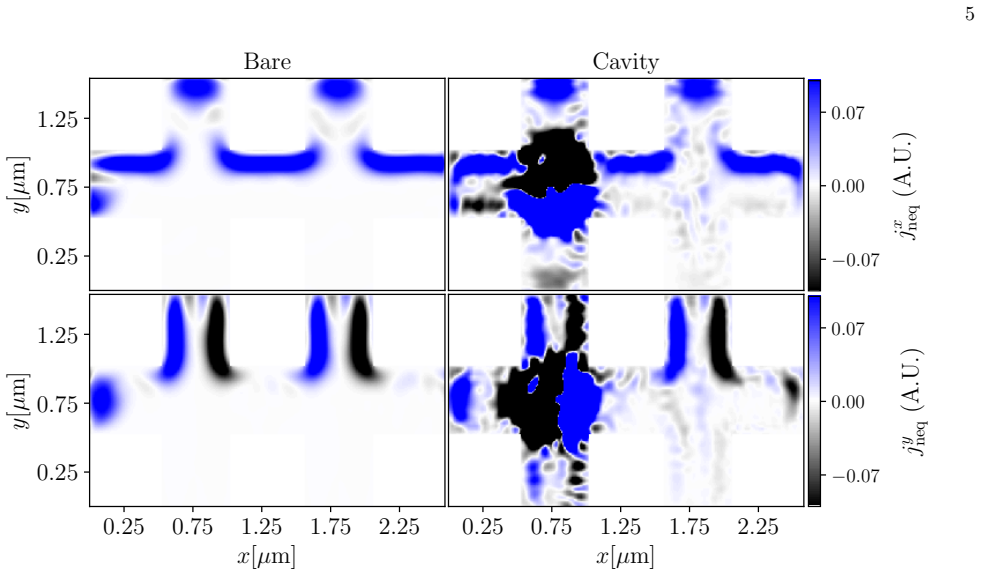
The central claim is that, in a finite-size system, the cavity-mediated hopping matrix $\Gamma$ of Eq. (1) couples single-electron eigenstates that would otherwise be disconnected, in particular edge states on opposite sides of a Hall bar. This coupling acts as an effective backscattering channel that bypasses the insulating bulk. Concretely, for the six-terminal bar studied numerically at $B=0.1$ T with GaAs parameters and strong mode compression $\eta=10^{-10}$, the bare integer quantum Hall plateaus $R_H=h/(\nu e^2)$ become smeared and $R_L$ becomes nonzero at integer $\nu$, with odd fillings more fragile because the Zeeman-split levels lie close together when $E_Z\ll\hbar\omega_{\mathrm{cyc}}$. The current-density maps show reverse-flow components crossing the sample, and the local density of states develops new features. In a quantum point contact, conductance plateaus are largely destroyed, more so for a spatially nonuniform cavity mode; in an Aharonov-Bohm interferometer the periodicity and evenness of $G(\Phi)$ survive but the visibility $\Lambda(E_F)$ changes markedly because the cavity creates new electronic paths. The paper's claim is that these are generic consequences of vacuum-field-induced inter-site hopping, not fine-tuned artifacts of a particular device.
Load-bearing premise
The predictions rest on the assumption that the cavity's influence on each electron is fully captured by a first-order, zero-photon effective hopping term with the sum over intermediate electron states truncated; if higher-order or multi-photon processes matter at the strong couplings used, the predicted breakdown of quantization and the interference changes may be artifacts of that simplification.
Editorial extensions
If this is right
- In a Hall bar whose bare edge states are topologically protected, a cavity with a spatially varying mode introduces inter-edge backscattering: the Hall resistance stops being quantized at integer fillings and the longitudinal resistance becomes nonzero there.
- Odd-integer Hall plateaus are more susceptible than even ones when the Zeeman splitting is small, matching the pattern reported in the experiments the paper cites.
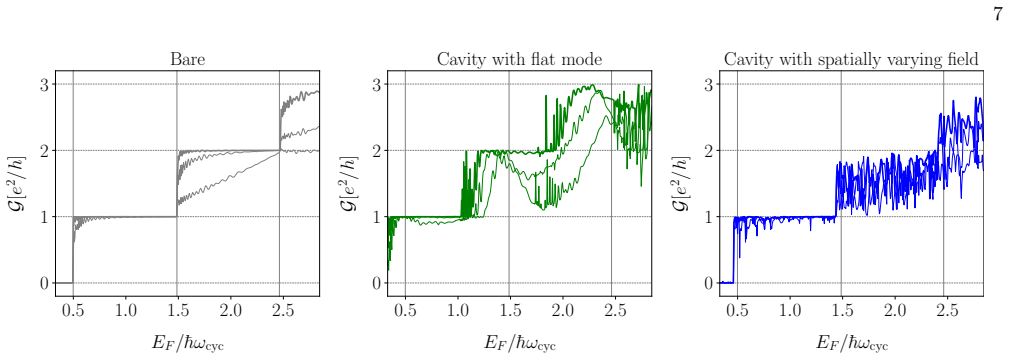
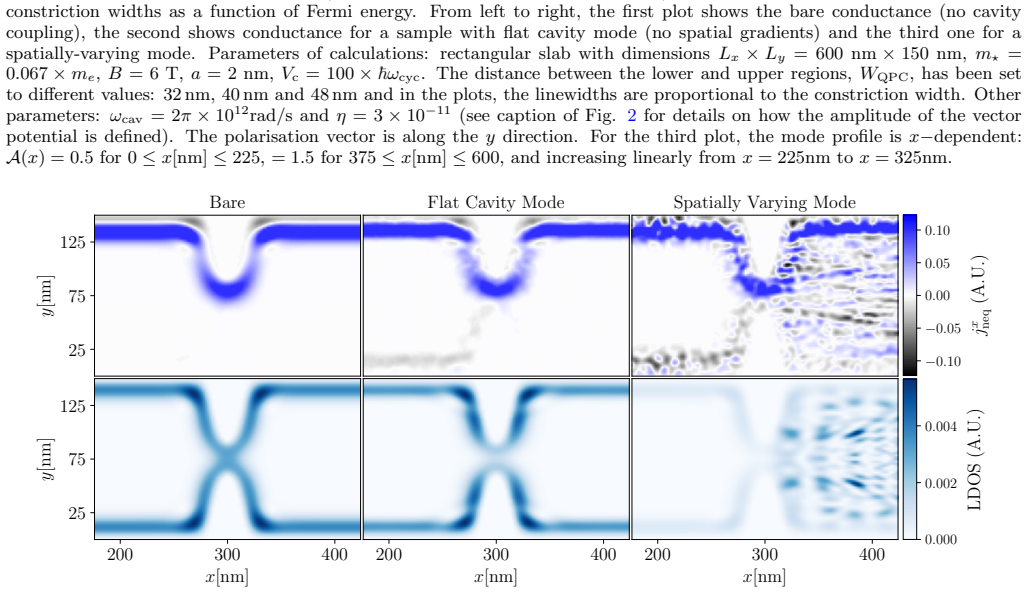
- For quantum point contacts, the same effective hopping suppresses the sharp conductance steps; a spatially nonuniform cavity mode has a stronger effect than a flat mode because it breaks translational invariance, and it can create new bulk states visible in the local density of states.
- In Aharonov-Bohm interferometers, conductance remains periodic and even in magnetic flux, but the visibility as a function of Fermi energy is strongly modified because the cavity adds new paths that change how partial waves interfere.
- If these predictions hold, any strong local electromagnetic environment, such as metal gates, contact antennas, or an intentional cavity, should be treated as part of the transport problem in small devices.
Reading between the lines
- An implicit extension is that the sensitivity to the cavity-mode profile gives a tunable knob: shifting or shaping the vacuum-field profile should change the amount of backscattering, which could be checked in a single device.
- A neighbouring system the paper does not treat is the electronic Mach-Zehnder interferometer, where the longer edge path should make cavity-mediated hopping more visible; a coupling-dependent visibility change there would be a transport-only test of the mechanism.
- Because the effective hopping is built from a sum over intermediate states of the bare Hamiltonian, applying the same framework to graphene or transition-metal dichalcogenides will change which channels are coupled; the filling-factor dependence of the predicted breakdown should then differ from the GaAs case.
Editorial analysis
A structured set of objections, weighed in public.
Referee Report
Summary. This paper extends a previously developed cavity-mediated electron-hopping framework [32] to multi-terminal devices: a six-terminal quantum Hall bar, quantum point contacts, and Aharonov-Bohm interferometers. Starting from the effective zero-photon Hamiltonian H_eff = H_0 + Gamma of Eq. (1), it uses the Landauer-Buttiker/NEGF formalism to compute conductance matrices, Hall and longitudinal resistances, spatially resolved non-equilibrium current densities, and local densities of states. The main numerical predictions are that cavity vacuum fields destroy Hall resistance quantization and produce finite longitudinal resistance at integer fillings (Figs. 2-3), that they suppress conductance quantization in QPCs (Figs. 5-6), and that they substantially modify AB interference visibility as a function of Fermi energy (Figs. 8-10). The paper also derives a current-density formula for arbitrary-range hopping and provides lead self-energies for a 2DEG in an appendix.
Significance. If valid, the paper would show that vacuum-field-induced long-range electron hopping qualitatively changes chiral edge transport in realistic mesoscopic devices, including inter-edge backscattering in Hall bars and altered interference visibility in AB rings. The extension of the framework to multi-terminal setups and the explicit expressions for current densities and LDOS are useful methodological contributions, and the qualitative connection to the experimental breakdown of topological protection reported in Ref. [36] is potentially important. However, the central numerical conclusions rest on effective-Hamiltonian truncation assumptions that are not validated at the strong couplings used, on a single disorder realization, and on a Zeeman energy that is not GaAs-like. These issues are load-bearing for the quantitative and semi-quantitative claims of the paper.
major comments (3)
- [Sec. II, Eq. (1); Sec. VI] All central predictions are computed from the effective zero-photon Hamiltonian H_eff = H_0 + Gamma inherited from Ref. [32]. The derivation expands the Peierls phases to first order in the dimensionless couplings g_ij and adiabatically eliminates photons. The simulations use eta = 10^-10 (Figs. 2-3) and eta = 3 x 10^-11 (Figs. 5-10), values for which the couplings g_ij are not small: they are of order 0.3 for the Hall bar and 0.1-0.6 for the QPC/AB geometries, depending on the mode profile. The omitted second-order (diamagnetic) terms are therefore of relative size |g|/2, i.e., up to roughly 30%, and the truncation of the intermediate-state sum in Eq. (1) is not tested. Because the claimed Hall quantization breakdown and the AB visibility changes could be truncation artifacts rather than physical cavity-induced backscattering, I request a convergence test on at least one representative geometry: either comparison with the full cavity-QED Hamiltonian in a truncated photon Hilbert space, or an explicit estimate of the second-order Peierls contributions, or a systematic g-scaling study showing that the predictions survive as g is reduced. The paper's own Sec. VI defers non-adiabatic regimes to future work without establishing that the chosen parameters avoid that regime.
- [Sec. III, Fig. 1(c) and Fig. 2] The Hall-bar results are obtained with a single disorder realization characterized by correlation length 60 nm and potential amplitude roughly within +/- 0.2 hbar*omega_cyc. The central claim that cavity vacuum fields break Hall quantization at integer filling factors is a statement about generic disordered devices, but no ensemble averaging or realization-to-realization spread is provided. The statement in Sec. III that the considered configuration is an 'illustrative and representative example' does not by itself establish representativeness. Please repeat the calculation for several independent disorder configurations, or present disorder-averaged R_H and R_L with error bars, and show that the plateau breakdown is not accidental to this particular realization.
- [Fig. 2 caption] The Zeeman energy is set to E_Z = 0.2 x hbar*omega_cyc, but this is not consistent with the quoted GaAs parameters (m* = 0.067 m_e, B = 0.1 T) or with the g-factor of the GaAs 2DEG used in the experiments of Ref. [36]. With g* approximately -0.44, the physical ratio is E_Z/(hbar*omega_cyc) = |g*| m*/(2 m_e) approximately 0.015, more than an order of magnitude smaller. Since the enhanced sensitivity of odd-integer plateaus is attributed to the smallness of the Zeeman gap, the calculation as presented does not quantitatively justify the comparison with Ref. [36]. The authors should either repeat the calculation at the physical E_Z/(hbar*omega_cyc) ratio or explicitly state that the model uses an artificially enhanced Zeeman splitting.
minor comments (5)
- [Sec. III] There is a typo in the paragraph after Fig. 2: 'whlie' should be 'while'.
- [Sec. V and Fig. 7] The spelling 'Aharanov-Bohm' is used in the section title and Fig. 7 caption, while 'Aharonov-Bohm' is used elsewhere; please make the spelling consistent.
- [Sec. III] The claim that the continuum limit has been 'carefully verified' is not supported by any shown convergence data. A short Appendix with a convergence test in lattice spacing would make the numerical results more reproducible.
- [Fig. 5] The linewidth encoding of the three constriction widths W_QPC is likely hard to read in print; using distinct colors or line styles would improve clarity.
- [Sec. II, Eq. (16)] The definition of the local current density in Eq. (16) would benefit from a brief derivation or a reference, because the prefactors involving the lattice spacing and the resistance matrix elements are not immediately transparent.
Circularity Check
No significant circularity: all results follow from forward application of the inherited effective Hamiltonian to new observables.
full rationale
The paper's central input is the effective Hamiltonian H_eff = H_0 + Gamma of Eq. (1), inherited from the authors' previous work [32]. That is self-citation, but it is not circular: Eq. (1) is presented as a derived effective Hamiltonian obtained from an intermediate-Hamiltonian treatment and a first-order Peierls expansion, and the present paper does not invert any data to obtain it. All transport observables, including Hall and longitudinal resistances, current densities, local density of states, and Aharonov-Bohm visibility, are computed by forward NEGF/Landauer-Buttiker evaluation of H_eff over ranges of Fermi energies and fluxes. No parameter is fitted to the claimed Hall-breakdown or visibility predictions, and the comparison to experiment [36] is qualitative validation rather than an input to the calculation. The skeptical concern about the validity of the first-order and zero-photon truncation at the chosen coupling strengths is a correctness or approximation risk, not a circularity: even if that truncation were quantitatively inadequate, the derivation would not reduce to its own conclusion. Accordingly, the circularity score is 0.
Assumptions & free parameters
free parameters (4)
- Zeeman splitting ratio EZ/(hbar*omega_cyc) =
0.2
- Cavity compression factor eta =
10^-10 (Hall bar), 3 x 10^-11 (QPC, AB)
- Cavity mode spatial profile A(y) or A(x) =
exponential decay length 0.16 um; x-dependent step 0.5 to 1.5
- Disorder potential amplitude and realization =
U(r) roughly within +/- 0.2 hbar*omega_cyc, correlation length 60 nm
assumptions (6)
- domain assumption Effective zero-photon Hamiltonian H_eff = H_0 + Gamma with Gamma_lambda_lambda' given by Eq. (1) (from [32]) is the correct low-energy description of the cavity-embedded electron system.
- domain assumption Peierls substitution can be expanded to first order in g_ij, with all higher-order and multi-photon processes neglected.
- standard math Landauer-Buttiker and Caroli NEGF formulas are valid for linear response at zero temperature and for voltages small compared with spectral gaps.
- ad hoc to paper The sum over intermediate eigenstates mu in Eq. (1) can be truncated to the finite lattice eigenbasis without materially changing Gamma.
- domain assumption Spin-up and spin-down channels are independent and additive, and the cavity coupling conserves spin.
- ad hoc to paper A single disorder realization with correlation length 60 nm and U(r) roughly within +/- 0.2 hbar*omega_cyc is representative of the Hall-bar physics.
Cite this review
Pith. "Pith review of Cavity-modified quantum electron transport in multi-terminal devices and interferometers." pith.science (2026). https://pith.science/paper/WPYC5QG7
@misc{pith2026241206721,
  author       = {Pith},
  title        = {Pith review of: Cavity-modified quantum electron transport in multi-terminal devices and interferometers},
  year         = {2026},
  howpublished = {\url{https://pith.science/paper/WPYC5QG7}},
  note         = {Machine review of arXiv:2412.06721}
}
read the original abstract
We theoretically investigate transport affected by cavity-mediated electron hopping in multi-terminal quantum Hall bars, quantum point contacts, and Aharonov-Bohm interferometers. Beyond determining conductances and resistances, we analyze spatially resolved current distributions and local density of states. Our study reveals how cavity-mediated inter-edge scattering impacts quantum magnetotransport in finite-size systems and how the cavity-mediated hopping significantly alters electron quantum interference effects.
Figures


Figures from the paper (6 more)



Forward citations
Cited by 1 Pith paper
-
Observation of Cavity-Mediated Nonlinear Landau Fan and Modified Landau Level Degeneracy in Graphene Quantum Transport
Cavity vacuum fields in ultra-strong coupling reduce the effective degeneracy of Landau levels in graphene, shifting quantum Hall features to densities more than 20% lower and producing a nonlinear Landau fan.
Reference graph
Works this paper leans on
-
[32]
D. Hagenm¨ uller, J. Schachenmayer, S. Sch¨ utz, C. Genes, and G. Pupillo, Cavity-enhanced transport of charge, Physical review letters 119, 223601 (2017)
work page 2017
-
[36]
F. Appugliese, J. Enkner, G. L. Paravicini-Bagliani, M. Beck, C. Reichl, W. Wegscheider, G. Scalari, C. Ciuti, and J. Faist, Breakdown of topological protection by cav- ity vacuum fields in the integer quantum Hall effect, Sci- ence 375, 1030 (2022)
work page 2022
-
[1]
is I1 = I >0. Since there is only one drain (lead 6), we must have I2 = I3 = I4 = I5 = 0 and the conserva- tion of current imposes I1 = −I6 = −I. The Hall and longitudinal resistances are hence obtained as follows: RH = VH I = V4 − V5 I1 = R41 − R51 , (10) RL = VL I = V3 − V5 I1 = R31 − R51 , (11) where we have used Eq. (3) to obtain the terminal volt- ag...
-
[2]
F. Schlawin, D. M. Kennes, and M. A. Sentef, Cavity quantum materials, Applied Physics Reviews 9, 011312 (2022)
work page 2022
- [3]
-
[4]
F. J. Garcia-Vidal, C. Ciuti, and T. W. Ebbesen, Ma- nipulating matter by strong coupling to vacuum fields, Science 373 (2021)
work page 2021
-
[5]
Despite the destruction of quantization, the conduc- tance still exhibits the characteristic of increasing with larger openings. The spatially varying cavity mode ap- pears to have a stronger impact on the system, due to a stronger breaking of translational invariance. This re- sults in significant deviations from quantization, caused by cavity-mediated h...
- [6]
Show all 57 references
-
[7]
Scalari, C
G. Scalari, C. Maissen, D. Turˇ cinkov´ a, D. Hagenm¨ uller, S. De Liberato, C. Ciuti, C. Reichl, D. Schuh, W. Wegscheider, M. Beck, et al. , Ultrastrong coupling of the cyclotron transition of a 2d electron gas to a thz metamaterial, Science 335, 1323 (2012)
2012
-
[8]
Keller, G
J. Keller, G. Scalari, S. Cibella, C. Maissen, F. Ap- pugliese, E. Giovine, R. Leoni, M. Beck, and J. Faist, Few-electron ultrastrong light-matter coupling at 300 GHz with nanogap hybrid LC microcavities, Nano Let- ters 17, 7410 (2017)
2017
-
[9]
A. F. Kockum, A. Miranowicz, S. D. Liberato, S. Savasta, and F. Nori, Ultrastrong coupling between light and mat- ter, Nature Reviews Physics 1, 19 (2019)
2019
-
[10]
Herzig Sheinfux, L
H. Herzig Sheinfux, L. Orsini, M. Jung, I. Torre, M. Cec- canti, S. Marconi, R. Maniyara, D. Barcons Ruiz, A. H¨ otger, R. Bertini, et al. , High-quality nanocavities through multimodal confinement of hyperbolic polari- tons in hexagonal boron nitride, Nature Materials 23, 499 (2024)
2024
-
[11]
Forn-D ´ ıaz, L
P. Forn-D ´ ıaz, L. Lamata, E. Rico, J. Kono, and E. Solano, Ultrastrong coupling regimes of light-matter interaction, Reviews of Modern Physics 91 (2019)
2019
-
[12]
M. A. Sentef, M. Ruggenthaler, and A. Rubio, Cav- ity Quantum-Electrodynamical polaritonically enhanced electron-phonon coupling and its influence on supercon- ductivity, Science advances 4, eaau6969 (2018)
2018
-
[13]
Schlawin, A
F. Schlawin, A. Cavalleri, and D. Jaksch, Cavity- mediated electron-photon superconductivity, Physical re- view letters 122, 133602 (2019)
2019
-
[14]
J. B. Curtis, Z. M. Raines, A. A. Allocca, M. Hafezi, and V. M. Galitski, Cavity Quantum Eliashberg Enhance- ment of Superconductivity, Physical Review Letters 122 (2019)
2019
-
[15]
M´ endez-C´ ordoba, J
F. M´ endez-C´ ordoba, J. Mendoza-Arenas, F. G´ omez- Ruiz, F. Rodr ´ ıguez, C. Tejedor, and L. Quiroga, R´ enyi entropy singularities as signatures of topological critical- ity in coupled photon-fermion systems, Physical Review Research 2, 043264 (2020)
2020
-
[16]
Dmytruk and M
O. Dmytruk and M. Schir` o, Controlling topological phases of matter with quantum light, Communications Physics 5 (2022)
2022
-
[17]
V. K. Kozin, E. Thingstad, D. Loss, and J. Klinovaja, Cavity-enhanced superconductivity via band engineer- ing, arXiv preprint arXiv:2405.08642 (2024)
2024 arXiv
-
[18]
P´ erez-Gonz´ alez, G
B. P´ erez-Gonz´ alez, G. Platero, and ´A. G´ omez-Le´ on, 12 Light-matter correlations in quantum Floquet engineer- ing, arXiv preprint arXiv:2302.12290 (2023)
2023 arXiv
-
[19]
Ciuti, Cavity-mediated electron hopping in disordered quantum Hall systems, Physical Review B 104 (2021)
C. Ciuti, Cavity-mediated electron hopping in disordered quantum Hall systems, Physical Review B 104 (2021)
2021
-
[20]
Nguyen, G
D.-P. Nguyen, G. Arwas, Z. Lin, W. Yao, and C. Ciuti, Electron-Photon Chern Number in Cavity-Embedded 2D Moir´ e Materials, Physical Review Letters131 (2023)
2023
-
[21]
Nguyen, G
D.-P. Nguyen, G. Arwas, and C. Ciuti, Electron conduc- tance and many-body marker of a cavity-embedded topo- logical one-dimensional chain, Phys. Rev. B 110, 195416 (2024)
2024
-
[22]
Z. Lin, C. Xiao, D.-P. Nguyen, G. Arwas, C. Ciuti, and W. Yao, Remote gate control of topological transitions in moir´ e superlattices via cavity vacuum fields, Proceedings of the National Academy of Sciences 120 (2023)
2023
-
[23]
M´ endez-C´ ordoba, F
F. M´ endez-C´ ordoba, F. Rodr ´ ıguez, C. Tejedor, and L. Quiroga, From edge to bulk: Cavity-induced displace- ment of topological nonlocal qubits, Physical Review B 107, 125104 (2023)
2023
-
[24]
Shaffer, M
D. Shaffer, M. Claassen, A. Srivastava, and L. H. Santos, Entanglement and topology in Su-Schrieffer-Heeger cav- ity quantum electrodynamics, Physical Review B 109, 155160 (2024)
2024
-
[25]
Dmytruk and M
O. Dmytruk and M. Schir` o, Hybrid light-matter states in topological superconductors coupled to cavity photons, Physical Review B 110, 075416 (2024)
2024
-
[26]
G´ omez-Le´ on, M
´A. G´ omez-Le´ on, M. Schir` o, and O. Dmytruk, High- quality poor man’s majorana bound states from cavity embedding, arXiv preprint arXiv:2407.12088 (2024)
2024 arXiv
-
[27]
Bacciconi, H
Z. Bacciconi, H. Xavier, I. Carusotto, T. Chanda, and M. Dalmonte, Theory of fractional quantum Hall liq- uids coupled to quantum light and emergent graviton- polaritons, arXiv preprint arXiv:2405.12292 (2024)
2024
-
[28]
Bacciconi, G
Z. Bacciconi, G. M. Andolina, and C. Mora, Topological protection of majorana polaritons in a cavity, Physical Review B 109, 165434 (2024)
2024
-
[29]
Yang and Q.-D
L. Yang and Q.-D. Jiang, Emergent Haldane model and photon-valley locking in chiral cavities, arXiv preprint arXiv:2403.11063 (2024)
2024 arXiv
-
[30]
Bartolo and C
N. Bartolo and C. Ciuti, Vacuum-dressed cavity magne- totransport of a two-dimensional electron gas, Physical Review B 98, 205301 (2018)
2018
-
[31]
C. B. Dag and V. Rokaj, Engineering topology in graphene with chiral cavities, Physical Review B 110, L121101 (2024)
2024
-
[33]
Rokaj, J
V. Rokaj, J. Wang, J. Sous, M. Penz, M. Ruggenthaler, and A. Rubio, Weakened topological protection of the quantum Hall effect in a cavity, Physical Review Letters 131, 196602 (2023)
2023
-
[34]
Hagenm¨ uller, S
D. Hagenm¨ uller, S. Sch¨ utz, J. Schachenmayer, C. Genes, and G. Pupillo, Cavity-assisted mesoscopic transport of fermions: Coherent and dissipative dynamics, Physical Review B 97, 205303 (2018)
2018
-
[35]
Arwas and C
G. Arwas and C. Ciuti, Quantum electron transport con- trolled by cavity vacuum fields, Physical Review B 107 (2023)
2023
-
[37]
Winter and O
L. Winter and O. Zilberberg, Fractional quantum Hall edge polaritons, arXiv preprint arXiv:2308.12146 (2023)
2023
-
[38]
G. L. Paravicini-Bagliani, F. Appugliese, E. Richter, F. Valmorra, J. Keller, M. Beck, N. Bartolo, C. R¨ ossler, T. Ihn, K. Ensslin, C. Ciuti, G. Scalari, and J. Faist, Magneto-transport controlled by Landau polariton states, Nature Physics 15, 186 (2018)
2018
-
[39]
Enkner, L
J. Enkner, L. Graziotto, F. Appugliese, V. Rokaj, J. Wang, M. Ruggenthaler, C. Reichl, W. Wegscheider, A. Rubio, and J. Faist, Testing the renormalization of the von Klitzing constant by cavity vacuum fields, Physical Review X 14, 021038 (2024)
2024
-
[40]
Kuroyama, J
K. Kuroyama, J. Kwoen, Y. Arakawa, and K. Hirakawa, Electrical detection of ultrastrong coherent interaction between Terahertz fields and electrons using quantum point contacts, Nano Letters 23, 11402 (2023)
2023
-
[41]
Kuroyama, J
K. Kuroyama, J. Kwoen, Y. Arakawa, and K. Hirakawa, Coherent interaction of a few-electron quantum dot with a Terahertz optical resonator, Physical Review Letters 132, 066901 (2024)
2024
-
[42]
is given by the Caroli formula: Gpq(EF ) = e2 h Tr{GrΓpGaΓq} . (4) The quantities involved are the following: the retarded Gr(E) = ( E − ˆHeff − Σr)−1 and advanced Ga = ( Gr)† Green’s functions of the device coupled to the leads and the linewidths associated to each lead, name...
-
[43]
Enkner, L
J. Enkner, L. Graziotto, D. Bori¸ ci, F. Appugliese, C. Re- ichl, G. Scalari, N. Regnault, W. Wegscheider, C. Ciuti, and J. Faist, Enhanced fractional quantum Hall gaps in a two-dimensional electron gas coupled to a hovering split- ring resonator, arXiv preprint arXiv:2405.183...
2024 arXiv
-
[44]
G. Jarc, S. Y. Mathengattil, A. Montanaro, F. Giusti, E. M. Rigoni, R. Sergo, F. Fassioli, S. Winnerl, S. Dal Zilio, D. Mihailovic, P. Prelovˇ sek, M. Eckstein, and D. Fausti, Cavity-mediated thermal control of metal- to-insulator transition in 1T-TaS 2, Nature 622, 487–492 (2023)
2023
-
[45]
Datta, Electronic Transport in Mesoscopic Systems (Cambridge University Press, 1995)
S. Datta, Electronic Transport in Mesoscopic Systems (Cambridge University Press, 1995)
1995
-
[46]
Malrieu, P
J.-P. Malrieu, P. Durand, and J.-P. Daudey, Intermediate Hamiltonians as a new class of effective Hamiltonians, Journal of Physics A: Mathematical and General 18, 809 (1985)
1985
-
[47]
Landauer, Spatial variation of currents and fields due to localized scatterers in metallic conduction, IBM Jour- nal of research and development 1, 223 (1957)
R. Landauer, Spatial variation of currents and fields due to localized scatterers in metallic conduction, IBM Jour- nal of research and development 1, 223 (1957)
1957
-
[48]
B¨ uttiker, Four-terminal phase-coherent conductance, Physical review letters 57, 1761 (1986)
M. B¨ uttiker, Four-terminal phase-coherent conductance, Physical review letters 57, 1761 (1986)
1986
-
[49]
D. S. Fisher and P. A. Lee, Relation between conductivity and transmission matrix, Physical Review B 23, 6851 (1981)
1981
-
[50]
L. P. Zˆ arbo and B. K. Nikoli´ c, Spatial distribution of local currents of massless Dirac fermions in quantum transport through graphene nanoribbons, Europhysics Letters 80, 47001 (2007)
2007
-
[51]
Meir and N
Y. Meir and N. S. Wingreen, Landauer formula for the current through an interacting electron region, Physical Review Letters 68, 2512 (1992)
1992
-
[52]
S. M. Girvin and K. Yang, Modern Condensed Matter Physics (Cambridge University Press, 2019)
2019
-
[53]
Faist, Interchannel scattering and interior contacts in the quantum hall effect, Europhysics Letters 15, 331 (1991)
J. Faist, Interchannel scattering and interior contacts in the quantum hall effect, Europhysics Letters 15, 331 (1991)
1991
-
[54]
The dimension of the dense (not sparse) Hamiltonian ma- trix in our case is 7’000 × 7’000, which is close to the memory limit in our computer cluster
-
[55]
Van Houten and C
H. Van Houten and C. Beenakker, Quantum point con- tacts, Physics today 49, 22 (1996)
1996
-
[56]
Aharonov and D
Y. Aharonov and D. Bohm, Significance of electromag- netic potentials in the quantum theory, Phys. Rev. 115, 485 (1959)
1959
-
[57]
which-path?
V. I. Puller and Y. Meir, Controlled breaking of phase symmetry in a “which-path?” interferometer, Journal of Physics: Conference Series 193, 012011 (2009)
2009
Reviewed August 11, 2026 · model on record in the stance chip above.
Discussion (0). Continue with ORCID to comment.