Morphology, sizes, and scatter in a large sample of distant quiescent galaxies
Pith reviewed 2026-06-27 12:21 UTC · model grok-4.3
The pith
Stellar mass and redshift suffice to predict sizes of quiescent galaxies at z>3, with large remaining scatter.
A machine-rendered reading of the paper's core claim, the machinery that carries it, and where it could break.
Core claim
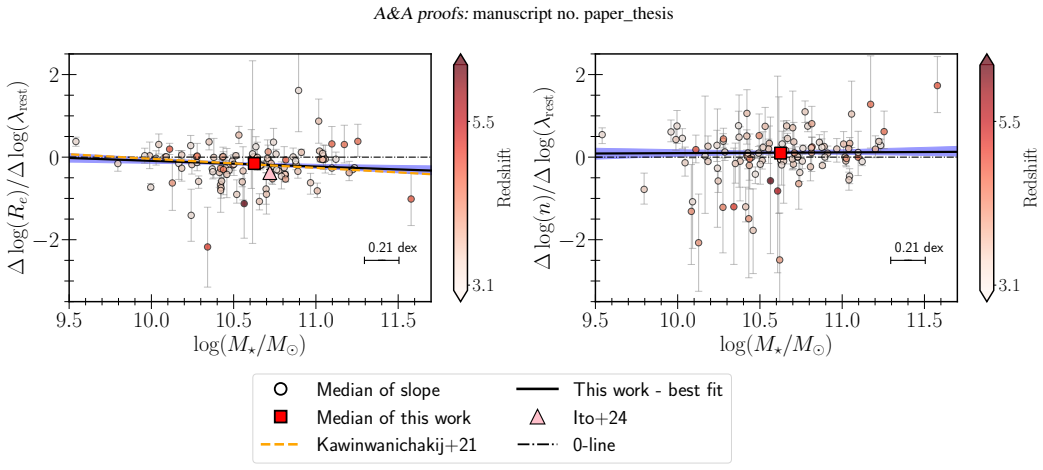
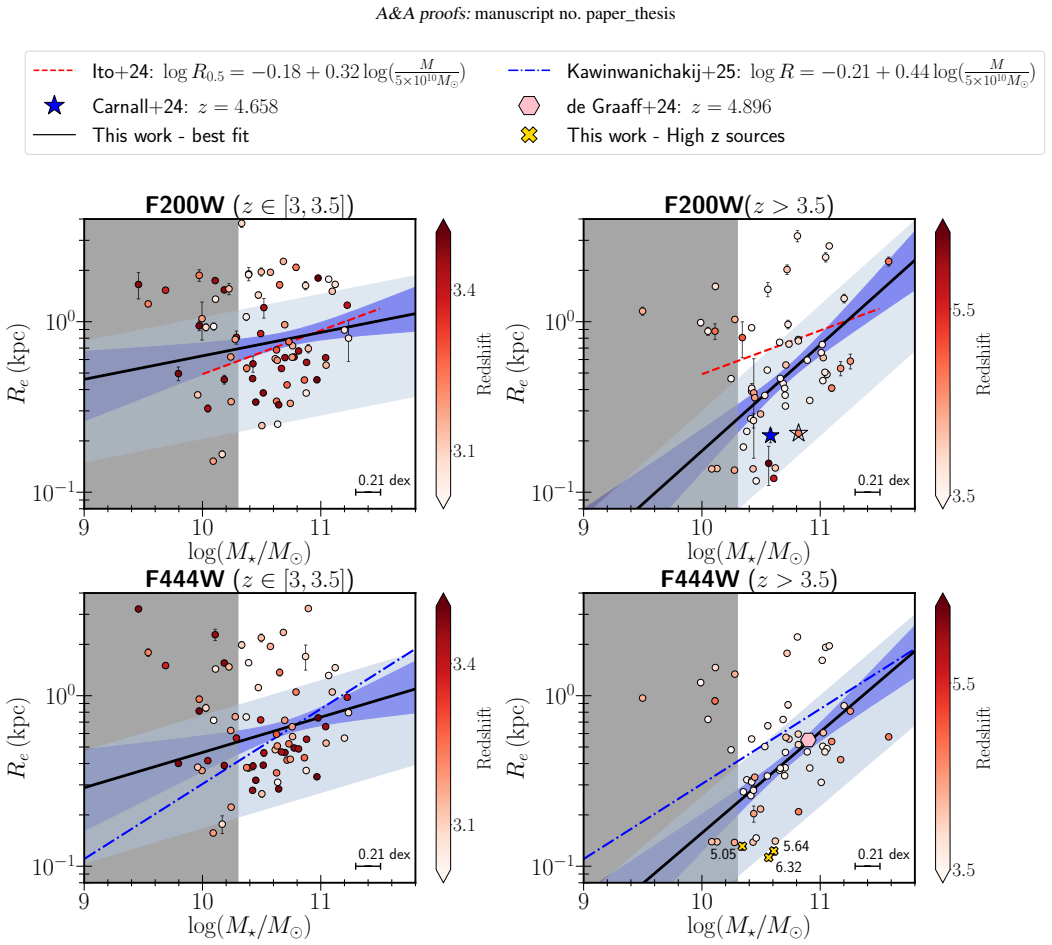
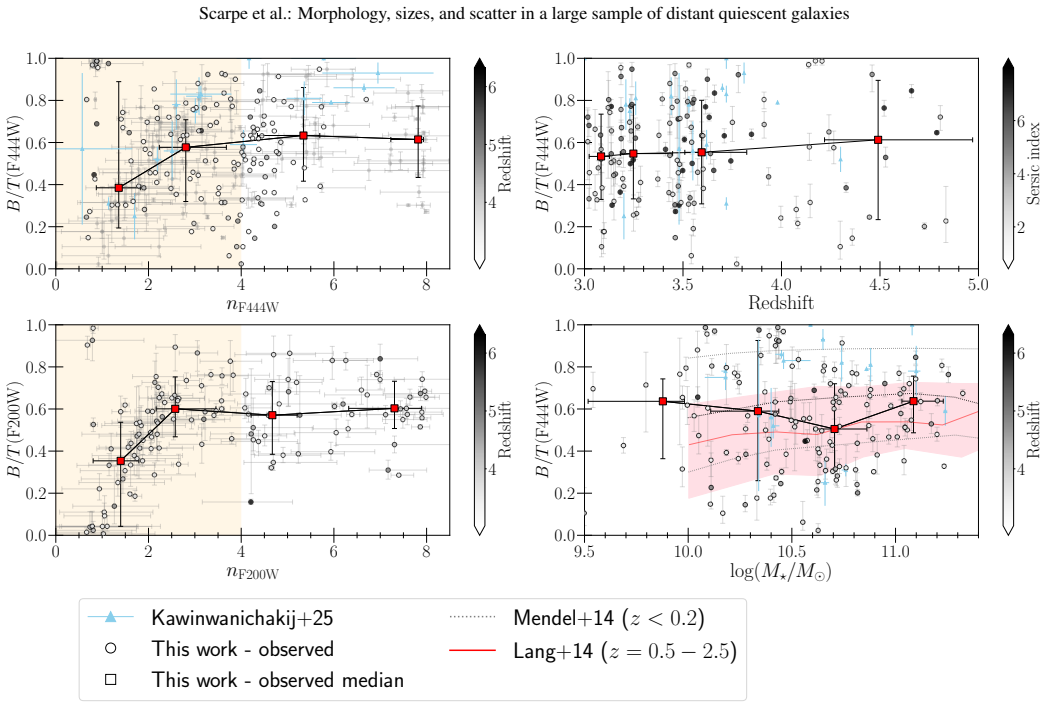
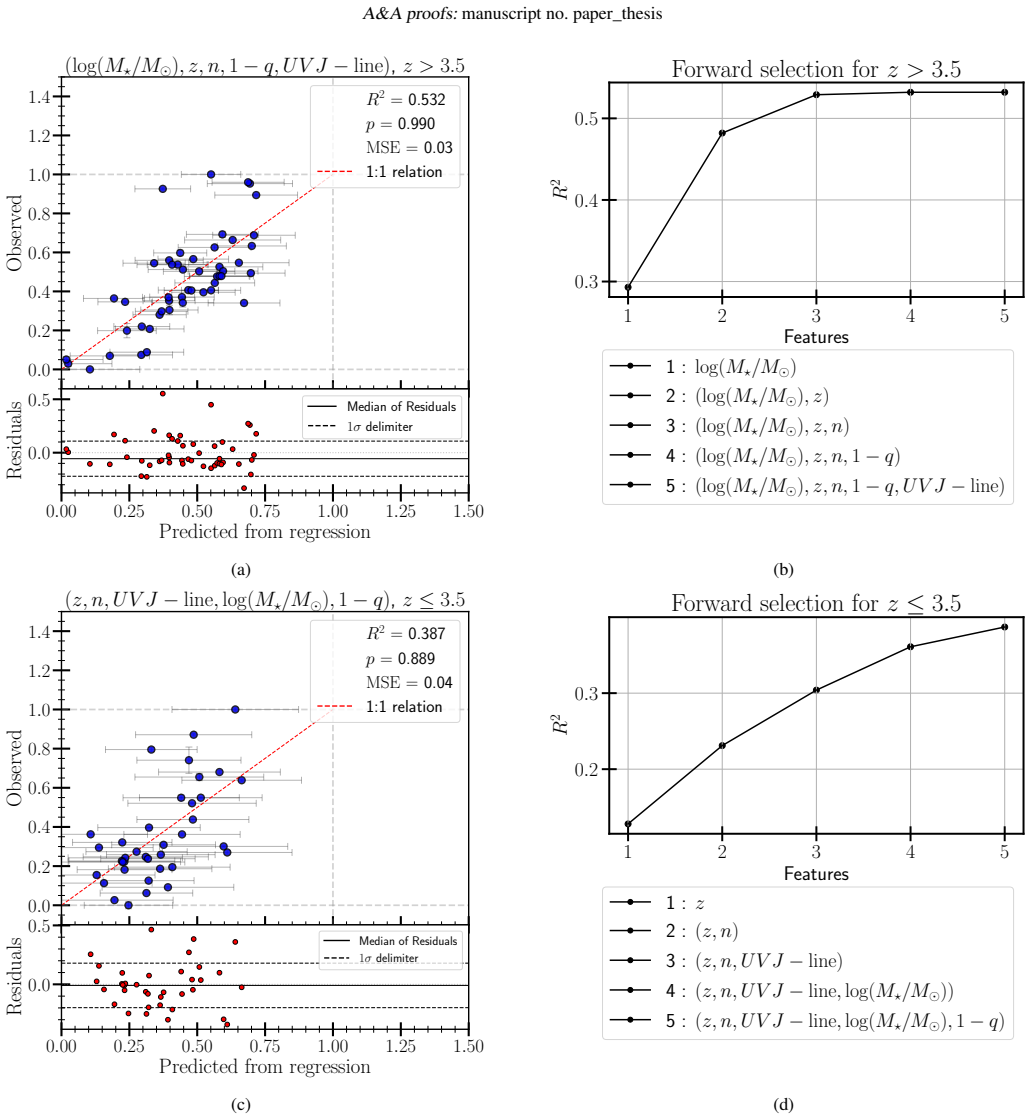
In 137 quiescent candidates at 3<z<7, the size-mass relation is consistent with prior results and extends to z_spec=4.9, with size decreasing at higher redshift. Intrinsic scatter is independent of redshift and filter. Size decreases with wavelength, with the gradient decreasing at higher stellar mass, while Sersic index is wavelength-independent. Forward and backward Bayesian fits show no significant secondary dependence on axis ratio q, Sersic index n, UVJ-colors, or environment, so stellar mass and redshift alone predict size, albeit with large scatter that requires other physical quantities.
What carries the argument
Forward and backward Bayesian fitting applied to the stellar mass-size relation derived from multi-band Sersic modeling to test for secondary parameter dependencies.
If this is right
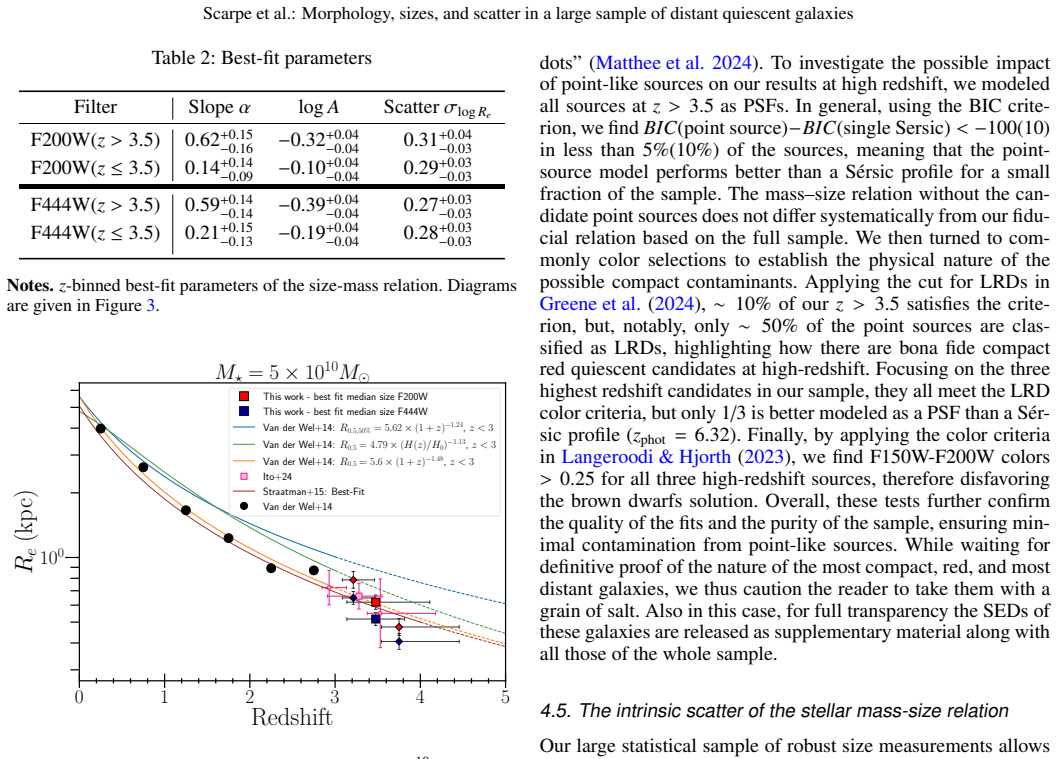
- Size decreases with increasing redshift, extending prior trends to z_spec=4.9.
- Size decreases with increasing observed wavelength, with a steeper gradient at lower stellar mass.
- Sersic index shows no significant dependence on wavelength, independent of stellar mass.
- No significant secondary dependence of size on axis ratio, Sersic index, UVJ-colors, or environment.
- Stellar mass and redshift together predict size, but large intrinsic scatter remains unexplained by Sersic parameters.
Where Pith is reading between the lines
- Merger histories or variations in dark matter halo assembly could be among the additional factors needed to explain the scatter.
- Spectroscopic follow-up on a subset would directly test selection purity and its impact on the measured scatter.
- The wavelength dependence of size points to radial stellar population gradients that may distinguish growth modes.
- Repeating the Bayesian test on lower-mass or higher-redshift samples could show when mass and redshift become dominant predictors.
Load-bearing premise
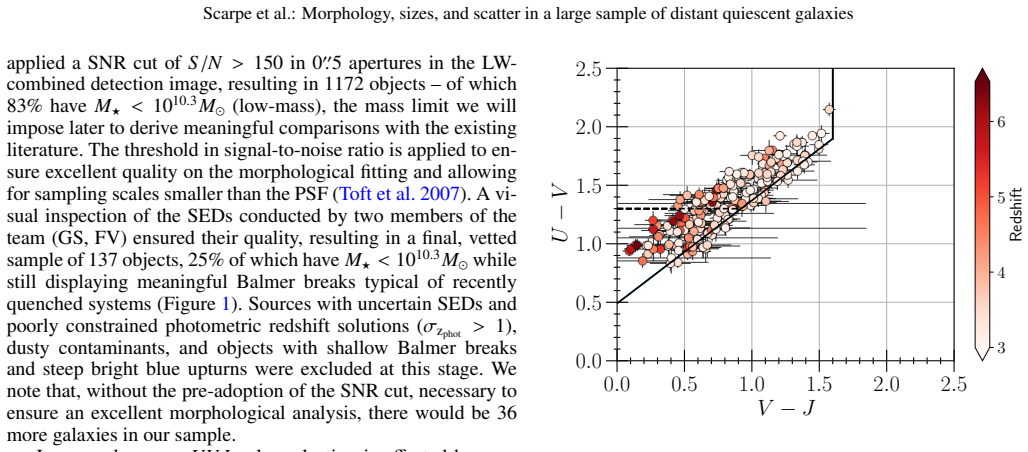
The 137 objects selected by photometric criteria are genuine quiescent galaxies with minimal contamination from dusty star-forming systems.
What would settle it
Spectroscopic confirmation that a substantial fraction of the photometrically selected sample are actually star-forming galaxies would change the reported size trends and scatter values.
Figures
read the original abstract
After quenching galaxies keep growing in size across time, as established in the literature up to cosmic noon. In this work, we assemble one of the largest and most comprehensive multi-wavelength photometric sample of massive quenched galaxies at z > 3, counting 137 quiescent candidates within 825 sq.arcmin and redshift 3<z<7 across the well-studied extragalactic JWST fields. We model their surface brightness distribution across 5 bands mapping their UV-to-NIR rest-frame wavelength with Sersic profiles, and derive their sizes, concentrations, and ellipticities. The size-mass relation is consistent with previous studies. Size decreases with increasing redshift, in agreement with previous studies and extending them up to z_spec=4.9. The intrinsic scatter of the mass-size relation has no relevant dependence on the redshift and the filter used. Our multi-wavelength modeling reveals that size decreases with increasing observed wavelength, and the wavelength gradient decreases with increasing stellar mass. This result proves that in the NIR-bands massive elliptical galaxies appear more compact. The Sersic index does not show significant dependence on wavelength, independently of the stellar mass. Following a forward/backward Bayesian fit analysis to assess the significance of several parameters in predicting the size of our sample, we do not identify any significant secondary dependence of the size on axis ratio q, Sersic index n, UVJ-colors, and environment. The combination of stellar mass and redshift is sufficient to predict the size of quiescent galaxies at z>3, albeit with a large scatter. This suggests that the commonly used parameters of a Sersic distribution cannot explain the large intrinsic scatter around the stellar mass-size relation, suggesting that other physical quantities need to be taken into account to break the degeneracy between evolution paths across the galaxy population.
Editorial analysis
A structured set of objections, weighed in public.
Referee Report
Summary. The paper assembles one of the largest photometric samples of 137 quiescent galaxy candidates at 3<z<7 across JWST fields, fits multi-band Sersic profiles to derive sizes, concentrations and ellipticities, and reports that the size-mass relation is consistent with prior work, that sizes decrease with redshift and observed wavelength (with the gradient weakening at higher mass), and that a Bayesian forward/backward selection finds stellar mass plus redshift sufficient to predict size with no significant secondary dependence on Sersic index n, axis ratio q, UVJ colors or environment. The large intrinsic scatter around the relation is independent of redshift and filter and is not explained by standard Sersic parameters.
Significance. If the photometric quiescent selection is robust and the size measurements are unbiased, the work extends the mass-size relation and its scatter properties to z~5 with a statistically useful sample size, and the finding that commonly used Sersic parameters do not account for the scatter would motivate searches for additional physical drivers of size evolution at early times.
major comments (2)
- [Sample selection] Sample selection (abstract and §2): the central claim that mass + redshift suffice and that no secondary parameters matter rests on the 137 objects being genuine quiescent systems. At z>3 photometric UVJ or similar cuts are known to admit non-negligible contamination from dusty star-formers whose sizes and colors differ systematically; any impurity directly biases the reported intrinsic scatter, wavelength dependence, and the Bayesian predictor selection. A quantitative purity assessment or spectroscopic validation fraction is required.
- [Bayesian analysis] Bayesian forward/backward fit (abstract): the statement that n, q, UVJ and environment show “no significant secondary dependence” requires explicit reporting of the model evidence ratios, prior choices, and how the large intrinsic scatter is propagated into the significance thresholds; without these the conclusion that mass + redshift are sufficient cannot be evaluated.
minor comments (2)
- [Abstract] The abstract states “the intrinsic scatter … has no relevant dependence on the redshift and the filter used” but does not quote the measured scatter values or their uncertainties; these should be tabulated.
- [Methods] Clarify the exact wavelength range and filter set used for the five-band modeling and whether the reported size-wavelength trend is measured at fixed rest-frame or observed-frame wavelengths.
Simulated Author's Rebuttal
We thank the referee for their careful reading and constructive comments. We address the two major points below and will revise the manuscript to strengthen the presentation of sample purity and the Bayesian analysis details.
read point-by-point responses
-
Referee: [Sample selection] Sample selection (abstract and §2): the central claim that mass + redshift suffice and that no secondary parameters matter rests on the 137 objects being genuine quiescent systems. At z>3 photometric UVJ or similar cuts are known to admit non-negligible contamination from dusty star-formers whose sizes and colors differ systematically; any impurity directly biases the reported intrinsic scatter, wavelength dependence, and the Bayesian predictor selection. A quantitative purity assessment or spectroscopic validation fraction is required.
Authors: We agree that quantitative assessment of photometric selection purity is important at z>3. Our UVJ selection follows standard criteria from the literature, but to address this we will add a new paragraph in §2 that provides a quantitative estimate of expected contamination from dusty star-formers, based on recent JWST-specific simulations and studies. We will also report the spectroscopic validation fraction for the subset of sources with available spec-z confirming quiescence. These changes will be incorporated in the revised version. revision: yes
-
Referee: [Bayesian analysis] Bayesian forward/backward fit (abstract): the statement that n, q, UVJ and environment show “no significant secondary dependence” requires explicit reporting of the model evidence ratios, prior choices, and how the large intrinsic scatter is propagated into the significance thresholds; without these the conclusion that mass + redshift are sufficient cannot be evaluated.
Authors: We appreciate the request for additional methodological transparency. In the revised manuscript we will expand the description of the forward/backward Bayesian analysis (in the methods section and/or an appendix) to include the specific prior choices, the computed model evidence ratios (or Bayes factors) for models including versus excluding secondary parameters, and an explicit statement of how the intrinsic scatter enters the significance assessment. This will allow full evaluation of the claim that stellar mass plus redshift suffice. revision: yes
Circularity Check
No circularity: purely empirical observational analysis
full rationale
The paper assembles a photometric sample of 137 z>3 quiescent candidates, fits Sersic profiles across bands to extract sizes/n/q, and applies forward/backward Bayesian regression to test secondary predictors of size. All reported relations (size-mass, size-redshift, wavelength dependence, lack of secondary dependence on n/q/UVJ/environment) are direct statistical outputs from the data and standard modeling; none reduce by the paper's own equations to a fitted parameter renamed as prediction, a self-citation chain, or a self-definitional loop. The central claim that mass+redshift suffice is an empirical finding from the regression, not a tautology. No load-bearing self-citations or imported uniqueness theorems appear in the provided text.
Axiom & Free-Parameter Ledger
axioms (2)
- domain assumption Sersic profiles provide an adequate description of the surface-brightness distribution of high-redshift quiescent galaxies across UV-to-NIR rest-frame wavelengths
- domain assumption Photometric criteria reliably isolate quiescent galaxies with low contamination at 3<z<7
Reference graph
Works this paper leans on
-
[1]
A surprising abundance of massive quiescent galaxies at 3 < z < 5 in the first data from JWST CEERS. , keywords =. doi:10.1093/mnras/stad369 , archivePrefix =. 2208.00986 , primaryClass =
-
[2]
threedhst: 3D-HST grism analysis software
-
[3]
A dominant population of optically invisible massive galaxies in the early Universe. , keywords =. doi:10.1038/s41586-019-1452-4 , archivePrefix =. 1908.02372 , primaryClass =
-
[4]
Quiescent or dusty? Unveiling the nature of extremely red galaxies at z > 3. , keywords =. doi:10.1093/mnras/staf013 , archivePrefix =. 2404.08052 , primaryClass =
-
[5]
Yang, Tiancheng and Wang, Tao and Xu, Ke and Sun, Hanwen and Zhou, Luwenjia and Xie, Lizhi and De Lucia, Gabriella and del P. Lagos, Claudia and Wang, Kai and Fontanot, Fabio and Guo, Qi and Wu, Yuxuan and Lu, Shiying and Chen, Longyue and Hirschmann, Michaela , title =. , abstract =. 2026 , month =. doi:10.3847/2041-8213/ae4803 , url =
-
[6]
A Bending in the Size─Mass Relation of Star-forming Galaxies across 0.5 < z < 6.0 at a Critical Stellar Mass of 10 ^ 10 M _ Revealed by JWST. , keywords =. doi:10.3847/2041-8213/ae5a93 , archivePrefix =. 2603.22239 , primaryClass =
work page internal anchor Pith review Pith/arXiv arXiv doi:10.3847/2041-8213/ae5a93 2041
-
[7]
Pérez-González, Pablo G. and Barro, Guillermo and Annunziatella, Marianna and Costantin, Luca and García-Argumánez, Ángela and McGrath, Elizabeth J. and Mérida, Rosa M. and Zavala, Jorge A. and Arrabal Haro, Pablo and Bagley, Micaela B. and Backhaus, Bren E. and Behroozi, Peter and Bell, Eric F. and Bisigello, Laura and Buat, Véronique and Calabrò, Antone...
-
[8]
unicorn: Full 3D-HST grism pipeline
-
[9]
PRIMER and JADES reveal an abundance of massive quiescent galaxies at 2 < z < 5. arXiv e-prints , keywords =. doi:10.48550/arXiv.2509.06913 , archivePrefix =. 2509.06913 , primaryClass =
-
[10]
Benson, A. J. and Bower, R. G. and Frenk, C. S. and Lacey, C. G. and Baugh, C. M. and Cole, S. , title =. , abstract =. 2003 , month =. doi:10.1086/379160 , url =
-
[11]
Bower, R. G. and Benson, A. J. and Malbon, R. and Helly, J. C. and Frenk, C. S. and Baugh, C. M. and Cole, S. and Lacey, C. G. , title =. , volume =. 2006 , month =. doi:10.1111/j.1365-2966.2006.10519.x , url =
-
[12]
Quenching precedes bulge formation in dense environments but follows it in the field
Euclid Quick Data Release (Q1). Quenching precedes bulge formation in dense environments but follows it in the field. arXiv e-prints , keywords =
-
[13]
George, Angelo and Damjanov, Ivana and Sawicki, Marcin and Williams, Devin J. and Chen, Lingjian and Desprez, Guillaume and Annunziatella, Marianna and Arnouts, Stéphane and Gwyn, Stephen and Marchesini, Danilo and Moutard, Thibaud and Sajina, Anna , title =. The Astrophysical Journal , abstract =. 2025 , month =. doi:10.3847/1538-4357/addc6b , url =
-
[14]
Puskás, Dávid and Tacchella, Sandro and Simmonds, Charlotte and Hainline, Kevin and D’Eugenio, Francesco and Alberts, Stacey and Arribas, Santiago and Baker, William M and Bunker, Andrew J and Carniani, Stefano and Charlot, Stéphane and Duan, Qiao and Eisenstein, Daniel J and Ji, Zhiyuan and Johnson, Benjamin D and Jones, Gareth C and Maiolino, Roberto an...
-
[15]
Cosmic Vine: High abundance of massive galaxies and dark matter halos in a forming cluster at z=3.44. arXiv e-prints , keywords =. doi:10.48550/arXiv.2510.23549 , archivePrefix =. 2510.23549 , primaryClass =
-
[16]
The rest-frame optical sizes of massive galaxies with suppressed star formation at $z\sim4$
The Rest-frame Optical Sizes of Massive Galaxies with Suppressed Star Formation at z 4. , keywords =. doi:10.3847/1538-4357/aae3e8 , archivePrefix =. 1810.00543 , primaryClass =
work page internal anchor Pith review Pith/arXiv arXiv doi:10.3847/1538-4357/aae3e8
-
[17]
COSMOS-DASH: The Evolution of the Galaxy Size-Mass Relation since z 3 from New Wide-field WFC3 Imaging Combined with CANDELS/3D-HST. , keywords =. doi:10.3847/1538-4357/ab290a , archivePrefix =. 1808.04379 , primaryClass =
-
[18]
MAGAZ3NE: High Stellar Velocity Dispersions for Ultramassive Quiescent Galaxies at z 3. , keywords =. doi:10.3847/1538-4357/ac8747 , archivePrefix =. 2208.04329 , primaryClass =
-
[19]
Kakimoto, Takumi and Tanaka, Masayuki and Onodera, Masato and Shimakawa, Rhythm and Wu, Po-Feng and Gould, Katriona M. L. and Ito, Kei and Jin, Shuowen and Kubo, Mariko and Suzuki, Tomoko L. and Toft, Sune and Valentino, Francesco and Yabe, Kiyoto , title =. 2024 , month =. doi:10.3847/1538-4357/ad1ff1 , url =
-
[20]
Antwi-Danso, Jacqueline and Papovich, Casey and Esdaile, James and Nanayakkara, Themiya and Glazebrook, Karl and Hutchison, Taylor A. and Whitaker, Katherine E. and Marsan, Z. Cemile and Diaz, Ruben J. and Marchesini, Danilo and Muzzin, Adam and Tran, Kim-Vy H. and Setton, David J. and Kaushal, Yasha and Speagle, Joshua S. and Cole, Justin , title =. 2024...
-
[21]
Consistent Dynamical and Stellar Masses with Potential Light IMF in Massive Quiescent Galaxies at 3 < z < 4 Using Velocity Dispersions Measurements with MOSFIRE. , keywords =. doi:10.3847/2041-8213/abe11e , archivePrefix =. 2010.09738 , primaryClass =
-
[22]
Stellar Velocity Dispersion of a Massive Quenching Galaxy at z = 4.01. , keywords =. doi:10.3847/2041-8213/ab4ff3 , archivePrefix =. 1909.10721 , primaryClass =
-
[23]
Lustig, Peter and Strazzullo, Veronica and D’Eugenio, Chiara and Daddi, Emanuele and Pannella, Maurilio and Renzini, Alvio and Cimatti, Andrea and Gobat, Raphael and Jin, Shuowen and Mohr, Joseph J and Onodera, Masato , title =. , volume =. 2020 , month =. doi:10.1093/mnras/staa3766 , url =
-
[24]
2003, PASP, 115, 763, doi: 10.1086/376392
Chabrier, Gilles , title =. , abstract =. 2003 , month =. doi:10.1086/376392 , url =
work page internal anchor Pith review doi:10.1086/376392 2003
-
[25]
A recently quenched galaxy 700 million years after the Big Bang. , keywords =. doi:10.1038/s41586-024-07227-0 , archivePrefix =. 2302.14155 , primaryClass =
-
[26]
2024 , eprint=
Efficient formation of a massive quiescent galaxy at redshift 4.9 , author=. 2024 , eprint=
2024
-
[27]
JWST/NIRSpec spectroscopy of intermediate-mass quiescent galaxies at z 3-4. , keywords =. doi:10.1093/mnras/stae2300 , archivePrefix =. 2410.08745 , primaryClass =
-
[28]
and Conroy, Charlie and Johnson, Benjamin D
Byler, Nell and Dalcanton, Julianne J. and Conroy, Charlie and Johnson, Benjamin D. and Levesque, Emily M. and Berg, Danielle A. , title =. , abstract =. 2018 , month =. doi:10.3847/1538-4357/aacd50 , url =
-
[29]
The Propagation of Uncertainties in Stellar Population Synthesis Modeling. III. Model Calibration, Comparison, and Evaluation. , keywords =. doi:10.1088/0004-637X/712/2/833 , archivePrefix =. 0911.3151 , primaryClass =
work page internal anchor Pith review Pith/arXiv arXiv doi:10.1088/0004-637x/712/2/833
-
[30]
The Dust Attenuation Law in Distant Galaxies: Evidence for Variation with Spectral Type
The Dust Attenuation Law in Distant Galaxies: Evidence for Variation with Spectral Type. , keywords =. doi:10.1088/2041-8205/775/1/L16 , archivePrefix =. 1308.1099 , primaryClass =
work page internal anchor Pith review Pith/arXiv arXiv doi:10.1088/2041-8205/775/1/l16 2041
-
[31]
Newly-quenched galaxies as the cause for the apparent evolution in average size of the population
Newly Quenched Galaxies as the Cause for the Apparent Evolution in Average Size of the Population. , keywords =. doi:10.1088/0004-637X/773/2/112 , archivePrefix =. 1302.5115 , primaryClass =
work page internal anchor Pith review Pith/arXiv arXiv doi:10.1088/0004-637x/773/2/112
-
[32]
CANDELS: The progenitors of compact quiescent galaxies at z~2
CANDELS: The Progenitors of Compact Quiescent Galaxies at z -0.5ex 2. , keywords =. doi:10.1088/0004-637X/765/2/104 , archivePrefix =. 1206.5000 , primaryClass =
work page internal anchor Pith review Pith/arXiv arXiv doi:10.1088/0004-637x/765/2/104
-
[33]
The Relation Between Compact, Quiescent High-redshift Galaxies and Massive Nearby Elliptical Galaxies: Evidence for Hierarchical, Inside-Out Growth. , keywords =. doi:10.1088/0004-637X/697/2/1290 , archivePrefix =. 0903.2044 , primaryClass =
work page internal anchor Pith review Pith/arXiv arXiv doi:10.1088/0004-637x/697/2/1290 2044
-
[34]
Suess, Katherine A. and Williams, Christina C. and Robertson, Brant and Ji, Zhiyuan and Johnson, Benjamin D. and Nelson, Erica and Alberts, Stacey and Hainline, Kevin and D’Eugenio, Francesco and Übler, Hannah and Rieke, Marcia and Rieke, George and Bunker, Andrew J. and Carniani, Stefano and Charlot, Stephane and Eisenstein, Daniel J. and Maiolino, Rober...
-
[35]
Minor mergers and the size evolution of elliptical galaxies
Minor Mergers and the Size Evolution of Elliptical Galaxies. , keywords =. doi:10.1088/0004-637X/699/2/L178 , archivePrefix =. 0903.1636 , primaryClass =
work page internal anchor Pith review Pith/arXiv arXiv doi:10.1088/0004-637x/699/2/l178
-
[36]
A merging pair of massive quiescent galaxies at z = 3.44 in the Cosmic Vine. , keywords =. doi:10.1051/0004-6361/202453211 , archivePrefix =. 2503.01953 , primaryClass =
-
[37]
Black hole mass of a quiescent galaxy hosting a Type 1 AGN at z = 2.09: implications for black hole-galaxy coevolution and AGN quenching at high redshift. , keywords =. doi:10.1093/mnras/staf372 , archivePrefix =. 2408.08492 , primaryClass =
-
[38]
Feeding the dead: neutral gas inflow with suppressed star formation in a long-quenched ancient massive galaxy at z -0.5ex 2.7 observed with JWST/NIRSpec. arXiv e-prints , keywords =. doi:10.48550/arXiv.2510.11455 , archivePrefix =. 2510.11455 , primaryClass =
-
[39]
On the origin of star formation quenching in massive galaxies at z 3 in the cosmological simulations IllustrisTNG. , keywords =. doi:10.1093/mnras/stae2297 , archivePrefix =. 2310.03083 , primaryClass =
-
[40]
The Astrophysical Journal , abstract =
Stone, Connor and Courteau, Stéphane and Arora, Nikhil , title =. The Astrophysical Journal , abstract =. 2021 , month =. doi:10.3847/1538-4357/abebe4 , url =
-
[41]
Schreiber, C. and Glazebrook, K. and Nanayakkara, T. and Kacprzak, G. G. and Labbé, I. and Oesch, P. and Yuan, T. and Tran, K.-V. and Papovich, C. and Spitler, L. and Straatman, C. , year=. Near infrared spectroscopy and star-formation histories of 3 ≤ z ≤ 4 quiescent galaxies , volume=. doi:10.1051/0004-6361/201833070 , journal=
-
[42]
RUBIES: A complete census of the bright and red distant Universe with JWST/NIRSpec , DOI= "10.1051/0004-6361/202452186", url= "https://doi.org/10.1051/0004-6361/202452186", journal =
-
[43]
Little Red Dots: An Abundant Population of Faint Active Galactic Nuclei at z 5 Revealed by the EIGER and FRESCO JWST Surveys. , keywords =. doi:10.3847/1538-4357/ad2345 , archivePrefix =. 2306.05448 , primaryClass =
-
[44]
Toft, S. and van Dokkum, P. and Franx, M. and Labbe, I. and Forster Schreiber, N. M. and Wuyts, S. and Webb, T. and Rudnick, G. and Zirm, A. and Kriek, M. and van der Werf, P. and Blakeslee, J. P. and Illingworth, G. and Rix, H.‐W. and Papovich, C. and Moorwood, A. , year=. Hubble Space TelescopeandSpitzerImaging of Red and Blue Galaxies atz∼ 2.5: A Corre...
-
[45]
A catalog of bulge, disk, and total stellar mass estimates for the Sloan Digital Sky Survey
A Catalog of Bulge, Disk, and Total Stellar Mass Estimates for the Sloan Digital Sky Survey. , keywords =. doi:10.1088/0067-0049/210/1/3 , archivePrefix =. 1310.8304 , primaryClass =
work page internal anchor Pith review Pith/arXiv arXiv doi:10.1088/0067-0049/210/1/3
-
[46]
Bulge Growth and Quenching since z = 2.5 in CANDELS/3D-HST
Bulge Growth and Quenching since z = 2.5 in CANDELS/3D-HST. , keywords =. doi:10.1088/0004-637X/788/1/11 , archivePrefix =. 1402.0866 , primaryClass =
work page internal anchor Pith review Pith/arXiv arXiv doi:10.1088/0004-637x/788/1/11
-
[47]
Straatman, Caroline M. S. and Labbé, Ivo and Spitler, Lee R. and Glazebrook, Karl and Tomczak, Adam and Allen, Rebecca and Brammer, Gabriel B. and Cowley, Michael and Dokkum, Pieter van and Kacprzak, Glenn G. and Kawinwanichakij, Lalit and Mehrtens, Nicola and Nanayakkara, Themiya and Papovich, Casey and Persson, S. Eric and Quadri, Ryan F. and Rees, Glen...
-
[48]
Hamadouche, M L and McLure, R J and Carnall, A C and McLeod, D J and Dunlop, J S and Whitaker, K E and Donnan, C T and Begley, R and Stanton, T M and Almaini, O and Aird, J and Cullen, F and Cutler, S and Grogin, N A and Koekemoer, A M , title =. , volume =. 2025 , month =. doi:10.1093/mnras/staf971 , url =
-
[49]
The ALMaQUEST survey IX: the nature of the resolved star forming main sequence. , keywords =. doi:10.1093/mnras/stab3672 , archivePrefix =. 2201.03592 , primaryClass =
-
[50]
Are galactic star formation and quenching governed by local, global, or environmental phenomena?. , keywords =. doi:10.1093/mnras/stz3264 , archivePrefix =. 1911.08857 , primaryClass =
-
[51]
Fast rotators at cosmic noon: Stellar kinematics for 15 quiescent galaxies from JWST-SUSPENSE. , keywords =. doi:10.1051/0004-6361/202555812 , archivePrefix =. 2506.04310 , primaryClass =
-
[52]
A massive, dead disk galaxy in the early Universe
A massive, dead disk galaxy in the early Universe. , keywords =. doi:10.1038/nature22388 , archivePrefix =. 1706.07030 , primaryClass =
work page internal anchor Pith review Pith/arXiv arXiv doi:10.1038/nature22388
-
[53]
The cosmological size and velocity dispersion evolution of massive early-type galaxies
The Cosmological Size and Velocity Dispersion Evolution of Massive Early-type Galaxies. , keywords =. doi:10.1088/0004-637X/744/1/63 , archivePrefix =. 1106.5490 , primaryClass =
work page internal anchor Pith review Pith/arXiv arXiv doi:10.1088/0004-637x/744/1/63
-
[54]
Zapped then napped? A rapidly quenched remnant leaker candidate with a steep spectroscopic _ UV slope at z = 8.5. , keywords =. doi:10.1051/0004-6361/202553766 , archivePrefix =. 2501.09070 , primaryClass =
-
[55]
JADES: Rest-frame UV-to-NIR Size Evolution of Massive Quiescent Galaxies from Redshift z = 5 to z = 0.5. , keywords =. doi:10.3847/1538-4357/ae3b2a , archivePrefix =. 2401.00934 , primaryClass =
-
[56]
Simulating JWST deep extragalactic imaging surveys and physical parameter recovery , DOI= "10.1051/0004-6361/202037450", url= "https://doi.org/10.1051/0004-6361/202037450", journal =
-
[57]
Cassata, P. and Giavalisco, M. and Williams, C. C. and Guo, Yicheng and Lee, Bomee and Renzini, A. and Ferguson, H. and Faber, S. F. and Barro, G. and McIntosh, D. H. and Lu, Yu and Bell, E. F. and Koo, D. C. and Papovich, C. J. and Ryan, R. E. and Conselice, C. J. and Grogin, N. and Koekemoer, A. and Hathi, N. P. , title =. , abstract =. 2013 , month =. ...
-
[58]
and Rudnick, Gregory and Barden, Marco and Franx, Marijn and Rix, Hans-Walter and Caldwell, J
Trujillo, Ignacio and Förster Schreiber, Natascha M. and Rudnick, Gregory and Barden, Marco and Franx, Marijn and Rix, Hans-Walter and Caldwell, J. A. R. and McIntosh, Daniel H. and Toft, Sune and Häussler, Boris and Zirm, Andrew and van Dokkum, Pieter G. and Labbé, Ivo and Moorwood, Alan and Röttgering, Huub and van der Wel, Arjen and van der Werf, Paul ...
-
[59]
Passively Evolving Early-type Galaxies at 1.4<z<2.5 in the Hubble Ultra Deep Field
Passively Evolving Early-Type Galaxies at 1.4 < -0.5ex z < -0.5ex 2.5 in the Hubble Ultra Deep Field. , keywords =. doi:10.1086/430104 , archivePrefix =. astro-ph/0503102 , primaryClass =
work page internal anchor Pith review Pith/arXiv arXiv doi:10.1086/430104
-
[60]
Nipoti, Carlo and Treu, Tommaso and Leauthaud, Alexie and Bundy, Kevin and Newman, Andrew B. and Auger, Matthew W. , title =. Monthly Notices of the Royal Astronomical Society , volume =. 2012 , month =. doi:10.1111/j.1365-2966.2012.20749.x , url =
-
[61]
The Massive Ancient Galaxies at z > 3 NEar-infrared (MAGAZ3NE) Survey: Confirmation of Extremely Rapid Star Formation and Quenching Timescales for Massive Galaxies in the Early Universe. , keywords =. doi:10.3847/1538-4357/abb819 , archivePrefix =. 2009.07281 , primaryClass =
-
[62]
Quiescent Galaxies 1.5 Billion Years after the Big Bang and Their Progenitors. , keywords =. doi:10.3847/1538-4357/ab64dc , archivePrefix =. 1909.10540 , primaryClass =
-
[63]
A massive, quiescent galaxy at redshift of z=3.717
A massive, quiescent galaxy at a redshift of 3.717. , keywords =. doi:10.1038/nature21680 , archivePrefix =. 1702.01751 , primaryClass =
work page internal anchor Pith review Pith/arXiv arXiv doi:10.1038/nature21680
-
[64]
Cosmic quenching. arXiv e-prints , keywords =. doi:10.48550/arXiv.2502.01724 , archivePrefix =. 2502.01724 , primaryClass =
-
[66]
Identification of galaxies that experienced a recent major drop of star formation
Identification of galaxies that experienced a recent major drop of star formation. , keywords =. doi:10.1051/0004-6361/201832715 , archivePrefix =. 1803.10239 , primaryClass =
work page internal anchor Pith review Pith/arXiv arXiv doi:10.1051/0004-6361/201832715
-
[67]
MISTRAL: a model for AGN winds from radiatively efficient accretion in cosmological simulations. , keywords =. doi:10.1093/mnras/staf1464 , archivePrefix =. 2504.08041 , primaryClass =
-
[68]
A Proposed Revision of the Hubble Sequence for Elliptical Galaxies. , keywords =. doi:10.1086/310095 , adsurl =
-
[69]
Little Red Dots or Brown Dwarfs? NIRSpec Discovery of Three Distant Brown Dwarfs Masquerading as NIRCam-selected Highly Reddened Active Galactic Nuclei. , keywords =. doi:10.3847/2041-8213/acfeec , archivePrefix =. 2308.10900 , primaryClass =
-
[70]
emcee: The MCMC Hammer. , keywords =. doi:10.1086/670067 , archivePrefix =. 1202.3665 , primaryClass =
work page internal anchor Pith review Pith/arXiv arXiv doi:10.1086/670067
-
[71]
and Kawinwanichakij, Lalitwadee and Kimmig, Lucas C
Nanayakkara, Themiya and Glazebrook, Karl and Schreiber, Corentin and Chittenden, Harry and Brammer, Gabriel and Esdaile, James and Jacobs, Colin and Kacprzak, Glenn G. and Kawinwanichakij, Lalitwadee and Kimmig, Lucas C. and Labbe, Ivo and Lagos, Claudia and Marchesini, Danilo and Martìnez-Marìn, M. and Marsan, Z. Cemile and Oesch, Pascal A. and Papovich...
-
[72]
Weibel, Andrea and de Graaff, Anna and Setton, David J. and Miller, Tim B. and Oesch, Pascal A. and Brammer, Gabriel and Lagos, Claudia D. P. and Whitaker, Katherine E. and Williams, Christina C. and Baggen, Josephine F.W. and Bezanson, Rachel and Boogaard, Leindert A. and Cleri, Nikko J. and Greene, Jenny E. and Hirschmann, Michaela and Hviding, Raphael ...
-
[73]
Detailed Structural Decomposition of Galaxy Images
Detailed Structural Decomposition of Galaxy Images. Astronomical Journal , keywords =. doi:10.1086/340952 , archivePrefix =. astro-ph/0204182 , primaryClass =
work page internal anchor Pith review Pith/arXiv arXiv doi:10.1086/340952
-
[74]
The Journal of Open Source Software , keywords =
pysersic: A Python package for determining galaxy structural properties via Bayesian inference, accelerated with jax. The Journal of Open Source Software , keywords =. doi:10.21105/joss.05703 , archivePrefix =. 2306.05454 , primaryClass =
-
[75]
Analytical properties of the R^(1/m) luminosity law
Analytical properties of the R ^ 1/m law. , keywords =. doi:10.48550/arXiv.astro-ph/9911078 , archivePrefix =. astro-ph/9911078 , primaryClass =
work page internal anchor Pith review Pith/arXiv arXiv doi:10.48550/arxiv.astro-ph/9911078
-
[76]
Detailed Decomposition of Galaxy Images. II. Beyond Axisymmetric Models. Astronomical Journal , keywords =. doi:10.1088/0004-6256/139/6/2097 , archivePrefix =. 0912.0731 , primaryClass =
work page internal anchor Pith review Pith/arXiv arXiv doi:10.1088/0004-6256/139/6/2097 2097
-
[77]
3D-HST+CANDELS: The Evolution of the Galaxy Size-Mass Distribution since $z=3$
3D-HST+CANDELS: The Evolution of the Galaxy Size-Mass Distribution since z = 3. , keywords =. doi:10.1088/0004-637X/788/1/28 , archivePrefix =. 1404.2844 , primaryClass =
work page internal anchor Pith review Pith/arXiv arXiv doi:10.1088/0004-637x/788/1/28
-
[78]
UNCOVER Spectroscopy Confirms the Surprising Ubiquity of Active Galactic Nuclei in Red Sources at z > 5. , keywords =. doi:10.3847/1538-4357/ad1e5f , archivePrefix =. 2309.05714 , primaryClass =
-
[79]
A Census of Photometrically Selected Little Red Dots at 4 < z < 9 in JWST Blank Fields. , keywords =. doi:10.3847/1538-4357/ad4265 , archivePrefix =. 2401.09981 , primaryClass =
-
[80]
2024b, ApJ, 975, 178, doi: 10.3847/1538-4357/ad7d03
Silencing the Giant: Evidence of Active Galactic Nucleus Feedback and Quenching in a Little Red Dot at z = 4.13. , keywords =. doi:10.3847/1538-4357/ad7d03 , archivePrefix =. 2407.20320 , primaryClass =
-
[81]
Weaver, J. R. and Davidzon, I. and Toft, S. and Ilbert, O. and McCracken, H. J. and Gould, K. M. L. and Jespersen, C. K. and Steinhardt, C. and Lagos, C. D. P. and Capak, P. L. and Casey, C. M. and Chartab, N. and Faisst, A. L. and Hayward, C. C. and Kartaltepe, J. S. and Kauffmann, O. B. and Koekemoer, A. M. and Kokorev, V. and Laigle, C. and Liu, D. and...
discussion (0)
Sign in with ORCID, Apple, or X to comment. Anyone can read and Pith papers without signing in.