REVIEW 3 major objections 4 minor 121 references
Learning Representations and Agents for Information Retrieval
T0 review · 3 major / 4 minor · reviewed 2026-08-14 · deepseek-v4-flash
Pith's one-line read This dissertation argues that retrieval, not parametric memory, should carry question answering, and shows that two neural components—document expansion by predicted queries and a BERT re-ranker—combine to roughly double the effectiveness…
desk verdict A solid dissertation that assembles the author's earlier peer-reviewed work; the headline doubling claim is credible on MS MARCO but the TREC-CAR half has an unverified pretraining step worth chasing. read the letter →
The pith
A machine-rendered reading of the paper's core claim, the machinery that carries it, and where it could break.
The reading
What carries the argument
The load-bearing machinery is an asymmetry: enrich the document before the index lookup, then re-rank after it. Doc2query is a Transformer sequence-to-sequence model (six encoder and six decoder layers, 512 hidden units) trained to output the query a user would ask for a given passage; top-k random sampling produces ten queries per document, and those strings are concatenated to the document before BM25 indexing. The re-ranker is BERT-large, a pretrained language model fine-tuned to output a relevance probability from the [CLS] vector for the concatenation of query and passage. The mechanism that carries the argument is that predicted queries both copy terms from the document, re-weighting them, and introduce unseen terms, acting as synonym expansion; the two effects are shown to be complementary, and the combined pipeline is where the doubling occurs.
What would settle it
Run the exact BM25+Doc2query+BERT pipeline on a corpus whose queries come from a different domain and query style than MS MARCO (for example, TREC Robust or a medical search collection) without retraining the expansion model, and compare against BM25+BERT. If the relative gain from Doc2query falls well below the roughly 15% reported, or if classical query expansion matches or beats it on that corpus, the transfer and additivity claims are settled the other way.
Extended reading notes
Core claim
The central discovery is that the two bottlenecks of a search engine—the match between query and document vocabulary, and the ordering of retrieved candidates—can be attacked separately and the gains add up. Doc2query is a sequence-to-sequence Transformer trained on MS MARCO's real-user query-passage pairs; at index time it generates ten predicted queries per document, which are appended to the document text and indexed with BM25 as usual. On its own this raises retrieval effectiveness by roughly 15% relative to BM25, largely by improving Recall@1000 so the re-ranker has better candidates. The BERT-large re-ranker, fed the query as sentence A and the passage as sentence B, then reorders the candidates. The paper reports MRR@10 (mean reciprocal rank of the top ten results) on MS MARCO dev rising from 18.4 (BM25) to 37.5 (BM25+Doc2query+BERT), and MAP (mean average precision) on TREC-CAR test rising from 15.3 to 36.5, and interprets this as evidence that the two improvements are orthogonal.
Load-bearing premise
The doubling result rests on the assumption that a model trained to guess what queries people would ask for a passage, using MS MARCO's query-passage pairs, will produce useful guesses for the whole MS MARCO corpus and for the different TREC-CAR corpus.
Editorial extensions
If this is right
- Existing BM25 search systems can be upgraded to roughly double effectiveness without replacing the underlying index or retrieval algorithm.
- Most of the neural computation moves offline to indexing time, so query-time latency stays near classical BM25 unless the optional re-ranker is also used.
- The gains from document expansion and neural re-ranking are additive, so the two components can be deployed independently or together.
- A model trained on MS MARCO query-passage pairs transfers to TREC-CAR, suggesting the expansion method is not tied to a single corpus or query style.
- On these precision-oriented benchmarks, document expansion outperforms classical query expansion (RM3), because documents carry more terms to exploit.
Reading between the lines
- If the transfer assumption holds beyond encyclopedic text, Doc2query-style expansion could be applied to specialized search domains (medicine, law, product support) where vocabulary mismatch is most damaging, as long as a modest set of query-document pairs exists.
- A testable extension is to make the number of appended queries per document corpus-dependent; the paper observes a peak around ten queries, but the optimum likely varies with document length and term diversity.
- The doubling result weakens the case for end-to-end parametric question answering: if an enriched index plus a re-ranker retrieves this well, future QA systems could reserve their parameters for answer synthesis rather than memory.
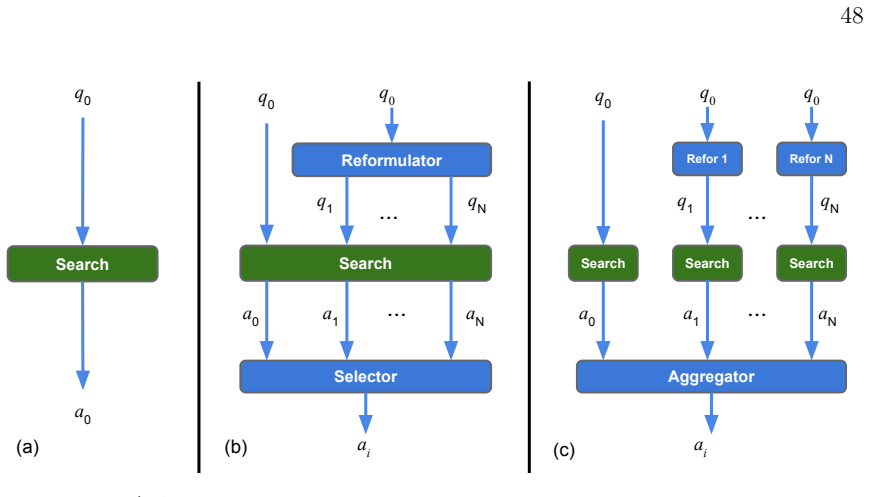
- The multi-agent reformulation results suggest diversity among reinforcement-learned policies is itself a resource; an aggregator could be trained to exploit it in other interactive retrieval settings, such as conversational search.
Signed reviews
Editorial analysis
A structured set of objections, weighed in public.
Referee Report
Summary. This dissertation develops learned components for information retrieval systems. Chapter 2 proposes a goal-driven web navigation agent (NeuAgent) that searches a graph of Wikipedia pages by following hyperlinks, trained with supervised learning and fine-tuned with Q-learning; it is evaluated on WikiNav and WikiNav-Jeopardy and compared against BM25, Lucene, Google Search, and human volunteers. Chapter 3 frames query reformulation as a reinforcement learning problem, introducing term-selection and sequential reformulators (RL-CNN, RL-RNN, RL-RNN-SEQ) and a multi-agent extension with sub-agents and a learned aggregator; these are evaluated on TREC-CAR, Jeopardy, MS Academic, and SearchQA. Chapter 4 introduces two components inside the search pipeline: a BERT-based passage re-ranker and a Doc2query document expansion method that appends predicted queries to documents before indexing. Table 4.2 reports that BM25 plus Doc2query plus BERT improves MS MARCO dev MRR@10 from 18.4 to 37.5 and TREC-CAR test MAP from 15.3 to 36.5, which is the basis for the abstract's claim that the combined methods can double the retrieval effectiveness of an off-the-shelf search engine.
Significance. If the empirical claims hold, the Chapter 4 pipeline is a substantial practical contribution: it shows that a modular combination of an inverted index, document expansion, and a pretrained transformer re-ranker can roughly double BM25 effectiveness on two public benchmarks, and it verifies that the two components are complementary rather than redundant. The Doc2query method is notable because it shifts neural inference cost from query time to indexing time and improves retrieval even without a neural re-ranker. The Chapter 3 multi-agent reformulation framework is also valuable: it demonstrates a simple parallelization strategy for RL-based query reformulation and provides evidence that diversity among reformulations is correlated with effectiveness. The dissertation is largely built on the author's own peer-reviewed publications, but the manuscript includes public benchmark evaluations, significance tests, and links to code repositories, which strengthen reproducibility. The main weakness is the unverifiable BERT pretraining claim for TREC-CAR and several underdocumented training details, which are load-bearing for the two-dataset state-of-the-art claim.
major comments (3)
- [Section 4.1.3 and Appendix A] The TREC-CAR results in Tables 4.1 and 4.2 depend entirely on the assertion that the BERT re-ranker was pretrained only on the half of Wikipedia used by TREC-CAR's training set, in order to avoid test-data leakage from the official full-Wikipedia BERT checkpoint. The manuscript provides no details of this pretraining: no data split description, tokenization or sequence-length settings, number of training steps, hardware configuration, or checkpoint link. Appendix A only links to the fine-tuning repository. As written, a reader cannot rule out the possibility that the official BERT-large checkpoint (which saw the full Wikipedia) was used, in which case the TREC-CAR numbers would be contaminated by test-set leakage. Please provide the pretraining script and data split and release the pretrained checkpoint, or else rerun TREC-CAR experiments with the official checkpoint and report the difference.
- [Section 4.2.2 and Section 4.2.4] The manuscript does not state which dataset is used to train the Doc2query model for the TREC-CAR experiments. Section 4.2.2 says only that a sequence-to-sequence Transformer is trained on query-relevant document pairs, while Section 4.2.6 refers to a model 'trained on MS MARCO.' If the TREC-CAR numbers were obtained by applying an MS MARCO-trained model to Wikipedia without adaptation, the transfer assumption is unexamined and should be discussed; if a TREC-CAR-trained model was used instead, that should be stated explicitly. This detail is needed to interpret the ~15% improvement from Doc2query in Table 4.2 and to reproduce the result.
- [Section 3.3.4 and Table 3.3] The RL-Oracle is described as a 'conservative upper-bound effectiveness' for the RL models, but the procedure trains a model on each small validation or test subset until it overfits and then averages the resulting rewards. This is an in-sample, optimistic estimate, not a conservative upper bound in any formal sense. The reported gap between RL-RNN and RL-Oracle therefore does not by itself establish that there is 'large room for improvement,' because the oracle had access to the same examples on which it was evaluated. Please reframe the oracle analysis as a diagnostic heuristic or compute a genuinely held-out estimate.
minor comments (4)
- [Section 2.4 and Table 2.4] The human evaluation involved only five volunteers and up to twenty queries per condition; the statement that 'humans generally performed worse than the NeuAgents' should be presented as anecdotal rather than as a robust comparative result.
- [Figure 4.1] The text says that a BERT-large trained on 100k pairs uses 'less than 0.3% of the MS MARCO training data,' but Section 4.1.2 describes the training set as containing approximately 500k query-passage pairs; the denominator should be defined.
- [Section 2.5.1 and Figure 2.3] There are typographical errors, including 'Kentuchy Derby' in Figure 2.3 and 'assigned the to most relevant words' in the discussion of attention weights; these should be corrected.
- [Table 4.2] The 'Retrieval Time' column reports 3400–3500 ms/query for BERT-based methods, but the footnote says TPUs are used; please clarify whether this is single-query latency or an amortized batch latency, since the comparison with Duet v2's 650 ms/query is otherwise difficult to interpret.
Circularity Check
No significant circularity: the central results are external measurements against baselines, and the thesis's self-citations are not load-bearing.
full rationale
This is an experimental systems thesis. Each chapter makes a measured claim against external baselines. In Chapter 4, the 'doubling' claim is a comparison in Table 4.2: BM25 18.4 MRR@10 on MS MARCO dev versus 37.5 for BM25+Doc2query+BERT, and 15.3 versus 36.5 MAP on TREC-CAR. Doc2query is trained with a sequence-to-sequence Transformer on MS MARCO query-passage training pairs (Section 4.2.2) and evaluated on the MS MARCO dev set and TREC-CAR test set; the evaluation metric is not used to construct the training labels or the predicted queries. BERT is fine-tuned with the cross-entropy loss in Equation 4.1 on labeled training pairs, not on the dev/test metric. In Chapter 3, the RL reformulator optimizes retrieval effectiveness as a reward, but the reported results are on held-out test sets and are compared with PRF and supervised baselines; no fitted constant is renamed as a 'prediction.' In Chapter 2, the navigation agent is trained on shortest-path supervision and fine-tuned with a binary reward, and it is evaluated against Lucene/BM25, SimpleSearch, and Google on Jeopardy-derived held-out queries. The thesis cites the author's own prior papers, but those citations are not used as a uniqueness theorem and do not justify an ansatz; the experiments are reported directly in the manuscript. The only notable concern is Section 4.1.3, where the author asserts BERT was pretrained only on the half of Wikipedia used by TREC-CAR's training set to avoid test-data leakage, without providing a pretraining script or checkpoint. If this assertion is false, the TREC-CAR numbers would be contaminated. That is a reproducibility and validity risk, not circularity: BERT's pretraining objective is language modeling, and the TREC-CAR MAP metric is not an input to that pretraining. No step in the paper defines a predicted quantity in terms of the target metric or imports a conclusion solely from a self-citation. Score 0.
Assumptions & free parameters
free parameters (9)
- N_n (max explored edges per node) =
4
- N_h (max hops) =
4, 8, 16
- N_q (query size in sentences) =
1, 2, 4
- Candidate term counts for RL reformulation (M, K) =
M=300, K=7
- PRF and RM3 hyperparameters =
N=300, K=9, lambda=0.65, u=1500
- Entropy regularization coefficient (lambda) =
1e-3 for Chapter 3
- Number of predicted queries appended per document =
10
- BERT sequence truncation lengths =
query <=64 tokens, query+passage <=512 tokens
- Doc2query early stopping threshold =
Stop when train/dev BLEU gap exceeds 4 points
assumptions (7)
- domain assumption Wikipedia's hyperlink graph and page text are a sufficient proxy for the web when evaluating navigational retrieval agents.
- domain assumption A reward of 1 when the query sentence appears verbatim in the target document (Eq. 2.2) captures relevance.
- domain assumption MS MARCO and TREC-CAR relevance labels are reliable ground truth for retrieval quality.
- domain assumption BM25 implemented by Lucene or Anserini is a strong enough off-the-shelf baseline for the proposed improvements.
- domain assumption Fixed pretrained word embeddings from Mikolov et al. are adequate representations for NeuAgent's content and query encoders.
- domain assumption R@40 is an appropriate reward signal for training query reformulators.
- ad hoc to paper The oracle upper bounds in Chapter 3 are computed by overfitting models on small validation/test subsets, and this procedure yields a conservative estimate of achievable effectiveness.
Cite this review
Pith. "Pith review of Learning Representations and Agents for Information Retrieval." pith.science (2026). https://pith.science/paper/WS3QEYHU
@misc{pith2026190806132,
  author       = {Pith},
  title        = {Pith review of: Learning Representations and Agents for Information Retrieval},
  year         = {2026},
  howpublished = {\url{https://pith.science/paper/WS3QEYHU}},
  note         = {Machine review of arXiv:1908.06132}
}
read the original abstract
A goal shared by artificial intelligence and information retrieval is to create an oracle, that is, a machine that can answer our questions, no matter how difficult they are. A more limited, but still instrumental, version of this oracle is a question-answering system, in which an open-ended question is given to the machine, and an answer is produced based on the knowledge it has access to. Such systems already exist and are increasingly capable of answering complicated questions. This progress can be partially attributed to the recent success of machine learning and to the efficient methods for storing and retrieving information, most notably through web search engines. One can imagine that this general-purpose question-answering system can be built as a billion-parameters neural network trained end-to-end with a large number of pairs of questions and answers. We argue, however, that although this approach has been very successful for tasks such as machine translation, storing the world's knowledge as parameters of a learning machine can be very hard. A more efficient way is to train an artificial agent on how to use an external retrieval system to collect relevant information. This agent can leverage the effort that has been put into designing and running efficient storage and retrieval systems by learning how to best utilize them to accomplish a task. ...
Figures


Figures from the paper (10 more)




Reference graph
Works this paper leans on
-
[1]
Bruce Croft, Fernando Diaz, Leah Larkey, Xiaoyan Li, Donald Metzler, Mark D
Nasreen Abdul-Jaleel, James Allan, W. Bruce Croft, Fernando Diaz, Leah Larkey, Xiaoyan Li, Donald Metzler, Mark D. Smucker, Trevor Strohman, Howard Turtle, and Courtney Wade. UMass at TREC 2004: Novelty and HARD. In Proceedings of the Thirteenth Text REtrieval Conference (TREC 2004), Gaithersburg, Maryland, 2004
2004
-
[2]
Deepbot: a focused crawler for accessing hidden web content
Manuel Álvarez, Juan Raposo, Alberto Pan, Fidel Cacheda, Fernando Bellas, and Víctor Carneiro. Deepbot: a focused crawler for accessing hidden web content. InProceedings of the 3rd international workshop on Data enginering issues in E-commerce and services: In conjunction with ACM Conference on Electronic Commerce (EC’07), pages 18–25. ACM, 2007
2007
-
[3]
Rohan Anil, Gabriel Pereyra, Alexandre Passos, Robert Ormandi, George E Dahl, and Geoffrey E Hinton. Large scale distributed neural network training through online distillation.arXiv preprint arXiv:1804.03235, 2018
arXiv 2018
-
[4]
Im- provements that don’t add up: ad-hoc retrieval results since 1998
Timothy G Armstrong, Alistair Moffat, William Webber, and Justin Zobel. Im- provements that don’t add up: ad-hoc retrieval results since 1998. InProceedings of the 18th ACM conference on Information and knowledge management, pages 601–610. ACM, 2009
1998
-
[5]
Neural machine translation by jointly learning to align and translate
Dzmitry Bahdanau, Kyunghyun Cho, and Yoshua Bengio. Neural machine translation by jointly learning to align and translate. InICLR 2015, 2014
2015
-
[6]
The arcade learning environment: An evaluation platform for general agents.J
Marc G Bellemare, Yavar Naddaf, Joel Veness, and Michael Bowling. The arcade learning environment: An evaluation platform for general agents.J. Artif. Intell. Res.(JAIR), 47:253–279, 2013
2013
-
[7]
Information retrieval as statistical translation
Adam Berger and John Lafferty. Information retrieval as statistical translation. In Proceedings of the 22nd Annual International ACM SIGIR Conference on Research and Development in Information Retrieval (SIGIR 1999), pages 222– 229, 1999
1999
-
[8]
Document expansion versus query expansion for ad-hoc retrieval
Bodo Billerbeck and Justin Zobel. Document expansion versus query expansion for ad-hoc retrieval. InProceedings of the 10th Australasian Document Computing Symposium, pages 34–41, 2005
2005
Show all 121 references
-
[9]
Bagging predictors.Machine learning, 24(2):123–140, 1996
Leo Breiman. Bagging predictors.Machine learning, 24(2):123–140, 1996. 73
1996
-
[10]
Bias, variance, and arcing classifiers
Leo Breiman. Bias, variance, and arcing classifiers. Technical report, Statistics Department, University of California, Berkeley, CA, USA, 1996
1996
-
[11]
John S. Bridle. Training stochastic model recognition algorithms as networks can lead to maximum mutual information estimation of parameters. In D.S. Touretzky, editor,Advances in Neural Information Processing Systems 2, pages 211–217. Morgan-Kaufmann, 1990
1990
-
[12]
Openai gym
Greg Brockman, Vicki Cheung, Ludwig Pettersson, Jonas Schneider, John Schulman, Jie Tang, and Wojciech Zaremba. Openai gym. arXiv preprint arXiv:1606.01540, 2016
2016 arXiv
-
[13]
Analyzing language learned by an active question answering agent.arXiv preprint arXiv:1801.07537, 2018
Christian Buck, Jannis Bulian, Massimiliano Ciaramita, Wojciech Gajewski, Andrea Gesmundo, Neil Houlsby, and Wei Wang. Analyzing language learned by an active question answering agent.arXiv preprint arXiv:1801.07537, 2018
2018 arXiv
-
[14]
Ask the right questions: Active question reformulation with reinforcement learning
Christian Buck, Jannis Bulian, Massimiliano Ciaramita, Andrea Gesmundo, Neil Houlsby, Wojciech Gajewski, and Wei Wang. Ask the right questions: Active question reformulation with reinforcement learning. InProceedings of ICLR, 2018
2018
-
[15]
Selecting good expansion terms for pseudo-relevance feedback
Guihong Cao, Jian-Yun Nie, Jianfeng Gao, and Stephen Robertson. Selecting good expansion terms for pseudo-relevance feedback. InProceedings of the 31st annual international ACM SIGIR conference on Research and development in information retrieval, pages 243–250. ACM, 2008
2008
-
[16]
Asurveyofautomaticqueryexpansion in information retrieval.ACM Computing Surveys (CSUR), 44(1):1, 2012
ClaudioCarpinetoandGiovanniRomano. Asurveyofautomaticqueryexpansion in information retrieval.ACM Computing Surveys (CSUR), 44(1):1, 2012
2012
-
[17]
Focused crawling: a new approach to topic-specific web resource discovery.Computer Networks, 31 (11):1623–1640, 1999
Soumen Chakrabarti, Martin Van den Berg, and Byron Dom. Focused crawling: a new approach to topic-specific web resource discovery.Computer Networks, 31 (11):1623–1640, 1999
1999
-
[18]
Asystematiccomparisonofsmoothingtechniques for sentence-level bleu
BoxingChenandColinCherry. Asystematiccomparisonofsmoothingtechniques for sentence-level bleu. In Proceedings of the Ninth Workshop on Statistical Machine Translation, pages 362–367, 2014
2014
-
[19]
Reading wikipedia to answer open-domain questions.arXiv preprint arXiv:1704.00051, 2017
Danqi Chen, Adam Fisch, Jason Weston, and Antoine Bordes. Reading wikipedia to answer open-domain questions.arXiv preprint arXiv:1704.00051, 2017
2017 arXiv
-
[20]
Collecting highly parallel data for para- phrase evaluation
David L Chen and William B Dolan. Collecting highly parallel data for para- phrase evaluation. InProceedings of the 49th Annual Meeting of the Association for Computational Linguistics: Human Language Technologies-Volume 1, pages 190–200. Association for Computational Linguist...
2011
-
[21]
Learning phrase repre- sentations using rnn encoder-decoder for statistical machine translation.arXiv preprint arXiv:1406.1078, 2014
Kyunghyun Cho, Bart Van Merriënboer, Caglar Gulcehre, Dzmitry Bahdanau, Fethi Bougares, Holger Schwenk, and Yoshua Bengio. Learning phrase repre- sentations using rnn encoder-decoder for statistical machine translation.arXiv preprint arXiv:1406.1078, 2014. 74
2014 arXiv
-
[22]
Simple and effective multi-paragraph reading comprehension
Christopher Clark and Matt Gardner. Simple and effective multi-paragraph reading comprehension. arXiv preprint arXiv:1710.10723, 2017
2017 arXiv
-
[23]
Improving exploration in evolution strategies for deep reinforcement learning via a population of novelty-seeking agents.arXiv preprint arXiv:1712.06560, 2017
Edoardo Conti, Vashisht Madhavan, Felipe Petroski Such, Joel Lehman, Ken- neth O Stanley, and Jeff Clune. Improving exploration in evolution strategies for deep reinforcement learning via a population of novelty-seeking agents.arXiv preprint arXiv:1712.06560, 2017
2017 arXiv
-
[24]
Convolutional neural networks for soft-matching n-grams in ad-hoc search
Zhuyun Dai, Chenyan Xiong, Jamie Callan, and Zhiyuan Liu. Convolutional neural networks for soft-matching n-grams in ad-hoc search. InProceedings of the Eleventh ACM International Conference on Web Search and Data Mining, pages 126–134. ACM, 2018
2018
-
[25]
Feudal reinforcement learning
Peter Dayan and Geoffrey E Hinton. Feudal reinforcement learning. InAdvances in neural information processing systems, pages 271–278, 1993
1993
-
[26]
Dumais, George W
Scott Deerwester, Susan T. Dumais, George W. Furnas, Thomas K. Landauer, and Richard Harshman. Indexing by latent semantic analysis.Journal of the Association for Information Science, 41(6):391–407, 1990
1990
-
[27]
Bert: Pre- training of deep bidirectional transformers for language understanding.arXiv preprint arXiv:1810.04805, 2018
Jacob Devlin, Ming-Wei Chang, Kenton Lee, and Kristina Toutanova. Bert: Pre- training of deep bidirectional transformers for language understanding.arXiv preprint arXiv:1810.04805, 2018
2018 arXiv
-
[28]
Quasar: Datasets for question answering by search and reading.arXiv preprint arXiv:1707.03904, 2017
Bhuwan Dhingra, Kathryn Mazaitis, and William W Cohen. Quasar: Datasets for question answering by search and reading.arXiv preprint arXiv:1707.03904, 2017
2017 arXiv
-
[29]
Pseudo-query reformulation
Fernando Diaz. Pseudo-query reformulation. InEuropean Conference on Infor- mation Retrieval, pages 521–532. Springer, 2016
2016
-
[30]
Improvingtheestimationofrelevancemodels using large external corpora
FernandoDiazandDonaldMetzler. Improvingtheestimationofrelevancemodels using large external corpora. InProceedings of the 29th annual international ACM SIGIR conference on Research and development in information retrieval, pages 154–161. ACM, 2006
2006
-
[31]
Query expansion with locally-trained word embeddings.arXiv preprint arXiv:1605.07891, 2016
Fernando Diaz, Bhaskar Mitra, and Nick Craswell. Query expansion with locally-trained word embeddings.arXiv preprint arXiv:1605.07891, 2016
2016 arXiv
-
[32]
Hierarchical reinforcement learning with the maxq value function decomposition
Thomas G Dietterich. Hierarchical reinforcement learning with the maxq value function decomposition. J. Artif. Intell. Res.(JAIR), 13(1):227–303, 2000
2000
-
[33]
Trec car: A data set for complex answer retrieval
Laura Dietz and Gamari Ben. Trec car: A data set for complex answer retrieval. http://trec-car.cs.unh.edu, 2017
2017
-
[34]
Searchqa: A new q&a dataset augmented with context from a search engine.arXiv preprint arXiv:1704.05179, 2017
Matthew Dunn, Levent Sagun, Mike Higgins, Ugur Guney, Volkan Cirik, and Kyunghyun Cho. Searchqa: A new q&a dataset augmented with context from a search engine.arXiv preprint arXiv:1704.05179, 2017. 75
2017 arXiv
-
[35]
Improving retrieval of short texts through document expansion
Miles Efron, Peter Organisciak, and Katrina Fenlon. Improving retrieval of short texts through document expansion. InProceedings of the 35th international ACM SIGIR conference on Research and development in information retrieval (SIGIR 2012), pages 911–920, 2012
2012
-
[36]
The divergence of reinforcement learning algorithms with value-iteration and function approximation.arXiv preprint arXiv:1107.4606, 2011
Michael Fairbank and Eduardo Alonso. The divergence of reinforcement learning algorithms with value-iteration and function approximation.arXiv preprint arXiv:1107.4606, 2011
2011 arXiv
-
[37]
Hierarchical neural story generation
Angela Fan, Mike Lewis, and Yann Dauphin. Hierarchical neural story generation. arXiv:1805.04833, 2018
2018 arXiv
-
[38]
Boosting a weak learning algorithm by majority.Information and computation, 121(2):256–285, 1995
Yoav Freund. Boosting a weak learning algorithm by majority.Information and computation, 121(2):256–285, 1995
1995
-
[39]
A deep relevance matching model for ad-hoc retrieval
Jiafeng Guo, Yixing Fan, Qingyao Ai, and W Bruce Croft. A deep relevance matching model for ad-hoc retrieval. InProceedings of the 25th ACM Interna- tional on Conference on Information and Knowledge Management, pages 55–64. ACM, 2016
2016
-
[40]
An analytical comparison of approaches to personalizing pagerank
Taher Haveliwala, Sepandar Kamvar, and Glen Jeh. An analytical comparison of approaches to personalizing pagerank. Technical report, Stanford, 2003
2003
-
[41]
Topic-sensitive pagerank
Taher H Haveliwala. Topic-sensitive pagerank. In Proceedings of the 11th international conference on World Wide Web, pages 517–526. ACM, 2002
2002
-
[42]
Distilling the knowledge in a neural network.arXiv preprint arXiv:1503.02531, 2015
Geoffrey Hinton, Oriol Vinyals, and Jeff Dean. Distilling the knowledge in a neural network.arXiv preprint arXiv:1503.02531, 2015
2015 arXiv
-
[43]
Long short-term memory.Neural computation, 9(8):1735–1780, 1997
Sepp Hochreiter and Jürgen Schmidhuber. Long short-term memory.Neural computation, 9(8):1735–1780, 1997
1997
-
[44]
Analyzing and evaluating query reformu- lation strategies in web search logs
Jeff Huang and Efthimis N Efthimiadis. Analyzing and evaluating query reformu- lation strategies in web search logs. InProceedings of the 18th ACM conference on Information and knowledge management, pages 77–86. ACM, 2009
2009
-
[45]
Co-pacrr: A context-aware neural ir model for ad-hoc retrieval
Kai Hui, Andrew Yates, Klaus Berberich, and Gerard de Melo. Co-pacrr: A context-aware neural ir model for ad-hoc retrieval. InProceedings of the Eleventh ACM International Conference on Web Search and Data Mining, pages 279–287. ACM, 2018
2018
-
[46]
Adaptive mixtures of local experts.Neural computation, 3(1):79–87, 1991
Robert A Jacobs, Michael I Jordan, Steven J Nowlan, and Geoffrey E Hinton. Adaptive mixtures of local experts.Neural computation, 3(1):79–87, 1991
1991
-
[47]
Scaling personalized web search
Glen Jeh and Jennifer Widom. Scaling personalized web search. InProceedings of the 12th international conference on World Wide Web, pages 271–279. Acm, 2003. 76
2003
-
[48]
Hierarchical mixtures of experts and the em algorithm.Neural computation, 6(2):181–214, 1994
Michael I Jordan and Robert A Jacobs. Hierarchical mixtures of experts and the em algorithm.Neural computation, 6(2):181–214, 1994
1994
-
[49]
Triviaqa: A large scale distantly supervised challenge dataset for reading comprehension
Mandar Joshi, Eunsol Choi, Daniel S Weld, and Luke Zettlemoyer. Triviaqa: A large scale distantly supervised challenge dataset for reading comprehension. arXiv preprint arXiv:1705.03551, 2017
2017 arXiv
-
[50]
Reinforcement learning: A survey.Journal of artificial intelligence research, 4:237–285, 1996
Leslie Pack Kaelbling, Michael L Littman, and Andrew W Moore. Reinforcement learning: A survey.Journal of artificial intelligence research, 4:237–285, 1996
1996
-
[51]
Exploiting the block structure of the web for computing pagerank
Sepandar Kamvar, Taher Haveliwala, Christopher Manning, and Gene Golub. Exploiting the block structure of the web for computing pagerank. Technical report, Stanford, 2003
2003
-
[52]
Convolutional neural networks for sentence classification.arXiv preprint arXiv:1408.5882, 2014
Yoon Kim. Convolutional neural networks for sentence classification.arXiv preprint arXiv:1408.5882, 2014
2014 arXiv
-
[53]
Adam: A method for stochastic optimization
Diederik Kingma and Jimmy Ba. Adam: A method for stochastic optimization. arXiv preprint arXiv:1412.6980, 2014
2014 arXiv
-
[54]
Guillaume Klein, Yoon Kim, Yuntian Deng, Jean Senellart, and Alexander M. Rush. OpenNMT: Open-source toolkit for neural machine translation. InProc. ACL, 2017. doi: 10.18653/v1/P17-4012. URL https://doi.org/10.18653/ v1/P17-4012
2017 doi
-
[55]
Imagenet classification with deep convolutional neural networks
Alex Krizhevsky, Ilya Sutskever, and Geoffrey E Hinton. Imagenet classification with deep convolutional neural networks. InAdvances in neural information processing systems, pages 1097–1105, 2012
2012
-
[56]
Query expansion using word embeddings
Saar Kuzi, Anna Shtok, and Oren Kurland. Query expansion using word embeddings. In Proceedings of the 25th ACM International on Conference on Information and Knowledge Management, pages 1929–1932. ACM, 2016
1929
-
[57]
Toutanova, Llion Jones, Ming-Wei Chang, Andrew Dai, Jakob Uszkoreit, Quoc Le, and Slav Petrov
Tom Kwiatkowski, Jennimaria Palomaki, Olivia Redfield, Michael Collins, Ankur Parikh, Chris Alberti, Danielle Epstein, Illia Polosukhin, Matthew Kelcey, Jacob Devlin, Kenton Lee, Kristina N. Toutanova, Llion Jones, Ming-Wei Chang, Andrew Dai, Jakob Uszkoreit, Quoc Le, and Slav...
2019
-
[58]
Introduction to information retrieval.Journal of the American Society for Information Science and Technology, 61(4):852–853, 2010
Ray R Larson. Introduction to information retrieval.Journal of the American Society for Information Science and Technology, 61(4):852–853, 2010
2010
-
[59]
Relevance based language models
Victor Lavrenko and W Bruce Croft. Relevance based language models. In Proceedings of the 24th annual international ACM SIGIR conference on Research and development in information retrieval, pages 120–127. ACM, 2001
2001
-
[60]
The neural hype and comparisons against weak baselines
Jimmy Lin. The neural hype and comparisons against weak baselines. InACM SIGIR Forum, volume 52, pages 40–51. ACM, 2019. 77
2019
-
[61]
Reinforcement learning for robots using neural networks
Long-Ji Lin. Reinforcement learning for robots using neural networks. Technical report, DTIC Document, 1993
1993
-
[62]
Contextualized pacrr for complex answer retrieval
Sean MacAvaney, Andrew Yates, and Kai Hui. Contextualized pacrr for complex answer retrieval. InProceedings of TREC, 2017
2017
-
[63]
Focused crawling for structured data
Robert Meusel, Peter Mika, and Roi Blanco. Focused crawling for structured data. In Proceedings of the 23rd ACM International Conference on Conference on Information and Knowledge Management, pages 1039–1048. ACM, 2014
2014
-
[64]
Efficient estimation of word representations in vector space.arXiv preprint arXiv:1301.3781, 2013
Tomas Mikolov, Kai Chen, Greg Corrado, and Jeffrey Dean. Efficient estimation of word representations in vector space.arXiv preprint arXiv:1301.3781, 2013
2013 arXiv
-
[65]
Wordnet: a lexical database for english.Communications of the ACM, 38(11):39–41, 1995
George A Miller. Wordnet: a lexical database for english.Communications of the ACM, 38(11):39–41, 1995
1995
-
[66]
An introduction to neural information retrieval
Bhaskar Mitra and Nick Craswell. An introduction to neural information retrieval. Foundations and Trends in Information Retrieval, 13(1):1–126, 2019
2019
-
[67]
An updated duet model for passage re-ranking
Bhaskar Mitra and Nick Craswell. An updated duet model for passage re-ranking. arXiv:1903.07666, 2019
1903 arXiv
-
[68]
Learning to match using local and distributed representations of text for web search
Bhaskar Mitra, Fernando Diaz, and Nick Craswell. Learning to match using local and distributed representations of text for web search. InProceedings of the 26th International Conference on World Wide Web, pages 1291–1299. International World Wide Web Conferences Steering Commi...
2017
-
[69]
Human-level control through deep reinforcement learning
Volodymyr Mnih, Koray Kavukcuoglu, David Silver, Andrei A Rusu, Joel Veness, Marc G Bellemare, Alex Graves, Martin Riedmiller, Andreas K Fidjeland, Georg Ostrovski, et al. Human-level control through deep reinforcement learning. Nature, 518(7540):529–533, 2015
2015
-
[70]
Asynchronous methods for deep reinforcement learning
Volodymyr Mnih, Adria Puigdomenech Badia, Mehdi Mirza, Alex Graves, Timo- thy Lillicrap, Tim Harley, David Silver, and Koray Kavukcuoglu. Asynchronous methods for deep reinforcement learning. InInternational Conference on Ma- chine Learning, pages 1928–1937, 2016
1928
-
[71]
Prioritized sweeping: Reinforce- ment learning with less data and less time.Machine Learning, 13(1):103–130, 1993
Andrew W Moore and Christopher G Atkeson. Prioritized sweeping: Reinforce- ment learning with less data and less time.Machine Learning, 13(1):103–130, 1993
1993
-
[72]
Rectified linear units improve restricted boltzmann machines
Vinod Nair and Geoffrey E Hinton. Rectified linear units improve restricted boltzmann machines. In Proceedings of the 27th international conference on machine learning (ICML-10), pages 807–814, 2010
2010
-
[73]
Language under- standing for text-based games using deep reinforcement learning.arXiv preprint arXiv:1506.08941, 2015
Karthik Narasimhan, Tejas Kulkarni, and Regina Barzilay. Language under- standing for text-based games using deep reinforcement learning.arXiv preprint arXiv:1506.08941, 2015. 78
2015 arXiv
-
[74]
Improving information extraction by acquiring external evidence with reinforcement learning.arXiv preprint arXiv:1603.07954, 2016
Karthik Narasimhan, Adam Yala, and Regina Barzilay. Improving information extraction by acquiring external evidence with reinforcement learning.arXiv preprint arXiv:1603.07954, 2016
2016 arXiv
-
[75]
Ms marco: A human generated machine reading comprehension dataset
Tri Nguyen, Mir Rosenberg, Xia Song, Jianfeng Gao, Saurabh Tiwary, Rangan Majumder, and Li Deng. Ms marco: A human generated machine reading comprehension dataset. arXiv preprint arXiv:1611.09268, 2016
2016 arXiv
-
[76]
End-to-end goal-driven web navigation
Rodrigo Nogueira and Kyunghyun Cho. End-to-end goal-driven web navigation. In Advances in Neural Information Processing Systems, pages 1903–1911, 2016
1903
-
[77]
Task-oriented query reformulation with reinforcement learning
Rodrigo Nogueira and Kyunghyun Cho. Task-oriented query reformulation with reinforcement learning. arXiv preprint arXiv:1704.04572, 2017
2017 arXiv
-
[78]
Wallace, Maarten Rijke, and Matthew Lease
Kezban Dilek Onal, Ye Zhang, Ismail Sengor Altingovde, Md Mustafizur Rah- man, Pinar Karagoz, Alex Braylan, Brandon Dang, Heng-Lu Chang, Henna Kim, Quinten Mcnamara, Aaron Angert, Edward Banner, Vivek Khetan, Tyler Mcdonnell, An Thanh Nguyen, Dan Xu, Byron C. Wallace, Maarten ...
2018
-
[79]
Deep exploration via bootstrapped dqn
Ian Osband, Charles Blundell, Alexander Pritzel, and Benjamin Van Roy. Deep exploration via bootstrapped dqn. InAdvances in neural information processing systems, pages 4026–4034, 2016
2016
-
[80]
The pagerank citation ranking: Bringing order to the web
Lawrence Page, Sergey Brin, Rajeev Motwani, and Terry Winograd. The pagerank citation ranking: Bringing order to the web. Technical report, Stanford InfoLab, 1999
1999
-
[81]
Reverted indexing for feedback and expansion
Jeremy Pickens, Matthew Cooper, and Gene Golovchinsky. Reverted indexing for feedback and expansion. In Proceedings of the 19th ACM International Conference on Information and Knowledge Management (CIKM 2010), pages 1049–1058, 2010
2010
-
[82]
Adaptive step-size for policy gradient methods
Matteo Pirotta, Marcello Restelli, and Luca Bascetta. Adaptive step-size for policy gradient methods. InAdvances in Neural Information Processing Systems, pages 1394–1402, 2013
2013
-
[83]
Squad: 100,000+ questions for machine comprehension of text
Pranav Rajpurkar, Jian Zhang, Konstantin Lopyrev, and Percy Liang. Squad: 100,000+ questions for machine comprehension of text. arXiv preprint arXiv:1606.05250, 2016
2016 arXiv
-
[84]
Using reinforcement learning to spider the web efficiently
Jason Rennie, Andrew McCallum, et al. Using reinforcement learning to spider the web efficiently. InICML, volume 99, pages 335–343, 1999
1999
-
[85]
Okapi at trec-3.Nist Special Publication Sp, 109:109, 1995
StephenERobertson, SteveWalker, SusanJones, MichelineMHancock-Beaulieu, Mike Gatford, et al. Okapi at trec-3.Nist Special Publication Sp, 109:109, 1995. 79
1995
-
[86]
Relevance feedback in information retrieval
Joseph John Rocchio. Relevance feedback in information retrieval. In Gerard Salton, editor,The SMART Retrieval System—Experiments in Automatic Docu- ment Processing, pages 313–323. Prentice-Hall, Englewood Cliffs, New Jersey, 1971
1971
-
[87]
Efficient reductions for imitation learning
Stéphane Ross and Drew Bagnell. Efficient reductions for imitation learning. In International Conference on Artificial Intelligence and Statistics, pages 661–668, 2010
2010
-
[88]
Using word embeddings for automatic query expansion.arXiv preprint arXiv:1606.07608, 2016
Dwaipayan Roy, Debjyoti Paul, Mandar Mitra, and Utpal Garain. Using word embeddings for automatic query expansion.arXiv preprint arXiv:1606.07608, 2016
2016 arXiv
-
[89]
Learning representa- tions by back-propagating errors.Nature, pages 323–533, 1986
David Rumelhart, Geoffrey Hinton, and Ronald Williams. Learning representa- tions by back-propagating errors.Nature, pages 323–533, 1986
1986
-
[90]
Learning representations by back-propagating errors.Cognitive modeling, 5(3):1, 1988
David E Rumelhart, Geoffrey E Hinton, and Ronald J Williams. Learning representations by back-propagating errors.Cognitive modeling, 5(3):1, 1988
1988
-
[91]
Policy distillation
Andrei A Rusu, Sergio Gomez Colmenarejo, Caglar Gulcehre, Guillaume Desjardins, James Kirkpatrick, Razvan Pascanu, Volodymyr Mnih, Ko- ray Kavukcuoglu, and Raia Hadsell. Policy distillation. arXiv preprint arXiv:1511.06295, 2015
2015 arXiv
-
[92]
Winner’s curse? on pace, progress, and empirical rigor
D Sculley, Jasper Snoek, Alex Wiltschko, and Ali Rahimi. Winner’s curse? on pace, progress, and empirical rigor. InICLR, Workshop track, 2018
2018
-
[93]
Neural machine translation of rare words with subword units.arXiv preprint arXiv:1508.07909, 2015
Rico Sennrich, Barry Haddow, and Alexandra Birch. Neural machine translation of rare words with subword units.arXiv preprint arXiv:1508.07909, 2015
2015 arXiv
-
[94]
Bidirectional attention flow for machine comprehension
Minjoon Seo, Aniruddha Kembhavi, Ali Farhadi, and Hannaneh Hajishirzi. Bidirectional attention flow for machine comprehension. arXiv preprint arXiv:1611.01603, 2016
2016 arXiv
-
[95]
A deep reinforcement learning chatbot
Iulian V Serban, Chinnadhurai Sankar, Mathieu Germain, Saizheng Zhang, Zhouhan Lin, Sandeep Subramanian, Taesup Kim, Michael Pieper, Sarath Chandar, Nan Rosemary Ke, et al. A deep reinforcement learning chatbot. arXiv preprint arXiv:1709.02349, 2017
2017 arXiv
-
[96]
Outrageously large neural networks: The sparsely-gated mixture-of-experts layer.arXiv preprint arXiv:1701.06538, 2017
Noam Shazeer, Azalia Mirhoseini, Krzysztof Maziarz, Andy Davis, Quoc Le, Geoffrey Hinton, and Jeff Dean. Outrageously large neural networks: The sparsely-gated mixture-of-experts layer.arXiv preprint arXiv:1701.06538, 2017
2017 arXiv
-
[97]
Mastering the game of go with deep neural networks and tree search.Nature, 529(7587):484–489, 2016
David Silver, Aja Huang, Chris J Maddison, Arthur Guez, Laurent Sifre, George Van Den Driessche, Julian Schrittwieser, Ioannis Antonoglou, Veda Panneershel- vam, Marc Lanctot, et al. Mastering the game of go with deep neural networks and tree search.Nature, 529(7587):484–489, 2016. 80
2016
-
[98]
Reinforcement learning with a hierarchy of abstract models
Satinder P Singh. Reinforcement learning with a hierarchy of abstract models. In AAAI, pages 202–207, 1992
1992
-
[99]
Document expansion for speech retrieval
Amit Singhal and Fernando Pereira. Document expansion for speech retrieval. In Proceedings of the 22nd Annual International ACM SIGIR Conference on Research and Development in Information Retrieval (SIGIR 1999), pages 34–41, 1999
1999
-
[100]
Learning concept embeddings for query expansion by quantum entropy minimization
Alessandro Sordoni, Yoshua Bengio, and Jian-Yun Nie. Learning concept embeddings for query expansion by quantum entropy minimization. InAAAI, pages 1586–1592, 2014
2014
-
[101]
Curiosity search: producing generalists by encouraging individuals to continually explore and acquire skills throughout their lifetime
Christopher Stanton and Jeff Clune. Curiosity search: producing generalists by encouraging individuals to continually explore and acquire skills throughout their lifetime. PloS one, 11(9):e0162235, 2016
2016
-
[102]
Sequence to sequence learning with neural networks
Ilya Sutskever, Oriol Vinyals, and Quoc V Le. Sequence to sequence learning with neural networks. InAdvances in neural information processing systems, pages 3104–3112, 2014
2014
-
[103]
MIT Press Cambridge, 1998
Richard S Sutton and Andrew G Barto.Introduction to reinforcement learning, volume 135. MIT Press Cambridge, 1998
1998
-
[104]
Language model information retrieval with document expansion
Tao Tao, Xuanhui Wang, Qiaozhu Mei, and ChengXiang Zhai. Language model information retrieval with document expansion. InProceedings of the main conference on Human Language Technology Conference of the North American Chapter of the Association of Computational Linguistics, pa...
2006
-
[105]
An analysis of temporal-difference learning with function approximationtechnical
JN Tsitsiklis and B Van Roy. An analysis of temporal-difference learning with function approximationtechnical. Technical report, Report LIDS-P-2322). Laboratory for Information and Decision Systems, Massachusetts Institute of Technology, 1996
1996
-
[106]
Attention is all you need
Ashish Vaswani, Noam Shazeer, Niki Parmar, Jakob Uszkoreit, Llion Jones, Aidan N Gomez, Łukasz Kaiser, and Illia Polosukhin. Attention is all you need. In Advances in Neural Information Processing Systems, pages 5998–6008, 2017
2017
-
[107]
Voorhees
Ellen M. Voorhees. Query expansion using lexical-semantic relations. InPro- ceedings of the 17th Annual International ACM SIGIR Conference on Research and Development in Information Retrieval (SIGIR 1994), pages 61–69, 1994
1994
-
[108]
R3: Re- inforced reader-ranker for open-domain question answering
Shuohang Wang, Mo Yu, Xiaoxiao Guo, Zhiguo Wang, Tim Klinger, Wei Zhang, Shiyu Chang, Gerald Tesauro, Bowen Zhou, and Jing Jiang. R3: Re- inforced reader-ranker for open-domain question answering. arXiv preprint arXiv:1709.00023, 2017
2017 arXiv
-
[109]
Evidence 81 aggregation for answer re-ranking in open-domain question answering.arXiv preprint arXiv:1711.05116, 2017
Shuohang Wang, Mo Yu, Jing Jiang, Wei Zhang, Xiaoxiao Guo, Shiyu Chang, Zhiguo Wang, Tim Klinger, Gerald Tesauro, and Murray Campbell. Evidence 81 aggregation for answer re-ranking in open-domain question answering.arXiv preprint arXiv:1711.05116, 2017
2017 arXiv
-
[110]
Q-learning.Machine learning, 8 (3-4):279–292, 1992
Christopher JCH Watkins and Peter Dayan. Q-learning.Machine learning, 8 (3-4):279–292, 1992
1992
-
[111]
Automatic versus human navigation in infor- mation networks
Robert West and Jure Leskovec. Automatic versus human navigation in infor- mation networks. InICWSM, 2012
2012
-
[112]
Human wayfinding in information networks
Robert West and Jure Leskovec. Human wayfinding in information networks. In 21st International World Wide Web Conference, pages 619–628. ACM, 2012
2012
-
[113]
Wikispeedia: An online game for inferring semantic distances between concepts
Robert West, Joelle Pineau, and Doina Precup. Wikispeedia: An online game for inferring semantic distances between concepts. InIJCAI, pages 1598–1603, 2009
2009
-
[114]
Simple statistical gradient-following algorithms for connec- tionist reinforcement learning.Machine learning, 8(3-4):229–256, 1992
Ronald J Williams. Simple statistical gradient-following algorithms for connec- tionist reinforcement learning.Machine learning, 8(3-4):229–256, 1992
1992
-
[115]
End-to-end neural ad-hoc ranking with kernel pooling
Chenyan Xiong, Zhuyun Dai, Jamie Callan, Zhiyuan Liu, and Russell Power. End-to-end neural ad-hoc ranking with kernel pooling. InProceedings of the 40th International ACM SIGIR Conference on Research and Development in Information Retrieval, pages 55–64. ACM, 2017
2017
-
[116]
Query expansion using local and global document analysis
Jinxi Xu and W Bruce Croft. Query expansion using local and global document analysis. InProceedings of the 19th annual international ACM SIGIR conference on Research and development in information retrieval, pages 4–11. ACM, 1996
1996
-
[117]
Bruce Croft
Jinxi Xu and W. Bruce Croft. Improving the effectiveness of information retrieval with local context analysis.ACM Transactions on Information Systems, 18(1): 79–112, 2000
2000
-
[118]
Anserini: Enabling the use of Lucene for information retrieval research
Peilin Yang, Hui Fang, and Jimmy Lin. Anserini: Enabling the use of Lucene for information retrieval research. In Proceedings of the 40th International ACM SIGIR Conference on Research and Development in Information Retrieval (SIGIR 2017), pages 1253–1256, 2017
2017
-
[119]
Anserini: Reproducible ranking baselines using Lucene
Peilin Yang, Hui Fang, and Jimmy Lin. Anserini: Reproducible ranking baselines using Lucene. Journal of Data and Information Quality, 10(4):Article 16, 2018
2018
-
[120]
Qanet: Combining local convolution with global self-attention for reading comprehension.arXiv preprint arXiv:1804.09541, 2018
Adams Wei Yu, David Dohan, Minh-Thang Luong, Rui Zhao, Kai Chen, Moham- mad Norouzi, and Quoc V Le. Qanet: Combining local convolution with global self-attention for reading comprehension.arXiv preprint arXiv:1804.09541, 2018
2018 arXiv
-
[121]
A study of smoothing methods for language models applied to ad hoc information retrieval
Chengxiang Zhai and John Lafferty. A study of smoothing methods for language models applied to ad hoc information retrieval. In Proceedings of the 24th annual international ACM SIGIR conference on Research and development in information retrieval, pages 334–342. ACM, 2001. 82 ...
2001
Reviewed August 14, 2026 · model on record in the stance chip above.
Discussion (0). Continue with ORCID to comment.