REVIEW 5 major objections 6 minor 59 references
GENNAV: Polygon Mask Generation for Generalized Referring Navigable Regions
T0 review · 5 major / 6 minor · reviewed 2026-08-15 · deepseek-v4-flash
Pith's one-line read An automated driving system can now answer navigation instructions with zero, one, or several region masks, outperforming prior pixel-based and multimodal baselines on the new GRiN-Drive benchmark and in zero-shot road tests.
desk verdict GENNAV's real task extension deserves a serious referee, but the custom metric and post hoc threshold choices mean the reported margin is not fully established. read the letter →
The pith
A machine-rendered reading of the paper's core claim, the machinery that carries it, and where it could break.
The reading
What carries the argument
The argument is carried by three modules inside one network. Existence Aware Polygon Segmentation Module (ExPo) is the load-bearing one: a classification head predicts whether the instruction names zero, one, or several target regions, and a regression head predicts polygon vertices $\hat{c}_i$ for every region, trained by cross-entropy plus an L1 vertex loss that is masked out for no-target samples. Landmark Distribution Patchification Module (LDPM) cuts the high-resolution image into patches whose layout follows where landmarks concentrate in training data and encodes each patch, which gives distant small landmarks enough pixels. Visual-Linguistic Spatial Integration Module (VLSiM) multiplies the language embedding with visual and pseudo-depth features and with a road-region feature, so mask predictions are pulled toward the road surface and away from sky and occluded objects. The polygon decoder, rather than a pixel classifier, is what makes arbitrary many masks cheap: GENNAV runs at 31.31 ms per sample.
What would settle it
Take a fresh test set of the same Talk2Car-RegSeg and Refer-KITTI-V2 images annotated by humans with their own natural navigation instructions, without GPT-4o filtering or template substitution, and with per-sample agreement recorded; if GENNAV's msIoU margin over TNRSM shrinks toward zero, or if human labels disagree as much as the models differ, the benchmark itself, not the model, would be carrying the reported gap.
Extended reading notes
Core claim
On its own terms, the paper's central discovery is that explicit existence prediction can be attached to polygon-based segmentation without sacrificing efficiency, and that this combination is what lets a navigation-grounding model handle the full range of real instructions: targets that are absent, targets that occur once, and targets that occur several times in one image. GENNAV's Existence Aware Polygon Segmentation Module takes a fused multimodal representation plus the road feature and outputs both a class distribution over no/single/multi target and, when targets exist, clockwise-ordered polygon vertices for each region. On GRiN-Drive, built by adding no-target and multi-target samples to Talk2Car-RegSeg and Refer-KITTI-V2 data, GENNAV reaches msIoU 46.35 against the strongest baseline TNRSM at 37.90, with the gains statistically significant at p < 0.05, and it transfers zero-shot to real-world driving video with msIoU 34.32. The paper also introduces msIoU to stop existence-only 'no target' predictions from inflating scores.
Load-bearing premise
The load-bearing premise is that GRiN-Drive's ground truth is a fair picture of how people actually give instructions and mark navigable regions, even though no-target samples were created by swapping instructions and filtering with GPT-4o and multi-target samples were made by filling MLLM-generated templates with noun phrases.
Editorial extensions
If this is right
- A vehicle can safely answer an instruction like 'park by the red car' with no mask when no red car is visible, instead of inventing a destination.
- Multiple valid destinations in one scene can be produced in the same forward pass, which pixel-wise single-region baselines cannot do.
- The 31.31 ms per-sample speed puts polygon-based grounding in range for real-time use in an onboard system.
- Stuff-type regions with soft boundaries, such as road space next to a landmark, are tractable for this architecture, not just countable objects.
- Zero-shot results across four cars and five urban areas suggest the model does not need per-city retraining to transfer.
Reading between the lines
- If GRiN-Drive's artificially swapped and template-generated instructions are systematically simpler than human speech, the benchmark margin may overstate real-world gains; a test set of naturally spoken instructions would reveal the gap.
- The same existence head could be grafted onto other polygon-based referring-expression segmentation models, since ExPo is decoupled from the specific visual encoder choices.
- Because LDPM's patch layout is learned from the training landmark distribution, it may degrade on environments with a different spatial layout, suggesting an adaptive patch assignment as a testable extension.
- Adding temporal context, which the paper lists as a limitation, could reduce frame-to-frame mask inconsistency and is a natural next experiment.
Signed reviews
Editorial analysis
A structured set of objections, weighed in public.
Referee Report
Summary. This manuscript proposes GENNAV for the Generalized Referring Navigable Regions (GRNR) task, in which a model receives a front-camera image and a natural-language navigation instruction and must predict whether a target region exists and, if so, output zero or more polygon masks for stuff-type regions. The method combines an existence-aware polygon segmentation head (ExPo) with a landmark-distribution patchification module (LDPM) and a visual-linguistic spatial integration module (VLSiM) that fuses depth and road priors. The authors introduce a new benchmark, GRiN-Drive, covering single-, no-, and multi-target cases, and report experiments on this benchmark plus zero-shot real-world tests with four vehicles in five urban areas. The headline result is an msIoU of 46.35 on GRiN-Drive, outperforming the best baseline (TNRSM, 37.90), with faster inference than most pixel-based baselines.
Significance. If the empirical claims hold, GENNAV is a useful step: it handles absent and multiple stuff-type targets, produces compact polygon outputs at about 31 ms per sample, and the real-world deployment study is a strength. The paper also contains a detailed error taxonomy (Appendix F) and explicit discussion of limitations. However, the central superiority claim rests on a newly introduced metric (msIoU), a self-constructed benchmark, and a threshold range that is truncated post hoc; the evaluation therefore needs substantial strengthening before the contribution can be assessed against prior work.
major comments (5)
- [§4.1, Eq. (3)–(4), Appendix D] The primary metric msIoU is new to this paper and its definition is incomplete: the threshold K is never given, and the averaging range 'k=1,...,1/K' is not operationalized. More importantly, Appendix D restricts P@K to K=0.1 and 0.2 and excludes K≥0.3 with the explicit justification that baseline methods already outperform human performance there. That is a post hoc restriction of the evaluation range to values where the proposed method wins, so the claim of 'superior performance on standard evaluation metrics' is not established. Because Eq. (4) gives a full score to every true-negative sample, an always-no-target predictor already obtains 256/758 ≈ 33.8% msIoU on the reported test set; the paper should report the mask-quality component separately (e.g., IoU averaged over positive samples only) and provide a sensitivity analysis over K and over the full P@K curve.
- [Appendix B] The ground truth of GRiN-Drive is the basis for all conclusions, but its reliability is unquantified. No-target samples are created by swapping instructions and filtering with GPT-4o followed by manual inspection; multi-target instructions are produced by MLLM template filling with noun phrases from Refer-KITTI-V2; and no inter-annotator agreement is reported for the 244 annotators (average 29.07 samples per annotator). If the generated instructions are systematically simpler or more template-like than natural user instructions, the reported gap between GENNAV and baselines may partly reflect dataset artifact. Please report inter-annotator agreement on mask placement and existence labels, describe the manual filtering criteria, and provide a human-written instruction subset or an analysis of instruction diversity.
- [Table 1, §4.1] The baselines are not evaluated under a common protocol. Pixel-based methods are fine-tuned on the benchmark and then also tested at 640×640 even though their backbones were fine-tuned at 224×224; MLLMs are evaluated zero-shot with bounding-box outputs (converted to masks), which is a different output representation from GENNAV's polygons; only one MLLM is given a polygon prompt. The 8.45-point msIoU improvement over TNRSM (224×224) therefore mixes differences in task formulation, output type, resolution, and training data. Please either train all comparable methods under the same output modality and data split, or clearly separate the 'trained on GRiN-Drive' results from the 'zero-shot' results and discuss the consequences for the comparison.
- [Appendix E.1, Table 6] The confusion matrix in Table 6 (TP=359, FN=143, FP=81, TN=175) yields accuracy (359+175)/758 = 70.45%, which contradicts the reported Acc. of 75.41% in Table 1. This discrepancy must be resolved; as written, the quantitative claim is not reproducible from the paper's own appendix.
- [§5, Appendix G] In the real-world experiments, the navigation instructions themselves are generated by GPT-4o conditioned on Grounding DINO detections, and no-target instructions are generated by swapping. Because the test distribution is produced by the same type of model used to construct the synthetic benchmark, the zero-shot claim is weakened: the model may be tuned to the distribution of LLM-generated instructions. Please report the raw prompts, state how many unique instructions were used, and include a human-authored instruction set (even a small one) to validate the zero-shot conclusion.
minor comments (6)
- [Eq. (1)] The Hadamard product between hinst and spatial visual features requires a channel and spatial alignment that is not stated; please specify the shapes of the visual, depth, and road feature tensors.
- [§3.2] 'Depth Anything V2 [47]' should cite reference [45] rather than [47] (which is DINOv2); Figure 2 also lists 'Depth Anything' without a version.
- [§3.1] 'An navigation instruction' should be 'A navigation instruction'.
- [Eq. (3)] The notation 'mean(1/N ∑ ...)' is redundant, and the relationship between the threshold K and the averaging index k is unclear; define K explicitly.
- [Table 1] The baseline name 'GSV A-Vicuna-7B' has a spacing artifact; use GSVA consistently.
- [§4.1] 'Statistical power greater than 0.999' is reported without the assumed effect size or the statistical test used; please specify.
Circularity Check
No significant circularity: the reported gains are empirical and evaluated on held-out data, not derived from self-citations or fitted inputs.
full rationale
GENNAV's contribution is an empirical system evaluated under a supervised train/validation/test protocol: Eq. (2) trains the existence head and polygon head on labeled examples, and the test-set numbers in Table 1 come from the model selected on validation, with five trials. The same-group citations (TNRSM [2], TRiP [28]) and the polygon RES line [6,7,20,21] are used as architectural inspiration or baselines, not as an unverified premise that forces GENNAV's claimed advantage; no 'uniqueness theorem' or fitted parameter is imported. The GRiN-Drive benchmark and msIoU metric are introduced by the authors, but the metric is not part of the loss and the benchmark labels are not produced by GENNAV, so evaluating on them is standard benchmark construction rather than a definitional identity between output and input. The paper candidly reports limitations and error categories in Section F. Concerns about the nonstandard msIoU, the post hoc choice of P@K thresholds in Appendix D, and LLM-generated instructions are evaluation-validity or generalization risks, not circularity: they do not make any reported prediction equal to the model's training input by construction. Thus no circular step can be quoted, and the honest finding is no significant circularity (score 0).
Assumptions & free parameters
free parameters (3)
- lambda_pt =
3
- LDPM patch layout =
not learned; derived from Talk2Car landmark distribution
- msIoU threshold K =
implicit (0.1 from P@0.1)
assumptions (4)
- domain assumption Road mask from PIDNet correctly identifies navigable, non-sky, non-occluded regions.
- domain assumption Pseudo-depth from Depth Anything V2 provides spatial cues accurate enough to ground relations like 'near', 'left of', 'behind'.
- domain assumption The landmark distribution in the Talk2Car training set is representative of other datasets and the five real-world cities.
- domain assumption Human annotator agreement on target-region polygons is high enough to treat GRiN-Drive labels as ground truth.
invented entities (3)
-
GRiN-Drive benchmark
-
msIoU metric
-
ExPo / LDPM / VLSiM modules
Cite this review
Pith. "Pith review of GENNAV: Polygon Mask Generation for Generalized Referring Navigable Regions." pith.science (2026). https://pith.science/paper/WSFADWZR
@misc{pith2026250821102,
  author       = {Pith},
  title        = {Pith review of: GENNAV: Polygon Mask Generation for Generalized Referring Navigable Regions},
  year         = {2026},
  howpublished = {\url{https://pith.science/paper/WSFADWZR}},
  note         = {Machine review of arXiv:2508.21102}
}
read the original abstract
We focus on the task of identifying the location of target regions from a natural language instruction and a front camera image captured by a mobility. This task is challenging because it requires both existence prediction and segmentation, particularly for stuff-type target regions with ambiguous boundaries. Existing methods often underperform in handling stuff-type target regions, in addition to absent or multiple targets. To overcome these limitations, we propose GENNAV, which predicts target existence and generates segmentation masks for multiple stuff-type target regions. To evaluate GENNAV, we constructed a novel benchmark called GRiN-Drive, which includes three distinct types of samples: no-target, single-target, and multi-target. GENNAV achieved superior performance over baseline methods on standard evaluation metrics. Furthermore, we conducted real-world experiments with four automobiles operated in five geographically distinct urban areas to validate its zero-shot transfer performance. In these experiments, GENNAV outperformed baseline methods and demonstrated its robustness across diverse real-world environments. The project page is available at https://gennav.vercel.app/.
Figures


Figures from the paper (9 more)



Reference graph
Works this paper leans on
- [1]
- [2]
-
[3]
A. Kirillov, K. He, R. Girshick, C. Rother, and P. Dollár. Panoptic Segmentation. In CVPR, pages 9404–9413, 2019
work page 2019
-
[4]
C. Liu, H. Ding, and X. Jiang. GRES: Generalized Referring Expression Segmentation. In CVPR, pages 23592–23601, 2023
work page 2023
-
[5]
Z. Xia, D. Han, Y . Han, X. Pan, S. Song, and G. Huang. GSV A: Generalized Segmentation via Multimodal Large Language Models. In CVPR, pages 3858–3869, 2024
work page 2024
-
[6]
T. Nishimura, K. Kuyo, M. Kambara, and K. Sugiura. Object Segmentation from Open- V ocabulary Manipulation Instructions Based on Optimal Transport Polygon Matching with Multimodal Foundation Models. In IROS, pages 9549–9556, 2024
work page 2024
-
[7]
J. Liu, H. Ding, Z. Cai, Y . Zhang, R. Satzoda, V . Mahadevan, and R. Manmatha. PolyFormer: Referring Image Segmentation as Sequential Polygon Generation. In CVPR, pages 18653– 18663, 2023
work page 2023
-
[8]
C. Cui, Y . Ma, X. Cao, W. Ye, Y . Zhou, K. Liang, J. Chen, J. Lu, Z. Yang, K.-D. Liao, et al. A Survey on Multimodal Large Language Models for Autonomous Driving. In WACV, pages 958–979, 2024
work page 2024
Show all 59 references
-
[9]
M. Liu, E. Yurtsever, J. Fossaert, X. Zhou, W. Zimmer, Y . Cui, B. Zagar, and A. Knoll. A Survey on Autonomous Driving Datasets: Statistics, Annotation Quality, and a Future Outlook. IEEE T-IV, pages 1–29, 2024
2024
-
[10]
Huang, B
K. Huang, B. Shi, X. Li, X. Li, S. Huang, and Y . Li. Multi-modal Sensor Fusion for Auto Driving Perception: A Survey. arXiv preprint arXiv:2202.02703, 2022
2022 arXiv
-
[11]
X. Zhou, M. Liu, E. Yurtsever, B. Zagar, W. Zimmer, H. Cao, and A. Knoll. Vision Language Models in Autonomous Driving: A Survey and Outlook. IEEE T-IV, pages 1–20, 2024
2024
-
[12]
Y . Du, C. Lei, Z. Zhao, and F. Su. iKUN: Speak to Trackers without Retraining. In CVPR, pages 19135–19144, 2024
2024
-
[13]
Nguyen, K
P. Nguyen, K. Quach, K. Kitani, and K. Luu. Type-to-Track: Retrieve Any Object via Prompt- based Tracking. In NeurIPS, volume 36, pages 3205–3219, 2023
2023
-
[14]
Deruyttere, S
T. Deruyttere, S. Vandenhende, D. Grujicic, L. Gool, and M. Moens. Talk2Car: Taking Control of Your Self-Driving Car. In EMNLP, pages 2088–2098, 2019. 9
2019
-
[15]
D. Wu, W. Han, T. Wang, X. Dong, X. Zhang, and J. Shen. Referring Multi-Object Tracking. In CVPR, pages 14633–14642, 2023
2023
-
[16]
Zhang, D
Y . Zhang, D. Wu, W. Han, and X. Dong. Bootstrapping Referring Multi-Object Tracking. arXiv preprint arXiv:2406.05039, 2024
2024
-
[17]
Kamath, M
A. Kamath, M. Singh, Y . LeCun, G. Synnaeve, I. Misra, and N. Carion. MDETR-Modulated Detection for End-to-end Multi-modal Understanding. In ICCV, pages 1780–1790, 2021
2021
-
[18]
F. Zeng, B. Dong, Y . Zhang, T. Wang, X. Zhang, and Y . Wei. MOTR: End-to-End Multiple- Object Tracking with Transformer. In ECCV, pages 659–675, 2022
2022
-
[19]
Zhang, C
Y . Zhang, C. Wang, X. Wang, W. Zeng, and W. Liu. FairMOT: On the Fairness of Detection and Re-Identification in Multiple Object Tracking. IJCV, 129:3069–3087, 2021
2021
-
[20]
C. Zhu, Y . Zhou, Y . Shen, G. Luo, X. Pan, M. Lin, C. Chen, L. Cao, X. Sun, and R. Ji. SeqTR: A Simple yet Universal Network for Visual Grounding. In ECCV, pages 598–615, 2022
2022
-
[21]
Cheng, K
Z. Cheng, K. Li, P. Jin, S. Li, X. Ji, L. Yuan, C. Liu, and J. Chen. Parallel Vertex Diffusion for Unified Visual Grounding. In AAAI, pages 1326–1334, 2024
2024
-
[22]
Z. Yang, J. Wang, Y . Tang, K. Chen, H. Zhao, and P. H. Torr. LA VT: Language-Aware Vision Transformer for Referring Image Segmentation. In CVPR, pages 18155–18165, 2022
2022
-
[23]
X. Lai, Z. Tian, Y . Chen, Y . Li, Y . Yuan, S. Liu, and J. Jia. LISA: Reasoning Segmentation via Large Language Model. In CVPR, pages 9579–9589, 2024
2024
-
[24]
Cheng, S
M. Cheng, S. Zheng, W. Lin, V . Vineet, P. Sturgess, N. Crook, N. Mitra, and P. Torr. Image- Spirit: Verbal Guided Image Parsing. ACM Trans. Graph., 34(1), 2015
2015
-
[25]
Y . Hu, Q. Wang, W. Shao, E. Xie, Z. Li, J. Han, and P. Luo. Beyond One-to-One: Rethinking the Referring Image Segmentation. In ICCV, pages 4067–4077, 2023
2023
-
[26]
Z. Luo, Y . Wu, T. Cheng, Y . Liu, Y . Xiao, H. Wang, X. Zhang, and Y . Yang. CoHD: A Counting-Aware Hierarchical Decoding Framework for Generalized Referring Expression Segmentation. arXiv preprint arXiv:2405.15658, 2024
2024 arXiv
-
[27]
W. Li, Z. Zhao, H. Bai, and F. Su. Bring Adaptive Binding Prototypes to Generalized Referring Expression Segmentation. arXiv preprint arXiv:2405.15169, 2024
2024 arXiv
-
[28]
Hosomi, Y
N. Hosomi, Y . Iioka, S. Hatanaka, T. Misu, K. Yamada, N. Tsukamoto, S. Kobayashi, and K. Sugiura. Multimodal Target Localization With Landmark-Aware Positioning for Urban Mobility. IEEE RA-L, 10(1):716–723, 2025
2025
-
[29]
Anderson, Q
P. Anderson, Q. Wu, D. Teney, J. Bruce, M. Johnson, N. Sünderhauf, I. Reid, S. Gould, and A. Hengel. Vision-and-Language Navigation: Interpreting Visually-Grounded Navigation In- structions in Real Environments. In CVPR, pages 3674–3683, 2018
2018
-
[30]
F. Zhu, X. Liang, Y . Zhu, Q. Yu, X. Chang, and X. Liang. SOON: Scenario Oriented Object Navigation with Graph-Based Exploration. In CVPR, pages 12689–12699, 2021
2021
-
[31]
Y . Qi, Q. Wu, P. Anderson, X. Wang, Y . Wang, C. Shen, and A. Hengel. REVERIE: Remote Embodied Visual Referring Expression in Real Indoor Environments. In CVPR, pages 9982– 9991, 2020
2020
-
[32]
Zhang, K
J. Zhang, K. Wang, R. Xu, G. Zhou, Y . Hong, X. Fang, Q. Wu, Z. Zhang, and H. Wang. NaVid: Video-based VLM Plans the Next Step for Vision-and-Language Navigation. In RSS, 2024
2024
-
[33]
Krantz, E
J. Krantz, E. Wijmans, A. Majumdar, D. Batra, and S. Lee. Beyond the Nav-Graph: Vision- and-Language Navigation in Continuous Environments. In ECCV, pages 104–120, 2020. 10
2020
-
[34]
Deruyttere, D
T. Deruyttere, D. Grujicic, M. B. Blaschko, and M.-F. Moens. Talk2car: Predicting Physical Trajectories for Natural Language Commands. IEEE Access, 10:123809–123834, 2022
2022
-
[35]
Omama, P
M. Omama, P. Inani, P. Paul, and et al. ALT-Pilot: Autonomous navigation with Language augmented Topometric maps. arXiv preprint arXiv:2310.02324, 2023
2023 arXiv
-
[36]
D. Shah, B. Osi ´nski, B. Ichter, and S. Levine. LM-Nav: Robotic Navigation with Large Pre- Trained Models of Language, Vision, and Action. In CoRL, pages 492–504, 2022
2022
-
[37]
K. Jain, V . Chhangani, A. Tiwari, K. M. Krishna, and V . Gandhi. Ground then Navigate: Language-guided Navigation in Dynamic Scenes. In ICRA, pages 4113–4120, 2023
2023
-
[38]
Xiang, X
J. Xiang, X. Wang, and Y . Wang. Learning to Stop: A Simple yet Effective Approach to Urban Vision-Language Navigation. In EMNLP, pages 699–707, 2020
2020
-
[39]
Schumann and S
R. Schumann and S. Riezler. Analyzing Generalization of Vision and Language Navigation to Unseen Outdoor Areas. In ACL, pages 7519–7532, 2022
2022
-
[40]
Dosovitskiy, L
A. Dosovitskiy, L. Beyer, A. Kolesnikov, D. Weissenborn, X. Zhai, T. Unterthiner, et al. An Image is Worth 16x16 Words: Transformers for Image Recognition at Scale. In ICLR, pages 12888–12900, 2021
2021
-
[41]
F. Yu, H. Chen, X. Wang, W. Xian, Y . Chen, F. Liu, V . Madhavan, and T. Darrell. BDD100K: A Diverse Driving Dataset for Heterogeneous Multitask Learning. In CVPR, pages 2636–2645, 2020
2020
-
[42]
Cordts, M
M. Cordts, M. Omran, S. Ramos, T. Rehfeld, M. Enzweiler, R. Benenson, U. Franke, S. Roth, and B. Schiele. The Cityscapes Dataset for Semantic Urban Scene Understanding. In CVPR, pages 3213–3223, 2016
2016
-
[43]
Geiger, P
A. Geiger, P. Lenz, and R. Urtasun. Are we ready for Autonomous Driving? The KITTI Vision Benchmark Suite. In CVPR, pages 3354–3361, 2012
2012
-
[44]
Caesar, V
H. Caesar, V . Bankiti, A. Lang, S. V ora, V . Liong, Q. Xu, A. Krishnan, Y . Pan, G. Baldan, and O. Beijbom. nuScenes: A Multimodal Dataset for Autonomous Driving. In CVPR, pages 11621–11631, 2020
2020
-
[45]
L. Yang, B. Kang, Z. Huang, Z. Zhao, X. Xu, J. Feng, and H. Zhao. Depth Anything V2. arXiv:2406.09414, 2024
2024 arXiv
-
[46]
Solatorio
A. Solatorio. GISTEmbed: Guided In-sample Selection of Training Negatives for Text Em- bedding Fine-tuning. arXiv preprint arXiv:2402.16829, 2024
2024 arXiv
-
[47]
Oquab, T
M. Oquab, T. Darcet, T. Moutakanni, H. V o, M. Szafraniec, V . Khalidov, P. Fernandez, D. Haz- iza, F. Massa, A. El-Nouby, R. Howes, Y . Huang, H. Xu, V . Sharma, S.-W. Li, W. Galuba, et al. DINOv2: Learning Robust Visual Features without Supervision, 2023
2023
-
[48]
J. Xu, Z. Xiong, and S. Bhattacharyya. PIDNet: A Real-Time Semantic Segmentation Network Inspired by PID Controllers. In CVPR, pages 19529–19539, 2023
2023
-
[49]
M. Reid, N. Savinov, D. Teplyashin, D. Lepikhin, T. Lillicrap, et al. Gemini 1.5: Un- locking Multimodal Understanding Across Millions of Tokens of Context. arXiv preprint arXiv:2403.05530, 2024
2024 arXiv
-
[50]
Achiam, S
J. Achiam, S. Adler, S. Agarwal, et al. GPT-4 Technical Report. arXiv preprint arXiv:2303.08774, 2023
2023 arXiv
-
[51]
P. Wang, S. Bai, S. Tan, S. Wang, Z. Fan, J. Bai, K. Chen, X. Liu, J. Wang, W. Ge, Y . Fan, K. Dang, M. Du, X. Ren, R. Men, et al. Qwen2-VL: Enhancing Vision-Language Model’s Perception of the World at Any Resolution. arXiv preprint arXiv:2409.12191, 2024. 11
2024 arXiv
-
[52]
T. Ren, S. Liu, A. Zeng, J. Lin, K. Li, H. Cao, J. Chen, X. Huang, Y . Chen, F. Yan, Z. Zeng, et al. Grounded SAM: Assembling Open-World Models for Diverse Visual Tasks. arXiv preprint arXiv:2401.14159, 2024
2024 arXiv
-
[53]
X. Zhou, R. Girdhar, A. Joulin, P. Krähenbühl, and I. Misra. Detecting Twenty-thousand Classes using Image-level Supervision. In ECCV, pages 350–368, 2022
2022
-
[54]
S. Liu, Z. Zeng, T. Ren, F. Li, H. Zhang, J. Yang, C. Li, J. Yang, H. Su, J. Zhu, et al. Grounding DINO: Marrying DINO with Grounded Pre-Training for Open-Set Object Detection. arXiv preprint arXiv:2303.05499, 2023
2023 arXiv
-
[55]
H. Yuan, X. Li, C. Zhou, Y . Li, K. Chen, and C. Loy. Open-V ocabulary SAM: Segment and Recognize Twenty-thousand Classes Interactively. In ECCV, pages 419–437, 2024
2024
-
[56]
J. Mao, J. Huang, A. Toshev, O. Camburu, A. Yuille, and K. Murphy. Generation and Com- prehension of Unambiguous Object Descriptions. In CVPR, pages 11–20, 2016
2016
-
[57]
Fiedler, M
N. Fiedler, M. Bestmann, and N. Hendrich. ImageTagger: An Open Source Online Platform for Collaborative Image Labeling. In RoboCup, pages 162–169, 2019
2019
-
[58]
Z. Liu, Y . Lin, Y . Cao, H. Hu, Y . Wei, Z. Zhang, S. Lin, and B. Guo. Swin Transformer: Hierarchical Vision Transformer Using Shifted Windows. InICCV, pages 10012–10022, 2021
2021
-
[59]
Pull up the left side of the right bicycle,
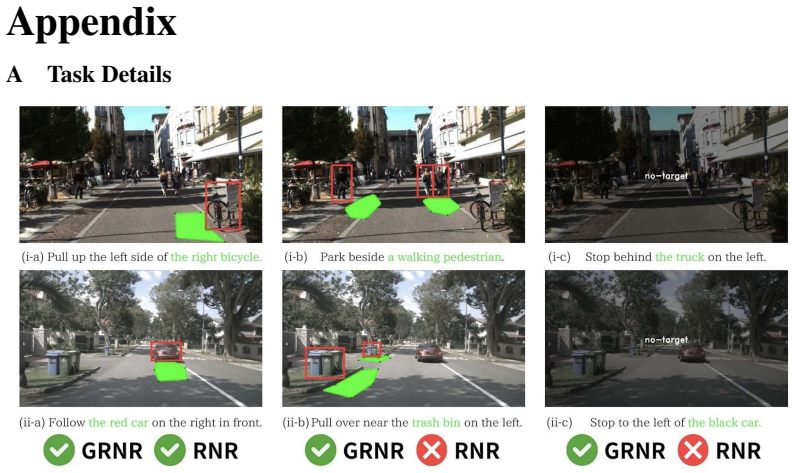
A. Kumar, T. Kashiyama, H. Maeda, and Y . Sekimoto. Citywide Reconstruction of Cross- Sectional Traffic Flow from Moving Camera Videos. In Big Data, pages 1670–1678, 2021. 12 Appendix A Task Details Figure 5: Typical examples of the GRNR task. Left: single target. Center: mult...
2021
Reviewed August 15, 2026 · model on record in the stance chip above.
Discussion (0). Continue with ORCID to comment.