REVIEW 3 major objections 5 minor 75 references
Non-periodic Boundary Conditions for Euler Class and Dynamical Signatures of Obstruction
T0 review · 3 major / 5 minor · reviewed 2026-08-06 · deepseek-v4-flash
Pith's one-line read The paper establishes that in two-dimensional three-band Euler insulators the parity of the Euler class is fixed by Brillouin zone boundary conditions, with odd (meronic) values only for non-trivial and anisotropic boundary conditions…
desk verdict Useful new classification of BZBCs for three-band Euler systems with a plausible parity rule, but the 'only if' direction for odd invariants is argued by continuity rather than proven. read the letter →
The pith
A machine-rendered reading of the paper's core claim, the machinery that carries it, and where it could break.
The reading
What carries the argument
The central object is the phase matrix $V(\mathbf{G})=\mathrm{diag}(e^{i\mathbf{G}\cdot\mathbf{r}_\alpha})$, the Brillouin zone boundary condition obeyed by Bloch eigenvectors, $\mathbf{u}_n(\mathbf{k}+\mathbf{G})=s_n V(\mathbf{G})\mathbf{u}_n(\mathbf{k})$; in the real gauge it reduces to one of the four $\pm1$ diagonal matrices, which rotate the eigenframe by $\pi$ about a Bloch-sphere axis. These matrices carry the orbital Zak phases, i.e. the atomic-limit Dirac strings, and the classification hinges on whether the strings along $\mathbf{b}_1$ and $\mathbf{b}_2$ lie in the same or different adjacent gaps. The second piece of machinery is the Hopf-map quench protocol: after a quench from a trivial state $\Psi_0$, the three-level evolution defines a projected Bloch vector $\mathbf{p}(\mathbf{k},t)$ whose inverse images form links in $(k_x,k_y,t)$, with linking number equal to the Euler invariant; the paper extends this by imposing $\mathbf{n}(\mathbf{k}+\mathbf{G})=V(\mathbf{G})\mathbf{n}(\mathbf{k})$ and deriving the transformation rules for $\mathbf{p}$ across zone boundaries.
What would settle it
Compute the Euler class along a continuous deformation on a Type 2bII lattice, such as the kagome model with $V(\mathbf{b}_1)=v_3$ and $V(\mathbf{b}_2)=v_2$, attempting to reach a fully gapped orientable phase with $\chi=0$ without band touching; reaching zero would falsify the parity classification. Alternatively, in the quench protocol measure the linking number per Brillouin zone: an even number of links per zone, or the absence of the predicted polarity swap along $\mathbf{b}_1$, would falsify the dynamical signature.
Extended reading notes
Core claim
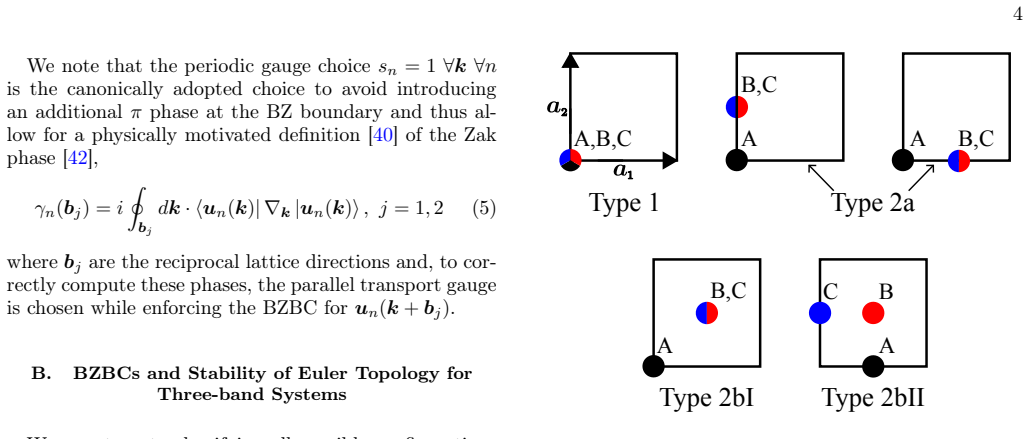
For a three-band real ($\mathcal{C}_2\mathcal{T}$-symmetric) Hamiltonian in two dimensions, the Euler class $\chi_{2,3}$ over one Brillouin zone is not always even. The phase matrices $V(\mathbf{b}_1)$ and $V(\mathbf{b}_2)$ that encode the boundary conditions, each one of the four diagonal matrices $v_0=\mathrm{diag}(1,1,1)$, $v_1=\mathrm{diag}(-1,-1,1)$, $v_2=\mathrm{diag}(1,-1,-1)$, $v_3=\mathrm{diag}(-1,1,-1)$, are determined by where the three orbitals sit relative to the unit-cell corners. Starting from the atomic limit, the paper shows that the associated Dirac strings are removable in Types 1, 2a and 2bI, leaving only even invariants, while in Type 2bII ($V(\mathbf{b}_1)\neq V(\mathbf{b}_2)$, both non-trivial) the strings cannot all be removed and the Euler class is forced to be odd. The quench section then proves that for these obstructed systems the Hopf linking number of the time-evolved state is still the Euler class, but the periodic unit of the momentum-time torus is two or four Brillouin zones, and translations between zones transform the projected Bloch vector according to the same $V$ matrices, producing one link per zone with polarity swaps for meronic phases.
Load-bearing premise
The classification assumes that the atomic-limit Dirac string configuration, determined by the orbital positions, cannot be changed by creating, braiding, or annihilating band nodes, so the parity of the Euler class is fixed once the lattice configuration is fixed; no general homotopy proof of this rigidity is given, and the quench protocol also assumes the Euler subspace remains orientable.
Editorial extensions
If this is right
- The parity of the Euler class in any three-band $\mathcal{C}_2\mathcal{T}$ Euler insulator can be read off from the lattice geometry: even for trivial, one-directional, or equal two-directional boundary conditions, odd only for anisotropic non-trivial boundary conditions.
- Type 2a and Type 2bI systems, although non-periodic, are adiabatically connected to a fully orientable zero-Euler state, so their non-trivial boundary conditions do not produce obstruction in the Euler sector.
- Type 2bII systems are intrinsically obstructed: no continuous deformation to a fully gapped orientable state with even Euler class exists, and the minimal odd invariant is $\chi=\pm1$.
- In quench experiments, the BZBCs are not a gauge artifact: the linking pattern repeats over a two- or four-Brillouin-zone unit cell, and the transformation of inverse images across boundaries reconstructs $V(\mathbf{b}_1)$ and $V(\mathbf{b}_2)$.
- The same atomic-limit Dirac-string criterion extends the parity classification to more bands and to two-dimensional slices of higher-dimensional spaces.
Reading between the lines
- A direct test would be to scan all tight-binding parameters on a fixed Type 2bII lattice and search for an adiabatic path to a fully gapped orientable phase with $\chi=0$ without band touching; the paper's claim is that no such path exists.
- The transformation rules in Eq. (12) are strong enough to reconstruct the full phase matrix, not just its parity: measuring inverse-image color swaps, or their absence, for the three initial states $\hat{\mathbf{x}}$, $\hat{\mathbf{y}}$, $\hat{\mathbf{z}}$ would determine each entry of $V(\mathbf{G})$.
- The same obstruction logic should apply to other multi-gap invariants in higher dimensions, for instance Pontryagin-index or quaternion-charge phases, wherever off-centered orbitals generate atomic-limit Dirac strings; the paper sketches the recipe but does not carry out those classifications.
- Because the Hopf protocol assumes an orientable Euler subspace, the dynamical signature is expected to fail exactly in non-orientable phases, where a Dirac string sits in the adjacent gap and the Euler class is only defined patchwise; a future extension would need to handle the non-vanishing boundary integral in Eq. (1).
Editorial analysis
A structured set of objections, weighed in public.
Referee Report
Summary. The manuscript investigates how non-Bravais lattice geometries produce non-trivial Brillouin zone boundary conditions (BZBCs) for real, C2T-symmetric Bloch Hamiltonians, and how these BZBCs constrain the parity of the Euler class. After deriving a periodictization recipe and enumerating the five inequivalent three-site lattice configurations in two dimensions, the authors classify the resulting Euler phases: Type 1, 2a, and 2bI are claimed to admit only even (skyrmionic) invariants, while Type 2bII, with two distinct non-trivial phase matrices, is claimed to admit only odd (meronic) invariants. The second half of the paper extends quench-dynamics Hopf-linking signatures from the periodic Type 1 setting to these obstructed cases, deriving transformation rules for the linking patterns across adjacent Brillouin zones and confirming them numerically on a kagome lattice with a meronic Euler phase.
Significance. If the central classification holds, the paper provides a useful organizing principle: odd Euler class is allowed exactly when the BZBCs are non-trivial and anisotropic, linking lattice geometry to multi-gap topology. The constructive derivation of the phase matrices from atomic positions, the explicit enumeration of possible unit cells, and the numerical confirmation of the quench signatures are concrete strengths. The proposed quench protocol also yields falsifiable predictions, which is valuable for ultracold-atom and metamaterial experiments. However, the 'only if' part of the parity classification is argued by a physical continuity assumption rather than by a proven homotopy statement, and the integer quantization step in Eq. (8) is not fully justified; these issues are load-bearing for the main conclusion and need to be repaired before the classification can be regarded as established.
major comments (3)
- [Sec. IIIB2, IIIC, Table I] The central claim that odd Euler phases occur only for Type 2bII is not proven. Equation (8) establishes only that χ(1BZ) is integer quantized for p = 2, 4; it does not exclude even integers. The exclusion of even χ for Type 2bII rests entirely on the assertion in Sec. IIIB2 that the atomic-limit Dirac-string configuration is continuously connected only to an orientable state with χ ∈ 2Z + 1 (Fig. 2(c)). This is a continuity argument, not a homotopy classification: it assumes that creating, braiding, and annihilating band nodes cannot change the parity set by the orbital Zak phases, and that every gapped orientable phase with these BZBCs lies in the same connected component as the atomic-limit configuration. Because the abstract and the conclusion state the 'only when' claim, this gap is load-bearing. Please supply a rigorous argument, for example by decomposing a map with V(b1) ≠ V(b2) into a fixed reference twisting map (which has odd degree) composed with a single-BZ-periodic map (which has even degree by Eq. (2)), or by otherwise explicitly ruling out an orientable Type 2bII phase with even χ. The same connectivity assumption also underlies the even-parity assignments for Types 2a and 2bI.
- [Sec. IIIB2, Eq. (8), footnote [43]] The integer quantization of χ(1BZ) for Type 2bII is asserted rather than derived. For p = 4, Eq. (8) gives χ(1BZ) ∈ 2Z/4 = (1/2)Z, and the statement that C2 symmetry rules out half-integer values is only a footnote. The paper should state the explicit action of C2 on the gapped eigenvector n(k) and show how this symmetry forces the Euler curvature integral over one BZ to be an integer despite the twisted boundary conditions. Without this step, the classification cannot distinguish odd integer invariants from half-integer obstructions, so this is a load-bearing point.
- [Sec. IVB, Eq. (12), Appendix C] The derivation of the transformation rules for the quench linking patterns is presented as a result of 'algebraic manipulations' but is not shown in detail. Since the main dynamical claim is that the phase matrices V(G) are directly imprinted on the linking patterns, the reader needs to see how p(k + G, t) is obtained for each v_i, including the definition of ~p and the role of the time coordinate under BZ translations. In particular, because a(k) is not periodic under non-trivial BZBCs, the proof that the link invariant over the 2- or 4-BZ patch remains well defined should be explicit. The numerical figures are consistent with Eq. (12), but the analytical statement that the signatures are imposed 'solely by the phase matrix BZBCs' requires this missing derivation.
minor comments (5)
- [Abstract and Sec. IVA] There are several typographical errors, including 'generalperiodictization' in the abstract and 'signitures' in Sec. IVA; these should be corrected.
- [Eq. (12)] The vector ~p(k, t) is defined in the text but not in the displayed equation; please add a sentence defining it precisely each time it appears.
- [Fig. 3] The caption does not define the hopping parameters t, t', t'' or state the model parameters; please refer explicitly to Eq. (13) and Appendix B in the caption.
- [Table I] The header row 'V(b1), V(b2) ∈ Parity of χ' is awkwardly formatted; the parity column should be separated clearly from the boundary-condition column.
- [Sec. IVB, reference [56]] Reference [56] is actually a note about orientability, not a citation; it should be placed as a footnote or integrated into the text.
Circularity Check
No circularity: the parity classification and quench signatures follow from the BZBC phase matrices and prior independent results, not from fitted or self-referential inputs.
full rationale
The derivation chain is self-contained rather than circular. The BZBC phase matrices V(G) are fixed by the lattice configuration through Eq. (4) and the appendix construction, and Eq. (8) follows from the periodicity of the Euler forms over p BZ patches, giving integer quantization but not by itself the parity table. The parity classification in Table I is argued from the atomic-limit Dirac strings determined by those V(G), with the Type 2bII odd-parity statement presented as a physical connectivity conclusion, not as a definition or as a fitted parameter. The quench transformation rules in Eq. (12) are derived in Appendix C from n(k+G)=V(G)n(k) and the previously established Hopf-map protocol, and the numerical results confirm rather than fit those analytic relations. The cited prior work [16,18,25,37] consists of independently published results, including an experimental observation of meronic Euler insulators, so the reliance on it does not constitute a self-citation chain that supplies the central conclusion. The paper explicitly flags its orientability assumption in Sec. V and footnote [56], and the Type 2bII parity exclusion rests on a continuity argument rather than a formal homotopy proof; these are completeness or correctness caveats, not circular reductions, because the parity conclusion is not an input to the construction that produces it.
Assumptions & free parameters
free parameters (1)
- Kagome hopping amplitudes t, t', t'' =
t = t' = -1, t'' = -0.8
assumptions (4)
- domain assumption Reality condition: C2T symmetry with [C2T]^2 = +1 leaves k unchanged and allows a real Bloch Hamiltonian.
- domain assumption The atomic limit Dirac string pattern uniquely determines the allowed parity of the Euler class after continuous deformation and node braiding.
- domain assumption Orientability of the Euler subspace (no Dirac string in the adjacent gap).
- domain assumption For C2-centered lattices with an odd number of orbitals, a Bravais-lattice origin choice exists with det V(b1) = det V(b2) = +1.
invented entities (1)
-
None
Cite this review
Pith. "Pith review of Non-periodic Boundary Conditions for Euler Class and Dynamical Signatures of Obstruction." pith.science (2026). https://pith.science/paper/WSGNIUXO
@misc{pith2026250722874,
  author       = {Pith},
  title        = {Pith review of: Non-periodic Boundary Conditions for Euler Class and Dynamical Signatures of Obstruction},
  year         = {2026},
  howpublished = {\url{https://pith.science/paper/WSGNIUXO}},
  note         = {Machine review of arXiv:2507.22874}
}
abstract
While the landscape of free-fermion phases has drastically been expanded in the last decades, recently novel multi-gap topological phases were proposed where groups of bands can acquire new invariants such as Euler class. As in conventional single-gap topologies, obstruction plays an inherent role that so far has only been incidentally addressed. We here systematically investigate the nuances of the relation between the non-Bravais lattice configurations and the Brillouin zone boundary conditions (BZBCs) for any number of dimensions. Clarifying the nomenclature, we provide a general periodictization recipe to obtain a gauge with an almost Brillouin-zone-periodic Bloch Hamiltonian both generally and upon imposing a reality condition on Hamiltonians for Euler class. Focusing on three-band $\mathcal{C}_2$ symmetric Euler systems in two dimensions as a guiding example, we present a procedure to enumerate the possible lattice configurations, and thus the unique BZBCs possibilities. We establish a comprehensive classification for the identified BZBC patterns according to the parity constraints they impose on the Euler invariant, highlighting how it extends to more bands and higher dimensions. Moreover, by building upon previous work utilizing Hopf maps, we illustrate physical consequences of non-trivial BZBCs in the quench dynamics of non-Bravais lattice Euler systems, reflecting the parity of the Euler invariant. We numerically confirm our results and corresponding observable signatures, and discuss possible experimental implementations. Our work presents a general framework to study the role of non-trivial boundary conditions and obstructions on multi-gap topology that can be employed for arbitrary number bands or in higher dimensions.
Figures


Figures from the paper (2 more)


Reference graph
Works this paper leans on
-
[1]
D. J. Thouless, Wannier functions for magnetic sub- bands, Journal of Physics C: Solid State Physics17, L325 (1984)
work page 1984
-
[2]
Thonhauser and D
T. Thonhauser and D. Vanderbilt, Insulator/chern- insulator transition in the haldane model, Phys. Rev. B 74, 235111 (2006)
2006
- [3]
-
[4]
Qi and S.-C
X.-L. Qi and S.-C. Zhang, Topological insulators and su- perconductors, Rev. Mod. Phys.83, 1057 (2011)
2011
-
[5]
M. Z. Hasan and C. L. Kane, Colloquium: Topological insulators, Rev. Mod. Phys.82, 3045 (2010)
2010
-
[6]
Fu, Topological crystalline insulators, Phys
L. Fu, Topological crystalline insulators, Phys. Rev. Lett. 106, 106802 (2011)
2011
- [7]
-
[8]
Kruthoff, J
J. Kruthoff, J. de Boer, J. van Wezel, C. L. Kane, and R.-J. Slager, Topological classification of crystalline insu- lators through band structure combinatorics, Phys. Rev. X 7, 041069 (2017)
2017
Show all 75 references
-
[9]
Slager, The translational side of topological band insulators, J
R.-J. Slager, The translational side of topological band insulators, J. Phys. Chem. Solids128, 24 (2019), spin- Orbit Coupled Materials
2019
-
[10]
H. C. Po, A. Vishwanath, and H. Watanabe, Symmetry- based indicators of band topology in the 230 space groups, Nat. Commun.8, 50 (2017)
2017
-
[11]
Bradlyn, L
B. Bradlyn, L. Elcoro, J. Cano, M. G. Vergniory, Z. Wang, C. Felser, M. I. Aroyo, and B. A. Bernevig, Topological quantum chemistry, Nature547, 298 (2017)
2017
-
[12]
Shiozaki and M
K. Shiozaki and M. Sato, Topology of crystalline insu- lators and superconductors, Phys. Rev. B 90, 165114 (2014)
2014
-
[13]
Ahn and B.-J
J. Ahn and B.-J. Yang, Symmetry representation ap- proach to topological invariants inC2zt-symmetric sys- tems, Phys. Rev. B99, 235125 (2019)
2019
-
[14]
Q. Wu, A. A. Soluyanov, and T. Bzdušek, Non-abelian band topology in noninteracting metals, Science 365, 1273 (2019)
2019
-
[15]
J. Ahn, S. Park, and B.-J. Yang, Failure of nielsen-ninomiya theorem and fragile topology in two- dimensional systems with space-time inversion symme- try: Application to twisted bilayer graphene at magic angle, Phys. Rev. X9, 021013 (2019)
2019
-
[16]
Bouhon, Q
A. Bouhon, Q. Wu, R.-J. Slager, H. Weng, O. V. Yazyev, andT.Bzdušek,Non-AbelianreciprocalbraidingofWeyl points and its manifestation in ZrTe, Nat. Phys.16, 1137 (2020)
2020
-
[17]
Bouhon, T
A. Bouhon, T. Bzdušek, and R.-J. Slager, Geometric ap- proach to fragile topology beyond symmetry indicators, Phys. Rev. B102, 115135 (2020)
2020
-
[18]
F. N. Ünal, A. Bouhon, and R.-J. Slager, Topological euler class as a dynamical observable in optical lattices, Phys. Rev. Lett.125, 053601 (2020)
2020
-
[19]
Palumbo, Non-abelian tensor berry connections in multiband topological systems, Phys
G. Palumbo, Non-abelian tensor berry connections in multiband topological systems, Phys. Rev. Lett. 126, 246801 (2021)
2021
-
[20]
Bouhon, A
A. Bouhon, A. Timmel, and R.-J. Slager, Quantum geometry beyond projective single bands, (2023), arXiv:2303.02180 [cond-mat.mes-hall]
2023 arXiv
-
[21]
Bouhon and R.-J
A. Bouhon and R.-J. Slager, Multi-gap topological con- version of euler class via band-node braiding: minimal models, pt-linked nodal rings, and chiral heirs, (2022), arXiv:2203.16741 [cond-mat.mes-hall]
2022 arXiv
-
[22]
Davoyan, W
Z. Davoyan, W. J. Jankowski, A. Bouhon, and R.- J. Slager, Three-dimensional PT -symmetric topological phases with a pontryagin index, Phys. Rev. B 109, 165125 (2024)
2024
-
[23]
Y. X. Zhao and Y. Lu, PT-symmetric real Dirac fermions and semimetals, Phys. Rev. Lett.118, 056401 (2017)
2017
-
[24]
Jiang, A
B. Jiang, A. Bouhon, Z.-K. Lin, X. Zhou, B. Hou, F. Li, R.-J. Slager, and J.-H. Jiang, Experimental observation of non-abelian topological acoustic semimetals and their phase transitions, Nature Physics17, 1239 (2021)
2021
-
[25]
Jiang, A
B. Jiang, A. Bouhon, S.-Q. Wu, Z.-L. Kong, Z.-K. Lin, R.-J. Slager, and J.-H. Jiang, Observation of an acoustic topological euler insulator with meronic waves, Science Bulletin 69, 1653 (2024)
2024
-
[26]
Jiang, Q
T. Jiang, Q. Guo, R.-Y. Zhang, Z.-Q. Zhang, B. Yang, and C. T. Chan, Four-band non-abelian topological in- sulator and its experimental realization, Nature commu- nications 12, 6471 (2021)
2021
-
[27]
Q. Guo, T. Jiang, R.-Y. Zhang, L. Zhang, Z.-Q. Zhang, B. Yang, S. Zhang, and C. T. Chan, Experimental obser- vation of non-abelian topological charges and edge states, Nature 594, 195 (2021)
2021
-
[28]
O.Breach, R.-J.Slager,andF.N.Ünal,Interferometryof non-abelian band singularities and euler class topology, Phys. Rev. Lett.133, 093404 (2024)
2024
-
[29]
Zhao, Y.-B
W. Zhao, Y.-B. Yang, Y. Jiang, Z. Mao, W. Guo, L. Qiu, G. Wang, L. Yao, L. He, Z. Zhou,et al., Quantum sim- ulation for topological euler insulators, Communications Physics 5, 223 (2022)
2022
-
[30]
Karle, M
V. Karle, M. Lemeshko, A. Bouhon, R.-J. Slager, and F. N. Ünal, Anomalous multi-gap topological phases in periodically driven quantum rotors, (2024), arXiv:2408.16848
2024
-
[31]
S. H. Lee, Y. Qian, and B.-J. Yang, Euler band topol- ogy in spin-orbit coupled magnetic systems, (2024), arXiv:2404.16383 [cond-mat.mes-hall]
2024 arXiv
-
[32]
Bouhon, G
A. Bouhon, G. F. Lange, and R.-J. Slager, Topological correspondence between magnetic space group represen- tations and subdimensions, Phys. Rev. B 103, 245127 (2021)
2021
-
[33]
S. Chen, A. Bouhon, R.-J. Slager, and B. Monser- rat, Non-Abelian braiding of Weyl nodes via symmetry- constrained phase transitions, Phys. Rev. B 105, L081117 (2022)
2022
-
[34]
B. Peng, A. Bouhon, B. Monserrat, and R.-J. Slager, Phonons as a platform for non-abelian braiding and its manifestation in layered silicates, Nature Communica- tions 13, 423 (2022)
2022
-
[35]
S. Park, Y. Hwang, H. C. Choi, and B.-J. Yang, Topo- logical acoustic triple point, Nature communications12, 6781 (2021)
2021
-
[36]
G. F. Lange, A. Bouhon, B. Monserrat, and R.-J. Slager, Topological continuum charges of acoustic phonons in two dimensions and the nambu-goldstone theorem, Phys. Rev. B105, 064301 (2022)
2022
-
[37]
Slager, A
R.-J. Slager, A. Bouhon, and F. N. Ünal, Non-abelian floquet braiding and anomalous dirac string phase in pe- riodically driven systems, Nature Communications 15, 1144 (2024)
2024
-
[38]
T. B. Wahl, W. J. Jankowski, A. Bouhon, G. Chaudhary, and R.-J. Slager, Exact projected entangled pair ground states with topological euler invariant, Nature Commu- nications 16, 284 (2025)
2025
-
[39]
S. H. Simon and M. S. Rudner, Contrasting lattice ge- 13 ometry dependent versus independent quantities: Rami- fications for berry curvature, energy gaps, and dynamics, Phys. Rev. B102, 165148 (2020)
2020
-
[40]
Fruchart, D
M. Fruchart, D. Carpentier, and K. Gawędzki, Parallel transport and band theory in crystals, Europhysics Let- ters 106, 60002 (2014)
2014
-
[41]
Such a condition is also satisfied byPT + symme- try with P inversion symmetry andT + the bosonic time reversal symmetry
This condition is satisfied both for bosonic T + and fermionic T − time reversal symmetries, where [T ±]2 = ±1. Such a condition is also satisfied byPT + symme- try with P inversion symmetry andT + the bosonic time reversal symmetry
-
[42]
Zak, Berry’s phase for energy bands in solids, Phys
J. Zak, Berry’s phase for energy bands in solids, Phys. Rev. Lett.62, 2747 (1989)
1989
-
[43]
C2 dictates that nodes are formed in pairs and periodi- cally across the BZs and thusχ2,3(1BZ) cannot take half integer values
-
[44]
W. J. Jankowski, A. S. Morris, Z. Davoyan, A. Bouhon, F. N. Ünal, and R.-J. Slager, Non-abelian hopf-euler in- sulators, Phys. Rev. B110, 075135 (2024)
2024
-
[45]
C. Wang, P. Zhang, X. Chen, J. Yu, and H. Zhai, Scheme to measure the topological number of a chern insulator from quench dynamics, Phys. Rev. Lett. 118, 185701 (2017)
2017
-
[46]
Tarnowski, F
M. Tarnowski, F. N. Ünal, N. Fläschner, B. S. Rem, A. Eckardt, K. Sengstock, and C. Weitenberg, Measuring topology from dynamics by obtaining the Chern number from a linking number, Nat. Commun.10, 1728 (2019)
2019
-
[47]
F. N. Ünal, A. Eckardt, and R.-J. Slager, Hopf character- ization of two-dimensional floquet topological insulators, Phys. Rev. Res.1, 022003 (2019)
2019
-
[48]
Sun, C.-R
W. Sun, C.-R. Yi, B.-Z. Wang, W.-W. Zhang, B. C. Sanders, X.-T. Xu, Z.-Y. Wang, J. Schmiedmayer, Y. Deng, X.-J. Liu, S. Chen, and J.-W. Pan, Uncover topology by quantum quench dynamics, Phys. Rev. Lett. 121, 250403 (2018)
2018
-
[49]
C. Yang, L. Li, and S. Chen, Dynamical topological in- variant after a quantum quench, Phys. Rev. B97, 060304 (2018)
2018
-
[50]
X. Chen, C. Wang, and J. Yu, Linking invariant for the quench dynamics of a two-dimensional two-band chern insulator, Phys. Rev. A101, 032104 (2020)
2020
-
[51]
Yi, J.-L
C.-R. Yi, J.-L. Yu, W. Sun, X.-T. Xu, S. Chen, and J.-W. Pan, Observation of the hopf links and hopf fibration in a 2d topological raman lattice, (2019), arXiv:1904.11656 [cond-mat.quant-gas]
2019 arXiv
-
[52]
Hu and E
H. Hu and E. Zhao, Topological invariants for quan- tum quench dynamics from unitary evolution, Phys. Rev. Lett. 124, 160402 (2020)
2020
-
[53]
L. S. Pontryagin, A classification of mappings of the three-dimensional complex into the two-dimensional sphere, Mat. Sbornik (Recueil Mathematique NS)9, 331 (1941)
1941
-
[54]
Time evolution forms a circleS1, which is completed af- ter 2π rotation by the state upon considering spectrally flatteningtheHamiltonian HC (k), whichdoesnotchange the Chern number. This ensures that the state returns to itself at the same time for allk, while the Hopf-linkin...
-
[55]
W. J. Jankowski, A. S. Morris, A. Bouhon, F. N. Ünal, and R.-J. Slager, Optical manifestations and bounds of topological euler class, Phys. Rev. B 111, L081103 (2025)
2025
-
[56]
V for further discussion
Note that here we inherently assume the system is ori- entable for the Euler class to be well defined as a BZ periodic invariant, see Sec. V for further discussion
-
[57]
This amounts to picking the gauge withs2 = −1 (while det(V (G)) = 1is maintained) in the BZBCs Eq.(4), thus breaking the periodic gauge choice, to makeu2 continu- ous so thatχ2,3 becomes well-defined
-
[58]
G.-B. Jo, J. Guzman, C. K. Thomas, P. Hosur, A. Vish- wanath, and D. M. Stamper-Kurn, Ultracold atoms in a tunable optical kagome lattice, Phys. Rev. Lett.108, 045305 (2012)
2012
-
[59]
C. J. D. Kemp, N. R. Cooper, and F. N. Ünal, Nested- sphere description of theN-level chern number and the generalizedBlochhypersphere,Phys.Rev.Res. 4,023120 (2022)
2022
-
[60]
Bradley and A
C. Bradley and A. Cracknell,The Mathematical Theory of Symmetry in Solids(Oxford University Press, 1972)
1972
-
[61]
Volume A, Space-group symmetry, online ed
International Tables for Crystallography. Volume A, Space-group symmetry, online ed. (2006) edited by T. Hahn
2006
-
[62]
Volume E, Sub- periodic groups, online ed
International Tables for Crystallography. Volume E, Sub- periodic groups, online ed. (2013) edited by V. Kopsk` y and D. B. Litvin
2013
-
[63]
Evarestov and V
R. Evarestov and V. P. Smirnov, Site Symmetry in Crystals, 0171-1873 (Springer-Verlag Berlin Heidelberg, 1997)
1997
-
[64]
Chen, R.-J
S. Chen, R.-J. Slager, B. Monserrat, and A. Bouhon, High-chirality and multiquaternion weyl nodes in hexag- onal reo3, Phys. Rev. B111, 195110 (2025)
2025
-
[65]
Zak, Band center—a conserved quantity in solids, Phys
J. Zak, Band center—a conserved quantity in solids, Phys. Rev. Lett.48, 359 (1982)
1982
-
[66]
Vanderbilt and R
D. Vanderbilt and R. D. King-Smith, Electric polariza- tion as a bulk quantity and its relation to surface charge, Phys. Rev. B48, 4442 (1993)
1993
-
[67]
Alexandradinata, X
A. Alexandradinata, X. Dai, and B. A. Bernevig, Wilson- loop characterization of inversion-symmetric topological insulators, Phys. Rev. B89, 155114 (2014)
2014
-
[68]
Note that the reality condition can be obtained from PT + combining inversion P and bosonic time reversal symmetry ([T +]2 = 1)
-
[69]
Bouhon and A
A. Bouhon and A. M. Black-Schaffer, Bulk topology of line-nodal structures protected by space group symme- tries in class AI, (2017), arXiv:1710.04871
2017 arXiv
-
[70]
A. M. Chebotarev and A. E. Teretenkov, Singular value decomposition for the takagi factorization of symmetric matrices, Applied Mathematics and Computation234, 380 (2014). 14 Appendix A: Bloch Formalism for Non-Bravais Lattices, C2T Symmetry, and Periodictization Indicated 1D ...
2014
-
[71]
T = {R = n1a1 + n2a2 : n1, n2 ∈ Z}
Crystalline Atomic Degrees of Freedom Weworkwiththelatticeofatwo-dimensionalsymmor- phic crystal associated to a Bravais lattice (BL) defined as the group of vector translations obtained as integer linear combinations of two primitive vectors,a1 and a2, i.e. T = {R = n1a1 + n2...
-
[72]
band centers
Zak Bloch-basis, Zak phase, and First Periodictization We now define a Bloch basis that represents the in- equivalent atomic degrees of freedom within each unit cell, while factoring the Bravais lattice degrees of free- dom through a discrete Fourier transform. We call the fol...
-
[73]
in [64])
C2T Symmetry, Reality Condition and Takagi Factorization In general, the Bloch Hamiltonian matrix H Z(k) is complex and there is no one-dimensional topology as- sociated with its lack of periodicity under translations by reciprocal lattice vectors (we discard here topological ...
-
[74]
A direct consequence of the real Bloch form is that Wil- son loops now define O(pν) orthonormal matrices, see Eq
1D Topology Indicated by Maximally Periodic Real Bloch Hamiltonians We have derived above that the reality condition guarantees the existence of a change of basis, obtained throughaTakagifactorization, inwhichtheBlochHamil- tonian matrix and its associated shift matriceseV (G)...
-
[75]
Periodictization Procedure and 1D Topological Atomic Obstructions ofC2T-symmetric Euler Systems We have considered above the various choices of ba- sis that govern the periodicity of the real Bloch Hamil- tonian matrix of 2D C2T -symmetric systems under the assumption that a f...
Reviewed August 6, 2026 · model on record in the stance chip above.
Discussion (0). Continue with ORCID to comment.