REVIEW 3 major objections 5 minor 1 cited by
A multimodal tactile finger combining fast PVDF dynamic sensing with slow capacitive static pressure enables a four-finger hand to rotate fragile paper objects in-hand without crushing them, a capability that has not been shown before.
Reviewed by Pith at T0; open to challenge. T0 means a machine referee read the full paper against a public rubric. the ladder, T0–T4 →
A fingertip with 16-taxel PVDF dynamic sensing plus capacitive static sensing enables fast delicate grasping and, with RLHF fine-tuning, in-hand manipulation of fragile objects.
T0 review reviewed 2026-08-04 challenge →
load-bearing objection The 16-taxel PVDF fingertip is a genuinely new piece of hardware with solid fast-grasping evidence, but the in-hand rotation claim is supported by only five rollouts per condition and needs a real evaluation before it should be taken at face value. the 3 major comments →
SpikeATac: A Multimodal Tactile Finger with Taxelized Dynamic Sensing for Dexterous Manipulation
The pith
A machine-rendered reading of the paper's core claim, the machinery that carries it, and where it could break.
The reading
Core claim
The paper's central discovery is that a taxelized PVDF film, read through charge amplifiers with a high-pass cut-off around 6 Hz, provides a signal that marks the precise onset and breaking of contact with a sensitivity and speed that static sensors and load cells lack, and that this signal can be combined with capacitive pressure readings to enable both fast reaction and gentle force control. When integrated into a four-finger hand, the raw signals are usable by a policy that starts in simulation with binary contact, transfers to the real robot, and is fine-tuned with semi-sparse human labels plus a tactile reward that penalizes high capacitive force and rewards PVDF 'spikes' (contact event
What carries the argument
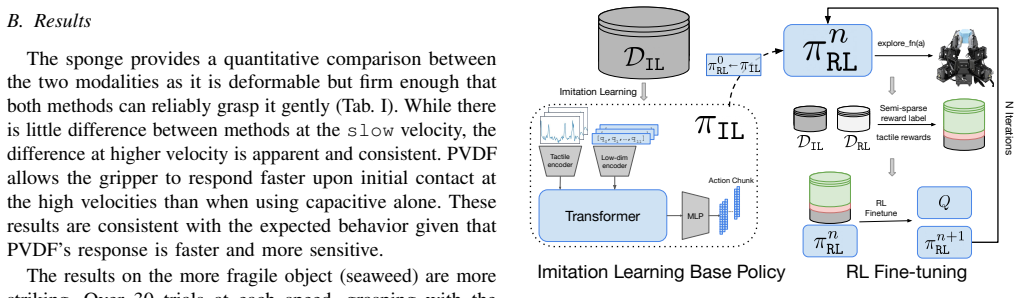
The load-bearing component is the PVDF charge-amplifier design: a feedback resistor-capacitor pair (1.2 GΩ and 22 pF) gives a high-pass filter with a 6 Hz cutoff and 30 ms time constant, so the 16-taxel PVDF film responds to transients with large 'spiky' signals and then decays, never saturating. This is what makes the finger sensitive to contact onset and breakage at 4 kHz while remaining robust. The 7 capacitive pads underneath provide the slow, stable pressure channel, and the learning pipeline — imitation learning from a simulated binary-contact policy, then on-robot SAC fine-tuning with a reward combining human segment labels and a tactile term — is what turns those raw signals into a f
Load-bearing premise
The demonstration of in-hand fragile-object rotation rests on only five rollouts per fine-tuning iteration on two paper objects, with results pooled and no error bars, and the paper itself notes the policy may be overfit to those particular objects and sizes.
What would settle it
Evaluate the fine-tuned policy on a held-out set of fragile objects with different sizes, shapes, and materials, reporting per-object destruction rates and rotation amounts with confidence intervals; if destruction rates rise above zero or rotation fails on any of these, the claimed new capability is not established. Separately, retrain the policy with the PVDF spike reward term removed: if rotation and destruction are unchanged, the dynamic sensing contribution claimed by the paper is falsified.
If this is right
- High-speed, delicate grasping: a gripper using PVDF contact detection can approach fragile objects at ~280 mm/s and stop within ~2.4 mm, whereas capacitive-only detection crushes nori in most trials.
- Raw, difficult-to-simulate sensor signals can be used in real-robot RL fine-tuning without a faithful simulator.
- A dense tactile reward — penalizing high capacitive force and rewarding PVDF spike counts — is a practical way to shape delicate manipulation behavior.
- The policy's rotation of paper objects improves over fine-tuning iterations, with the final policy outperforming an IL baseline trained on the same data.
- The findings imply that dynamic tactile sensing, not just static pressure, is a necessary ingredient for contact-rich dexterous tasks with deformable objects.
Where Pith is reading between the lines
- The high-pass nature of the PVDF amplifier means sensitivity to contact onset grows with approach speed, which suggests the same finger could enable high-speed catching or impact avoidance, where faster motion makes the sensor more, not less, responsive.
- An ablation that removes the PVDF spike term from the reward or disables the dynamic taxels would likely show a large drop in the policy's delicacy; the paper leaves this untested, so the dynamic modality's specific contribution is not yet isolated.
- The 64-sample history buffer implies the policy learns from transient temporal patterns; a natural extension is slip detection or early regrasp prediction, where contact-breaking spikes are informative.
- A testable next step is training a single policy on a set of fragile objects with varied shapes and materials, rather than the two paper objects used here, to see whether the learned force modulation generalizes.
Editorial analysis
A structured set of objections, weighed in public.
Referee Report
Summary. SpikeATac is a multimodal tactile fingertip that combines a 16-taxel PVDF dynamic sensor (4 kHz) with seven capacitive static pads, integrated into a finger-shaped form factor. The paper contributes a fabrication process, a characterization of PVDF sensitivity and spatial resolution, a parallel-gripper experiment showing faster contact detection and more delicate grasping with PVDF than with capacitive sensing alone, and a learning pipeline (imitation learning plus on-robot RL with human and tactile rewards) that fine-tunes a policy for in-hand rotation of fragile paper objects. The central claim is that the hardware and learning pipeline together enable a difficult dexterous, contact-rich task that has not previously been achieved: in-hand manipulation of fragile objects.
Significance. The hardware contribution is solid and potentially valuable: a multi-taxel PVDF fingertip with 4 kHz sampling and 16 taxels, combined with static capacitive sensing, is a meaningful step beyond the one- or two-strip PVDF fingertips in prior work. The fast-grasping experiment is convincing: n=30 per condition, objective stopping-distance measurements, and a dramatic difference on the fragile seaweed object (0/30 crushed with PVDF vs. 20/30 and 23/30 with capacitive sensing at medium and fast speeds). The paper also reports detailed fabrication and electronics specifications, releases videos, and is transparent about its limitations, including the overfitting caveat and the lack of a sensor ablation. If the in-hand manipulation claim is robustly supported, the paper would be a strong systems contribution to tactile sensing and real-robot reinforcement learning. However, the evidence for the flagship manipulation claim is currently too thin to support publication in its present form.
major comments (3)
- [§VI-C, Fig. 8] The paper's headline claim—'in-hand manipulation of fragile objects' as a previously unachieved capability—rests on evaluation with only 5 rollouts per fine-tuning iteration on two paper objects, with results pooled across objects and no error bars, confidence intervals, or statistical tests reported. The 'object destruction rate' is not operationally defined (no pre/post weight, deformation threshold, or blinded assessment). The authors themselves state that the policy 'may be overfit to these particular objects and object sizes' and that there is no 'definitive analysis of what each sensor contributes.' This level of evidence is insufficient for the strong central claim. Please report per-object results with confidence intervals, increase the number of rollouts, define destruction criteria objectively, and include at least one generalization or ablation check.
- [§V-A] The fast-grasping comparison depends on contact-detection thresholds that were chosen empirically on the same experimental setup, with the reported values (40/80 counts for PVDF, 5.5/6.5 counts for capacitive, and stable-grasp thresholds of 3/5) but no sensitivity analysis. The claim that PVDF is superior to capacitive for delicate grasping could shift if the thresholds are not comparably tuned; for example, a more aggressive capacitive threshold might detect earlier, while a more conservative PVDF threshold might lose the advantage. The authors also note that the actual approach speeds differ between objects in the fast condition (281 vs. 180 mm/s for sponge vs. seaweed), which complicates cross-object interpretation. Please provide a threshold sweep and matched-speed or speed-controlled conditions to establish that the advantage is robust.
- [§VI-A, tactile reward definition] The tactile reward explicitly encodes the desired behavior: it penalizes normalized capacitive readings ≥0.9 and rewards PVDF spike magnitudes >0.8. This means the fine-tuning result partly reflects reward engineering rather than emergent perception from the sensor. The claim that SpikeATac's raw signals 'enable' the dexterous manipulation capability is therefore not established by the current experiments; an ablation that removes the tactile reward, or uses only proprioceptive observations, would be needed to attribute the improvement to the tactile modality. The paper itself concedes in §VI-C that there is no definitive analysis of what each sensor contributes, which is precisely the missing experiment needed for the central claim.
minor comments (5)
- [Abstract and §VI-A] The method is described as 'RLHF' (reinforcement learning from human feedback), but the human supervision is semi-sparse good/bad segment labels, not preference pairs. This is a weaker form of human feedback and differs from standard RLHF terminology; please clarify the distinction.
- [§VI-C, Fig. 8] The phrase '5 rollouts each' is ambiguous: does it mean 5 per object, 5 total, or 5 per iteration per object? Please clarify. Also, the destruction-rate axis in Fig. 8 is undefined; adding a written definition would help.
- [§VI-A, equation for r_tac] The reward weights w1 and w2, the sigmoid normalization parameters, and the exploration-noise standard deviations are not reported. These are important for reproducibility and for understanding the sensitivity of the learning result. Please provide the values or a reference to the code.
- [§IV, Fig. 3] The claim that PVDF detects contact 'before the load cell or capacitive sensors move above their noise floor' is supported for the 10 mm/s condition, but the 'approach only' response is acknowledged to be non-negligible. Since the fast-grasping algorithm uses a simple threshold, a quantitative comparison of the proximity signal magnitude to the contact signal magnitude at equivalent speeds would strengthen the interpretation.
- [§VI-B] The observation contains a 64-step history buffer of 16 PVDF and 7 capacitive signals per finger, but the policy runs at 20 Hz while PVDF is sampled at 450 Hz—this means the 64-sample history spans about 3.2 seconds at 20 Hz, which is long compared to typical manipulation dynamics. Please justify this choice or clarify the actual dimensionality and temporal span.
Circularity Check
No significant circularity: SpikeATac is an empirical systems paper with no fitted-input-called-prediction or self-citation chain.
full rationale
The paper's claims are direct empirical demonstrations rather than derivations from prior results. The fast-grasping comparison (Tab. I) measures distances traveled after contact onset for PVDF- vs capacitive-based detection; the thresholds are 'chosen empirically to be just above the noise floor' (Sec. V-A), which is standard detector calibration, not a fitted parameter being renamed a prediction. The RL fine-tuning reward (Sec. VI-A) intentionally penalizes high capacitive force and rewards PVDF transients; this is an explicitly stated reward design, and the reported metrics (rotation amount and destruction rate, Fig. 8) are measured independently of that reward, so the result is not equivalent to the reward by construction. The paper's own caveats—the policy 'may be overfit to these particular objects and object sizes' and the lack of a 'definitive analysis of what each sensor contributes' (Sec. VI-C)—are validity limitations about evaluation breadth, not circularity. Self-citations ([13], [17], [36]) appear only as background context for dynamic-sensing capabilities and simulation-based in-hand rotation; none is invoked as a load-bearing proof or uniqueness theorem. The headline capability claim rests on small, pooled rollouts with no error bars, which is an evidence-strength concern for correctness risk, not a circularity finding under the enumerated patterns.
Axiom & Free-Parameter Ledger
free parameters (7)
- PVDF contact-detection threshold (difference-based, ≥2 taxels) =
not reported
- Capacitive contact-detection threshold (mean of 7 taxels) =
not reported
- Stable-grasp capacitive threshold =
3 (seaweed), 5 (sponge); 5.5/6.5 counts per finger
- Tactile reward weights w1, w2 =
w1<0, w2>0; exact values not stated
- Sigmoid normalization parameters for tactile observations =
not specified
- Exploration noise stddev for distal joints =
not specified
- Learning hyperparameters (SAC, network sizes, iterations) =
not reported
axioms (7)
- standard math PVDF charge-amplifier circuit acts as a high-pass filter with 6 Hz cutoff / 30 ms time constant, so static pressure is not measured.
- domain assumption PVDF contact detection is dominated by mechanical contact rather than static-charge proximity.
- domain assumption The 'light touch' characterization condition (probe just barely makes visual contact) is a reliable ground truth for contact.
- domain assumption Ground-truth contact point in grasping experiments can be inferred from object width.
- domain assumption The simulation-trained base policy with binary touch/no-touch contact transfers well enough to initialize real-world fine-tuning.
- domain assumption Human segment labels ('good' if rotating, 'bad' otherwise) are a reliable reward signal.
- ad hoc to paper The hand-crafted tactile reward (penalize capacitive ≥0.9, reward |PVDF|>0.8) is a valid operationalization of 'delicate manipulation'.
Cite this review
Pith. "Pith review of SpikeATac: A Multimodal Tactile Finger with Taxelized Dynamic Sensing for Dexterous Manipulation." pith.science (2026). https://pith.science/paper/WSIIGSS5
@misc{pith2026251027048,
  author       = {Pith},
  title        = {Pith review of: SpikeATac: A Multimodal Tactile Finger with Taxelized Dynamic Sensing for Dexterous Manipulation},
  year         = {2026},
  howpublished = {\url{https://pith.science/paper/WSIIGSS5}},
  note         = {Machine review of arXiv:2510.27048}
}
read the original abstract
In this work, we introduce SpikeATac, a multimodal tactile finger combining a taxelized and highly sensitive dynamic response (PVDF) with a static transduction method (capacitive) for multimodal touch sensing. Named for its `spiky' response, SpikeATac's 16-taxel PVDF film sampled at 4 kHz provides fast, sensitive dynamic signals to the very onset and breaking of contact. We characterize the sensitivity of the different modalities, and show that SpikeATac provides the ability to stop quickly and delicately when grasping fragile, deformable objects. Beyond parallel grasping, we show that SpikeATac can be used in a learning-based framework to achieve new capabilities on a dexterous multifingered robot hand. We use reinforcement learning from human feedback to fine-tune the behavior of a policy to modulate force. Our hardware platform and learning pipeline together enable a difficult dexterous and contact-rich task that has not previously been achieved: in-hand manipulation of fragile objects. Videos are available at https://roamlab.github.io/spikeatac/ .
Figures



Forward citations
Cited by 1 Pith paper
-
Adaptive Policy Selection and Fine-Tuning under Interaction Budgets for Offline-to-Online Reinforcement Learning
An adaptive UCB-based policy selection and fine-tuning strategy improves performance over standard O2O-RL baselines under interaction budgets.
Reference graph
Works this paper leans on
-
[1]
Coding and use of tactile signals from the fingertips in object manipulation tasks,
R. S. Johansson and J. R. Flanagan, “Coding and use of tactile signals from the fingertips in object manipulation tasks,” Nat Rev Neurosci , vol. 10, no. 5, pp. 345–359, May 2009
2009
-
[2]
Dynamic Tactile Sensing,
M. R. Cutkosky and J. Ulmen, “Dynamic Tactile Sensing,” in The Human Hand as an Inspiration for Robot Hand Development , R. Bal- asubramanian and V . J. Santos, Eds. Cham: Springer International Publishing, 2014, pp. 389–403
2014
-
[3]
Tactile sensing in dexterous robot hands — Review,
Z. Kappassov, J.-A. Corrales, and V . Perdereau, “Tactile sensing in dexterous robot hands — Review,” Robotics and Autonomous Systems , vol. 74, pp. 195–220, Dec. 2015
2015
-
[4]
PVDF-based ferroelectric polymers and dielectric elastomers for sensor and actuator applications: a review,
J.-H. Bae and S.-H. Chang, “PVDF-based ferroelectric polymers and dielectric elastomers for sensor and actuator applications: a review,” Funct. Compos. Struct. , vol. 1, no. 1, p. 012003, Mar. 2019
2019
-
[5]
Tri-modal thin-film flexible electronic skin to augment robotic grasping,
C. Yu, M. R. Cavallari, and I. Kymissis, “Tri-modal thin-film flexible electronic skin to augment robotic grasping,” in 2018 IEEE Micro Electro Mechanical Systems (MEMS) , Jan. 2018, pp. 886–888
2018
-
[6]
A Locally Amplified Strain Sensor Based on a Piezoelectric Polymer and Organic Field-Effect Transistors,
Y .-J. Hsu, Z. Jia, and I. Kymissis, “A Locally Amplified Strain Sensor Based on a Piezoelectric Polymer and Organic Field-Effect Transistors,” IEEE Transactions on Electron Devices , vol. 58, no. 3, Mar. 2011
2011
-
[7]
Design and fabrication of posfet devices for tactile sensing,
R. Dahiya, M. Valle, G. Metta, L. Lorenzelli, and A. Adami, “Design and fabrication of posfet devices for tactile sensing,” in TRANSDUC- ERS 2009 - 2009 International Solid-State Sensors, Actuators and Microsystems Conference, June 2009, pp. 1881–1884
2009
-
[8]
Extended Tactile Perception: Vibration Sensing through Tools and Grasped Objects,
T. Taunyazov, L. S. Song, E. Lim, H. H. See, D. Lee, B. C. Tee, and H. Soh, “Extended Tactile Perception: Vibration Sensing through Tools and Grasped Objects,” in 2021 IEEE/RSJ International Conference on Intelligent Robots and Systems (IROS) , Sept. 2021, pp. 1755–1762
2021
-
[9]
Bayesian Exploration for Intelligent Identification of Textures,
J. A. Fishel and G. E. Loeb, “Bayesian Exploration for Intelligent Identification of Textures,” Front. Neurorobot., vol. 6, June 2012
2012
-
[10]
Artificial SA-I, RA-I and RA- II/vibrotactile afferents for tactile sensing of texture,
N. Pestell and N. F. Lepora, “Artificial SA-I, RA-I and RA- II/vibrotactile afferents for tactile sensing of texture,” Journal of The Royal Society Interface , vol. 19, no. 189, p. 20210603, Apr. 2022
2022
-
[11]
Adding internal audio sensing to internal vision enables human-like in-hand fabric recognition with soft robotic fingertips,
I. Andrussow, L. J. Solano Vega, B. A. Richardson, G. Martius, and K. J. Kuchenbecker, “Adding internal audio sensing to internal vision enables human-like in-hand fabric recognition with soft robotic fingertips,” in Proceedings of the IEEE-RAS International Conference on Humanoid Robots (Humanoids), Seoul, Korea, Sept. 2025
2025
-
[12]
Digitizing Touch with an Artificial Multimodal Fingertip,
M. Lambeta, et al., “Digitizing Touch with an Artificial Multimodal Fingertip,” Nov. 2024, arXiv:2411.02479 [cs]
Pith/arXiv arXiv 2024
-
[13]
An Investigation of Multi-feature Extraction and Super-resolution with Fast Microphone Arrays,
E. T. Chang, R. Wang, P. Ballentine, J. Xu, T. Smith, B. Coltin, I. Kymissis, and M. Ciocarlie, “An Investigation of Multi-feature Extraction and Super-resolution with Fast Microphone Arrays,” in 2024 IEEE International Conference on Robotics and Automation (ICRA), May 2024, pp. 3388–3394
2024
-
[14]
Touch Classification on Robotic Skin using Multimodal Tactile Sensing Modules,
M. J. Yang, J. Cho, H. Chung, K. Park, and J. Kim, “Touch Classification on Robotic Skin using Multimodal Tactile Sensing Modules,” in 2023 IEEE International Conference on Robotics and Automation (ICRA), May 2023, pp. 9917–9923
2023
-
[15]
Dynamic tactile sensing: perception of fine surface features with stress rate sensing,
R. Howe and M. Cutkosky, “Dynamic tactile sensing: perception of fine surface features with stress rate sensing,” IEEE Transactions on Robotics and Automation , vol. 9, no. 2, pp. 140–151, Apr. 1993
1993
-
[16]
A tactile sensor for localizing transient events in manipulation,
J. Son, E. Monteverde, and R. Howe, “A tactile sensor for localizing transient events in manipulation,” in Proceedings of the 1994 IEEE International Conference on Robotics and Automation , May 1994, pp. 471–476 vol.1
1994
-
[17]
A Sensorized Multicurved Robot Finger With Data-Driven Touch Sensing via Overlapping Light Signals,
P. Piacenza, K. Behrman, B. Schifferer, I. Kymissis, and M. Ciocarlie, “A Sensorized Multicurved Robot Finger With Data-Driven Touch Sensing via Overlapping Light Signals,” IEEE/ASME Transactions on Mechatronics, vol. 25, no. 5, pp. 2416–2427, Oct. 2020
2020
-
[18]
Grasping, manipulation, and control with tactile sensing,
R. Howe, N. Popp, P. Akella, I. Kao, and M. Cutkosky, “Grasping, manipulation, and control with tactile sensing,” in , IEEE International Conference on Robotics and Automation Proceedings , May 1990, pp. 1258–1263 vol.2
1990
-
[19]
Surface Recognition With a Bioinspired Tactile Fingertip,
X. Shi, Y . Wang, and L. Qin, “Surface Recognition With a Bioinspired Tactile Fingertip,” IEEE Sensors Journal , vol. 23, no. 16, pp. 18 842– 18 855, Aug. 2023
2023
-
[20]
VibroTact: Soft Piezo Vibration Fingertip Sensor for Recognition of Texture Roughness via Robotic Sliding Exploratory Procedures,
Q. Guo, G. A. Al, and U. Martinez-Hernandez, “VibroTact: Soft Piezo Vibration Fingertip Sensor for Recognition of Texture Roughness via Robotic Sliding Exploratory Procedures,” IEEE Sensors Letters , vol. 8, no. 7, pp. 1–4, July 2024
2024
-
[21]
Development of Anthropomorphic Robot Hand with Tactile Sensor : SKKU Hand II,
B. Choi, S. Lee, H. R. Choi, and S. Kang, “Development of Anthropomorphic Robot Hand with Tactile Sensor : SKKU Hand II,” in 2006 IEEE/RSJ International Conference on Intelligent Robots and Systems, Oct. 2006, pp. 3779–3784
2006
-
[22]
Tactile sensing for an anthropo- morphic robotic hand: Hardware and signal processing,
D. Goger, N. Gorges, and H. Worn, “Tactile sensing for an anthropo- morphic robotic hand: Hardware and signal processing,” in 2009 IEEE International Conference on Robotics and Automation , May 2009, pp. 895–901
2009
-
[23]
Fingertip Tactile Sensor With Single Sensing Element Based on FSR and PVDF,
A. Ke, J. Huang, L. Chen, Z. Gao, J. Han, C. Wang, J. Zhou, and J. He, “Fingertip Tactile Sensor With Single Sensing Element Based on FSR and PVDF,” IEEE Sensors Journal, vol. 19, no. 23, Dec. 2019
2019
-
[24]
Flexible Piezoelectric Tactile Sensor Array for Dynamic Three-Axis Force Measurement,
P. Yu, W. Liu, C. Gu, X. Cheng, and X. Fu, “Flexible Piezoelectric Tactile Sensor Array for Dynamic Three-Axis Force Measurement,” Sensors, vol. 16, no. 6, p. 819, June 2016
2016
-
[25]
GTac: A Biomimetic Tactile Sensor with Skin-like Heterogeneous Force Feedback for Robots,
Z. Lu, X. Gao, and H. Yu, “GTac: A Biomimetic Tactile Sensor with Skin-like Heterogeneous Force Feedback for Robots,” IEEE Sensors J., vol. 22, no. 14, pp. 14 491–14 500, July 2022, arXiv:2201.12005 [cs]
Pith/arXiv arXiv 2022
-
[26]
Dynamic Tactile Exploration for Texture Classification using a Miniaturized Multi-modal Tactile Sensor and Machine Learning,
B. M. R. Lima, V . P. d. Fonseca, T. E. A. d. Oliveira, Q. Zhu, and E. M. Petriu, “Dynamic Tactile Exploration for Texture Classification using a Miniaturized Multi-modal Tactile Sensor and Machine Learning,” in 2020 IEEE International Systems Conference , Aug. 2020, pp. 1–7
2020
-
[27]
Soft Tactile Sensor With Multimodal Data Processing for Texture Recognition,
U. Martinez-Hernandez and T. Assaf, “Soft Tactile Sensor With Multimodal Data Processing for Texture Recognition,” IEEE Sensors Letters, vol. 7, no. 8, pp. 1–4, Aug. 2023
2023
-
[28]
Human-Inspired Robotic Grasp Control With Tactile Sensing,
J. M. Romano, K. Hsiao, G. Niemeyer, S. Chitta, and K. J. Kuchen- becker, “Human-Inspired Robotic Grasp Control With Tactile Sensing,” IEEE Trans. Robot. , vol. 27, no. 6, pp. 1067–1079, Dec. 2011
2011
-
[29]
Design of a Multimodal Fingertip Sensor for Dynamic Manipulation,
A. SaLoutos, E. Stanger-Jones, M. Guo, H. Kim, and S. Kim, “Design of a Multimodal Fingertip Sensor for Dynamic Manipulation,” in 2023 IEEE International Conference on Robotics and Automation (ICRA) , May 2023, pp. 8017–8024
2023
-
[30]
Grow your limits: Continuous improvement with real-world rl for robotic locomotion,
L. Smith, Y . Cao, and S. Levine, “Grow your limits: Continuous improvement with real-world rl for robotic locomotion,” in 2024 IEEE International Conference on Robotics and Automation (ICRA) . IEEE, 2024, pp. 10 829–10 836
2024
-
[31]
A walk in the park: Learning to walk in 20 minutes with model-free reinforcement learning,
L. Smith, I. Kostrikov, and S. Levine, “A walk in the park: Learning to walk in 20 minutes with model-free reinforcement learning,” arXiv preprint arXiv:2208.07860, 2022
Pith/arXiv arXiv 2022
-
[32]
Efficient online reinforcement learning fine-tuning need not retain offline data,
Z. Zhou, A. Peng, Q. Li, S. Levine, and A. Kumar, “Efficient online reinforcement learning fine-tuning need not retain offline data,” arXiv preprint arXiv:2412.07762, 2024
Pith/arXiv arXiv 2024
-
[33]
Serl: A software suite for sample-efficient robotic reinforcement learning,
J. Luo, Z. Hu, C. Xu, Y . L. Tan, J. Berg, A. Sharma, S. Schaal, C. Finn, A. Gupta, and S. Levine, “Serl: A software suite for sample-efficient robotic reinforcement learning,” 2024
2024
-
[34]
Diffusion policy policy optimization,
A. Z. Ren, J. Lidard, L. L. Ankile, A. Simeonov, P. Agrawal, A. Majumdar, B. Burchfiel, H. Dai, and M. Simchowitz, “Diffusion policy policy optimization,” in arXiv preprint arXiv:2409.00588 , 2024
Pith/arXiv arXiv 2024
-
[35]
PDMS Curing Inhibition on 3D-Printed Molds: Why? Also, How to Avoid It?
B. Venzac, S. Deng, Z. Mahmoud, A. Lenferink, A. Costa, F. Bray, C. Otto, C. Rolando, and S. Le Gac, “PDMS Curing Inhibition on 3D-Printed Molds: Why? Also, How to Avoid It?” Anal. Chem., vol. 93, no. 19, pp. 7180–7187, May 2021
2021
-
[36]
R $$\times $$R: Rapid eXploration for Reinforcement learning via sampling-based reset distributions and imitation pre-training,
G. Khandate, T. L. Saidi, S. Shang, E. T. Chang, Y . Liu, S. Dennis, J. Adams, and M. Ciocarlie, “R $$\times $$R: Rapid eXploration for Reinforcement learning via sampling-based reset distributions and imitation pre-training,” Auton Robot, vol. 48, no. 7, p. 17, Aug. 2024
2024
-
[37]
J. Wang, Y . Yuan, H. Che, H. Qi, Y . Ma, J. Malik, and X. Wang, “Lessons from Learning to Spin ”Pens”,” Oct. 2024, arXiv:2407.18902 [cs]
Pith/arXiv arXiv 2024
-
[38]
General In-Hand Object Rotation with Vision and Touch,
H. Qi, B. Yi, S. Suresh, M. Lambeta, Y . Ma, R. Calandra, and J. Malik, “General In-Hand Object Rotation with Vision and Touch,” Sept. 2023, arXiv:2309.09979 [cs]
Pith/arXiv arXiv 2023
-
[39]
Soft actor-critic: Off- policy maximum entropy deep reinforcement learning with a stochastic actor,
T. Haarnoja, A. Zhou, P. Abbeel, and S. Levine, “Soft actor-critic: Off- policy maximum entropy deep reinforcement learning with a stochastic actor,” in International conference on machine learning , 2018
2018
-
[40]
The UmboMic: a PVDF cantilever microphone*,
A. J. Yeiser, E. F. Wawrzynek, J. Z. Zhang, L. Graf, C. I. McHugh, I. Kymissis, E. S. Olson, J. H. Lang, and H. Heidi Nakajima, “The UmboMic: a PVDF cantilever microphone*,” J. Micromech. Microeng., vol. 34, no. 8, p. 085010, July 2024
2024
This paper was first reviewed by deepseek-v4-flash on August 4, 2026.
discussion (0)
Sign in with ORCID, Apple, or X to comment. Anyone can read and Pith papers without signing in.