REVIEW 3 major objections 95 references
Low-fidelity predictions become extra inputs that let a Gaussian process learn a high-fidelity surrogate from scarce data, with better accuracy and lower cost than standard multifidelity methods.
Reviewed by Pith at T0; open to challenge. T0 means a machine referee read the full paper against a public rubric. the ladder, T0–T4 →
T0 review · grok-4.5
2026-07-13 20:27 UTC pith:WSRUITZC
load-bearing objection Practical multifidelity GP recipe that is genuinely useful, with one real fairness soft spot in the baselines that does not sink the contribution. the 3 major comments →
Multifidelity-Augmented Gaussian Process Inputs for Surrogate Modeling from Scarce Data
The pith
A machine-rendered reading of the paper's core claim, the machinery that carries it, and where it could break.
Core claim
Augmenting the high-fidelity input vector with the predictions of every available low-fidelity surrogate produces a single Gaussian process whose posterior mean and variance are more accurate than both single-fidelity kriging and the leading autoregressive multifidelity estimators, at a training cost that scales only with the scarce high-fidelity sample size.
What carries the argument
The multifidelity feature map φ_l that recursively concatenates the original coordinates with every lower-fidelity predictor already trained; the high-fidelity GP is then fit on φ_1(X_1) and can therefore condition on all low-fidelity information at once.
Load-bearing premise
The reported gains rest on giving the proposed method a linear mean that already mixes low-fidelity predictions while restricting the baseline methods to constant means, and on replacing low-fidelity Gaussian processes by nearest-neighbor models whenever full GPs become too expensive.
What would settle it
Retrain every method on the same three test suites under identical mean functions and identical low-fidelity regressors (full GPs when feasible); if the accuracy and log-marginal-likelihood gaps disappear, the claim of superiority does not hold.
If this is right
- Many-query tasks (optimization, UQ, inverse problems) can be run with far fewer high-fidelity evaluations once low-fidelity features are free to enter the kernel.
- Low-fidelity surrogates need not be Gaussian processes; cheap alternatives such as nearest neighbors or neural nets keep total offline cost practical even for millions of low-fidelity points.
- Extrapolation beyond a constrained high-fidelity design space becomes reliable when the mean itself is a linear combination of low-fidelity predictors.
- Uncertainty estimates of the high-fidelity posterior remain well-calibrated enough to flag regions where additional high-fidelity data would help most.
Where Pith is reading between the lines
- The same feature-augmentation idea can be dropped into sparse or deep Gaussian processes without changing the recursive construction, potentially removing residual oscillations seen in the CFD posterior.
- When low-fidelity models are themselves hierarchical (e.g., successive mesh refinements), an automatic relevancy determination length-scale on each feature can prune useless fidelities before the high-fidelity kernel is optimized.
- The method supplies a natural experimental-design loop: allocate the next high-fidelity point where the current multifidelity posterior variance is largest relative to the cost of the remaining low-fidelity models.
Editorial analysis
A structured set of objections, weighed in public.
Referee Report
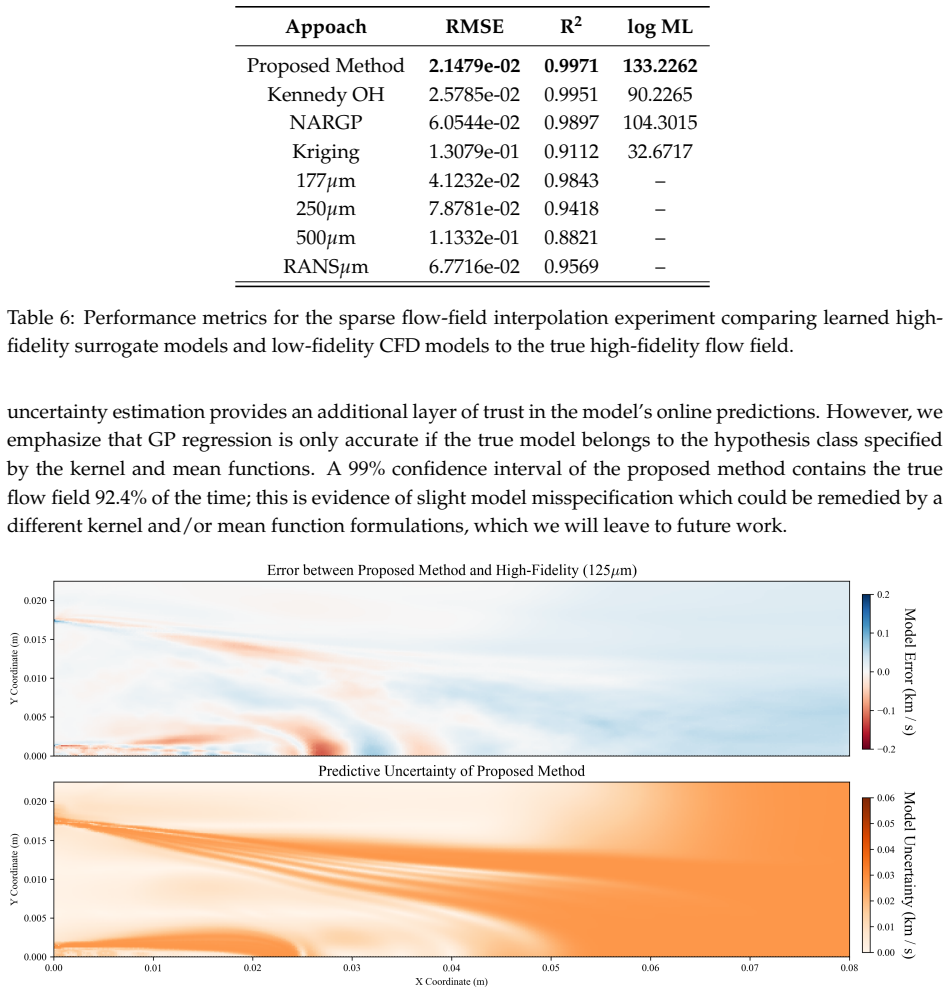
Summary. The paper proposes MAGPI, a multifidelity Gaussian-process surrogate that recursively augments the high-fidelity input space with predictions of all available lower-fidelity surrogates (Algorithms 1–2, feature map (11)). Low-fidelity stages may be any point-estimate regressor, while the high-fidelity stage remains a GP whose kernel and (optionally linear) mean act on the augmented features; this is claimed to combine cokriging-style use of all fidelities with the sequential cost of autoregressive methods. Complexity is stated as O(N1^3 + sum of low-fidelity train/predict costs). Three numerical studies (1-D analytic, laminar flame-speed extrapolation, sparse LES/RANS velocity interpolation) report lower RMSE, higher R2 and higher log marginal likelihood than Kennedy–O’Hagan, NARGP and single-fidelity kriging (Tables 2, 4, 6).
Significance. If the accuracy and cost claims hold under fair baselines, MAGPI is a practical and useful addition to the multifidelity GP literature: it removes the Markov restriction of classical autoregressive schemes, permits non-GP low-fidelity models (critical when low-fidelity data are abundant), and supplies a simple, implementable recipe that engineers can drop into existing GP tool-chains. The three application-oriented benchmarks and the explicit complexity comparison are genuine strengths. The theoretical contribution (Proposition 1) is modest—an essentially tautological statement that a larger hypothesis class cannot lower the supremum marginal likelihood—but does not undermine the engineering value of the method.
major comments (3)
- §4.2 and Eq. (14): MAGPI is given a linear mean that already mixes the low-fidelity surrogate outputs as features, while KOH, NARGP and single-fidelity kriging receive only constant means “to correct for vertical bias.” Because that linear mean is itself a simple multifidelity model, part of the reported gains in Table 2 (and likewise Tables 4 and 6) may be attributable to the mean rather than to the augmented-input kernel. Equalizing the mean class across all methods (or reporting an ablation with constant mean for MAGPI) is required before the claim of superiority over the state of the art can be accepted.
- §4.4: Full-rank GPs at the intermediate LES resolutions are declared prohibitively expensive, so KNN approximations are substituted for the low-fidelity stages of KOH and NARGP as well as MAGPI. The resulting comparison therefore no longer tests the published KOH/NARGP algorithms; it tests three different ways of using the same KNN features. Either a sparse/approximate GP implementation of the baselines or an explicit statement that the comparison is only among KNN-augmented variants is needed for the CFD claim to be load-bearing.
- Proposition 1 only guarantees that a larger hypothesis class can achieve a higher marginal likelihood; it does not guarantee better generalization or that the observed numerical superiority survives equalized means and equalized low-fidelity models. The abstract and introduction statements that the method is “more accurate … relative to the state of the art” therefore rest almost entirely on the three tables; those tables must be made robust to the two design choices above.
Circularity Check
No load-bearing circularity; methods paper whose accuracy claims rest on external numerical benchmarks, with only a near-tautological existence guarantee (Prop. 1) that does not force the reported gains.
full rationale
The derivation of MAGPI is definitional of a new estimator (augment high-fidelity GP inputs by recursive low-fidelity surrogate predictions, Algorithms 1–2 and eqs. 11–13) rather than a claimed first-principles derivation of a physical law. Hyperparameters are obtained by ordinary Type-II maximum likelihood (eq. 5 / §3.1), not by baking test-set RMSE/R^{2} into the objective. Proposition 1 merely observes that a larger hypothesis class (more features) can attain a marginal likelihood at least as high as a nested smaller class; this is true by construction of the suprema but is not used to claim that the numerical superiority over KOH/NARGP/kriging is forced, nor does it equate any reported prediction to a fitted target. No uniqueness theorem, ansatz, or load-bearing result is imported via self-citation. The three numerical tables compare against external baselines on independent test problems; any fairness concerns about mean-function choice or KNN substitution affect experimental design, not circularity of the method’s own equations. Hence the central claim of improved accuracy/cost does not reduce by construction to its inputs.
Axiom & Free-Parameter Ledger
free parameters (4)
- ARD lengthscales λ and kernel amplitude b (high-fidelity GP)
- High-fidelity noise variance σ₁²
- Linear mean coefficients α_i, β_ℓ, γ
- Low-fidelity surrogate hyperparameters (if GPs) or model choices (e.g., KNN k)
axioms (5)
- standard math High-fidelity observations are a GP prior plus i.i.d. Gaussian noise; posterior mean/variance follow the standard conditioning formulas.
- domain assumption Anisotropic RBF/ARD kernels define a sufficiently rich hypothesis class for the target high-fidelity maps.
- domain assumption Low-fidelity surrogate predictions are informative features for the high-fidelity map even when correlations are moderate (~0.4–0.6) and relationships are nonlinear.
- ad hoc to paper Fidelity ordering need only designate y₁ as highest; other levels may be arbitrarily ordered.
- standard math Enlarging the mean/kernel class by adding features cannot decrease the supremum achievable marginal likelihood (Prop. 1).
invented entities (1)
-
Multifidelity-augmented feature map φ_l (recursive concatenation of inputs with all higher-index surrogate predictions)
no independent evidence
read the original abstract
Supervised machine learning describes the practice of fitting a parameterized model to labeled input-output data. Supervised machine learning methods have demonstrated promise in learning efficient surrogate models that can (partially) replace expensive high-fidelity models, making many-query analyses, such as optimization, uncertainty quantification, and inference, tractable. However, when training data must be obtained through the evaluation of an expensive model or experiment, the amount of training data that can be obtained is often limited, which can make learned surrogate models unreliable. In many engineering and scientific settings, cheaper low-fidelity models may be available, for example arising from simplified physics modeling or coarse grids. These models may be used to generate additional low-fidelity training data. The goal of multifidelity machine learning is to use both high- and low-fidelity training data to learn a surrogate model which is cheaper to evaluate than the high-fidelity model, but more accurate than any available low-fidelity model. This work proposes a new multifidelity training approach for Gaussian process regression which uses low-fidelity data to define additional features that augment the input space of the learned model. Similarly to cokriging estimators, the proposed approach conditions the high-fidelity surrogate model on the predictions of all available low-fidelity surrogate models, while benefiting from the computational efficiency of autoregressive estimators. Numerical experiments on several test problems demonstrate both increased predictive accuracy and reduced computational cost relative to the state of the art.
Figures


Reference graph
Works this paper leans on
-
[1]
Multi-level CFD-based Airfoil Shape Optimization With Automated Low- fidelity Model Selection,
S. Koziel and L. Leifsson, “Multi-level CFD-based Airfoil Shape Optimization With Automated Low- fidelity Model Selection,”Procedia Computer Science, 2013 International Conference on Computational Science, vol. 18, pp. 889–898, Jan. 2013,ISSN: 1877-0509.DOI:10 . 1016 / j . procs . 2013 . 05 . 254 Accessed: Aug. 10, 2025. [Online]. Available:https://www.sc...
2013
-
[2]
MULTI-FIDELITY MACHINE LEARNING FOR UNCERTAINTY QUANTIFICATION AND OPTIMIZATION,
R. Zhang and N. Alemazkoor, “MULTI-FIDELITY MACHINE LEARNING FOR UNCERTAINTY QUANTIFICATION AND OPTIMIZATION,” English,Journal of Machine Learning for Modeling and Computing, vol. 5, no. 4, 2024,ISSN: 2689-3967, 2689-3975.DOI:10.1615/JMachLearnModelComput. 2024055786Accessed: Nov. 18, 2024. [Online]. Available:https : / / www . dl . begellhouse . com / jo...
-
[3]
Data-driven model reduction for the Bayesian solution of inverse problems,
T. Cui, Y. M. Marzouk, and K. E. Willcox, “Data-driven model reduction for the Bayesian solution of inverse problems,” en,International Journal for Numerical Methods in Engineering, vol. 102, no. 5, pp. 966–990, May 2015,ISSN: 0029-5981, 1097-0207.DOI:10.1002/nme.4748Accessed: Oct. 27, 2025. [Online]. Available:https://onlinelibrary.wiley.com/doi/10.1002/nme.4748
-
[4]
Model Reduction of Linear Dynamical Systems via Balancing for Bayesian Inference,
E. Qian et al., “Model Reduction of Linear Dynamical Systems via Balancing for Bayesian Inference,” en,Journal of Scientific Computing, vol. 91, no. 1, p. 29, Mar. 2022,ISSN: 1573-7691.DOI:10 . 1007 / s10915 - 022 - 01798 - 8Accessed: Oct. 27, 2025. [Online]. Available:https : / / doi . org / 10 . 1007 / s10915-022-01798-8
2022
-
[5]
Recent Advances in Surrogate Modeling Methods for Uncer- tainty Quantification and Propagation,
C. Wang, X. Qiang, M. Xu, and T. Wu, “Recent Advances in Surrogate Modeling Methods for Uncer- tainty Quantification and Propagation,” en,Symmetry, vol. 14, no. 6, p. 1219, Jun. 2022,ISSN: 2073- 8994.DOI:10.3390/sym14061219Accessed: Oct. 27, 2025. [Online]. Available:https://www.mdpi. com/2073-8994/14/6/1219
-
[6]
Bayesian Calibration of Computer Models,
M. C. Kennedy and A. O’Hagan, “Bayesian Calibration of Computer Models,”Journal of the Royal Statistical Society Series B: Statistical Methodology, vol. 63, no. 3, pp. 425–464, Sep. 2001,ISSN: 1369-7412. DOI:10.1111/1467-9868.00294Accessed: Oct. 27, 2025. [Online]. Available:https://doi.org/10. 1111/1467-9868.00294
-
[7]
Design and Analysis of Computer Experiments,
J. Sacks, W. J. Welch, T. J. Mitchell, and H. P . Wynn, “Design and Analysis of Computer Experiments,” Statistical Science, vol. 4, no. 4, pp. 409–423, Nov. 1989,ISSN: 0883-4237, 2168-8745.DOI:10.1214/ss/ 1177012413Accessed: Oct. 27, 2025. [Online]. Available:https://projecteuclid.org/journals/ statistical- science/volume- 4/issue- 4/Design- and- Analysis...
doi:10.1214/ss/ 1989
-
[8]
Y. Wang, Y. Wang, X. Zhang, G. Zhou, B. Yan, and R. J. M. Bastiaans, “Experimental and Numerical Study of the Laminar Burning Velocity and Pollutant Emissions of the Mixture Gas of Methane and Carbon Dioxide,”International Journal of Environmental Research and Public Health, vol. 19, no. 4, p. 2078, Feb. 2022,ISSN: 1661-7827.DOI:10.3390/ijerph19042078Acce...
-
[9]
An overview of statistical learning theory,
V . N. Vapnik, “An overview of statistical learning theory,” eng,IEEE transactions on neural networks, vol. 10, no. 5, pp. 988–999, 1999,ISSN: 1045-9227.DOI:10.1109/72.788640
-
[10]
Hastie, R
T. Hastie, R. Tibshirani, and J. Friedman,The Elements of Statistical Learning: Data Mining, Inference, and Prediction, Second Edition, en. Springer Science & Business Media, Aug. 2009, Google-Books-ID: tVIjmNS3Ob8C,ISBN: 978-0-387-84858-7. 21
2009
-
[11]
C. E. Rasmussen and C. K. I. Williams,Gaussian processes for machine learning(Adaptive computation and machine learning), en, 3. print. Cambridge, Mass.: MIT Press, 2008,ISBN: 978-0-262-18253-9
2008
-
[12]
Survey of Multifidelity Methods in Uncertainty Propagation, Inference, and Optimization,
B. Peherstorfer, K. Willcox, and M. Gunzburger, “Survey of Multifidelity Methods in Uncertainty Propagation, Inference, and Optimization,”SIAM Review, vol. 60, no. 3, pp. 550–591, Jan. 2018,ISSN: 0036-1445.DOI:10.1137/16M1082469Accessed: Oct. 17, 2025. [Online]. Available:https://epubs. siam.org/doi/10.1137/16M1082469
-
[13]
Multifidelity linear regression for scientific machine learning from scarce data,
E. Qian, D. Kang, V . Sella, and A. Chaudhuri, “Multifidelity linear regression for scientific machine learning from scarce data,” en,Foundations of Data Science, vol. 7, no. 1, pp. 271–297, Mar. 2025.DOI: 10.3934/fods.2024049Accessed: Oct. 15, 2025. [Online]. Available:https://www.aimsciences. org/en/article/doi/10.3934/fods.2024049
-
[14]
Review of multi-fidelity models,
M. G. Fernández-Godino, “Review of multi-fidelity models,”Advances in Computational Science and Engineering, vol. 1, no. 4, pp. 351–400, 2023, arXiv:1609.07196 [stat],ISSN: 2837-1739.DOI:10.3934/ acse.2023015Accessed: Dec. 31, 2024. [Online]. Available:http://arxiv.org/abs/1609.07196
Pith/arXiv arXiv 2023
-
[15]
L. Brevault, M. Balesdent, and A. Hebbal, “Overview of Gaussian process based multi-fidelity tech- niques with variable relationship between fidelities, application to aerospace systems,”Aerospace Sci- ence and Technology, vol. 107, p. 106 339, Dec. 2020,ISSN: 1270-9638.DOI:10.1016/j.ast.2020.106339 Accessed: Oct. 15, 2025. [Online]. Available:https://www...
-
[16]
MFNets: MULTI-FIDELITY DATA- DRIVEN NETWORKS FOR BAYESIAN LEARNING AND PREDICTION,
A. A. Gorodetsky, J. D. Jakeman, G. Geraci, and M. S. Eldred, “MFNets: MULTI-FIDELITY DATA- DRIVEN NETWORKS FOR BAYESIAN LEARNING AND PREDICTION,” en,International Journal for Uncertainty Quantification, vol. 10, no. 6, pp. 595–622, 2020,ISSN: 2152-5080.DOI:10.1615/Int.J. UncertaintyQuantification.2020032978Accessed: Jun. 7, 2025. [Online]. Available:http...
doi:10.1615/int.j 2020
-
[17]
Multifidelity deep operator networks for data-driven and physics-informed problems,
A. A. Howard, M. Perego, G. E. Karniadakis, and P . Stinis, “Multifidelity deep operator networks for data-driven and physics-informed problems,”Journal of Computational Physics, vol. 493, p. 112 462, Nov. 2023,ISSN: 0021-9991.DOI:10 . 1016 / j . jcp . 2023 . 112462Accessed: Feb. 12, 2026. [Online]. Available:https://www.sciencedirect.com/science/article/...
2023
-
[18]
A multifidelity approach to continual learning for physical systems,
A. Howard, Y. Fu, and P . Stinis, “A multifidelity approach to continual learning for physical systems,” en,Machine Learning: Science and Technology, vol. 5, no. 2, p. 025 042, May 2024,ISSN: 2632-2153.DOI: 10.1088/2632- 2153/ad45b2Accessed: Feb. 12, 2026. [Online]. Available:https://doi.org/10. 1088/2632-2153/ad45b2
doi:10.1088/2632- 2024
-
[19]
L. Lu, R. Pestourie, S. G. Johnson, and G. Romano, “Multifidelity deep neural operators for efficient learning of partial differential equations with application to fast inverse design of nanoscale heat transport,”Physical Review Research, vol. 4, no. 2, p. 023 210, Jun. 2022.DOI:10.1103/PhysRevResearch. 4 . 023210Accessed: Feb. 12, 2026. [Online]. Availa...
-
[20]
A. Heinlein, A. A. Howard, D. Beecroft, and P . Stinis,Multifidelity domain decomposition-based physics- informed neural networks and operators for time-dependent problems, en, arXiv:2401.07888 [math], Jun. 2024.DOI:10.48550/arXiv.2401.07888Accessed: Feb. 12, 2026. [Online]. Available:http://arxiv. org/abs/2401.07888 22
Pith/arXiv arXiv doi:10.48550/arxiv.2401.07888accessed: 2024
-
[21]
Multilevel Monte Carlo methods,
M. B. Giles, “Multilevel Monte Carlo methods,” en,Acta Numerica, vol. 24, pp. 259–328, May 2015, ISSN: 0962-4929, 1474-0508.DOI:10 . 1017 / S096249291500001XAccessed: Jan. 17, 2026. [Online]. Available:https://www.cambridge.org/core/journals/acta-numerica/article/abs/multilevel- monte-carlo-methods/C5AF9A57ED8FF8FDF08074C1071C5511
2015
-
[22]
A generalized approximate con- trol variate framework for multifidelity uncertainty quantification,
A. A. Gorodetsky, G. Geraci, M. S. Eldred, and J. D. Jakeman, “A generalized approximate con- trol variate framework for multifidelity uncertainty quantification,”Journal of Computational Physics, vol. 408, p. 109 257, May 2020,ISSN: 0021-9991.DOI:10 . 1016 / j . jcp . 2020 . 109257Accessed: Oct. 17, 2025. [Online]. Available:https : / / www . sciencedire...
2020
-
[23]
Optimal Model Management for Multifidelity Monte Carlo Estimation,
B. Peherstorfer, K. Willcox, and M. Gunzburger, “Optimal Model Management for Multifidelity Monte Carlo Estimation,” en,SIAM Journal on Scientific Computing, vol. 38, no. 5, A3163–A3194, Jan. 2016, ISSN: 1064-8275, 1095-7197.DOI:10.1137/15M1046472Accessed: Oct. 17, 2025. [Online]. Available: http://epubs.siam.org/doi/10.1137/15M1046472
-
[24]
A. A. Gorodetsky, J. D. Jakeman, and M. S. Eldred,Grouped approximate control variate estimators, arXiv:2402.14736 [stat], Feb. 2024.DOI:10.48550/arXiv.2402.14736Accessed: Jan. 12, 2026. [On- line]. Available:http://arxiv.org/abs/2402.14736
Pith/arXiv arXiv doi:10.48550/arxiv.2402.14736accessed: 2024
-
[25]
On Multilevel Best Linear Unbiased Estimators,
D. Schaden and E. Ullmann, “On Multilevel Best Linear Unbiased Estimators,”SIAM/ASA Journal on Uncertainty Quantification, vol. 8, no. 2, pp. 601–635, Jan. 2020.DOI:10.1137/19M1263534Accessed: Oct. 21, 2025. [Online]. Available:https://epubs.siam.org/doi/10.1137/19M1263534
-
[26]
Multifidelity Monte Carlo Es- timation of Variance and Sensitivity Indices,
E. Qian, B. Peherstorfer, D. O’Malley, V . V . Vesselinov, and K. Willcox, “Multifidelity Monte Carlo Es- timation of Variance and Sensitivity Indices,”SIAM/ASA Journal on Uncertainty Quantification, vol. 6, no. 2, pp. 683–706, Jan. 2018.DOI:10.1137/17M1151006Accessed: Feb. 12, 2026. [Online]. Available: https://epubs.siam.org/doi/abs/10.1137/17M1151006
-
[27]
A. A. Popov and A. Sandu,Multifidelity Ensemble Kalman Filtering Using Surrogate Models Defined by Physics-Informed Autoencoders, arXiv:2102.13025 [math], Mar. 2021.DOI:10.48550/arXiv.2102.13025 Accessed: Jan. 26, 2026. [Online]. Available:http://arxiv.org/abs/2102.13025
work page internal anchor Pith review Pith/arXiv arXiv doi:10.48550/arxiv.2102.13025 2021
-
[28]
A transport-based multifidelity preconditioner for Markov chain Monte Carlo
B. Peherstorfer and Y. Marzouk,A transport-based multifidelity preconditioner for Markov chain Monte Carlo, arXiv:1808.09379 [math], Aug. 2018.DOI:10.48550/arXiv.1808.09379Accessed: Jan. 17, 2026. [Online]. Available:http://arxiv.org/abs/1808.09379
work page internal anchor Pith review Pith/arXiv arXiv doi:10.48550/arxiv.1808.09379accessed: 2018
-
[29]
T. A. Catanach, H. D. Vo, and B. Munsky, “Bayesian inference of Stochastic reaction networks using Multifidelity Sequential Tempered Markov Chain Monte Carlo,” English,International Journal for Un- certainty Quantification, vol. 10, no. 6, Jun. 2020, Number: SAND2020–7898J; SAND2019–15382J,ISSN: 2152-5080.DOI:10.1615/int.j.uncertaintyquantification.202003...
work page doi:10.1615/int.j.uncertaintyquantification.2020033241accessed: 2020
-
[30]
Markov chain Monte Carlo Using an Approximation,
J. A. Christen and C. Fox, “Markov chain Monte Carlo Using an Approximation,”Journal of Computa- tional and Graphical Statistics, vol. 14, no. 4, pp. 795–810, Dec. 2005, _eprint: https://doi.org/10.1198/106186005X76983, ISSN: 1061-8600.DOI:10.1198/106186005X76983Accessed: Mar. 5, 2026. [Online]. Available:https: //doi.org/10.1198/106186005X76983
-
[31]
Multi-fidelity Monte Carlo: A pseudo-marginal approach,
D. Cai and R. P . Adams, “Multi-fidelity Monte Carlo: A pseudo-marginal approach,” en,Advances in Neural Information Processing Systems, vol. 35, pp. 21 654–21 667, Dec. 2022. Accessed: Jan. 17, 2026. [Online]. Available:https://proceedings.neurips.cc/paper_files/paper/2022/hash/8803b9ae0b13011f28e6dd57da2ebbd8- Abstract-Conference.html?utm_source=chatgpt.com 23
2022
-
[32]
D. J. Warne, T. P . Prescott, R. E. Baker, and M. J. Simpson, “Multifidelity multilevel Monte Carlo to accelerate approximate Bayesian parameter inference for partially observed stochastic processes,” Journal of Computational Physics, vol. 469, p. 111 543, Nov. 2022,ISSN: 0021-9991.DOI:10 . 1016 / j . jcp.2022.111543Accessed: Jan. 17, 2026. [Online]. Avai...
arXiv 2022
-
[33]
A relaxed localized trust-region reduced basis approach for optimization of multiscale problems,
T. Keil and M. Ohlberger, “A relaxed localized trust-region reduced basis approach for optimization of multiscale problems,” en,ESAIM: Mathematical Modelling and Numerical Analysis, vol. 58, no. 1, pp. 79–105, Jan. 2024,ISSN: 2822-7840, 2804-7214.DOI:10 . 1051 / m2an / 2023089Accessed: Feb. 12,
2024
-
[34]
Available:https://www.esaim-m2an.org/articles/m2an/abs/2024/01/m2an220169/ m2an220169.html
[Online]. Available:https://www.esaim-m2an.org/articles/m2an/abs/2024/01/m2an220169/ m2an220169.html
2024
-
[35]
A Certified Trust Region Reduced Basis Approach to PDE-Constrained Optimization,
E. Qian, M. Grepl, K. Veroy, and K. Willcox, “A Certified Trust Region Reduced Basis Approach to PDE-Constrained Optimization,”SIAM Journal on Scientific Computing, vol. 39, no. 5, S434–S460, Jan. 2017,ISSN: 1064-8275.DOI:10.1137/16M1081981Accessed: Feb. 12, 2026. [Online]. Available:https: //epubs.siam.org/doi/abs/10.1137/16M1081981
-
[36]
B. Klein and M. Ohlberger,Multi-fidelity Learning of Reduced Order Models for Parabolic PDE Constrained Optimization, arXiv:2503.21252 [math], Mar. 2025.DOI:10 . 48550 / arXiv . 2503 . 21252Accessed: Feb. 12, 2026. [Online]. Available:http://arxiv.org/abs/2503.21252
Pith/arXiv arXiv 2025
-
[37]
K. Li and F. Li,Multi-Fidelity Methods for Optimization: A Survey, arXiv:2402.09638 [cs], Feb. 2024.DOI: 10.48550/arXiv.2402.09638Accessed: Feb. 12, 2026. [Online]. Available:http://arxiv.org/abs/ 2402.09638
Pith/arXiv arXiv doi:10.48550/arxiv.2402.09638accessed: 2024
-
[38]
A General Framework for Multi-fidelity Bayesian Optimization with Gaussian Processes,
J. Song, Y. Chen, and Y. Yue, “A General Framework for Multi-fidelity Bayesian Optimization with Gaussian Processes,” en, inProceedings of the Twenty-Second International Conference on Artificial Intel- ligence and Statistics, PMLR, Apr. 2019, pp. 3158–3167. Accessed: Feb. 12, 2026. [Online]. Available: https://proceedings.mlr.press/v89/song19b.html
2019
-
[39]
Multi-fidelity optimization via surrogate modelling,
A. I. Forrester, A. Sóbester, and A. J. Keane, “Multi-fidelity optimization via surrogate modelling,” Proceedings of the Royal Society A: Mathematical, Physical and Engineering Sciences, vol. 463, no. 2088, pp. 3251–3269, Oct. 2007,ISSN: 1364-5021.DOI:10.1098/rspa.2007.1900Accessed: Feb. 12, 2026. [Online]. Available:https://doi.org/10.1098/rspa.2007.1900
-
[40]
M. J. Zahr, P . Avery, and C. Farhat, “A multilevel projection-based model order reduction framework for nonlinear dynamic multiscale problems in structural and solid mechanics,” en,International Jour- nal for Numerical Methods in Engineering, vol. 112, no. 8, pp. 855–881, Nov. 2017,ISSN: 0029-5981, 1097- 0207.DOI:10.1002/nme.5535Accessed: Feb. 12, 2026. ...
-
[41]
Design optimization using hyper-reduced-order mod- els,
D. Amsallem, M. Zahr, Y. Choi, and C. Farhat, “Design optimization using hyper-reduced-order mod- els,” en,Structural and Multidisciplinary Optimization, vol. 51, no. 4, pp. 919–940, Apr. 2015,ISSN: 1615- 147X, 1615-1488.DOI:10 . 1007 / s00158 - 014 - 1183 - yAccessed: Feb. 12, 2026. [Online]. Available: http://link.springer.com/10.1007/s00158-014-1183-y
-
[42]
An optimization-based framework for anisotropic simplex mesh adap- tation,
M. Yano and D. L. Darmofal, “An optimization-based framework for anisotropic simplex mesh adap- tation,”Journal of Computational Physics, vol. 231, no. 22, pp. 7626–7649, Sep. 2012,ISSN: 0021-9991. DOI:10 . 1016 / j . jcp . 2012 . 06 . 040Accessed: Feb. 12, 2026. [Online]. Available:https : / / www . sciencedirect.com/science/article/pii/S0021999112003749 24
2012
-
[43]
A statistical approach to some basic mine valuation problems on the Witwatersrand,
D. G. Krige, “A statistical approach to some basic mine valuation problems on the Witwatersrand,” Journal of the Southern African Institute of Mining and Metallurgy, vol. 52, no. 6, pp. 119–139, Dec. 1951. DOI:10.10520/AJA0038223X_4792Accessed: Jun. 23, 2025. [Online]. Available:https://journals. co.za/doi/10.10520/AJA0038223X_4792
-
[44]
G. Matheron, “Principles of geostatistics,”Economic Geology, vol. 58, no. 8, pp. 1246–1266, Dec. 1963, ISSN: 0361-0128.DOI:10.2113/gsecongeo.58.8.1246Accessed: Jun. 23, 2025. [Online]. Available: https://doi.org/10.2113/gsecongeo.58.8.1246
-
[45]
Predicting the Output from a Complex Computer Code When Fast Approximations Are Available,
M. C. Kennedy and A. O’Hagan, “Predicting the Output from a Complex Computer Code When Fast Approximations Are Available,”Biometrika, vol. 87, no. 1, pp. 1–13, 2000,ISSN: 0006-3444. Accessed: Nov. 23, 2024. [Online]. Available:https://www.jstor.org/stable/2673557
arXiv 2000
-
[46]
R. M. Neal, “Priors for Infinite Networks,” en, inBayesian Learning for Neural Networks, R. M. Neal, Ed., New York, NY: Springer, 1996, pp. 29–53,ISBN: 978-1-4612-0745-0.DOI:10.1007/978-1-4612-0745- 0_2Accessed: Nov. 3, 2025. [Online]. Available:https://doi.org/10.1007/978-1-4612-0745-0_2
-
[47]
Multilayer feedforward networks are universal approx- imators,
K. Hornik, M. Stinchcombe, and H. White, “Multilayer feedforward networks are universal approx- imators,”Neural Networks, vol. 2, no. 5, pp. 359–366, Jan. 1989,ISSN: 0893-6080.DOI:10.1016/0893- 6080(89)90020- 8Accessed: Nov. 3, 2025. [Online]. Available:https://www.sciencedirect.com/ science/article/pii/0893608089900208
doi:10.1016/0893- 1989
-
[48]
Evaluation of gaussian processes and other methods for non-linear regression,
C. E. Rasmussen, “Evaluation of gaussian processes and other methods for non-linear regression,” AAINQ28300 ISBN-10: 0612283003, phd, University of Toronto, CAN, 1997
1997
-
[49]
Matrix formulation of co-kriging,
D. E. Myers, “Matrix formulation of co-kriging,” en,Journal of the International Association for Math- ematical Geology, vol. 14, no. 3, pp. 249–257, Jun. 1982,ISSN: 1573-8868.DOI:10 . 1007 / BF01032887 Accessed: Sep. 10, 2024. [Online]. Available:https://doi.org/10.1007/BF01032887
-
[50]
Linear coregionalization model: Tools for estimation and choice of cross- variogram matrix,
M. Goulard and M. Voltz, “Linear coregionalization model: Tools for estimation and choice of cross- variogram matrix,” en,Mathematical Geology, vol. 24, no. 3, pp. 269–286, Apr. 1992,ISSN: 1573-8868. DOI:10.1007/BF00893750Accessed: Sep. 9, 2025. [Online]. Available:https://doi.org/10.1007/ BF00893750
-
[51]
Kernels for Vector-Valued Functions: A Review,
M. A. Álvarez, L. Rosasco, and N. D. Lawrence, “Kernels for Vector-Valued Functions: A Review,” English,Foundations and Trends® in Machine Learning, vol. 4, no. 3, pp. 195–266, Jun. 2012,ISSN: 1935- 8237, 1935-8245.DOI:10.1561/2200000036Accessed: Oct. 15, 2025. [Online]. Available:https:// www.nowpublishers.com/article/Details/MAL-036
-
[52]
Multi-task Gaussian Process Prediction,
E. V . Bonilla, K. Chai, and C. Williams, “Multi-task Gaussian Process Prediction,” inAdvances in Neural Information Processing Systems, vol. 20, Curran Associates, Inc., 2007. Accessed: Oct. 15, 2025. [Online]. Available:https://papers.nips.cc/paper_files/paper/2007/hash/66368270ffd51418ec58bd793f2d9b1b- Abstract.html
arXiv 2007
-
[53]
Z. Xu, H. Wang, J. M. Phillips, and S. Zhe,Standard Gaussian Process is All You Need for High-Dimensional Bayesian Optimization, arXiv:2402.02746 [cs], Mar. 2025.DOI:10.48550/arXiv.2402.02746Accessed: Oct. 27, 2025. [Online]. Available:http://arxiv.org/abs/2402.02746
Pith/arXiv arXiv doi:10.48550/arxiv.2402.02746accessed: 2025
-
[54]
T. Zhou and Y. Peng, “Kernel principal component analysis-based Gaussian process regression mod- elling for high-dimensional reliability analysis,”Computers & Structures, vol. 241, p. 106 358, Dec. 2020,ISSN: 0045-7949.DOI:10.1016/j.compstruc.2020.106358Accessed: Oct. 27, 2025. [Online]. Available:https://www.sciencedirect.com/science/article/pii/S0045794...
-
[55]
Variable noise and dimensionality reduction for sparse Gaussian pro- cesses,
E. Snelson and Z. Ghahramani, “Variable noise and dimensionality reduction for sparse Gaussian pro- cesses,” inProceedings of the Twenty-Second Conference on Uncertainty in Artificial Intelligence, ser. UAI’06, Arlington, Virginia, USA: AUAI Press, Jul. 2006, pp. 461–468,ISBN: 978-0-9749039-2-7. Accessed: Oct. 27, 2025
2006
-
[56]
R. Tripathy, I. Bilionis, and M. Gonzalez, “Gaussian processes with built-in dimensionality reduction: Applications to high-dimensional uncertainty propagation,”Journal of Computational Physics, vol. 321, pp. 191–223, Sep. 2016,ISSN: 0021-9991.DOI:10.1016/j.jcp.2016.05.039Accessed: Oct. 27, 2025. [Online]. Available:https://www.sciencedirect.com/science/a...
-
[57]
A. G. Wilson, Z. Hu, R. Salakhutdinov, and E. P . Xing,Deep Kernel Learning, arXiv:1511.02222 [cs], Nov. 2015.DOI:10.48550/ arXiv.1511. 02222Accessed: Apr. 16, 2025. [Online]. Available:http: //arxiv.org/abs/1511.02222
Pith/arXiv arXiv 2015
-
[58]
J. O. Berger, “Bayesian Analysis,” en, inStatistical Decision Theory and Bayesian Analysis, J. O. Berger, Ed., New York, NY: Springer, 1985, pp. 118–307,ISBN: 978-1-4757-4286-2.DOI:10.1007/978-1-4757- 4286- 2_4Accessed: Nov. 3, 2025. [Online]. Available:https://doi.org/10.1007/978- 1- 4757- 4286-2_4
-
[59]
Sparse Gaussian process hyperparam- eters: Optimize or integrate?
V . Lalchand, W. P . Bruinsma, D. R. Burt, and C. E. Rasmussen, “Sparse Gaussian process hyperparam- eters: Optimize or integrate?” InProceedings of the 36th International Conference on Neural Information Processing Systems, ser. NIPS ’22, Red Hook, NY, USA: Curran Associates Inc., Nov. 2022, pp. 16 612– 16 623,ISBN: 978-1-71387-108-8. Accessed: Oct. 27, 2025
2022
-
[60]
M. L. Stein,Interpolation of Spatial Data(Springer Series in Statistics). New York, NY: Springer, 1999, ISBN: 978-1-4612-7166-6 978-1-4612-1494-6.DOI:10.1007/ 978- 1- 4612- 1494- 6Accessed: Oct. 27,
1999
-
[61]
Available:http://link.springer.com/10.1007/978-1-4612-1494-6
[Online]. Available:http://link.springer.com/10.1007/978-1-4612-1494-6
-
[62]
Practical Bayesian Optimization of Machine Learning Al- gorithms,
J. Snoek, H. Larochelle, and R. P . Adams, “Practical Bayesian Optimization of Machine Learning Al- gorithms,” inAdvances in Neural Information Processing Systems, vol. 25, Curran Associates, Inc., 2012. Accessed: Nov. 3, 2025. [Online]. Available:https://papers.nips.cc/paper_files/paper/2012/ hash/05311655a15b75fab86956663e1819cd-Abstract.html
arXiv 2012
-
[63]
Spatial Modelling Using a New Class of Nonstationary Covariance Functions,
C. J. Paciorek and M. J. Schervish, “Spatial Modelling Using a New Class of Nonstationary Covariance Functions,”Environmetrics, vol. 17, no. 5, pp. 483–506, 2006,ISSN: 1180-4009.DOI:10 . 1002 / env . 785Accessed: Oct. 27, 2025. [Online]. Available:https : / / pmc . ncbi . nlm . nih . gov / articles / PMC2157553/
2006
-
[64]
Y. Kındap and S. Godsill,Non-Gaussian Process Regression, arXiv:2209.03117 [stat], Sep. 2022.DOI:10. 48550 /arXiv .2209 .03117Accessed: Oct. 27, 2025. [Online]. Available:http: / /arxiv .org /abs / 2209.03117
Pith/arXiv arXiv 2022
-
[65]
Deep Gaussian Processes,
A. Damianou and N. D. Lawrence, “Deep Gaussian Processes,” en, inProceedings of the Sixteenth International Conference on Artificial Intelligence and Statistics, PMLR, Apr. 2013, pp. 207–215. Accessed: Jun. 20, 2025. [Online]. Available:https://proceedings.mlr.press/v31/damianou13a.html
2013
-
[66]
Sparse Greedy Matrix Approximation for Machine Learning,
A. J. Smola and B. Schökopf, “Sparse Greedy Matrix Approximation for Machine Learning,” inPro- ceedings of the Seventeenth International Conference on Machine Learning, ser. ICML ’00, San Francisco, CA, USA: Morgan Kaufmann Publishers Inc., Jun. 2000, pp. 911–918,ISBN: 978-1-55860-707-1. Ac- cessed: Mar. 13, 2025. 26
2000
-
[67]
Using the Nyström Method to Speed Up Kernel Machines,
C. Williams and M. Seeger, “Using the Nyström Method to Speed Up Kernel Machines,” inAdvances in Neural Information Processing Systems, vol. 13, MIT Press, 2000. Accessed: Mar. 13, 2025. [Online]. Available:https://papers.nips.cc/paper_files/paper/2000/hash/19de10adbaa1b2ee13f77f679fa1483a- Abstract.html
2000
-
[68]
Variational Learning of Inducing Variables in Sparse Gaussian Processes,
M. Titsias, “Variational Learning of Inducing Variables in Sparse Gaussian Processes,” en, inPro- ceedings of the Twelfth International Conference on Artificial Intelligence and Statistics, PMLR, Apr. 2009, pp. 567–574. Accessed: Jun. 23, 2025. [Online]. Available:https : / / proceedings . mlr . press / v5 / titsias09a.html
2009
-
[69]
Efficient SVM Training Using Low-Rank Kernel Representations,
S. Fine and K. Scheinberg, “Efficient SVM Training Using Low-Rank Kernel Representations,”Jour- nal of Machine Learning Research, vol. 2, no. Dec, pp. 243–264, 2001,ISSN: ISSN 1533-7928. Accessed: Mar. 13, 2025. [Online]. Available:https://www.jmlr.org/papers/v2/fine01a.html
2001
-
[70]
Kernel Interpolation for Scalable Structured Gaussian Processes (KISS- GP),
A. Wilson and H. Nickisch, “Kernel Interpolation for Scalable Structured Gaussian Processes (KISS- GP),” en, inProceedings of the 32nd International Conference on Machine Learning, PMLR, Jun. 2015, pp. 1775–1784. Accessed: Apr. 30, 2025. [Online]. Available:https://proceedings.mlr.press/v37/ wilson15.html
2015
-
[71]
Random Features for Large-Scale Kernel Machines,
A. Rahimi and B. Recht, “Random Features for Large-Scale Kernel Machines,” inAdvances in Neural Information Processing Systems, vol. 20, Curran Associates, Inc., 2007. Accessed: Jun. 23, 2025. [Online]. Available:https://papers.nips.cc/paper_files/paper/2007/hash/013a006f03dbc5392effeb8f18fda755- Abstract.html
2007
-
[72]
Scalable Kernel Methods via Doubly Stochastic Gradients,
B. Dai et al., “Scalable Kernel Methods via Doubly Stochastic Gradients,” inAdvances in Neural In- formation Processing Systems, vol. 27, Curran Associates, Inc., 2014. Accessed: Dec. 20, 2024. [Online]. Available:https://proceedings.neurips.cc/paper_files/paper/2014/hash/95d309f0b035d97f69902e7972c2b2e6- Abstract.html
2014
-
[73]
Multi-fidelity Gaussian process regression for computer experiments,
L. L. Gratiet, “Multi-fidelity Gaussian process regression for computer experiments,” fr, Ph.D. dis- sertation, Université Paris-Diderot - Paris VII, Oct. 2013. Accessed: Oct. 28, 2024. [Online]. Available: https://theses.hal.science/tel-00866770
2013
-
[74]
Multi-Fidelity for MDO Using Gaussian Pro- cesses,
N. Garland, R. Le Riche, Y. Richet, and N. Durrande, “Multi-Fidelity for MDO Using Gaussian Pro- cesses,” en, inAerospace System Analysis and Optimization in Uncertainty, L. Brevault, M. Balesdent, and J. Morio, Eds., Cham: Springer International Publishing, 2020, pp. 295–320,ISBN: 978-3-030-39126-3. DOI:10.1007/978-3-030-39126-3_8Accessed: Mar. 5, 2026. ...
-
[75]
M. Raissi and G. Karniadakis,Deep Multi-fidelity Gaussian Processes, arXiv:1604.07484 [cs], Apr. 2016. DOI:10.48550/arXiv.1604.07484Accessed: Dec. 31, 2024. [Online]. Available:http://arxiv.org/ abs/1604.07484
Pith/arXiv arXiv doi:10.48550/arxiv.1604.07484accessed: 2016
-
[76]
A combined modeling method for complex multi-fidelity data fusion,
L. Tang et al., “A combined modeling method for complex multi-fidelity data fusion,” en,Machine Learning: Science and Technology, vol. 5, no. 3, p. 035 071, Sep. 2024,ISSN: 2632-2153.DOI:10 . 1088 / 2632- 2153/ad718fAccessed: Nov. 18, 2024. [Online]. Available:https://dx.doi.org/10.1088/ 2632-2153/ad718f
2024
-
[77]
A generalized hierarchical co-Kriging model for multi- fidelity data fusion,
Q. Zhou, Y. Wu, Z. Guo, J. Hu, and P . Jin, “A generalized hierarchical co-Kriging model for multi- fidelity data fusion,” en,Structural and Multidisciplinary Optimization, vol. 62, no. 4, pp. 1885–1904, Oct. 2020,ISSN: 1615-1488.DOI:10.1007/s00158- 020- 02583- 7Accessed: Nov. 18, 2024. [Online]. Available:https://doi.org/10.1007/s00158-020-02583-7 27
doi:10.1007/s00158- 1904
-
[78]
A sequential multi-fidelity metamodeling approach for data regression,
Q. Zhou, Y. Wang, S.-K. Choi, P . Jiang, X. Shao, and J. Hu, “A sequential multi-fidelity metamodeling approach for data regression,”Knowledge-Based Systems, vol. 134, pp. 199–212, Oct. 2017,ISSN: 0950- 7051.DOI:10.1016/j.knosys.2017.07.033Accessed: Nov. 18, 2024. [Online]. Available:https: //www.sciencedirect.com/science/article/pii/S0950705117303556
-
[79]
B. Yang, B. Chen, Y. Liu, and J. Chen, “Gaussian process fusion method for multi-fidelity data with heterogeneity distribution in aerospace vehicle flight dynamics,”Engineering Applications of Artificial Intelligence, vol. 138, p. 109 228, Dec. 2024,ISSN: 0952-1976.DOI:10.1016/j.engappai.2024.109228 Accessed: Nov. 18, 2024. [Online]. Available:https://www...
-
[80]
Nonlinear information fusion algorithms for data-efficient multi-fidelity modelling,
P . Perdikaris, M. Raissi, A. Damianou, N. D. Lawrence, and G. E. Karniadakis, “Nonlinear information fusion algorithms for data-efficient multi-fidelity modelling,”Proceedings of the Royal Society A: Math- ematical, Physical and Engineering Sciences, vol. 473, no. 2198, p. 20 160 751, Feb. 2017.DOI:10.1098/ rspa.2016.0751Accessed: Nov. 18, 2024. [Online]...
discussion (0)
Sign in with ORCID, Apple, or X to comment. Anyone can read and Pith papers without signing in.