Comparing Semi-Parametric Model Learning Algorithms for Dynamic Model Estimation in Robotics
Pith reviewed 2026-05-25 14:07 UTC · model grok-4.3
The pith
Semi-parametric Gaussian process regression yields the most accurate inverse dynamics models for robots in all but one tested case.
A machine-rendered reading of the paper's core claim, the machinery that carries it, and where it could break.
Core claim
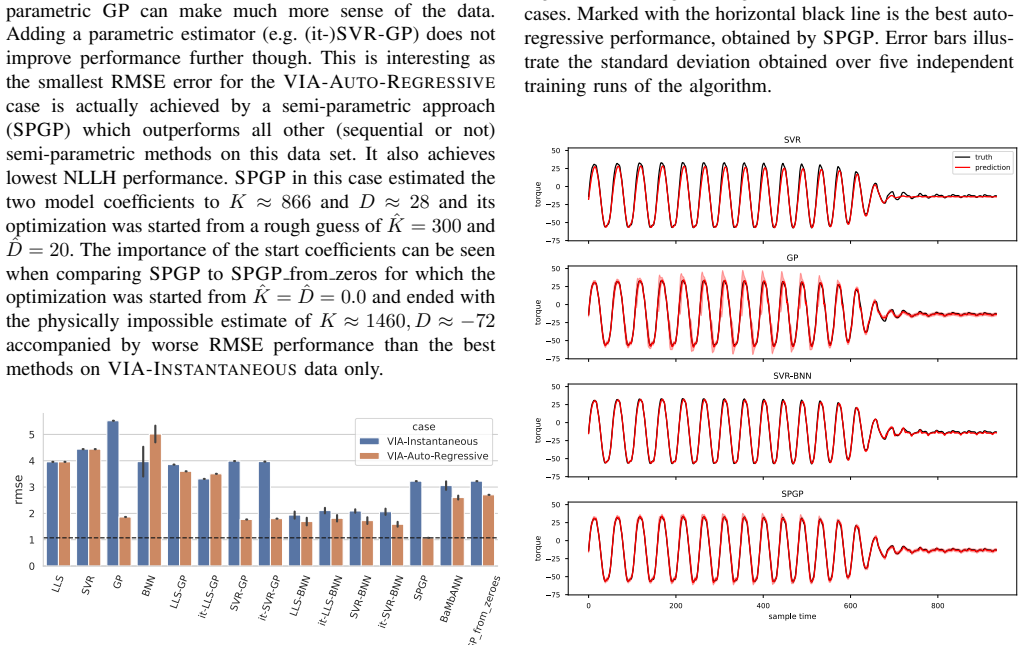
We evaluated semi-parametric Gaussian process regression and a novel model-based neural network architecture, and compared their modeling accuracy to a series of naive semi-parametric, parametric-only and non-parametric-only regression methods. The comparison has been carried out on three test scenarios, one involving a real test-bed and two involving simulated scenarios, with the most complex scenario targeting the modeling a simulated robot's inverse dynamics model. We found that in all but one case, semi-parametric Gaussian process regression yields the most accurate models, also with little tuning required for the training procedure.
What carries the argument
Semi-parametric Gaussian process regression, which augments a physical model with a Gaussian process to capture residual dynamics.
If this is right
- Semi-parametric GP regression can be applied directly to improve accuracy in robot control tasks without extensive hyperparameter search.
- Hybrid physical-ML models outperform both purely physical and purely data-driven approaches in the tested inverse dynamics cases.
- The model-based neural network provides a viable alternative but does not match GP regression performance in most scenarios.
- Little tuning requirement for the GP method reduces the engineering effort needed to deploy accurate dynamic models.
Where Pith is reading between the lines
- These results point toward standardizing semi-parametric GP methods in robotic simulation and control pipelines where inverse dynamics accuracy is critical.
- Extending the comparison to online learning or adaptive scenarios could reveal whether the low-tuning advantage persists during operation.
- The findings suggest that residual modeling with GPs may generalize to other robotic estimation problems like forward dynamics or contact forces.
Load-bearing premise
The three chosen test scenarios and the selected baseline methods are representative enough to draw general conclusions about real-world robotic inverse dynamics modeling.
What would settle it
A new experiment on an additional robot platform or scenario where a different method, such as the model-based neural network or a pure non-parametric approach, consistently produces lower error than semi-parametric GP regression across multiple trials.
Figures




read the original abstract
Physical modeling of robotic system behavior is the foundation for controlling many robotic mechanisms to a satisfactory degree. Mechanisms are also typically designed in a way that good model accuracy can be achieved with relatively simple models and model identification strategies. If the modeling accuracy using physically based models is not enough or too complex, model-free methods based on machine learning techniques can help. Of particular interest to us was therefore the question to what degree semi-parametric modeling techniques, meaning combinations of physical models with machine learning, increase the modeling accuracy of inverse dynamics models which are typically used in robot control. To this end, we evaluated semi-parametric Gaussian process regression and a novel model-based neural network architecture, and compared their modeling accuracy to a series of naive semi-parametric, parametric-only and non-parametric-only regression methods. The comparison has been carried out on three test scenarios, one involving a real test-bed and two involving simulated scenarios, with the most complex scenario targeting the modeling a simulated robot's inverse dynamics model. We found that in all but one case, semi-parametric Gaussian process regression yields the most accurate models, also with little tuning required for the training procedure.
Editorial analysis
A structured set of objections, weighed in public.
Referee Report
Summary. The paper claims that semi-parametric Gaussian process regression, when combining physical models with machine learning, yields the most accurate inverse dynamics models for robotics in all but one of three evaluated scenarios (one real test-bed, two simulated), outperforming parametric-only, non-parametric-only, and other semi-parametric baselines including a novel model-based neural network, while requiring little tuning.
Significance. If the empirical results hold under broader conditions, the work demonstrates practical value in hybrid physical-ML modeling for robot control, showing that semi-parametric GPs can improve accuracy over pure physical or pure data-driven approaches with minimal hyperparameter effort.
major comments (2)
- [§5] §5 (experimental scenarios, particularly the simulated inverse dynamics case): The test distributions do not incorporate representative perturbations such as payload variation, unmodeled friction, or time-varying dynamics that would stress the physical model component of the semi-parametric approaches; without these, the reported superiority of semi-parametric GP may not generalize beyond the specific idealized conditions used.
- [Results] Results presentation (across all scenarios): No error bars, statistical significance tests, or data exclusion criteria are reported despite the central claim of consistent outperformance; this leaves the moderate soundness of the empirical support unaddressed for the claim that semi-parametric GP is reliably best.
minor comments (1)
- [Methods] Notation for the model-based neural network architecture could be clarified with an explicit equation or diagram in the methods section to distinguish it from standard baselines.
Simulated Author's Rebuttal
We thank the referee for these constructive comments on the experimental scenarios and results presentation. We address each point below and outline the revisions we will make.
read point-by-point responses
-
Referee: [§5] §5 (experimental scenarios, particularly the simulated inverse dynamics case): The test distributions do not incorporate representative perturbations such as payload variation, unmodeled friction, or time-varying dynamics that would stress the physical model component of the semi-parametric approaches; without these, the reported superiority of semi-parametric GP may not generalize beyond the specific idealized conditions used.
Authors: The evaluated scenarios were chosen to isolate the contribution of the learning components under conditions where the physical model is known to be accurate to different degrees (nominal real-robot operation and two simulated cases with increasing complexity). The real-robot test-bed inherently includes some unmodeled effects, while the simulated cases follow standard inverse-dynamics benchmarks. We agree, however, that explicit stress tests with payload variation or time-varying dynamics would better probe robustness of the semi-parametric component. In the revised manuscript we will add a dedicated Limitations subsection that explicitly states the scope of the tested distributions and notes that generalization to strongly perturbed regimes remains an open question for future work. revision: partial
-
Referee: [Results] Results presentation (across all scenarios): No error bars, statistical significance tests, or data exclusion criteria are reported despite the central claim of consistent outperformance; this leaves the moderate soundness of the empirical support unaddressed for the claim that semi-parametric GP is reliably best.
Authors: We accept that the absence of variability measures and formal statistical comparisons weakens the strength of the empirical claims. The original experiments recorded multiple independent trials in each scenario; we will therefore recompute and report mean performance together with standard-error bars, add paired statistical tests (Wilcoxon signed-rank or t-tests with appropriate correction) between the top-performing methods, and state that no data points were excluded. These additions will be included in the revised figures and text. revision: yes
Circularity Check
No circularity: purely empirical comparison of regression methods
full rationale
The paper reports direct empirical measurements of modeling accuracy for semi-parametric GP regression, a novel NN architecture, and baselines across one real and two simulated robotic scenarios. No derivation chain, uniqueness theorem, ansatz, or fitted parameter is invoked that reduces by construction to the paper's own inputs or self-citations. All claims rest on observed test errors rather than any self-referential prediction or redefinition.
Axiom & Free-Parameter Ledger
Reference graph
Works this paper leans on
-
[1]
Automatic design and manufacture of robotic lifeforms,
H. Lipson and J. B. Pollack, “Automatic design and manufacture of robotic lifeforms,” Nature, no. 406, pp. 974–978, 31 August 2000
work page 2000
-
[2]
Learning agile and dynamic motor skills for legged robots,
J. Hwangbo, J. Lee, A. Dosovitskiy, D. Bellicoso, V . Tsounis, V . Koltun, and M. Hutter, “Learning agile and dynamic motor skills for legged robots,” Science Robotics , vol. 4, no. 26, 2019. [Online]. Available: http://robotics.sciencemag.org/content/4/26/eaau5872
work page 2019
-
[3]
C. Gehring, S. Coros, M. Hutler, C. D. Bellicoso, H. Heijnen, R. Diethelm, M. Bloesch, P. Fankhauser, J. Hwangbo, M. Hoepflinger, et al. , “Practice makes perfect: An optimization-based approach to controlling agile motions for a quadruped robot,” IEEE Robotics & Automation Magazine, vol. 23, no. 1, pp. 34–43, 2016
work page 2016
-
[4]
Computed torque control with nonparametric regression models,
D. Nguyen-Tuong, M. Seeger, and J. Peters, “Computed torque control with nonparametric regression models,” in American Control Confer- ence, 2008. IEEE, 2008, pp. 212–217
work page 2008
-
[5]
Using model knowledge for learning inverse dynamics,
D. Nguyen-Tuong and J. Peters, “Using model knowledge for learning inverse dynamics,” in Robotics and Automation (ICRA), 2010 IEEE International Conference on . IEEE, 2010, pp. 2677–2682
work page 2010
-
[6]
Semi-parametric gaussian process for robot system identification,
T. Wu and J. Movellan, “Semi-parametric gaussian process for robot system identification,” in Intelligent Robots and Systems (IROS), 2012 IEEE/RSJ International Conference on . IEEE, 2012, pp. 725–731
work page 2012
-
[7]
S. Krishnamoorthi, “Model-based compensation for serial manipula- tors through semi-parametric gaussian process regression,” 2018
work page 2018
-
[8]
Incremental semiparametric inverse dynamics learning,
R. Camoriano, S. Traversaro, L. Rosasco, G. Metta, and F. Nori, “Incremental semiparametric inverse dynamics learning,” in Robotics and Automation (ICRA), 2016 IEEE International Conference on . IEEE, 2016, pp. 544–550
work page 2016
-
[9]
Symoro+: a system for the symbolic modelling of robots,
W. Khalil and D. Creusot, “Symoro+: a system for the symbolic modelling of robots,” Robotica, vol. 15, no. 2, pp. 153–161, 1997
work page 1997
-
[10]
Gaussian processes in machine learning,
C. E. Rasmussen, “Gaussian processes in machine learning,” in Summer School on Machine Learning . Springer, 2003, pp. 63–71
work page 2003
-
[11]
Curve fitting and optimal design for prediction,
A. O’Hagan, “Curve fitting and optimal design for prediction,” Journal of the Royal Statistical Society: Series B (Methodological) , vol. 40, no. 1, pp. 1–24, 1978
work page 1978
-
[12]
Gpflow: A gaussian process library using tensorflow,
D. G. Matthews, G. Alexander, M. Van Der Wilk, T. Nickson, K. Fujii, A. Boukouvalas, P. Le ´on-Villagr´a, Z. Ghahramani, and J. Hensman, “Gpflow: A gaussian process library using tensorflow,” The Journal of Machine Learning Research , vol. 18, no. 1, pp. 1299–1304, 2017
work page 2017
-
[13]
A. Cully, K. Chatzilygeroudis, F. Allocati, and J.-B. Mouret, “Limbo: A flexible high-performance library for gaussian processes modeling and data-efficient optimization,” International journal of open source software & processes, vol. 3, no. 26, 2018
work page 2018
-
[14]
Weight Uncertainty in Neural Networks
C. Blundell, J. Cornebise, K. Kavukcuoglu, and D. Wierstra, “Weight uncertainty in neural networks,” arXiv preprint arXiv:1505.05424 , 2015
work page internal anchor Pith review Pith/arXiv arXiv 2015
-
[15]
Tensor2Tensor for Neural Machine Translation
A. Vaswani, S. Bengio, E. Brevdo, F. Chollet, A. N. Gomez, S. Gouws, L. Jones, Ł. Kaiser, N. Kalchbrenner, N. Parmar, et al., “Tensor2tensor for neural machine translation,” arXiv preprint arXiv:1803.07416 , 2018
work page internal anchor Pith review Pith/arXiv arXiv 2018
-
[16]
A tutorial on support vector regres- sion,
A. J. Smola and B. Sch ¨olkopf, “A tutorial on support vector regres- sion,” Statistics and computing , vol. 14, no. 3, pp. 199–222, 2004
work page 2004
-
[17]
Enhancing joint torque control of series elastic actuators with physical damping,
M. J. Kim, A. Werner, F. C. Loeffl, and C. Ott, “Enhancing joint torque control of series elastic actuators with physical damping,” in 2017 IEEE International Conference on Robotics and Automation (ICRA) . IEEE, 2017, pp. 1227–1234
work page 2017
-
[18]
G. Garofalo, A. Werner, F. Loeffl, and C. Ott, “Joint-space impedance control using intrinsic parameters of compliant actuators and inner sliding mode torque loop,” IEEE control systems letters , vol. 3, no. 1, pp. 1–6, 2019
work page 2019
-
[19]
Opensymoro: An open-source soft- ware package for symbolic modelling of robots,
W. Khalil, A. Vijayalingam, B. Khomutenko, I. Mukhanov, P. Lemoine, and G. Ecorchard, “Opensymoro: An open-source soft- ware package for symbolic modelling of robots,” in Advanced Intelli- gent Mechatronics (AIM), 2014 IEEE/ASME International Conference on. IEEE, 2014, pp. 1206–1211
work page 2014
-
[20]
Ripple compensation of harmonic drive built-in torque sensing,
I. Godler, T. Ninomiya, M. Horiuchi, and M. Hashimoto, “Ripple compensation of harmonic drive built-in torque sensing,” in Industrial Electronics, 1999. ISIE’99. Proceedings of the IEEE International Symposium on, vol. 2. IEEE, 1999, pp. 888–892
work page 1999
-
[21]
Model learning for robot control: a survey,
D. Nguyen-Tuong and J. Peters, “Model learning for robot control: a survey,” Cognitive processing, vol. 12, no. 4, pp. 319–340, 2011
work page 2011
-
[22]
On-line regression algorithms for learning mechanical models of robots: a survey,
O. Sigaud, C. Sala ¨un, and V . Padois, “On-line regression algorithms for learning mechanical models of robots: a survey,” Robotics and Autonomous Systems, vol. 59, no. 12, pp. 1115–1129, 2011
work page 2011
-
[23]
A survey on policy search algorithms for learning robot controllers in a handful of trials,
K. Chatzilygeroudis, V . Vassiliades, F. Stulp, S. Calinon, and J.-B. Mouret, “A survey on policy search algorithms for learning robot controllers in a handful of trials,” arXiv preprint arXiv:1807.02303 , 2018
-
[24]
Using parameterized black- box priors to scale up model-based policy search for robotics,
K. Chatzilygeroudis and J.-B. Mourer, “Using parameterized black- box priors to scale up model-based policy search for robotics,” in 2018 IEEE International Conference on Robotics and Automation (ICRA) . IEEE, 2018, pp. 1–9
work page 2018
-
[25]
Real-time model learning using incremen- tal sparse spectrum gaussian process regression,
A. Gijsberts and G. Metta, “Real-time model learning using incremen- tal sparse spectrum gaussian process regression,” Neural Networks , vol. 41, pp. 59–69, 2013
work page 2013
-
[26]
A bayesian approach to nonlinear parameter identification for rigid body dynamics
J.-A. Ting, M. Mistry, J. Peters, S. Schaal, and J. Nakanishi, “A bayesian approach to nonlinear parameter identification for rigid body dynamics.” in Robotics: Science and Systems , 2006, pp. 32–39
work page 2006
-
[27]
Graph networks as learnable physics engines for inference and control
A. Sanchez-Gonzalez, N. Heess, J. T. Springenberg, J. Merel, M. Riedmiller, R. Hadsell, and P. Battaglia, “Graph networks as learnable physics engines for inference and control,” arXiv preprint arXiv:1806.01242, 2018
work page internal anchor Pith review Pith/arXiv arXiv 2018
discussion (0)
Sign in with ORCID, Apple, or X to comment. Anyone can read and Pith papers without signing in.