REVIEW 4 major objections 5 minor 84 references
Coexistent multifractal mesoscopic fluctuations in Integer Quantum Hall Transition and in Orbital Hall Transition
T0 review · 4 major / 5 minor · reviewed 2026-08-06 · deepseek-v4-flash
Pith's one-line read This paper claims that the integer quantum Hall transition in a disordered nanowire comes paired with an orbital Hall transition whose mesoscopic fluctuations share the same multifractal statistics as the charge conductance fluctuations.
desk verdict Plausible new observation that orbital Hall fluctuations are multifractal at the IQHT, but single-sample MF-DFA without ensemble averaging or surrogates leaves the claim unsecured. read the letter →
The pith
A machine-rendered reading of the paper's core claim, the machinery that carries it, and where it could break.
The reading
What carries the argument
The carrying object is the four-terminal disordered nanowire described by a four-orbital tight-binding Hamiltonian with momentum-space orbital texture; its Landau levels acquire orbital polarization under the applied field. The carrying identity is the multifractal detrended fluctuation analysis (MF-DFA) on the transmission series: the coefficients $T^{c,L}_{xx,xy}(\phi)$ and $T^{c,L}_{xx,xy}(E)$ are sliced into segments, linearly detrended, and converted into $q$-th order fluctuation functions $F_q(s) \sim s^{h(q)}$. A $q$-dependent generalized Hurst exponent $h(q)$ and the Legendre transform $f(\alpha)$ with width $\Delta\alpha = \alpha_{\max} - \alpha_{\min}$ then classify the series as multifractal or monofractal. This machinery is what lets the paper compare charge and orbital channels on equal footing and extract the disorder and finite-size dependence of the multifractality.
What would settle it
Repeat the multifractal analysis on many independent disorder realizations at a fixed disorder strength and finite size, and average the singularity spectrum width $\Delta\alpha$; if the ensemble-averaged width falls far below the claimed $\Delta\alpha \simeq 2$ or scatters widely between realizations, the reported multifractality is a single-sample artifact.
Extended reading notes
Core claim
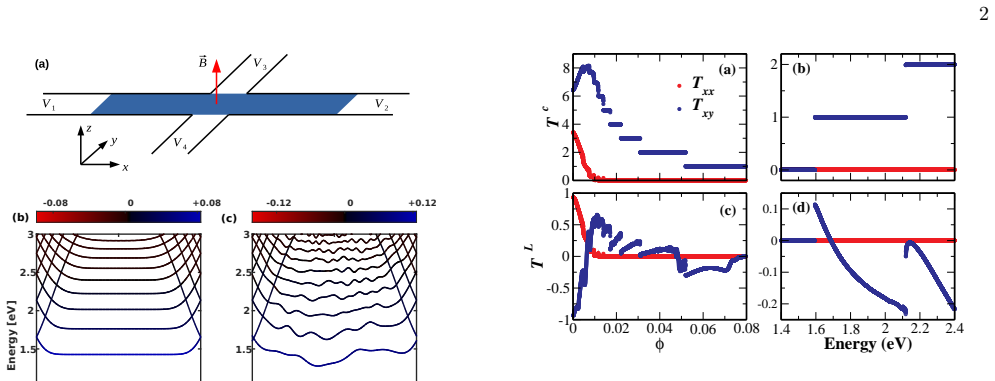
On its own terms, the paper's central claim is coexistence with similarity: the same mesoscopic fluctuations that appear in the charge conductance between the second and first Hall plateaus appear in the transverse orbital transmission, and the two fluctuation types are quantitatively comparable under MF-DFA. The orbital transmission $T^L_{xy}$ does not quantize or conserve angular momentum, but it tracks $T^c_{xy}$ across the transition and produces essentially the same $h(q)$ and $f(\alpha)$ curves, with $\Delta\alpha \simeq 2$ at $U = 1.5$ eV. The authors interpret the multifractality as disorder-driven, with an additional finite-size contribution that first weakens multifractality at intermediate disorder and then strengthens it as disorder grows, producing two peaks in $\Delta\alpha$ versus $U$. They conclude that the orbital Hall transition is not negligible in integer quantum Hall transition analysis and that a unified picture of the transition should include orbital degrees of freedom.
Load-bearing premise
The conclusions depend on the assumption that the transmission curves from the single disorder configuration used for the multifractal analysis are representative; if that configuration is atypical, the reported multifractal widths and their disorder dependence would be sample artifacts rather than robust physics.
Editorial extensions
If this is right
- A complete account of the integer quantum Hall transition in orbital-textured materials must include orbital transport, because the orbital Hall transition accompanies the integer quantum Hall transition in the disordered nanowire.
- Because charge and orbital channels show similar multifractal spectra, orbital-conductance fluctuations could serve as an additional statistical probe of integer quantum Hall transition criticality.
- The non-monotonic dependence of $\Delta\alpha$ on disorder shows that finite-size effects can suppress multifractality before disorder-driven enhancement takes over, so sample size matters when interpreting such spectra.
- Experimental detection of the orbital multifractal signal could use magneto-optical Kerr effect or orbital-to-spin conversion, as the paper suggests.
- The same multifractal analysis of transmission series could be extended to other topological transitions, such as quantum spin Hall or anomalous Hall systems.
Reading between the lines
- If the spectral similarity reflects a shared critical mechanism, then orbital transmission statistics might remain multifractal even when charge plateaus are degraded by strong disorder, offering a route to detect an otherwise hidden integer quantum Hall transition.
- A direct test beyond the paper's numerics would be to repeat the MF-DFA with ensemble averaging over disorder realizations and over wire lengths; one would predict $\Delta\alpha$ to converge to a well-defined length-dependent value rather than fluctuate from sample to sample.
- The single-configuration analysis implies a practical warning for experiments: one transmission sweep in a nanowire can look multifractal purely because of the specific disorder landscape, so sample size and sweep range should be controlled before attributing multifractality to critical physics.
Editorial analysis
A structured set of objections, weighed in public.
Referee Report
Summary. The paper studies a disordered four-terminal nanowire with orbital momentum-space texture under a strong perpendicular magnetic field, modeled by a nearest-neighbor tight-binding Hamiltonian and solved with the Kwant package. The authors report that the integer quantum Hall transition (IQHT) is accompanied by an orbital Hall transition (OHT), evidenced by orbital transmission coefficients that fluctuate in the same plateau-to-plateau regions as the charge transmission coefficients. Treating magnetic flux and Fermi energy as fictitious time variables, they apply multifractal detrended fluctuation analysis (MF-DFA) to four transmission coefficients from a single disorder realization and claim that both charge and orbital fluctuations are multifractal with similar singularity spectra (Δα ≃ 2 at U = 1.5 eV). They further report a non-monotonic dependence of the multifractal width Δα on disorder strength U, which they attribute to finite-size effects.
Significance. If established, the coexistence of multifractal charge and orbital conductance fluctuations at the IQHT would extend the phenomenology of orbital transport into a critical quantum Hall regime and suggest a common underlying critical mechanism for charge and orbital degrees of freedom. The paper benefits from a standard model, a standard numerical methodology, and consistency of the charge-channel multifractality with earlier work (Refs. [33,34]). However, the central quantitative claims rest on a single disorder configuration analyzed without error bars, without disorder ensemble averaging, and without surrogate tests against monofractal null models. The results are therefore not yet supported to the standard expected for a claim of coexistent multifractality; the work is promising but requires substantial additional statistical analysis.
major comments (4)
- [Multifractal analysis; Fig. 4] The multifractal spectra are computed from a single disorder realization. The 'four independent fictitious time series' are the four transmission coefficients T_c_xx, T_c_xy, T_L_xx, T_L_xy obtained from the same scattering matrix; they are not statistically independent samples and do not provide an ensemble. No disorder averaging or error bars are presented, so the reported Δα values and the similarity between charge and orbital spectra in Fig. 4 could be artifacts of one particular configuration. The authors should average over many disorder realizations and report the spread (or at least show that the results are robust across several realizations).
- [Multifractal analysis; Fig. 4] No surrogate testing is performed. MF-DFA with linear detrending on a single 5000-point series can produce spurious multifractal spectra for nonstationary, short, or heavy-tailed data, and the negative-q moments can be dominated by a few small values. The authors should compare the observed h(q) and f(α) with those obtained from phase-randomized surrogates (e.g., IAAFT) or shuffled series, and ideally with synthetic monofractal series of the same length and correlation structure. Without such a null baseline, the claim that Δα ≃ 2 indicates genuine multifractality is not secured.
- [Fig. 5 and following paragraph] The interpretation of the non-monotonic U-dependence of Δα as a finite-size effect is not supported by any direct test. The text states that Δα 'attains its maximum value around U = 3.5 eV' but later refers to 'the existence of two peaks in Figs. 5(a,b)', which is internally inconsistent with the abstract's description of a weakening followed by an increase. More importantly, no system-size dependence is studied. To attribute the structure in Fig. 5 to finite-size effects, the authors should repeat the calculations for at least one other nanowire length or width and show that the position and depth of the extrema change accordingly.
- [Multifractal analysis] The description of MF-DFA is incomplete and hinders reproducibility. The authors do not specify the range of segment sizes s used in the scaling fit, do not state how the q = 0 moment is handled (the expression Fq(s) as written diverges for q = 0), and do not mention whether both forward and backward segmentations are included as in the standard MF-DFA algorithm. These technical choices can materially affect the estimates of h(q) and Δα. The authors should provide these details in the main text or in a self-contained Supplemental Material.
minor comments (5)
- [Fig. 4 caption] The caption states the fictitious time series range 'between energy 0.210, ...,0.215 eV', which is inconsistent with the energy scales (about 2.0–2.2 eV) shown in Fig. 3 and used elsewhere; this appears to be a typo.
- [Dirty nanowire section] The text says the fluctuations in Fig. 3(b) are for 'ϕ = 0.4', but the caption and the surrounding discussion indicate the magnetic flux should be ϕ = 0.064; please correct this.
- [Multifractal analysis] The phrase 'four independent fictitious time series' is misleading: the four transmission coefficients come from the same scattering matrix and are not statistically independent. I suggest rephrasing to 'four fictitious time series' or 'four transmission observables'.
- [Fig. 5] The labels 'C' and 'L' in Fig. 5 are not defined in the caption; please define them (charge and orbital/angular-momentum channels) for clarity.
- [Conclusions] The description of the U-dependence is inconsistent: the abstract and conclusions describe a weakening of multifractality followed by an increase, while the results section mentions 'two peaks'. Please clarify whether the curves in Fig. 5 have a local maximum, a local minimum, or two maxima, and adjust the text accordingly.
Circularity Check
No load-bearing circularity: the multifractal spectra are computed directly from the model's transmission series, with cited prior work used only for context and agreement.
full rationale
The derivation chain is self-contained. The transmission coefficients T^c and T^L are computed directly from the tight-binding Hamiltonian via the scattering matrix (Eq. 1 and the Landauer-Buttiker trace formula), and the multifractal spectra h(q) and f(alpha) are evaluated in this paper from those series using the standard MF-DFA algorithm. No parameter is fitted to the multifractal outputs, and no prediction reduces to an input by construction. The charge and orbital spectra could have differed; the reported similarity is an empirical comparison, not a tautology. The paper's self-citations ([14], [19], [33], [23], and others) are used for nomenclature, method pedigree, or post-computation agreement; in particular, [33] is invoked only after the h(q) and f(alpha) curves are presented ('These results agree with [33,34]'), so it is not load-bearing for the central claim. The reader-identified concern that the 'four independent fictitious time series' are four observables from a single disorder realization, with no surrogate null or ensemble averaging shown, is a statistical robustness and verification issue, not a circularity of the derivation. Similarly, the non-monotonic Delta-alpha(U) curves and their finite-size interpretation are post hoc inferences from the computed spectra. No step falls under any of the seven circularity patterns.
Assumptions & free parameters
free parameters (3)
- MF-DFA q range =
q = -4 to 4, step 0.2
- Fictitious time series length =
N = 5000
- Fictitious-time windows =
phi in [0.048,0.056] at E=2.0 eV; E in [0.210,0.215] eV at phi=0.064
assumptions (5)
- domain assumption Landauer-Buttiker transport with orbital projector P_L^eta defines physically meaningful charge and orbital transmission coefficients.
- domain assumption The four-orbital tight-binding Hamiltonian from Go et al. [39] with Peierls phase accurately models the IQHT/OHT regime.
- domain assumption Magnetic flux and Fermi energy can be treated as fictitious time variables, making the transmission curves amenable to MF-DFA.
- ad hoc to paper The sampled fluctuation series is representative of the disorder ensemble.
- standard math MF-DFA scaling Fq(s) ~ s^h(q) holds for q=-4 to 4, and the Legendre transform gives a meaningful f(alpha).
Cite this review
Pith. "Pith review of Coexistent multifractal mesoscopic fluctuations in Integer Quantum Hall Transition and in Orbital Hall Transition." pith.science (2026). https://pith.science/paper/WTMF7IOX
@misc{pith2026250704475,
  author       = {Pith},
  title        = {Pith review of: Coexistent multifractal mesoscopic fluctuations in Integer Quantum Hall Transition and in Orbital Hall Transition},
  year         = {2026},
  howpublished = {\url{https://pith.science/paper/WTMF7IOX}},
  note         = {Machine review of arXiv:2507.04475}
}
read the original abstract
We show that the integer quantum Hall transition in a disordered nanowire with orbital momentum-space texture connected to four terminals is accompanied by an orbital Hall transition. We applied a multifractal detrended fluctuation analysis and found that both conductance fluctuations in the integer quantum Hall transition (IQHT) and orbital-conductance fluctuations in the orbital Hall transition (OHT) display multifractal behavior. We argue that this multifractality is primarily related to disorder, which gives rise to the strong fluctuations that are fingerprints of IQHT and OHT, but is also a consequence of the fact that the nanowire has finite size, which causes a weakening of the multifractality in a certain range of values of disorder strength followed by a new regime of increasing multifractality with increasing disorder strength. Furthermore, our findings indicate that OHT can bring novel insights to future IQHT analysis.
Figures


Reference graph
Works this paper leans on
-
[1]
C. W. J. Beenakker, Random-matrix theory of quantum transport, Rev. Mod. Phys. 69, 731 (1997)
1997
-
[2]
Rotter and S
S. Rotter and S. Gigan, Light fields in complex media: Mesoscopic scattering meets wave control, Rev. Mod. Phys. 89, 015005 (2017)
2017
-
[3]
P. A. Lee and A. D. Stone, Universal conductance fluc- tuations in metals, Phys. Rev. Lett. 55, 1622 (1985)
1985
-
[4]
Ver¸ cosa, Y.-J
T. Ver¸ cosa, Y.-J. Doh, J. G. G. S. Ramos, and A. L. R. Barbosa, Conductance peak density in nanowires, Phys. Rev. B 98, 155407 (2018)
2018
-
[5]
L. G. C. S. S´ a, A. L. R. Barbosa, and J. G. G. S. Ramos, Conductance peak density in disordered graphene topo- logical insulators, Phys. Rev. B 102, 115105 (2020)
work page 2020
-
[6]
Ando, Localization and fluctuations in the quantum hall regime, Phys
T. Ando, Localization and fluctuations in the quantum hall regime, Phys. Rev. B 49, 4679 (1994)
work page 1994
-
[7]
D. H. Cobden, C. H. W. Barnes, and C. J. B. Ford, Fluc- tuations and evidence for charging in the quantum hall effect, Phys. Rev. Lett. 82, 4695 (1999)
work page 1999
- [8]
Show all 84 references
-
[9]
D. S. Antonenko, E. Khalaf, P. M. Ostrovsky, and M. A. Skvortsov, Mesoscopic conductance fluctuations 6 and noise in disordered majorana wires, Phys. Rev. B 102, 195152 (2020)
2020
-
[10]
W. Ren, Z. Qiao, J. Wang, Q. Sun, and H. Guo, Univer- sal spin-hall conductance fluctuations in two dimensions, Phys. Rev. Lett. 97, 066603 (2006)
2006
-
[11]
J. H. Bardarson, i. d. I. Adagideli, and P. Jacquod, Meso- scopic spin hall effect, Phys. Rev. Lett.98, 196601 (2007)
2007
-
[12]
T. C. Vasconcelos, J. G. G. S. Ramos, and A. L. R. Barbosa, Universal spin hall conductance fluctuations in chaotic dirac quantum dots, Phys. Rev. B 93, 115120 (2016)
2016
-
[13]
F. A. F. Santana, J. M. da Silva, T. C. Vasconcelos, J. G. G. S. Ramos, and A. L. R. Barbosa, Spin hall angle fluc- tuations in a device with disorder, Phys. Rev. B 102, 041107 (2020)
2020
-
[14]
D. B. Fonseca, L. L. A. Pereira, and A. L. R. Barbosa, Orbital hall effect in mesoscopic devices, Phys. Rev. B 108, 245105 (2023)
2023
-
[15]
Kwon, B.-K
D. Kwon, B.-K. Kim, Y.-J. Doh, D. Yu, J. Song, and M.-H. Bae, Quantum interference probed by the thermo- voltage in sb-doped bi2se3 nanowires, iScience26, 105691 (2023)
2023
-
[16]
L. E. Anderson, A. Laitinen, A. Zimmerman, T. Werk- meister, H. Shackleton, A. Kruchkov, T. Taniguchi, K. Watanabe, S. Sachdev, and P. Kim, Magneto- thermoelectric transport in graphene quantum dot with strong correlations, Phys. Rev. Lett. 132, 246502 (2024)
2024
-
[17]
L.-K. Lim, C. Lou, and C. Tian, Mesoscopic fluctuations in entanglement dynamics, Nature Communications 15, 10.1038/s41467-024-46078-1 (2024)
2024 doi
-
[18]
K. R. Amin, S. S. Ray, N. Pal, R. Pandit, and A. Bid, Ex- otic multifractal conductance fluctuations in graphene, Communications Physics 1, 1 (2017)
2017
-
[19]
N. L. Pessoa, A. L. R. Barbosa, G. L. Vasconcelos, and A. M. S. Macedo, Multifractal magnetoconductance fluctuations in mesoscopic systems, Phys. Rev. E 104, 054129 (2021)
2021
-
[20]
Mul- tifractality was also reported in mesoscopic spin polar- ization fluctuations [21, 22] and mesoscopic thermovolt- age fluctuations [23]
under low magnetic fields, they reemerged on the sci- entific scene into the context of complex systems. Mul- tifractality was also reported in mesoscopic spin polar- ization fluctuations [21, 22] and mesoscopic thermovolt- age fluctuations [23]. Multifractality in these syste...
2025 arXiv
-
[21]
E. B. Olshanetsky, G. M. Gusev, A. D. Levin, Z. D. Kvon, and N. N. Mikhailov, Multifractal conductance fluctua- tions of helical edge states, Phys. Rev. Lett. 131, 076301 (2023)
2023
-
[22]
D. B. Fonseca, L. F. C. Pereira, and A. L. R. Barbosa, L´ evy flight for electrons in graphene: Superdiffusive-to- diffusive transport transition, Phys. Rev. B 107, 155432 (2023)
2023
-
[23]
D. B. Fonseca, A. L. R. Barbosa, and L. F. C. Pereira, L´ evy flight for electrons in graphene in the presence of regions with enhanced spin-orbit coupling, Phys. Rev. B 110, 075421 (2024)
2024
-
[24]
N. L. Pessoa, D. Kwon, J. Song, M.-H. Bae, A. M. S. Macˆ edo, and A. L. R. Barbosa, Multifractal thermovolt- age fluctuations in topological insulators, Phys. Rev. B 111, L081405 (2025)
2025
-
[25]
K. v. Klitzing, G. Dorda, and M. Pepper, New method for high-accuracy determination of the fine-structure con- stant based on quantized hall resistance, Phys. Rev. Lett. 45, 494 (1980)
1980
-
[26]
D. J. Thouless, M. Kohmoto, M. P. Nightingale, and M. den Nijs, Quantized hall conductance in a two- dimensional periodic potential, Phys. Rev. Lett. 49, 405 (1982)
1982
-
[27]
Huckestein, Scaling theory of the integer quantum hall effect, Rev
B. Huckestein, Scaling theory of the integer quantum hall effect, Rev. Mod. Phys. 67, 357 (1995)
1995
-
[28]
M. R. Zirnbauer, Reprint of: Marginal cft perturbations at the integer quantum hall transition, Annals of Physics 435, 168691 (2021), special Issue on Localisation 2020
2021
-
[29]
E. J. Dresselhaus, B. Sbierski, and I. A. Gruzberg, Numerical evidence for marginal scaling at the integer quantum hall transition, Annals of Physics 435, 168676 (2021), special Issue on Localisation 2020
2021
-
[30]
Sbierski, E
B. Sbierski, E. J. Dresselhaus, J. E. Moore, and I. A. Gruzberg, Criticality of two-dimensional disordered dirac fermions in the unitary class and universality of the in- teger quantum hall transition, Phys. Rev. Lett. 126, 076801 (2021)
2021
-
[31]
E. J. Dresselhaus, B. Sbierski, and I. A. Gruzberg, Scal- ing collapse of longitudinal conductance near the integer quantum hall transition, Phys. Rev. Lett. 129, 026801 (2022)
2022
-
[32]
Topchyan, I
H. Topchyan, I. A. Gruzberg, W. Nuding, A. Kl¨ umper, and A. Sedrakyan, Integer quantum hall transition: An s-matrix approach to random networks, Phys. Rev. B 110, L081112 (2024)
2024
-
[33]
Evers, A
F. Evers, A. Mildenberger, and A. D. Mirlin, Multi- fractality at the quantum hall transition: Beyond the parabolic paradigm, Phys. Rev. Lett.101, 116803 (2008)
2008
-
[34]
A. L. R. Barbosa, T. H. V. de Lima, I. R. R. Gonz´ alez, N. L. Pessoa, A. M. S. Macˆ edo, and G. L. Vasconcelos, Turbulence hierarchy and multifractality in the integer quantum hall transition, Phys. Rev. Lett. 128, 236803 (2022)
2022
-
[35]
K. R. Amin, R. Nagarajan, R. Pandit, and A. Bid, Multifractal conductance fluctuations in high-mobility graphene in the integer quantum hall regime, Phys. Rev. Lett. 129, 186802 (2022)
2022
-
[36]
G¨ obel and I
B. G¨ obel and I. Mertig, Orbital hall effect accompanying quantum hall effect: Landau levels cause orbital polar- ized edge currents, Phys. Rev. Lett. 133, 146301 (2024)
2024
-
[37]
D. Go, D. Jo, H.-W. Lee, M. Kl¨ aui, and Y. Mokrousov, Orbitronics: Orbital currents in solids, Europhysics Let- ters 135, 37001 (2021)
2021
-
[38]
B. A. Bernevig, T. L. Hughes, and S.-C. Zhang, Orbi- tronics: The intrinsic orbital current in p-doped silicon, Phys. Rev. Lett. 95, 066601 (2005)
2005
-
[39]
Tanaka, H
T. Tanaka, H. Kontani, M. Naito, T. Naito, D. S. Hi- rashima, K. Yamada, and J. Inoue, Intrinsic spin hall ef- fect and orbital hall effect in 4d and 5d transition metals, Phys. Rev. B 77, 165117 (2008)
2008
-
[40]
D. Go, D. Jo, C. Kim, and H.-W. Lee, Intrinsic spin and orbital hall effects from orbital texture, Phys. Rev. Lett. 121, 086602 (2018)
2018
-
[41]
Go and H.-W
D. Go and H.-W. Lee, Orbital torque: Torque generation by orbital current injection, Phys. Rev. Res. 2, 013177 (2020)
2020
-
[42]
T. G. Rappoport, First light on orbitronics as a viable al- ternative to electronics, Nature (London) 619, 38 (2023)
2023
-
[43]
K.-J. Lee, V. Cros, and H.-W. Lee, Electric-field-induced orbital angular momentum in metals, Nature Materials 23, 1302 (2024)
2024
-
[44]
D. Jo, D. Go, G.-M. Choi, and H.-W. Lee, Spintronics meets orbitronics: Emergence of orbital angular momen- tum in solids, npj Spintronics 2 (2024)
2024
-
[45]
Y.-G. Choi, D. Jo, K.-H. Ko, D. Go, K.-H. Kim, H. G. Park, C. Kim, B.-C. Min, G.-M. Choi, and H.-W. Lee, Observation of the orbital Hall effect in a light metal Ti, Nature (London) 619, 52 (2023), arXiv:2109.14847 [cond-mat.mes-hall]
2023 arXiv
-
[46]
Hayashi, D
H. Hayashi, D. Jo, D. Go, T. Gao, S. Haku, 7 Y. Mokrousov, H.-W. Lee, and K. Ando, Observation of long-range orbital transport and giant orbital torque, Communications Physics 6, 10.1038/s42005-023-01139-7 (2023)
2023 doi
-
[47]
Lyalin, S
I. Lyalin, S. Alikhah, M. Berritta, P. M. Oppeneer, and R. K. Kawakami, Magneto-optical detection of the orbital hall effect in chromium, Phys. Rev. Lett. 131, 156702 (2023)
2023
-
[48]
G. Sala, H. Wang, W. Legrand, and P. Gambardella, Or- bital hanle magnetoresistance in a 3 d transition metal, Phys. Rev. Lett. 131, 156703 (2023)
2023
-
[49]
Santos, J
E. Santos, J. Abr˜ ao, J. Costa, J. Santos, G. Rodrigues- Junior, J. Mendes, and A. Azevedo, Negative orbital hall effect in germanium, Phys. Rev. Appl. 22, 064071 (2024)
2024
-
[50]
Sala and P
G. Sala and P. Gambardella, Giant orbital hall effect and orbital-to-spin conversion in 3d, 5d, and 4f metallic het- erostructures, Phys. Rev. Res. 4, 033037 (2022)
2022
-
[51]
Ding, M.-G
S. Ding, M.-G. Kang, W. Legrand, and P. Gambardella, Orbital torque in rare-earth transition-metal ferrimag- nets, Phys. Rev. Lett. 132, 236702 (2024)
2024
-
[52]
Han, H.-W
S. Han, H.-W. Lee, and K.-W. Kim, Orbital dynamics in centrosymmetric systems, Phys. Rev. Lett. 128, 176601 (2022)
2022
-
[53]
Busch, F
O. Busch, F. Ziolkowski, B. G¨ obel, I. Mertig, and J. Henk, Ultrafast orbital hall effect in metallic nanorib- bons, Phys. Rev. Res. 6, 013208 (2024)
2024
-
[54]
X. Ning, A. Pezo, K.-W. Kim, W. Zhao, K.-J. Lee, and A. Manchon, Orbital diffusion, polarization, and swap- ping in centrosymmetric metals, Phys. Rev. Lett. 134, 026303 (2025)
2025
-
[55]
Han, H.-W
S. Han, H.-W. Ko, J. H. Oh, H.-W. Lee, K.-J. Lee, and K.-W. Kim, Orbital pumping incorporating both orbital angular momentum and position, Phys. Rev. Lett. 134, 036305 (2025)
2025
-
[56]
J. E. Abr˜ ao, E. Santos, J. L. Costa, J. G. S. Santos, J. B. S. Mendes, and A. Azevedo, Anomalous spin and or- bital hall phenomena in antiferromagnetic systems, Phys. Rev. Lett. 134, 026702 (2025)
2025
-
[57]
H. Liu, J. H. Cullen, D. P. Arovas, and D. Culcer, Quan- tum correction to the orbital hall effect, Phys. Rev. Lett. 134, 036304 (2025)
2025
-
[58]
T. S. Seifert, D. Go, H. Hayashi, R. Rouzegar, F. Freimuth, K. Ando, Y. Mokrousov, and T. Kampfrath, Time-domain observation of ballistic orbital-angular- momentum currents with giant relaxation length in tung- sten, Nature Nanotechnology 18, 1132–1138 (2023)
2023
-
[59]
Kumar and S
S. Kumar and S. Kumar, Ultrafast thz probing of nonlocal orbital current in transverse multilayer metallic heterostructures, Nature Communications 14, 10.1038/s41467-023-43956-y (2023)
2023 doi
-
[60]
Y. Xu, F. Zhang, F. Albert, H.-Y. Jaffres, Y. Liu, R. Y. Xu, Y. Jiang, H. Cheng, and W. ZHAO, Orbi- tronics: light-induced orbital currents in ni studied by terahertz emission experiments, Nature Communications 15 (2024)
2024
-
[61]
Hayashi, D
H. Hayashi, D. Go, S. Haku, Y. Mokrousov, and K. Ando, Observation of orbital pumping, Nature Electronics 7, 1 (2024)
2024
-
[62]
El Hamdi, J.-Y
A. El Hamdi, J.-Y. Chauleau, M. Boselli, C. Thibault, C. Gorini, A. Smogunov, C. Barreteau, S. Gariglio, J.-M. Triscone, and M. Viret, Observation of the orbital inverse Rashba–Edelstein effect, Nature Physics 19, 1855 (2023)
2023
-
[63]
Costa, B
M. Costa, B. Focassio, L. M. Canonico, T. P. Cysne, G. R. Schleder, R. B. Muniz, A. Fazzio, and T. G. Rappoport, Connecting higher-order topology with the orbital hall effect in monolayers of transition metal dichalcogenides, Phys. Rev. Lett. 130, 116204 (2023)
2023
-
[64]
Liu and D
H. Liu and D. Culcer, Dominance of extrinsic scattering mechanisms in the orbital hall effect: Graphene, transi- tion metal dichalcogenides, and topological antiferromag- nets, Phys. Rev. Lett. 132, 186302 (2024)
2024
-
[65]
A. L. R. Barbosa, L. M. Canonico, J. H. Garc ´ ıa, and T. G. Rappoport, Orbital hall effect and topology on a two-dimensional triangular lattice: From bulk to edge, Phys. Rev. B 110, 085412 (2024)
2024
-
[66]
Tang and G
P. Tang and G. E. W. Bauer, Role of disorder in the intrinsic orbital hall effect, Phys. Rev. Lett. 133, 186302 (2024)
2024
-
[67]
L. M. Canonico, J. H. Garcia, and S. Roche, Orbital hall responses in disordered topological materials, Phys. Rev. B 110, L140201 (2024)
2024
-
[68]
Veneri, T
A. Veneri, T. G. Rappoport, and A. Ferreira, Extrinsic orbital hall effect: Orbital skew scattering and crossover between diffusive and intrinsic orbital transport, Phys. Rev. Lett. 134, 136201 (2025)
2025
-
[69]
J. Sohn, J. M. Lee, and H.-W. Lee, Dyakonov-perel-like orbital and spin relaxations in centrosymmetric systems, Phys. Rev. Lett. 132, 246301 (2024)
2024
-
[70]
T. P. Cysne, L. M. Canonico, M. Costa, R. B. Muniz, and T. G. Rappoport, Orbitronics in two-dimensional mate- rials (2025), arXiv:2502.12339 [cond-mat.mes-hall]
2025
-
[71]
J. L. Costa, E. Santos, J. B. S. Mendes, and A. Azevedo, Revealing the dominance of the orbital hall effect over spin in transition metal heterostructures (2025), arXiv:2506.08425 [cond-mat.mes-hall]
2025 arXiv
-
[72]
A. L. R. Barbosa, H.-W. Lee, and T. G. Rappoport, Ex- trinsic orbital hall effect and orbital relaxation in meso- scopic devices (2025), arXiv:2507.01941 [cond-mat.mes- hall]
2025 arXiv
-
[73]
Wang, Y.-C
B. Wang, Y.-C. Hung, H. Lin, S. Li, R.-H. He, and A. Bansil, Topological characteristics and bulk-boundary correspondence in the orbital hall effect, Phys. Rev. B 111, 195102 (2025)
2025
-
[74]
D. Joy, V. Pandey, and P. Bhalla, Linear and nonlinear intrinsic ac orbital hall conductivity in a system with broken inversion symmetry, Phys. Rev. B 111, 075149 (2025)
2025
-
[75]
G¨ obel, L
B. G¨ obel, L. Schimpf, and I. Mertig, Topological orbital hall effect caused by skyrmions and antiferromagnetic skyrmions, Communications Physics 8, 10.1038/s42005- 024-01925-x (2025)
2025 doi
-
[76]
P. Wang, F. Chen, Y. Yang, S. Hu, Y. Li, W. Wang, D. Zhang, and Y. Jiang, Orbitronics: Mechanisms, ma- terials and devices, Advanced Electronic Materials 11, 2400554 (2025)
2025
-
[77]
J. W. Kantelhardt, S. A. Zschiegner, E. Koscielny-Bunde, S. Havlin, A. Bunde, and H. Stanley, Multifractal de- trended fluctuation analysis of nonstationary time series, Physica A: Statistical Mechanics and its Applications 316, 87 (2002)
2002
-
[78]
Rak and D
R. Rak and D. Grech, Quantitative approach to multi- fractality induced by correlations and broad distribution of data, Physica A: Statistical Mechanics and its Appli- cations 508, 48 (2018)
2018
-
[79]
D. R. Hofstadter, Energy levels and wave functions of bloch electrons in rational and irrational magnetic fields, Phys. Rev. B 14, 2239 (1976)
1976
-
[80]
C. W. Groth, M. Wimmer, A. R. Akhmerov, and 8 X. Waintal, Kwant: a software package for quantum transport, New Journal of Physics 16, 063065 (2014)
2014
-
[81]
1, multifractal analysis of data, and an analysis of clean and dirty nanowires connected to two terminals
See Supplemental Material for more details about the tight-binding model Eq. 1, multifractal analysis of data, and an analysis of clean and dirty nanowires connected to two terminals
-
[82]
C. L. Kane and E. J. Mele, Quantum spin hall effect in graphene, Phys. Rev. Lett. 95, 226801 (2005)
2005
-
[83]
T. Li, P. Wang, H. Fu, L. Du, K. A. Schreiber, X. Mu, X. Liu, G. Sullivan, G. A. Cs´ athy, X. Lin, and R.-R. Du, Observation of a helical luttinger liquid in InAs /GaSb quantum spin hall edges, Phys. Rev. Lett. 115, 136804 (2015)
2015
-
[84]
Bampoulis, C
P. Bampoulis, C. Castenmiller, D. J. Klaassen, J. van Mil, Y. Liu, C.-C. Liu, Y. Yao, M. Ezawa, A. N. Rudenko, and H. J. W. Zandvliet, Quantum spin hall states and topological phase transition in germanene, Phys. Rev. Lett. 130, 196401 (2023)
2023
Reviewed August 6, 2026 · model on record in the stance chip above.
Discussion (0). Sign in to comment.