Quantum Non-Gaussian State Preparation of Levitated Particles via Time-Dependent Control of Weakly Nonharmonic Hybrid Potentials
Pith reviewed 2026-06-27 15:59 UTC · model grok-4.3
The pith
Time-dependent modulation of the linear potential component in a static cubic-nonharmonic trap enables universal control and preparation of Fock and cat states in levitated particles without auxiliary systems.
A machine-rendered reading of the paper's core claim, the machinery that carries it, and where it could break.
Core claim
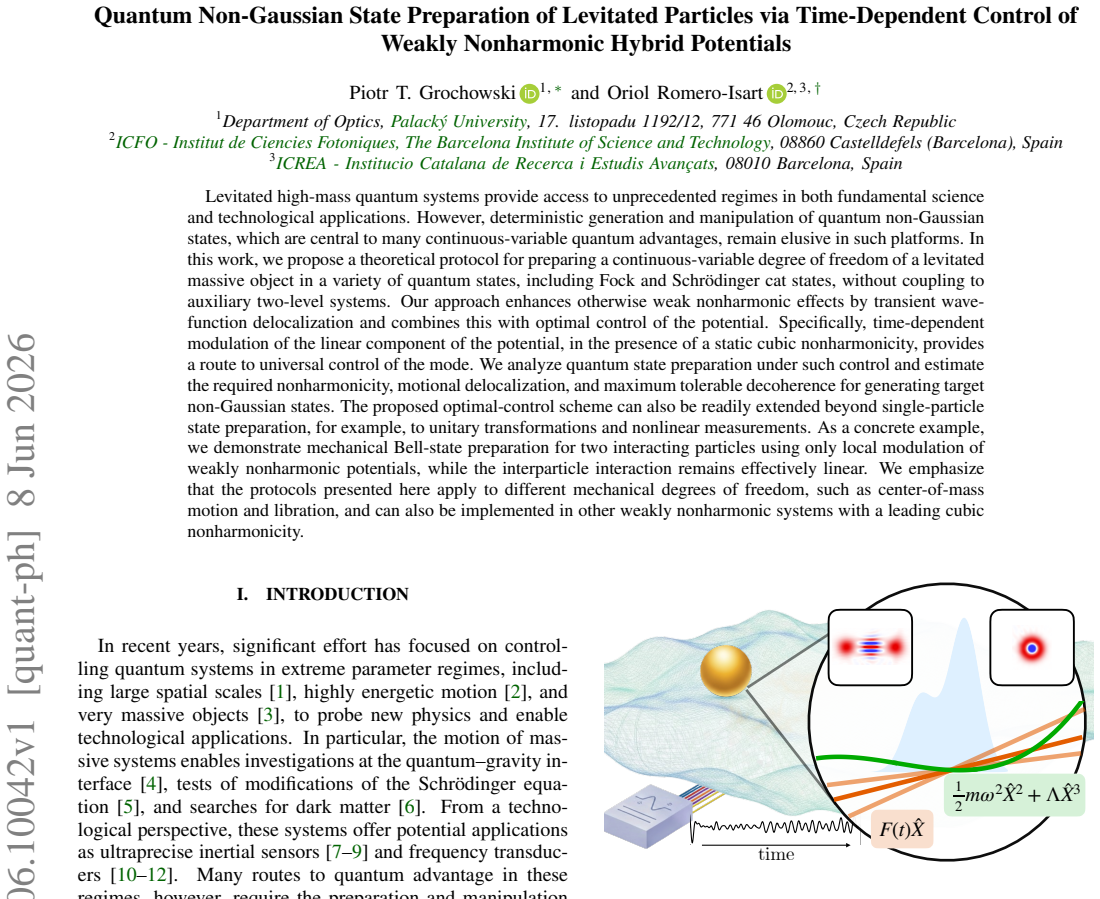
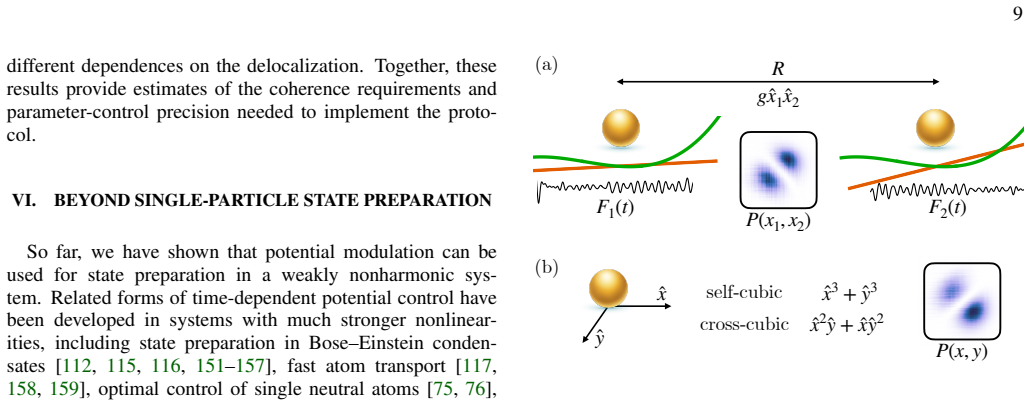
Time-dependent modulation of the linear component of the potential, in the presence of a static cubic nonharmonicity, provides a route to universal control of the mode. Quantum state preparation under such control is analyzed, with estimates for the required nonharmonicity, motional delocalization, and maximum tolerable decoherence to generate target non-Gaussian states. The scheme extends to unitary transformations, nonlinear measurements, and mechanical Bell-state preparation for two particles using only local modulation while keeping interparticle interactions effectively linear.
What carries the argument
time-dependent modulation of the linear component of the potential in the presence of a static cubic nonharmonicity, which enables universal control by enhancing nonharmonic effects through transient delocalization
If this is right
- Fock states and Schrödinger cat states become deterministically preparable in single levitated particles.
- The control scheme extends directly to unitary transformations and nonlinear measurements on the mode.
- Two-particle mechanical Bell states can be prepared using only local modulations of weakly nonharmonic potentials.
- The method applies to multiple mechanical degrees of freedom including center-of-mass motion and libration.
Where Pith is reading between the lines
- The same control strategy could be tested for generating macroscopic superpositions large enough to probe gravity-induced decoherence models.
- Local modulation techniques might simplify scaling to few-particle entangled states compared to global potential shaping.
- Implementation in other platforms with leading cubic terms, such as certain ion traps or optomechanical systems, could be explored by matching the estimated nonharmonicity thresholds.
Load-bearing premise
Transient wave-function delocalization can sufficiently amplify otherwise weak nonharmonic effects to allow the optimal control, and the required nonharmonicity and decoherence levels are experimentally reachable in levitated systems.
What would settle it
An experiment showing that achievable nonharmonicity combined with transient delocalization produces decoherence rates exceeding the estimated tolerance before target state fidelity is reached would falsify the protocol's viability.
Figures
read the original abstract
Levitated high-mass quantum systems provide access to unprecedented regimes in both fundamental science and technological applications. However, deterministic generation and manipulation of quantum non-Gaussian states, which are central to many continuous-variable quantum advantages, remain elusive in such platforms. In this work, we propose a theoretical protocol for preparing a continuous-variable degree of freedom of a levitated massive object in a variety of quantum states, including Fock and Schr\"odinger cat states, without coupling to auxiliary two-level systems. Our approach enhances otherwise weak nonharmonic effects by transient wave-function delocalization and combines this with optimal control of the potential. Specifically, time-dependent modulation of the linear component of the potential, in the presence of a static cubic nonharmonicity, provides a route to universal control of the mode. We analyze quantum state preparation under such control and estimate the required nonharmonicity, motional delocalization, and maximum tolerable decoherence for generating target non-Gaussian states. The proposed optimal-control scheme can also be readily extended beyond single-particle state preparation, for example, to unitary transformations and nonlinear measurements. As a concrete example, we demonstrate mechanical Bell-state preparation for two interacting particles using only local modulation of weakly nonharmonic potentials, while the interparticle interaction remains effectively linear. We emphasize that the protocols presented here apply to different mechanical degrees of freedom, such as center-of-mass motion and libration, and can also be implemented in other weakly nonharmonic systems with a leading cubic nonharmonicity.
Editorial analysis
A structured set of objections, weighed in public.
Referee Report
Summary. The manuscript proposes a theoretical protocol for deterministic preparation of quantum non-Gaussian states (Fock states, Schrödinger cat states) of a levitated massive object's continuous-variable degree of freedom. The approach relies on transient wave-function delocalization to enhance weak cubic nonharmonicity combined with optimal time-dependent modulation of the linear potential component, achieving universal control without auxiliary two-level systems. It provides explicit estimates for the required nonharmonicity strength, delocalization scale, and maximum tolerable decoherence, analyzes state-preparation fidelity under this control, and extends the scheme to unitary transformations, nonlinear measurements, and two-particle mechanical Bell states via local modulation of weakly nonharmonic potentials (with effectively linear interparticle interaction). The protocols are stated to apply to center-of-mass motion, libration, and other weakly nonharmonic systems.
Significance. If the controllability analysis and parameter estimates are validated, the work provides a concrete route to non-Gaussian state engineering in levitated optomechanics without auxiliary qubits, addressing a key limitation for continuous-variable quantum information with massive objects. Strengths include the explicit, falsifiable estimates for experimental feasibility, the demonstration of multi-particle extension with only local control, and the framing as an optimal-control problem that can be tested numerically or in simulation. These elements make the result potentially impactful for both fundamental tests and technological applications in high-mass quantum systems.
major comments (2)
- [Section deriving estimates for nonharmonicity and decoherence] The central controllability claim (universal control via linear modulation plus static cubic term) rests on the transient-delocalization enhancement; the manuscript should provide a quantitative bound or scaling argument showing that the effective cubic coupling during delocalization exceeds the decoherence rate by a sufficient margin for the target fidelities (e.g., in the section deriving the estimates).
- [Section on two-particle extension] For the two-particle Bell-state example, the assumption that the interparticle interaction remains effectively linear while local potentials are modulated needs explicit verification that cross terms do not introduce uncontrolled nonlinearities at the required delocalization scale.
minor comments (2)
- [Introduction / potential definition] Notation for the hybrid potential (linear + cubic terms) should be defined once in the main text with explicit Hamiltonian form before the optimal-control discussion.
- [Figures showing state preparation] Figure captions for state-preparation trajectories should include the specific target states and the achieved fidelity values for direct comparison with the estimates.
Simulated Author's Rebuttal
We thank the referee for the positive evaluation and recommendation for minor revision. The comments are addressed point by point below, with revisions incorporated where they strengthen the manuscript.
read point-by-point responses
-
Referee: [Section deriving estimates for nonharmonicity and decoherence] The central controllability claim (universal control via linear modulation plus static cubic term) rests on the transient-delocalization enhancement; the manuscript should provide a quantitative bound or scaling argument showing that the effective cubic coupling during delocalization exceeds the decoherence rate by a sufficient margin for the target fidelities (e.g., in the section deriving the estimates).
Authors: We agree that an explicit scaling argument clarifies the separation of timescales. In the revised manuscript we have added a paragraph in the estimates section deriving that the effective cubic coupling strength during delocalization scales as the cube of the wave-packet width. For the quoted parameter regimes this integrated nonlinear phase accumulation exceeds the decoherence rate by a factor of several, sufficient to reach the reported target fidelities before decoherence dominates. The added bound is consistent with the existing numerical estimates and does not alter any conclusions. revision: yes
-
Referee: [Section on two-particle extension] For the two-particle Bell-state example, the assumption that the interparticle interaction remains effectively linear while local potentials are modulated needs explicit verification that cross terms do not introduce uncontrolled nonlinearities at the required delocalization scale.
Authors: We thank the referee for highlighting this point. The manuscript models the interparticle coupling as linear in the relative coordinate (standard for the dipole or Coulomb regime at the relevant separations). In the revised version we have inserted a short explicit calculation (now in the appendix) showing that any cross terms generated by the local cubic modulation remain higher-order in the small nonharmonicity parameter and contribute negligibly to the Bell-state infidelity at the delocalization amplitudes used. The verification confirms the assumption holds under the stated conditions. revision: yes
Circularity Check
No significant circularity; derivation is self-contained
full rationale
The paper proposes a protocol using time-dependent linear modulation of a potential with static cubic nonharmonicity, enhanced by transient delocalization, combined with standard optimal control to prepare non-Gaussian states. No load-bearing step reduces by construction to a fitted input, self-definition, or self-citation chain; the controllability argument and state-preparation estimates follow from the described Hamiltonian dynamics and external benchmarks on decoherence and nonharmonicity. The two-particle Bell-state example similarly relies on local modulation without internal reduction to prior fitted results. This is the normal case of an independent theoretical proposal.
Axiom & Free-Parameter Ledger
Forward citations
Cited by 1 Pith paper
-
To Cool, or Not to Cool? Displacement Sensing with Hot Quantum States
Hot thermal states enable quantum-enhanced bosonic displacement sensing via parity projection and coherence mechanisms, making full ground-state cooling non-universal under realistic decoherence.
Reference graph
Works this paper leans on
-
[1]
δω Ω Ω ω 3 4 #4 +c e 4
Similarly,|0⟩ −,ν− is the ground state of the relative motion, ˆX− = ( ˆX1 − ˆX2)/ √ 2, which is given by the harmonic oscillator with frequency 10 ν− =ν √1−g ν. The stability condition for this Hamiltonian is given byg ν <1. Protocols exploiting the unstable regime have also been considered [9]. We assume that the interacting ground state|00⟩ Ω,gΩ is pre...
2020
-
[2]
H. J. Manetsch, G. Nomura, E. Bataille, X. Lv, K. H. Leung, and M. Endres,A tweezer array with 6,100 highly coherent atomic qubits, Nature647, 60 (2025)
2025
-
[3]
The ATLAS Collaboration,Observation of quantum entangle- ment with top quarks at the ATLAS detector, Nature633, 542 (2024)
2024
-
[4]
Whittle, E
C. Whittle, E. D. Hall, S. Dwyer,et al.,Approaching the motional ground state of a 10-kg object, Science372, 1333 (2021)
2021
-
[5]
S. Bose, I. Fuentes, A. A. Geraci, S. M. Khan, S. Qvarfort, M. Rademacher, M. Rashid, M. Toroš, H. Ulbricht, and C. C. Wanjura,Massive quantum systems as interfaces of quantum mechanics and gravity, Rev. Mod. Phys.97, 015003 (2025)
2025
-
[6]
Romero-Isart, A
O. Romero-Isart, A. C. Pflanzer, F. Blaser, R. Kaltenbaek, N. Kiesel, M. Aspelmeyer, and J. I. Cirac,Large Quantum Superpositions and Interference of Massive Nanometer-Sized Objects, Phys. Rev. Lett.107, 020405 (2011)
2011
-
[7]
Higgins, S
G. Higgins, S. Kalia, and Z. Liu,Maglev for dark matter: Dark-photon and axion dark matter sensing with levitated su- perconductors, Phys. Rev. D109, 055024 (2024)
2024
-
[8]
Geraci and H
A. Geraci and H. Goldman,Sensing short range forces with a nanosphere matter-wave interferometer, Phys. Rev. D92, 062002 (2015)
2015
-
[9]
Hebestreit, M
E. Hebestreit, M. Frimmer, R. Reimann, and L. Novotny,Sens- ing Static Forces with Free-Falling Nanoparticles, Phys. Rev. Lett.121, 063602 (2018)
2018
-
[10]
Weiss, M
T. Weiss, M. Roda-Llordes, E. Torrontegui, M. Aspelmeyer, and O. Romero-Isart,Large Quantum Delocalization of a Lev- itated Nanoparticle Using Optimal Control: Applications for Force Sensing and Entangling via Weak Forces, Phys. Rev. Lett.127, 023601 (2021)
2021
-
[11]
Bagci, A
T. Bagci, A. Simonsen, S. Schmid, L. G. Villanueva, E. Zeuthen, J. Appel, J. M. Taylor, A. Sørensen, K. Usami, A. Schliesser, and E. S. Polzik,Optical detection of radio waves through a nanomechanical transducer, Nature507, 81 (2014)
2014
-
[12]
R. W. Andrews, R. W. Peterson, T. P. Purdy, K. Cicak, R. W. Simmonds, C. A. Regal, and K. W. Lehnert,Bidirectional and efficient conversion between microwave and optical light, Nat. Phys.10, 321 (2014)
2014
-
[13]
Forsch, R
M. Forsch, R. Stockill, A. Wallucks, I. Marinkovi ´c, C. Gärt- ner, R. A. Norte, F. van Otten, A. Fiore, K. Srinivasan, and S. Gröblacher,Microwave-to-optics conversion using a me- chanical oscillator in its quantum ground state, Nat. Phys.16, 69 (2020)
2020
-
[14]
Walschaers,Non-Gaussian Quantum States and Where to Find Them, PRX Quantum2, 030204 (2021)
M. Walschaers,Non-Gaussian Quantum States and Where to Find Them, PRX Quantum2, 030204 (2021)
2021
-
[15]
A. A. Rakhubovsky, D. W. Moore, and R. Filip,Quantum non- Gaussian optomechanics and electromechanics, Prog. Quan- tum Electron.93, 100495 (2024)
2024
-
[16]
Fadel, N
M. Fadel, N. Roux, and M. Gessner,Quantum metrology with a continuous-variable system, Rep. Prog. Phys.88, 106001 (2025)
2025
-
[17]
P. T. Grochowski and R. Filip,Optimal Phase-Insensitive Force Sensing with Non-Gaussian States, Phys. Rev. Lett.135, 230802 (2025)
2025
-
[18]
M. Bild, M. Fadel, Y . Yang, U. von Lüpke, P. Martin, A. Bruno, and Y . Chu,Schrödinger cat states of a 16- microgram mechanical oscillator, Science380, 274 (2023)
2023
-
[19]
Marti, U
S. Marti, U. von Lüpke, O. Joshi, Y . Yang, M. Bild, A. Oma- hen, Y . Chu, and M. Fadel,Quantum squeezing in a nonlinear mechanical oscillator, Nat. Phys.20, 1448 (2024)
2024
-
[20]
Galinskiy, G
I. Galinskiy, G. Enzian, M. Parniak, and E. S. Polzik,Nonclas- sical Correlations between Photons and Phonons of Center- of-Mass Motion of a Mechanical Oscillator, Phys. Rev. Lett. 133, 173605 (2024)
2024
-
[21]
Y . Yang, I. Kladari´c, M. Drimmer, U. von Lüpke, D. Lenter- man, J. Bus, S. Marti, M. Fadel, and Y . Chu,A mechanical qubit, Science386, 783 (2024)
2024
-
[22]
Gonzalez-Ballestero, M
C. Gonzalez-Ballestero, M. Aspelmeyer, L. Novotny, R. Quidant, and O. Romero-Isart,Levitodynamics: Levitation and control of microscopic objects in vacuum, Science374, eabg3027 (2021)
2021
-
[23]
Millen, T
J. Millen, T. S. Monteiro, R. Pettit, and A. N. Vamivakas, Optomechanics with levitated particles, Rep. Prog. Phys.83, 026401 (2020)
2020
-
[24]
Rashid, T
M. Rashid, T. Tufarelli, J. Bateman, J. V ovrosh, D. Hemp- ston, M. S. Kim, and H. Ulbricht,Experimental Realization of a Thermal Squeezed State of Levitated Optomechanics, Phys. Rev. Lett.117, 273601 (2016)
2016
-
[25]
Frimmer, T
M. Frimmer, T. L. Heugel, Ž. Nosan, F. Tebbenjohanns, D. Hälg, A. Akin, C. L. Degen, L. Novotny, R. Chitra, O. Zil- berberg, and A. Eichler,Rapid Flipping of Parametric Phase States, Phys. Rev. Lett.123, 254102 (2019)
2019
-
[26]
M. A. Ciampini, T. Wenzl, M. Konopik, G. Thalhammer- Thurner, M. Aspelmeyer, E. Lutz, and N. Kiesel,Erasure 16 of a nonequilibrium memory beyond Landauer’s bound using levitated optomechanics with spatio-temporal optical control, Phys. Rev. Res.7, 043321 (2025)
2025
-
[27]
Bonvin, L
E. Bonvin, L. Devaud, M. Rossi, A. Militaru, L. Dania, D. S. Bykov, O. Romero-Isart, T. E. Northup, L. Novotny, and M. Frimmer,State Expansion of a Levitated Nanoparticle in a Dark Harmonic Potential, Phys. Rev. Lett.132, 253602 (2024)
2024
-
[28]
Deli ´c, M
U. Deli ´c, M. Reisenbauer, K. Dare, D. Grass, V . Vuleti ´c, N. Kiesel, and M. Aspelmeyer,Cooling of a levitated nanoparticle to the motional quantum ground state, Science 367, 892 (2020)
2020
-
[29]
Magrini, P
L. Magrini, P. Rosenzweig, C. Bach, A. Deutschmann-Olek, S. G. Hofer, S. Hong, N. Kiesel, A. Kugi, and M. Aspelmeyer, Real-time optimal quantum control of mechanical motion at room temperature, Nature595, 373 (2021)
2021
-
[30]
Tebbenjohanns, M
F. Tebbenjohanns, M. L. Mattana, M. Rossi, M. Frimmer, and L. Novotny,Quantum control of a nanoparticle optically levi- tated in cryogenic free space, Nature595, 378 (2021)
2021
-
[31]
Kamba, R
M. Kamba, R. Shimizu, and K. Aikawa,Optical cold damping of neutral nanoparticles near the ground state in an optical lattice, Opt. Express30, 26716 (2022)
2022
-
[32]
Ranfagni, K
A. Ranfagni, K. Børkje, F. Marino, and F. Marin,Two- dimensional quantum motion of a levitated nanosphere, Phys. Rev. Res.4, 033051 (2022)
2022
-
[33]
Piotrowski, D
J. Piotrowski, D. Windey, J. Vijayan, C. Gonzalez-Ballestero, A. de los Ríos Sommer, N. Meyer, R. Quidant, O. Romero- Isart, R. Reimann, and L. Novotny,Simultaneous ground-state cooling of two mechanical modes of a levitated nanoparticle, Nat. Phys.19, 1009 (2023)
2023
-
[34]
Kamba, R
M. Kamba, R. Shimizu, and K. Aikawa,Nanoscale feedback control of six degrees of freedom of a near-sphere, Nat. Com- mun.14, 7943 (2023)
2023
-
[35]
Deplano, A
Q. Deplano, A. Pontin, A. Ranfagni, F. Marino, and F. Marin, High purity two-dimensional levitated mechanical oscillator, Nat. Commun.16, 4215 (2025)
2025
-
[36]
Dania, O
L. Dania, O. S. Kremer, J. Piotrowski, D. Candoli, J. Vi- jayan, O. Romero-Isart, C. Gonzalez-Ballestero, L. Novotny, and M. Frimmer,High-purity quantum optomechanics at room temperature, Nat. Phys.21, 1603 (2025)
2025
-
[37]
Troyer, F
S. Troyer, F. Fechtel, L. Hummer, H. Rudolph, B. A. Stickler, U. Deli´c, and M. Arndt,Quantum ground-state cooling of two librational modes of a nanorotor, Nat. Phys.22, 584 (2026)
2026
-
[38]
Romero-Isart, L
O. Romero-Isart, L. Clemente, C. Navau, A. Sanchez, and J. I. Cirac,Quantum Magnetomechanics with Levitating Supercon- ducting Microspheres, Phys. Rev. Lett.109, 147205 (2012)
2012
-
[39]
T. M. Hoang, J. Ahn, J. Bang, and T. Li,Electron spin con- trol of optically levitated nanodiamonds in vacuum, Nat. Com- mun.7, 12250 (2016)
2016
-
[40]
Martinetz, K
L. Martinetz, K. Hornberger, J. Millen, M. S. Kim, and B. A. Stickler,Quantum electromechanics with levitated nanoparti- cles, npj Quantum Inf.6, 1 (2020)
2020
-
[41]
Perdriat, C
M. Perdriat, C. Pellet-Mary, P. Huillery, L. Rondin, and G. Hétet,Spin-Mechanics with Nitrogen-Vacancy Centers and Trapped Particles, Micromachines12, 651 (2021)
2021
-
[42]
R. J. Marshman, A. Mazumdar, R. Folman, and S. Bose,Con- structing nano-object quantum superpositions with a Stern- Gerlach interferometer, Phys. Rev. Res.4, 023087 (2022)
2022
-
[43]
D. S. Bykov, L. Dania, F. Goschin, and T. E. Northup, Nanoparticle Stored with an Atomic Ion in a Linear Paul Trap, Phys. Rev. Lett.135, 213602 (2025)
2025
-
[44]
S. Gupta, D. S. Bykov, T. E. Northup, and C. Gonzalez- Ballestero,Quantum theory of electrically levitated nanoparticle-ion systems: Motional dynamics and sym- pathetic cooling, arXiv:2511.21495 (2025)
Pith/arXiv arXiv 2025
-
[45]
Bemani, A
F. Bemani, A. A. Rakhubovsky, and R. Filip,Heralded quan- tum non-Gaussian states in pulsed levitating optomechanics, npj Quantum Inf.11, 160 (2025)
2025
-
[46]
Romero-Isart,Coherent inflation for large quantum super- positions of levitated microspheres, New J
O. Romero-Isart,Coherent inflation for large quantum super- positions of levitated microspheres, New J. Phys.19, 123029 (2017)
2017
-
[47]
L. Braccini, A. Serafini, and S. Bose,Exponential Expansion of Massive Schrödinger Cats for Sensing and Entanglement, arXiv:2408.11930 (2024)
arXiv 2024
-
[48]
R. Zhou, Q. Xiang, and A. Mazumdar,Spin-dependent force and inverted harmonic potential for rapid creation of macro- scopic quantum superpositions, Phys. Rev. A111, 052207 (2025)
2025
-
[49]
S.-C. Ji, P. Schüttelkopf, N. Bazhan, F. Cataldini, M. Tajik, F. S. Møller, I. Mazets, S. Erne, and J. Schmiedmayer,Exper- imentally probing the Quantum Physics in the Inverted Har- monic Oscillator, arXiv:2606.05125 (2026)
Pith/arXiv arXiv 2026
-
[50]
Riera-Campeny, M
A. Riera-Campeny, M. Roda-Llordes, P. T. Grochowski, and O. Romero-Isart,Wigner Analysis of Particle Dynamics and Decoherence in Wide Nonharmonic Potentials, Quantum8, 1393 (2024)
2024
-
[51]
Roda-Llordes, A
M. Roda-Llordes, A. Riera-Campeny, D. Candoli, P. T. Gro- chowski, and O. Romero-Isart,Macroscopic Quantum Super- positions via Dynamics in a Wide Double-Well Potential, Phys. Rev. Lett.132, 023601 (2024)
2024
-
[52]
C. A. Rosiek, M. Rossi, A. Schliesser, and A. S. Sørensen, Quadrature Squeezing Enhances Wigner Negativity in a Me- chanical Duffing Oscillator, PRX Quantum5, 030312 (2024)
2024
-
[53]
Kamba and K
M. Kamba and K. Aikawa,Revealing the Velocity Uncertain- ties of a Levitated Particle in the Quantum Ground State, Phys. Rev. Lett.131, 183602 (2023)
2023
-
[54]
Muffato, T
R. Muffato, T. S. Georgescu, J. Homans, T. Guerreiro, Q. Wu, D. A. Chisholm, M. Carlesso, M. Paternostro, and H. Ulbricht, Generation of classical non-Gaussian states by squeezing a thermal state into nonlinear motion of levitated optomechan- ics, Phys. Rev. Res.7, 013171 (2025)
2025
-
[55]
Ducha ˇn, M
M. Ducha ˇn, M. Šiler, P. Jákl, O. Brzobohatý, A. Rakhubovsky, R. Filip, and P. Zemánek,Nanomechanical state amplifier based on optical inverted pendulum, Commun. Phys.8, 276 (2025)
2025
-
[56]
Steiner, Y
D. Steiner, Y . Y . Fein, G. Meier, S. Lindner, P. Juschitz, M. A. Ciampini, M. Aspelmeyer, and N. Kiesel,Free expansion of a charged nanoparticle via electrostatic compensation, Appl. Phys. Lett.127, 191103 (2025)
2025
-
[57]
G. F. M. Tomassi, D. Veldhuizen, B. Melo, D. Can- doli, A. Riera-Campeny, O. Romero-Isart, N. Meyer, and R. Quidant,Accelerated state expansion of a nanoparticle in a dark inverted potential, Phys. Rev. Res.8, L012026 (2026)
2026
-
[58]
G. P. Seta, L. Devaud, L. Dania, L. Novotny, and M. Frimmer, Shot-to-Shot Displacement Noise in State-Expansion Proto- cols with Inverted Potentials, Phys. Rev. Lett.136, 123602 (2026)
2026
-
[59]
Rossi, A
M. Rossi, A. Militaru, N. Carlon Zambon, A. Riera-Campeny, O. Romero-Isart, M. Frimmer, and L. Novotny,Quantum De- localization of a Levitated Nanoparticle, Phys. Rev. Lett.135, 083601 (2025)
2025
-
[60]
Kamba, N
M. Kamba, N. Hara, and K. Aikawa,Quantum squeezing of a levitated nanomechanical oscillator, Science389, 1225 (2025)
2025
-
[61]
S. Otabe, M. Kamba, Y . Kojima, and K. Aikawa,Time-of- flight force sensing below the quantum zero-point fluctuation, arXiv:2605.09854 (2026). 17
Pith/arXiv arXiv 2026
-
[62]
M. Skrabulis, M. C. Sosa, N. C. Zambon, A. Militaru, M. Rossi, M. Frimmer, and L. Novotny,Nanomechanical sen- sor resolving impulsive forces below its zero-point fluctua- tions, arXiv:2601.19392 (2026)
arXiv 2026
-
[63]
Gottesman, A
D. Gottesman, A. Kitaev, and J. Preskill,Encoding a qubit in an oscillator, Phys. Rev. A64, 012310 (2001)
2001
-
[64]
A. A. Rakhubovsky and R. Filip,Stroboscopic high-order nonlinearity for quantum optomechanics, npj Quantum Inf.7, 1 (2021)
2021
-
[65]
Neumeier, M
L. Neumeier, M. A. Ciampini, O. Romero-Isart, M. As- pelmeyer, and N. Kiesel,Fast quantum interference of a nanoparticle via optical potential control, Proc. Natl. Acad. Sci. U.S.A.121, e2306953121 (2024)
2024
-
[66]
Roda-Llordes, D
M. Roda-Llordes, D. Candoli, P. T. Grochowski, A. Riera- Campeny, T. Agrenius, J. J. García-Ripoll, C. Gonzalez- Ballestero, and O. Romero-Isart,Numerical simulation of large-scale nonlinear open quantum mechanics, Phys. Rev. Res.6, 013262 (2024)
2024
-
[67]
Casulleras, P
S. Casulleras, P. T. Grochowski, and O. Romero-Isart,Opti- mization of static potentials for large delocalization and non- Gaussian quantum dynamics of levitated nanoparticles under decoherence, Phys. Rev. A110, 033511 (2024)
2024
-
[68]
V . Jain, J. Gieseler, C. Moritz, C. Dellago, R. Quidant, and L. Novotny,Direct Measurement of Photon Recoil from a Lev- itated Nanoparticle, Phys. Rev. Lett.116, 243601 (2016)
2016
-
[69]
H. Pino, J. Prat-Camps, K. Sinha, B. P. Venkatesh, and O. Romero-Isart,On-chip quantum interference of a super- conducting microsphere, Quantum Sci. Technol.3, 025001 (2018)
2018
-
[70]
Maurer, C
P. Maurer, C. Gonzalez-Ballestero, and O. Romero-Isart, Quantum theory of light interaction with a Lorenz-Mie par- ticle: Optical detection and three-dimensional ground-state cooling, Phys. Rev. A108, 033714 (2023)
2023
-
[71]
W. C.-W. Huang, H. Batelaan, and M. Arndt,Kapitza-Dirac Blockade: A Universal Tool for the Deterministic Prepara- tion of Non-Gaussian Oscillator States, Phys. Rev. Lett.126, 253601 (2021)
2021
-
[72]
Riera-Campeny, P
A. Riera-Campeny, P. Maurer, and O. Romero-Isart,Certi- fying macroscopic quantum mechanics via hypothesis testing with finite data, Phys. Rev. Res.8, 023196 (2026)
2026
-
[73]
Romero-Isart,Quantum superposition of massive objects and collapse models, Phys
O. Romero-Isart,Quantum superposition of massive objects and collapse models, Phys. Rev. A84, 052121 (2011)
2011
-
[74]
K. Park, T. Krisnanda, Y . Gao, and R. Filip,Quantum Phase Estimation Beyond the Gaussian Limit, arXiv.2508.13046 (2025)
arXiv 2025
-
[75]
P. T. Grochowski, M. Fadel, and R. Filip,Distributed Phase- Insensitive Displacement Sensing, arXiv:2602.03727 (2026)
arXiv 2026
-
[76]
P. T. Grochowski, H. Pichler, C. A. Regal, and O. Romero- Isart,Quantum control of continuous systems via nonharmonic potential modulation, Quantum9, 1824 (2025)
2025
-
[77]
H. C. P. Kendell, G. Ferranti, and C. A. Weidner,Deterministic generation of highly squeezed GKP states in ultracold atoms, APL Quantum1, 026109 (2024)
2024
-
[78]
Leibfried, B
D. Leibfried, B. DeMarco, V . Meyer, D. Lucas, M. Barrett, J. Britton, W. M. Itano, B. Jelenkovi ´c, C. Langer, T. Rosen- band, and D. J. Wineland,Experimental demonstration of a robust, high-fidelity geometric two ion-qubit phase gate, Na- ture422, 412 (2003)
2003
-
[79]
D. I. Schuster, A. Wallraff, A. Blais, L. Frunzio, R.-S. Huang, J. Majer, S. M. Girvin, and R. J. Schoelkopf,Ac Stark Shift and Dephasing of a Superconducting Qubit Strongly Coupled to a Cavity Field, Phys. Rev. Lett.94, 123602 (2005)
2005
-
[80]
M. H. Devoret and R. J. Schoelkopf,Superconducting Circuits for Quantum Information: An Outlook, Science339, 1169 (2013)
2013
discussion (0)
Sign in with ORCID, Apple, or X to comment. Anyone can read and Pith papers without signing in.