Wave Activity at MHD-ion Scales Associated with Switchbacks
Pith reviewed 2026-06-30 00:28 UTC · model grok-4.3
The pith
Transverse magnetic power is intrinsically enhanced inside solar wind switchbacks even at small deflection angles.
A machine-rendered reading of the paper's core claim, the machinery that carries it, and where it could break.
Core claim
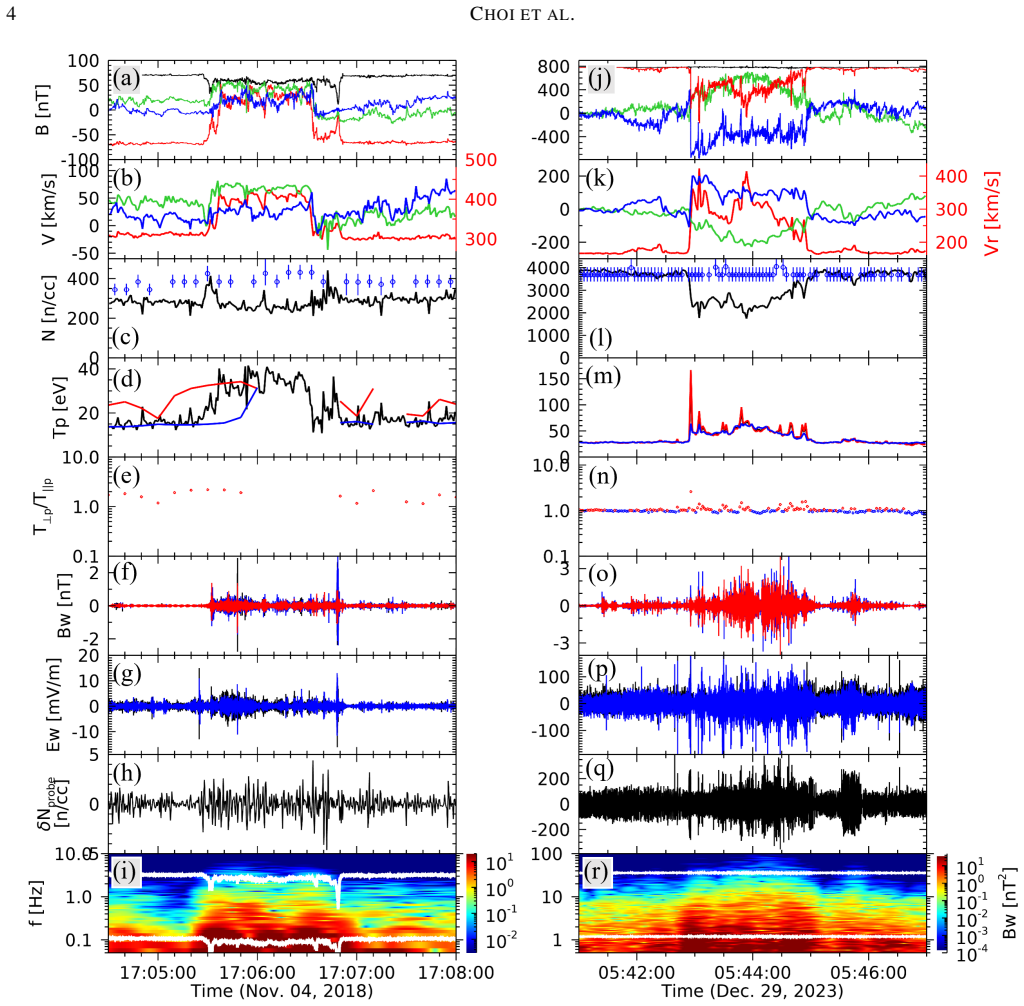
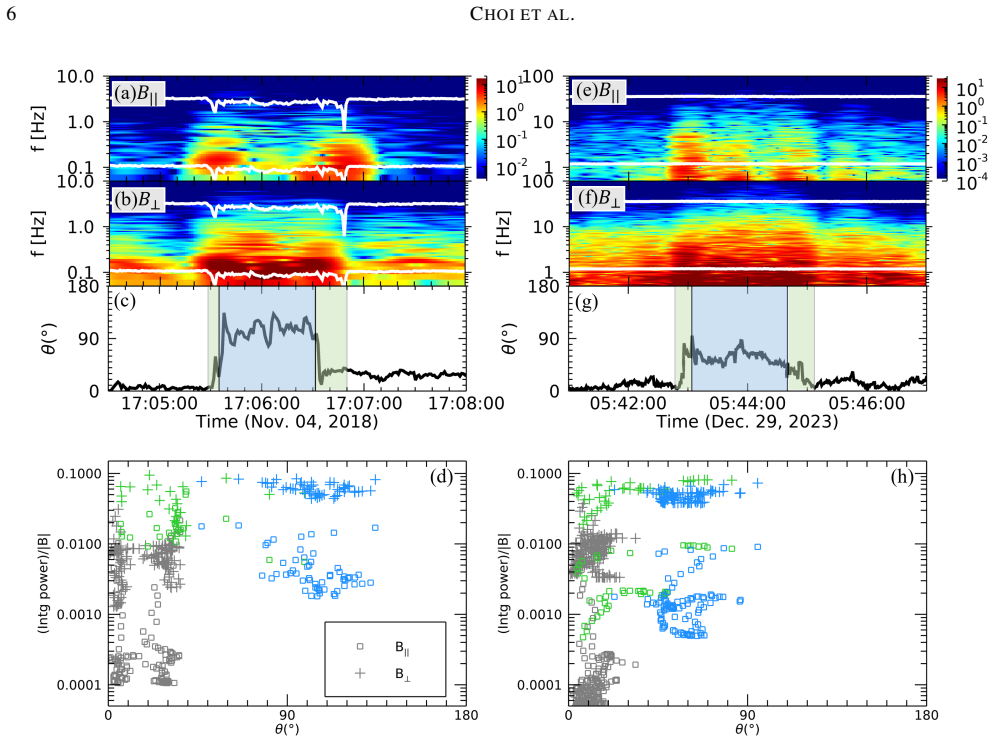
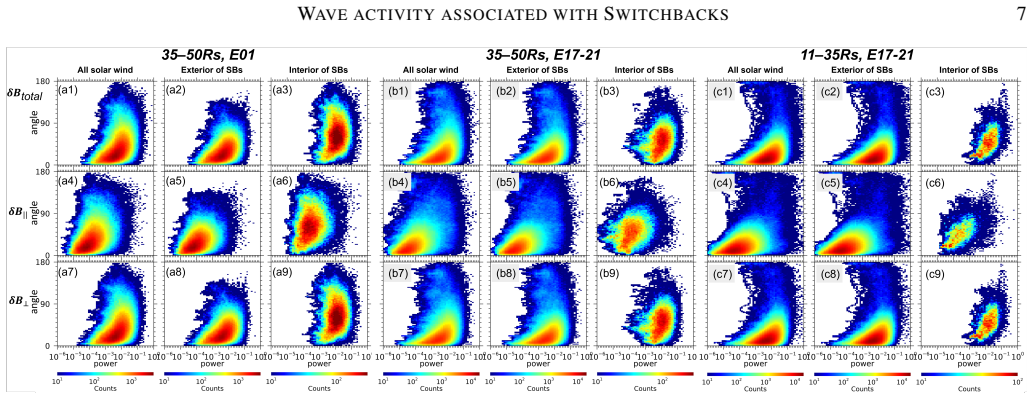
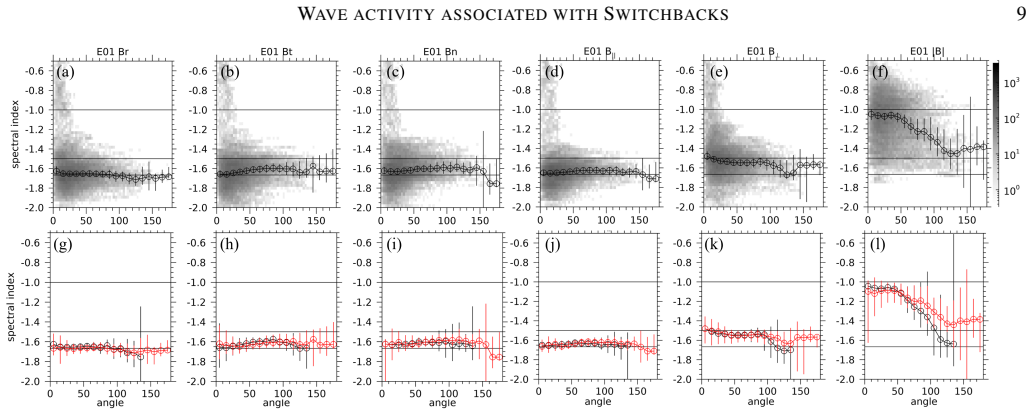
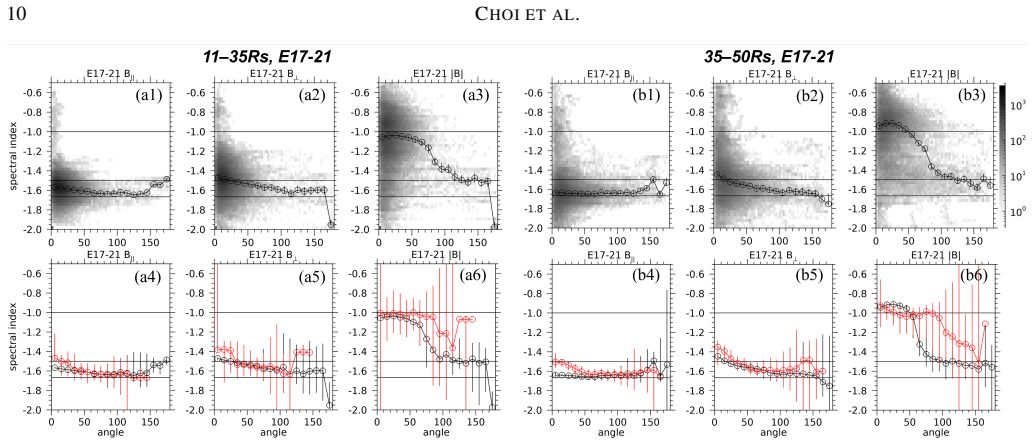
Decomposing fluctuations into field-aligned and transverse components and matching intervals by local magnetic field angle θ reveals that transverse magnetic power δB⊥ is systematically higher inside switchbacks than outside across a wide range of θ. The enhancement remains even where geometric projection predicts little extra power. Inertial-range spectral indices are similar inside and outside switchbacks, proton temperatures are elevated, and electric-field fluctuations increase, pointing to intrinsic wave amplification and dissipation rather than sampling effects alone.
What carries the argument
Comparison of transverse magnetic power δB⊥ inside versus outside switchbacks at matched local magnetic field angles θ in the 0.1–3 f_cp frequency band.
If this is right
- The turbulence cascade proceeds with similar spectral indices inside and outside switchbacks despite added wave power.
- Switchbacks serve as localized sites of ion-scale wave activity and cross-scale energy transfer.
- Elevated proton temperatures and electric fluctuations accompany the magnetic power increase inside switchbacks.
- The enhancement appears for both small and large field deflections, extending beyond projection geometry.
Where Pith is reading between the lines
- Solar wind heating models may need to treat switchbacks as distinct patches with elevated dissipation rates at ion scales.
- Observations farther from the Sun could check whether the intrinsic excess power changes with radial distance.
- Deflection-triggered instabilities offer one possible mechanism for generating the extra transverse power.
Load-bearing premise
Comparing switchback and non-switchback intervals at the same local magnetic field angle removes geometric sampling effects without leaving other uncontrolled differences in plasma conditions or interval selection.
What would settle it
A study that selects intervals at identical θ distributions but finds no excess transverse magnetic power inside switchbacks would falsify the claim of intrinsic enhancement.
Figures
read the original abstract
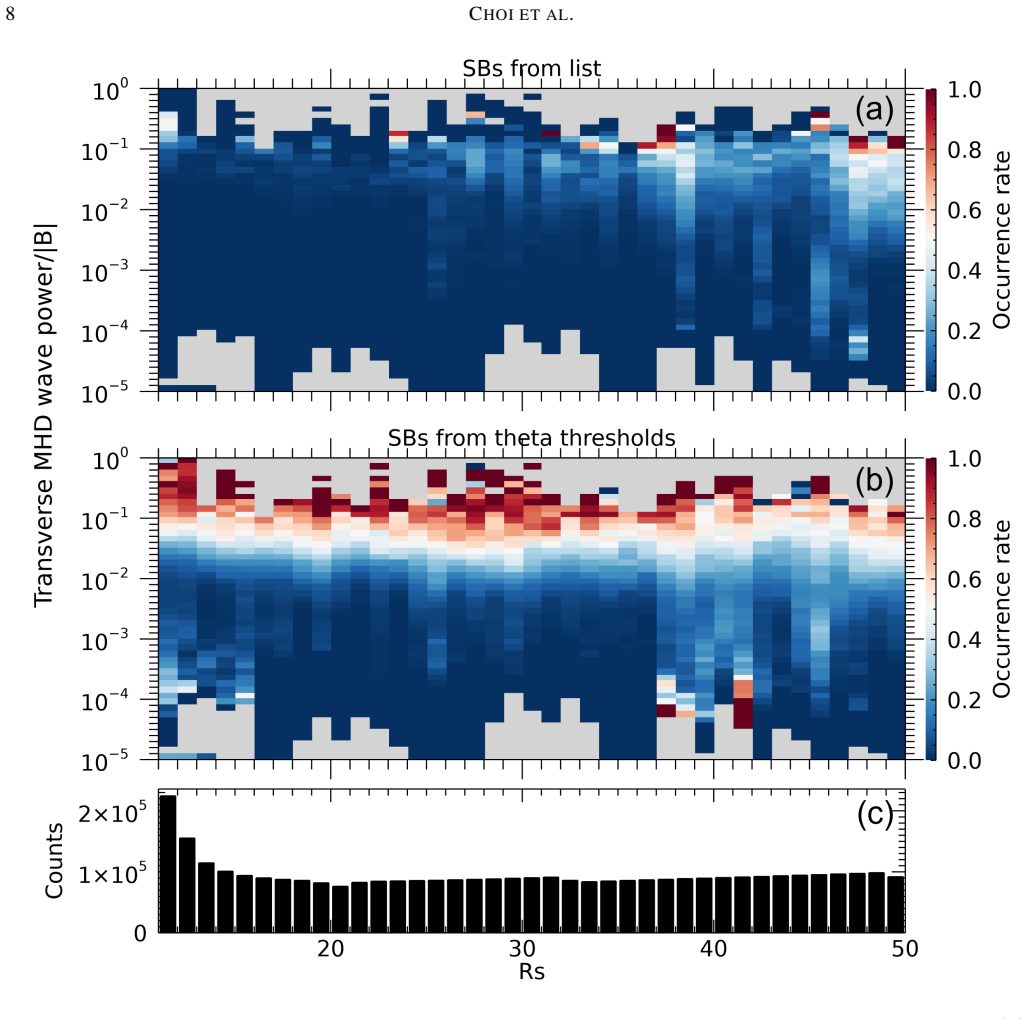
Magnetic switchbacks (SB) -- the localized magnetic structures with magnetic field direction inclined at an angle $\theta$ relative to the background $B_0$ -- in the young solar wind have been associated with enhanced ion-scale wave activity and local plasma heating. It remains debated whether the apparent wave-power increase is intrinsic or mainly caused by sampling geometry. In this work, we analyze magnetic and electric field fluctuations measured by Parker Solar Probe, focusing on the 0.1--3~\(f_{cp}\) frequency band that spans the transition from the MHD inertial range to ion-kinetic scales. By decomposing magnetic fluctuations into field-aligned and transverse components and comparing SB and non-SB intervals at the same local magnetic field angle, we test whether SBs sample an anisotropic cascade from different viewing angles or host intrinsically amplified wave activity. We find that the transverse magnetic power $\delta B_{\perp}$ is systematically enhanced inside switchbacks across a wide range of magnetic field rotation angles $\theta$. The enhancement persists even at small and intermediate deflections, where geometric projection alone predicts weak power, indicating an intrinsic origin beyond sampling geometry. The inertial-range spectral indices also remain similar between SB and non-SB intervals despite the enhanced wave power inside SBs, suggesting that the underlying turbulence cascade is largely preserved. This excess $\delta B_{\perp}$ coincides with elevated proton temperatures and enhanced electric-field fluctuations, supporting the interpretation that SBs act as localized sites of cross-scale energy transfer and ion-scale dissipation in the near-Sun solar wind.
Editorial analysis
A structured set of objections, weighed in public.
Referee Report
Summary. The manuscript analyzes Parker Solar Probe magnetic and electric field data in the 0.1-3 f_cp band. It decomposes fluctuations into field-aligned and transverse components and compares switchback (SB) and non-SB intervals matched at the same local magnetic field angle θ. The central claim is that transverse magnetic power δB⊥ is systematically enhanced inside SBs across a wide range of θ (including small and intermediate angles where geometric projection predicts weak power), indicating an intrinsic origin. Inertial-range spectral indices remain similar between SB and non-SB intervals, and the excess δB⊥ coincides with elevated proton temperatures and enhanced electric-field fluctuations, interpreted as evidence that SBs are localized sites of cross-scale energy transfer and ion-scale dissipation.
Significance. If the θ-matched comparison adequately isolates geometry from other effects, the result would strengthen the case that switchbacks host intrinsically amplified wave activity at MHD-ion scales and contribute to solar-wind heating. The persistence of the δB⊥ excess at small θ is a direct test of the geometry hypothesis and, if confirmed with full controls, would be a useful observational constraint on turbulence models. The similarity of spectral indices despite the power enhancement is also noteworthy as it suggests the underlying cascade is preserved.
major comments (1)
- [Abstract] Abstract (method description): The central claim that the observed δB⊥ enhancement is intrinsic rests on the assertion that 'comparing SB and non-SB intervals at the same local magnetic field angle' sufficiently controls for sampling geometry. However, the manuscript provides no information on whether SB and non-SB samples are also matched or statistically equivalent in other properties such as plasma β, density variance, proton temperature, solar-wind speed, or interval duration. Without these controls, the residual δB⊥ difference could arise from systematic differences in plasma conditions rather than an intrinsic switchback property, directly undermining the interpretation that the excess at small θ indicates an intrinsic origin.
minor comments (2)
- [Abstract] The abstract would benefit from a brief statement of the number of intervals analyzed, the θ range covered, and whether error bars or significance tests accompany the reported power enhancement.
- [Abstract] Notation for the frequency band (0.1--3 f_cp) and the decomposition into δB⊥ should be defined at first use for clarity.
Simulated Author's Rebuttal
We thank the referee for the constructive comments. The major comment raises a valid point about additional controls, which we will address through revision.
read point-by-point responses
-
Referee: [Abstract] Abstract (method description): The central claim that the observed δB⊥ enhancement is intrinsic rests on the assertion that 'comparing SB and non-SB intervals at the same local magnetic field angle' sufficiently controls for sampling geometry. However, the manuscript provides no information on whether SB and non-SB samples are also matched or statistically equivalent in other properties such as plasma β, density variance, proton temperature, solar-wind speed, or interval duration. Without these controls, the residual δB⊥ difference could arise from systematic differences in plasma conditions rather than an intrinsic switchback property, directly undermining the interpretation that the excess at small θ indicates an intrinsic origin.
Authors: We agree that the manuscript does not explicitly demonstrate or report matching of SB and non-SB intervals on plasma parameters beyond θ. This is a legitimate concern, as unaccounted differences in β, density variance, or other conditions could contribute to the observed δB⊥ excess. In the revised manuscript we will add a dedicated subsection (or appendix) presenting the statistical distributions and mean values of plasma β, density variance, proton temperature, solar-wind speed, and interval durations for the θ-matched samples. We will also include a supplementary check confirming that the δB⊥ enhancement at small and intermediate θ remains statistically significant after restricting to subsets with closely matched plasma parameters. These additions will directly address the referee’s point and strengthen the intrinsic-origin interpretation. revision: yes
Circularity Check
No circularity: direct observational comparison with no derivation chain
full rationale
The paper reports an empirical finding from Parker Solar Probe data: transverse magnetic power is higher inside switchbacks than non-switchbacks when intervals are matched on local field angle θ. No equations, models, or derivations are presented that reduce the result to a fitted parameter, self-definition, or self-citation chain. The comparison is a straightforward data partitioning and spectral analysis; the result is not forced by construction from the inputs. External validity concerns (possible unmatched confounders) are separate from circularity.
Axiom & Free-Parameter Ledger
axioms (1)
- domain assumption Fluctuations in the 0.1-3 f_cp band represent the transition from MHD to ion-kinetic scales in solar wind turbulence.
Reference graph
Works this paper leans on
-
[1]
Agapitov, O. V ., Drake, J. F., Swisdak, M., Choi, K.-E., & Raouafi, N. 2023, Constraints on the Alfv´enicity of Switchbacks, The Astrophysical Journal Letters, 959, L21, doi: 10.3847/2041-8213/ad12a5
-
[2]
V ., Drake, J
Agapitov, O. V ., Drake, J. F., Swisdak, M., et al. 2022, Flux rope merging and the structure of switchbacks in the solar wind, The Astrophysical Journal
2022
-
[3]
Agapitov, O. V ., Wit, T. D. D., Mozer, F. S., et al. 2020, Sunward-propagating Whistler Waves Collocated with Localized Magnetic Field Holes in the Solar Wind: Parker Solar Probe Observations at 35.7 R⊙ Radii, The Astrophysical Journal Letters, 891, L20, doi: 10.3847/2041-8213/ab799c
-
[4]
T., Fargette, N., Matteini, L., Agapitov, O
Badman, S. T., Fargette, N., Matteini, L., Agapitov, O. V ., et al. 2026, Properties of Magnetic Switchbacks in the Near-Sun Solar Wind, in Space Science Reviews (Springer) 12 CHOI ET AL
2026
-
[5]
Bale, S., Kasper, J., Howes, G., et al. 2009, Magnetic Fluctuation Power Near Proton Temperature Anisotropy Instability Thresholds¡? format?¿ in the Solar Wind, Physical review letters, 103, 211101, doi: 10.1103/PhysRevLett.103.211101
-
[6]
Bale, S., Goetz, K., Harvey, P., et al. 2016, The FIELDS instrument suite for Solar Probe Plus: measuring the coronal plasma and magnetic field, plasma waves and turbulence, and radio signatures of solar transients, Space Science Reviews, 204, 49, doi: 10.1007/s11214-016-0244-5
-
[7]
Bale, S., Badman, S., Bonnell, J., et al. 2019, Highly structured slow solar wind emerging from an equatorial coronal hole, Nature, 576, 237, doi: 10.1038/s41586-019-1818-7
-
[8]
Bandyopadhyay, R., Goldstein, M., Maruca, B., et al. 2020, Enhanced energy transfer rate in solar wind turbulence observed near the sun from parker solar probe, The Astrophysical Journal Supplement Series, 246, 48, doi: 10.3847/1538-4365/ab5dae
-
[9]
A., Mallet, A., Huang, J., et al
Bowen, T. A., Mallet, A., Huang, J., et al. 2020a, Ion-scale Electromagnetic Waves in the Inner Heliosphere, The Astrophysical Journal Supplement Series, 246, 66, doi: 10.3847/1538-4365/ab6c65
-
[10]
Bowen, T. A., Mallet, A., Bale, S. D., et al. 2020b, Constraining ion-scale heating and spectral energy transfer in observations of plasma turbulence, Physical review letters, 125, 025102, doi: 10.1103/PhysRevLett.125.025102
-
[11]
Bruno, R., Telloni, D., Sorriso-Valvo, L., et al. 2019, The low-frequency break observed in the slow solar wind magnetic spectra, Astronomy & Astrophysics, 627, A96, doi: 10.1051/0004-6361/201935841
-
[12]
Case, A. W., Kasper, J. C., Stevens, M. L., et al. 2020, The solar probe cup on the Parker Solar Probe, The Astrophysical Journal Supplement Series, 246, 43, doi: 10.3847/1538-4365/ab5a7b
-
[13]
2021, Modeling Interactions of Narrowband Large Amplitude Whistler-mode Waves with Electrons in the Solar Wind inside∼0.3 au and at 1 au Using a Particle Tracing
Cattell, C., & V o, T. 2021, Modeling Interactions of Narrowband Large Amplitude Whistler-mode Waves with Electrons in the Solar Wind inside∼0.3 au and at 1 au Using a Particle Tracing
2021
-
[14]
Code, The Astrophysical Journal Letters, 914, L33, doi: 10.3847/2041-8213/ac08a1
-
[15]
Chen, C., Leung, L., Boldyrev, S., Maruca, B., & Bale, S. 2014, Ion-scale spectral break of solar wind turbulence at high and low beta, Geophysical Research Letters, 41, 8081, doi: 10.1002/2014GL062009
-
[16]
Chen, C., Bale, S., Bonnell, J., et al. 2020, The evolution and role of solar wind turbulence in the inner heliosphere, The Astrophysical Journal Supplement Series, 246, 53, doi: 10.3847/1538-4365/ab60a3
-
[17]
Choi, K.-E., Agapitov, O., Colomban, L., et al. 2024a, Whistler waves in the young solar wind: statistics of amplitude and propagation direction from Parker Solar Probe encounters 1–11, The Astrophysical Journal, 971, 177, doi: 10.3847/1538-4357/ad54c4
-
[18]
Colomban, L. 2025a, Surface Waves at Switchback Boundaries in the Young Solar Wind from Parker Solar Probe Observations, The Astrophysical Journal, 992, 208, doi: 10.3847/1538-4357/ae0b65
-
[19]
Choi, K.-E., Agapitov, O. V ., Lee, D.-Y ., et al. 2025b, Switchbacks near Boundaries of Small-scale Magnetic Flux Ropes in the Young Solar Wind from Parker Solar Probe Observations, The Astrophysical Journal, 988, 49, doi: 10.3847/1538-4357/ade4be
-
[20]
Observations, The Astrophysical Journal, 961, 3, doi: 10.3847/1538-4357/ad02f6
-
[21]
Colomban, L., Kretzschmar, M., Krasnoselkikh, V ., et al. 2024, Quantifying the diffusion of suprathermal electrons by whistler waves between 0.2 and 1 AU with Solar Orbiter and Parker Solar Probe, Astronomy & Astrophysics, 684, A143, doi: 10.1051/0004-6361/202347489
-
[22]
Crooker, N., Kahler, S., Larson, D., & Lin, R. 2004, Large-scale magnetic field inversions at sector boundaries, Journal of Geophysical Research: Space Physics, 109, doi: 10.1029/2003JA010278
-
[23]
Duan, D., He, J., Bowen, T. A., et al. 2021, Anisotropy of solar wind turbulence in the inner heliosphere at kinetic scales: PSP observations, The Astrophysical Journal Letters, 915, L8, doi: 10.3847/2041-8213/ac07ac Dudok de Wit, T., Krasnoselskikh, V . V ., Bale, S. D., et al. 2020, Switchbacks in the near-Sun magnetic field: long memory and impact on t...
-
[24]
Ervin, T., Mallet, A., Eriksson, S., et al. 2025, The impact of Alfvenic shear flow on magnetic reconnection and turbulence, The Astrophysical Journal Letters, 992, L11, doi: 10.3847/2041-8213/ae0b56
-
[25]
Fargette, N., Lavraud, B., Rouillard, A. P., et al. 2022, The preferential orientation of magnetic switchbacks and its implications for solar magnetic flux transport, Astronomy & Astrophysics, 663, A109, doi: 10.1051/0004-6361/202243537
-
[26]
M., MacDowall, R
Farrell, W. M., MacDowall, R. J., Gruesbeck, J. R., et al. 2020, Magnetic field dropouts at near-sun switchback boundaries: A superposed epoch analysis, The Astrophysical Journal
2020
-
[27]
Fisk, L., & Gloeckler, G. 2006, The common spectrum for accelerated ions in the quiet-time solar wind, The Astrophysical Journal Letters, 640, L79, doi: 10.1086/503293
-
[28]
Franci, L., Landi, S., Matteini, L., Verdini, A., & Hellinger, P. 2015, High-resolution hybrid simulations of kinetic plasma turbulence at proton scales, The Astrophysical Journal, 812, 21, doi: 10.1088/0004-637X/812/1/21 WAVE ACTIVITY ASSOCIATED WITHSWITCHBACKS13
-
[29]
Froment, C., Agapitov, O., Krasnoselskikh, V ., et al. 2023, Whistler waves generated inside magnetic dips in the young solar wind: Observations of the search-coil magnetometer on board Parker Solar Probe, Astronomy & Astrophysics, 672, A135
2023
-
[30]
He, J., Marsch, E., Tu, C., Yao, S., & Tian, H. 2011, Possible evidence of Alfv´en-cyclotron waves in the angle distribution of magnetic helicity of solar wind turbulence, The Astrophysical Journal, 731, 85, doi: 10.1088/0004-637X/731/2/85
-
[31]
Horbury, T., Matteini, L., & Stansby, D. 2018, Short, large-amplitude speed enhancements in the near-Sunfast solar wind, Monthly Notices of the Royal Astronomical Society, 478, 1980, doi: 10.1093/mnras/sty953
-
[32]
S., Woolley, T., Laker, R., et al
Horbury, T. S., Woolley, T., Laker, R., et al. 2020, Sharp Alfv´enic Impulses in the Near-Sun Solar Wind, The Astrophysical Journal Supplement Series, 246, 45, doi: 10.3847/1538-4365/ab5b15
-
[33]
C., Larson, D
Huang, J., Kasper, J. C., Larson, D. E., et al. 2023, The
2023
-
[34]
Huang, Z., Velli, M., Chandran, B., et al. 2025, Two Types of 1/f Range in Solar Wind Turbulence, The Astrophysical Journal Letters, 990, L34, doi: 10.3847/2041-8213/adfa13
-
[35]
1963, Turbulence of a conducting fluid in a strong magnetic field, Astronomicheskii Zhurnal, 40, 742
Iroshnikov, P. 1963, Turbulence of a conducting fluid in a strong magnetic field, Astronomicheskii Zhurnal, 40, 742
1963
-
[36]
Jagarlamudi, V . K., Raouafi, N. E., Bourouaine, S., et al. 2023, Occurrence and Evolution of Switchbacks in the Inner Heliosphere: Parker Solar Probe Observations, The Astrophysical Journal Letters, 950, L7, doi: 10.3847/2041-8213/acd778
-
[37]
K., Russell, C
Jian, L. K., Russell, C. T., Luhmann, J. G., et al. 2009, Ion cyclotron waves in the solar wind observed by STEREO near 1
2009
-
[38]
AU, The Astrophysical Journal, 701, L105, doi: 10.1088/0004-637X/701/2/L105
-
[39]
Kahler, S., & Lin, R. 1994, The determination of interplanetary magnetic field polarities around sector boundaries using E¿ 2 keV electrons, Geophysical Research Letters, 21, 1575, doi: 10.1029/94GL01362
-
[40]
Karbashewski, S., Agapitov, O., Kim, H., et al. 2023, Whistler wave observations by Parker Solar Probe during encounter 1: Counter-propagating whistlers collocated with magnetic field inhomogeneities and their application to electric field measurement calibration, The Astrophysical Journal, 947, 73
2023
-
[41]
C., Abiad, R., Austin, G., et al
Kasper, J. C., Abiad, R., Austin, G., et al. 2016, Solar wind electrons alphas and protons (SWEAP) investigation: Design of the solar wind and coronal plasma instrument suite for solar probe plus, Space Science Reviews, 204, 131, doi: 10.1007/s11214-015-0206-3
-
[42]
Kasper, J. C., Bale, S. D., Belcher, J. W., et al. 2019, Alfv´enic velocity spikes and rotational flows in the near-Sun solar wind, Nature, 576, 228, doi: 10.1038/s41586-019-1813-z
-
[43]
Kasper, J. C., Klein, K. G., Lichko, E., et al. 2021, Parker Solar Probe Enters the Magnetically Dominated Solar Corona, PhRvL, 127, 255101, doi: 10.1103/PhysRevLett.127.255101
-
[44]
Kraichnan, R. H. 1965, Inertial-range spectrum of hydromagnetic turbulence, Physics of Fluids, 8, 1385, doi: 10.1063/1.1761412
-
[45]
2020, Localized magnetic-field structures and their boundaries in the near-sun solar wind from parker solar probe measurements, The Astrophysical Journal
Krasnoselskikh, V ., Larosa, A., Agapitov, O., et al. 2020, Localized magnetic-field structures and their boundaries in the near-sun solar wind from parker solar probe measurements, The Astrophysical Journal
2020
-
[46]
S., Woodham, L
Laker, R., Horbury, T. S., Woodham, L. D., et al. 2024, Coherent deflection pattern and associated temperature enhancements in the near-Sun solar wind, Monthly Notices of the Royal Astronomical Society
2024
-
[47]
Larosa, A., Krasnoselskikh, V ., Dudok De Wit, T., et al. 2021, Switchbacks: statistical properties and deviations from Alfv´enicity, Astronomy & Astrophysics, 650, A3, doi: 10.1051/0004-6361/202039442
-
[48]
Lee, D.-Y ., Choi, D., Choi, K.-E., & Noh, S. 2026, Multiple magnetic flux ropes within reconnection exhausts close to the centers of heliospheric current sheets near the Sun, Astronomy & Astrophysics, 709, A189, doi: 10.1051/0004-6361/202659246
-
[49]
Liu, M., Issautier, K., Meyer-Vernet, N., et al. 2021, Solar wind energy flux observations in the inner heliosphere: first results from Parker Solar Probe, A&A, 650, A14, doi: 10.1051/0004-6361/202039615
-
[50]
Liu, M., Issautier, K., Moncuquet, M., et al. 2023, Total electron temperature derived from quasi-thermal noise spectroscopy in the pristine solar wind from Parker Solar Probe observations, A&A, 674, A49, doi: 10.1051/0004-6361/202245450
-
[51]
W., Larson, D
Liu, M., Bonnell, J. W., Larson, D. E., et al. 2025, High-Frequency Solar Wind Electron Density Measurements Derived from Spacecraft Surface Charging Method on Parker Solar Probe, in AGU Fall Meeting Abstracts, American Geophysical Union, SH43D–2620
2025
-
[52]
Livi, R., Larson, D. E., Kasper, J. C., et al. 2022, The solar probe analyzer—ions on the Parker Solar Probe, The Astrophysical Journal, 938, 138, doi: 10.3847/1538-4357/ac93f5
-
[53]
2023, Statistical Study of Anisotropic Proton Heating in Interplanetary Magnetic Switchbacks Measured by Parker Solar Probe, The Astrophysical Journal
Luo, Q., Duan, D., He, J., Zhu, X., et al. 2023, Statistical Study of Anisotropic Proton Heating in Interplanetary Magnetic Switchbacks Measured by Parker Solar Probe, The Astrophysical Journal
2023
-
[54]
Mallet, A., Squire, J., Chandran, B. D., Bowen, T., & Bale, S. D. 2021, Evolution of large-amplitude Alfv´en waves and generation of switchbacks in the expanding solar wind, The Astrophysical Journal, 918, 62, doi: 10.3847/1538-4357/ac0c12 Martinovi´c, M. M., Klein, K. G., Huang, J., et al. 2021, Multiscale solar wind turbulence properties inside and near...
-
[55]
Moncuquet, M., Meyer-Vernet, N., Issautier, K., et al. 2020, First In Situ Measurements of Electron Density and Temperature from Quasi-thermal Noise Spectroscopy with Parker Solar Probe/FIELDS, ApJS, 246, 44, doi: 10.3847/1538-4365/ab5a84
-
[56]
Direct Evidence of Non-Ideal Dissipative Dynamics in Solar Wind Magnetic Switchbacks
Mozer, F., Agapitov, O., Choi, K.-E., & Sydora, R. 2026, Direct Evidence of Non-Ideal Dissipative Dynamics in Solar Wind Magnetic Switchbacks, arXiv preprint arXiv:2605.14114, doi: 10.48550/arXiv.2605.14114
work page internal anchor Pith review Pith/arXiv arXiv doi:10.48550/arxiv.2605.14114 2026
-
[57]
S., Agapitov, O
Mozer, F. S., Agapitov, O. V ., Bale, S. D., et al. 2020, Switchbacks in the solar magnetic field: Their evolution, their content, and their effects on the plasma, The Astrophysical Journal
2020
-
[58]
Owens, M., Crooker, N., & Lockwood, M. 2013, Solar origin of heliospheric magnetic field inversions: Evidence for coronal loop opening within pseudostreamers, Journal of Geophysical Research: Space Physics, 118, 1868, doi: 10.1002/jgra.50259
-
[59]
E., Matteini, L., Squire, J., Badman, S
Raouafi, N. E., Matteini, L., Squire, J., Badman, S. T., et al. 2023, Parker solar probe: Four years of discoveries at solar cycle minimum, in Space Science Reviews (Springer)
2023
-
[60]
P., Farrell, W
Rasca, A. P., Farrell, W. M., MacDowall, R. J., et al. 2021, Near-Sun Switchback Boundaries: Dissipation with Solar
2021
-
[61]
2022, Patches of magnetic switchbacks and their origins, The Astrophysical Journal
Shi, C., Panasenco, O., Velli, M., Tenerani, A., et al. 2022, Patches of magnetic switchbacks and their origins, The Astrophysical Journal
2022
-
[62]
Squire, J., Chandran, B. D. G., & Meyrand, R. 2020, In-situ Switchback Formation in the Expanding Solar Wind, The Astrophysical Journal Letters, 891, L2, doi: 10.3847/2041-8213/ab74e1
-
[63]
Tatum, P. D., Malaspina, D. M., Chasapis, A., & Short, B. 2024, The independence of magnetic turbulent power spectra to the presence of switchbacks in the inner heliosphere, The Astrophysical Journal, 973, 156, doi: 10.3847/1538-4357/ad7115
-
[64]
Tenerani, A., Sioulas, N., Matteini, L., et al. 2021, Evolution of switchbacks in the inner heliosphere, The Astrophysical Journal Letters, 919, L31, doi: 10.3847/2041-8213/ac2606
-
[65]
Verniero, J. L., Larson, D. E., Livi, R., et al. 2020, Parker Solar Probe Observations of Proton Beams Simultaneous with Ion-scale Waves, The Astrophysical Journal Supplement Series, 248, 5, doi: 10.3847/1538-4365/ab86af V o, T., Agapitov, O. V ., Choi, K.-E., et al. 2024, Enhanced efficiency of solar wind electron interaction with whistlers caused by swi...
-
[66]
Whittlesey, P. L., Larson, D. E., Kasper, J. C., et al. 2020, The Solar Probe ANalyzers—Electrons on the Parker Solar Probe, The Astrophysical Journal Supplement Series, 246, 74, doi: 10.3847/1538-4365/ab7370
-
[67]
D., Horbury, T
Woodham, L. D., Horbury, T. S., Matteini, L., et al. 2021, Enhanced proton parallel temperature inside patches of switchbacks in the inner heliosphere, Astronomy & Astrophysics
2021
-
[68]
S., et al
Woolley, T., Matteini, L., Horbury, T. S., et al. 2020, Proton core behaviour inside magnetic field switchbacks, Monthly Notices of the Royal Astronomical Society
2020
-
[69]
Woolley, T., Matteini, L., McManus, M. D., et al. 2021, Plasma properties, switchback patches, and lowα-particle abundance in slow Alfv´enic coronal hole wind at 0.13 au, Monthly Notices of the Royal Astronomical Society, 508, 236, doi: 10.1093/mnras/stab2281
-
[70]
F., Squire, J., Pariat, E., et al
Wyper, P. F., Squire, J., Pariat, E., et al. 2026, Magnetic switchback formation: a review of proposed mechanisms, Space Science Reviews, 222, 43
2026
-
[71]
Zank, G., Nakanotani, M., Zhao, L.-L., Adhikari, L., & Kasper, J. 2020, The origin of switchbacks in the solar corona: Linear theory, The Astrophysical Journal, 903, 1, doi: 10.3847/1538-4357/abb828
-
[72]
Zhao, S. Q., Yan, H., Liu, T. Z., Liu, M., & Shi, M. 2021, Analysis of Magnetohydrodynamic Perturbations in the Radial-field Solar Wind from Parker Solar Probe Observations, ApJ, 923, 253, doi: 10.3847/1538-4357/ac2ffe
discussion (0)
Sign in with ORCID, Apple, or X to comment. Anyone can read and Pith papers without signing in.