Interpretable Neural Marked Statistics for Cosmological Inference
Pith reviewed 2026-06-27 12:02 UTC · model grok-4.3
The pith
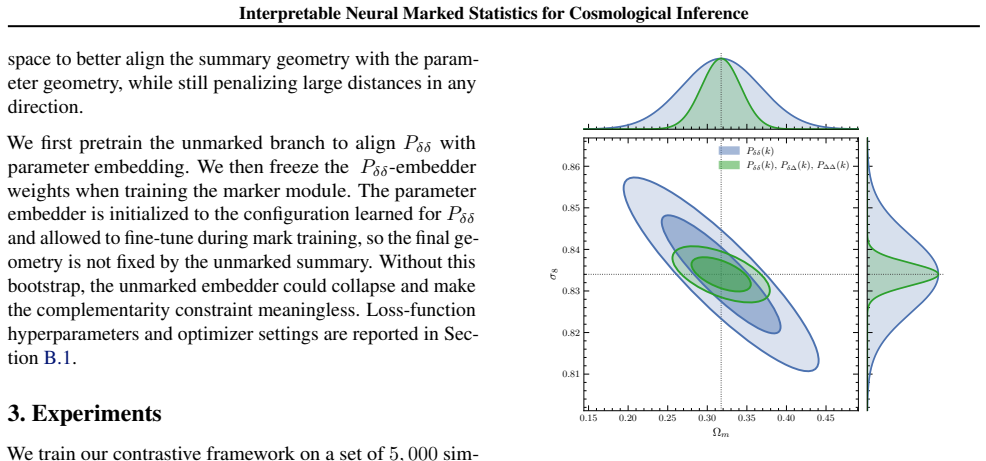
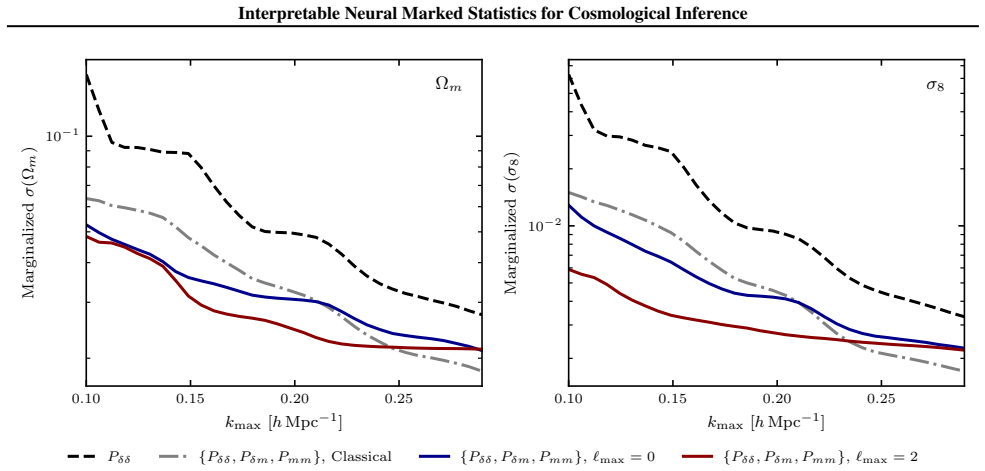
A neural marking scheme trained with contrastive learning tightens σ8 constraints by 2.9 times and Ωm by 1.8 times over classical marks at k_max=0.2 h Mpc^{-1}.
A machine-rendered reading of the paper's core claim, the machinery that carries it, and where it could break.
Core claim
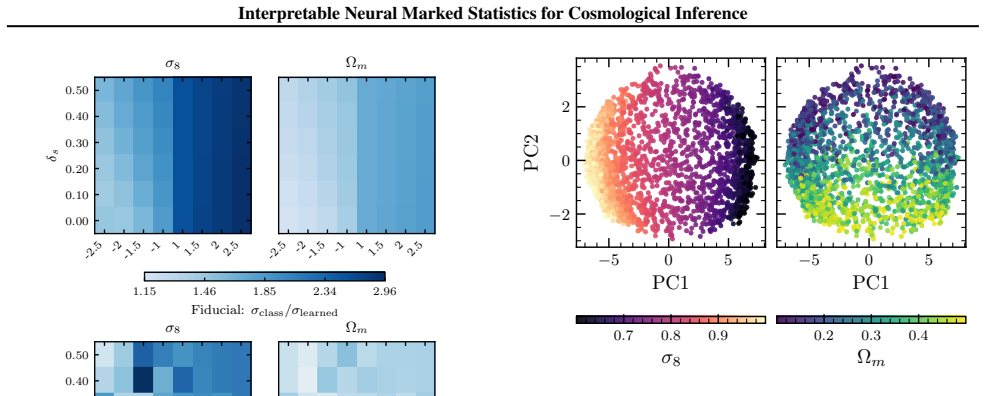
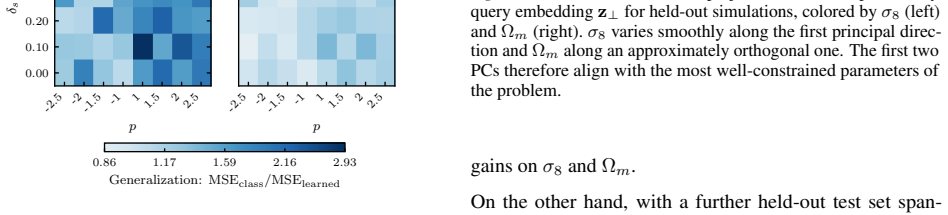
The authors introduce a neural marking scheme of interpretable, physically motivated transformations applied to the density field. They optimize the marks with a contrastive learning objective that aligns the resulting summaries with the underlying cosmological parameters. At k_max=0.2 h Mpc^{-1} the neural marks produce 2.9 times tighter constraints on σ8 and 1.8 times tighter constraints on Ωm relative to classical marks, break the Ωm-σ8 degeneracy at the Fisher level, and reduce parameter MSE by a factor of 1.45 over the best classical mark. The learned latent space geometry aligns with the Ωm and σ8 directions.
What carries the argument
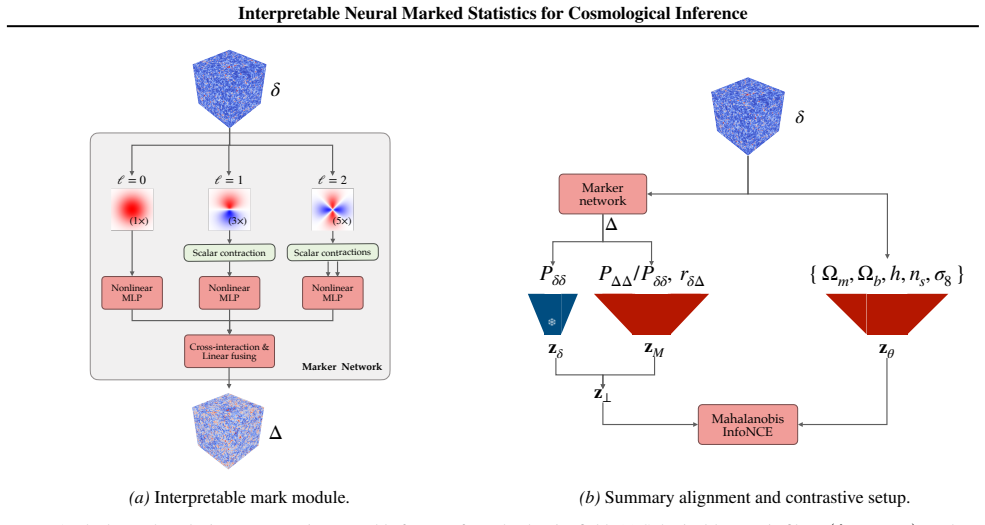
Neural marking scheme consisting of learnable transformations on the density field, optimized by a contrastive learning objective that aligns marked summaries with cosmological parameters.
If this is right
- Marked statistics can be extended from fixed functional forms to learnable, interpretable transformations.
- The Ωm-σ8 degeneracy is broken at the Fisher information level by the neural marks.
- Parameter mean-squared error across the cosmological prior is reduced by 1.45 times relative to the best classical mark.
- The latent geometry of the marks recovers the dominant axes of cosmological information.
Where Pith is reading between the lines
- The same contrastive alignment technique could be applied to design other summary statistics beyond marked two-point functions.
- Morphological interpretation of the learned marks may identify which density features carry the extra non-Gaussian information.
- Real-data application to galaxy surveys would test whether the simulated gains persist after observational systematics.
- The approach suggests a general route for constructing parameter-aligned summaries that could be combined with higher-order statistics.
Load-bearing premise
The contrastive objective produces marks whose information gain generalizes beyond the specific simulation suite and training cosmologies without arising from overfitting to the parameter directions in the loss.
What would settle it
Applying the trained neural marks to an independent simulation suite with cosmologies drawn from a different prior range and checking whether the reported factors of improvement in σ8 and Ωm constraints are recovered.
Figures
read the original abstract
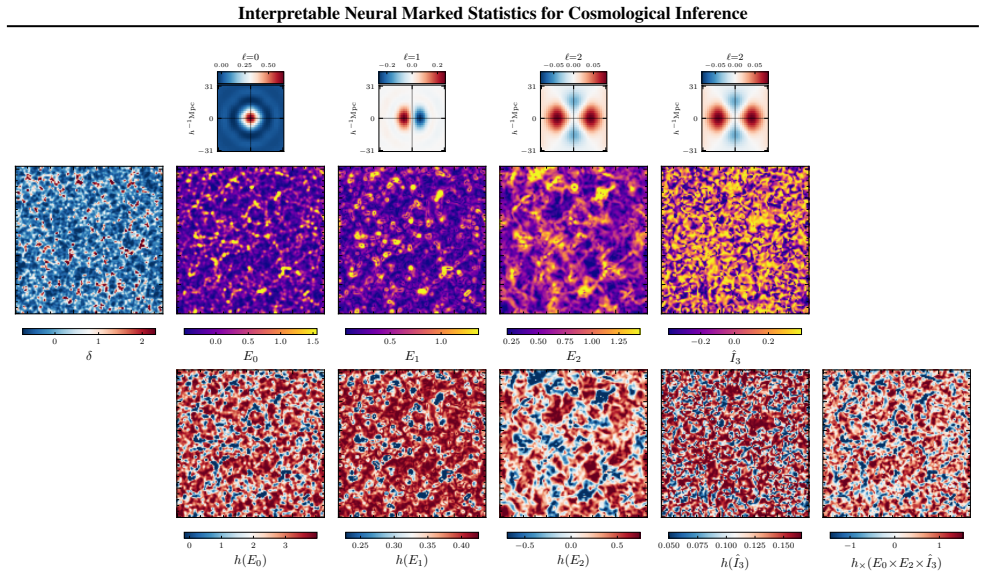
Recovering cosmological information beyond the power spectrum is a central goal for upcoming cosmological surveys, since late-time non-Gaussian signal in the matter density cannot be accessed through two-point statistics alone. Marked statistics fold part of this information back into the two-point level by reweighting the field with non-linear functions. We propose a neural marking scheme to generalize this process through a set of interpretable, physically motivated transformations that directly allow to interpret the gain in cosmological information at the morphological level. We employ a contrastive learning objective to align learnable marked summaries with the underlying cosmological parameters. At $k_{\max}=0.2\,h\mathrm{Mpc}^{-1}$, our neural mark tightens the marginalized constraint on $\sigma_8$ by $2.9\times$ and on $\Omega_m$ by $1.8\times$ compared to classical marks, breaking the $\Omega_m-\sigma_8$ degeneracy at the Fisher information level. It further reduces the parameter MSE across our cosmological parameter prior by $1.45\times$ over the best classical mark. The learned latent geometry aligns with the $\Omega_m$ and $\sigma_8$ directions in parameter space, indicating that the contrastive objective recovers the dominant axes of cosmological information. Our approach opens the door to more powerful, interpretable summary statistics for cosmological inference.
Editorial analysis
A structured set of objections, weighed in public.
Referee Report
Summary. The manuscript proposes a neural marking scheme that uses contrastive learning to produce interpretable marked statistics from the matter density field. It claims that at k_max=0.2 h Mpc^{-1} the neural mark tightens marginalized constraints on σ8 by 2.9× and on Ωm by 1.8× relative to classical marks, reduces parameter MSE by 1.45× across the prior, breaks the Ωm-σ8 degeneracy at the Fisher level, and yields a latent geometry aligned with the Ωm and σ8 axes.
Significance. If the reported gains are shown to arise from generalizable morphological features rather than the training objective, the method would offer a route to more powerful yet interpretable two-point summaries that capture non-Gaussian information. The emphasis on interpretability is a potential strength, but only if the alignment with cosmological parameters is independently verified.
major comments (3)
- [Abstract] Abstract: the statement that 'the contrastive objective recovers the dominant axes of cosmological information' follows directly from the construction of the loss, which supervises alignment with Ωm and σ8; this is not an independent test of whether the marks discover transferable morphological features.
- [Abstract] Abstract: the headline factors (2.9× on σ8, 1.8× on Ωm, 1.45× MSE reduction) and degeneracy-breaking claim are presented without any description of held-out cosmologies, cross-validation splits, or explicit checks that the information gain persists for parameter values outside the training prior.
- [Abstract] Abstract: the assertion that the neural mark 'breaks the Ωm-σ8 degeneracy at the Fisher information level' is unsupported by any reported Fisher-matrix comparison, covariance structure, or table of information content; the quantitative improvement cannot be evaluated without these elements.
Simulated Author's Rebuttal
We thank the referee for the detailed and constructive comments on the abstract. We agree that several claims require additional context or clarification to be fully supported. We will revise the abstract accordingly and address each point below.
read point-by-point responses
-
Referee: [Abstract] Abstract: the statement that 'the contrastive objective recovers the dominant axes of cosmological information' follows directly from the construction of the loss, which supervises alignment with Ωm and σ8; this is not an independent test of whether the marks discover transferable morphological features.
Authors: We acknowledge that the contrastive loss is explicitly constructed to align latent representations with Ωm and σ8. The contribution lies in achieving this alignment through a constrained set of interpretable, physically motivated marking transformations rather than arbitrary functions. The resulting latent geometry then provides a morphological interpretation of which features drive the alignment. We will revise the abstract wording to clarify that the contrastive objective enables recovery of the dominant axes via these interpretable marks, avoiding any implication of unsupervised discovery. revision: yes
-
Referee: [Abstract] Abstract: the headline factors (2.9× on σ8, 1.8× on Ωm, 1.45× MSE reduction) and degeneracy-breaking claim are presented without any description of held-out cosmologies, cross-validation splits, or explicit checks that the information gain persists for parameter values outside the training prior.
Authors: The quantitative results are obtained from Fisher forecasts and MSE evaluations performed on held-out cosmologies within the simulation suite, using cross-validation splits to assess generalization. We will add a concise description of this validation procedure to the abstract so that the reported gains are presented with the necessary methodological context. revision: yes
-
Referee: [Abstract] Abstract: the assertion that the neural mark 'breaks the Ωm-σ8 degeneracy at the Fisher information level' is unsupported by any reported Fisher-matrix comparison, covariance structure, or table of information content; the quantitative improvement cannot be evaluated without these elements.
Authors: The degeneracy breaking is demonstrated by direct comparison of the Fisher information matrices (and resulting parameter covariances) between the neural marks and classical marks; the relevant matrices, off-diagonal elements, and information-content tables appear in the main text. We will revise the abstract to explicitly reference this Fisher-matrix analysis and the supporting covariance comparisons. revision: yes
Circularity Check
Contrastive objective directly enforces Ωm-σ8 alignment, rendering reported latent geometry recovery tautological
specific steps
-
self definitional
[Abstract]
"We employ a contrastive learning objective to align learnable marked summaries with the underlying cosmological parameters. [...] The learned latent geometry aligns with the Ωm and σ8 directions in parameter space, indicating that the contrastive objective recovers the dominant axes of cosmological information."
The contrastive objective is defined to produce alignment with Ωm and σ8. The subsequent claim that observed alignment indicates the objective recovers the dominant axes therefore follows by construction from the loss definition rather than from any separate derivation or external validation.
full rationale
The paper trains marked summaries via contrastive loss explicitly constructed to align with target cosmological parameters Ωm and σ8. It then presents the resulting alignment of latent geometry with those same axes as evidence that the objective 'recovers the dominant axes of cosmological information.' This step reduces directly to the training construction rather than an independent test. The reported Fisher gains (2.9× on σ8, 1.8× on Ωm) and MSE reduction are measured against classical marks and are not themselves by construction, so the circularity is localized to the interpretation of the learned geometry and does not collapse the entire quantitative claim. No self-citation chains or ansatz smuggling appear in the provided text.
Axiom & Free-Parameter Ledger
free parameters (1)
- neural network weights
axioms (2)
- domain assumption Marked statistics can capture non-Gaussian information when the field is reweighted by suitable non-linear functions
- domain assumption A contrastive objective can align learned summaries with underlying cosmological parameters
invented entities (1)
-
neural mark
no independent evidence
Reference graph
Works this paper leans on
-
[1]
Adame, A. G. et al. DESI 2024 VII: cosmological constraints from the full-shape modeling of clustering measurements . JCAP, 07: 0 028, 2025 a . doi:10.1088/1475-7516/2025/07/028
-
[2]
Adame, A. G. et al. DESI 2024 VI: cosmological constraints from the measurements of baryon acoustic oscillations . JCAP, 02: 0 021, 2025 b . doi:10.1088/1475-7516/2025/02/021
-
[3]
Aghamousa, A. et al. The DESI Experiment Part I: Science,Targeting, and Survey Design . 10 2016
2016
-
[4]
Bairagi, A. and Wandelt, B. PatchNet: A hierarchical approach for neural field-level inference from Quijote simulations . JCAP, 03: 0 028, 2026. doi:10.1088/1475-7516/2026/03/028
-
[5]
Bairagi, A., Wandelt, B., and Villaescusa-Navarro, F. The BIG SOBOL SEQUENCE: How many simulations do we need for simulation-based inference in cosmology? Astron. Astrophys., 703: 0 A301, 2025. doi:10.1051/0004-6361/202554602
-
[6]
Large scale structure of the universe and cosmological perturbation theory
Bernardeau, F., Colombi, S., Gaztanaga, E., and Scoccimarro, R. Large scale structure of the universe and cosmological perturbation theory . Phys. Rept., 367: 0 1--248, 2002. doi:10.1016/S0370-1573(02)00135-7
-
[7]
Observed galaxy number counts on the lightcone up to second order: II
Bertacca, D., Maartens, R., and Clarkson, C. Observed galaxy number counts on the lightcone up to second order: II. Derivation . JCAP, 11: 0 013, 2014. doi:10.1088/1475-7516/2014/11/013
-
[8]
Charnock , T., Lavaux , G., and Wandelt , B. D. Automatic physical inference with information maximizing neural networks . , 97 0 (8): 0 083004, April 2018. doi:10.1103/PhysRevD.97.083004
-
[9]
A Simple Framework for Contrastive Learning of Visual Representations
Chen , T., Kornblith , S., Norouzi , M., and Hinton , G. A Simple Framework for Contrastive Learning of Visual Representations . arXiv e-prints, art. arXiv:2002.05709, feb 2020. doi:10.48550/arXiv.2002.05709
work page internal anchor Pith review Pith/arXiv arXiv doi:10.48550/arxiv.2002.05709 2002
-
[10]
Cowell, J. A., Alonso, D., and Liu, J. Optimizing marked power spectra for cosmology . Mon. Not. Roy. Astron. Soc., 535 0 (4): 0 3129--3140, 2024. doi:10.1093/mnras/stae2492
-
[11]
Dalal, N., Dor \'e , O., Huterer, D., and Shirokov, A. The imprints of primordial non-gaussianities on large-scale structure: scale dependent bias and abundance of virialized objects . Phys. Rev. D, 77: 0 123514, 2008. doi:10.1103/PhysRevD.77.123514
-
[12]
Dor \'e , O. et al. Cosmology with the SPHEREX All-Sky Spectral Survey . 12 2014
2014
-
[13]
Ebina, H. and White, M. An analytically tractable marked power spectrum . JCAP, 01: 0 150, 2025. doi:10.1088/1475-7516/2025/01/150
-
[14]
The Marked Power Spectrum as a Practical Bispectrum Measure for Galaxy Redshift Surveys
Ebina, H., White, M., and Chaussidon, E. The Marked Power Spectrum as a Practical Bispectrum Measure for Galaxy Redshift Surveys . 3 2026
2026
-
[15]
Elbers, W. et al. Constraints on neutrino physics from DESI DR2 BAO and DR1 full shape . Phys. Rev. D, 112 0 (8): 0 083513, 2025. doi:10.1103/w9pk-xsk7
-
[16]
nbodykit: an open-source, massively parallel toolkit for large-scale structure
Hand, N., Feng, Y., Beutler, F., Li, Y., Modi, C., Seljak, U., and Slepian, Z. nbodykit: an open-source, massively parallel toolkit for large-scale structure . Astron. J., 156 0 (4): 0 160, 2018. doi:10.3847/1538-3881/aadae0
-
[17]
Heavens, A. F. and Taylor, A. N. A Spherical Harmonic Analysis of Redshift Space . Mon. Not. Roy. Astron. Soc., 275: 0 483--497, 1995. doi:10.1093/mnras/275.2.483
-
[18]
Lemos, P. et al. Field-level simulation-based inference of galaxy clustering with convolutional neural networks . Phys. Rev. D, 109 0 (8): 0 083536, 2024. doi:10.1103/PhysRevD.109.083536
-
[19]
Lesgourgues, J. and Pastor, S. Massive neutrinos and cosmology. Phys. Rept., 429: 0 307--379, 2006. doi:10.1016/j.physrep.2006.04.001
-
[20]
Lucchin, F. and Matarrese, S. The Effect of nonGaussian statistics on the mass multiplicity of cosmic structures . Astrophys. J., 330: 0 535--544, 1988. doi:10.1086/166492
-
[21]
L., Charnock, T., Alsing, J., and Wandelt, B
Makinen, T. L., Charnock, T., Alsing, J., and Wandelt, B. D. Lossless, scalable implicit likelihood inference for cosmological fields . JCAP, 11 0 (11): 0 049, 2021. doi:10.1088/1475-7516/2021/11/049. [Erratum: JCAP 04, E02 (2023)]
-
[22]
Makinen, T. L., Sui, C., Wandelt, B. D., Porqueres, N., and Heavens, A. Hybrid summary statistics, 2025. URL https://arxiv.org/abs/2410.07548
arXiv 2025
-
[23]
Non-gaussian features of primordial fluctuations in single field inflationary models
Maldacena and Martin, J. Non-gaussian features of primordial fluctuations in single field inflationary models. JHEP, 05: 0 013, 2003. doi:10.1088/1126-6708/2003/05/013
-
[24]
Marinucci, M. et al. The constraining power of the marked power spectrum: an analytical study . JCAP, 09: 0 036, 2025. doi:10.1088/1475-7516/2025/09/036
-
[25]
Massara, E., Villaescusa-Navarro, F., Ho, S., Dalal, N., and Spergel, D. N. Using the Marked Power Spectrum to Detect the Signature of Neutrinos in Large-Scale Structure . Phys. Rev. Lett., 126 0 (1): 0 011301, 2021. doi:10.1103/PhysRevLett.126.011301
-
[26]
Matarrese, S. and Verde, L. The effect of primordial non-Gaussianity on halo bias . Astrophys. J. Lett., 677: 0 L77--L80, 2008. doi:10.1086/587840
-
[27]
Mellier, Y. et al. Euclid. I. Overview of the Euclid mission . 5 2024
2024
-
[28]
Srinivasan, Matthew Tancik, Jonathan T
Mildenhall , B., Srinivasan , P. P., Tancik , M., Barron , J. T., Ramamoorthi , R., and Ng , R. NeRF: Representing Scenes as Neural Radiance Fields for View Synthesis . arXiv e-prints, art. arXiv:2003.08934, March 2020. doi:10.48550/arXiv.2003.08934
-
[29]
Percival, W. J., Verde, L., and Peacock, J. A. Fourier analysis of luminosity-dependent galaxy clustering . Mon. Not. Roy. Astron. Soc., 347: 0 645, 2004. doi:10.1111/j.1365-2966.2004.07245.x
-
[30]
Philcox , O. H. E., Massara , E., and Spergel , D. N. What does the marked power spectrum measure? Insights from perturbation theory . , 102 0 (4): 0 043516, August 2020. doi:10.1103/PhysRevD.102.043516
-
[31]
Learning Transferable Visual Models From Natural Language Supervision
Radford , A., Kim , J. W., Hallacy , C., Ramesh , A., Goh , G., Agarwal , S., Sastry , G., Askell , A., Mishkin , P., Clark , J., Krueger , G., and Sutskever , I. Learning Transferable Visual Models From Natural Language Supervision . arXiv e-prints, art. arXiv:2103.00020, February 2021. doi:10.48550/arXiv.2103.00020
work page internal anchor Pith review Pith/arXiv arXiv doi:10.48550/arxiv.2103.00020 2021
-
[32]
Scoccimarro, R., Couchman, H. M. P., and Frieman, J. A. The Bispectrum as a Signature of Gravitational Instability in Redshift-Space . Astrophys. J., 517: 0 531--540, 1999. doi:10.1086/307220
-
[33]
Sefusatti, E. and Komatsu, E. The bispectrum of galaxies from high-redshift galaxy surveys: primordial non-Gaussianity and non-linear galaxy bias . Phys. Rev. D, 76: 0 083004, 2007. doi:10.1103/PhysRevD.76.083004
-
[34]
Tegmark, M. Measuring cosmological parameters with galaxy surveys . Phys. Rev. Lett., 79: 0 3806--3809, 1997. doi:10.1103/PhysRevLett.79.3806
-
[35]
Representation Learning with Contrastive Predictive Coding
van den Oord , A., Li , Y., and Vinyals , O. Representation Learning with Contrastive Predictive Coding . arXiv e-prints, art. arXiv:1807.03748, July 2018. doi:10.48550/arXiv.1807.03748
work page internal anchor Pith review Pith/arXiv arXiv doi:10.48550/arxiv.1807.03748 2018
-
[36]
Verde, L., Wang, L.-M., Heavens, A., and Kamionkowski, M. Large scale structure, the cosmic microwave background, and primordial non-gaussianity. Mon.Not.Roy.Astron.Soc., 313: 0 L141, 2000. doi:10.1046/j.1365-8711.2000.03191.x
-
[37]
Ingredients for 21 cm intensity mapping
Villaescusa-Navarro et al. Ingredients for 21 cm intensity mapping. The Astrophysical Journal, 866 0 (2): 0 135, oct 2018. ISSN 1538-4357. doi:10.3847/1538-4357/aadba0
-
[38]
A marked correlation function for constraining modified gravity models
White, M. A marked correlation function for constraining modified gravity models . JCAP, 11: 0 057, 2016. doi:10.1088/1475-7516/2016/11/057
discussion (0)
Sign in with ORCID, Apple, or X to comment. Anyone can read and Pith papers without signing in.