REVIEW 2 major objections 7 minor 41 references
One graph language aims to unify every major theory of mind
Reviewed by Pith at T0; open to challenge. T0 means a machine referee read the full paper against a public rubric. the ladder, T0–T4 →
T0 review · glm-5.2
2026-07-08 17:48 UTC pith:WWVAB5YH
load-bearing objection NEST is an ambitious, well-organized graph ontology for cognitive states, but its central unification claim is currently vacuous: the core operators are defined as arbitrary functions of the correct type, so every cognitive architecture is trivially an instance of the framework. the 2 major comments →
Nested Episodic State Topology (NEST): A Graph-Theoretic Architecture of Cognitive States
The pith
A machine-rendered reading of the paper's core claim, the machinery that carries it, and where it could break.
Core claim
The paper's central technical contribution is the construction of a recursive graph ontology in which nodes may themselves contain subgraphs (graph payloads), edges are typed under six disjoint relation classes each governed by structural constraints (e.g., causal edges are antisymmetric and acyclic; containment edges require existential dependency; evidential edges carry signed weights), and a separation between durable belief graphs and capacity-limited working-memory graphs is enforced. On this substrate, the paper defines a compact operator toolkit—activation maps, graph-property functionals (fragmentation, distraction, cognitive load), working-memory transition operators, awareness and控
What carries the argument
The load-bearing machinery is the recursive base graph G=(V,E,R,τ,w) with six edge-type classes (causal, containment, temporal, associative, evidential, spatial); the separation of belief graph B from working-memory graph W_t; the incompatibility constraint (F,S) and conflict catalog constructor BuildConflictCatalog; the belief-update operator Δ• with micro and macro application interfaces; the awareness functional A selecting accessed subgraphs; the control functional K emitting control operations; and the chunking operator U_χ compressing co-active nodes into recursive graph payloads. Framework mappings in Section 5 are the culminating technical step.
Load-bearing premise
The paper assumes that mapping the high-level architectural variables of existing cognitive frameworks (ACT-R buffers, Soar problem spaces, GWT workspaces) to generic graph-theoretic constructs (designated subgraphs, transition operators, access-privileged regions) constitutes a meaningful theoretical unification rather than a relabeling. If the mapped graph operators lack the computational specificity to reproduce the actual dynamics of the original architectures, the unific
What would settle it
A concrete falsifier would be selecting a well-studied cognitive phenomenon with established empirical signatures in two different frameworks (e.g., a chunking task modeled in both ACT-R and Soar), implementing both within NEST, and showing that the graph-theoretic diagnostics fail to reproduce the quantitative predictions either architecture makes—demonstrating that the variable-level mappings in Section 5 are not sufficiently fine-grained to capture the dynamics they claim to subsume.
If this is right
- If NEST's mappings are computationally realized, two cognitive architectures (e.g., ACT-R and Soar) could be compared by inspecting which graph objects they treat as primitive, which transitions they license, and which conflict patterns they forbid—enabling direct structural rather than merely informal comparison.
- The graph-theoretic definitions of cognitive load (intrinsic as task-schema size, extraneous as avoidable working-memory complexity, germane as productive belief-graph restructuring) could, if implemented, yield quantitative load predictions from structural graph properties rather than from behavioral proxies alone.
- The conflict catalog mechanism—where transient working-memory content is tested against stored belief via collation graphs—provides a formal language for modeling phenomena like cognitive dissonance, failed recognition, and confusion as graph-theoretic incompatibility events, which could be tested against behavioral or neuroimaging data.
- Conceptual change, modeled as macro-scale belief-graph restructuring under Δ, could be studied empirically as learnable graph-rewrite behavior, potentially connecting to education research on schema formation and theory revision.
Where Pith is reading between the lines
- The paper's unification claim would be substantially strengthened if a structure-preserving simulation were demonstrated: e.g., running a simple ACT-R production system and a Soar problem-space task within the NEST substrate and showing that the graph-theoretic diagnostics (fragmentation, conflict count, coherence) reproduce known behavioral predictions from each architecture. The paper acknowledg
- The separation of awareness functional A from the full working-memory graph W_t implies that cognitive failures can arise not from missing content but from content being present in W_t yet outside A(W_t)—a formal account of access-limited control failure. This connects to debates about conscious versus unconscious processing, but the paper does not draw out the empirical consequences.
- The six edge-type partition is presented as canonical, but the paper does not argue for its completeness. A natural extension would test whether any cognitive relation central to existing frameworks resists classification into these six classes, which would either validate the taxonomy or reveal its boundaries.
Editorial analysis
A structured set of objections, weighed in public.
Referee Report
Summary. The paper presents NEST (Nested Episodic State Topology), a graph-theoretic representational ontology for cognitive science. The core formalism (Section 2) defines typed, weighted, recursive graphs with six edge classes, separating durable belief graphs (B) from capacity-limited working-memory graphs (W_t). A toolkit of generic functionals and operators—activation maps, graph-property functionals, conflict catalogs, coherence measures, a working-memory transition operator U, a belief-update operator Δ, an awareness functional A, and a control functional K—is introduced. Section 3 derives graph-theoretic signatures for phenomena including fragmentation, recognition, distraction, confusion, cognitive load, and conceptual change. Section 4 presents a task-instantiation schema for action selection and failure-mode reasoning. Section 5 provides compatibility mappings to ACT-R, Soar, Sigma/CMC, GWT, semantic networks, Theory-Theory, and graph-based AI. The paper is explicitly foundational: it offers a representational substrate rather than a computational implementation or empirical model.
Significance. The paper addresses a genuine gap in cognitive science: the lack of a shared representational language for comparing theories. The formal apparatus is internally consistent at the level of type signatures, and the six-edge-class taxonomy with recursive node payloads is a reasonable design choice for a representational substrate. The separation of belief and working-memory graphs, the incompatibility/conflict catalog machinery (Definitions 19–28), and the encoding gate (Remark 31) constitute a coherent framework for reasoning about belief revision under conflict. The cognitive load decomposition (Section 3.5) and the task-instantiation schema (Section 4) are thoughtful applications. However, the significance is substantially limited by the fact that the central operators (U, Δ, A, K) are defined as arbitrary functions of the appropriate type, which makes the unification claim difficult to evaluate as stated. No computational implementation, simulation, or worked example with concrete dynamics is provided to verify that the framework reproduces the behavior of the architectures it claims to unify.
major comments (2)
- §2.4, Definition 36 (p. 12): The working-memory transition operator U is defined as 'any function U: W × B → W.' Similarly, Definition 42 defines Δ as 'any function Δ: B × W* → B,' Definition 60 defines A as 'any mapping A: W → 2^W,' and Definition 72 defines K as 'any trajectory functional K: W* → O.' When the core operators are unconstrained function spaces, the claim in §5 that existing frameworks (ACT-R, Soar, etc.) are 'constrained regions of one language' is at risk of being trivially true: any computation is an instance of an unconstrained function. The structural constraints NEST does impose (six edge types, incompatibility constraints (F,S), capacity limits) constrain the representational substrate but not the transition or update dynamics. This is load-bearing for the paper's central unification claim. The authors should either (a) add non-trivial constraints on U and Δ (e.g.,U
- §5 (Mappings to Existing Frameworks, pp. 33–37): The mappings presented are variable-level correspondences—e.g., 'ACT-R buffers correspond to designated active subgraphs of W_t' (§5.1), 'Soar operators correspond to candidate graph transitions' (§5.2). These mappings do not demonstrate that NEST's operators can reproduce the actual dynamics of the target architectures. For example, ACT-R productions have specific matching, conflict resolution, and firing semantics; the paper states that 'productions correspond to constrained transition templates: condition-sensitive instances of U' but does not specify what the constraints are or how production matching is realized. Without at least one worked example showing that a specific ACT-R production (or Soar operator) can be faithfully represented as a NEST graph transition with specified constraints, the unification claim remains unsupported. A
minor comments (7)
- The paper uses a large number of symbols with similar notation (e.g., C for conflict catalogs vs. C_V, C_E for capacity; S for relational incompatibility vs. S_self for self-image; σ for grounding scores vs. σ_Q for signing functions; τ for edge-type maps vs. τ_trans for transition strictness). A notation table would aid readability.
- Definition 39 (p. 12): The parameter bundle Θ includes θ_inv and θ_coh, but these thresholds are not referenced in the definitions of involvement (Definition 32) or coherence (Definition 30) themselves—they appear only later in application contexts (e.g., Definition 84). This makes the definition feel forward-referencing and disconnected from the point of definition.
- Remark 31 (p. 11): The encoding gate is introduced in a remark rather than a definition, despite being a load-bearing constraint on belief update. Consider promoting it to a formal definition.
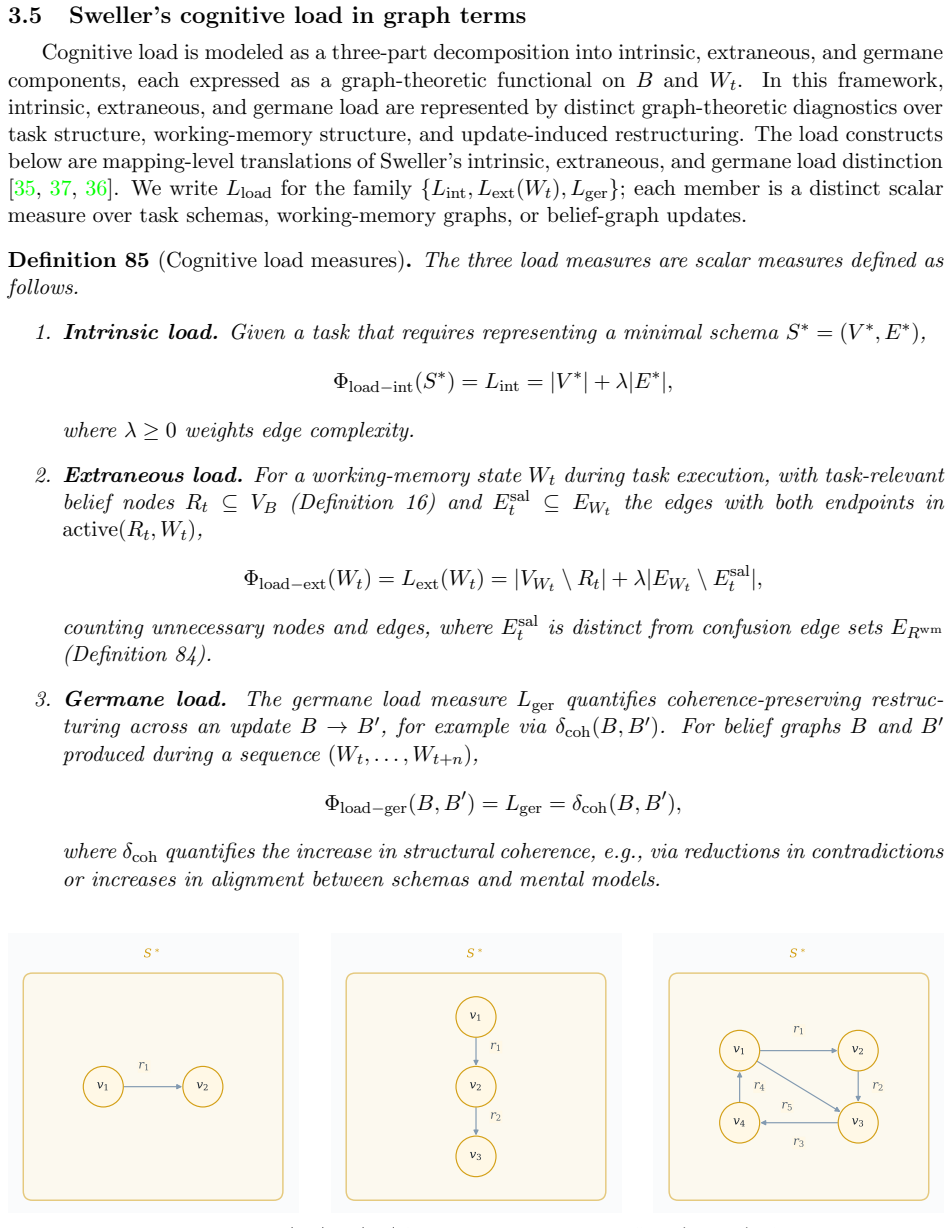
- §3.5, Proposition 87 (p. 24): The trade-off constraint L_int + L_ext + L_ger ≤ C_CM is stated as following 'directly from modeling load measures as counts or weighted counts of nodes and edges within a capacity-limited working-memory graph.' However, L_ger is defined as δ_coh(B, B'), a coherence-change measure over belief graphs, not a count of WM elements. The proof sketch does not address this mismatch and needs justification.
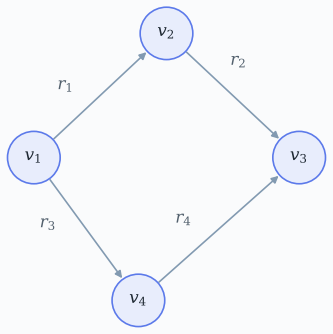
- Figure 1 (p. 3): The caption states 'specific relation names are domain-dependent and belong in captions or instantiations, not in schematic figures,' but the figure itself shows generic labels r_1, ..., r_4 without indicating which edge classes they represent. Adding a brief note on which classes are illustrated would improve the figure's pedagogical value.
- §5.7 (Graph-Based AI, pp. 36–37): This subsection reads more as a literature survey than a compatibility mapping. Unlike §5.1–§5.6, it does not specify which NEST variables correspond to which graph-based AI constructs. Consider either adding specific correspondences or trimming to keep parallel structure with other subsections.
- The paper has no empirical validation, simulation, or even a small worked numerical example. While the authors explicitly acknowledge this as a deliberate foundational contribution (§6.2), at least one concrete instantiation—even a toy example showing a few time steps of W_t evolution under a specified U, with conflict detection and belief update—would substantially strengthen the paper and demonstrate that the operators compose as intended.
Simulated Author's Rebuttal
We thank the referee for a careful and constructive reading of the manuscript. The two major comments both concern the gap between NEST's representational substrate and its dynamic operators: the referee observes that U, Δ, A, and K are defined as unconstrained function spaces, and that the Section 5 mappings are variable-level correspondences rather than demonstrations of faithful dynamical reproduction. We agree that this gap is real and that the paper must do more to address it. Below we respond to each comment and describe the revisions we will make.
read point-by-point responses
-
Referee: §2.4, Definition 36: U is defined as 'any function U: W × B → W.' Similarly, Δ (Def. 42), A (Def. 60), and K (Def. 72) are unconstrained function spaces. When core operators are unconstrained, the unification claim in §5 is at risk of being trivially true. The authors should add non-trivial constraints on U and Δ, or otherwise address the triviality concern.
Authors: The referee is correct that defining U, Δ, A, and K as arbitrary functions of the appropriate type does not, by itself, constrain dynamics. We accept this point and will revise the manuscript to address it. Our response has two parts. First, a concession: we agree that the current definitions are too permissive to support the unification claim as stated, and we will add a new subsection (§2.4.2) that imposes non-trivial structural constraints on each operator. Specifically: (a) U will be constrained to respect capacity bounds (C_V, C_E), the activation threshold θ_W for WM membership, and the encoding gate of Remark 31 (κ = 0 at commit); (b) Δ will be constrained to produce only well-formed graphs under (F_B, S_B) at commit, with ApplyMicroUpdate requiring κ(C_wb) = 0 and ApplyMacroUpdate requiring well-formedness of the committed output even when τ_trans = permit allows transient violations; (c) A will be constrained to select subgraphs whose nodes are WM-active (α ≥ θ_W); (d) K will be constrained to emit only operations from the admissible set O (Definition 73) and to be awareness-conditioned (Definition 75) when the architecture requires it. These constraints are already present in scattered form across Definitions 37, 42, 46, 73, 75, and Remark 31, but we agree they have not been consolidated into operator-level admissibility conditions, and their absence from the operator definitions themselves creates the impression of unconstrained function spaces. Second, a clarification of scope: even with these constraints, NEST does not uniquely specify dynamics—it specifies a constrained operator space within which particular architectures (ACT-R, Soar, etc.) correspond to particular choices of U, Δ, A, K, and Θ. The unification claim is therefore not that NEST reproduces a revision: no
-
Referee: §5 mappings are variable-level correspondences and do not demonstrate that NEST's operators can reproduce the actual dynamics of target architectures. Without at least one worked example showing that a specific ACT-R production or Soar operator can be faithfully represented as a NEST graph transition with specified constraints, the unification claim remains unsupported.
Authors: We agree that at least one worked example is needed, and we will add one. In the revised §5.1, we will include a fully specified ACT-R production example—specifically, a production that matches a retrieval buffer containing a chunk of type 'addition-fact' with slots augend and result, fires, and updates the goal buffer. We will show: (1) the buffer contents as a designated active subgraph of W_t with typed nodes and edges; (2) the production as a constrained instance of U whose preconditions are specified as a graph-pattern match (using sim_match from Definition 80 over the buffer subgraph); (3) the conflict-resolution semantics as a selection among multiple candidate U-instances ranked by activation-weighted priority; (4) the firing as the selected U-instance producing W_{t+1} with the goal buffer subgraph updated. We will specify the constraints on U that make this work: the production's LHS is a graph pattern P_lhs, the match is an injective partial match f_match preserving edge types, and the RHS is a graph rewrite rule that adds, deletes, or retypes nodes and edges in the designated buffer subgraph. This makes the production a graph-rewrite instance of U constrained by pattern-matching preconditions and buffer-designated scope. We acknowledge that this single example does not prove that all of ACT-R's dynamics can be faithfully reproduced—that would require a full formal encoding, which is beyond the scope of a foundational paper. But it does show concretely how the mapping works and what the constraints are, which we agree is necessary to make the unification claim evaluable rather than merely asserted. We will also add a briefer parallel example for Soar (operator selection in a problem space as candidate graph transitions with impasse as a failure state under §4 revision: no
- We cannot, within the scope of this paper, provide a full formal proof that NEST faithfully reproduces the complete dynamics of ACT-R, Soar, or any other target architecture. Such a proof would require encoding the full operational semantics of each architecture and demonstrating bisimulation or equivalent preservation—this is a substantial research program, not a revision. The referee's concern about the strength of the unification claim is therefore partly a standing limitation: the paper can make the claim more precise and illustrate it with worked examples, but cannot fully discharge it here.
Circularity Check
No significant circularity; the framework is self-contained with standard graph-theoretic definitions and no self-citation chains. The main concern is vacuity of operator definitions, which is a correctness issue, not circularity.
full rationale
The paper defines NEST as a foundational graph-theoretic ontology using standard mathematical definitions (typed weighted graphs, activation maps, conflict catalogs, transition operators). The derivation chain is: (1) define base graphs and recursive nodes (Definitions 1–4), (2) define belief/working-memory graphs (Definitions 8–12), (3) define generic functionals and operators (Definitions 15–72), (4) instantiate these for cognitive phenomena (Section 3), task schemas (Section 4), and framework mappings (Section 5). No step in this chain reduces to its inputs by construction. The operators U, Δ, A, K are defined as arbitrary functions of the appropriate type signature (e.g., Definition 36: 'U: W × B → W' as 'any function'; Definition 42: 'Δ: B × W* → B' as 'any function'). This makes the Section 5 mappings (ACT-R productions as 'constrained instances of U,' Soar operators as 'candidate graph transitions') trivially true rather than substantively derived — but this is a vacuity/correctness concern, not circularity. The paper does not define X in terms of Y and then derive Y from X. It does not fit parameters to data and then predict the same data. There are no self-citations (single author, all references are to external work). The cognitive-phenomenon definitions (distraction as Shannon entropy over component masses, confusion as a disjunction of disconnection/incoherence/conflict) are new constructions from the paper's own primitives, not renamings presented as derivations. The paper is transparent that Section 5 mappings are 'compatibility mappings' and 'variable-level sketches rather than executable comparative simulations.' Score 1 reflects the absence of circularity with a minor note that the breadth of operator definitions makes some 'unification' claims vacuous — a correctness risk rather than a circularity defect.
Axiom & Free-Parameter Ledger
free parameters (9)
- C_V, C_E
- theta_W
- theta_gnd
- theta_sim
- theta_dist
- theta_coh
- lambda_match
- beta_Q
- lambda
axioms (4)
- domain assumption Cognition can be adequately modeled as structured state formation and transformation using finite, typed, weighted graphs.
- domain assumption The six relation classes (causal, containment, temporal, associative, evidential, spatial) are sufficient to capture the necessary structural commitments of major cognitive theories.
- domain assumption A clear separation between durable belief graphs and capacity-limited working-memory graphs maps meaningfully onto human cognitive architecture.
- ad hoc to paper Variable-level correspondences between existing frameworks and NEST constructs constitute meaningful theoretical unification.
invented entities (4)
-
Recursive node with representational payload
no independent evidence
-
WM-belief collation graph
no independent evidence
-
Awareness functional A
no independent evidence
-
Control functional K
no independent evidence
read the original abstract
We present NEST (Nested Episodic State Topology), a foundational graph-theoretic representational ontology for modeling cognition as structured state formation and transformation rather than as a finished empirical model. Concepts, episodes, percepts, and task contexts are represented as typed, weighted graphs whose nodes may carry internal subgraph payloads; edges are typed under six relation classes -- causal, containment, temporal, associative, evidential, and spatial. Durable belief graphs are separated from capacity-limited working-memory graphs that may host transient non-belief content. WM-belief grounding, conflict catalogs, and belief-update operators specify how transient structure is tested against stored knowledge and how belief is revised. A reusable operator toolkit -- activation, graph-property functionals, working-memory transitions, awareness and trajectory functionals, and belief update -- organizes the formal core. Derived diagnostics such as fragmentation, involvement, signed evaluation, coherence, and active conflict define familiar phenomena in the same ontology; self-related processing is modeled through designated self-image subgraphs within belief. Subsequent sections instantiate this core without new primitives: phenomena signatures, a task-instantiation schema for action selection and failure modes, and compatibility mappings that embed ACT-R, Soar, Sigma, the Common Model of Cognition, Global Workspace Theory, semantic networks, Theory-Theory, and chunking as constrained regions of one language. Mappings constitute the culminating technical section; discussion addresses scope, limitations, and open research directions. The contribution is intentionally foundational: a transparent representational substrate for later empirical, computational, and domain-specific work.
Figures




Reference graph
Works this paper leans on
-
[1]
John R. Anderson.How Can the Human Mind Occur in the Physical Universe?Oxford University Press, New York, 2007
work page 2007
-
[2]
Anderson, Daniel Bothell, Michael D
John R. Anderson, Daniel Bothell, Michael D. Byrne, Scott Douglass, Christian Lebiere, and Yulin Qin. An integrated theory of the mind.Psychological Review, 111(4):1036–1060, 2004
work page 2004
-
[3]
Baars.A Cognitive Theory of Consciousness
Bernard J. Baars.A Cognitive Theory of Consciousness. Cambridge University Press, Cam- bridge, UK, 1988
work page 1988
-
[4]
William G. Chase and Herbert A. Simon. Perception in chess.Cognitive Psychology, 4(1):55– 81, 1973. 38
work page 1973
-
[5]
Michelene T. H. Chi. Conceptual change within and across ontological categories: Examples from learning and discovery in science. In Ronald N. Giere, editor,Cognitive Models of Science, volume 15 ofMinnesota Studies in the Philosophy of Science, pages 129–186. University of Minnesota Press, Minneapolis, 1992
work page 1992
-
[6]
Allan M. Collins and Elizabeth F. Loftus. A spreading-activation theory of semantic processing. Psychological Review, 82(6):407–428, 1975
work page 1975
-
[7]
Allan M. Collins and M. Ross Quillian. Retrieval time from semantic memory.Journal of Verbal Learning and Verbal Behavior, 8(2):240–247, 1969
work page 1969
-
[8]
Large Language Models Can Better Understand Knowledge Graphs Than We Thought
Xinbang Dai, Yuncheng Hua, Tongtong Wu, Yang Sheng, Qiu Ji, and Guilin Qi. Large language models can better understand knowledge graphs than we thought.arXiv preprint arXiv:2402.11541, 2024
work page internal anchor Pith review Pith/arXiv arXiv 2024
-
[9]
Viking Penguin, New York, 2014
Stanislas Dehaene.Consciousness and the Brain: Deciphering How the Brain Codes Our Thoughts. Viking Penguin, New York, 2014
work page 2014
-
[10]
Experimental and theoretical approaches to conscious processing.Neuron, 70(2):200–227, 2011
Stanislas Dehaene and Jean-Pierre Changeux. Experimental and theoretical approaches to conscious processing.Neuron, 70(2):200–227, 2011
work page 2011
-
[11]
Stanislas Dehaene, Michel Kerszberg, and Jean-Pierre Changeux. A neuronal model of a global workspace in effortful cognitive tasks.Proceedings of the National Academy of Sciences, 95(24):14529–14534, 1998
work page 1998
-
[12]
Andrea A. diSessa. A history of conceptual change research: Threads and fault lines. In R. Keith Sawyer, editor,The Cambridge Handbook of the Learning Sciences, pages 88–108. Cambridge University Press, Cambridge, UK, 2 edition, 2014
work page 2014
-
[13]
Fernand Gobet and Herbert A. Simon. Templates in chess memory: A mechanism for recalling several board positions.Cognitive Psychology, 31(1):1–40, 1996
work page 1996
-
[14]
Fernand Gobet and Herbert A. Simon. Expert chess memory: Revisiting the chunking hy- pothesis.Memory, 6(3):225–255, 1998
work page 1998
-
[15]
Meltzoff.Words, Thoughts, and Theories
Alison Gopnik and Andrew N. Meltzoff.Words, Thoughts, and Theories. MIT Press, Cam- bridge, MA, 1997
work page 1997
-
[16]
Alison Gopnik and Henry M. Wellman. The theory theory. In Lawrence A. Hirschfeld and Susan A. Gelman, editors,Mapping the Mind: Domain Specificity in Cognition and Culture, pages 257–293. Cambridge University Press, New York, 1994
work page 1994
-
[17]
Combining Knowledge Graphs and Large Language Models
Amanda Kau, Xuzeng He, Aishwarya Nambissan, Aland Astudillo, Hui Yin, and Amir Aryani. Combining knowledge graphs and large language models.arXiv preprint arXiv:2407.06564, 2024
work page internal anchor Pith review Pith/arXiv arXiv 2024
-
[18]
Metacognition and consciousness
Asher Koriat. Metacognition and consciousness. In Philip David Zelazo, Morris Moscovitch, and Evan Thompson, editors,The Cambridge Handbook of Consciousness, pages 289–325. Cambridge University Press, Cambridge, UK, 2007
work page 2007
-
[19]
Laird.The Soar Cognitive Architecture
John E. Laird.The Soar Cognitive Architecture. MIT Press, Cambridge, MA, 2012. 39
work page 2012
-
[20]
Laird, Christian Lebiere, and Paul S
John E. Laird, Christian Lebiere, and Paul S. Rosenbloom. A standard model of the mind: Toward a common computational framework across artificial intelligence, cognitive science, neuroscience, and robotics.AI Magazine, 38(4):13–26, 2017
work page 2017
-
[21]
A Proposal to Extend the Common Model of Cognition with Metacognition
John E. Laird, Christian Lebiere, Paul S. Rosenbloom, and Andrea Stocco. A proposal to extend the common model of cognition with metacognition.arXiv preprint arXiv:2506.07807, 2025
work page internal anchor Pith review Pith/arXiv arXiv 2025
-
[22]
John E. Laird, Paul S. Rosenbloom, and Allen Newell. Chunking in Soar: The anatomy of a general learning mechanism.Machine Learning, 1(1):11–46, 1986
work page 1986
-
[23]
Antonio Lieto, Mehul Bhatt, Alessandro Oltramari, and David Vernon. The role of cognitive architectures in general artificial intelligence.Cognitive Systems Research, 48:1–3, 2018
work page 2018
-
[24]
Marcin Mi lkowski. Unification strategies in cognitive science.Studies in Logic, Grammar and Rhetoric, 48(1):13–33, 2016
work page 2016
-
[25]
Michael Moutoussis, Pasco Fearon, Wael El-Deredy, Raymond J. Dolan, and Karl J. Friston. Bayesian inferences about the self (and others): A review.Consciousness and Cognition, 25:67–76, 2014
work page 2014
-
[26]
Murphy.The Big Book of Concepts
Gregory L. Murphy.The Big Book of Concepts. MIT Press, Cambridge, MA, 2002
work page 2002
-
[27]
Thomas O. Nelson and Louis Narens. Metamemory: A theoretical framework and new findings. In Gordon H. Bower, editor,The Psychology of Learning and Motivation, volume 26, pages 125–173. Academic Press, New York, 1990
work page 1990
-
[28]
Allen Newell. Putting it all together. In David Klahr and Kenneth Kotovsky, editors,Complex Information Processing: The Impact of Herbert A. Simon, pages 399–437. Erlbaum, Hillsdale, NJ, 1989
work page 1989
-
[29]
Harvard University Press, Cambridge, MA, 1990
Allen Newell.Unified Theories of Cognition. Harvard University Press, Cambridge, MA, 1990
work page 1990
-
[30]
Shirui Pan, Linhao Luo, Yufei Wang, Chen Chen, Jiapu Wang, and Xindong Wu. Unifying large language models and knowledge graphs: A roadmap.IEEE Transactions on Knowledge and Data Engineering, 36(7):3580–3599, 2024
work page 2024
-
[31]
Paul S. Rosenbloom. Combining procedural and declarative knowledge in a graphical archi- tecture. In Dario D. Salvucci and Glenn Gunzelmann, editors,Proceedings of the 10th In- ternational Conference on Cognitive Modeling, pages 205–210, Philadelphia, PA, 2010. Drexel University
work page 2010
-
[32]
Rosenbloom, Abram Demski, and Volkan Ustun
Paul S. Rosenbloom, Abram Demski, and Volkan Ustun. The Sigma cognitive architecture and system: Towards functionally elegant grand unification.Journal of Artificial General Intelligence, 7(1):1–103, 2016
work page 2016
-
[33]
Sowa.Conceptual Structures: Information Processing in Mind and Machine
John F. Sowa.Conceptual Structures: Information Processing in Mind and Machine. Addison- Wesley, Reading, MA, 1984
work page 1984
- [34]
-
[35]
Cognitive load during problem solving: Effects on learning.Cognitive Science, 12(2):257–285, 1988
John Sweller. Cognitive load during problem solving: Effects on learning.Cognitive Science, 12(2):257–285, 1988. 40
work page 1988
-
[36]
Element interactivity and intrinsic, extraneous, and germane cognitive load
John Sweller. Element interactivity and intrinsic, extraneous, and germane cognitive load. Educational Psychology Review, 22(2):123–138, 2010
work page 2010
-
[37]
Why some material is difficult to learn.Cognition and Instruction, 12(3):185–233, 1994
John Sweller and Paul Chandler. Why some material is difficult to learn.Cognition and Instruction, 12(3):185–233, 1994
work page 1994
-
[38]
Taatgen, Christian Lebiere, and John R
Niels A. Taatgen, Christian Lebiere, and John R. Anderson. Modeling paradigms in ACT-R. In Ron Sun, editor,Cognition and Multi-Agent Interaction: From Cognitive Modeling to Social Simulation, pages 29–52. Cambridge University Press, Cambridge, 2006
work page 2006
-
[39]
Zonghan Wu, Shirui Pan, Fengwen Chen, Guodong Long, Chengqi Zhang, and Philip S. Yu. A comprehensive survey on graph neural networks.IEEE Transactions on Neural Networks and Learning Systems, 32(1):4–24, 2021
work page 2021
-
[40]
Yu Zhang, Lingzhong Fan, Yongfu Hao, Alain Dagher, Tianzi Jiang, and Pierre Bellec. Inter- pretable brain decoding from sensations to cognition to action: Graph neural networks reveal the representational hierarchy of human cognition.bioRxiv, 2022
work page 2022
-
[41]
Yu Zhang, Nicolas Farrugia, and Pierre Bellec. Deep learning models of cognitive processes constrained by human brain connectomes.Medical Image Analysis, 80:102507, 2022. 41
work page 2022
discussion (0)
Sign in with ORCID, Apple, or X to comment. Anyone can read and Pith papers without signing in.