PUFFERDOS: Efficient and Effective Attack String Generation for Regular Expression Denial of Service Vulnerabilities
Pith reviewed 2026-06-26 20:04 UTC · model grok-4.3
The pith
PUFFERDOS generates attack strings for regex denial-of-service that stay short enough and work when run on real programs.
A machine-rendered reading of the paper's core claim, the machinery that carries it, and where it could break.
Core claim
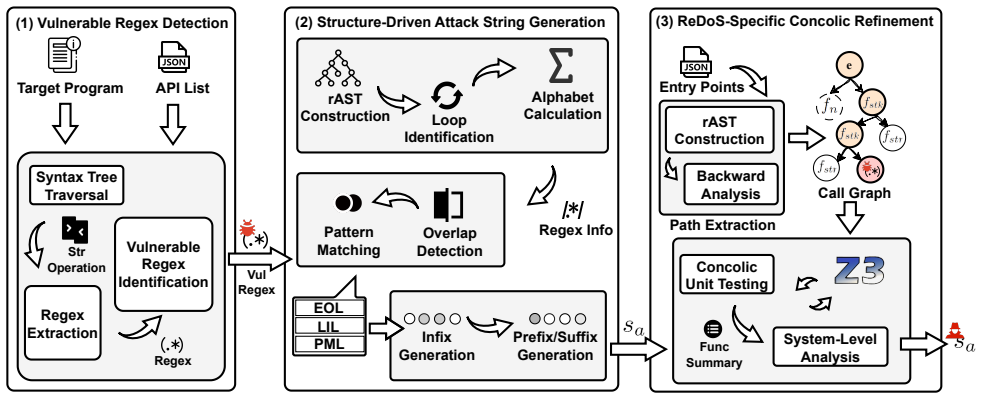
PUFFERDOS first defines three vulnerable patterns based on observation and formal verification. According to the patterns it conducts a synthesis technique to generate attack strings, then refines and validates the strings with ReDoS-specific compositional concolic execution to guarantee real-world exploitability within realistic length budgets.
What carries the argument
Three vulnerable patterns plus synthesis followed by ReDoS-specific compositional concolic execution for refinement and program-level validation.
If this is right
- Attack strings become short enough to be sent over normal network channels yet still trigger the vulnerability.
- Strings that previously failed to exploit real programs are replaced by ones that have been validated at the program level.
- Detection can occur earlier in development because the strings are both feasible and effective.
- Remediation effort focuses on regexes that actually produce measurable resource exhaustion when attacked.
Where Pith is reading between the lines
- The same pattern-plus-validation approach could be tried on other resource-exhaustion problems that depend on input structure.
- If the three patterns turn out to miss some real-world cases, adding a fourth pattern would be the direct next step.
- The validation step could be run automatically on any regex found inside application source during routine builds.
Load-bearing premise
The three vulnerable patterns identified from observation and formal verification cover the ReDoS cases that matter in practice.
What would settle it
Run the generated strings on programs that contain the three patterns and measure whether CPU time or execution steps rise sharply within short input lengths while the same strings produce no such rise on equivalent non-vulnerable regexes.
Figures
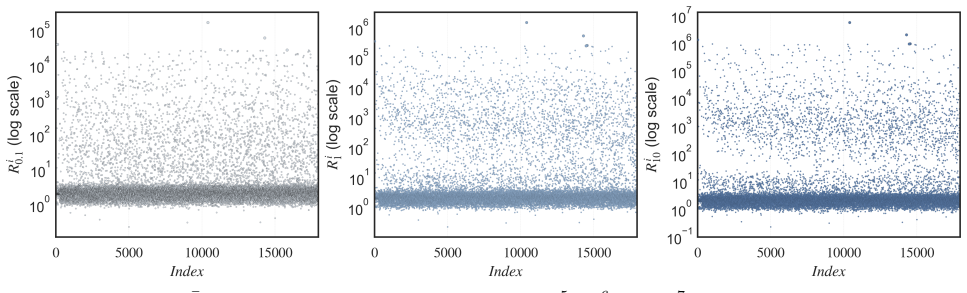
read the original abstract
ReDoS attacks constitute a critical class of resource-exhaustion vulnerabilities. In such attacks, adversaries exploit the pathological worst-case execution behavior of regular expression (regex) engines to induce highly asymmetric computational workloads, ultimately exhausting system resources and degrading service availability. To protect systems against ReDoS attacks, numerous detection techniques have been proposed that simulate the attack process by generating attack strings to proactively exploit ReDoS vulnerabilities at the early development stage and facilitate remediation. Existing techniques broadly fall into two classes: static analyses that search for pathological regex structures, and dynamic exploration methods that synthesize candidate attack strings. However, the generated attack strings are often impractical for real-world exploitation because they usually assume unrealistic input-length budgets and do not validate the effectiveness and efficiency of the attack at the program level. Therefore, many generated strings fail to trigger vulnerable regexes when applied to real-world programs, further limiting the practical utility. To address these shortcomings, we introduce an effective and efficient attack string generator, PUFFERDOS, designed to synthesize attack inputs that are both feasible within realistic length budgets and validated at the program level, enabling effective exploitation of ReDoS vulnerabilities in real-world programs. Specifically, we first define three vulnerable patterns based on our observation and formal verification. According to the patterns, PUFFERDOS conducts a synthesis technique to generate attack strings, and then refines and validates the strings with ReDoS-specific compositional concolic execution to guarantee real-world exploitability.
Editorial analysis
A structured set of objections, weighed in public.
Referee Report
Summary. The paper introduces PUFFERDOS, an attack string generator for ReDoS vulnerabilities. It defines three vulnerable patterns based on observation and formal verification, synthesizes attack strings according to these patterns, and refines/validates them via ReDoS-specific compositional concolic execution to produce strings that are feasible within realistic length budgets and exploitable in real-world programs.
Significance. If the central claims hold with supporting evidence, the work would address a practical gap in ReDoS detection by producing attack strings that existing static and dynamic methods often fail to make usable in real programs, potentially improving early-stage vulnerability remediation.
major comments (2)
- [Abstract] Abstract: the manuscript asserts that the generated strings are 'validated at the program level' and 'guarantee real-world exploitability' via compositional concolic execution, yet the abstract (and the provided text) contains no evaluation data, success rates, comparison baselines, or quantitative results on how many strings were validated or their performance on real programs, leaving the headline claim unsupported.
- [Abstract] Abstract (paragraph describing the synthesis technique): the approach is defined exclusively over the three vulnerable patterns identified from observation and formal verification. No evidence is supplied that these patterns were tested for exhaustiveness against a corpus of known ReDoS-vulnerable regexes or that they capture the structures producing exploitable worst-case behavior under realistic length budgets, which is required for the claim that the method enables effective exploitation in practice.
minor comments (1)
- The three patterns would benefit from explicit formal definitions, examples, and a dedicated section or figure rather than being described only at high level in the abstract.
Simulated Author's Rebuttal
We thank the referee for the constructive feedback on the abstract. We will revise the manuscript to better support the central claims with quantitative evidence and additional discussion on the patterns. Below we respond point by point.
read point-by-point responses
-
Referee: [Abstract] Abstract: the manuscript asserts that the generated strings are 'validated at the program level' and 'guarantee real-world exploitability' via compositional concolic execution, yet the abstract (and the provided text) contains no evaluation data, success rates, comparison baselines, or quantitative results on how many strings were validated or their performance on real programs, leaving the headline claim unsupported.
Authors: We agree that the abstract, as a concise summary, does not present specific quantitative results. The full manuscript includes a dedicated evaluation section reporting success rates for program-level validation, comparisons against baselines, and performance on real-world programs. To address the concern, we will revise the abstract to incorporate key quantitative highlights from the evaluation (e.g., validation success rate and exploitability metrics under realistic length budgets). revision: yes
-
Referee: [Abstract] Abstract (paragraph describing the synthesis technique): the approach is defined exclusively over the three vulnerable patterns identified from observation and formal verification. No evidence is supplied that these patterns were tested for exhaustiveness against a corpus of known ReDoS-vulnerable regexes or that they capture the structures producing exploitable worst-case behavior under realistic length budgets, which is required for the claim that the method enables effective exploitation in practice.
Authors: The three patterns were derived from systematic observation of ReDoS vulnerabilities reported in the literature and were formally verified to produce the pathological worst-case behavior. The formal verification establishes that they capture the relevant structures for exploitable behavior under realistic budgets. The current manuscript does not include an exhaustive corpus study; we will add a clarifying discussion of the observation-plus-verification methodology and, space permitting, results from applying the patterns to a corpus of known vulnerable regexes. revision: partial
Circularity Check
No circularity; derivation is self-contained
full rationale
The abstract describes defining three vulnerable patterns from observation and formal verification, then synthesizing strings according to those patterns and refining them via compositional concolic execution. No equations, fitted parameters, or self-referential reductions appear. The synthesis technique and validation step are presented as independent contributions rather than quantities forced by prior definitions or self-citations within the paper. The workflow does not equate any claimed result to its inputs by construction.
Axiom & Free-Parameter Ledger
axioms (1)
- domain assumption Three vulnerable patterns identified by observation and formal verification cover the relevant ReDoS cases
Reference graph
Works this paper leans on
-
[1]
Rengar: Regular expression denial-of-service analyzer,
“Rengar: Regular expression denial-of-service analyzer,” https://sites. google.com/view/rengar/resources?authuser=0
-
[2]
PUFFERDOS: Anonymous artifact repository,
“PUFFERDOS: Anonymous artifact repository,” https://anonymous. 4open.science/r/PufferDoS-7E0D/
-
[3]
CVE-2017-16098: Apache Charset Regular Expression Denial of Service (ReDoS),
“CVE-2017-16098: Apache Charset Regular Expression Denial of Service (ReDoS),” https://cvefeed.io/vuln/detail/CVE-2017-16098, 2017, affected package:charset¡= 1.0.0. Regular expression DoS via crafted input. CWE-400: Uncontrolled Resource Consumption. CVSS v3.0 Score: 7.5 (High). Published: 2018-06-07, Last Modified: 2024-11-21
2017
-
[4]
CVE-2017-16137: Regular Expression Denial of Service in debug module ( ¨o¨formatter),
“CVE-2017-16137: Regular Expression Denial of Service in debug module ( ¨o¨formatter),” https://nvd.nist.gov/vuln/detail/ CVE-2017-16137, 2017, affected product:debug(Node.js). Vulnerable versions: ¿=2.0.0 ¡2.6.9; ¿=3.0.0 ¡3.1.0; ¿=3.2.0 ¡3.2.7; ¿=4.0.0 ¡4.3.1. ReDoS issue via untrusted input intooformatter. Requires 50k characters to block for about 2 se...
2017
-
[5]
CVE-2023-39663: MathJax Regular Expression Denial of Ser- vice (ReDoS),
“CVE-2023-39663: MathJax Regular Expression Denial of Ser- vice (ReDoS),” https://www.suse.com/security/cve/CVE-2023-39663. html, 2023, affects MathJax up to v2.7.9: two ReDoS vulner- abilities viapatternandmarkdownPattern. SUSE states “Does not affect SUSE products.” CVSS v3.1 Base Score: 7.5 (A V:N/AC:L/PR:N/UI:N/S:U/C:N/I:N/A:H). Overall severity: Impo...
2023
-
[6]
Hifrog: Smt-based function summarization for software verification,
L. Alt, S. Asadi, H. Chockler, K. Even Mendoza, G. Fedyukovich, A. E. Hyv ¨arinen, and N. Sharygina, “Hifrog: Smt-based function summarization for software verification,” inInternational Conference on Tools and Algorithms for the Construction and Analysis of Systems. Springer, 2017, pp. 207–213
2017
-
[7]
Demand-driven composi- tional symbolic execution,
S. Anand, P. Godefroid, and N. Tillmann, “Demand-driven composi- tional symbolic execution,” inInternational Conference on Tools and Algorithms for the Construction and Analysis of Systems. Springer, 2008, pp. 367–381
2008
-
[8]
Counterexample- guided abstraction refinement for linear programs with arrays,
A. Armando, M. Benerecetti, and J. Mantovani, “Counterexample- guided abstraction refinement for linear programs with arrays,”Au- tomated Software Engineering, vol. 21, no. 2, pp. 225–285, 2014
2014
-
[9]
cvc5: A versatile and industrial-strength smt solver,
H. Barbosa, C. Barrett, M. Brain, G. Kremer, H. Lachnitt, M. Mann, A. Mohamed, M. Mohamed, A. Niemetz, A. N ¨otzliet al., “cvc5: A versatile and industrial-strength smt solver,” inInternational Confer- ence on Tools and Algorithms for the Construction and Analysis of Systems. Springer, 2022, pp. 415–442
2022
-
[10]
Exploiting input sanitization for regex denial of service,
E. Barlas, X. Du, and J. C. Davis, “Exploiting input sanitization for regex denial of service,” inProceedings of the 44th International Conference on Software Engineering, 2022, pp. 883–895
2022
-
[11]
Inference of regular expressions for text extraction from examples,
A. Bartoli, A. De Lorenzo, E. Medvet, and F. Tarlao, “Inference of regular expressions for text extraction from examples,”IEEE Transactions on Knowledge and Data Engineering, vol. 28, no. 5, pp. 1217–1230, 2016
2016
-
[12]
Sok: A literature and engineering review of regular expression denial of service (redos),
M. H. M. Bhuiyan, B. C ¸ akar, E. H. Burmane, J. C. Davis, and C.-A. Staicu, “Sok: A literature and engineering review of regular expression denial of service (redos),” inProceedings of the 20th ACM Asia Conference on Computer and Communications Security, 2025, pp. 1659–1675
2025
-
[13]
An additional non-backtracking regexp engine · v8,
M. Bidlingmaier, “An additional non-backtracking regexp engine · v8,” https://v8.dev/blog/non-backtracking-regexp, 2021
2021
-
[14]
Klee: unassisted and automatic generation of high-coverage tests for complex systems programs
C. Cadar, D. Dunbar, D. R. Engleret al., “Klee: unassisted and automatic generation of high-coverage tests for complex systems programs.” inOSDI, vol. 8, 2008, pp. 209–224. 14
2008
-
[15]
regexploit: Find regu- lar expressions which are vulnerable to redos,
B. Caller, L. Carettoni, and Doyensec, “regexploit: Find regu- lar expressions which are vulnerable to redos,” https://github.com/ doyensec/regexploit, 2021, release v1.0.0 (Mar 11, 2021). License: Apache-2.0
2021
-
[16]
Exploring regular expression usage and context in python,
C. Chapman and K. T. Stolee, “Exploring regular expression usage and context in python,” inProceedings of the 25th International Symposium on Software Testing and Analysis, 2016, pp. 282–293
2016
-
[17]
Rethinking regex engines to address redos,
J. C. Davis, “Rethinking regex engines to address redos,” inPro- ceedings of the 2019 27th ACM Joint Meeting on European Software Engineering Conference and Symposium on the Foundations of Soft- ware Engineering, 2019, pp. 1256–1258
2019
-
[18]
The impact of regular expression denial of service (redos) in practice: an empirical study at the ecosystem scale,
J. C. Davis, C. A. Coghlan, F. Servant, and D. Lee, “The impact of regular expression denial of service (redos) in practice: an empirical study at the ecosystem scale,” inProceedings of the 2018 26th ACM joint meeting on european software engineering conference and symposium on the foundations of software engineering, 2018, pp. 246–256
2018
-
[19]
Z3: an efficient smt solver,
L. De Moura and N. Bjørner, “Z3: an efficient smt solver,” in Proceedings of the Theory and Practice of Software, 14th Interna- tional Conference on Tools and Algorithms for the Construction and Analysis of Systems, ser. TACAS’08/ETAPS’08. Berlin, Heidelberg: Springer-Verlag, 2008, p. 337–340
2008
-
[20]
Detecting asymmetric application-layer{Denial-of- Service}attacks{In-Flight}with{FineLame},
H. M. Demoulin, I. Pedisich, N. Vasilakis, V . Liu, B. T. Loo, and L. T. X. Phan, “Detecting asymmetric application-layer{Denial-of- Service}attacks{In-Flight}with{FineLame},” in2019 USENIX Annual Technical Conference (USENIX ATC 19), 2019, pp. 693–708
2019
-
[21]
regexploit: Regular expression security tooling,
doyensec, “regexploit: Regular expression security tooling,” https:// github.com/doyensec/regexploit, 2025, gitHub repository
2025
-
[22]
Friedl,Mastering regular expressions
J. Friedl,Mastering regular expressions. ” O’Reilly Media, Inc.”, 2006
2006
-
[23]
Compositional dynamic test generation,
P. Godefroid, “Compositional dynamic test generation,” inProceed- ings of the 34th annual ACM SIGPLAN-SIGACT symposium on Principles of programming languages, 2007, pp. 47–54
2007
-
[24]
Dart: directed automated random testing,
P. Godefroid, N. Klarlund, and K. Sen, “Dart: directed automated random testing,” inProceedings of the 2005 ACM SIGPLAN Conference on Programming Language Design and Implementation, ser. PLDI ’05. New York, NY , USA: Association for Computing Machinery, 2005, p. 213–223. [Online]. Available: https://doi.org/10. 1145/1065010.1065036
arXiv 2005
-
[25]
pytype: A static type analyzer for python,
Google, “pytype: A static type analyzer for python,” https://github. com/google/pytype, 2025
2025
-
[26]
RE2: Linear-time regular expression engine,
Google, “RE2: Linear-time regular expression engine,” https://github. com/google/re2, 2025
2025
-
[27]
Details of the cloudflare out- age on july 2, 2019,
J. Graham-Cumming, “Details of the cloudflare out- age on july 2, 2019,” https://blog.cloudflare.com/ details-of-the-cloudflare-outage-on-july-2-2019/
2019
-
[28]
M. M. Hasan, H. Li, E. Fallahzadeh, G. K. Rajbahadur, B. Adams, and A. E. Hassan, “Model context protocol (mcp) at first glance: Studying the security and maintainability of mcp servers,”arXiv preprint arXiv:2506.13538, 2025
Pith/arXiv arXiv 2025
-
[29]
Introduction to automata theory, languages, and computation,
J. E. Hopcroft, R. Motwani, and J. D. Ullman, “Introduction to automata theory, languages, and computation,” Boston, MA, 2006, iSBN 978-0321455369
2006
-
[30]
Towards automatic detection and exploitation of java web application vulnerabilities via concolic execution guided by cross- thread object manipulation,
X. Huang, L. Zhang, Y . Liu, P. Deng, Y . Cao, Y . Zhang, and M. Yang, “Towards automatic detection and exploitation of java web application vulnerabilities via concolic execution guided by cross- thread object manipulation,” in34th USENIX Security Symposium (USENIX Security 25), 2025, pp. 8367–8384
2025
-
[31]
Outage postmortem — july 20, 2016,
S. E. Inc., “Outage postmortem — july 20, 2016,” https://stackstatus. tumblr.com/post/147710624694/outage-postmortem-july-20-2016
arXiv 2016
-
[32]
Model checking embedded control software using os-in-the-loop cegar,
D. Kim and Y . Choi, “Model checking embedded control software using os-in-the-loop cegar,” in2019 34th IEEE/ACM International Conference on Automated Software Engineering (ASE). IEEE, 2019, pp. 565–576
2019
-
[33]
Pbe-based selective abstraction and refinement for efficient property falsification of embedded software,
Y . Kim and Y . Choi, “Pbe-based selective abstraction and refinement for efficient property falsification of embedded software,”Proceedings of the ACM on Software Engineering, vol. 1, no. FSE, pp. 293–315, 2024
2024
-
[34]
Target-driven compositional concolic testing with function summary refinement for effective bug detection,
Y . Kim, S. Hong, and M. Kim, “Target-driven compositional concolic testing with function summary refinement for effective bug detection,” inProceedings of the 2019 27th ACM Joint Meeting on European Software Engineering Conference and Symposium on the Foundations of Software Engineering, 2019, pp. 16–26
2019
-
[35]
Static analysis for reg- ular expression denial-of-service attacks,
J. Kirrage, A. Rathnayake, and H. Thielecke, “Static analysis for reg- ular expression denial-of-service attacks,” inInternational conference on network and system security. Springer, 2013, pp. 135–148
2013
-
[36]
Oniguruma: Regular expression library,
kkos, “Oniguruma: Regular expression library,” https://github.com/ kkos/oniguruma, 2025, gitHub repository
2025
-
[37]
S. C. Kleene,Representation of events in nerve nets and finite automata. Princeton University Press Princeton, 1956, vol. 34
1956
-
[38]
{ReDoSHunter}: A combined static and dynamic approach for regular expression{DoS}detection,
Y . Li, Z. Chen, J. Cao, Z. Xu, Q. Peng, H. Chen, L. Chen, and S.-C. Cheung, “{ReDoSHunter}: A combined static and dynamic approach for regular expression{DoS}detection,” in30th USENIX Security Symposium (USENIX Security 21), 2021, pp. 3847–3864
2021
-
[39]
{RegexScalpel}: Regular expression denial of service ({{{{{ReDoS}}}}}) defense by{Localize-and-Fix},
Y . Li, Y . Sun, Z. Xu, J. Cao, Y . Li, R. Li, H. Chen, S.-C. Cheung, Y . Liu, and Y . Xiao, “{RegexScalpel}: Regular expression denial of service ({{{{{ReDoS}}}}}) defense by{Localize-and-Fix},” in 31st USENIX Security Symposium (USENIX Security 22), 2022, pp. 4183–4200
2022
-
[40]
{CO3}: Concolic co-execution for firmware,
C. Liu, A. Mera, E. Kirda, M. Xu, and L. Lu, “{CO3}: Concolic co-execution for firmware,” in33rd USENIX Security Symposium (USENIX Security 24), 2024, pp. 5591–5608
2024
-
[41]
A unified framework for compressed and encrypted text direct processing,
Y . Liu, F. Zhang, Y . Zhang, S. Ma, E. Bertino, and X. Du, “A unified framework for compressed and encrypted text direct processing,” in ICDE, 2026
2026
-
[42]
Revealer: Detecting and exploiting regular expression denial-of-service vulnerabilities,
Y . Liu, M. Zhang, and W. Meng, “Revealer: Detecting and exploiting regular expression denial-of-service vulnerabilities,” in2021 IEEE Symposium on Security and Privacy (SP). IEEE, 2021, pp. 1468– 1484
2021
-
[43]
Goshawk: Hunting memory corruptions via structure- aware and object-centric memory operation synopsis,
Y . Lyu, Y . Fang, Y . Zhang, Q. Sun, S. Ma, E. Bertino, K. Lu, and J. Li, “Goshawk: Hunting memory corruptions via structure- aware and object-centric memory operation synopsis,” in2022 IEEE Symposium on Security and Privacy (SP). IEEE, 2022, pp. 2096– 2113
2022
-
[44]
Pythonregexmodule on pypi,
Matthew Barnett, “Pythonregexmodule on pypi,” https://pypi.org/ project/regex/
-
[45]
Redos vulnerability reports: Relevant or noisy nuisance,
D. McInerney, W. Woodruff, and A. Nygate, “Redos vulnerability reports: Relevant or noisy nuisance,” https://mlsecops.com/podcast/ redos-vulnerability-reports-security-relevance-vs.-noisy-nuisance? utm source=chatgpt.com
-
[46]
Regulator: Dynamic analysis to detect{ReDoS},
R. McLaughlin, F. Pagani, N. Spahn, C. Kruegel, and G. Vigna, “Regulator: Dynamic analysis to detect{ReDoS},” in31st USENIX Security Symposium (USENIX Security 22), 2022, pp. 4219–4235
2022
-
[47]
Common vulnerabilities and exposures (cve),
MITRE, “Common vulnerabilities and exposures (cve),” https://www. cve.org/, 2025
2025
-
[48]
Nielsen,Usability Engineering
J. Nielsen,Usability Engineering. San Francisco, CA, USA: Morgan Kaufmann Publishers Inc., 1994
1994
-
[49]
Node.js official website,
Node.js Foundation, “Node.js official website,” https://nodejs.org/en/ about
-
[50]
Badger: complexity analysis with fuzzing and symbolic execution,
Y . Noller, R. Kersten, and C. S. P ˘as˘areanu, “Badger: complexity analysis with fuzzing and symbolic execution,” inProceedings of the 27th ACM SIGSOFT international symposium on software testing and analysis, 2018, pp. 322–332
2018
-
[51]
Openjdk regular expression engine commit,
OpenJDK Project, “Openjdk regular expression engine commit,” https://github.com/openjdk/jdk/commit/b45ea89
-
[52]
java.util.regexpackage documen- tation,
Oracle Corporation, “java.util.regexpackage documen- tation,” https://docs.oracle.com/javase/8/docs/api/java/util/regex/ package-summary.html. 15
-
[53]
Sound static analysis of regular expressions for vulnerabilities to denial of service attacks,
F. Parolini and A. Min ´e, “Sound static analysis of regular expressions for vulnerabilities to denial of service attacks,”Science of Computer Programming, vol. 229, p. 102960, 2023
2023
-
[54]
Slowfuzz: Automated domain-independent detection of algorithmic complexity vulnerabilities,
T. Petsios, J. Zhao, A. D. Keromytis, and S. Jana, “Slowfuzz: Automated domain-independent detection of algorithmic complexity vulnerabilities,” inProceedings of the 2017 ACM SIGSAC conference on computer and communications security, 2017, pp. 2155–2168
2017
-
[55]
“re—regular expression operations — python 3 library reference
Python Software Foundation, ““re—regular expression operations — python 3 library reference”,” https://docs.python.org/3/library/re.html
-
[56]
Static analysis for regular expression exponential runtime via substructural logics,
A. Rathnayake and H. Thielecke, “Static analysis for regular expression exponential runtime via substructural logics,”CoRR abs/1405.7058, 2014
Pith/arXiv arXiv 2014
-
[57]
Pycg: Practical call graph generation in python. in 2021 ieee/acm 43rd international conference on software engineering (icse),
V . Salis, T. Sotiropoulos, P. Louridas, D. Spinellis, and D. Mitropou- los, “Pycg: Practical call graph generation in python. in 2021 ieee/acm 43rd international conference on software engineering (icse),”IEEE, IEEE, Madrid, Spain, pp. 1646–1657, 2021
2021
-
[58]
Towards a scalable software model checker for higher-order programs,
R. Sato, H. Unno, and N. Kobayashi, “Towards a scalable software model checker for higher-order programs,” inProceedings of the ACM SIGPLAN 2013 workshop on Partial evaluation and program manipulation, 2013, pp. 53–62
2013
-
[59]
Crosshair: A symbolic execution framework for python,
P. Schanely, “Crosshair: A symbolic execution framework for python,” https://github.com/pschanely/CrossHair, 2025
2025
-
[60]
Interpolation-based function summaries in bounded model checking,
O. Sery, G. Fedyukovich, and N. Sharygina, “Interpolation-based function summaries in bounded model checking,” inHaifa verification conference. Springer, 2011, pp. 160–175
2011
-
[61]
Rescue: crafting regular expression dos attacks,
Y . Shen, Y . Jiang, C. Xu, P. Yu, X. Ma, and J. Lu, “Rescue: crafting regular expression dos attacks,” inProceedings of the 33rd ACM/IEEE International Conference on Automated Software Engineering, 2018, pp. 225–235
2018
-
[62]
Understanding regular expression denial of service (redos): Insights from llm- generated regexes and developer forums,
M. L. Siddiq, J. Zhang, and J. C. D. S. Santos, “Understanding regular expression denial of service (redos): Insights from llm- generated regexes and developer forums,” inProceedings of the 32nd IEEE/ACM International Conference on Program Comprehension, 2024, pp. 190–201
2024
-
[63]
The state of open-source security,
Snyk, “The state of open-source security,” https://snyk.io/, 2020
2020
-
[64]
A regular-expression matcher,
H. Spencer, “A regular-expression matcher,” inSoftware solutions in C, 1994, pp. 35–71
1994
-
[65]
Symbolic boolean deriva- tives for efficiently solving extended regular expression constraints,
C. Stanford, M. Veanes, and N. Bjørner, “Symbolic boolean deriva- tives for efficiently solving extended regular expression constraints,” inProceedings of the 42nd ACM SIGPLAN International Conference on Programming Language Design and Implementation, 2021, pp. 620–635
2021
-
[66]
Towards an effective method of{ReDoS}detection for non-backtracking engines,
W. Su, H. Huang, R. Li, H. Chen, and T. Ge, “Towards an effective method of{ReDoS}detection for non-backtracking engines,” in33rd USENIX Security Symposium (USENIX Security 24), 2024, pp. 271– 288
2024
-
[67]
Programming techniques: Regular expression search algorithm,
K. Thompson, “Programming techniques: Regular expression search algorithm,”Communications of the ACM, vol. 11, no. 6, pp. 419–422, 1968
1968
-
[68]
Counting in regexes considered harmful: Exposing{ReDoS} vulnerability of nonbacktracking matchers,
L. Turo ˇnov´a, L. Hol´ık, I. Homoliak, O. Leng´al, M. Veanes, and T. V o- jnar, “Counting in regexes considered harmful: Exposing{ReDoS} vulnerability of nonbacktracking matchers,” in31st USENIX Security Symposium (USENIX Security 22), 2022, pp. 4165–4182
2022
-
[69]
Abstracting concolic execution for soft contract verification,
B. Vandenbogaerde, Q. Sti ´evenart, and C. De Roover, “Abstracting concolic execution for soft contract verification,” in32nd Static Analysis Symposium, 2025
2025
-
[70]
oo7: Low-overhead defense against spectre attacks via program analysis,
G. Wang, S. Chattopadhyay, I. Gotovchits, T. Mitra, and A. Roy- choudhury, “oo7: Low-overhead defense against spectre attacks via program analysis,”IEEE Transactions on Software Engineering, vol. 47, no. 11, pp. 2504–2519, 2019
2019
-
[71]
A modular nfa architecture for regular expression matching,
H. Wang, S. Pu, G. Knezek, and J.-C. Liu, “A modular nfa architecture for regular expression matching,” inProceedings of the 18th annual ACM/SIGDA international symposium on Field programmable gate arrays, 2010, pp. 209–218
2010
-
[72]
{NLP-EYE}: Detecting memory corruptions via{Semantic-Aware} memory operation function identification,
J. Wang, S. Ma, Y . Zhang, J. Li, Z. Ma, L. Mai, T. Chen, and D. Gu, “{NLP-EYE}: Detecting memory corruptions via{Semantic-Aware} memory operation function identification,” in22nd International Sym- posium on Research in Attacks, Intrusions and Defenses (RAID 2019), 2019, pp. 309–321
2019
-
[73]
Wacana: A concolic analyzer for detecting on-chain data vulnerabilities in wasm smart contracts,
W. Wang, C. Tu, Z. Meng, W. Huang, and Y . Xiong, “Wacana: A concolic analyzer for detecting on-chain data vulnerabilities in wasm smart contracts,”ACM Transactions on Software Engineering and Methodology, 2024
2024
-
[74]
Effective redos detection by principled vulner- ability modeling and exploit generation,
X. Wang, C. Zhang, Y . Li, Z. Xu, S. Huang, Y . Liu, Y . Yao, Y . Xiao, Y . Zou, Y . Liuet al., “Effective redos detection by principled vulner- ability modeling and exploit generation,” in2023 IEEE Symposium on Security and Privacy (SP). IEEE, 2023, pp. 2427–2443
2023
-
[75]
Compiling parallel symbolic execution with continuations,
G. Wei, S. Jia, R. Gao, H. Deng, S. Tan, O. Bra ˇcevac, and T. Rompf, “Compiling parallel symbolic execution with continuations,” in2023 IEEE/ACM 45th International Conference on Software Engineering (ICSE). IEEE, 2023, pp. 1316–1328
2023
-
[76]
An- alyzing matching time behavior of backtracking regular expression matchers by using ambiguity of nfa,
N. Weideman, B. Van Der Merwe, M. Berglund, and B. Watson, “An- alyzing matching time behavior of backtracking regular expression matchers by using ambiguity of nfa,” inInternational Conference on Implementation and Application of Automata. Springer, 2016, pp. 322–334
2016
-
[77]
Static detection of dos vulnerabilities in programs that use regular expressions,
V . W¨ustholz, O. Olivo, M. J. Heule, and I. Dillig, “Static detection of dos vulnerabilities in programs that use regular expressions,” inIn- ternational Conference on Tools and Algorithms for the Construction and Analysis of Systems. Springer, 2017, pp. 3–20
2017
-
[78]
Scheduling constraint based abstraction refinement for weak memory models,
L. Yin, W. Dong, W. Liu, and J. Wang, “Scheduling constraint based abstraction refinement for weak memory models,” inProceedings of the 33rd ACM/IEEE International Conference on Automated Software Engineering, 2018, pp. 645–655
2018
-
[79]
{QSYM}: A practi- cal concolic execution engine tailored for hybrid fuzzing,
I. Yun, S. Lee, M. Xu, Y . Jang, and T. Kim, “{QSYM}: A practi- cal concolic execution engine tailored for hybrid fuzzing,” in27th USENIX Security Symposium (USENIX Security 18), 2018, pp. 745– 761
2018
-
[80]
Z3: The theorem prover,
Z3Prover, “Z3: The theorem prover,” https://github.com/Z3Prover/z3, 2025
2025
discussion (0)
Sign in with ORCID, Apple, or X to comment. Anyone can read and Pith papers without signing in.