Motion Planning in Compressed Representation Spaces
Pith reviewed 2026-07-01 01:06 UTC · model grok-4.3
The pith
Motion planning reduces to search in the latent space of hierarchically ordered discrete tokens from a high-compression autoencoder.
A machine-rendered reading of the paper's core claim, the machinery that carries it, and where it could break.
Core claim
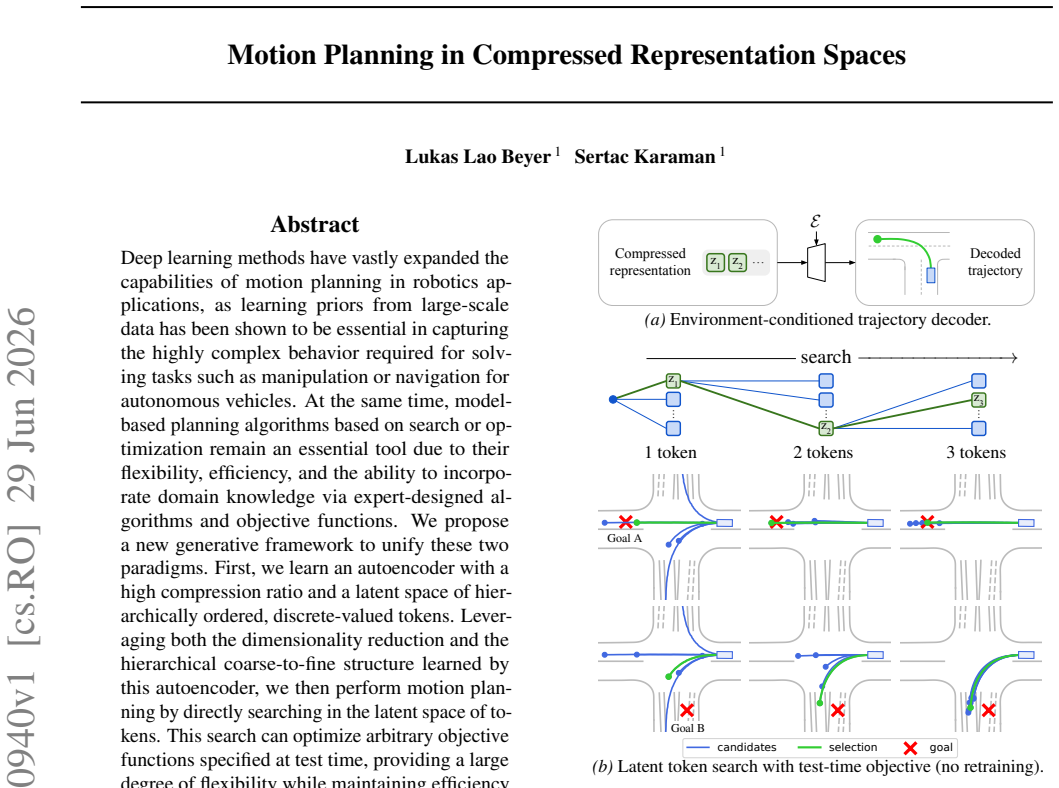
We learn an autoencoder with a high compression ratio and a latent space of hierarchically ordered, discrete-valued tokens. Leveraging both the dimensionality reduction and the hierarchical coarse-to-fine structure learned by this autoencoder, we then perform motion planning by directly searching in the latent space of tokens. This search can optimize arbitrary objective functions specified at test time, providing a large degree of flexibility while maintaining efficiency and producing realistic solutions by relying on the generative capabilities of the highly compressed autoencoder.
What carries the argument
Autoencoder producing hierarchically ordered discrete tokens in its latent space, used as the representation in which search-based planning occurs.
If this is right
- Arbitrary objective functions can be optimized at test time without any retraining.
- Dimensionality reduction and hierarchy keep the search computationally efficient.
- Realistic trajectories are obtained by decoding from the trained generative autoencoder.
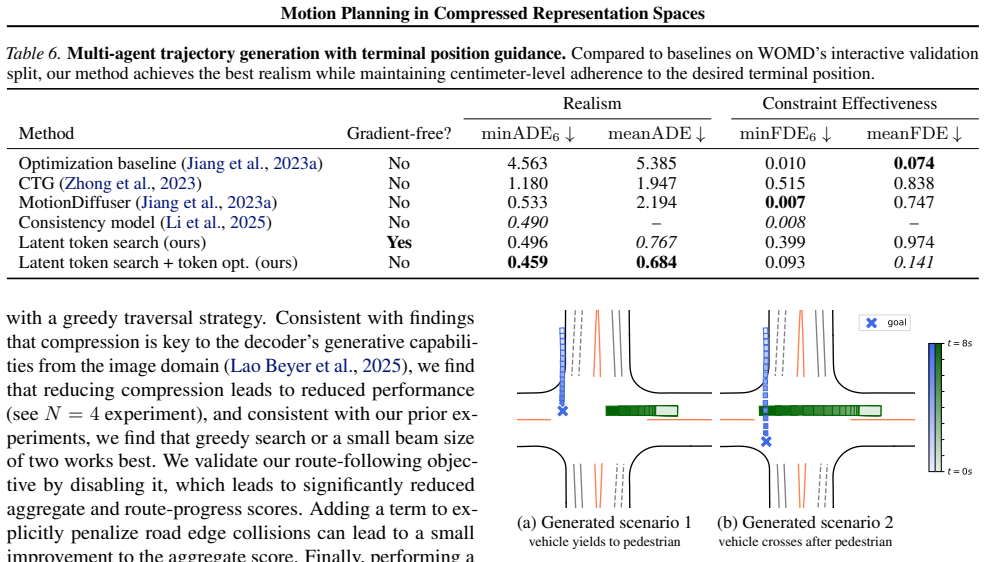
- The same trained model supports both closed-loop motion planning and multi-agent guided scenario synthesis.
Where Pith is reading between the lines
- The discrete token representation could allow integration with symbolic or combinatorial planning techniques that operate on sequences.
- Hierarchical ordering suggests a natural way to implement coarse-to-fine refinement where higher-level tokens are fixed first.
- If similar large-scale trajectory datasets exist in other robotics domains, the same compression-plus-search pattern could be applied without domain-specific redesign.
Load-bearing premise
The latent space of hierarchically ordered discrete tokens learned by the autoencoder preserves enough structure that search inside it produces dynamically feasible, collision-free, and realistic trajectories for arbitrary test-time objective functions.
What would settle it
If trajectories decoded from latent-space search plans frequently violate vehicle dynamics constraints or collide with obstacles when rolled out on the nuPlan and Waymo test sets, the central claim would be falsified.
Figures


read the original abstract
Deep learning methods have vastly expanded the capabilities of motion planning in robotics applications, as learning priors from large-scale data has been shown to be essential in capturing the highly complex behavior required for solving tasks such as manipulation or navigation for autonomous vehicles. At the same time, model-based planning algorithms based on search or optimization remain an essential tool due to their flexibility, efficiency, and the ability to incorporate domain knowledge via expert-designed algorithms and objective functions. We propose a new generative framework to unify these two paradigms. First, we learn an autoencoder with a high compression ratio and a latent space of hierarchically ordered, discrete-valued tokens. Leveraging both the dimensionality reduction and the hierarchical coarse-to-fine structure learned by this autoencoder, we then perform motion planning by directly searching in the latent space of tokens. This search can optimize arbitrary objective functions specified at test time, providing a large degree of flexibility while maintaining efficiency and producing realistic solutions by relying on the generative capabilities of the highly compressed autoencoder. We evaluate our method on nuPlan and the Waymo Open Motion Dataset, showing how latent space search can be used for a variety of guided behavior generation tasks, achieving strong performance for closed-loop motion planning and multi-agent guided scenario synthesis without requiring any task-specific training.
Editorial analysis
A structured set of objections, weighed in public.
Referee Report
Summary. The paper proposes a generative framework for motion planning that trains a highly compressed autoencoder whose latent space consists of hierarchically ordered discrete tokens; motion planning is then performed by direct search over these tokens to optimize arbitrary test-time objective functions. The approach is claimed to unify data-driven priors with model-based flexibility, achieving strong performance on closed-loop planning and multi-agent guided scenario synthesis on the nuPlan and Waymo Open Motion Datasets without any task-specific training, by relying on the autoencoder's generative capabilities to produce realistic trajectories.
Significance. If the central claim holds, the method would offer a flexible way to perform test-time optimization of custom objectives while inheriting realism and efficiency from a learned compressed representation, potentially advancing hybrid learning-plus-search approaches in robotics motion planning. The hierarchical token structure and high compression ratio are presented as enabling both coarse-to-fine search and computational efficiency.
major comments (2)
- [Abstract] Abstract: the central claim that direct search over the hierarchically ordered discrete tokens 'produces realistic solutions by relying on the generative capabilities of the highly compressed autoencoder' and yields dynamically feasible, collision-free trajectories for arbitrary (unseen) test-time objectives is load-bearing, yet the provided description supplies no mechanism—such as an explicit dynamics model, constraint projection step, feasibility repair, or post-decoding validation—inside the search procedure. Because the autoencoder is trained unsupervised on observed trajectories, nothing in the given account guarantees that out-of-distribution objectives will not decode to infeasible or colliding trajectories; this is the least-secured link in the argument.
- [Abstract] Abstract: the evaluation claims 'strong performance for closed-loop motion planning and multi-agent guided scenario synthesis' on nuPlan and Waymo without task-specific training, but supplies no implementation details, baselines, ablation studies, or error analysis. Without these, it is impossible to assess whether the reported results actually support the claim that latent-space search alone suffices for feasibility and realism.
Simulated Author's Rebuttal
We thank the referee for the detailed and constructive feedback. We address each major comment below, clarifying the mechanisms described in the full manuscript and indicating where revisions to the abstract will strengthen the presentation.
read point-by-point responses
-
Referee: [Abstract] Abstract: the central claim that direct search over the hierarchically ordered discrete tokens 'produces realistic solutions by relying on the generative capabilities of the highly compressed autoencoder' and yields dynamically feasible, collision-free trajectories for arbitrary (unseen) test-time objectives is load-bearing, yet the provided description supplies no mechanism—such as an explicit dynamics model, constraint projection step, feasibility repair, or post-decoding validation—inside the search procedure. Because the autoencoder is trained unsupervised on observed trajectories, nothing in the given account guarantees that out-of-distribution objectives will not decode to infeasible or colliding trajectories; this is the least-secured link in the argument.
Authors: The mechanism is the learned generative prior itself: the autoencoder is trained end-to-end on large-scale real trajectories from nuPlan and Waymo, so its decoder is constrained to map any valid sequence of hierarchical discrete tokens to dynamically feasible, collision-free motions observed in the data distribution. Search occurs entirely inside this compressed latent space; decoded outputs are therefore guaranteed to lie on the manifold of realistic trajectories without an auxiliary dynamics model or repair step. The hierarchical token ordering further supports coarse-to-fine optimization that stays within the learned representation. We agree the abstract would benefit from an explicit sentence on this inductive bias and will revise it accordingly. revision: yes
-
Referee: [Abstract] Abstract: the evaluation claims 'strong performance for closed-loop motion planning and multi-agent guided scenario synthesis' on nuPlan and Waymo without task-specific training, but supplies no implementation details, baselines, ablation studies, or error analysis. Without these, it is impossible to assess whether the reported results actually support the claim that latent-space search alone suffices for feasibility and realism.
Authors: The abstract is a high-level summary; the full manuscript (Sections 3–5) supplies the requested details: the autoencoder architecture and training procedure, the exact latent-space search algorithm, closed-loop baselines (including rule-based and learning-based planners), ablation studies on token hierarchy and compression ratio, and quantitative metrics with error analysis on both nuPlan and Waymo. We will revise the abstract to include a concise pointer to these evaluation elements and a summary of the key quantitative findings. revision: partial
Circularity Check
No circularity: method is empirical training + search, no derivation reduces to fitted inputs by construction
full rationale
The paper presents an autoencoder trained on trajectory data followed by latent-space search for planning. No equations, uniqueness theorems, or self-citations are shown that would make any claimed output (feasibility, collision avoidance) equivalent to the training inputs by definition. The generative claim is an empirical assertion about the learned model rather than a self-referential derivation. This matches the reader's assessment of score 2.0 with no visible circularity signal.
Axiom & Free-Parameter Ledger
Reference graph
Works this paper leans on
-
[1]
F., Amirloo, E., El-Nouby, A., Zamir, A., and Dehghan, A
Bachmann, R., Allardice, J., Mizrahi, D., Fini, E., Kar, O. F., Amirloo, E., El-Nouby, A., Zamir, A., and Dehghan, A. FlexTok : Resampling images into 1D token sequences of flexible length. arXiv 2025, 2025
2025
-
[2]
Universal guidance for diffusion models
Bansal, A., Chu, H.-M., Schwarzschild, A., Sengupta, S., Goldblum, M., Geiping, J., and Goldstein, T. Universal guidance for diffusion models. In Conference on Computer Vision and Pattern Recognition, pp.\ 843--852, 2023
2023
-
[3]
S., Fong, W
Caesar, H., Kabzan, J., Tan, K. S., Fong, W. K., Wolff, E., Lang, A., Fletcher, L., Beijbom, O., and Omari, S. NuPlan : A closed-loop ML -based planning benchmark for autonomous vehicles. In CVPR ADP3 workshop, 2021
2021
-
[4]
Chang, H., Zhang, H., Jiang, L., Liu, C., and Freeman, W. T. MaskGIT : Masked generative image transformer. In Conference on Computer Vision and Pattern Recognition, June 2022
2022
-
[5]
Rethinking imitation-based planners for autonomous driving
Cheng, J., Chen, Y., Mei, X., Yang, B., Li, B., and Liu, M. Rethinking imitation-based planners for autonomous driving. In International Conference on Robotics and Automation, pp.\ 14123--14130, 2024
2024
-
[6]
Diffusion policy: Visuomotor policy learning via action diffusion
Chi, C., Feng, S., Du, Y., Xu, Z., Cousineau, E., Burchfiel, B., and Song, S. Diffusion policy: Visuomotor policy learning via action diffusion. In Robotics: Science and Systems, 2023
2023
-
[7]
VQGAN-CLIP : Open domain image generation and editing with natural language guidance
Crowson, K., Biderman, S., Kornis, D., Stander, D., Hallahan, E., Castricato, L., and Raff, E. VQGAN-CLIP : Open domain image generation and editing with natural language guidance. arXiv preprint arXiv:2204.08583, 2022
-
[8]
Vision transformers need registers
Darcet, T., Oquab, M., Mairal, J., and Bojanowski, P. Vision transformers need registers. In International Conference on Learning Representations, 2024
2024
-
[9]
Parting with misconceptions about learning-based vehicle motion planning
Dauner, D., Hallgarten, M., Geiger, A., and Chitta, K. Parting with misconceptions about learning-based vehicle motion planning. In Conference on Robot Learning, 2023
2023
-
[10]
and Nichol, A
Dhariwal, P. and Nichol, A. Diffusion models beat GANs on image synthesis. Advances in Neural Information Processing Systems, 34: 0 8780--8794, 2021
2021
-
[11]
Taming transformers for high-resolution image synthesis
Esser, P., Rombach, R., and Ommer, B. Taming transformers for high-resolution image synthesis. In Conference on Computer Vision and Pattern Recognition, pp.\ 12873--12883, June 2021
2021
-
[12]
R., Zhou, Y., et al
Ettinger, S., Cheng, S., Caine, B., Liu, C., Zhao, H., Pradhan, S., Chai, Y., Sapp, B., Qi, C. R., Zhou, Y., et al. Large scale interactive motion forecasting for autonomous driving: The Waymo open motion dataset. In International Conference on Computer Vision, pp.\ 9710--9719, 2021
2021
-
[13]
Time-optimal planning for quadrotor waypoint flight
Foehn, P., Romero, A., and Scaramuzza, D. Time-optimal planning for quadrotor waypoint flight. Science Robotics, 6 0 (56): 0 eabh1221, 2021
2021
-
[14]
A., and Feron, E
Frazzoli, E., Dahleh, M. A., and Feron, E. Maneuver-based motion planning for nonlinear systems with symmetries. IEEE Transactions on Robotics, 21 0 (6): 0 1077--1091, 2005
2005
-
[15]
Goh, J. Y. and Gerdes, J. C. Simultaneous stabilization and tracking of basic automobile drifting trajectories. In IEEE Intelligent Vehicles Symposium, pp.\ 597--602, 2016
2016
-
[16]
J., Pouget-Abadie, J., Mirza, M., Xu, B., Warde-Farley, D., Ozair, S., Courville, A., and Bengio, Y
Goodfellow, I. J., Pouget-Abadie, J., Mirza, M., Xu, B., Warde-Farley, D., Ozair, S., Courville, A., and Bengio, Y. Generative adversarial nets. Advances in Neural Information Processing Systems, 27, 2014
2014
-
[17]
and Salimans, T
Ho, J. and Salimans, T. Classifier-free diffusion guidance. In NeurIPS 2021 Workshop on Deep Generative Models and Downstream Applications, 2021
2021
-
[18]
Denoising diffusion probabilistic models
Ho, J., Jain, A., and Abbeel, P. Denoising diffusion probabilistic models. Advances in Neural Information Processing Systems, 33: 0 6840--6851, 2020
2020
-
[19]
M., Vernaza, P., Phan-Minh, T., Chen, H., Hayden, D
Huang, X., Wolff, E. M., Vernaza, P., Phan-Minh, T., Chen, H., Hayden, D. S., Edmonds, M., Pierce, B., Chen, X., Jacob, P. E., Chen, X., Tairbekov, C., Agarwal, P., Gao, T., Chai, Y., and Srinivasa, S. Drive GPT : Scaling autoregressive behavior models for driving. In International Conference on Machine Learning, 2025 a
2025
-
[20]
Gameformer: Game-theoretic modeling and learning of transformer-based interactive prediction and planning for autonomous driving
Huang, Z., Liu, H., and Lv, C. Gameformer: Game-theoretic modeling and learning of transformer-based interactive prediction and planning for autonomous driving. In International Conference on Computer Vision, pp.\ 3903--3913, October 2023
2023
-
[21]
Gen-drive: Enhancing diffusion generative driving policies with reward modeling and reinforcement learning fine-tuning
Huang, Z., Weng, X., Igl, M., Chen, Y., Cao, Y., Ivanovic, B., Pavone, M., and Lv, C. Gen-drive: Enhancing diffusion generative driving policies with reward modeling and reinforcement learning fine-tuning. In International Conference on Robotics and Automation, pp.\ 3445--3451, 2025 b
2025
-
[22]
MotionDiffuser : Controllable multi-agent motion prediction using diffusion
Jiang, C., Cornman, A., Park, C., Sapp, B., Zhou, Y., Anguelov, D., et al. MotionDiffuser : Controllable multi-agent motion prediction using diffusion. In Conference on Computer Vision and Pattern Recognition, pp.\ 9644--9653, 2023 a
2023
-
[23]
Efficient planning in a compact latent action space
Jiang, Z., Zhang, T., Janner, M., Li, Y., Rocktäschel, T., Grefenstette, E., and Tian, Y. Efficient planning in a compact latent action space. International Conference on Learning Representations, 2023 b
2023
-
[24]
Kingma, D. P. and Welling, M. Auto-encoding variational Bayes . In International Conference on Learning Representations , 2014
2014
-
[25]
Highly compressed tokenizer can generate without training
Lao Beyer, L., Li, T., Chen, X., Karaman, S., and He, K. Highly compressed tokenizer can generate without training. In International Conference on Machine Learning, July 2025
2025
- [26]
-
[27]
Autoregressive image generation without vector quantization
Li, T., Tian, Y., Li, H., Deng, M., and He, K. Autoregressive image generation without vector quantization. Advances in Neural Information Processing Systems, 37: 0 56424--56445, 2024
2024
-
[28]
and Hutter, F
Loshchilov, I. and Hutter, F. Decoupled weight decay regularization. In International Conference on Learning Representations, 2019
2019
-
[29]
Finite scalar quantization: VQ - VAE made simple
Mentzer, F., Minnen, D., Agustsson, E., and Tschannen, M. Finite scalar quantization: VQ - VAE made simple. In International Conference on Learning Representations, 2024
2024
-
[30]
One-d-piece: Image tokenizer meets quality-controllable compression
Miwa, K., Sasaki, K., Arai, H., Takahashi, T., and Yamaguchi, Y. One-d-piece: Image tokenizer meets quality-controllable compression. In ICML Tokenization Workshop, 2025
2025
-
[31]
Robust post-stall perching with a simple fixed-wing glider using lqr-trees
Moore, J., Cory, R., and Tedrake, R. Robust post-stall perching with a simple fixed-wing glider using lqr-trees. Bioinspiration & biomimetics, 9 0 (2): 0 025013, 2014
2014
-
[32]
Vector quantized models for planning
Ozair, S., Li, Y., Razavi, A., Antonoglou, I., Van Den Oord, A., and Vinyals, O. Vector quantized models for planning. In International Conference on Machine Learning, pp.\ 8302--8313. PMLR, 2021
2021
-
[33]
StyleCLIP : Text-driven manipulation of stylegan imagery
Patashnik, O., Wu, Z., Shechtman, E., Cohen-Or, D., and Lischinski, D. StyleCLIP : Text-driven manipulation of stylegan imagery. In International Conference on Computer Vision, pp.\ 2085--2094, October 2021
2085
-
[34]
A., and Kelly, A
Pivtoraiko, M., Knepper, R. A., and Kelly, A. Differentially constrained mobile robot motion planning in state lattices. Journal of Field Robotics, 26 0 (3): 0 308--333, 2009
2009
-
[35]
R., Su, H., Mo, K., and Guibas, L
Qi, C. R., Su, H., Mo, K., and Guibas, L. J. Pointnet: Deep learning on point sets for 3d classification and segmentation. In Conference on Computer Vision and Pattern Recognition, pp.\ 652--660, 2017
2017
-
[36]
W., Hallacy, C., Ramesh, A., Goh, G., Agarwal, S., Sastry, G., Askell, A., Mishkin, P., Clark, J., et al
Radford, A., Kim, J. W., Hallacy, C., Ramesh, A., Goh, G., Agarwal, S., Sastry, G., Askell, A., Mishkin, P., Clark, J., et al. Learning transferable visual models from natural language supervision. In International Conference on Machine Learning, pp.\ 8748--8763. PMLR, 2021
2021
-
[37]
Learning ordered representations with nested dropout
Rippel, O., Gelbart, M., and Adams, R. Learning ordered representations with nested dropout. In International Conference on Machine Learning, pp.\ 1746--1754. PMLR, 2014
2014
-
[38]
High-resolution image synthesis with latent diffusion models
Rombach, R., Blattmann, A., Lorenz, D., Esser, P., and Ommer, B. High-resolution image synthesis with latent diffusion models. In Conference on Computer Vision and Pattern Recognition, pp.\ 10684--10695, 2022
2022
-
[39]
On the pitfalls of heteroscedastic uncertainty estimation with probabilistic neural networks
Seitzer, M., Tavakoli, A., Antic, D., and Martius, G. On the pitfalls of heteroscedastic uncertainty estimation with probabilistic neural networks. In International Conference on Learning Representations, 2022
2022
-
[40]
Motion transformer with global intention localization and local movement refinement
Shi, S., Jiang, L., Dai, D., and Schiele, B. Motion transformer with global intention localization and local movement refinement. Advances in Neural Information Processing Systems, 35: 0 6531--6543, 2022
2022
-
[41]
Smith, J. G. The information capacity of amplitude- and variance-constrained scalar Gaussian channels. Information and control, 18 0 (3): 0 203--219, 1971
1971
-
[42]
Loss-guided diffusion models for plug-and-play controllable generation
Song, J., Zhang, Q., Yin, H., Mardani, M., Liu, M.-Y., Kautz, J., Chen, Y., and Vahdat, A. Loss-guided diffusion models for plug-and-play controllable generation. In International Conference on Machine Learning, volume 202 of Proceedings of Machine Learning Research, pp.\ 32483--32498. PMLR, 23--29 Jul 2023
2023
-
[43]
Neural discrete representation learning
van den Oord, A., Vinyals, O., and Kavukcuoglu, K. Neural discrete representation learning. In Advances in Neural Information Processing Systems, volume 30, 2017
2017
-
[44]
`` P rincipal components'' enable a new language of images
Wen, X., Zhao, B., Elezi, I., Deng, J., and Qi, X. `` P rincipal components'' enable a new language of images. In International Conference on Computer Vision, 2025
2025
-
[45]
An image is worth 32 tokens for reconstruction and generation
Yu, Q., Weber, M., Deng, X., Shen, X., Cremers, D., and Chen, L.-C. An image is worth 32 tokens for reconstruction and generation. In Advances in Neural Information Processing Systems, volume 38, 2024
2024
-
[46]
Carplanner: Consistent auto-regressive trajectory planning for large-scale reinforcement learning in autonomous driving
Zhang, D., Liang, J., Guo, K., Lu, S., Wang, Q., Xiong, R., Miao, Z., and Wang, Y. Carplanner: Consistent auto-regressive trajectory planning for large-scale reinforcement learning in autonomous driving. In Conference on Computer Vision and Pattern Recognition, pp.\ 17239--17248, 2025
2025
-
[47]
Guided conditional diffusion for controllable traffic simulation
Zhong, Z., Rempe, D., Xu, D., Chen, Y., Veer, S., Che, T., Ray, B., and Pavone, M. Guided conditional diffusion for controllable traffic simulation. In International Conference on Robotics and Automation, pp.\ 3560--3566, 2023
2023
discussion (0)
Sign in with ORCID, Apple, or X to comment. Anyone can read and Pith papers without signing in.