REVIEW 3 major objections 4 minor 2 cited by
Many late-time TDE plateaus can be explained by disks formed with a large angular-momentum spread, not by year-long viscous spreading, and the same model reproduces AT2018cow's optical-UV emission for 10-100 solar-mass black holes.
Reviewed by Pith at T0; open to challenge. T0 means a machine referee read the full paper against a public rubric. the ladder, T0–T4 →
T0 review · deepseek-v4-flash
2026-08-03 17:33 UTC pith:WXMMXT4P
load-bearing objection Solid, honest extension of the spreading-disk program; the TDE non-spreading claim is more robust to disk-mass uncertainty than the stress-test suggests, and the real soft spots are the f_J initial radius and the magnetic viscosity closure. the 3 major comments →
Viscously Spreading Accretion Disks around Black Holes: Implications for TDEs, LFBOTs and other Transients
The pith
A machine-rendered reading of the paper's core claim, the machinery that carries it, and where it could break.
Core claim
The central discovery is that the observed late-time plateaus of many TDEs can be reproduced by disks that form with a large radial spread in angular momentum (e.g., an initial radius of ~10 tidal radii rather than ~2), so that the outer disk's viscous time is long and the disk barely spreads over observable timescales; viscous spreading on year timescales is therefore not required, though it remains compatible. A second discovery is that the late-time TDE luminosity is incompatible with the collapse of radiation-pressure-dominated disks to the gas-pressure-dominated branch: such collapse underpredicts the plateau luminosities by orders of magnitude, which the authors interpret as strong evi
What carries the argument
The central object is the one-zone approximation to the standard Shakura-Sunyaev thin-disk diffusion equation, generalized to include mass and angular-momentum loss from super-Eddington outflows via the scaling Mdot ~ r^p with p ~ 0.5 and an outflow torque C ~ 0.5 (equations 16-19). This is calibrated against full radial, time-dependent solutions. The load-bearing initial conditions are the disk mass set by suppressed super-Eddington fallback, M_d,0 ~ 0.07 M_sun for parabolic TDEs (equation 28), and the disk radius enlarged by angular-momentum redistribution during circularization (f_J > 1). Two viscosity prescriptions bracket the uncertainty: a gas-pressure-supported alpha-disk and a magnet
Load-bearing premise
The load-bearing premise is that super-Eddington accretion during disk formation removes mass and angular momentum in the specific pattern described by p ~ 0.5 and C ~ 0.5, and that only a small fraction (f_fb <= 0.1) of the stellar debris remains bound to form the disk; these choices set the initial disk mass and radius that drive all luminosity predictions.
What would settle it
A concrete test: monitor a TDE's full optical-UV SED over several years. The non-spreading, large-angular-momentum model predicts little evolution of the spectral shape (the Rayleigh-Jeans break stays nearly fixed), while the spreading model predicts a clear redward movement of the break; observing the latter would falsify the non-spreading interpretation for that event. For AT2018cow, a definitive falsifier is whether late-time X-rays re-brighten to ~10^39-10^40 erg/s as the absorbing outflow becomes photoionized; continued non-detection at that level would disfavor the absorption scenario.
If this is right
- Late-time TDE plateaus do not uniquely require viscous spreading; disks formed with a large angular-momentum spread can match many observed plateau luminosities, so BH masses and alpha inferred from plateau fits must account for this degeneracy.
- Gas-pressure-dominated TDE disk models are effectively ruled out by the observed plateau brightness; the disks must instead be magnetically dominated and thermally stable, motivating further MHD studies of saturated field strengths.
- Irradiation of the outer warped disk by the inner aligned flow increases plateau luminosity and duration by factors of a few, so the observer's viewing angle relative to the BH spin matters for interpreting TDE SEDs.
- The late-time optical-UV emission of AT2018cow is naturally explained by a stellar-mass BH (10-100 M_sun) with super-Eddington outflows, and the faint X-rays are explained by ongoing absorption in those outflows.
- The model predicts that late-time X-rays at ~10^39-10^40 erg/s should become detectable again as the outflow ionization parameter rises, and that JWST/HST observations of AT2018cow may reveal a spectral break in the near-IR-optical, probing outer disk thermodynamics.
Where Pith is reading between the lines
- If the angular-momentum-spread scenario is right, the early-time SED shape of a TDE should be nearly static (the break does not move) for years, whereas a spreading disk should show a redward drift; this offers a direct observational discriminator using multi-epoch UV/optical spectroscopy or photometry.
- The same model could be applied to other fast-forming compact disks, such as neutron star-black hole mergers or stellar collisions; late-time optical plateaus in such events would be a testable extension of the framework.
- The conclusion that gas-pressure-dominated disks are ruled out implies that late-time TDE luminosities could be used as a rough probe of the magnetic field strength in accretion flows, linking observed light curves to magnetohydrodynamic simulations.
- The prediction of future X-ray re-brightening in AT2018cow is a falsifiable legacy: if deep X-ray observations in the coming decades do not reveal ~10^39-10^40 erg/s emission, the absorption + re-emission scenario would be in serious doubt.
Editorial analysis
A structured set of objections, weighed in public.
Referee Report
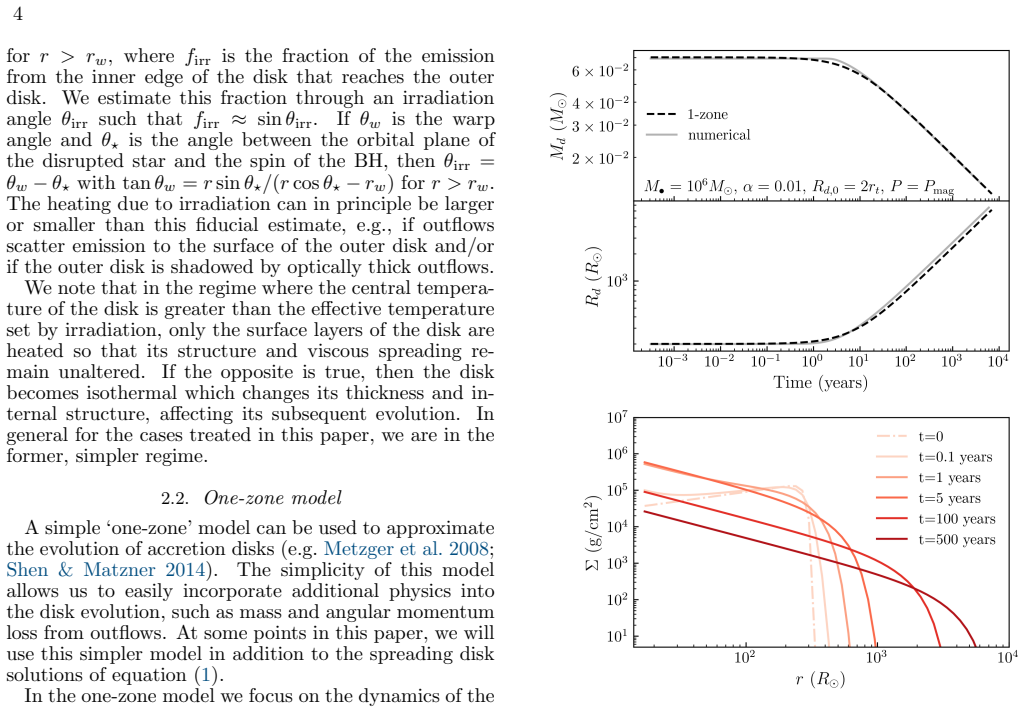
Summary. The paper presents a one-zone and a one-dimensional time-dependent model for viscously spreading accretion disks around black holes with masses 10–10^8 M_sun, extending earlier work by incorporating super-Eddington outflows, non-conservation of mass and angular momentum during TDE circularization, irradiation of a warped outer disk, and two viscosity closures: gas-pressure-supported disks and magnetically supported disks. The model is calibrated against full radial solutions in Fig. 1 and used to derive analytic scalings for the Rayleigh-Jeans luminosity and viscous timescale. The paper's main claim is that many late-time optical/UV plateaus in TDEs can be explained without invoking viscous spreading on year timescales, provided the disk initially forms with a large angular-momentum spread (R_d,0 ~ 5–10 r_t), and that collapse to the gas-pressure-dominated branch would underpredict plateau luminosities, favoring magnetically dominated models. The same framework is applied to the late-time emission of AT2018cow, arguing for a 10–100 M_sun BH and for X-ray absorption/reprocessing by winds as an explanation for the faint X-rays. The authors explicitly flag several of the underlying uncertainties, including the super-Eddington circularization physics (footnote 1, §3.2.1) and the r^{1/2} inflow scaling (§5).
Significance. If correct, the paper provides a useful and flexible framework for modeling late-time emission from compact accretion disks, with transparent one-zone scalings and a direct comparison to observed TDE plateaus and AT2018cow data. The validation of the one-zone approximation against the full radial solver (Fig. 1) and the explicit analytic scaling laws (eqs. 30–34, 37) are strengths that make the model easy to test and reproduce. The paper also makes falsifiable predictions, notably the eventual reappearance of X-rays in LFBOTs and a measurable near-IR/optical SED break in AT2018cow. The significance is somewhat qualified by the fact that the central TDE and LFBOT conclusions rely on several uncalibrated, order-of-magnitude parameters — the retained fallback fraction f_fb, the angular-momentum retention factor f_J, and the outflow torque parameters p and C — for which the authors themselves note the supporting physics is not yet firmly established.
major comments (3)
- [§3.2, Eq. (24), Fig. 2] The non-spreading TDE interpretation is directly tied to the assumed initial disk radius R_d,0 = f_J (2 r_t) with f_J > 1. The only cited motivation is Lu & Bonnerot (2020), but the paper does not provide a quantitative mapping from that simulation to typical TDE parameters, and footnote 1 (§3.2.1) concedes that the exact outflow of mass and angular momentum during TDE circularization is not well understood. Since t_visc,0 scales as (R_d,0)^{3/2} in eq. (30), taking f_J = 5 lengthens t_visc,0 by an order of magnitude relative to f_J = 1. The claim that 'viscous spreading on year timescales is not required' therefore rests almost entirely on an unquantified parameter. I ask the authors to either calibrate f_J from the cited simulations more directly or to show how the fraction of observed late-time plateaus that fall in the non-spreading region changes when f_J = 1 is assumed.
- [§3.2.1, Eq. (28), Fig. 5] The initial disk mass M_d,0 ~ 0.07 M_sun is obtained from a toy model in which the disk retains only a fraction f_fb <= 0.1 of the super-Eddington fallback. The paper itself notes (footnote 1) that the relevant physics is not well understood, and no calibration against a self-consistent circularization-plus-outflow simulation is provided. This quantity sets the luminosity normalization in the TDE calculations: eq. (31) and Fig. 5 show that L_nu depends directly on M_d. Moreover, in the magnetized-disk case H/R increases with M_d^{1/7} (eq. 10), so adopting f_fb = 0.3–0.5 changes both the luminosity and the viscous timescale, potentially moving some of the 'non-spreading' models in Fig. 2 into the spreading regime. The authors should carry out a sensitivity test for f_fb and demonstrate that the main qualitative conclusions survive for a broader range of retained-fallback fractions.
- [§2.3, Eqs. (16)–(19), §4.2, Fig. 7] The LFBOT conclusions are strongly dependent on the super-Eddington outflow prescriptions Mdot ~ r^p with p = 0.5 and the torque parameter C = 0.5, taken from Guo et al. (2025). These prescriptions cause the models to lose more than 3/4 of the disk's mass and angular momentum before the outer disk becomes sub-Eddington (Fig. 7), which in turn determines the plateau luminosity, the time of the sub-Eddington transition, and the inferred BH mass range for AT2018cow. The paper itself notes in §5 that the r^{1/2} scaling 'has yet to be explicitly demonstrated for the long term spreading of disks relevant to this work.' Given the direct impact of p and C on the headline AT2018cow conclusion, the authors should either justify these values with simulations tailored to the relevant configuration or show how the inferred BH mass changes when p and C are varied within a plausible range.
minor comments (4)
- [Abstract] The abstract contains a typo: '10−10 8M⊙' should read '10–10^8 M_sun'.
- [§3.2.2, Eq. (29)] The initial surface density profile is taken with gamma = -0.5, which corresponds to a surface density that increases with radius. The authors state this choice is arbitrary and that results are insensitive to it, but a brief justification or a note that gamma > 0 would also be acceptable would improve clarity.
- [§4.2, Figs. 8–9] The truncation of the thin-disk SED at h nu = 3 k_B T_eff(r_Edd) is physically motivated but not explained in the main text. Adding one sentence in §4.2 clarifying why this is the appropriate cutoff would help readers interpret the figures.
- [§2.1, Eq. (13)] The irradiation term q_irr uses f_irr = sin(theta_irr), but the relationship between L(r_in) and the inner-disk luminosity is not explicitly defined. Please define L(r_in) in the text.
Circularity Check
Derivation is conditional on stated inputs, not circular; self-cited outflow scalings are flagged as unverified but constitute external simulation evidence.
full rationale
No step in the paper reduces a prediction to its inputs by construction. The core TDE claim (§4.1.1, Fig. 2) is an existence argument: for plausible initial disk masses (eq. 28, from a f_fb ≲ 0.1 toy model) and radii (eq. 24, with f_J from Lu & Bonnerot 2020), the thermal luminosity of an initially non-spreading disk (eq. 31) overlaps observed plateau luminosities (Mummery et al. 2023). Those observed luminosities are external data, not used to set M_d,0 or R_d,0; the conclusion is therefore conditional, not fitted-prediction circularity. The LFBOT analysis (§4.2) integrates the one-zone model with outflow scalings p ≈ C ≈ 0.5 adopted from Guo et al. 2025, and uses outflow spectral models from Strubbe & Quataert 2009 and Linial & Quataert 2024; Fig. 10 selects models matching the t = 703 d HST epoch and then extrapolates to t = 9 yr, which is a forecast, not a fit renamed as a prediction. The self-citations are load-bearing for the LFBOT mass range but are external simulation/theory results with stated assumptions that do not include the target AT2018cow data; the paper itself flags the missing demonstration in footnote 1 (§3.2.1) and §5, noting the r^{1/2} scaling has yet to be explicitly demonstrated for long-term disk spreading. Under the rule that externally falsifiable cited work counts as real evidence, this does not constitute circularity; the appropriate finding is no significant circularity (score 1, reflecting the minor self-citation and uncalibrated initial conditions, not a reduction by construction).
Axiom & Free-Parameter Ledger
free parameters (9)
- alpha (viscosity parameter) =
0.01 fiducial; varied 10^-3 to 10^0
- p (super-Eddington outflow mass-loss exponent) =
0.5
- C (outflow torque constant) =
0.5
- f_fb (retained fallback fraction during super-Eddington phase) =
<=0.1 (assumed)
- f_J (angular-momentum retention factor in circularization) =
1 or >1 (R_d,0 = 2 r_t or 10 r_t)
- gamma (initial surface-density power-law slope) =
-0.5
- f_irr (irradiation fraction) =
sin(theta_irr); upper limit 0.3
- H/R during super-Eddington phase =
1/3
- beta_w (inner-outflow velocity) =
about 1/3
axioms (10)
- domain assumption Thin, Keplerian, vertically averaged disk with the diffusion equation (eq. 1) for surface density.
- domain assumption Local thermal equilibrium: viscous heating balances radiative cooling, sigma T_eff^4 = (9/8) nu Sigma GM/R^3 (eq. 5).
- domain assumption Disk is optically thick to Thomson scattering with kappa_e = 0.34 cm^2/g and emits isotropically as a blackbody (eq. 6).
- domain assumption Magnetic-pressure viscosity: nu_mag = alpha v_A H with v_A ~ sqrt(v_K c_s) (eqs. 3 and 8), after Begelman & Pringle 2007 and Pessah & Psaltis 2005.
- domain assumption Super-Eddington inflow rate scales as Mdot(r) ~ r^p with p = 0.5 and outflow torque C = 0.5 (eqs. 16-19).
- ad hoc to paper During super-Eddington fallback, only a small fraction f_fb <= 0.1 of the fallback mass is retained, giving M_d,0 ~ 0.07 M_sun (eq. 28).
- domain assumption Bardeen-Petterson alignment and the warp radius (eq. 11) set the irradiation geometry; f_irr ~ sin(theta_irr) (eq. 13).
- domain assumption LFBOT inner super-Eddington outflows obey L ~ L_Edd^{2/3} Mdot_w^{1/3} with a single-velocity blackbody photosphere at beta_w ~ 1/3 (eq. 38, from Strubbe & Quataert 2009 and Linial & Quataert 2024).
- domain assumption X-ray absorption by outflowing gas is governed by the ionization parameter with critical value xi_c = 0.015 (Govreen-Segal et al. 2025; eqs. 39-41).
- domain assumption Parabolic TDE fallback follows Mdot_fb ~ t^{-5/3} with t_fb ~ 30 d (M/1e6 M_sun)^{1/2} (eqs. 25-26).
Cite this review
Pith. "Pith review of Viscously Spreading Accretion Disks around Black Holes: Implications for TDEs, LFBOTs and other Transients." pith.science (2026). https://pith.science/paper/WXMMXT4P
@misc{pith2026251209017,
  author       = {Pith},
  title        = {Pith review of: Viscously Spreading Accretion Disks around Black Holes: Implications for TDEs, LFBOTs and other Transients},
  year         = {2026},
  howpublished = {\url{https://pith.science/paper/WXMMXT4P}},
  note         = {Machine review of arXiv:2512.09017}
}
read the original abstract
We present a simple time-dependent model of viscously spreading accretion disks around black holes (BHs) with masses between $10-10^8M_\odot$. We apply the results to observations of late-time emission in tidal disruption events (TDEs) and luminous fast blue optical transients (LFBOT) such as AT2018cow. Our model generalizes previous work by incorporating outflows during super-Eddington accretion, non-conservation of mass and angular momentum in TDE circularization, irradiation of the outer disk by the inner accretion flow, and a range of viscous stress models. We show that many late-time plateaus in TDEs can be explained by disks formed with a large spread in angular momentum due to redistribution during circularization. Viscous spreading on year timescales is not required, although it is also compatible with the data. The collapse of radiation pressure dominated thin disks to the stable gas-pressure dominated phase greatly underpredicts TDE plateau luminosities, strongly favoring thermally stable magnetically dominated disk models. Irradiation of the outer disk in TDEs due to misalignment of the stellar orbit and black hole spin increases plateau luminosities and durations by factors of a few. Continued study of late-time TDE emission provides a unique opportunity to constrain the physics of disk formation and circularization, disk warps, angular momentum transport, and other poorly understood aspects of disk physics. The models we develop can also explain the late-time optical-UV emission in the LFBOT AT2018cow for BH masses of ~$10-100M_\odot$. The faint X-ray emission at late times in AT2018cow is likely due to ongoing absorption. Our models predict that late-time X-rays should eventually be detectable again, and that HST/JWST observations of AT2018cow may detect a break in the SED at near-IR-optical wavelengths, providing a powerful probe of outer accretion disk thermodynamics.
Figures


Forward citations
Cited by 2 Pith papers
-
Implications of the UV/optical Plateau of AT2018cow
A wind-and-irradiation disk model fits the AT2018cow UV plateau with accretor masses from 1.4 to ~100 solar masses, removing the need for a >200 solar-mass black hole.
-
Delayed Radio Flares in Tidal Disruption Events from Star-Disk Collision Outflows
A time-dependent model shows that star-disk collisions in TDE systems hosting EMRIs can eject 10^{-3} to 1 solar masses at 0.02-0.1c years after the initial flare, producing radio emission via interaction with circumn...
Reference graph
Works this paper leans on
-
[1]
Alush, Y., & Stone, N. C. 2025, Late-Time Evolution of Magnetized Disks in Tidal Disruption Events, arXiv, doi: 10.48550/arXiv.2503.03811
-
[2]
2024, ApJ, 961, L2, doi: 10.3847/2041-8213/ad0388 15
Bandopadhyay, A., Fancher, J., Athian, A., et al. 2024, ApJ, 961, L2, doi: 10.3847/2041-8213/ad0388 15
-
[3]
Bardeen, J. M., & Petterson, J. A. 1975, ApJ, 195, L65, doi: 10.1086/181711
doi:10.1086/181711 1975
-
[4]
Begelman, M. C., & Pringle, J. E. 2007, Monthly Notices of the Royal Astronomical Society, 375, 1070, doi: 10.1111/j.1365-2966.2006.11372.x
arXiv 2007
-
[5]
Blandford, R. D., & Begelman, M. C. 1999, MNRAS, 303, L1, doi: 10.1046/j.1365-8711.1999.02358.x
arXiv 1999
-
[6]
Bonnerot, C., Rossi, E. M., Lodato, G., & Price, D. J. 2016, MNRAS, 455, 2253, doi: 10.1093/mnras/stv2411
-
[7]
Cannizzo, J. K., Lee, H. M., & Goodman, J. 1990, ApJ, 351, 38, doi: 10.1086/168442
doi:10.1086/168442 1990
-
[8]
Cao, Z., Jonker, P. G., Wen, S., Stone, N. C., & Zabludoff, A. I. 2023, Monthly Notices of the Royal Astronomical Society, 519, 2375, doi: 10.1093/mnras/stac3539
-
[9]
Chen, Y., Drout, M. R., Piro, A. L., et al. 2023, ApJ, 955, 43, doi: 10.3847/1538-4357/ace964
-
[10]
Chrimes, A. A., Jonker, P. G., Levan, A. J., & Mummery, A. 2025, arXiv e-prints, arXiv:2510.03402, doi: 10.48550/arXiv.2510.03402
-
[11]
2013, ApJ, 775, L9, doi: 10.1088/2041-8205/775/1/L9
Dai, L., Escala, A., & Coppi, P. 2013, ApJ, 775, L9, doi: 10.1088/2041-8205/775/1/L9
-
[12]
Dai, X., Kochanek, C. S., Chartas, G., et al. 2010, ApJ, 709, 278, doi: 10.1088/0004-637X/709/1/278
-
[13]
R., Chornock, R., Soderberg, A
Drout, M. R., Chornock, R., Soderberg, A. M., et al. 2014, ApJ, 794, 23, doi: 10.1088/0004-637X/794/1/23
-
[14]
X-ray Transmission Through Photoionized Gas with Moderate Thomson Optical Depth
Govreen-Segal, T., Nakar, E., & Quataert, E. 2025, X-ray Transmission Through Photoionized Gas with Moderate Thomson Optical Depth, arXiv, doi: 10.48550/arXiv.2509.08119
work page internal anchor Pith review Pith/arXiv arXiv doi:10.48550/arxiv.2509.08119 2025
-
[15]
Cyclic Zoom: Multiscale GRMHD Modeling of Black Hole Accretion and Feedback
Guo, M., Stone, J. M., Quataert, E., & Springel, V. 2025, Cyclic Zoom: Multi-scale GRMHD Modeling of Black Hole Accretion and Feedback, arXiv, doi: 10.48550/arXiv.2504.16802
work page internal anchor Pith review Pith/arXiv arXiv doi:10.48550/arxiv.2504.16802 2025
-
[16]
2013, MNRAS, 434, 909, doi: 10.1093/mnras/stt871
Hayasaki, K., Stone, N., & Loeb, A. 2013, MNRAS, 434, 909, doi: 10.1093/mnras/stt871
-
[17]
Hills, J. G. 1975, Nature, 254, 295, doi: 10.1038/254295a0
doi:10.1038/254295a0 1975
-
[18]
Ho, A. Y. Q., Perley, D. A., Kulkarni, S. R., et al. 2020, ApJ, 895, 49, doi: 10.3847/1538-4357/ab8bcf
-
[19]
Ho, A. Y. Q., Perley, D. A., Gal-Yam, A., et al. 2023, ApJ, 949, 120, doi: 10.3847/1538-4357/acc533
-
[20]
Honma, F., Matsumoto, R., Kato, S., & Abramowicz, M. A. 1991, PASJ, 43, 261, doi: 10.1093/pasj/43.2.261
-
[21]
2022, ApJ, 934, 132, doi: 10.3847/1538-4357/ac75d8
Hu, H., Inayoshi, K., Haiman, Z., Quataert, E., & Kuiper, R. 2022, ApJ, 934, 132, doi: 10.3847/1538-4357/ac75d8
-
[22]
2023, The Astrophysical Journal, 945, 57, doi: 10.3847/1538-4357/acb6fc
Huang, J., Jiang, Y.-F., Feng, H., et al. 2023, The Astrophysical Journal, 945, 57, doi: 10.3847/1538-4357/acb6fc
-
[23]
Huang, X., Davis, S. W., & Jiang, Y.-f. 2024, ApJ, 974, 165, doi: 10.3847/1538-4357/ad6c39
-
[24]
Inkenhaag, A., Jonker, P. G., Levan, A. J., et al. 2023, MNRAS, 525, 4042, doi: 10.1093/mnras/stad2531
-
[25]
Inkenhaag, A., Levan, A. J., Mummery, A., & Jonker, P. G. 2025, MNRAS, 544, L108, doi: 10.1093/mnrasl/slaf107
-
[26]
2002, ApJ, 576, 908, doi: 10.1086/341804
Janiuk, A., Czerny, B., & Siemiginowska, A. 2002, ApJ, 576, 908, doi: 10.1086/341804
doi:10.1086/341804 2002
-
[27]
Jiang, Y.-F., Blaes, O., Kaul, I., & Zhang, L. 2025, Radiation and Magnetic Pressure Support in Accretion Disks around Supermassive Black Holes and The Physical Origin of the Extreme Ultraviolet to Soft X-ray Spectrum, arXiv, doi: 10.48550/arXiv.2505.09671
-
[28]
2016, ApJ, 830, 125, doi: 10.3847/0004-637X/830/2/125
Jiang, Y.-F., Guillochon, J., & Loeb, A. 2016, ApJ, 830, 125, doi: 10.3847/0004-637X/830/2/125
-
[29]
Jiang, Y.-F., Stone, J. M., & Davis, S. W. 2014, ApJ, 796, 106, doi: 10.1088/0004-637X/796/2/106
-
[30]
Klencki, J., & Metzger, B. D. 2025, arXiv e-prints, arXiv:2510.09745. https://arxiv.org/abs/2510.09745
Pith/arXiv arXiv 2025
-
[31]
Kremer, K., Mockler, B., Piro, A. L., & Lombardi, J. C. 2023, MNRAS, 524, 6358, doi: 10.1093/mnras/stad2239
-
[32]
Kuin, N. P. M., Wu, K., Oates, S., et al. 2019, MNRAS, 487, 2505, doi: 10.1093/mnras/stz053
-
[33]
Lightman, A. P., & Eardley, D. M. 1974, ApJ, 187, L1, doi: 10.1086/181377
doi:10.1086/181377 1974
-
[34]
2024, The Astrophysical Journal, 974, 67, doi: 10.3847/1538-4357/ad67cf
Linial, I., & Quataert, E. 2024, The Astrophysical Journal, 974, 67, doi: 10.3847/1538-4357/ad67cf
-
[35]
2022, in Handbook of X-ray and Gamma-ray Astrophysics, ed
Lu, W. 2022, in Handbook of X-ray and Gamma-ray Astrophysics, ed. C. Bambi & A. Sangangelo, 3, doi: 10.1007/978-981-16-4544-0 127-1
-
[36]
2020, MNRAS, 492, 686, doi: 10.1093/mnras/stz3405
Lu, W., & Bonnerot, C. 2020, MNRAS, 492, 686, doi: 10.1093/mnras/stz3405
-
[37]
Margutti, R., Metzger, B. D., Chornock, R., et al. 2019, ApJ, 872, 18, doi: 10.3847/1538-4357/aafa01
-
[38]
Metzger, B. D. 2022, ApJ, 932, 84, doi: 10.3847/1538-4357/ac6d59
-
[39]
Metzger, B. D., Piro, A. L., & Quataert, E. 2008, Monthly Notices of the Royal Astronomical Society, doi: 10.1111/j.1365-2966.2008.13789.x
arXiv 2008
-
[40]
Metzger, B. D., & Stone, N. C. 2016, Monthly Notices of the Royal Astronomical Society, 461, 948, doi: 10.1093/mnras/stw1394
-
[41]
Migliori, G., Margutti, R., Metzger, B. D., et al. 2024, ApJ, 963, L24, doi: 10.3847/2041-8213/ad2764
-
[42]
Mummery, A., & Balbus, S. A. 2020, MNRAS, 492, 5655, doi: 10.1093/mnras/staa192
-
[43]
2025, Monthly Notices of the Royal Astronomical Society, staf1565, doi: 10.1093/mnras/staf1565
Mummery, A., Nathan, E., Ingram, A., & Gardner, M. 2025, Monthly Notices of the Royal Astronomical Society, staf1565, doi: 10.1093/mnras/staf1565
-
[44]
2023, Monthly Notices of the Royal Astronomical Society, 527, 2452, doi: 10.1093/mnras/stad3001
Mummery, A., van Velzen, S., Nathan, E., et al. 2023, Monthly Notices of the Royal Astronomical Society, 527, 2452, doi: 10.1093/mnras/stad3001
-
[45]
Natarajan, P., & Pringle, J. E. 1998, ApJ, 506, L97, doi: 10.1086/311658
doi:10.1086/311658 1998
-
[46]
J., Margutti, R., Wiston, E., et al
Nayana, A. J., Margutti, R., Wiston, E., et al. 2025, ApJ, 993, L6, doi: 10.3847/2041-8213/ae0b4d
-
[47]
2005, The Astrophysical Journal, 640, doi: 10.1086/500184
Ohsuga, K. 2005, The Astrophysical Journal, 640, doi: 10.1086/500184
doi:10.1086/500184 2005
-
[48]
2011, ApJ, 736, 2, doi: 10.1088/0004-637X/736/1/2
Ohsuga, K., & Mineshige, S. 2011, ApJ, 736, 2, doi: 10.1088/0004-637X/736/1/2
-
[49]
Perley, D. A., Mazzali, P. A., Yan, L., et al. 2019, MNRAS, 484, 1031, doi: 10.1093/mnras/sty3420
-
[50]
Pessah, M. E., & Psaltis, D. 2005, ApJ, 628, 879, doi: 10.1086/430940
-
[51]
1978, ApJ, 221, 652, doi: 10.1086/156069
Piran, T. 1978, ApJ, 221, 652, doi: 10.1086/156069
doi:10.1086/156069 1978
-
[52]
Piro, A. L., & Mockler, B. 2025, The Astrophysical Journal, 985, 77, doi: 10.3847/1538-4357/adc729
-
[53]
Rees, M. J. 1988, Nature, 333, 523, doi: 10.1038/333523a0
doi:10.1038/333523a0 1988
-
[54]
Shakura, N. I., & Sunyaev, R. A. 1973, A&A, 24, 337 —. 1976, MNRAS, 175, 613, doi: 10.1093/mnras/175.3.613
-
[55]
Shen, R.-F., & Matzner, C. D. 2014, The Astrophysical Journal, 784, 87, doi: 10.1088/0004-637x/784/2/87
-
[56]
Shiokawa, H., Krolik, J. H., Cheng, R. M., Piran, T., & Noble, S. C. 2015, ApJ, 804, 85, doi: 10.1088/0004-637X/804/2/85
-
[57]
2019, Monthly Notices of the Royal Astronomical Society, 484, 4972, doi: 10.1093/mnras/stz364
Soker, N., Grichener, A., & Gilkis, A. 2019, Monthly Notices of the Royal Astronomical Society, 484, 4972, doi: 10.1093/mnras/stz364
-
[58]
Strubbe, L. E., & Quataert, E. 2009, Monthly Notices of the Royal Astronomical Society, 400, 2070, doi: 10.1111/j.1365-2966.2009.15599.x
arXiv 2009
-
[59]
Sun, N.-C., Maund, J. R., Crowther, P. A., & Liu, L.-D. 2022, MNRAS, 512, L66, doi: 10.1093/mnrasl/slac023
-
[60]
2017, Monthly Notices of the Royal Astronomical Society, 467, 1426, doi: 10.1093/mnras/stx117
Svirski, G., Piran, T., & Krolik, J. 2017, Monthly Notices of the Royal Astronomical Society, 467, 1426, doi: 10.1093/mnras/stx117
-
[61]
Szuszkiewicz, E., & Miller, J. C. 1998, Monthly Notices of the Royal Astronomical Society, 298, 888, doi: 10.1046/j.1365-8711.1998.01668.x
arXiv 1998
-
[62]
2025, ApJ, 986, 84, doi: 10.3847/1538-4357/add158 Van Velzen, S., Stone, N
Tsuna, D., & Lu, W. 2025, ApJ, 986, 84, doi: 10.3847/1538-4357/add158 Van Velzen, S., Stone, N. C., Metzger, B. D., et al. 2019, The Astrophysical Journal, 878, 82, doi: 10.3847/1538-4357/ab1844
-
[63]
Wen, S., Jonker, P. G., Stone, N. C., Van Velzen, S., & Zabludoff, A. I. 2023, MNRAS, 522, 1155, doi: 10.1093/mnras/stad991
-
[64]
Wen, S., Jonker, P. G., Stone, N. C., Zabludoff, A. I., & Psaltis, D. 2020, ApJ, 897, 80, doi: 10.3847/1538-4357/ab9817
-
[65]
Zhang, L., Stone, J. M., Mullen, P. D., et al. 2025, arXiv e-prints, arXiv:2506.02289, doi: 10.48550/arXiv.2506.02289 This paper was built using the Open Journal of As- trophysics LATEX template. The OJA is a journal which provides fast and easy peer review for new papers in the 16 astro-phsection of the arXiv, making the reviewing pro- cess simpler for a...
discussion (0)
Sign in with ORCID, Apple, or X to comment. Anyone can read and Pith papers without signing in.