Noise is Signal: Density-Based Outliers as Leading Indicators of Occupational Emergence in Labor Market Text
Pith reviewed 2026-06-26 09:31 UTC · model grok-4.3
The pith
Outliers treated as noise in job posting data indicate emerging occupations and form stable clusters in 1.4 quarters.
A machine-rendered reading of the paper's core claim, the machinery that carries it, and where it could break.
Core claim
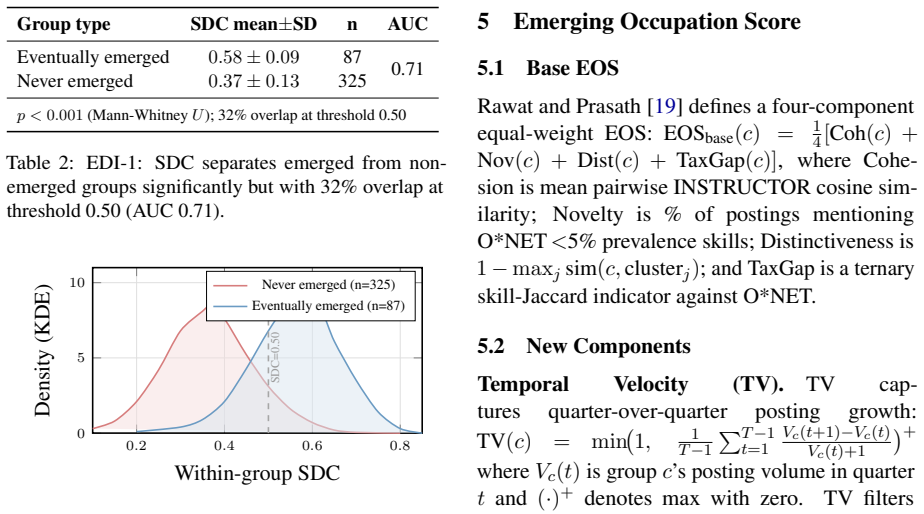
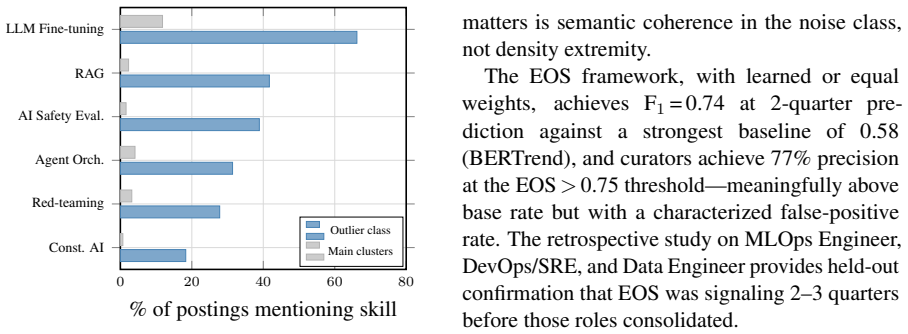
The Emergence-Density Inversion hypothesis claims that low-density postings in evolving labor markets represent occupational novelty. Analysis of 84,988 job postings reveals high-EOS outlier groups transition to stable clusters in 1.4 +/- 0.6 quarters versus 4.1 +/- 1.2 for low-EOS groups. The extended EOS with Temporal Velocity and Cross-Platform Convergence improves 2-quarter prediction F1 from 0.61 to 0.74 and shows 2-3 quarter lead time in retrospective validation on established roles.
What carries the argument
The Emerging Occupation Score (EOS) that identifies which density-based outliers are likely to represent emerging occupations, augmented with Temporal Velocity and Cross-Platform Convergence metrics.
If this is right
- High-EOS outlier groups transition to stable clusters in significantly fewer quarters than low-EOS groups.
- The extended EOS outperforms Isolation Forest, LOF, GLOSH, and BERTrend in predicting cluster formation.
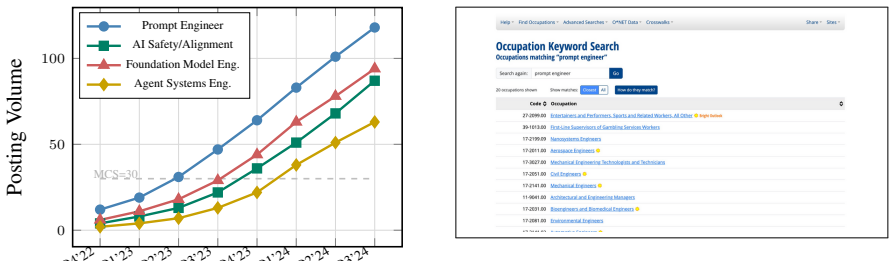
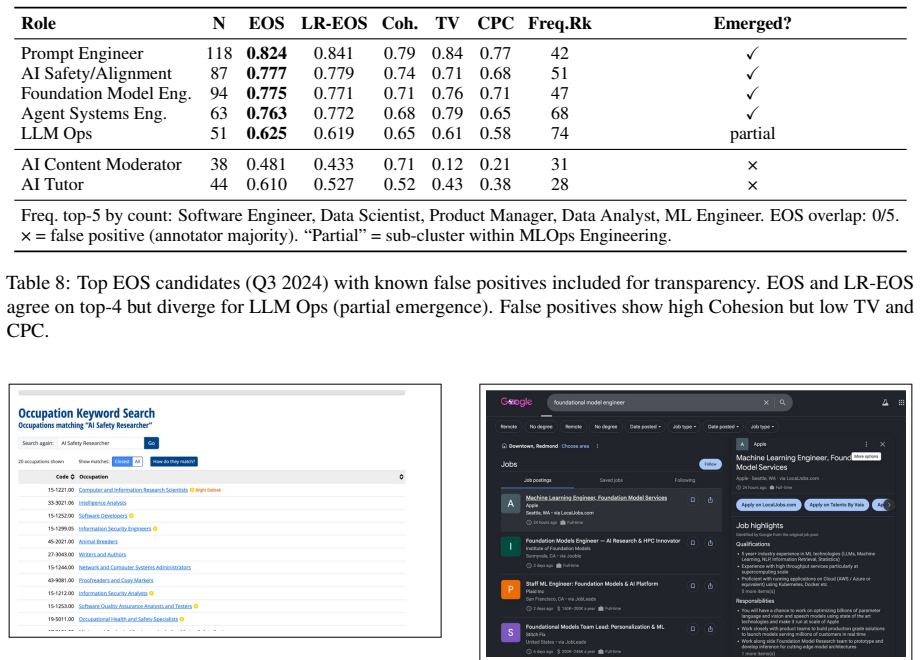
- Prompt Engineer, AI Safety Researcher, Foundation Model Engineer, and Agent Systems Engineer rank among the top emerging occupations in Q3 2024 and form clusters by Q1 2025.
- An annotator panel rates high-EOS items as coherent emerging occupations with 77% precision.
Where Pith is reading between the lines
- If the hypothesis holds, platforms could monitor noise clusters to anticipate skill demands before they appear in official taxonomies.
- The approach may extend to detecting emerging topics in other noisy text corpora such as social media or patent filings.
- The 19% failure cases point to the need for additional filters to distinguish novelty from low-quality postings.
Load-bearing premise
Postings grouped as noise by density-based methods mainly capture genuine new occupational concepts rather than incoherent or low-quality text.
What would settle it
Collecting a fresh dataset of job postings and finding that high-EOS outliers do not form stable clusters within approximately two quarters would disprove the leading indicator claim.
Figures
read the original abstract
Standard NLP pipelines for occupational clustering discard the 10-15% of job postings that density-based methods assign to noise. We argue this is an error: in rapidly evolving domains, low posting density signals novelty, not incoherence. We formalize this as the Emergence-Density Inversion (EDI) hypothesis and test it longitudinally on 84,988 job postings across eight quarters (Q4 2022-Q3 2024). EDI is partially confirmed: high-EOS outlier groups transition to stable clusters in 1.4 +/- 0.6 quarters vs. 4.1 +/- 1.2 for low-EOS groups (p < 0.001), though the signal fails in approximately 19% of cases, which we characterize as a failure analysis. We extend the Emerging Occupation Score (EOS) with Temporal Velocity and Cross-Platform Convergence, improving 2-quarter cluster-formation prediction from F1 = 0.61 to 0.74, outperforming Isolation Forest, LOF, GLOSH, and BERTrend baselines. A retrospective study on three now-established roles (MLOps Engineer, DevOps/SRE, Data Engineer) confirms EOS signalled 2-3 quarters before cluster formation, providing held-out validation. A held-out annotator panel (kappa = 0.74) rates EOS > 0.75 as coherent emerging occupations with 77% precision. Prompt Engineer, AI Safety Researcher, Foundation Model Engineer, and Agent Systems Engineer, all absent from O*NET, are top-4 in Q3 2024 and form stable clusters by Q1 2025.
Editorial analysis
A structured set of objections, weighed in public.
Referee Report
Summary. The paper proposes the Emergence-Density Inversion (EDI) hypothesis that job postings assigned to noise by density-based clustering in labor-market text primarily reflect occupational novelty rather than incoherence. On a corpus of 84,988 postings (Q4 2022–Q3 2024), it defines an Emerging Occupation Score (EOS), shows that high-EOS outlier groups form stable clusters in 1.4 ± 0.6 quarters versus 4.1 ± 1.2 for low-EOS groups (p < 0.001), extends EOS with Temporal Velocity and Cross-Platform Convergence to raise 2-quarter cluster-formation F1 from 0.61 to 0.74 (outperforming Isolation Forest, LOF, GLOSH, and BERTrend), and supplies retrospective validation on MLOps Engineer, DevOps/SRE, and Data Engineer plus a held-out annotator panel (κ = 0.74, 77 % precision at EOS > 0.75).
Significance. If the central claim holds, the work supplies a practical early-warning signal for occupational emergence that could inform labor-market monitoring and dynamic taxonomy construction. Strengths include the longitudinal design spanning eight quarters, the held-out annotator validation, the retrospective check on three now-established roles, and explicit baseline comparisons. The 19 % failure analysis is also a positive step toward characterizing limitations.
major comments (3)
- [Methods / Results] The manuscript reports statistically significant transition-time differences and F1 improvements but supplies no equations or pseudocode for the base EOS, its threshold of 0.75, or the cluster-stability criterion used to mark “formation.” These definitions are load-bearing for every quantitative claim (abstract and §4).
- [Experiments] No implementation details, hyper-parameter settings, or code for the four baselines (Isolation Forest, LOF, GLOSH, BERTrend) are provided, nor is any ablation that isolates the contribution of Temporal Velocity versus Cross-Platform Convergence. This prevents verification of the reported F1 lift from 0.61 to 0.74.
- [Discussion / Failure Analysis] The core EDI premise—that density-based noise primarily indexes genuine novelty—is tested only via annotator ratings and retrospective cases. The paper does not report lexical-novelty, text-quality, or posting-volume metrics contrasting high-EOS versus low-EOS noise groups, leaving open the possibility that the 1.4-quarter signal partly reflects volume fluctuations or domain-specific jargon rather than emergence.
minor comments (1)
- [Abstract] The abstract states “Prompt Engineer, AI Safety Researcher, Foundation Model Engineer, and Agent Systems Engineer … form stable clusters by Q1 2025,” but the manuscript does not indicate whether this is a prediction or an observation within the study window.
Simulated Author's Rebuttal
We thank the referee for the constructive feedback. We address each major comment below and will revise the manuscript to improve clarity, reproducibility, and validation.
read point-by-point responses
-
Referee: [Methods / Results] The manuscript reports statistically significant transition-time differences and F1 improvements but supplies no equations or pseudocode for the base EOS, its threshold of 0.75, or the cluster-stability criterion used to mark “formation.” These definitions are load-bearing for every quantitative claim (abstract and §4).
Authors: We agree these definitions are essential. In the revised manuscript we will add the full mathematical definition of the base Emerging Occupation Score (EOS), pseudocode for its computation, the empirical rationale and sensitivity analysis for the 0.75 threshold (derived from the annotator panel), and the precise operational definition of cluster formation (minimum posting count and density threshold sustained across consecutive quarters). These will appear in Sections 3 and 4. revision: yes
-
Referee: [Experiments] No implementation details, hyper-parameter settings, or code for the four baselines (Isolation Forest, LOF, GLOSH, BERTrend) are provided, nor is any ablation that isolates the contribution of Temporal Velocity versus Cross-Platform Convergence. This prevents verification of the reported F1 lift from 0.61 to 0.74.
Authors: We acknowledge the omission. The revision will include all hyper-parameter values, preprocessing steps, and experimental configuration for the four baselines. We will also add an ablation table isolating the incremental contribution of Temporal Velocity and Cross-Platform Convergence to the F1 gain. Code and replication scripts will be released upon acceptance. revision: yes
-
Referee: [Discussion / Failure Analysis] The core EDI premise—that density-based noise primarily indexes genuine novelty—is tested only via annotator ratings and retrospective cases. The paper does not report lexical-novelty, text-quality, or posting-volume metrics contrasting high-EOS versus low-EOS noise groups, leaving open the possibility that the 1.4-quarter signal partly reflects volume fluctuations or domain-specific jargon rather than emergence.
Authors: The primary evidence rests on the held-out annotator panel (κ = 0.74, 77 % precision) and the three retrospective cases. To further address potential confounds we will add, in the revision, comparative statistics on lexical novelty (new n-gram frequency), average posting length as a text-quality proxy, and normalized posting volume between high-EOS and low-EOS noise groups. This will strengthen the failure analysis section. revision: yes
Circularity Check
No significant circularity detected
full rationale
The paper tests the EDI hypothesis via longitudinal tracking of outlier groups across eight quarters, with explicit held-out elements including a retrospective study on three established roles (showing 2-3 quarter lead time) and an annotator panel (kappa=0.74, 77% precision at EOS>0.75). The F1 lift from 0.61 to 0.74 is presented as the result of adding Temporal Velocity and Cross-Platform Convergence features to EOS, not as a self-referential fit. No equations, definitions, or steps in the provided text reduce any claimed prediction or result to its inputs by construction, nor are there load-bearing self-citations or uniqueness claims. The derivation remains self-contained against external benchmarks such as O*NET and the failure analysis.
Axiom & Free-Parameter Ledger
free parameters (2)
- EOS threshold =
0.75
- Prediction horizon
axioms (1)
- domain assumption Low posting density under density-based clustering signals occupational novelty rather than incoherence in rapidly evolving domains (Emergence-Density Inversion hypothesis)
Reference graph
Works this paper leans on
-
[1]
and Levy, Frank and Murnane, Richard J
David H. Autor, Frank Levy, and Richard J. Mur- nane. 2003. The skill content of recent tech- nological change.Quarterly Journal of Eco- nomics, 118(4):1279–1333. https://doi.org/ 10.1162/003355303322552801
-
[2]
Allaa Boutaleb, J´erˆome Picault, and Guillaume Gros- jean. 2024. BERTrend: Neural topic modeling for emerging trends detection. InProceedings of Fu- tureD @ EMNLP 2024
2024
-
[3]
Breunig, Hans-Peter Kriegel, Raymond T
Markus M. Breunig, Hans-Peter Kriegel, Raymond T. Ng, and J ¨org Sander. 2000. LOF: Identifying density-based local outliers. InProceedings of ACM SIGMOD 2000, pp. 93–104. https://doi.org/ 10.1145/335191.335388
-
[4]
Jens-Joris Decorte, Jeroen Van Hautte, Thomas Demeester, and Chris Develder. 2021. Job- BERT: Understanding job titles through job descrip- tions.arXiv preprint arXiv:2109.09605. https: //arxiv.org/abs/2109.09605
arXiv 2021
-
[5]
Jacob Devlin, Ming-Wei Chang, Kenton Lee, and Kristina Toutanova. 2019. BERT: Pre-training of deep bidirectional transformers for language understanding. InProceedings of NAACL-HLT 2019, pp. 4171–4186. https://doi.org/10. 18653/v1/N19-1423
2019
-
[6]
European Commission. 2017. ESCO: European Skills, Competences, Qualifications and Occupations (v1)
2017
-
[7]
Kushankur Ghosh, Murilo Coelho Naldi, J ¨org Sander, and Euijin Choo. 2024. Unsuper- vised parameter-free outlier detection using HDB- SCAN* outlier profiles. InIEEE BigData 2024, pp. 7021–7030. https://doi.org/10.1109/ BigData62323.2024.10825530
arXiv 2024
-
[8]
Lorena Gonz´alez-Garc´ıa, Miguel-Angel Sicilia, and Elena Garc´ıa-Barriocanal. 2025. Classification of job offers into job positions using O*NET and BERT. Computers, Materials & Continua, 86(2)
2025
-
[9]
Amirhossein Herandi, Yitao Li, Zhanlin Liu, Ximin Hu, and Xiao Cai. 2024. Skill-LLM: Repur- posing general-purpose LLMs for skill extrac- tion.arXiv preprint arXiv:2410.12052. https: //arxiv.org/abs/2410.12052
arXiv 2024
-
[10]
Brad Hershbein and Lisa B. Kahn. 2018. Do recessions accelerate routine-biased techno- logical change?American Economic Re- view, 108(7):1737–1772. https://doi.org/ 10.1257/aer.20151232
-
[11]
Esposito, Paul Groth, Jonathan Sitruk, Balazs Szatmari, and Nachoem Wijnberg
Xue Li, Ciro D. Esposito, Paul Groth, Jonathan Sitruk, Balazs Szatmari, and Nachoem Wijnberg
-
[12]
Evaluation of unsupervised static topic mod- els’ emergence detection ability.PeerJ Computer Science
-
[13]
2025.AI and the Labor Market: Occu- pational Transformation in 2024–2025
Lightcast. 2025.AI and the Labor Market: Occu- pational Transformation in 2024–2025. Lightcast Research Report
2025
-
[14]
Fei Tony Liu, Kai Ming Ting, and Zhi-Hua Zhou
-
[15]
Isolation forest. InProceedings of IEEE ICDM 2008, pp. 413–422. https://doi.org/ 10.1109/ICDM.2008.17
-
[16]
Leland McInnes, John Healy, and Steve As- tels. 2017. HDBSCAN: Hierarchical density based clustering.Journal of Open Source Software, 2(11):205. https://doi.org/10. 21105/joss.00205
2017
-
[17]
Leland McInnes and John Healy. 2018. UMAP: Uniform manifold approximation and projec- tion.arXiv preprint arXiv:1802.03426. https: //arxiv.org/abs/1802.03426
Pith/arXiv arXiv 2018
-
[18]
David Nordfors. 2026. NLP occupational emer- gence analysis: How occupations form and evolve in real time.arXiv preprint arXiv:2603.15998. https: //arxiv.org/abs/2603.15998
arXiv 2026
-
[19]
OECD. 2025. Bridging the AI skills gap: Is training keeping up? OECD Publishing, Paris
2025
-
[20]
O*NET OnLine
National Center for O*NET Development. O*NET OnLine. U.S. Department of Labor, Employment and Training Administration
-
[21]
Shreyash Rawat and V . B. Surya Prasath. 2026. Be- yond job titles: Unsupervised discovery of occupa- tional structures from job descriptions using semantic embeddings and density-based clustering.Under re- view
2026
-
[22]
Elena Senger, Mike Zhang, Rob van der Goot, and Barbara Plank. 2024. Deep learning-based computational job market analysis: A survey on skill extraction and classification from job post- ings.arXiv preprint arXiv:2402.05617. https: //arxiv.org/abs/2402.05617
arXiv 2024
-
[23]
Hongjin Su et al. 2022. One embedder, any task: Instruction-finetuned text embed- dings.arXiv preprint arXiv:2212.09741. https://arxiv.org/abs/2212.09741
arXiv 2022
-
[24]
Bledi Taska et al. 2021. The demand for AI skills in the labor market.Labour Economics, 71:102002. https://doi.org/10. 1016/j.labeco.2021.102002
arXiv 2021
-
[25]
An Vu and Jonas Oppenlaender. 2026. Prompt en- gineer: Analyzing hard and soft skill requirements in the AI job market.arXiv preprint arXiv:2506.00058. https://arxiv.org/abs/2506.00058
arXiv 2026
-
[26]
Reihaneh Yazdanian et al. 2021. On the radar: Pre- dicting near-future surges in skills’ hiring demand. Computers and Education: Artificial Intelligence, 100043
2021
discussion (0)
Sign in with ORCID, Apple, or X to comment. Anyone can read and Pith papers without signing in.