REVIEW 4 major objections 5 minor 117 references
Market Making Strategies with Reinforcement Learning
T0 review · 4 major / 5 minor · reviewed 2026-08-15 · deepseek-v4-flash
Pith's one-line read The paper claims that deep reinforcement-learning market makers, trained with dynamic inventory penalties and a Pareto-front multi-objective objective, beat random and persistent baseline agents on average mark-to-market in a simulated…
desk verdict A well-structured RL market-making thesis with three genuinely new components, but the headline outperformance claim rests on a simulator where zero fees and greedy spread-routing make undercutting trivially profitable against weak baselines. read the letter →
The pith
A machine-rendered reading of the paper's core claim, the machinery that carries it, and where it could break.
The reading
What carries the argument
The machinery is a deep Q-network with a discretized three-lever action space: at each step the agent chooses a buy-spread multiplier, a sell-spread multiplier, and a hedging fraction over a fixed grid. The thesis wraps this agent in three progressively stronger controllers: a reward term that penalizes inventory outside a dynamic threshold set by cash and recent mid-price; a multi-objective version with two independent DQN blocks whose weighted Q-values are used for action selection and whose undominated policies form a Pareto front; and a policy-weighting layer (POW-dTS) that draws a policy from a pretrained library according to discounted Thompson sampling, so the active policy mixture follows changing market conditions. The mechanism carries the argument by making the learning objective explicit and tunable: a higher alpha means stricter inventory control, the utility weight chooses a point on the Pareto front, and the Thompson-sampling discount favors policies that have earned recent reward.
What would settle it
Run the trained policies in a simulator variant where investor orders are split stochastically among market makers, or where a small transaction fee is charged, and measure average end-of-session mark-to-market; the central claim fails if the RL agents no longer beat the random and persistent baselines in that setting.
Extended reading notes
Core claim
The central claim is that a DQN-based market maker operating in a simulated order-book market can learn to out-trade simple baselines: in single-agent and multi-agent competitions, the learned agent ends with positive average mark-to-market while random and persistent agents end negative. The thesis further claims that inventory can be managed without sacrificing profitability by making the penalty dynamic; two coefficients, the Alpha Inventory Impact Factor and the Dynamic Inventory Threshold Factor, set a time-varying inventory threshold based on cash and recent mid-prices. The M3ORL variant replaces the scalar reward with two Q-networks, one for mark-to-market and one for inventory, selected via a utility weight, producing a Pareto front of undominated policies and beating the reward-engineered version on multi-objective metrics. Finally, POW-dTS, which combines pretrained policies with discounted Thompson sampling, is claimed to outperform single-policy retraining and continual-learning baselines in non-stationary market scenarios.
Load-bearing premise
The load-bearing premise is that investor orders always match the market maker with the narrowest spread and that trades carry zero fees; if real order routing is less price-focused or fees matter, the learned policies' edge in the simulated tournament may not transfer.
Editorial extensions
If this is right
- A sweep over the inventory-penalty coefficient AIIF yields a family of market makers with different risk profiles, so an operator can select the desired spread aggressiveness without retraining from scratch.
- Because the multi-objective agent stores each objective in its own Q-network, the learned value estimates remain usable when the operator later changes the trade-off weight, letting one training run serve many utility preferences.
- Discounted Thompson sampling provides a continual-adaptation layer that can be applied on top of any library of pretrained policies, not only the Pareto-front agents trained here.
- The learned policies converge to a recognizable pattern, with buy and sell spreads slightly tighter than market and about 20 percent of inventory hedged per step, suggesting the RL agent discovers a simple interpretable market-making rule in this environment.
- If the claims transfer out of simulation, trading desks could replace hand-tuned spread and inventory rules with agents that tune themselves to each market regime.
Reading between the lines
- The zero-fee, narrowest-spread routing rule makes the experiment a pure spread tournament; a natural next test is to add a per-trade fee or queue-position priority and see how much of the measured margin survives.
- The dynamic penalty logic could be made volatility-adaptive by letting the risk coefficient track realized volatility; the thesis lists this as future work, so it is a testable extension rather than a claim.
- POW-dTS is a general recipe for non-stationary RL: any domain that can supply a handful of pretrained policies could use the same discounted Thompson-sampling selector, for example robotics or recommendation systems.
- The Pareto-front agent implies that inventory risk and profit are separable enough for an operator to choose a target point on the front; an empirical test would compare the front's best policy for a given utility against a scalarized agent tuned to that same utility.
Signed reviews
Editorial analysis
A structured set of objections, weighed in public.
Referee Report
Summary. This PhD thesis develops and evaluates reinforcement-learning (RL) market making agents in the ABIDES simulated market. Chapter 3 formulates market making as a deep Q-learning task with discrete buy, sell, and hedging actions, and studies single-agent, multi-agent, and direct-transfer scenarios. Chapter 4 addresses inventory management in two ways: a reward-engineered dynamic penalty called RIM with the AIIF and DITF coefficients, and a multi-objective agent called M3ORL that maintains separate Q-functions for mark-to-market and inventory objectives and uses Pareto-front tools. Chapter 5 introduces POW-dTS, a discounted-Thompson-sampling policy weighting method intended to adapt to non-stationary market regimes, and compares it with continual-learning baselines. The abstract's central claim is that the proposed RL-based approaches significantly outperform traditional and baseline algorithmic strategies across various performance metrics.
Significance. If the claims are taken in their stated breadth, the thesis would contribute useful techniques for RL market making: a dynamic inventory penalty that adapts to the agent's cash-to-inventory ratio, a Pareto-front multi-objective formulation with separate Q-networks, and a Thompson-sampling mechanism for combining pretrained policies. The experimental work is careful in several respects: most setups use 250 simulations, results are reported with rolling averages and standard deviations, multiple metrics are tracked (MtM, inventory, cash/inventory ratio, hypervolume, sparsity), and Chapter 5 includes an ablation study. The SHAP analysis and the reported evolution of buy/sell/hedge epsilons also provide useful interpretability. The main weakness is external validity: because the simulated investors always route to the narrowest spread and transaction fees are zero, the market making task reduces to a zero-sum spread competition, and the only baselines are a random and a persistent market maker. No classical market-making algorithm is implemented, so the abstract's phrase 'traditional and baseline algorithmic strategies' overstates what is actually tested.
major comments (4)
- [Abstract; Section 3.3.1; Section 4.1.2] The abstract claims that the proposed RL approaches 'significantly outperform traditional and baseline algorithmic strategies,' but the experiments only compare against a Random-MM and a Persistent-MM. No classical market-making strategy such as Avellaneda-Stoikov or a spread-based heuristic is implemented. Moreover, Section 3.3.1 states that the 50 investor agents always match with the MM offering the narrowest spread and that transaction fees are not considered; Section 4.1.2 repeats this design. Under these assumptions the market making problem is a pure zero-sum spread competition in which the dominant strategy is to undercut the spread, which is exactly what the DQL-MM learns (buy and sell epsilons converge near -0.2 to -0.4). The headline claim should be scoped to this simulated setting, or the experiments should include a classical baseline and variants with fees and non-greedy investor routing.
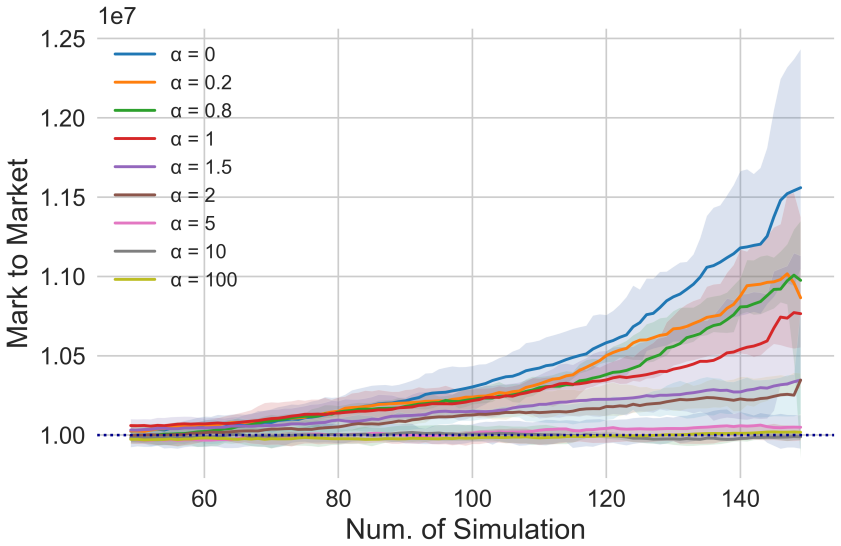
- [Section 4.1.2; Table 4.2; Table 4.3] The paper selects AIIF=0.2 as the best-performing reward configuration after testing ten AIIF values, but no multiple-comparison correction or pre-specified selection rule is reported. Given the reported standard deviations (for example, AIIF=0.2 gives MtM 12,833 ± 66 while AsymDamp gives 11,672 ± 162 over the tested sessions), the differences among the top configurations may not be statistically significant. The word 'significantly' in the abstract is not supported by significance tests. The authors should either provide paired hypothesis tests with an appropriate correction for the multiple AIIF values, or explicitly frame the comparison as exploratory.
- [Section 4.2.1; Eq. (4.19); Algorithm 3] The text states that alpha in R2(s,a) is only a scaling factor for the weight w and that it does not affect learning or agent performance. This is not justified by the equations as written: R2 enters the TD target for Q2, so different alpha values produce differently scaled Q2 estimates, and the greedy action selection argmax(w*Q1 + (1-w)*Q2) then changes the effective trade-off between the two objectives. If the Pareto-front results are robust to alpha, the authors should demonstrate this by showing that w is adjusted inversely with alpha or that Q-values are normalized before combination; otherwise the reported fronts and comparisons may depend on an arbitrarily chosen constant.
- [Section 5.4; Figure 5.9] The POW-dTS algorithm introduces hyperparameters alpha_inc, beta_inc, and gamma, and the experiments appear to use a single configuration (e.g., alpha_inc=1, beta_inc=1, gamma=0.4). No sensitivity analysis for these hyperparameters is reported, so the claimed advantage over continual-learning baselines may be specific to this hand-chosen setting. At minimum, the authors should report a small sensitivity study or justify the chosen values from the ablation.
minor comments (5)
- [Section 2.1.1] The heading 'Markov decission process' contains a typo; it should be 'Markov decision process'.
- [Section 4.2.1] The subsection title 'Multi-objetive RL MM: M3ORL' contains a typo; it should be 'Multi-objective RL MM: M3ORL'.
- [Definition 2, Section 4.1.1] The coefficient is written as 'Alfa Inventory Impact Factor' in Definition 2 but as 'Alpha' elsewhere; the spelling should be consistent.
- [Table 4.2] The table header and footnote notation (e.g., 'Experiment Avg 1 σ2 Var3') is difficult to parse, and the commas in values such as '413,121,21' appear to be formatting artifacts. Please reformat the table for readability.
- [General] The thesis is a compilation of published and submitted papers, but the chapters do not indicate which parts correspond to which source paper. A short note at the start of each chapter would help the reader understand the provenance and the amount of new material added.
Circularity Check
No significant circularity: the RL-vs-baseline comparisons are external, and the self-citations are not load-bearing.
full rationale
The thesis's central empirical claim is that the proposed RL market makers outperform baseline agents in the ABIDES simulator. The baselines (Random-MM, Persistent-MM) are independent agents with the same action space, and the comparison metrics (MtM, inventory, cash/inventory ratio) are not used to construct the RL policies. The AIIF and DITF coefficients are hand-set or selected by sweeping over values, and the paper does not present the sweep as a prediction; the best AIIF=0.2 is reported as an experimental comparison among trained variants. The state/action spaces and reward functions are taken from the author's prior work and from Ganesh et al., but those citations are used for design continuity, not as the evidence for the reported outperformance; the experiments are reproduced in the thesis. The investor-routing rule (narrowest spread, zero fees) is an explicit simulation assumption, not an equation that makes the RL result true by definition; it makes the setting favorable to undercutting, which is a validity concern, not circularity. The word 'traditional' in the abstract is not supported by the baselines, since no classical market-making algorithm is included, but this is a comparison-design gap rather than a circular derivation. No step was found where a fitted parameter is renamed as a prediction or where a uniqueness claim is imported from the authors' prior work.
Assumptions & free parameters
free parameters (4)
- AIIF (Alpha Inventory Impact Factor) =
0.2 (chosen as best of {0, 0.2, 0.5, 0.8, 1, 1.5, 2, 5, 10, 100})
- DITF (Dynamic Inventory Threshold Factor) =
0.5
- alpha in M3ORL R2 reward =
5
- POW-dTS hyperparameters (alpha_inc, beta_inc, gamma) =
e.g., 1, 1, 0.4 in one shown experiment (Section 5.4.3)
assumptions (4)
- standard math Bellman optimality and DQN convergence in the simulated environment
- domain assumption ABIDES configured with 100 noise, 10 value, 10 momentum, and 1 POV agent approximates a standard financial market
- domain assumption Investor agents always trade at the narrowest MM spread and transaction fees are zero
- domain assumption The 8 or 10 state features are Markov-sufficient for the market making task
Cite this review
Pith. "Pith review of Market Making Strategies with Reinforcement Learning." pith.science (2026). https://pith.science/paper/WYVJVZRN
@misc{pith2026250718680,
  author       = {Pith},
  title        = {Pith review of: Market Making Strategies with Reinforcement Learning},
  year         = {2026},
  howpublished = {\url{https://pith.science/paper/WYVJVZRN}},
  note         = {Machine review of arXiv:2507.18680}
}
read the original abstract
This thesis presents the results of a comprehensive research project focused on applying Reinforcement Learning (RL) to the problem of market making in financial markets. Market makers (MMs) play a fundamental role in providing liquidity, yet face significant challenges arising from inventory risk, competition, and non-stationary market dynamics. This research explores how RL, particularly Deep Reinforcement Learning (DRL), can be employed to develop autonomous, adaptive, and profitable market making strategies. The study begins by formulating the MM task as a reinforcement learning problem, designing agents capable of operating in both single-agent and multi-agent settings within a simulated financial environment. It then addresses the complex issue of inventory management using two complementary approaches: reward engineering and Multi-Objective Reinforcement Learning (MORL). While the former uses dynamic reward shaping to guide behavior, the latter leverages Pareto front optimization to explicitly balance competing objectives. To address the problem of non-stationarity, the research introduces POW-dTS, a novel policy weighting algorithm based on Discounted Thompson Sampling. This method allows agents to dynamically select and combine pretrained policies, enabling continual adaptation to shifting market conditions. The experimental results demonstrate that the proposed RL-based approaches significantly outperform traditional and baseline algorithmic strategies across various performance metrics. Overall, this research thesis contributes new methodologies and insights for the design of robust, efficient, and adaptive market making agents, reinforcing the potential of RL to transform algorithmic trading in complex financial systems.
Figures


Figures from the paper (104 more)






Reference graph
Works this paper leans on
-
[1]
Electronic trading in financial markets,
T. Hendershott, “Electronic trading in financial markets,”IT Professional Maga- zine, vol. 5, no. 4, p. 10, 2003
2003
-
[2]
A simple approach to arbitrage pricing theory,
G. Huberman, “A simple approach to arbitrage pricing theory,” inTheory of Val- uation, World Scientific, 2005, pp. 289–308.doi:10.1142/9789812701022_ 0009
-
[3]
T. Chordia, A. Goyal, B. N. Lehmann, and G. Saar, “High-frequency trading,” SSRN Electronic Journal, 2013.doi:10.2139/ssrn.2278347
-
[4]
Market making and mean reversion,
T. Chakraborty and M. Kearns, “Market making and mean reversion,” 2011, pp. 307– 313.doi:10.1145/1993574.1993622
-
[5]
market makers,https : / / web
AlphaTrade,List of u.s. market makers,https : / / web . archive . org / web / 20090122074413/http://www.alphatrade.com/techSupport/marketMakers. html, Archived from the original on 2009-01-22. Retrieved 2008-10-31
2009
-
[6]
alphatrade
AlphaTrade,List of market makers in canada,https://web.archive.org/ web / 20070109084732 / http : / / www . alphatrade . com / techSupport / canadianIDs.html, Archived from the original on 2007-01-09. Retrieved 2008- 10-31
2007
-
[7]
Information effects on the bid-ask spread,
T. E. Copeland and D. Galai, “Information effects on the bid-ask spread,”The Journal of Finance, vol. 38, no. 5, pp. 1457–1469, 1983.doi:10.1111/j.1540- 6261.1983.tb03834.x
arXiv 1983
-
[8]
R. S. Sutton and A. G. Barto,Reinforcement Learning: An Introduction, Second. Cambridge: The MIT Press, 2018
2018
Show all 117 references
-
[9]
Can alphago be apt subjects for praise/blame for
M. Hussain, “Can alphago be apt subjects for praise/blame for "move 37"?” In Proceedings of the 2023 AAAI/ACM Conference on AI, Ethics, and Society, ser. AIES ’23, Montreal, Canada: Association for Computing Machinery, 2023, pp. 977– 979.doi:10 . 1145 / 3600211 . 3604730[Onlin...
2023
-
[10]
Learning from delayed rewards,
C. Watkins, “Learning from delayed rewards,” Ph.D. dissertation, King’s College, Cambridge, UK, 1989
1989
-
[11]
Revisiting fundamentals of experience replay,
W. Fedus et al., “Revisiting fundamentals of experience replay,” inProceedings of the 37th International Conference on Machine Learning, H. D. III and A. Singh, Eds., ser. Proceedings of Machine Learning Research, vol. 119, PMLR, 2020, pp. 3061–3071. [Online]. Available:https ...
2020
-
[12]
Peeking inside the black-box: A survey on explainable artificial intelligence (xai),
A. Adadi and M. Berrada, “Peeking inside the black-box: A survey on explainable artificial intelligence (xai),”IEEE Access, vol. 6, pp. 52 138–52 160, 2018.doi: 10.1109/ACCESS.2018.2870052
2018
-
[13]
Simple statistical gradient-following algorithms for connectionist reinforcement learning,
R. J. Williams, “Simple statistical gradient-following algorithms for connectionist reinforcement learning,”Machine Learning, vol. 8, pp. 229–256, 1992
1992
-
[14]
Soft actor-critic: Off-policy maximum entropy deep reinforcement learning with a stochastic actor,
T. Haarnoja, A. Zhou, P. Abbeel, and S. Levine, “Soft actor-critic: Off-policy maximum entropy deep reinforcement learning with a stochastic actor,” inIn- ternational conference on machine learning, PMLR, 2018, pp. 1861–1870
2018
-
[15]
Proximal policy optimization algorithms,
J. Schulman, F. Wolski, P. Dhariwal, A. Radford, and O. Klimov, “Proximal policy optimization algorithms,”CoRR, vol. abs/1707.06347, 2017. arXiv:1707.06347. [Online]. Available:http://arxiv.org/abs/1707.06347
2017 arXiv
-
[16]
A survey of monte carlo tree search methods,
C. B. Browne et al., “A survey of monte carlo tree search methods,”IEEE Trans- actions on Computational Intelligence and AI in games, vol. 4, no. 1, pp. 1–43, 2012
2012
-
[17]
Human-level control through deep reinforcement learning,
V . Mnih et al., “Human-level control through deep reinforcement learning,”Na- ture, vol. 518, pp. 529–533, 7540 Feb. 2015.doi:10.1038/nature14236
2015 doi
-
[18]
A survey of multi- objective sequential decision-making,
D. M. Roijers, P. Vamplew, S. Whiteson, and R. Dazeley, “A survey of multi- objective sequential decision-making,”Journal of Artificial Intelligence Research, vol. 48, pp. 67–113, 2013
2013
-
[19]
Jin,Multi-objective machine learning
Y . Jin,Multi-objective machine learning. Springer Science & Business Media, 2006, vol. 16
2006
-
[20]
Multi-objective optimization,
K. Deb, K. Sindhya, and J. Hakanen, “Multi-objective optimization,” inDecision sciences, CRC Press, 2016, pp. 161–200
2016
-
[21]
A multi-objective deep reinforcement learning framework,
T. T. Nguyen, N. D. Nguyen, P. Vamplew, S. Nahavandi, R. Dazeley, and C. P. Lim, “A multi-objective deep reinforcement learning framework,”Engineering Applications of Artificial Intelligence, vol. 96, p. 103 915, 2020
2020
-
[22]
Multi-objective reinforcement learning using sets of pareto dominating policies,
K. Van Moffaert and A. Nowé, “Multi-objective reinforcement learning using sets of pareto dominating policies,”The Journal of Machine Learning Research, vol. 15, no. 1, pp. 3483–3512, 2014
2014
-
[23]
A practical guide to multi-objective reinforcement learning and planning,
C. F. Hayes et al., “A practical guide to multi-objective reinforcement learning and planning,”Autonomous Agents and Multi-Agent Systems, vol. 36, no. 1, p. 26, Apr. 2022.doi:10.1007/s10458-022-09552-y[Online]. Available:https: //doi.org/10.1007/s10458-022-09552-y
2022 doi
-
[24]
Reinforcement learning and the reward engineering principle,
D. Dewey, “Reinforcement learning and the reward engineering principle,” in 2014 AAAI Spring Symposium Series, 2014. [Online]. Available:https://aaai. org/papers/07704-7704-reinforcement-learning-and-the-reward- engineering-principle/ 131
2014
-
[25]
Reward function design in reinforcement learning,
J. Eschmann, “Reward function design in reinforcement learning,” inReinforce- ment Learning Algorithms: Analysis and Applications. Cham: Springer Interna- tional Publishing, 2021, pp. 25–33.doi:10 . 1007 / 978 - 3 - 030 - 41188 - 6 _ 3 [Online]. Available:https://doi.org/10.10...
2021 doi
-
[26]
Scalar reward is not enough: A response to silver, singh, pre- cup and sutton (2021),
P. Vamplew et al., “Scalar reward is not enough: A response to silver, singh, pre- cup and sutton (2021),”Autonomous Agents and Multi-Agent Systems, vol. 36, no. 2, p. 41, 2022
2021
-
[27]
Incremental rein- forcement learning for multi-objective robotic tasks,
J. García, R. Iglesias, M. A. Rodríguez, and C. V . Regueiro, “Incremental rein- forcement learning for multi-objective robotic tasks,”Knowledge and Information Systems, vol. 51, pp. 911–940, 2017
2017
-
[28]
A dynamic penalty function approach for constraint-handling in reinforcement learning,
H. Yoo, V . M. Zavala, and J. H. Lee, “A dynamic penalty function approach for constraint-handling in reinforcement learning,”IFAC-PapersOnLine, vol. 54, no. 3, pp. 487–491, 2021, 16th IFAC Symposium on Advanced Control of Chem- ical Processes ADCHEM 2021.doi:https://doi.org/1...
2021 doi
-
[29]
A study of multiple reward function performances for vehicle collision avoidance systems applying the dqn algorithm in reinforcement learning,
N. J. Zakaria, M. I. Shapiai, and N. Wahid, “A study of multiple reward function performances for vehicle collision avoidance systems applying the dqn algorithm in reinforcement learning,”IOP Conference Series: Materials Science and Engi- neering, vol. 1176, no. 1, p. 012 033,...
2021 doi
-
[30]
Learning adversarial attack policies through multi-objective reinforcement learning,
J. García, R. Majadas, and F. Fernández, “Learning adversarial attack policies through multi-objective reinforcement learning,”Engineering Applications of Ar- tificial Intelligence, vol. 96, p. 104 021, 2020.doi:10.1016/j.engappai.2020. 104021[Online]. Available:https://www.sc...
2020 doi
-
[31]
Pareto multi objective optimization,
P. Ngatchou, A. Zarei, and A. El-Sharkawi, “Pareto multi objective optimization,” inProceedings of the 13th international conference on, intelligent systems appli- cation to power systems, IEEE, 2005, pp. 84–91.doi:10 . 1109 / ISAP . 2005 . 1599231
2005
-
[32]
An evolutionary multi-objective optimization of market structures using pbil,
X. Li and A. Krause, “An evolutionary multi-objective optimization of market structures using pbil,” inIntelligent Data Engineering and Automated Learning – IDEAL 2010, C. Fyfe, P. Tino, D. Charles, C. Garcia-Osorio, and H. Yin, Eds., Berlin, Heidelberg: Springer Berlin Heidel...
2010
-
[33]
Pareto multi objective optimization,
P. Ngatchou, A. Zarei, and A. El-Sharkawi, “Pareto multi objective optimization,” inProceedings of the 13th International Conference on, Intelligent Systems Appli- cation to Power Systems, 2005, pp. 84–91.doi:10.1109/ISAP.2005.1599245 132
2005
-
[34]
Sampling reference points on the pareto fronts of benchmark multi-objective optimization problems,
Y . Tian, X. Xiang, X. Zhang, R. Cheng, and Y . Jin, “Sampling reference points on the pareto fronts of benchmark multi-objective optimization problems,” in2018 IEEE Congress on Evolutionary Computation (CEC), 2018, pp. 1–6.doi:10 . 1109/CEC.2018.8477730
2018
-
[35]
An easy-to-use real-world multi-objective opti- mization problem suite,
R. Tanabe and H. Ishibuchi, “An easy-to-use real-world multi-objective opti- mization problem suite,”Applied Soft Computing, vol. 89, p. 106 078, 2020.doi: https : / / doi . org / 10 . 1016 / j . asoc . 2020 . 106078[Online]. Available: https://www.sciencedirect.com/science/ar...
2020
-
[36]
A survey of reinforcement learning algorithms for dynamically varying environments,
S. Padakandla, “A survey of reinforcement learning algorithms for dynamically varying environments,”ACM Comput. Surv., vol. 54, no. 6, Jul. 2021.doi:10. 1145/3459991[Online]. Available:https://doi.org/10.1145/3459991
2021 doi
-
[37]
Addressing environment non-stationarity by repeat- ing q-learning updates,
S. Abdallah and M. Kaisers, “Addressing environment non-stationarity by repeat- ing q-learning updates,”Journal of Machine Learning Research, vol. 17, no. 46, pp. 1–31, 2016. [Online]. Available:http : / / jmlr . org / papers / v17 / 14 - 037.html
2016
-
[38]
Recursive adaptation of stepsize parameter for non-stationary environ- ments,
I. Noda, “Recursive adaptation of stepsize parameter for non-stationary environ- ments,” inPrinciples of Practice in Multi-Agent Systems, J.-J. Yang, M. Yokoo, T. Ito, Z. Jin, and P. Scerri, Eds., Berlin, Heidelberg: Springer Berlin Heidelberg, 2009, pp. 525–533.doi:https://do...
2009 doi
-
[39]
Adaptive stepsizes for recursive estimation with applications in approximate dynamic programming,
A. P. George and W. B. Powell, “Adaptive stepsizes for recursive estimation with applications in approximate dynamic programming,”Machine learning, vol. 65, pp. 167–198, 2006.doi:https://doi.org/10.1007/s10994-006-8365-9
2006 doi
-
[40]
Adaptive stock trad- ing strategies with deep reinforcement learning methods,
X. Wu, H. Chen, J. Wang, L. Troiano, V . Loia, and H. Fujita, “Adaptive stock trad- ing strategies with deep reinforcement learning methods,”Information Sciences, vol. 538, pp. 142–158, 2020.doi:https://doi.org/10.1016/j.ins.2020. 05.066[Online]. Available:https://www.scienced...
2020 doi
-
[42]
Sequential decision-making under non- stationary environments via sequential change-point detection,
E. Hadoux, A. Beynier, and P. Weng, “Sequential decision-making under non- stationary environments via sequential change-point detection,” inLearning over Multiple Contexts (LMCE), Nancy, France, Sep. 2014. [Online]. Available:https: //hal.science/hal-01200817 133
2014
-
[43]
Hidden-mode markov decision processes for nonstationary sequential decision making,
S. P. M. Choi, D.-Y . Yeung, and N. L. Zhang, “Hidden-mode markov decision processes for nonstationary sequential decision making,” inSequence Learning: Paradigms, Algorithms, and Applications, R. Sun and C. L. Giles, Eds. Berlin, Heidelberg: Springer Berlin Heidelberg, 2001, ...
2001 doi
-
[44]
Reinforcement learning in non-stationary environments,
S. Padakandla, P. K. J, and S. Bhatnagar, “Reinforcement learning in non-stationary environments,” May 2019.doi:10 . 1007 / s10489 - 020 - 01758 - 5[Online]. Available:http://arxiv.org/abs/1905.03970%20http://dx.doi.org/ 10.1007/s10489-020-01758-5
2019 arXiv
-
[45]
Change point de- tection for compositional multivariate data,
P. K. J., N. Singh, P. Dayama, A. Agarwal, and V . Pandit, “Change point de- tection for compositional multivariate data,”Applied Intelligence, vol. 52, no. 2, pp. 1930–1955, Jan. 2022.doi:10 . 1007 / s10489 - 021 - 02321 - 6[Online]. Available:https://doi.org/10.1007/s10489-0...
1930 doi
-
[46]
A continual learning survey: Defying forgetting in classifica- tion tasks,
M. D. Lange et al., “A continual learning survey: Defying forgetting in classifica- tion tasks,”IEEE Transactions on Pattern Analysis; Machine Intelligence, vol. 44, pp. 3366–3385, 07 Jul. 2022.doi:10.1109/TPAMI.2021.3057446
2022
-
[47]
Continual learning and catastrophic forgetting,
Z. Chen and B. Liu, “Continual learning and catastrophic forgetting,” inLifelong Machine Learning. Cham: Springer International Publishing, 2018, pp. 55–75. doi:10.1007/978-3-031-01581-6\_4
2018 doi
-
[48]
Catastrophic forgetting in connectionist networks,
R. M. French, “Catastrophic forgetting in connectionist networks,”Trends in Cog- nitive Sciences, vol. 3, no. 4, pp. 128–135, 1999.doi:https : / / doi . org / 10 . 1016 / S1364 - 6613(99 ) 01294 - 2[Online]. Available:https : / / www . sciencedirect.com/science/article/pii/S13...
1999
-
[49]
Selective freezing for efficient continual learning,
A. Sorrenti, G. Bellitto, F. Salanitri, M. Pennisi, C. Spampinato, and S. Palazzo, “Selective freezing for efficient continual learning,” IEEE Computer Society, Oct. 2023, pp. 3542–3551.doi:10.1109/ICCVW60793.2023.00381[Online]. Avail- able:https://doi.ieeecomputersociety.org/...
2023
-
[50]
Catastrophic forgetting, rehearsal and pseudorehearsal,
A. Robins, “Catastrophic forgetting, rehearsal and pseudorehearsal,”Connection Science, vol. 7, pp. 123–146, 2 1995.doi:10.1080/09540099550039318[On- line]. Available:https://doi.org/10.1080/09540099550039318
1995 doi
-
[51]
Rethinking experience replay: A bag of tricks for continual learning,
P. Buzzega, M. Boschini, A. Porrello, and S. Calderara, “Rethinking experience replay: A bag of tricks for continual learning,” in2020 25th International Confer- ence on Pattern Recognition (ICPR), Los Alamitos, CA, USA: IEEE Computer Society, Jan. 2021, pp. 2180–2187.doi:10.1...
2021
-
[52]
Pseudo-rehearsal: Achiev- ing deep reinforcement learning without catastrophic forgetting,
C. Atkinson, B. McCane, L. Szymanski, and A. Robins, “Pseudo-rehearsal: Achiev- ing deep reinforcement learning without catastrophic forgetting,”Neurocomput- ing, vol. 428, pp. 291–307, 2021.doi:https://doi.org/10.1016/j.neucom. 2020 . 11 . 050[Online]. Available:https : / / w...
2021 doi
-
[53]
Overcoming catastrophic forgetting in neural networks,
J. Kirkpatrick et al., “Overcoming catastrophic forgetting in neural networks,” Proceedings of the National Academy of Sciences, vol. 114, no. 13, pp. 3521– 3526, 2017.doi:10.1073/pnas.1611835114eprint:https://www.pnas. org / doi / pdf / 10 . 1073 / pnas . 1611835114. [Online]...
2017 doi
-
[54]
Order-book modelling and market making strategies,
X. Lu and F. Abergel, “Order-book modelling and market making strategies,” Jun
-
[55]
Stationarity and nonstationarity in time series analysis,
R. Manuca and R. Savit, “Stationarity and nonstationarity in time series analysis,” Physica D: Nonlinear Phenomena, vol. 99, no. 2, pp. 134–161, 1996.doi:https: //doi.org/10.1016/S0167-2789(96)00139-X[Online]. Available:https: //www.sciencedirect.com/science/article/pii/S01672...
1996 doi
-
[56]
Nonstationarity of efficient finance markets: Fx market evolution from stability to instability,
J. L. McCauley, “Nonstationarity of efficient finance markets: Fx market evolution from stability to instability,”International Review of Financial Analysis, vol. 17, no. 5, pp. 820–837, 2008.doi:https://doi.org/10.1016/j.irfa.2008. 02.004[Online]. Available:https://www.scienc...
2008 doi
-
[57]
Non stationarity and market structure dynamics in financial time series,
P. F. Procacci, “Non stationarity and market structure dynamics in financial time series,” Ph.D. dissertation, UCL (University College London), 2023
2023
-
[58]
Non-stationarity in finan- cial time series: Generic features and tail behavior,
T. A. Schmitt, D. Chetalova, R. Schäfer, and T. Guhr, “Non-stationarity in finan- cial time series: Generic features and tail behavior,”Europhysics Letters, vol. 103, no. 5, p. 58 003, Sep. 2013.doi:10.1209/0295- 5075/103/58003[Online]. Available:https://dx.doi.org/10.1209/029...
2013 doi
-
[59]
After-hours trading of nyse stocks on the regional stock exchanges,
T. H. McInish, B. F. Van Ness, and R. A. Van Ness, “After-hours trading of nyse stocks on the regional stock exchanges,”Review of Financial Economics, vol. 11, no. 4, pp. 287–297, 2002.doi:https://doi.org/10.1016/S1058-3300(02) 00060-5[Online]. Available:https://www.sciencedir...
2002 doi
-
[60]
Information sources, news, and rumors in fi- nancial markets: Insights into the foreign exchange market,
T. Oberlechner and S. Hocking, “Information sources, news, and rumors in fi- nancial markets: Insights into the foreign exchange market,”Journal of Eco- nomic Psychology, vol. 25, no. 3, pp. 407–424, 2004.doi:https://doi.org/ 10 . 1016 / S0167 - 4870(02 ) 00189 - 7[Online]. Av...
2004
-
[61]
Intraday news trading: The recipro- cal relationships between the stock market and economic news,
N. Strauß, R. Vliegenthart, and P. Verhoeven, “Intraday news trading: The recipro- cal relationships between the stock market and economic news,”Communication Research, vol. 45, no. 7, pp. 1054–1077, 2018, PMID: 30443092.doi:10.1177/ 0093650217705528eprint:https://doi.org/10.1...
2018 doi
-
[62]
High-frequency trading in a limit order book,
M. Avellaneda and S. Stoikov, “High-frequency trading in a limit order book,” Quantitative Finance, vol. 8, pp. 217–224, 3 Apr. 2008.doi:10.1080/14697680701381228 135
2008 doi
-
[63]
Optimal dealer pricing under transactions and return un- certainty,
T. Ho and H. R. Stoll, “Optimal dealer pricing under transactions and return un- certainty,”Journal of Financial Economics, vol. 9, no. 1, pp. 47–73, 1981.doi: 10.1016/0304-405X(81)90020-9
1981 doi
-
[64]
Dealing with the inventory risk. a solution to the market making problem,
O. Guéant, C.-A. Lehalle, and J. F. Tapia, “Dealing with the inventory risk. a solution to the market making problem,”Mathematics and Financial Economics, May 2011.doi:10.1007/s11579-012-0087-0
2011 doi
-
[65]
Optimal market making,
O. Guéant, “Optimal market making,”Applied Mathematical Finance, vol. 24, no. 2, pp. 112–154, Aug. 2017.doi:10.1080/1350486X.2017.1342552[On- line]. Available:https://hal.archives-ouvertes.fr/hal-02862554
2017
-
[66]
High frequency market making: Implications for liquidity,
Y . Ait-Sahalia and M. Saalam, “High frequency market making: Implications for liquidity,”SSRN Electronic Journal, 2017.doi:10.2139/ssrn.2908438
2017 doi
-
[67]
An intelligent market making strategy in algorithmic trading,
X. Li, X. Deng, S. Zhu, F. Wang, and H. Xie, “An intelligent market making strategy in algorithmic trading,”Front. Comput. Sci., vol. 8, no. 4, pp. 596–608, Aug. 2014.doi:10.1007/s11704-014-3312-6
2014 doi
-
[68]
High frequency market making with machine learning,
M. F. Dixon, “High frequency market making with machine learning,”SSRN Electronic Journal, 2017.doi:10.2139/ssrn.2868473
2017 doi
-
[69]
An electronic market-maker,
N. T. Chan and C. Shelton, “An electronic market-maker,” 2001
2001
-
[70]
Optimizing market making using multi-agent reinforcement learning,
Y . Patel, “Optimizing market making using multi-agent reinforcement learning,” Dec. 2018. [Online]. Available:http://arxiv.org/abs/1812.10252
2018 arXiv
-
[71]
Market making via rein- forcement learning,
T. Spooner, J. Fearnley, R. Savani, and A. Koukorinis, “Market making via rein- forcement learning,” AAMAS ’18, pp. 434–442, Apr. 2018. [Online]. Available: http://arxiv.org/abs/1804.04216
2018 arXiv
-
[72]
Reinforcement learning ap- proach for market-maker problem solution,
K. Lokhacheva, D. Parfenov, and I. Bolodurina, “Reinforcement learning ap- proach for market-maker problem solution,” inProceedings of the International Session on Factors of Regional Extensive Development (FRED 2019), Atlantis Press, 2020, pp. 256–260.doi:10.2991/fred-19.2020.52
2019 doi
-
[73]
The agent-based simulation of inventory-based model’s impact on market maker trading mechanism,
Y . Wang, H. Zhou, and W. Zeng, “The agent-based simulation of inventory-based model’s impact on market maker trading mechanism,” 2011, pp. 601–604.doi: 10.1109/IWACI.2011.6160079
2011
-
[75]
Abides: Towards high-fidelity market simulation for ai research,
D. Byrd, M. Hybinette, and T. H. Balch, “Abides: Towards high-fidelity market simulation for ai research,” SIGSIM-PADS ’20, pp. 11–22, Apr. 2019.doi:10. 1145 / 3384441 . 3395986[Online]. Available:http : / / arxiv . org / abs / 1904.12066 136
2019 arXiv
-
[76]
Data-driven market-making via model- free learning,
Y . Zhong, Y . Bergstrom, and A. Ward, “Data-driven market-making via model- free learning,” inProceedings of the Twenty-Ninth International Joint Conference on Artificial Intelligence, IJCAI-20, C. Bessiere, Ed., Special Track on AI in Fin- Tech, International Joint Conferenc...
2020 doi
-
[77]
Optimal market making by reinforcement learning,
M. Selser, J. Kreiner, and M. Maurette, “Optimal market making by reinforcement learning,”SSRN Electronic Journal, 2021.doi:10.2139/ssrn.3829984
2021 doi
-
[78]
Market making with signals through deep re- inforcement learning,
B. Gasperov and Z. Kostanjcar, “Market making with signals through deep re- inforcement learning,”IEEE Access, vol. 9, pp. 61 611–61 622, 2021.doi:10 . 1109/ACCESS.2021.3074782
2021
-
[79]
Lim and D
Y .-S. Lim and D. Gorse,Reinforcement learning for high-frequency market mak- ing. 26th European Symposium on Artificial Neural Networks, Computational Intelligence and Machine Learning ESANN 2018 : Bruges, Belgium, April 25, 26, 27, 2018 : proceedings, 2018. [Online]. Availab...
2018
-
[80]
Reinforcement learning for optimal market making with the presence of rebate,
G. Zhang and Y . Chen, “Reinforcement learning for optimal market making with the presence of rebate,”SSRN Electronic Journal, 2020.doi:10.2139/ssrn. 3646753
2020 doi
-
[81]
Applications of reinforcement learning in automated market-making,
M. A. Mani and S. Phelps, “Applications of reinforcement learning in automated market-making,” inGAIW, May 2019, Montreal, Canada, 2019. [Online]. Avail- able:https://nms.kcl.ac.uk/simon.parsons/publications/conferences/ gaiw19.pdf
2019
-
[82]
Sim-to-real trans- fer of robotic control with dynamics randomization,
X. B. Peng, M. Andrychowicz, W. Zaremba, and P. Abbeel, “Sim-to-real trans- fer of robotic control with dynamics randomization,” in2018 IEEE International Conference on Robotics and Automation (ICRA), Brisbane, Australia: IEEE Press, 2018, pp. 1–8.doi:10.1109/ICRA.2018.8460528...
2018
-
[83]
Sim2real in robotics and automation: Applications and chal- lenges,
S. Hofer et al., “Sim2real in robotics and automation: Applications and chal- lenges,”IEEE transactions on automation science and engineering, vol. 18, no. 2, pp. 398–400, 2021
2021
-
[84]
Abides- gym: Gym environments for multi-agent discrete event simulation and application to financial markets,
S. Amrouni, A. Moulin, J. Vann, S. Vyetrenko, T. Balch, and M. Veloso, “Abides- gym: Gym environments for multi-agent discrete event simulation and application to financial markets,” inProceedings of the Second ACM International Confer- ence on AI in Finance, ser. ICAIF ’21, V...
2022
-
[86]
Improving generalization in reinforcement learning–based trading by using a generative adversarial market model,
C.-H. Kuo, C.-T. Chen, S.-J. Lin, and S.-H. Huang, “Improving generalization in reinforcement learning–based trading by using a generative adversarial market model,”IEEE Access, vol. 9, pp. 50 738–50 754, 2021.doi:10.1109/ACCESS. 2021.3068269
2021
-
[87]
Deep learning for market by order data,
Z. Zhang, B. Lim, and S. Zohren, “Deep learning for market by order data,”Ap- plied Mathematical Finance, vol. 28, no. 1, pp. 79–95, 2021.doi:10 . 1080 / 1350486X.2021.1967767
2021
-
[88]
Re- inforcement learning for market making in a multi-agent dealer market,
S. Ganesh, N. Vadori, M. Xu, H. Zheng, P. P. Reddy, and M. M. Veloso, “Re- inforcement learning for market making in a multi-agent dealer market,”ArXiv, vol. abs/1911.05892, 2019
1911 arXiv
-
[89]
Empirical eval- uation methods for multiobjective reinforcement learning algorithms,
P. Vamplew, R. Dazeley, A. Berry, R. Issabekov, and E. Dekker, “Empirical eval- uation methods for multiobjective reinforcement learning algorithms,”Machine Learning, vol. 84, no. 1, pp. 51–80, Jul. 2011.doi:10 . 1007 / s10994 - 010 - 5232 - 5[Online]. Available:https : / / do...
2011
-
[90]
Automated market maker inventory management with deep reinforcement learning,
Ó. F. Vicente, F. Fernández, and J. García, “Automated market maker inventory management with deep reinforcement learning,”Applied Intelligence, 2023.doi: 10.1007/s10489-023-04647-9[Online]. Available:https://doi.org/10. 1007/s10489-023-04647-9
2023 doi
-
[91]
Cournapeau,Scikit-learn (machine learning in python), https://scikit-learn.org/stable/, 2007
D. Cournapeau,Scikit-learn (machine learning in python), https://scikit-learn.org/stable/, 2007
2007
-
[92]
Lundberg,Shap (shapley additive explanations), https://shap.readthedocs.io/en/latest/index.html, 2018
S. Lundberg,Shap (shapley additive explanations), https://shap.readthedocs.io/en/latest/index.html, 2018
2018
-
[93]
Movemo: A structured approach for engineering reward functions,
P. Mallozzi, R. Pardo, V . Duplessis, P. Pelliccione, and G. Schneider, “Movemo: A structured approach for engineering reward functions,” in2018 Second IEEE International Conference on Robotic Computing (IRC), 2018, pp. 250–257.doi: 10.1109/IRC.2018.00053
2018
-
[94]
Deep reward shaping from demonstrations,
A. Hussein, E. Elyan, M. M. Gaber, and C. Jayne, “Deep reward shaping from demonstrations,” in2017 International Joint Conference on Neural Networks (IJCNN), 2017, pp. 510–517.doi:10.1109/IJCNN.2017.7965896
2017
-
[95]
A survey of inverse reinforcement learn- ing,
S. Adams, T. Cody, and P. A. Beling, “A survey of inverse reinforcement learn- ing,”Artificial Intelligence Review, Aug. 2022.doi:10 . 1007 / s10462 - 021 - 10108-x
2022
-
[96]
Pol- icy invariant explicit shaping: An efficient alternative to reward shaping,
P. Behboudian, Y . Satsangi, M. E. Taylor, A. Harutyunyan, and M. Bowling, “Pol- icy invariant explicit shaping: An efficient alternative to reward shaping,”Neu- ral Computing and Applications, vol. 34, no. 3, pp. 1673–1686, Feb. 2022.doi: 10.1007/s00521-021-06259-1 138
2022 doi
-
[97]
Trend-following trading strategies in commodity futures: A re-examination,
A. C. Szakmary, Q. Shen, and S. C. Sharma, “Trend-following trading strategies in commodity futures: A re-examination,”Journal of Banking&Finance, vol. 34, no. 2, pp. 409–426, 2010.doi:https://doi.org/10.1016/j.jbankfin. 2009 . 08 . 004[Online]. Available:https : / / www . sci...
2010 doi
-
[98]
Momentum and trend follow- ing trading strategies for currencies revisited-combining academia and industry,
J. Rohrbach, S. Suremann, and J. Osterrieder, “Momentum and trend follow- ing trading strategies for currencies revisited-combining academia and industry,” Available at SSRN 2949379, 2017
2017
-
[99]
The application of trend following strategies in stock market trading,
S. Fong and J. Tai, “The application of trend following strategies in stock market trading,” in2009 Fifth International Joint Conference on INC, IMS and IDC, 2009, pp. 1971–1976.doi:10.1109/NCM.2009.402
2009 doi
-
[100]
On the limitations of scalar- isation for multi-objective reinforcement learning of pareto fronts,
P. Vamplew, J. Yearwood, R. Dazeley, and A. Berry, “On the limitations of scalar- isation for multi-objective reinforcement learning of pareto fronts,” inAI 2008: Advances in Artificial Intelligence, W. Wobcke and M. Zhang, Eds., Berlin, Hei- delberg: Springer Berlin Heidelber...
2008 doi
-
[101]
Performance metrics in multi-objective optimization,
N. Riquelme, C. V on Lücken, and B. Baran, “Performance metrics in multi-objective optimization,” in2015 Latin American Computing Conference (CLEI), 2015, pp. 1– 11.doi:10.1109/CLEI.2015.7360024
2015
-
[102]
Directed exploration in black-box optimization for multi-objective reinforcement learning,
J. García, R. Iglesias, M. A. Rodríguez, and C. V . Regueiro, “Directed exploration in black-box optimization for multi-objective reinforcement learning,”Interna- tional Journal of Information Technology&Decision Making, vol. 18, no. 03, pp. 1045–1082, 2019.doi:10 . 1142 / S02...
2019 doi
-
[103]
A new model for the multi-objective mul- tiple allocation hub network design and routing problem,
I. Demir, F. C. Ergin, and B. Kiraz, “A new model for the multi-objective mul- tiple allocation hub network design and routing problem,”IEEE Access, vol. 7, pp. 90 678–90 689, 2019.doi:10.1109/ACCESS.2019.2927418
2019
-
[104]
Multi-objective optimization,
K. Deb and K. Deb, “Multi-objective optimization,” inSearch Methodologies: Introductory Tutorials in Optimization and Decision Support Techniques. Boston, MA: Springer US, 2014, pp. 403–449.doi:10.1007/978-1-4614-6940-7_15 [Online]. Available:https://doi.org/10.1007/978-1-4614...
2014 doi
-
[105]
Universal value function ap- proximators,
T. Schaul, D. Horgan, K. Gregor, and D. Silver, “Universal value function ap- proximators,” inProceedings of the 32nd International Conference on Machine Learning, F. Bach and D. Blei, Eds., ser. Proceedings of Machine Learning Re- search, vol. 37, Lille, France: PMLR, Jul. 20...
2015
-
[106]
Partial is better than all: Revisiting fine-tuning strategy for few-shot learning,
Z. Shen, Z. Liu, J. Qin, M. Savvides, and K.-T. Cheng, “Partial is better than all: Revisiting fine-tuning strategy for few-shot learning,”Proceedings of the AAAI Conference on Artificial Intelligence, vol. 35, no. 11, pp. 9594–9602, May 2021. doi:10.1609/aaai.v35i11.17155[Onl...
2021 doi
-
[107]
Layerout: Freezing layers in deep neural networks,
K. Goutam, S. Balasubramanian, D. Gera, and R. R. Sarma, “Layerout: Freezing layers in deep neural networks,”SN Computer Science, vol. 1, no. 5, p. 295, Sep. 2020.doi:10 . 1007 / s42979 - 020 - 00312 - x[Online]. Available:https : / / doi.org/10.1007/s42979-020-00312-x
2020 doi
-
[108]
On the likelihood that one unknown probability exceeds an- other in view of the evidence of two samples,
W. R. Thompson, “On the likelihood that one unknown probability exceeds an- other in view of the evidence of two samples,”Biometrika, vol. 25, no. 3/4, pp. 285–294, 1933.doi:10.1093/biomet/25.3- 4.285[Online]. Available: http://www.jstor.org/stable/2332286
1933
-
[109]
Spectrum sensing across multiple service providers: A discounted thompson sampling method,
M. Zhou, T. Wang, and S. Wang, “Spectrum sensing across multiple service providers: A discounted thompson sampling method,”IEEE Communications Letters, vol. 23, no. 12, pp. 2402–2406, 2019.doi:10 . 1109 / LCOMM . 2019 . 2941717
2019
-
[110]
Empirical evaluation on dis- counted thompson sampling for multi-armed bandit problem with piecewise-stationary bernoulli arms,
F. C. Asyuraa, S. Abdullah, and T. E. Sutanto, “Empirical evaluation on dis- counted thompson sampling for multi-armed bandit problem with piecewise-stationary bernoulli arms,”Journal of Physics: Conference Series, vol. 1722, no. 1, p. 012 096, Jan. 2021.doi:10 . 1088 / 1742 -...
2021 doi
-
[111]
Domain randomization for transferring deep neural networks from simulation to the real world,
J. Tobin, R. Fong, A. Ray, J. Schneider, W. Zaremba, and P. Abbeel, “Domain randomization for transferring deep neural networks from simulation to the real world,” in2017 IEEE/RSJ international conference on intelligent robots and sys- tems (IROS), IEEE, 2017, pp. 23–30
2017
-
[112]
Efficient calibration of multi-agent simulation models from output series with bayesian optimization,
Y . Bai, H. Lam, T. Balch, and S. Vyetrenko, “Efficient calibration of multi-agent simulation models from output series with bayesian optimization,” inProceedings of the Third ACM International Conference on AI in Finance, ser. ICAIF ’22, New York, NY , USA: Association for Co...
2022
-
[113]
Get real: Realism metrics for robust limit order book market simulations,
S. Vyetrenko et al., “Get real: Realism metrics for robust limit order book market simulations,” inProceedings of the First ACM International Conference on AI in Finance, ser. ICAIF ’20, New York, New York: Association for Computing Machinery, 2021.doi:10.1145/3383455.3422561[...
2021
-
[114]
A comprehensive survey on safe reinforcement learning,
J. García, Fern, and o Fernández, “A comprehensive survey on safe reinforcement learning,”Journal of Machine Learning Research, vol. 16, no. 42, pp. 1437–1480,
-
[115]
Probabilistic policy reuse in a reinforcement learn- ing agent,
F. Fernández and M. Veloso, “Probabilistic policy reuse in a reinforcement learn- ing agent,” inProceedings of the Fifth International Joint Conference on Au- tonomous Agents and Multiagent Systems, ser. AAMAS ’06, Hakodate, Japan: As- sociation for Computing Machinery, 2006, ...
2006
-
[116]
Attention is all you need,
A. Vaswani et al., “Attention is all you need,” inAdvances in Neural Information Processing Systems, I. Guyon et al., Eds., vol. 30, Curran Associates, Inc., 2017. [Online]. Available:https : / / proceedings . neurips . cc / paper _ files / paper/2017/file/3f5ee243547dee91fbd0...
2017
-
[117]
Multimodal large language mod- els: A survey,
J. Wu, W. Gan, Z. Chen, S. Wan, and P. S. Yu, “Multimodal large language mod- els: A survey,” in2023 IEEE International Conference on Big Data (BigData), 2023, pp. 2247–2256.doi:10.1109/BigData59044.2023.10386743
2023
-
[118]
On Robustness and Fragility
N. N. Taleb,The Black Swan:: The Impact of the Highly Improbable: With a new section:" On Robustness and Fragility". Random house trade paperbacks, 2010, vol. 2. 141 APPENDIX A.1. Appendix: Additional AIIF plots Additional experiments were performed changing the AIIF factors. ...
2010
-
[2015]
Available:http://jmlr.org/papers/v16/garcia15a.html 140
[Online]. Available:http://jmlr.org/papers/v16/garcia15a.html 140
- [2018]
Reviewed August 15, 2026 · model on record in the stance chip above.
Discussion (0). Continue with ORCID to comment.