REVIEW 3 major objections 5 minor 69 references
Analyzing and Improving Speaker Similarity Assessment for Speech Synthesis
T0 review · 3 major / 5 minor · reviewed 2026-08-06 · deepseek-v4-flash
Pith's one-line read Widely used speaker-verification embeddings capture timbre and pitch but ignore rhythm, and the paper's U3D metric fills that gap.
desk verdict A useful confound analysis and a plausible but under-validated rhythm metric; the probe evidence for neglect is softer than stated. read the letter →
The pith
A machine-rendered reading of the paper's core claim, the machinery that carries it, and where it could break.
The reading
What carries the argument
There are two load-bearing mechanisms. The first is a probe: lasso regressors trained per embedding model to predict 14 handcrafted phonetic features from each utterance embedding, with the coefficient of determination $R^2$ used as the measure of what the embedding encodes. The second is U3D (Unit Duration Distribution Distance), computed in three steps: cluster self-supervised speech units into broad phoneme-like groups using agglomerative hierarchical clustering; segment each utterance into contiguous same-group runs and record run durations; then compute the Wasserstein distance between genuine and synthesized duration distributions per group and average over groups. U3D is validated both with forced-alignment phoneme groups and with fully unsupervised speech-unit groups, and its key property is that it separates speakers who are nearest neighbors in syllable rate.
What would settle it
Re-run the same lasso probe on a corpus of spontaneous or conversational speech and add dynamic features like pause durations, F0 contour shape, and articulatory rate; if the $R^2$ for these dynamic features rises well above the 0.0–0.4 range reported here, the claim that ASV embeddings neglect dynamics would be contradicted.
Extended reading notes
Core claim
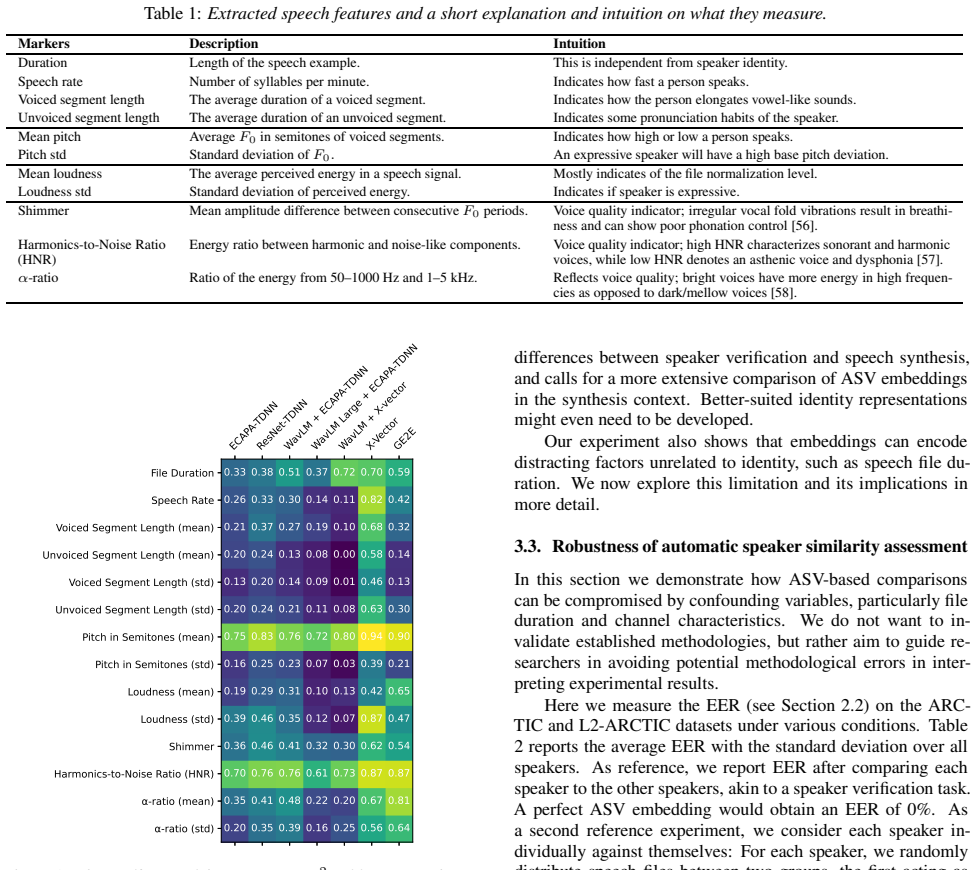
The paper's central claim is that widely used ASV embeddings, trained to discriminate between speakers, do not characterize a voice fully: the probe experiments show high $R^2$ values (0.6–0.94) for mean pitch, HNR, shimmer, and $\alpha$-ratio, alongside low $R^2$ values (mostly 0.0–0.4) for speech rate, voiced/unvoiced segment lengths, and pitch and loudness variability. In the same experiments, file duration is partially encoded, and follow-up EER tests confirm that the same speaker's utterances can be told apart by duration, noise level, and equalization, with EER falling from the expected 50% to as low as 1–5% under heavy noise or spectral-color changes. The proposed U3D metric instead compares the distribution of durations of contiguous same-unit segments in broad phoneme-like groups learned from self-supervised speech units, and shows that speakers who are nearest neighbors by syllable rate still have clearly larger U3D distances than same-speaker splits. The paper therefore claims that rhythm is a measurable, content-aware part of speaker identity that current ASV evaluations omit.
Load-bearing premise
The probe conclusion that ASV embeddings neglect dynamics assumes that low $R^2$ from a lasso regressor predicting handcrafted features truly reflects what the embeddings encode.
Editorial extensions
If this is right
- Speaker-similarity scores built on ASV embeddings will systematically understate differences in rhythm and dynamic prosody, so two voices can look equally similar to a target even when one has the wrong timing.
- Duration mismatch between synthesized and genuine audio can push EER-based similarity numbers down for reasons unrelated to identity; evaluations should match utterance durations, ideally generating the same text as the reference.
- Noise and spectral equalization can collapse EER from 50% to near 0% for the same speaker, so reported similarity differences across systems with different output quality should be interpreted with caution; re-equalizing to the reference spectral balance restores the expected 50%.
- U3D distinguishes different speakers even when syllable rate cannot, and the unsupervised version needs no forced aligner, so it offers a language-agnostic rhythm score for synthesis evaluation.
- Older X-Vector embeddings encode a broader set of markers, including dynamic ones, than newer ECAPA or WavLM-based embeddings, so better verification accuracy does not imply richer identity characterization for synthesis.
Reading between the lines
- A natural extension not pursued in the paper: combine ASV cosine similarity with U3D into a single two-axis similarity report, since the probe results show the two capture largely separate information.
- U3D could serve not only as an evaluator but as a training objective or generation-time filter for voice-conversion and text-to-speech systems, since it needs no phonetic annotations.
- The duration-bias finding implies published EER comparisons between synthesis systems may need revisiting whenever compared systems produce utterances of different lengths or noise levels.
- A testable extension is computing U3D at several levels of the speech-unit hierarchy to capture pause patterns and prosodic phrasing, which may separate speakers even more sharply than phoneme-group durations.
Editorial analysis
A structured set of objections, weighed in public.
Referee Report
Summary. The paper investigates what automatic speaker verification (ASV) embeddings encode about voice identity, motivated by their widespread use in speech-synthesis evaluation. It reports a probe analysis in which lasso regressors predict handcrafted acoustic/prosodic features from ASV embeddings (Section 3.2, Figure 1), concluding that static spectral features such as timbre and pitch range are well represented while dynamic features such as speech rate and segment durations are not. It then measures equal error rates under duration-based sorting, additive noise, and spectral equalization (Section 3.3, Table 2), showing that these confounds can distort ASV-based similarity assessments. Finally, it proposes U3D, a Wasserstein distance between duration distributions of phoneme-like groups discovered from self-supervised speech units, and validates it on ARCTIC and L2-ARCTIC (Section 3.4, Table 3). The paper argues that U3D complements ASV embeddings by capturing rhythm-related aspects of speaker identity.
Significance. If the central conclusions hold, the paper provides a practically important caution for the speech-synthesis community: ASV-based speaker similarity metrics can be sensitive to duration and channel confounds and may under-represent behavioral/rhythmic identity. The confounding-factor experiments in Table 2 are carefully controlled, with per-speaker cross-validation and expected 50% EER baselines. The proposed U3D is simple, unsupervised, and open-sourced, and the confirmation using both forced-aligned and unsupervised units in Table 3 is a strength. However, the main empirical support for the 'neglect' claim requires methodological tightening: the probe evaluation protocol in Section 3.2 is ambiguous regarding held-out data, and the interpretation of per-utterance R² values as evidence of representational neglect is not fully justified without speaker-level variance analysis. The U3D validation in Table 3 also lacks variance information and significance tests.
major comments (3)
- [Section 3.2, Figure 1] The probe evaluation protocol is not fully specified. The text says hyperparameters are selected by 5-fold cross-validation with speaker-disjoint folds, but then 'after retraining the regressor on all data, we predict the value of each handcrafted feature' and compute R². If the final model is evaluated on the same data used to fit it, the reported R² values are in-sample and do not estimate how much information the embeddings generalize to new utterances. Please clarify whether Figure 1 reports held-out predictions, and if not, report R² on held-out utterances using the cross-validation folds.
- [Section 3.2, Figure 1] Interpreting low per-utterance R² as evidence that ASV embeddings 'neglect' dynamic markers is not justified without quantifying within-speaker versus between-speaker variance of the target features. Features such as speech rate, voiced/unvoiced segment durations, and pitch std vary across utterances of the same speaker due to phonetic content and speaking style; a speaker-level encoding can yield low per-utterance R² even if it encodes the speaker-level dynamic profile. Please add speaker-level analyses, for example by regressing on speaker-averaged embeddings and features, or by reporting variance components (e.g., ICC) for each target feature, to support the central claim.
- [Section 3.4, Table 3] The claim that rhythm distances are 'significantly larger' between different speakers is not supported by the reported statistics. Table 3 gives only average Wasserstein distances with no per-speaker variance, confidence intervals, or significance tests. Since the Same, Nearest, and Random conditions involve different dependency structures (random splits within a speaker versus pairs of speakers), please report per-speaker standard errors and a paired or permutation test comparing Same against Nearest and Random, and for the forced-aligned versus unsupervised U3D comparison.
minor comments (5)
- [Section 3.4 and Abstract] The claim that U3D is 'language agnostic' is supported only by the absence of forced-alignment tools, not by multilingual experiments; all validation is on English (ARCTIC and L2-ARCTIC). Please qualify the claim to 'does not require language-specific phonetic annotations' or add a non-English dataset.
- [Figure 1] The R² values are point estimates with no uncertainty. Adding confidence intervals across speakers or cross-validation folds would make comparisons across embeddings more interpretable.
- [Table 3] The caption should spell out 'approx.' (approximants), 'fric.' (fricatives), and 'sil.' (silence), and should state whether the 'Nearest' condition excludes the same speaker and how many pairs are used.
- [Section 3.2] Please specify whether the IQR outlier removal is applied to the handcrafted features, the embeddings, or both, and how many samples are removed; this affects reproducibility.
- [Conclusion] There is a typo in 'dynamic aspects of a identity' near the end of Section 4; it should read 'of identity'.
Circularity Check
No significant circularity: probe analysis and U3D validation are self-contained, with self-citations used transparently as methodology rather than as forced inputs.
full rationale
Section 3.2's probe analysis trains lasso/random-forest regressors from ASV embeddings to independently extracted handcrafted features (REAPER pitch, OpenSmile loudness/shimmer/HNR, and speech rate from [59]) and reports cross-validated R2 values. There is no fitted parameter renamed as a prediction: the regressors are auxiliary measurement tools, and the claim that dynamic markers are neglected is an empirical reading of the R2 table, not an identity imposed by construction. Section 3.3's EER experiments compare same-speaker utterances sorted by duration or perturbed by noise/equalization against control conditions; the observed EER drop is a measured outcome, not built into the metric. Section 3.4 defines U3D as Wasserstein distances between duration distributions of phoneme-like groups, and validates it by comparing same-speaker, nearest-speaker, and random-speaker distances using both forced alignment and unsupervised speech units. The finding that distances are larger across speakers is an empirical result; the metric is not fitted to produce that ordering, and the same conclusion is replicated with ground-truth phoneme segmentation independent of the authors' unsupervised pipeline. Self-citations to [23] and [59] supply the speech-unit extraction and clustering/segmentation methodology, but the load-bearing validation in Table 3 is independently measured, and no uniqueness theorem or prior result is invoked to forbid alternatives. No equation in the paper is equivalent to its input by definition.
Assumptions & free parameters
free parameters (3)
- Lasso regularization strength (alpha) =
optimized by 5-fold CV, value not reported
- Hierarchical clustering granularity for phoneme-like groups =
inherited from [59], number of groups not stated
- Segmentation score threshold =
inherited from [59], not stated
assumptions (6)
- domain assumption HuBERT self-supervised speech units provide phoneme-like representations across speakers.
- domain assumption Segment duration distributions conditioned on phoneme-like groups are stable within a speaker and discriminative across speakers.
- domain assumption The chosen handcrafted features (Table 1) capture the identity markers relevant to speaker similarity.
- domain assumption Lasso/random forest regression R2 is an unbiased estimator of the degree to which an embedding encodes a feature.
- domain assumption Cosine similarity between ASV embeddings is a valid operationalization of speaker similarity.
- standard math Wasserstein distance is an appropriate measure for comparing duration distributions.
Cite this review
Pith. "Pith review of Analyzing and Improving Speaker Similarity Assessment for Speech Synthesis." pith.science (2026). https://pith.science/paper/WZA5U6KW
@misc{pith2026250702176,
  author       = {Pith},
  title        = {Pith review of: Analyzing and Improving Speaker Similarity Assessment for Speech Synthesis},
  year         = {2026},
  howpublished = {\url{https://pith.science/paper/WZA5U6KW}},
  note         = {Machine review of arXiv:2507.02176}
}
read the original abstract
Modeling voice identity is challenging due to its multifaceted nature. In generative speech systems, identity is often assessed using automatic speaker verification (ASV) embeddings, designed for discrimination rather than characterizing identity. This paper investigates which aspects of a voice are captured in such representations. We find that widely used ASV embeddings focus mainly on static features like timbre and pitch range, while neglecting dynamic elements such as rhythm. We also identify confounding factors that compromise speaker similarity measurements and suggest mitigation strategies. To address these gaps, we propose U3D, a metric that evaluates speakers' dynamic rhythm patterns. This work contributes to the ongoing challenge of assessing speaker identity consistency in the context of ever-better voice cloning systems. We publicly release our code.
Figures

Reference graph
Works this paper leans on
-
[59]
WavLM: large-scale self-supervised pr e-training for full stack speech processing,
S. Chen et al., “WavLM: large-scale self-supervised pr e-training for full stack speech processing,” IEEE Journal of Selected Topics in Signal Processing, vol. 16, no. 6, 2022
work page 2022
-
[1]
Virtual chara cters are expected to possess unique identities that remain consi stent across time
Introduction Generative models that synthesize virtual humans have pro- gressed tremendously over the last few years. Virtual chara cters are expected to possess unique identities that remain consi stent across time. Despite recent progress, this remains a challe nge in visual [1–4] and text-based systems [5, 6]. This paper consi ders how identity is meas...
-
[2]
Background 2.1. Identity markers in speech Foundational phonetic research [7, 8] identifies two primar y cat- egories of cues that enable humans to recognize each other: anatomical and behavioral factors. Anatomical factors relate primarily to the physical struc- ture of the vocal apparatus. The morphology, shape, and size of the vocal tract, along with mu...
work page Pith review arXiv 2025
-
[3]
Experiments While ASV embeddings are widely used for speaker similarity evaluation in synthesis, very little is known about what the y ac- tually encode and how robust they are. We explore which mark- ers are represented in some widely used ASV embeddings, and measure the effect of confounding factors. Finally, we prop ose a metric for rhythm that we vali...
work page 2023
-
[4]
This reflects the lower bound of our metric, where we expect the smallest distances
Same: Compare distances between two randomly split sub- sets of a single speaker. This reflects the lower bound of our metric, where we expect the smallest distances
-
[5]
Nearest: Calculate distance between each speaker and their closest counterpart by syllable rate. This setting tests wh ether our metric can distinguish between speakers undistinguish - able with speech rate
-
[6]
Random: Report distance between random speaker pairs. The results in the top section of Table 3 show that rhythm distances are significantly larger between different speak ers, even those with similar speech rates. Our approach therefor e captures meaningful differences between speakers that can not be reduced to speech rate. We subsequently (bottom sectio...
-
[7]
We showed that ASV embeddings mainly encode speech identity markers relating to anatomy (e.g
Conclusion In this paper, we explored the limitations of ASV embeddings in the context of assessing speaker identity in speech synth e- sis. We showed that ASV embeddings mainly encode speech identity markers relating to anatomy (e.g. pitch range and t im- bre), and fail to capture time-dependent behavioral identity cues. Next, we explored the robustness ...
Show all 69 references
-
[8]
An image is worth one word: Personalizing t ext-to- image generation using textual inversion,
R. Gal et al., “An image is worth one word: Personalizing t ext-to- image generation using textual inversion,” in ICLR, 2022
2022
-
[9]
Dreambooth: Fine tuning text-to-image d iffusion models for subject-driven generation,
N. Ruiz et al., “Dreambooth: Fine tuning text-to-image d iffusion models for subject-driven generation,” in CVPR, 2023
2023
-
[10]
ConsistentID: Portrait generation wit h multimodal fine-grained identity preserving,
J. Huang et al., “ConsistentID: Portrait generation wit h multimodal fine-grained identity preserving,” Preprint arXiv:2404.16771, 2024
2024 arXiv
-
[11]
CharacterFactory: Sampling consistent charac- ters with gans for diffusion models,
G. Wang et al., “CharacterFactory: Sampling consistent charac- ters with gans for diffusion models,” Preprint arXiv:2404.15677, 2024
2024 arXiv
-
[12]
Generat ing video game scripts with style,
G. Lopez Latouche, L. Marcotte, and B. Swanson, “Generat ing video game scripts with style,” in ACL NLP4ConvAI W orkshop, 2023
2023
-
[13]
Meet your favorite character: Open-domai n chat- bot mimicking fictional characters with only a few utterance s,
S. Han et al., “Meet your favorite character: Open-domai n chat- bot mimicking fictional characters with only a few utterance s,” in NACL, 2022
2022
-
[14]
Information conveyed by vow- els
P . Ladefoged and D. Broadbent, “Information conveyed by vow- els.” Journal of the Acoustical Society of America , vol. 29, 1957
1957
-
[15]
The perception of personal iden tity in speech: Evidence from the perception of twins’ speech,
K. Johnson and M. Azara, “The perception of personal iden tity in speech: Evidence from the perception of twins’ speech,” 200 0
-
[16]
X-V ectors: Robust DNN embeddings for speaker recognition,
D. Snyder et al., “X-V ectors: Robust DNN embeddings for speaker recognition,” in ICASSP, 2018
2018
-
[17]
ECAPA - TDNN: emphasized channel attention, propagation and aggre ga- tion in TDNN based speaker verification,
B. Desplanques, J. Thienpondt, and K. Demuynck, “ECAPA - TDNN: emphasized channel attention, propagation and aggre ga- tion in TDNN based speaker verification,” in Interspeech, 2020
2020
-
[18]
State-of-the-art speaker recogni tion with neural network embeddings in NIST SRE18 and speakers in the wild evaluations,
J. Villalba et al., “State-of-the-art speaker recogni tion with neural network embeddings in NIST SRE18 and speakers in the wild evaluations,” Computer Speech and Language, vol. 60, 2020
2020
-
[19]
Generalized end-to-end loss for speaker verifica- tion,
L. Wan et al., “Generalized end-to-end loss for speaker verifica- tion,” in ICASSP, 2018
2018
-
[20]
We need variations in speech synthe- sis: Sub-center modelling for speaker embeddings,
I. Ulgen et al., “We need variations in speech synthe- sis: Sub-center modelling for speaker embeddings,” Preprint arXiv:2407.04291, 2024
2024
-
[21]
Predictions of subjective ratings and spoofing as- sessments of V oice Conversion Challenge 2020 submissions,
R. K. Das et al., “Predictions of subjective ratings and spoofing as- sessments of V oice Conversion Challenge 2020 submissions, ” in Joint W orkshop for the Blizzard Challenge and V oice Conversion Challenge, 2020
2020
-
[22]
Transfer learning from speaker verificat ion to multi- speaker text-to-speech synthesis,
Y . Jia et al., “Transfer learning from speaker verificat ion to multi- speaker text-to-speech synthesis,” in NeurIPS, 2018
2018
-
[23]
Zero-shot multi-speaker text-to-sp eech with state-of-the-art neural speaker embeddings,
E. Cooper et al., “Zero-shot multi-speaker text-to-sp eech with state-of-the-art neural speaker embeddings,” in ICASSP, 2020
2020
-
[24]
Y ourTTS: towards zero-shot multi- speaker tts and zero-shot voice conversion for everyone,
E. Casanova et al., “Y ourTTS: towards zero-shot multi- speaker tts and zero-shot voice conversion for everyone,” in ICML, 2022
2022
-
[25]
Investigating on incorporating pret rained and learnable speaker representations for multi-speaker mult i-style text-to-speech,
C-M. Chien et al, “Investigating on incorporating pret rained and learnable speaker representations for multi-speaker mult i-style text-to-speech,” in ICASSP M2V oC Challenge, 2021
2021
-
[26]
Koel-TTS: Enhancing LLM based speec h gen- eration with preference alignment and classifier free guida nce,
S. Hussain et al., “Koel-TTS: Enhancing LLM based speec h gen- eration with preference alignment and classifier free guida nce,” Preprint arXiv:2502.05236, 2025
2025 arXiv
-
[27]
The Multi-Speaker Multi-Style V oice Clo ning Chal- lenge 2021,
Q. Xie et al., “The Multi-Speaker Multi-Style V oice Clo ning Chal- lenge 2021,” in ICASSP, 2021
2021
-
[28]
V oxGenesis: Unsupervised discovery of latent speaker manifold for speech synthesis,
W.Lin et al., “V oxGenesis: Unsupervised discovery of latent speaker manifold for speech synthesis,” Preprint arXiv:2403.00529, 2024
2024 arXiv
-
[29]
Evaluating text-to-speech synthesis from a large discrete token-based speech language model,
S. Wang and ´E. Sz´ ekely, “Evaluating text-to-speech synthesis from a large discrete token-based speech language model,” i n LREC-COLING 2024, 2024
2024
-
[30]
A comparison of discrete and soft speech units for improved voice conversion,
B. van Niekerk et al., “A comparison of discrete and soft speech units for improved voice conversion,” in ICASSP, 2022
2022
-
[31]
V oicebox: Text-guided multilingual univ ersal speech generation at scale,
M. Le et al., “V oicebox: Text-guided multilingual univ ersal speech generation at scale,” in NeuRIPS, 2023
2023
-
[32]
Neural codec language models are zero-s hot text to speech synthesizers,
S. Chen et al., “Neural codec language models are zero-s hot text to speech synthesizers,” IEEE Transactions on Audio, Speech and Language Processing, vol. 33, 2025
2025
-
[33]
The Singing V oice Conversion Chall enge 2023,
W.-C. Huang et al., “The Singing V oice Conversion Chall enge 2023,” in ASRU, 2023
2023
-
[34]
Generative Data Augmentation Challe nge: Zero- shot speech synthesis for personalized speech enhancement ,
J.-S. Bae et al., “Generative Data Augmentation Challe nge: Zero- shot speech synthesis for personalized speech enhancement ,” in ICASSP GenDA W orkshop, 2025
2025
-
[35]
Acoustic properties of voice timbre t ypes and their influence on voice classification,
T. F. Cleveland, “Acoustic properties of voice timbre t ypes and their influence on voice classification,” The Journal of the Acous- tical Society of America , vol. 61, no. 6, Jun. 1977
1977
-
[36]
Speech production patterns in producing l inguis- tic contrasts are partly determined by individual differen ces in anatomy,
K. Johnson, “Speech production patterns in producing l inguis- tic contrasts are partly determined by individual differen ces in anatomy,” UC Berkeley PhonLab Annual Report , vol. 14, no. 1, 2018
2018
-
[37]
M. C. Resnick, Phonological V ariants and Dialect Identification in Latin American Spanish . De Gruyter Mouton, 1980
1980
-
[38]
A study of rhythm in London: Is syllable-timing a feature of Multicultural London English ?
E. Torgersen and A. Szakay, “A study of rhythm in London: Is syllable-timing a feature of Multicultural London English ?” Uni- versity of Pennsylvania W orking Papers in Linguistics , vol. 17, no. 2, 2011
2011
-
[39]
The measurement of rhythm: a comparison of Sin- gapore and British English,
D. Deterding, “The measurement of rhythm: a comparison of Sin- gapore and British English,” Journal of Phonetics , vol. 29, no. 2, 2001
2001
-
[40]
Sociophonetics of phonotactic pheno mena in french,
M. Avanzi et al., “Sociophonetics of phonotactic pheno mena in french,” in International Congress of Phonetic Sciences , 2015
2015
-
[41]
Individual di fferences in vowel production,
K. Johnson, P . Ladefoged, and M. Lindau, “Individual di fferences in vowel production,” The Journal of the Acoustical Society of America, vol. 94, no. 2, 1993
1993
-
[42]
Individual differences in speech pro- duction: V oice-onset-time,
J. S. Allen and J. L. Miller, “Individual differences in speech pro- duction: V oice-onset-time,” The Journal of the Acoustical Society of America, vol. 108, no. 5, 2000
2000
-
[43]
The social life of phonetic s and phonology,
P . Foulkes and G. Docherty, “The social life of phonetic s and phonology,” Journal of phonetics, vol. 34, no. 4, 2006
2006
-
[44]
Prosodic rhythm and Afric an American english,
E. R. Thomas and P . M. Carter, “Prosodic rhythm and Afric an American english,” English W orld-Wide, vol. 27, no. 3, 2006
2006
-
[45]
La liaison sans enchaˆ ınement,
P . Encrev´ e, “La liaison sans enchaˆ ınement,”Actes de la recherche en sciences sociales, vol. 46, no. 1, 1983
1983
-
[46]
Stuart-Smith, E
J. Stuart-Smith, E. Lawson, and J. M. Scobbie, Derhoticisation in Scottish English: A sociophonetic journey . John Benjamins Publishing Company, 2014
2014
-
[47]
The Blizzard Challenge 2023,
O. Perrotin et al., “The Blizzard Challenge 2023,” in 18th Blizzard Challenge W orkshop, 2023
2023
-
[48]
Refining the evaluation of speech synthesis: A summ ary of the blizzard challenge 2023,
——, “Refining the evaluation of speech synthesis: A summ ary of the blizzard challenge 2023,” Computer Speech and Language, vol. 90, 2025
2023
-
[49]
Good practices for evaluation of synthesized speech,
E. Cooper, S. L. Maguer, E. Klabbers, and J. Y amagishi, “Good practices for evaluation of synthesized speech,” Preprint arxiv.2503.03250, 2025
2025
-
[50]
Stuck in the MOS pit: A critical anal ysis of MOS test methodology in TTS evaluation,
A. Kirkland et al., “Stuck in the MOS pit: A critical anal ysis of MOS test methodology in TTS evaluation,” in Interspeech SSW W orkshop, 2023
2023
-
[51]
Rethinking MUSHRA: Address- ing modern challenges in text-to-speech evaluation,
P . S. V aradhan et al., “Rethinking MUSHRA: Address- ing modern challenges in text-to-speech evaluation,” Preprint arXiv.2411.12719, 2024
2024 arXiv
-
[52]
MOS vs . AB: evaluating text-to-speech systems reliably using cluster ed stan- dard errors,
J. Camp, T. Kenter, L. Finkelstein, and R. Clark, “MOS vs . AB: evaluating text-to-speech systems reliably using cluster ed stan- dard errors,” in Interspeech, 2023
2023
-
[53]
V oxSim: A perceptual voice similarity da taset,
J. Ahn et al., “V oxSim: A perceptual voice similarity da taset,” in Interspeech, 2024
2024
-
[54]
Salmon: A suite for acous tic language model evaluation,
G. Maimon, A. Roth, and Y . Adi, “Salmon: A suite for acous tic language model evaluation,” in ICASSP, 2025
2025
-
[55]
Automatic evaluation of speaker simila rity,
K. Deja et al., “Automatic evaluation of speaker simila rity,” in Interspeech, 2022
2022
-
[56]
SVSNet: An end-to-end speaker voice simi larity assessment model,
CH. Hu et al., “SVSNet: An end-to-end speaker voice simi larity assessment model,” IEEE Signal Processing Letters, 2022
2022
-
[57]
The V oxCeleb Speaker Recognition Challe nge: a retrospective,
J. Huh et al., “The V oxCeleb Speaker Recognition Challe nge: a retrospective,” IEEE/ACM Transactions on Audio, Speech, and Language Processing, 2024
2024
-
[58]
SpeechBrain: A General-Purpose Speech To olkit,
M. R. et al., “SpeechBrain: A General-Purpose Speech To olkit,” Preprint arXiv:2106.04624, 2021
2021 arXiv
-
[60]
The CMU Arctic speech databa ses,
J. Kominek and A. W. Black, “The CMU Arctic speech databa ses,” in Interspeech SSW W orkshop, 2004
2004
-
[61]
L2-ARCTIC: a non-native english speech c orpus,
G. Zhao et al, “L2-ARCTIC: a non-native english speech c orpus,” in Interspeech, 2018
2018
-
[62]
Lib- riSpeech: an ASR corpus based on public domain audio books,
V . Panayotov, G. Chen, D. Povey, and S. Khudanpur, “Lib- riSpeech: an ASR corpus based on public domain audio books,” in ICASSP, 2015
2015
-
[63]
Analysis of fun- damental frequency, jitter, shimmer and vocal intensity in chil- dren with phonological disorders,
H. F. Wertzner, S. Schreiber, and L. Amaro, “Analysis of fun- damental frequency, jitter, shimmer and vocal intensity in chil- dren with phonological disorders,” Revista Brasileira de Otorri- nolaringologia, vol. 71, 2005
2005
-
[64]
V ocal acoust ic analy- sis – jitter, shimmer and HNR parameters,
J. P . Teixeira, C. Oliveira, and C. Lopes, “V ocal acoust ic analy- sis – jitter, shimmer and HNR parameters,” Procedia Technology, vol. 9, 2013
2013
-
[65]
V ariation of the acoustic parameters: f0, jitter, shimmer and alpha ratio in relation with different background noise levels,
M.-J. Marsano-Cornejo and ´Angel Roco-Videla, “V ariation of the acoustic parameters: f0, jitter, shimmer and alpha ratio in relation with different background noise levels,” Acta Otorrinolaringolog- ica (English Edition), vol. 74, no. 4, 2023
2023
-
[66]
Rhyth m modeling for voice conversion,
B. van Niekerk, M.-A. Carbonneau, and H. Kamper, “Rhyth m modeling for voice conversion,” IEEE Signal Processing Letters , 2023
2023
-
[67]
Opensmile: the munich versatile and fast open-source audio feature extractor,
F. Eyben, M. W¨ ollmer, and B. Schuller, “Opensmile: the munich versatile and fast open-source audio feature extractor,” i n ACM- MM, 2010
2010
-
[68]
ASRRL-TTS: agile speaker representation reinforce- ment learning for text-to-speech speaker adaptation,
R. Fu et al., “ASRRL-TTS: agile speaker representation reinforce- ment learning for text-to-speech speaker adaptation,” Preprint arXiv:2407.05421, 2024
2024 arXiv
-
[69]
All about audio equalization: Solu- tions and frontiers,
V . V¨ alim¨ aki and J. D. Reiss, “All about audio equalization: Solu- tions and frontiers,” Applied Sciences, vol. 6, no. 5, 2016
2016
Reviewed August 6, 2026 · model on record in the stance chip above.
Discussion (0). Sign in to comment.