REVIEW 3 major objections 5 minor 37 references
ContactGuard: Pre-Contact Execution Monitoring with Action-Conditioned Latent World Models
T0 review · 3 major / 5 minor · reviewed 2026-08-14 · deepseek-v4-flash
Pith's one-line read ContactGuard predicts grasp failures before contact by rolling the planned action chunk through a frozen latent world model and vetoing the grasp when the predicted post-contact latent flags failure.
desk verdict Solid, real-robot pre-contact failure monitor with clean ablations; the one missing check is whether the latent rollout actually tracks the post-contact scene. read the letter →
The pith
A machine-rendered reading of the paper's core claim, the machinery that carries it, and where it could break.
The reading
What carries the argument
The central object is the action-conditioned latent world model: a shared ViT-Tiny encoder maps each camera view to a compact embedding, the per-view embeddings are mean-pooled across cameras into one latent, and a causal Transformer predictor (conditioned on actions through AdaLN-zero modulation and regularized with SIGReg) is trained with next-latent regression to roll the latent forward under planned actions. This follows the Joint-Embedding Predictive Architecture (JEPA) principle, predicting the embedding of a future signal rather than reconstructing pixels. At deployment the predictor is unrolled autoregressively for 30 steps from an anchor 15 frames before gripper closure, and a frozen ℓ2-regularized logistic regression probe scores the final predicted latent. This machinery converts a concrete proposed action chunk into a predicted visual-consequence latent that a low-capacity linear readout can classify, without pixel-level video prediction.
What would settle it
Collect a labeled set in which the same planned action chunk is executed from the same observation but succeeds and fails due to unobserved object state; if ContactGuard's predicted post-contact latent cannot separate these cases (ROC AUC near 0.5), the imagined-future signal is not carrying the outcome information the paper claims.
Extended reading notes
Core claim
On its own terms, ContactGuard establishes that an action-conditioned latent world model, trained without any success labels, produces a representation of a planned grasp's near future that a lightweight logistic probe can read to separate successful from failed grasps. Across four real tasks (cup and box pick-and-place, pencil-and-notebook, towel-fold), the predicted future latent achieves higher ROC AUC than the matched current-latent baseline and than external failure detectors, and live robot rollouts show the monitor aborting before closure with lower false-abort rates than direct prediction from the anchor latent and action. The paper also shows the signal is action-specific: holding the observation fixed and swapping in an action chunk from a failed attempt increases the predicted failure probability, while corrupting the action chunk collapses performance to near chance.
Load-bearing premise
The system relies on the compressed visual snapshot averaged across cameras, after being rolled forward by the world model, preserving enough information about contact (slip, displacement, misalignment) to tell success from failure half a second after the gripper closes, even though the world model is never trained on outcome labels.
Editorial extensions
If this is right
- ContactGuard can be attached to an existing chunked visuomotor policy as a black-box verifier, so deployment does not require retraining or modifying the policy.
- Pre-contact abort decisions happen within the control loop: the full encode–rollout–probe pass at 30 steps takes about 19 ms, leaving slack before gripper closure at 30 Hz.
- The monitor's signal comes from the specific pending action, not just a risky-looking scene; corrupting or swapping the action chunk changes the verdict.
- Multi-view mean-fused latents improve prediction over any single view, particularly when the contact region is occluded from one camera.
- The monitor is a veto, not a recovery; after an abort the task still needs an external recovery module, which the paper leaves as future work.
Reading between the lines
- The trigger in this paper is a gripper open-to-close transition, but the underlying rollout-and-probe machinery is trigger-agnostic; an equivalent monitor could be built for other imminent contact events such as insertion, pressing, or pushing by only changing the trigger detector.
- Because the world model is trained without outcome labels, its latent is not optimized to retain slip or misalignment details; a future objective that adds an auxiliary task-outcome or contrastive loss might raise the ceiling, or reveal a failure mode on tasks where those details are not visually expressed.
- The action-swap result suggests ContactGuard could be used offline as an action-chunk evaluator, screening or ranking candidate chunks before execution rather than only aborting a single chunk at runtime.
- The false-abort variation across tasks (for example, towel trading precision for coverage) implies threshold choice is consequential; a user deploying this would want to calibrate the threshold on their own success/failure distribution.
Signed reviews
Editorial analysis
A structured set of objections, weighed in public.
Referee Report
Summary. The paper introduces ContactGuard, a pre-contact execution monitor for chunked visuomotor policies. It trains a JEPA-style latent world model on unlabelled robot trajectories to predict multi-view visual latents under planned actions, then trains a linear logistic probe on the predicted post-contact latent to score grasp failure. At deployment, the monitor triggers on an imminent gripper-closure event, rolls the frozen predictor forward under the policy's action chunk, and aborts if the predicted failure probability exceeds a per-task threshold. The paper reports four real-world grasp tasks (cup, box, pencil, towel) and compares against a single-view world model, direct classification from the current latent plus actions, a matched current-latent ablation, and external failure detectors. The main empirical claims are that predicted future latents yield higher ROC AUC than current-latent and direct baselines, that action corruption destroys the signal, and that the system runs fast enough for a 0.5 s pre-contact window. The paper also includes a live real-robot evaluation with abort-based counterfactual outcome recording.
Significance. If the results hold, ContactGuard is a practical contribution: it adds a policy-decoupled predictive verifier to chunked visuomotor policies without retraining or candidate search. The ablation design in Table 2 is a genuine strength: the matched current-latent baseline shares the encoder, probe class, data pools, and cross-validation protocol, and the reported five-seed cross-validation makes the offline comparison credible. The action-swap test in Section 4.3 is a particularly clean falsifiable intervention. However, the paper's mechanistic claim—that the probe reads a faithful forecast of the post-contact latent—is not yet supported, and one baseline is not fully matched on input context. If the missing controls are added and support the current results, this would be a solid systems contribution to runtime monitoring.
major comments (3)
- [§3.3, §4.3, Eqs. (3)–(4)] The central mechanistic claim is that the failure signal comes from a faithful prediction of the post-contact latent, but no fidelity check is reported. The paper never compares the autoregressively rolled-out \hat{z}_{t+K} with the true latent z_{t+K} on held-out clips, and it never reports the probe's AUC when fed the true future latent instead of the predicted one. Because the world model is trained only with teacher-forced one-step MSE plus SIGReg (Eq. 4), multi-step rollouts are not guaranteed to stay near the true latent. The current-latent and corrupted-action ablations show that the signal is action-dependent, but a corrupted or unfaithful rollout could still produce a useful action-conditional representation. Add a latent-fidelity measurement (e.g., MSE or cosine similarity between predicted and true future latents at K=1, 15, 30) and a probe-on-real-future-latent control; without these, the abstract's claim that the monitor 'predicts its short-horizon consequence in latent visual space' is not established.
- [§4.2, Table 2; §4.3, Table 3] The 'Current latent' ablation is not fully matched on input features. ContactGuard's probe reads \hat{z}_{t+K}, which is a function of the C=3 latent context z_{t-C+1:t} and K future actions, whereas the Current latent baseline reads only the single anchor latent z_t. The observed AUC gain could therefore be due in part to the additional temporal context rather than to the imagined future. Add a baseline that consumes the full context without rollout—for example, the mean or concatenation of z_{t-C+1:t} fed to the same linear probe—to isolate the contribution of the action-conditioned latent prediction.
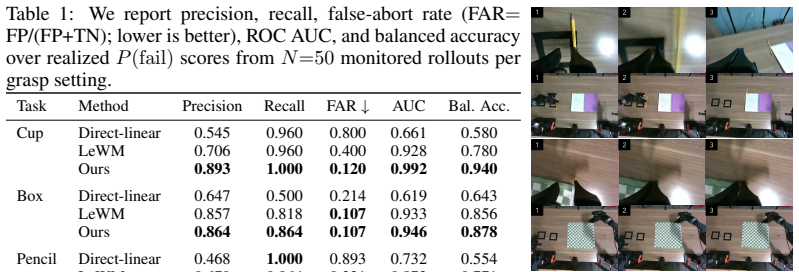
- [§4.2, Table 1] The live closed-loop results in Table 1 are reported as point estimates without any uncertainty quantification. With N=50 per task, the difference between Ours and LeWM on Box (AUC 0.946 vs 0.933, FAR 0.107 vs 0.107) and on Towel (balanced accuracy 0.820 vs 0.700) could be within sampling noise; for example, a single confusion-matrix entry change on Box alters recall by about 0.04. Report bootstrap confidence intervals or repeated-seed statistics for the live metrics, or at minimum state the number of independent rollouts per cell and how thresholds were fixed. This is needed to support the paper's claim that the monitor 'transfers to live robot'.
minor comments (5)
- [Table 2, Table 3] Both Table 2 and Table 3 report a 'Current latent' row with different values (e.g., Cup 0.840 vs 0.758) because they use different offline splits. The text says this in passing in §4.3, but the discrepancy should be flagged explicitly in the captions to avoid confusion.
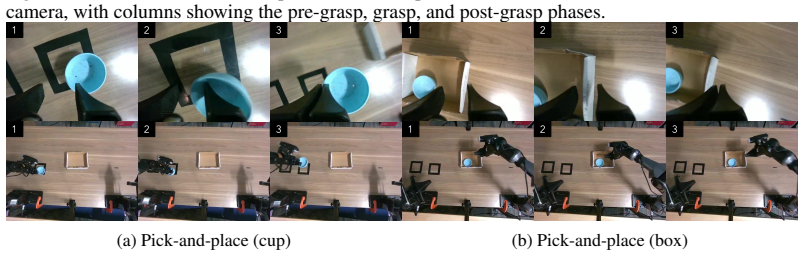
- [Figure 1] Figure 1 uses 'h steps' for the rollout horizon while the text and equations use K; unify the notation.
- [Abstract] The abstract has several formatting artifacts (e.g., missing space after the ContactGuard emphasis, 'setups' typo); please run a clean proofread and LaTeX pass.
- [§4.1] The text states the anchor is 0.5 s before closure and the rollout reaches 0.5 s after closure at 30 Hz, but the phrase could be misread because k_pre=15 frames at 30 Hz is 0.5 s and K=30 steps reaches T_g + 15 frames. Clarify the exact frame indices.
- [Eq. (6)] The class-weight notation is slightly confusing: s_c is defined for class c, but the loss uses s_{y_i}; consider defining the weight directly as a function of the sample's class to improve readability.
Circularity Check
No significant circularity: the failure probe is a supervised classifier on predicted latents, the world model is unsupervised, and all central comparisons are matched external baselines.
full rationale
The derivation chain is empirical and self-contained. ContactGuard trains an unsupervised JEPA-style world model with Eq. (4) on unlabelled trajectories, freezes it, and then trains a supervised logistic probe (Eq. (6)) on labelled pre-contact clips using the predicted latent \hat{z}_{t+K} as the feature. No parameter is fitted to test labels; the probe and per-task threshold are fixed on train/validation splits and evaluated on held-out live rollouts and offline pools. The central comparisons against 'Current latent' and corrupted-action ablations are matched interventions that differ only in whether the probe reads z_t or the rolled-out \hat{z}_{t+K}; the action-swap test holds the observation fixed while swapping the action chunk, showing the signal depends on the proposed action rather than static visual risk. The paper does not invoke any uniqueness theorem, and the related-work citations to Rewind-IL, PATCH, and Dose3 are not load-bearing for the empirical claim. The skeptic's concern that multi-step rollout fidelity to the true post-contact latent is never directly measured is a correctness/interpretability limitation, not a circular reduction: the paper never defines success as matching the true latent, and the reported ROC AUC is an external benchmark against matched baselines. No equation reduces to its own input, and no fitted parameter is renamed as a prediction.
Assumptions & free parameters
free parameters (3)
- Per-task abort threshold tau =
Cup 0.605; Box 0.487; Pencil 0.580; Towel 0.415
- Anchor offset k_pre and rollout horizon K =
k_pre = 15 frames (0.5 s before closure); K = 30 steps (1 s, readout 0.5 s after closure)
- Probe regularization rho and class-balance weights =
rho = 1; s_c = N/(2 N_c)
assumptions (5)
- domain assumption The gripper open-to-close transition in the commanded action reliably marks imminent contact and defines the anchor time T_g.
- domain assumption The mean-pooled multi-view latent preserves the physical details (slip, displacement, misalignment) needed to infer grasp outcome after roll-out.
- domain assumption A world model trained with next-latent MSE and SIGReg on unlabelled trajectories generalizes to the deployment distribution, including failed grasp attempts.
- domain assumption A linear logistic probe on the standardized predicted latent is sufficiently expressive to separate success and failure.
- standard math Standard statistical tools (logistic regression, bootstrap, cross-validation) are valid for the reported comparisons.
Cite this review
Pith. "Pith review of ContactGuard: Pre-Contact Execution Monitoring with Action-Conditioned Latent World Models." pith.science (2026). https://pith.science/paper/WZJXSVNZ
@misc{pith2026260813438,
  author       = {Pith},
  title        = {Pith review of: ContactGuard: Pre-Contact Execution Monitoring with Action-Conditioned Latent World Models},
  year         = {2026},
  howpublished = {\url{https://pith.science/paper/WZJXSVNZ}},
  note         = {Machine review of arXiv:2608.13438}
}
read the original abstract
Contact-rich manipulation failures are often detected only after the robot has committed to contact. This is especially limiting in wrist-camera setups: close gripper--object views help observe contact, but a poor approach may already push, miss, slip, or disturb the object before conventional detectors react. We introduce \emph{ContactGuard}, a pre-contact execution monitor for chunked visuomotor policies. Given the policy's planned action chunk, ContactGuard predicts its short-horizon consequence in latent visual space and aborts if the predicted future latent indicates likely failure. Its latent world model is trained from unlabelled robot trajectories to predict compact multi-view visual embeddings under planned actions, avoiding pixel-level video prediction. A lightweight failure probe is then trained from a small labelled set of pre-contact clips. At deployment, ContactGuard anchors prediction before an imminent contact event, rolls the model forward under the policy's own actions, and verifies the predicted post-contact latent. Across real-world contact-rich manipulation tasks, ContactGuard predicts failure more accurately than direct and corrupted-action ablations, and transfers to live robot as a pre-contact abort signal without modifying the underlying policy.
Figures


Figures from the paper (2 more)
Reference graph
Works this paper leans on
- [1]
- [2]
- [3]
- [4]
- [5]
- [6]
-
[7]
A. Srinivas, A. Jabri, P. Abbeel, S. Levine, and C. Finn. Universal Planning Networks: Learn- ing Generalizable Representations for Visuomotor Control. InProceedings of the 35th Inter- national Conference on Machine Learning, pages 4732–4741. PMLR, July 2018
work page 2018
-
[8]
C. Finn and S. Levine. Deep Visual Foresight for Planning Robot Motion, Mar. 2017. arXiv:1610.00696 [cs.LG]
arXiv 2017
Show all 37 references
-
[9]
F. Zhu, H. Wu, S. Guo, Y . Liu, C. Cheang, and T. Kong. IRASim: A Fine-Grained World Model for Robot Manipulation, July 2025. arXiv:2406.14540 [cs.RO]
2025 arXiv
-
[10]
Barcellona, A
L. Barcellona, A. Zadaianchuk, D. Allegro, S. Papa, S. Ghidoni, and E. Gavves. Dream to Manipulate: Compositional World Models Empowering Robot Imitation Learning with Imag- ination, Mar. 2025. arXiv:2412.14957 [cs.RO]
2025 arXiv
-
[11]
L. Maes, Q. L. Lidec, D. Scieur, Y . LeCun, and R. Balestriero. LeWorldModel: Stable End- to-End Joint-Embedding Predictive Architecture from Pixels, Mar. 2026. arXiv:2603.19312 [cs.LG]
2026 arXiv
-
[12]
Y . Du, K. Konyushkova, M. Denil, A. Raju, J. Landon, F. Hill, N. d. Freitas, and S. Cabi. Vision-Language Models as Success Detectors, Mar. 2023. arXiv:2303.07280
2023 arXiv
-
[13]
J. Duan, W. Pumacay, N. Kumar, Y . R. Wang, S. Tian, W. Yuan, R. Krishna, D. Fox, A. Man- dlekar, and Y . Guo. AHA: A Vision-Language-Model for Detecting and Reasoning Over Fail- ures in Robotic Manipulation, Oct. 2024. arXiv:2410.00371
2024 arXiv
-
[14]
Liang, Y
A. Liang, Y . Korkmaz, J. Zhang, M. Hwang, A. Anwar, S. Kaushik, A. Shah, A. S. Huang, L. Zettlemoyer, D. Fox, Y . Xiang, A. Li, A. Bobu, A. Gupta, S. Tu, E. Biyik, and J. Zhang. Robometer: Scaling General-Purpose Robotic Reward Models via Trajectory Comparisons, May 2026
2026
-
[15]
T. Lee, A. Wagenmaker, K. Pertsch, P. Liang, S. Levine, and C. Finn. RoboReward: General- Purpose Vision-Language Reward Models for Robotics, Jan. 2026. arXiv:2601.00675
2026
-
[16]
Cheng, T
H. Cheng, T. Zheng, Z. Ma, T. Zhang, M. Johnson-Roberson, and W. Zhi. Dose3: Diffusion- based unified out-of-distribution detection onSE(3)trajectories.IEEE Robotics and Automa- tion Letters, 11(2), 2026
2026
-
[17]
R ¨omer, A
R. R ¨omer, A. Kobras, L. Worbis, and A. P. Schoellig. Failure Prediction at Runtime for Gen- erative Robot Policies, Oct. 2025. arXiv:2510.09459. 10
2025
-
[18]
C. Xu, T. K. Nguyen, E. Dixon, C. Rodriguez, P. Miller, R. Lee, P. Shah, R. Ambrus, H. Nishimura, and M. Itkina. Can we detect failures without failure data? InRSS, 2025
2025
-
[19]
Burda, H
Y . Burda, H. Edwards, A. Storkey, and O. Klimov. Exploration by random network distillation. InICLR, 2019
2019
-
[20]
Q. Gu, Y . Ju, S. Sun, I. Gilitschenski, H. Nishimura, M. Itkina, and F. Shkurti. SAFE: Multitask failure detection for vision-language-action models. InNeurIPS, 2025
2025
-
[21]
Zheng, S
G. Zheng, S. Seenivasan, M. Johnson-Roberson, and W. Zhi. Rewind-il: Online failure detec- tion and state respawning for imitation learning.arXiv preprint arXiv:2604.16683, 2026
2026 arXiv
-
[22]
Y . Zhou, R. Qiu, Y . Chen, J. Cui, and W. Zhi. Patch: Action-chunk-conditioned latent patch innovation monitoring for robot manipulation.arXiv preprint arXiv:2606.16690, 2026
2026
-
[23]
H. Liu, S. Dass, R. Mart ´ın-Mart´ın, and Y . Zhu. Model-based runtime monitoring with interac- tive il. InICRA, 2024
2024
-
[24]
H. Liu, Y . Zhang, V . Betala, E. Zhang, J. Liu, C. Ding, and Y . Zhu. Multi-task interactive robot fleet learning with visual world models. InCoRL, 2024
2024
-
[25]
Damak, M
K. Damak, M. Boujelbene, C. Acun, A. Alvanpour, S. K. Das, D. O. Popa, and O. Nasraoui. Robot failure mode prediction with deep learning sequence models.Neural Computing and Applications, 37:4291–4302, Feb. 2025
2025
-
[26]
W. Zhi, T. Lai, L. Ott, and F. Ramos. Diffeomorphic transforms for generalised imitation learning. InLearning for Dynamics and Control Conference, L4DC, 2022
2022
-
[27]
Ravichandar, A
H. Ravichandar, A. S. Polydoros, S. Chernova, and A. Billard. Recent advances in robot learning from demonstration.Annual review of control, robotics, and autonomous systems, 2020
2020
-
[28]
W. Zhi, H. Tang, T. Zhang, and M. Johnson-Roberson. Teaching periodic stable robot motion generation via sketch.IEEE Robotics and Automation Letters, 2025
2025
-
[29]
W. Zhi, I. Akinola, K. van Wyk, N. Ratliff, and F. Ramos. Global and reactive motion genera- tion with geometric fabric command sequences. InIEEE International Conference on Robotics and Automation, ICRA. IEEE, 2023
2023
-
[30]
T. Z. Zhao, V . Kumar, S. Levine, and C. Finn. Learning Fine-Grained Bimanual Manipulation with Low-Cost Hardware, Apr. 2023. arXiv:2304.13705
2023 arXiv
-
[31]
C. Chi, Z. Xu, S. Feng, E. Cousineau, Y . Du, B. Burchfiel, R. Tedrake, and S. Song. Diffusion Policy: Visuomotor Policy Learning via Action Diffusion, Mar. 2024. arXiv:2303.04137
2024 arXiv
-
[32]
Z. Li, Y . Zhou, R. Qiu, H. Wu, G. Ren, and W. Zhi. Tripilot-ff: Coordinated whole-body teleoperation with force feedback.arXiv preprint arXiv:2602.09888, 2026
2026
-
[33]
M. Dai, L. Liu, Y . Bai, Y . Liu, Z. Wang, R. SU, C. Chen, L. Lin, and X. Wu. RoVer: Robot Reward Model as Test-Time Verifier for Vision-Language-Action Model, Oct. 2025. arXiv:2510.10975 [cs.RO]
2025
-
[34]
X. Sun, Z. Xu, C. Cao, Z. Liu, Y . Sun, J. Pang, R. Zhang, Z. Yang, K. Pang, D. He, M. Yuan, and J. Chen. AtomVLA: Scalable Post-Training for Robotic Manipulation via Predictive Latent World Models, Mar. 2026. arXiv:2603.08519 [cs.RO]
2026
-
[35]
Tang and W
J. Tang and W. Zhi. Autointervene: Calibrated intervention for action-chunking imitation learning policies.arXiv preprint arXiv:2608.07065, 2026
2026 arXiv
-
[36]
Lipman, R
Y . Lipman, R. T. Q. Chen, H. Ben-Hamu, M. Nickel, and M. Le. Flow matching for generative modeling. InThe Eleventh International Conference on Learning Representations, 2023. 11
2023
-
[37]
small” and “large
J. Long, D. Liu, W. Cai, I. Manchester, and W. Zhi. Safe policies post-training: Constraining streaming flow models for adapting learned robot trajectory distributions.IEEE Robotics and Automation Letters, 11(9), 2026. 12 A Implementation Details Encoder and latent dimensions....
2026
Reviewed August 14, 2026 · model on record in the stance chip above.
Discussion (0). Continue with ORCID to comment.