REVIEW 2 major objections 5 minor 74 references
TabPFN transfers calibration from tabular data to image, text, and audio embeddings, giving a conditional yes to reliable confidence without accuracy loss.
Reviewed by Pith at T0; open to challenge. T0 means a machine referee read the full paper against a public rubric. the ladder, T0–T4 →
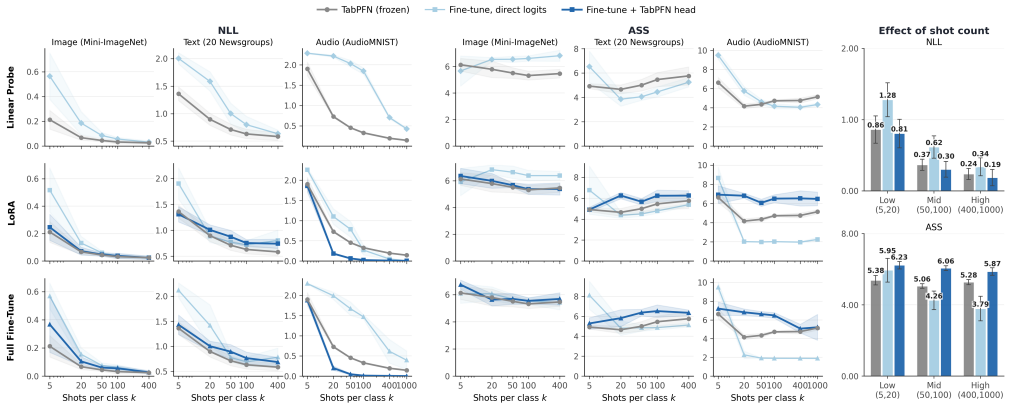
TabPFN as a training-free head on PCA-reduced frozen multimodal embeddings broadly improves calibration (NLL, ECE) over classical heads, with an accuracy edge only for k≥50 shots and d≤32 features.
T0 review reviewed 2026-08-02 challenge →
load-bearing objection A solid, honestly conditioned empirical benchmark: TabPFN broadly improves calibration as a zero-training head on frozen multimodal embeddings, with the accuracy advantage rightly confined to a mapped operating region. the 2 major comments →
TabPFN beyond Tabular Data: Calibration and Accuracy on Multimodal Embeddings
The pith
A machine-rendered reading of the paper's core claim, the machinery that carries it, and where it could break.
The reading
Core claim
TabPFN, a Prior-Fitted Network that approximates posterior predictive distributions through in-context learning on synthetic tabular data, can be applied to frozen multimodal encoder embeddings after z-normalization and PCA reduction. The paper shows that this zero-gradient head consistently produces better-calibrated probabilities than kNN, logistic regression, linear SVM, tree ensembles, and an MLP, with the best mean rank on NLL and ECE over all episodes. At the canonical setting (C=10, k=100, d=96), NLL drops by 48–62% and ECE by 2.1–5.3× relative to the average of eight baselines, with accuracy at or above the baseline average on every modality. The calibration benefit is broad; the acc
What carries the argument
TabPFN is a prior-fitted transformer that, at inference time, conditions on a labeled table of examples and outputs class probabilities in one forward pass, with no gradient updates. PFNs are trained to minimize expected KL divergence to the true posterior predictive under a synthetic-data prior, so calibration is part of the training objective. The pipeline preprocesses encoder outputs with per-dimension z-normalization and PCA down to d dimensions, then feeds the reduced train features and labels as in-context context. The central object is the posterior-predictive distribution approximated by TabPFN; the paper argues that standardized, PCA-reduced fixed-length embedding vectors fall close
Load-bearing premise
The load-bearing premise is that z-normalized, PCA-reduced embeddings from image, text, and audio encoders fall inside the support of the synthetic-data prior TabPFN was trained on, so its in-context probabilities are meaningful; the paper itself calls the mechanism interpretive rather than causally verified.
What would settle it
On a fixed suite of 10-class datasets with k=100 and d=32, if TabPFN's ECE is not below the best of kNN, logistic regression, and linear SVM in a majority of episodes, the paper's main calibration claim is falsified. A direct test of the mechanism: draw synthetic features from TabPFN's training prior and real PCA-reduced embeddings from a new encoder, then compare TabPFN's predictive NLL on both; a large gap would indicate the embeddings lie outside the prior's support.
If this is right
- Practitioners can obtain calibrated confidence from frozen encoders without a separate calibration set or gradient updates, provided they PCA-reduce embeddings to a moderate dimension.
- TabPFN should be preferred over logistic regression or SVM mainly at moderate-to-high shot counts and low-to-moderate feature dimensions (k≥50, d≤32), especially for multiclass tasks, rather than in very low-shot or high-dimension regimes.
- After backbone adaptation via LoRA or full fine-tuning, replacing the trained linear head with TabPFN is a lightweight way to improve calibration while keeping accuracy.
- The calibration advantage extends to other in-context tabular foundation models, suggesting a shared design principle rather than a TabPFN-specific quirk.
- TabPFN's larger conformal prediction sets mean it is not the right head when tight prediction sets are the priority; kNN remains best on that axis.
Where Pith is reading between the lines
- The paper's boundary result suggests a testable rule of thumb: for any frozen encoder whose embeddings can be whitened or PCA-reduced to roughly 32 dimensions, a tabular in-context head may provide near-free calibration; one could verify by sweeping d on a new encoder and checking the win-rate map.
- Because the explanation is interpretive, a stronger mechanistic check would estimate whether PCA-reduced embeddings actually fall inside TabPFN's prior support, for example by comparing its predictive NLL on in-prior synthetic features versus real embeddings.
- The ceiling effect implies that on near-saturated tasks, calibration gains remain available even when accuracy gains do not; for high-stakes applications the relevant comparison should be calibration-constrained accuracy, not raw win-rate.
- The ASS finding suggests a possible hybrid: use TabPFN's calibrated probabilities to re-rank classes or build a different nonconformity score, potentially tightening conformal sets while retaining calibration.
Editorial analysis
A structured set of objections, weighed in public.
Referee Report
Summary. The paper asks whether TabPFN v2.5, a prior-fitted transformer for tabular classification, can serve as a zero-gradient classification head on frozen multimodal embeddings, and under what conditions. The proposed pipeline is encode → PCA-reduce → TabPFN forward pass. The authors evaluate 22,820 episodes covering 14 datasets, 11 encoders, 3 modalities, 9 classification heads, and 5 seeds with identical train/test splits per episode. They report that TabPFN achieves the best mean rank on NLL and ECE and that its accuracy advantage is conditional: it concentrates at moderate-to-high shot counts, low-to-moderate feature dimensions, multiclass tasks, and tasks with room above the baseline ceiling. In a fine-tuning experiment, replacing the trained linear head with TabPFN on adapted backbones improves calibration while preserving competitive accuracy. Ablations address preprocessing variants, label noise, top-k calibration versus conformal prediction-set size, and comparison with other in-context learning tabular foundation models.
Significance. The empirical evaluation is a strength: the episode count is large, all heads are compared on identical splits, metrics are standard, and the released code supports reproducibility. The paper is also honest about negative results (poor ASS, low-shot accuracy disadvantage, conditional accuracy gains) and explicitly labels the prior-support explanation as interpretive. If the results hold, the paper provides practically useful guidance for calibration-sensitive few-shot multimodal classification and indicates that calibration transfer is shared by several in-context tabular foundation models rather than unique to TabPFN. The contribution is primarily empirical; the theoretical mechanism is not established, but the manuscript's own limitations section acknowledges this.
major comments (2)
- [Experiment 1, Figure 2 and Table 4] The headline quantitative claims (48–62% NLL reduction and 2.1–5.3× ECE reduction) are computed at a single canonical setting (C=10, k=100, d=96), and d=96 is justified after observing that d=all degrades TabPFN's calibration. Table 4 supports the rank claim across all 22,820 episodes, but it does not show that the magnitudes in the abstract are typical of other settings. Please report the distribution or median/range of relative NLL/ECE reductions over the full grid, or explicitly state that the abstract numbers are an illustrative post hoc selected operating point rather than a grid-average result.
- [Discussion, Interpretation and Limitations] The manuscript states that the explanation of PCA-z-normalized embeddings falling within TabPFN's pretraining prior is 'interpretive rather than a causally verified mechanism.' This is appropriately cautious, but earlier sections (Related Work and the motivation in Experiment 1) lean on TabPFN's Bayesian training objective as if it accounts for the transfer. The empirical claim does not depend on the mechanism, but the current framing invites a stronger reading. Please either add a concrete probe (for example, comparing TabPFN with a Bayesian linear or Gaussian-process head on the same embeddings, or varying PCA dimensions while holding the prior fixed) or move the mechanism statement to an explicitly labeled hypothesis in the introduction and abstract.
minor comments (5)
- [Table 4 and Figure 3] The statement that the low standard deviation of ranks indicates consistency refers to the spread of ranks across episodes, not to the precision of the mean rank. For statements such as 'best mean rank,' report standard errors or clustered confidence intervals, since episodes sharing datasets and encoders are not independent.
- [Experiment 3, Figure 4] The text says 'TabPFN improves or ties accuracy in 29 of the 32 configurations' without defining which 32 configurations are counted. Please specify the exact set (adaptation methods × datasets × shot counts) and, if possible, show the per-configuration comparison in a small table or appendix.
- [Experimental Setup, Classification Pipelines] The eight baseline heads use each library's standard fit function with default hyperparameters. Since the practical recommendation is 'TabPFN versus logistic regression or SVM,' please state explicitly that no hyperparameter tuning was performed and note whether default settings correspond to the usual out-of-the-box usage assumed by practitioners.
- [Evaluation Metrics, ECE] ECE is computed with M=15 fixed bins. This is a standard choice, but a short sensitivity check across M (e.g., 10, 15, 20) would reassure readers that the ranking is not an artifact of bin count.
- [Table 1 and Related Work] The LLM Emotion dataset is introduced in the authors' own prior work (Zhang and Zhong 2025). This is not a methodological problem, but the dataset's provenance should be disclosed in the table caption or main text for full transparency.
Circularity Check
No circularity: the central calibration result is an external empirical comparison using a fixed pretrained checkpoint on held-out episodes.
full rationale
The paper's central claims are empirical measurements: TabPFN v2.5 is a fixed, publicly released checkpoint, and its NLL/ECE/accuracy are evaluated on held-out test samples across a large grid of episodes against external baseline heads. No parameter is fitted to the test targets and then renamed as a prediction; the same train/test splits are used for all methods, so the comparison is external rather than self-referential. The only load-bearing explanatory assumption—that PCA-z-normalized embeddings fall within TabPFN's pretraining prior—is explicitly flagged by the authors as 'interpretive rather than a causally verified mechanism' in the Discussion/Limitations. That is an unverified mechanism, not a circular derivation, because it is not defined in terms of the result it is invoked to explain. Self-citations are present (LLM Emotion dataset by Zhang and Zhong 2025; PromptDx by Zhong et al. 2026), but they are a single dataset among fourteen and a related-work mention, respectively; neither supplies the evidence for the calibration ranking. Ablation 3 further compares against independent external ICL models (TabICL, TabDPT, later TabPFN releases), so the main claim is not forced by a self-citation chain. No equation or fitted parameter reduces to the claimed conclusion, and no uniqueness theorem from the authors' prior work is used to constrain choices. Accordingly, no circular step is identified; the principal risks are external-validity concerns about prior support and the post-hoc selection of a representative operating region, not circularity.
Axiom & Free-Parameter Ledger
free parameters (3)
- canonical evaluation setting (C=10, k=100, d=96) =
C=10, k=100, d=96
- kNN neighborhood size =
k=5
- ECE bin count =
M=15
axioms (5)
- domain assumption PCA-z-normalized encoder embeddings lie within the support of TabPFN's pretraining prior over tabular features
- domain assumption Class-balanced evaluation episodes (k train, 100 test per class) are representative of few-shot multimodal classification
- domain assumption Library-default baseline hyperparameters provide a fair comparison basis
- standard math Standard statistical machinery: PCA, z-normalization, split-conformal APS coverage guarantee, ECE binning
- standard math PFN training objective minimizes expected KL divergence under the training prior (Müller et al. 2021)
Cite this review
Pith. "Pith review of TabPFN beyond Tabular Data: Calibration and Accuracy on Multimodal Embeddings." pith.science (2026). https://pith.science/paper/WZKN7HR7
@misc{pith2026260711007,
  author       = {Pith},
  title        = {Pith review of: TabPFN beyond Tabular Data: Calibration and Accuracy on Multimodal Embeddings},
  year         = {2026},
  howpublished = {\url{https://pith.science/paper/WZKN7HR7}},
  note         = {Machine review of arXiv:2607.11007}
}
abstract
Few-shot multimodal classification commonly attaches a lightweight head, such as $k$-nearest neighbors, logistic regression, or a linear SVM, to a frozen pretrained encoder. Although computationally efficient, these heads can produce poorly calibrated confidence scores. We ask whether TabPFN can provide reliable confidence estimates on multimodal embeddings without sacrificing predictive accuracy, and under what conditions. We systematically evaluate TabPFN as a zero-gradient head for frozen image, text, and audio encoders. Across 22{,}820 evaluation episodes spanning 14 datasets, 11 encoders, and three modalities, TabPFN achieves the best mean rank among nine classification heads on both negative log-likelihood (NLL) and expected calibration error (ECE). At a representative setting, it reduces NLL by 48--62\% and ECE by 2.1--5.3$\times$ relative to the average of eight baselines while matching or exceeding their average accuracy. This calibration benefit transfers broadly, whereas the accuracy advantage is conditional: it concentrates at moderate-to-high shot counts and low-to-moderate feature dimensions ($k \ge 50$, $d \le 32$), and diminishes when labeled data are scarce, feature dimensions are high, or competing methods approach ceiling accuracy. After backbone adaptation, replacing the trained linear head with TabPFN improves calibration while preserving competitive accuracy, showing that representation adaptation and reliable head choice are complementary. Together, these results identify when TabPFN can serve as a training-free head for calibration-sensitive multimodal classification. To support transparency and reproducibility, we publicly release the source code, experiment configurations, and evaluation scripts in our GitHub repository: https://github.com/Jingxiang-Zhang/tabpfn-multimodal-embeddings.
Figures




Reference graph
Works this paper leans on
-
[1]
arXiv preprint arXiv:2207.01848 , year=
Hollmann, Noah and M. arXiv preprint arXiv:2207.01848 , year=
-
[2]
Nature , volume=
Accurate predictions on small data with a tabular foundation model , author=. Nature , volume=. 2025 , publisher=
2025
-
[3]
M. Transformers can do. arXiv preprint arXiv:2112.10510 , year=
-
[4]
M. Position: The future of. arXiv preprint arXiv:2505.23947 , year=
-
[5]
arXiv preprint arXiv:2511.08667 , year=
Grinsztajn, L. arXiv preprint arXiv:2511.08667 , year=
-
[6]
arXiv preprint arXiv:2605.13986 , year=
Grinsztajn, L. arXiv preprint arXiv:2605.13986 , year=
-
[7]
and Golestan, Keyvan and Yu, Guangwei and Caterini, Anthony L
Ma, Junwei and Thomas, Valentin and Hosseinzadeh, Rasa and Labach, Alex and Kamkari, Hamidreza and Cresswell, Jesse C. and Golestan, Keyvan and Yu, Guangwei and Caterini, Anthony L. and Volkovs, Maksims , booktitle=. 2025 , url=
2025
-
[8]
International Conference on Machine Learning , year=
Qu, Jingang and Holzm. International Conference on Machine Learning , year=
-
[9]
Drift-resilient
Helli, Kai and Schnurr, David and Hollmann, Noah and M. Drift-resilient. Advances in Neural Information Processing Systems , volume=
-
[10]
Images as Tables: In-Context Learning with
Walter, Jan Philip and Agnihotri, Shashank and Keuper, Margret , journal=. Images as Tables: In-Context Learning with
-
[11]
arXiv preprint arXiv:2604.06826 , year=
Environmental, Social and Governance Sentiment Analysis on Slovene News: A Novel Dataset and Models , author=. arXiv preprint arXiv:2604.06826 , year=
-
[12]
Foundation Models vs. Radiomics for Lung Computed Tomography: A Benchmark of Feature Extractors, Classification Heads, and Segmentation Choices , author=. arXiv preprint arXiv:2607.01001 , year=
-
[13]
Kim, Wall and Song, Chaeyoung and Kim, Hanul , journal=
-
[14]
Zhong, Lujia and Xia, Yihao and Huang, Shuo and Zhang, Jianwei and Shi, Yonggang , journal=
-
[15]
Towards Pretraining Text Encoders for
Tajjar, Mustafa and Pfefferle, Alexander and Purucker, Lennart and Hutter, Frank , journal=. Towards Pretraining Text Encoders for
-
[16]
International Conference on Machine Learning , pages=
On calibration of modern neural networks , author=. International Conference on Machine Learning , pages=. 2017 , organization=
2017
-
[17]
Proceedings of the 22nd International Conference on Machine Learning , pages=
Predicting good probabilities with supervised learning , author=. Proceedings of the 22nd International Conference on Machine Learning , pages=
-
[18]
Machine Learning , volume=
Classifier calibration: a survey on how to assess and improve predicted class probabilities , author=. Machine Learning , volume=. 2023 , publisher=
2023
-
[19]
Global Ecology and Biogeography , volume=
Calibration of probability predictions from machine-learning and statistical models , author=. Global Ecology and Biogeography , volume=. 2020 , publisher=
2020
-
[20]
arXiv preprint arXiv:2601.19944 , year=
Classifier calibration at scale: An empirical study of model-agnostic post-hoc methods , author=. arXiv preprint arXiv:2601.19944 , year=
-
[21]
Advances in Large Margin Classifiers , volume=
Probabilistic outputs for support vector machines and comparisons to regularized likelihood methods , author=. Advances in Large Margin Classifiers , volume=. 1999 , publisher=
1999
-
[22]
Proceedings of the Eighth ACM SIGKDD International Conference on Knowledge Discovery and Data Mining , pages=
Transforming classifier scores into accurate multiclass probability estimates , author=. Proceedings of the Eighth ACM SIGKDD International Conference on Knowledge Discovery and Data Mining , pages=
-
[23]
Obtaining calibrated probability estimates from decision trees and naive
Zadrozny, Bianca and Elkan, Charles , booktitle=. Obtaining calibrated probability estimates from decision trees and naive
-
[24]
Obtaining well calibrated probabilities using
Naeini, Mahdi Pakdaman and Cooper, Gregory and Hauskrecht, Milos , booktitle=. Obtaining well calibrated probabilities using
-
[25]
Artificial Intelligence and Statistics , pages=
Beta calibration: a well-founded and easily implemented improvement on logistic calibration for binary classifiers , author=. Artificial Intelligence and Statistics , pages=. 2017 , organization=
2017
-
[26]
Classifier calibration with
Berta, Eugene and Bach, Francis and Jordan, Michael , booktitle=. Classifier calibration with. 2024 , organization=
2024
-
[27]
arXiv preprint arXiv:2305.19249 , year=
Preserving pre-trained features helps calibrate fine-tuned language models , author=. arXiv preprint arXiv:2305.19249 , year=
-
[28]
Proceedings of the 61st Annual Meeting of the Association for Computational Linguistics (Volume 1: Long Papers) , pages=
A close look into the calibration of pre-trained language models , author=. Proceedings of the 61st Annual Meeting of the Association for Computational Linguistics (Volume 1: Long Papers) , pages=
-
[29]
Hu, Edward J and Shen, Yelong and Wallis, Phillip and Allen-Zhu, Zeyuan and Li, Yuanzhi and Wang, Shean and Wang, Lu and Chen, Weizhu , booktitle=
-
[30]
Advances in Neural Information Processing Systems , volume=
Language models are few-shot learners , author=. Advances in Neural Information Processing Systems , volume=
-
[31]
An explanation of in-context learning as implicit
Xie, Sang Michael and Raghunathan, Aditi and Liang, Percy and Ma, Tengyu , journal=. An explanation of in-context learning as implicit
-
[32]
International Conference on Machine Learning , pages=
Transformers learn in-context by gradient descent , author=. International Conference on Machine Learning , pages=. 2023 , organization=
2023
-
[33]
Advances in Neural Information Processing Systems , volume=
Many-shot in-context learning , author=. Advances in Neural Information Processing Systems , volume=
-
[34]
International Conference on Machine Learning , pages=
Learning transferable visual models from natural language supervision , author=. International Conference on Machine Learning , pages=. 2021 , organization=
2021
-
[35]
Proceedings of the IEEE/CVF Conference on Computer Vision and Pattern Recognition , pages=
Frozen feature augmentation for few-shot image classification , author=. Proceedings of the IEEE/CVF Conference on Computer Vision and Pattern Recognition , pages=
-
[36]
Image classification base on
Sun, Yaoqi and Li, Liang and Zheng, Liang and Hu, Ji and Li, Wenchao and Jiang, Yatong and Yan, Chenggang , journal=. Image classification base on. 2019 , publisher=
2019
-
[37]
A lightweight maize leaf disease recognition using
Abubakar, Mustapha and Ibrahim, Yusuf and Ajayi, Ore-Ofe and Saminu, Sani Saleh , journal=. A lightweight maize leaf disease recognition using
-
[38]
arXiv e-prints , pages=
Audio Contrastive-based Fine-tuning: Decoupling Representation Learning and Classification , author=. arXiv e-prints , pages=
-
[39]
Proceedings of the IEEE Conference on Computer Vision and Pattern Recognition , pages=
Deep residual learning for image recognition , author=. Proceedings of the IEEE Conference on Computer Vision and Pattern Recognition , pages=
-
[40]
arXiv preprint arXiv:2010.11929 , year=
An image is worth 16x16 words: Transformers for image recognition at scale , author=. arXiv preprint arXiv:2010.11929 , year=
Pith/arXiv arXiv 2010
-
[41]
Sentence-
Reimers, Nils and Gurevych, Iryna , booktitle=. Sentence-
-
[42]
arXiv preprint arXiv:2212.03533 , year=
Text embeddings by weakly-supervised contrastive pre-training , author=. arXiv preprint arXiv:2212.03533 , year=
-
[43]
Gong, Yuan and Chung, Yu-An and Glass, James , journal=
-
[44]
Transactions on Machine Learning Research , year=
Oquab, Maxime and Darcet, Timoth. Transactions on Machine Learning Research , year=
-
[45]
ICASSP 2023 -- IEEE International Conference on Acoustics, Speech and Signal Processing , pages=
Large-scale contrastive language-audio pretraining with feature fusion and keyword-to-caption augmentation , author=. ICASSP 2023 -- IEEE International Conference on Acoustics, Speech and Signal Processing , pages=. 2023 , organization=
2023
-
[46]
International Conference on Machine Learning , year=
Robust speech recognition via large-scale weak supervision , author=. International Conference on Machine Learning , year=
-
[47]
Communications Medicine , volume=
Low responsiveness of machine learning models to critical or deteriorating health conditions , author=. Communications Medicine , volume=. 2025 , publisher=
2025
-
[48]
Explainability and
Rezaeian, Olya and Bayrak, Alparslan Emrah and Asan, Onur , journal=. Explainability and. 2026 , publisher=
2026
-
[49]
Journal of the American Statistical Association , volume=
Least ambiguous set-valued classifiers with bounded error levels , author=. Journal of the American Statistical Association , volume=. 2019 , publisher=
2019
-
[50]
Advances in neural information processing systems , volume=
Classification with valid and adaptive coverage , author=. Advances in neural information processing systems , volume=
-
[51]
2009 , institution=
Learning multiple layers of features from tiny images , author=. 2009 , institution=
2009
-
[52]
Advances in Neural Information Processing Systems , volume=
Matching networks for one shot learning , author=. Advances in Neural Information Processing Systems , volume=
-
[53]
and Branson, S
Wah, C. and Branson, S. and Welinder, P. and Perona, P. and Belongie, S. , year=. The
-
[54]
Novel dataset for fine-grained image categorization:
Khosla, Aditya and Jayadevaprakash, Nityananda and Yao, Bangpeng and Li, Fei-Fei , booktitle=. Novel dataset for fine-grained image categorization:
-
[55]
Proceedings of the Fourteenth International Conference on Artificial Intelligence and Statistics , pages=
An analysis of single-layer networks in unsupervised feature learning , author=. Proceedings of the Fourteenth International Conference on Artificial Intelligence and Statistics , pages=. 2011 , organization=
2011
-
[56]
Machine Learning Proceedings 1995 , pages=
Newsweeder: Learning to filter netnews , author=. Machine Learning Proceedings 1995 , pages=. 1995 , publisher=
1995
-
[57]
Advances in Neural Information Processing Systems , volume=
Character-level convolutional networks for text classification , author=. Advances in Neural Information Processing Systems , volume=
-
[58]
Proceedings of the 38th International ACM SIGIR Conference on Research and Development in Information Retrieval , pages=
Image-based recommendations on styles and substitutes , author=. Proceedings of the 38th International ACM SIGIR Conference on Research and Development in Information Retrieval , pages=
-
[59]
Proceedings of the 49th Annual Meeting of the Association for Computational Linguistics: Human Language Technologies , pages=
Learning word vectors for sentiment analysis , author=. Proceedings of the 49th Annual Meeting of the Association for Computational Linguistics: Human Language Technologies , pages=
-
[60]
Decoding emotion in the deep: A systematic study of how
Zhang, Jingxiang and Zhong, Lujia , journal=. Decoding emotion in the deep: A systematic study of how
-
[61]
Proceedings of the 2013 Conference on Empirical Methods in Natural Language Processing , pages=
Recursive deep models for semantic compositionality over a sentiment treebank , author=. Proceedings of the 2013 Conference on Empirical Methods in Natural Language Processing , pages=
2013
-
[62]
arXiv preprint arXiv:1807.03418 , year=
Interpreting and explaining deep neural networks for classification of audio signals , author=. arXiv preprint arXiv:1807.03418 , year=
-
[63]
arXiv preprint arXiv:1804.03209 , year=
Speech commands: A dataset for limited-vocabulary speech recognition , author=. arXiv preprint arXiv:1804.03209 , year=
-
[64]
Piczak, Karol J , booktitle=
-
[65]
IEEE Transactions on Information Theory , volume=
Nearest neighbor pattern classification , author=. IEEE Transactions on Information Theory , volume=. 1967 , publisher=
1967
-
[66]
Journal of the Royal Statistical Society Series B: Methodological , volume=
The regression analysis of binary sequences , author=. Journal of the Royal Statistical Society Series B: Methodological , volume=. 1958 , publisher=
1958
-
[67]
Machine Learning , volume=
Support-vector networks , author=. Machine Learning , volume=. 1995 , publisher=
1995
-
[68]
Machine Learning , volume=
Random forests , author=. Machine Learning , volume=. 2001 , publisher=
2001
-
[69]
Chen, Tianqi and Guestrin, Carlos , booktitle=
-
[70]
Ke, Guolin and Meng, Qi and Finley, Thomas and Wang, Taifeng and Chen, Wei and Ma, Weidong and Ye, Qiwei and Liu, Tie-Yan , booktitle=
-
[71]
Prokhorenkova, Liudmila and Gusev, Gleb and Vorobev, Aleksandr and Dorogush, Anna Veronika and Gulin, Andrey , booktitle=
-
[72]
Nature , volume=
Learning representations by back-propagating errors , author=. Nature , volume=. 1986 , publisher=
1986
-
[73]
Journal of the Royal Statistical Society: Series B (Methodological) , volume=
Rational decisions , author=. Journal of the Royal Statistical Society: Series B (Methodological) , volume=. 1952 , publisher=
1952
-
[74]
arXiv preprint arXiv:2402.04344 , year=
Does confidence calibration help conformal prediction , author=. arXiv preprint arXiv:2402.04344 , year=
This paper was first reviewed by deepseek-v4-flash on August 2, 2026.
discussion (0)
Sign in with ORCID, Apple, or X to comment. Anyone can read and Pith papers without signing in.