Tidal origin of dark-matter free dwarf galaxies in the NGC 1052 group
Pith reviewed 2026-07-01 02:08 UTC · model grok-4.3
The pith
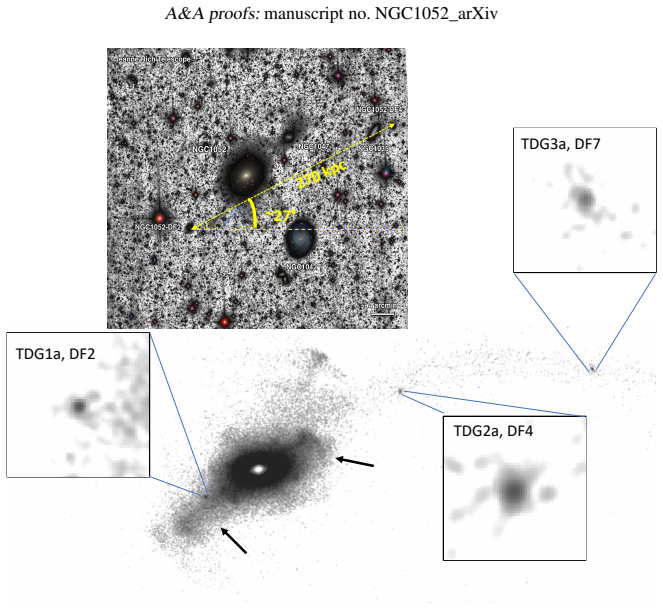
A tuned 1:1 head-on merger that shapes NGC 1052 into an E4 elliptical can also form the observed dark-matter-free dwarfs as tidal dwarf galaxies in long-lived tails.
A machine-rendered reading of the paper's core claim, the machinery that carries it, and where it could break.
Core claim
Simulations of a head-on 1:1 merger tuned to generate the E4 morphology of NGC 1052 produce long-lived tidal features associated with the remnant galaxy in the form of large tidal tails that include tidal dwarf galaxies whose sizes match those of the observed dark-matter-free dwarfs, reproducing both the tidal features in the NGC 1052 outskirts and the dwarf population within the hierarchical merger scenario.
What carries the argument
Tidal dwarf galaxies formed inside large tidal tails during a major galaxy merger.
If this is right
- Such mergers generate long-lived tidal features tied to the remnant galaxy.
- The simulated tidal dwarfs have sizes similar to the observed objects, unlike the much smaller dwarfs produced in the dwarf-collision model.
- Resolving the radial distances between the dwarfs and NGC 1052 can distinguish between formation scenarios.
- Many additional dark-matter-free dwarfs are expected in the neighborhoods of other local massive galaxies and groups.
Where Pith is reading between the lines
- High-resolution simulations that resolve globular clusters could test whether the merger model can also account for the luminous globular cluster systems around the dwarfs.
- Targeted searches for tidal features around other elliptical galaxies of similar mass could reveal additional examples of this formation channel.
- If confirmed, the mechanism would reduce the need to invoke rare events to explain apparent challenges to standard galaxy-formation models.
Load-bearing premise
Merger parameters can be adjusted to match both the E4 shape of NGC 1052 and the observed dwarf properties without the tidal-dwarf outcome being artificially imposed by the choice of parameters.
What would settle it
Precise three-dimensional positions of the dark-matter-free dwarfs that either place them along the geometry of simulated tidal tails or along the trajectory expected from a dwarf-dwarf collision.
Figures
read the original abstract
Discovery of dark-matter (DM) free dwarf galaxies in the NGC 1052 neighborhood has had a considerable impact on modern cosmology. They have been explained through a dwarf--dwarf head-on collision that is a rare event. We find that they could alternatively be associated with a head-on, 1:1 merger after it has been tuned to generate the E4 morphology of NGC 1052. Our simulations show that such mergers produce long-lived tidal features, associated with the remnant galaxy, and in the form of large tidal tails including tidal dwarf galaxies (TDGs). We underline that such tidal features are predicted by the hierarchical scenario in which massive galaxies are formed by galaxy mergers. The latter can reproduce both the tidal features in the NGC1052 outskirts and the observed dwarf galaxies. The simulated TDGs have similar sizes to those observed, while they are ten times smaller in the dwarf bullet scenario. However, we cannot reproduce the luminous globular cluster systems due to resolution limitations. Resolving the radial distance between the DM-free dwarfs is necessary to identify the scenario of their formation. We suggest that there should be many other examples of DM-free dwarf galaxies in the neighborhood of local massive galaxies and galaxy groups.
Editorial analysis
A structured set of objections, weighed in public.
Referee Report
Summary. The paper claims that the dark-matter-free dwarf galaxies observed near NGC 1052 could originate as tidal dwarf galaxies (TDGs) formed in long-lived tidal tails during a head-on 1:1 merger whose parameters have been tuned to reproduce the E4 morphology of NGC 1052, providing an alternative to the rare dwarf-dwarf collision scenario. The simulations are reported to produce TDGs whose sizes match the observed dwarfs (ten times larger than those in the dwarf-dwarf case), consistent with hierarchical merger-driven galaxy formation, although globular cluster systems cannot be reproduced due to resolution limits. The authors note that distinguishing the scenarios requires resolving the radial distances of the dwarfs and predict additional examples near other massive galaxies.
Significance. If the TDG properties prove robust to the merger tuning and resolution effects, the result would offer a natural explanation for DM-free dwarfs within standard hierarchical formation, reducing reliance on rare events and highlighting the role of tidal features around massive galaxies. The size contrast with the dwarf-dwarf case and the prediction of more such systems would be noteworthy if substantiated.
major comments (3)
- [Abstract] Abstract: The claim that a head-on 1:1 merger 'has been tuned' to generate the E4 morphology of NGC 1052 while simultaneously producing TDGs with matching sizes does not demonstrate that TDG formation, mass, size, and survival are independent of the specific tuning choices (impact parameter, orbital energy, gas fraction); no sensitivity tests or alternative E4-producing parameter sets are shown, making the outcome potentially an artifact of the fit rather than a generic prediction.
- [Abstract] Abstract (simulations paragraph): No information is supplied on the numerical methods, initial conditions, particle numbers, mass resolution, or gravitational softening used in the merger simulations, preventing evaluation of whether the reported long-lived tidal tails and TDG sizes are reliable or compromised by the same resolution limitations explicitly cited for the inability to reproduce globular cluster systems.
- [Abstract] Abstract: The size comparison stating that simulated TDGs are 'ten times smaller in the dwarf bullet scenario' is presented without quantitative details on how TDGs are identified or measured in either set of simulations, and the resolution caveat for globular clusters raises the possibility that the same limits affect TDG size determinations, weakening the claimed distinction between scenarios.
minor comments (1)
- [Abstract] The abstract refers to 'the dwarf bullet scenario' without a prior definition or citation in the provided text; a brief clarification of the term would improve readability.
Simulated Author's Rebuttal
We thank the referee for their constructive comments on our manuscript. We respond to each major comment below and indicate where revisions have been made to improve clarity and address the concerns.
read point-by-point responses
-
Referee: [Abstract] Abstract: The claim that a head-on 1:1 merger 'has been tuned' to generate the E4 morphology of NGC 1052 while simultaneously producing TDGs with matching sizes does not demonstrate that TDG formation, mass, size, and survival are independent of the specific tuning choices (impact parameter, orbital energy, gas fraction); no sensitivity tests or alternative E4-producing parameter sets are shown, making the outcome potentially an artifact of the fit rather than a generic prediction.
Authors: The manuscript does not assert that TDG formation, mass, size, or survival are independent of the specific tuning choices, nor does it present the result as a generic prediction applicable to all E4-producing mergers. The abstract describes one specific merger configuration that has been tuned to reproduce the observed E4 morphology of NGC 1052 and that simultaneously yields TDGs with sizes matching the observations. This serves as a proof-of-concept for a tidal origin within the hierarchical merger framework. We have revised the abstract to explicitly state that the result applies to this tuned model without implying broader independence from parameter choices. revision: yes
-
Referee: [Abstract] Abstract (simulations paragraph): No information is supplied on the numerical methods, initial conditions, particle numbers, mass resolution, or gravitational softening used in the merger simulations, preventing evaluation of whether the reported long-lived tidal tails and TDG sizes are reliable or compromised by the same resolution limitations explicitly cited for the inability to reproduce globular cluster systems.
Authors: The abstract is length-limited and therefore omits technical specifications, but the full manuscript includes a methods section providing the numerical methods (N-body/SPH code), initial conditions, particle numbers, mass resolution, and gravitational softening lengths. The TDGs are extended objects with sizes of several kpc, well above the softening scale, while the unresolved globular clusters are much smaller. We have added a short reference to the methods section within the revised abstract to facilitate evaluation. revision: yes
-
Referee: [Abstract] Abstract: The size comparison stating that simulated TDGs are 'ten times smaller in the dwarf bullet scenario' is presented without quantitative details on how TDGs are identified or measured in either set of simulations, and the resolution caveat for globular clusters raises the possibility that the same limits affect TDG size determinations, weakening the claimed distinction between scenarios.
Authors: We have added explicit details on TDG identification (friends-of-friends algorithm applied to stellar particles above a density threshold) and size measurement (half-mass radii) in the revised manuscript. The resolution limitations apply to compact, unresolved globular clusters whose sizes fall below the softening length. The TDGs are extended structures with sizes of order 1 kpc, which are resolved and unaffected by the same limits. The size contrast with the dwarf-dwarf collision simulations therefore remains valid, and this distinction is now stated explicitly. revision: yes
Circularity Check
No significant circularity; derivation self-contained
full rationale
The paper's central claim rests on N-body/hydro simulations of a 1:1 head-on merger whose parameters are adjusted to reproduce the observed E4 morphology of NGC 1052; the resulting long-lived tidal tails and TDGs are then compared to the DM-free dwarfs. No equations, fitted parameters, or self-citations are quoted that reduce the TDG sizes, masses, or survival times to the morphology-tuning inputs by construction. The tuning targets one observable (remnant shape) while TDG properties emerge from the simulation physics; the text does not demonstrate that alternative parameter sets yielding E4 remnants fail to produce comparable TDGs, nor does it invoke prior self-authored uniqueness theorems or ansatzes. The argument is therefore independent of the present paper's own fitted values and does not meet the criteria for any enumerated circularity pattern.
Axiom & Free-Parameter Ledger
free parameters (1)
- merger orbital parameters and mass ratio tuning
axioms (1)
- domain assumption Hierarchical galaxy formation via mergers produces long-lived tidal tails and tidal dwarf galaxies
Reference graph
Works this paper leans on
-
[1]
New Measurements of Distances to Galaxies in the NGC 1052 Field with the Hubble and James Webb Space Telescopes: Testing the Bullet-Dwarf Origin of the Trail. arXiv e-prints , keywords =. doi:10.48550/arXiv.2606.05144 , archivePrefix =. 2606.05144 , primaryClass =
work page internal anchor Pith review Pith/arXiv arXiv doi:10.48550/arxiv.2606.05144
-
[2]
Do dwarf galaxies form in tidal tails?. , keywords =. doi:10.1111/j.1365-2966.2006.11360.x , archivePrefix =. astro-ph/0510821 , primaryClass =
-
[3]
The SLUGGS survey: a comparison of total-mass profiles of early-type galaxies from observations and cosmological simulations, to 4 effective radii. , keywords =. doi:10.1093/mnras/sty456 , archivePrefix =. 1803.02373 , primaryClass =
work page internal anchor Pith review Pith/arXiv arXiv doi:10.1093/mnras/sty456
-
[4]
Dark matter-deficient twins: FCC 224 and FCC 240 as possible analogues of NGC 1052-DF2 and DF4
Dark matter-deficient twins: FCC 224 and FCC 240 as possible analogues of NGC 1052-DF2 and DF4. arXiv e-prints , keywords =. doi:10.48550/arXiv.2605.24099 , archivePrefix =. 2605.24099 , primaryClass =
work page internal anchor Pith review Pith/arXiv arXiv doi:10.48550/arxiv.2605.24099
-
[5]
Comparing Tip of the Red Giant Branch Distance Scales: An Independent Reduction of the Carnegie-Chicago Hubble Program and the Value of the Hubble Constant. , keywords =. doi:10.3847/1538-4357/ac68df , archivePrefix =. 2108.00007 , primaryClass =
-
[6]
Tip of the Red Giant Branch Distances with JWST: An Absolute Calibration in NGC 4258 and First Applications to Type Ia Supernova Hosts. , keywords =. doi:10.3847/1538-4357/ad2e0a , archivePrefix =. 2401.04776 , primaryClass =
-
[7]
Confirmation of an Anomalously Low Dark Matter Content for the Galaxy NGC 1052-DF4 from Deep, High-resolution Continuum Spectroscopy. , keywords =. doi:10.3847/1538-4357/acfa70 , archivePrefix =. 2309.08592 , primaryClass =
-
[8]
Galaxy archaeology for wet mergers: Globular cluster age distributions in the Milky Way and nearby galaxies. , keywords =. doi:10.1051/0004-6361/202348010 , archivePrefix =. 2309.11545 , primaryClass =
-
[9]
Galaxy Disks Do Not Need to Survive in the CDM Paradigm: The Galaxy Merger Rate Out to z -0.5ex 1.5 from Morpho-kinematic Data. , keywords =. doi:10.1088/0004-637X/753/2/128 , archivePrefix =. 1206.0008 , primaryClass =
work page internal anchor Pith review Pith/arXiv arXiv doi:10.1088/0004-637x/753/2/128
-
[10]
A Third Galaxy Missing Dark Matter along a Trail of Galaxies in the NGC 1052 Field
A Third Galaxy Missing Dark Matter along a Trail of Galaxies in the NGC 1052 Field. arXiv e-prints , keywords =. doi:10.48550/arXiv.2603.15860 , archivePrefix =. 2603.15860 , primaryClass =
work page internal anchor Pith review Pith/arXiv arXiv doi:10.48550/arxiv.2603.15860
-
[11]
The Relation between Quasar and Merging Galaxy Luminosity Functions and the Merger-driven Star Formation History of the Universe. , keywords =. doi:10.1086/508503 , archivePrefix =. astro-ph/0602290 , primaryClass =
work page internal anchor Pith review Pith/arXiv arXiv doi:10.1086/508503
-
[12]
BASS. XXVI. DR2 Host Galaxy Stellar Velocity Dispersions. , keywords =. doi:10.3847/1538-4365/ac650b , archivePrefix =. 2207.12435 , primaryClass =
-
[13]
Updated BaSTI Stellar Evolution Models and Isochrones. II. -enhanced Calculations. , keywords =. doi:10.3847/1538-4357/abd4d5 , archivePrefix =. 2012.10085 , primaryClass =
-
[14]
The mass-metallicity relation of tidal dwarf galaxies
The mass-metallicity relation of tidal dwarf galaxies. , keywords =. doi:10.1093/mnras/stv798 , archivePrefix =. 1504.02473 , primaryClass =
work page internal anchor Pith review Pith/arXiv arXiv doi:10.1093/mnras/stv798
-
[15]
Tidal dwarf galaxies in cosmological simulations
Tidal dwarf galaxies in cosmological simulations. , keywords =. doi:10.1093/mnras/stx2787 , archivePrefix =. 1710.09380 , primaryClass =
work page internal anchor Pith review Pith/arXiv arXiv doi:10.1093/mnras/stx2787
-
[16]
Galaxies lacking dark matter in the Illustris simulation. , keywords =. doi:10.1051/0004-6361/201833771 , archivePrefix =. 1905.03258 , primaryClass =
-
[17]
Refueled and shielded - The early evolution of Tidal Dwarf Galaxies
Refuelled and shielded - the early evolution of tidal dwarf galaxies. , keywords =. doi:10.1093/mnras/sty3418 , archivePrefix =. 1812.08093 , primaryClass =
work page internal anchor Pith review Pith/arXiv arXiv doi:10.1093/mnras/sty3418
-
[18]
On the tidal formation of dark matter-deficient galaxies. , keywords =. doi:10.1093/mnras/stab3658 , archivePrefix =. 2111.12104 , primaryClass =
-
[19]
UVIT view of NGC 5291: Ongoing star formation in tidal dwarf galaxies at 0.35 kpc resolution. , keywords =. doi:10.1093/mnras/stad970 , archivePrefix =. 2304.07244 , primaryClass =
-
[20]
Merge and strip: Dark matter-free dwarf galaxies in clusters can be formed by galaxy mergers. , keywords =. doi:10.1051/0004-6361/202449605 , archivePrefix =. 2402.09060 , primaryClass =
-
[21]
Dwarf galaxy formation induced by galaxy interactions
Dwarf Galaxy Formation Induced by Galaxy Interactions. , keywords =. doi:10.1086/317109 , archivePrefix =. astro-ph/0006006 , primaryClass =
work page internal anchor Pith review Pith/arXiv arXiv doi:10.1086/317109
-
[22]
Tip of the Red Giant Branch distances to galaxies with composite stellar populations. , keywords =. doi:10.1111/j.1365-2966.2005.08689.x , archivePrefix =. astro-ph/0412156 , primaryClass =
-
[23]
Formation of dwarf galaxies in tidal tails. , keywords =. doi:10.1038/360715a0 , adsurl =
-
[24]
A Tip of the Red Giant Branch Distance to the Dark Matter Deficient Galaxy NGC 1052-DF4 from Deep Hubble Space Telescope Data. , keywords =. doi:10.3847/2041-8213/ab8dc4 , archivePrefix =. 1910.07529 , primaryClass =
-
[25]
A JWST study of pair fractions, merger rates, and stellar mass accretion rates at z = 4.5 11.5
Galaxy mergers in the epoch of reionization I. A JWST study of pair fractions, merger rates, and stellar mass accretion rates at z = 4.5 11.5. MNRAs , keywords =. doi:10.1093/mnras/staf638 , archivePrefix =. 2407.09472 , primaryClass =
-
[26]
Impact of merger histories on the timing argument estimate of the Local Group mass. , keywords =. doi:10.1051/0004-6361/202553769 , archivePrefix =. 2502.13203 , primaryClass =
-
[27]
Discovery and analysis of low-surface-brightness galaxies in the environment of NGC 1052. , keywords =. doi:10.1051/0004-6361/202142161 , archivePrefix =. 2110.09527 , primaryClass =
-
[28]
What Suppresses Star Formation in Bulge-Dominated Early-Type Galaxies?. arXiv e-prints , keywords =. doi:10.48550/arXiv.2602.12324 , archivePrefix =. 2602.12324 , primaryClass =
-
[29]
GIZMO: A New Class of Accurate, Mesh-Free Hydrodynamic Simulation Methods
A new class of accurate, mesh-free hydrodynamic simulation methods. , keywords =. doi:10.1093/mnras/stv195 , archivePrefix =. 1409.7395 , primaryClass =
work page internal anchor Pith review Pith/arXiv arXiv doi:10.1093/mnras/stv195
-
[30]
Cosmological Simulations with TreeSPH
Cosmological Simulations with TreeSPH. , keywords =. doi:10.1086/192305 , archivePrefix =. astro-ph/9509107 , primaryClass =
work page internal anchor Pith review Pith/arXiv arXiv doi:10.1086/192305
-
[31]
Dark matter fraction derived from the M31 rotation curve. , keywords =. doi:10.1051/0004-6361/202452753 , archivePrefix =. 2412.02737 , primaryClass =
-
[32]
Most pseudo-bulges can be formed at later stages of major mergers
Most pseudo-bulges can be formed at later stages of major mergers. , keywords =. doi:10.1093/mnras/stx2453 , archivePrefix =. 1709.07455 , primaryClass =
work page internal anchor Pith review Pith/arXiv arXiv doi:10.1093/mnras/stx2453
-
[33]
The NGC 4013 tale: a pseudo-bulged, late-type spiral shaped by a major merger
The NGC 4013 tale: a pseudo-bulged, late-type spiral shaped by a major merger. , keywords =. doi:10.1093/mnras/stv1531 , archivePrefix =. 1508.03178 , primaryClass =
work page internal anchor Pith review Pith/arXiv arXiv doi:10.1093/mnras/stv1531
-
[34]
Loops formed by tidal tails as fossil records of a major merger
Loops formed by tidal tails as fossil records of a major merger. , keywords =. doi:10.1051/0004-6361/201117423 , archivePrefix =. 1202.4454 , primaryClass =
work page internal anchor Pith review Pith/arXiv arXiv doi:10.1051/0004-6361/201117423
-
[35]
A galaxy lacking dark matter. , keywords =. doi:10.1038/nature25767 , archivePrefix =. 1803.10237 , primaryClass =
work page internal anchor Pith review Pith/arXiv arXiv doi:10.1038/nature25767
-
[36]
Kinematic Confirmation of a Remarkable Linear Trail of Galaxies in the NGC 1052 Field, Consistent with Formation in a High-speed Bullet Dwarf Collision. , keywords =. doi:10.3847/1538-4357/addfd4 , archivePrefix =. 2506.10220 , primaryClass =
-
[37]
A new way to measure the distance to NGC1052-DF2. , keywords =. doi:10.1051/0004-6361/202452446 , archivePrefix =. 2503.03403 , primaryClass =
-
[38]
Testing the Bullet Dwarf Collision Scenario in the NGC 1052 Group through Morphologies and Stellar Populations. , keywords =. doi:10.3847/1538-4357/ad8cd0 , archivePrefix =. 2410.19331 , primaryClass =
-
[39]
Multiple Beads on a String: Dark-matter-deficient Galaxy Formation in a Mini-Bullet Satellite?Satellite Galaxy Collision. , keywords =. doi:10.3847/1538-4357/ad2932 , archivePrefix =. 2312.11350 , primaryClass =
-
[40]
A trail of dark-matter-free galaxies from a bullet-dwarf collision. , keywords =. doi:10.1038/s41586-022-04665-6 , archivePrefix =. 2205.08552 , primaryClass =
-
[41]
Tidal Distortions in NGC1052-DF2 and NGC1052-DF4: Independent Evidence for a Lack of Dark Matter. , keywords =. doi:10.3847/1538-4357/ac7dab , archivePrefix =. 2109.09778 , primaryClass =
-
[42]
A Tip of the Red Giant Branch Distance of 22.1 1.2 Mpc to the Dark Matter Deficient Galaxy NGC 1052-DF2 from 40 Orbits of Hubble Space Telescope Imaging. , keywords =. doi:10.3847/2041-8213/ac0335 , archivePrefix =. 2104.03319 , primaryClass =
-
[43]
Ultra-diffuse galaxies without dark matter
Ultra-diffuse galaxies without dark matter. , keywords =. doi:10.1093/mnrasl/slz090 , archivePrefix =. 1905.13235 , primaryClass =
work page internal anchor Pith review Pith/arXiv arXiv doi:10.1093/mnrasl/slz090 1905
-
[44]
Dark matter and no dark matter: on the halo mass of NGC 1052. , keywords =. doi:10.1093/mnras/stz2420 , archivePrefix =. 1908.10858 , primaryClass =
-
[45]
Still Missing Dark Matter: KCWI High-Resolution Stellar Kinematics of NGC1052-DF2
Still Missing Dark Matter: KCWI High-resolution Stellar Kinematics of NGC1052-DF2. , keywords =. doi:10.3847/2041-8213/ab0e8c , archivePrefix =. 1901.03711 , primaryClass =
work page internal anchor Pith review Pith/arXiv arXiv doi:10.3847/2041-8213/ab0e8c 2041
-
[46]
A tidal tale: detection of multiple stellar streams in the environment of NGC1052
A tidal tale: detection of several stellar streams in the environment of NGC 1052. , keywords =. doi:10.1051/0004-6361/201935463 , archivePrefix =. 1903.07285 , primaryClass =
work page internal anchor Pith review Pith/arXiv arXiv doi:10.1051/0004-6361/201935463 1903
-
[47]
The TRGB Distance to the Second Galaxy Missing Dark Matter : Evidence for Two Groups of Galaxies at 13.5 and 19 Mpc in the Line of Sight of NGC 1052. , keywords =. doi:10.3847/2041-8213/ab2fd2 , archivePrefix =. 1907.03761 , primaryClass =
-
[48]
A second galaxy missing dark matter in the NGC1052 group
A Second Galaxy Missing Dark Matter in the NGC 1052 Group. , keywords =. doi:10.3847/2041-8213/ab0d92 , archivePrefix =. 1901.05973 , primaryClass =
work page internal anchor Pith review Pith/arXiv arXiv doi:10.3847/2041-8213/ab0d92 2041
-
[49]
The ultra-diffuse galaxy NGC 1052-DF2 with MUSE. II. The population of DF2: stars, clusters, and planetary nebulae. , keywords =. doi:10.1051/0004-6361/201834911 , archivePrefix =. 1812.07346 , primaryClass =
work page internal anchor Pith review Pith/arXiv arXiv doi:10.1051/0004-6361/201834911
-
[50]
Massive star cluster formation and evolution in tidal dwarf galaxies. , keywords =. doi:10.1051/0004-6361/201834403 , archivePrefix =. 1903.10789 , primaryClass =
-
[51]
, year = 2018, month = sep, volume =
Does the galaxy NGC1052-DF2 falsify Milgromian dynamics?. , year = 2018, month = sep, volume =. doi:10.1038/s41586-018-0429-z , adsurl =
-
[52]
The most recent burst of star formation in the massive elliptical galaxy NGC 1052. , keywords =. doi:10.1111/j.1745-3933.2010.00985.x , archivePrefix =. 1011.2498 , primaryClass =
-
[53]
The elliptical galaxies NGC 1052 and NGC 7796: stellar populations and abundance alpha/Fe ratio
The elliptical galaxies NGC 1052 and NGC 7796. Stellar populations and abundance ratio /Fe. , keywords =. doi:10.1051/0004-6361:20054615 , archivePrefix =. astro-ph/0703425 , primaryClass =
work page internal anchor Pith review Pith/arXiv arXiv doi:10.1051/0004-6361:20054615
-
[54]
Evolutionary history of the elliptical galaxy NGC 1052. , keywords =. doi:10.1111/j.1365-2966.2005.08778.x , archivePrefix =. astro-ph/0501066 , primaryClass =
-
[55]
The distribution and kinematics of H I in the active elliptical galaxy NGC 1052. , keywords =. doi:10.1086/114060 , adsurl =
-
[56]
How do Disks Survive Mergers?. , keywords =. doi:10.1088/0004-637X/691/2/1168 , archivePrefix =. 0806.1739 , primaryClass =
work page internal anchor Pith review Pith/arXiv arXiv doi:10.1088/0004-637x/691/2/1168
-
[57]
Transformations of Galaxies. II. Gasdynamics in Merging Disk Galaxies. , keywords =. doi:10.1086/177957 , adsurl =
-
[58]
2002, MNRAS, 329, 355, doi: 10.1046/j.1365-8711.2002.04988.x
Formation of gas discs in merging galaxies. , keywords =. doi:10.1046/j.1365-8711.2002.05335.x , archivePrefix =. astro-ph/0201250 , primaryClass =
-
[59]
Planck 2018 results. VI. Cosmological parameters. , keywords =. doi:10.1051/0004-6361/201833910 , archivePrefix =. 1807.06209 , primaryClass =
work page internal anchor Pith review Pith/arXiv arXiv doi:10.1051/0004-6361/201833910 2018
-
[60]
The Milky Way: An Exceptionally Quiet Galaxy; Implications for the formation of spiral galaxies
The Milky Way, an Exceptionally Quiet Galaxy: Implications for the Formation of Spiral Galaxies. , keywords =. doi:10.1086/516727 , archivePrefix =. astro-ph/0702585 , primaryClass =
work page internal anchor Pith review Pith/arXiv arXiv doi:10.1086/516727
-
[61]
How was the Hubble sequence 6 Gyrs ago?
How was the Hubble sequence 6 Gyr ago?. , keywords =. doi:10.1051/0004-6361/200912704 , archivePrefix =. 0906.2805 , primaryClass =
work page internal anchor Pith review Pith/arXiv arXiv doi:10.1051/0004-6361/200912704
-
[62]
Dark Halo and Disk Galaxy Scaling Laws in Hierarchical Universes
Dark Halo and Disk Galaxy Scaling Laws in Hierarchical Universes. , keywords =. doi:10.1086/309175 , archivePrefix =. astro-ph/0001003 , primaryClass =
work page internal anchor Pith review Pith/arXiv arXiv doi:10.1086/309175
-
[63]
, year = 1962, month = nov, volume =
Evidence from the motions of old stars that the Galaxy collapsed. , year = 1962, month = nov, volume =. doi:10.1086/147433 , adsurl =
-
[64]
Galactic Disks, Infall, and the Global Value of Omega. , keywords =. doi:10.1086/171185 , adsurl =
-
[65]
A giant stream of metal-rich stars in the halo of the galaxy M31
A giant stream of metal-rich stars in the halo of the galaxy M31. , keywords =. doi:10.1038/35083506 , archivePrefix =. astro-ph/0107090 , primaryClass =
work page internal anchor Pith review Pith/arXiv arXiv doi:10.1038/35083506
-
[66]
Did most present-day spirals form during the last 8 Gyr?. A formation history with violent episodes revealed by panchromatic observations. , keywords =. doi:10.1051/0004-6361:20041471 , archivePrefix =. astro-ph/0410518 , primaryClass =
work page internal anchor Pith review Pith/arXiv arXiv doi:10.1051/0004-6361:20041471
-
[67]
The Hubble sequence: just a vestige of merger events?
The Hubble sequence: just a vestige of merger events?. , keywords =. doi:10.1051/0004-6361/200912115 , archivePrefix =. 0903.3962 , primaryClass =
work page internal anchor Pith review Pith/arXiv arXiv doi:10.1051/0004-6361/200912115
-
[68]
Feedback in simulations of disc-galaxy major mergers. , keywords =. doi:10.1111/j.1365-2966.2006.11107.x , archivePrefix =. astro-ph/0503201 , primaryClass =
-
[69]
On feathers, bifurcations and shells: the dynamics of tidal streams across the mass scale
On feathers, bifurcations and shells: the dynamics of tidal streams across the mass scale. , keywords =. doi:10.1093/mnras/stv648 , archivePrefix =. 1410.0360 , primaryClass =
work page internal anchor Pith review Pith/arXiv arXiv doi:10.1093/mnras/stv648
-
[70]
Contributions to the accreted stellar halo: an atlas of stellar deposition
Contributions to the accreted stellar halo: an atlas of stellar deposition. , keywords =. doi:10.1093/mnras/stw2229 , archivePrefix =. 1511.08806 , primaryClass =
work page internal anchor Pith review Pith/arXiv arXiv doi:10.1093/mnras/stw2229
-
[71]
The Panchromatic Hubble Andromeda Treasury
The Panchromatic Hubble Andromeda Treasury. , keywords =. doi:10.1088/0067-0049/200/2/18 , archivePrefix =. 1204.0010 , primaryClass =
work page internal anchor Pith review Pith/arXiv arXiv doi:10.1088/0067-0049/200/2/18
-
[72]
The distribution and kinematics of neutral hydrogen in spiral galaxies of various morphological types
-
[73]
Extended rotation curves of high-luminosity spiral galaxies. IV. Systematic dynamical properties, Sa -> Sc. , keywords =. doi:10.1086/182804 , adsurl =
-
[74]
Publications of Michigan Observatory , year = 1951, month = jan, volume =
Comparison of Rotational Motions Observed in the Spirals M31 and M33 and in The Galaxy. Publications of Michigan Observatory , year = 1951, month = jan, volume =
1951
-
[75]
Lick Observatory Bulletin , keywords =
The rotation of the Andromeda Nebula. Lick Observatory Bulletin , keywords =. doi:10.5479/ADS/bib/1939LicOB.19.41B , adsurl =
-
[76]
, year = 1925, month = jun, volume =
The Motions and the Distances of Spiral Nebul. , year = 1925, month = jun, volume =. doi:10.1093/mnras/85.8.865 , adsurl =
-
[77]
EAS2024 , year = 2024, month = jul, eid =
A major merger as the origin of the giant stream and inner halo substructures in the Andromeda Galaxy (M31): Comparing the predictions from 1:4 merger simulations with chemodynamical data. EAS2024 , year = 2024, month = jul, eid =
2024
-
[78]
Kinematics of M 31 inner-halo substructures and comparison with major-merger simulation predictions
The survey of planetary nebulae in Andromeda (M 31) VI. Kinematics of M 31 inner-halo substructures and comparison with major-merger simulation predictions. , keywords =. doi:10.1093/mnras/stad1378 , archivePrefix =. 2304.14151 , primaryClass =
-
[79]
Trudy Astrofizicheskogo Instituta Alma-Ata , year = 1965, month = jan, volume =
On the Construction of a Composite Model for the Galaxy and on the Determination of the System of Galactic Parameters. Trudy Astrofizicheskogo Instituta Alma-Ata , year = 1965, month = jan, volume =
1965
-
[80]
Battaglia, G. and Taibi, S. and Thomas, G. F. and Fritz, T. K. , year=. Gaia early DR3 systemic motions of Local Group dwarf galaxies and orbital properties with a massive Large Magellanic Cloud , volume=. doi:10.1051/0004-6361/202141528 , journal=
discussion (0)
Sign in with ORCID, Apple, or X to comment. Anyone can read and Pith papers without signing in.