REVIEW 5 major objections 7 minor 38 references
Avoiding Death through Fear Intrinsic Conditioning
T0 review · 5 major / 7 minor · reviewed 2026-08-07 · deepseek-v4-flash
Pith's one-line read A reinforcement learning agent can learn to avoid terminal 'death' states without direct experience, using an intrinsic fear reward produced by a memory-augmented network trained on a handful of dangerous behavior examples.
desk verdict Clever architecture, weak evaluation: the behavior-sequence fear reward is a plausible idea, but the danger classifier is never validated on the agent's own rollouts, so the central claim is unsupported. read the letter →
The pith
A machine-rendered reading of the paper's core claim, the machinery that carries it, and where it could break.
The reading
What carries the argument
The central object is the Siamese LSTM (SLSTM) controller embedded in a memory-augmented neural network (SMANN). The SLSTM replaces the linear projection gates of an LSTM with a Siamese (twin) network so the controller can mix image sequences and prior read vectors into one encoding; the SMANN then reads from memory by cosine similarity between the encoding of a behavior (state transitions) and stored parent behaviors. This read operation changes the MANN from comparing single states to comparing behaviors, and the resulting probability is scaled by a threshold to form the intrinsic reward.
What would settle it
Replace the trained SMANN's fear score with a fixed random score produced from the same 38 trajectories, retrain the agent, and check whether the episode-length and goal-finding differences disappear; if they remain, the observed avoidance is not caused by learned fear representations.
Extended reading notes
Core claim
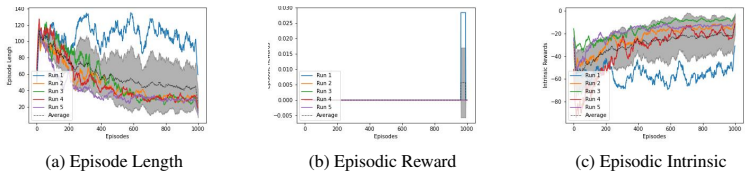
The central claim is that an intrinsic reward derived from remembered behaviors—rather than from direct experience of danger—can deter an agent from non-descriptive terminal conditions and produce avoidance behavior resembling animal fear conditioning. The paper operationalizes social conditioning as a behavior value computed over state transitions supplied by a 'parent' (trust set to 1), stores these behavior encodings in a memory, and at each step penalizes the agent proportionally to the cosine similarity between its current behavior sequence and the stored dangerous behaviors. This makes the agent avoid a class of state transitions, not just a single stimulus state, and the threshold parameter controls how stringently the representation generalizes. Empirically, the fear-conditioned PPO agent achieves longer average episode lengths (up to 135.4 steps) than base PPO (115.1), and several runs collect positive extrinsic reward (maximum 0.082) where base PPO collects none.
Load-bearing premise
The whole scheme depends on the fear classifier, trained on just 38 examples of 'danger' and 'safe' behavior, correctly recognizing danger in the agent's own experiences; if the agent's view of the world and the classifier's view drift apart, the fear signal becomes noise.
Editorial extensions
If this is right
- Agents can be preconditioned to avoid terminal states using only a handful of demonstrated dangerous behaviors, reducing the need to sample lethal states during training.
- The threshold parameter gives a tunable safety-exploration tradeoff: lower thresholds produce longer, safer episodes but fewer goal findings, while higher thresholds allow more exploration and more successes.
- The same framework could be applied to other partially-observable, sparse-reward environments with non-descriptive terminal conditions, such as the Lavagap environment.
- The method suggests a route toward single-life RL, where an agent cannot afford to die during training.
Reading between the lines
- If the mechanism is genuine, the same learned fear signal could shape behavior in continuous control and robotics by conditioning on demonstrations rather than engineered reward penalties; this is our inference, not tested in the paper.
- The threshold-behavior curve suggests a concrete testable analogue of anxiety: an agent with a near-zero threshold should freeze or become pathologically avoidant, and one with too high a threshold should fail to generalize danger; examining the shape of this curve across environments could ground the GAD analogy in measured performance.
- A harder test the paper does not run: ablating the SLSTM's memory read and replacing the fear score with a random-but-fixed classifier trained on the same 38 trajectories would show whether avoidance comes from the learned behavior representation or merely from any constant penalty.
Editorial analysis
A structured set of objections, weighed in public.
Referee Report
Summary. The paper proposes an intrinsic reward mechanism for RL agents to avoid terminal states without directly experiencing them, inspired by social fear conditioning. The agent uses a Siamese MANN with a new SLSTM module trained on a small set of parent behavior trajectories (danger and non-danger classes) to compute a similarity score between the agent's current behavior and stored fear behaviors. A thresholded negative intrinsic reward is added to the extrinsic reward. Experiments in Miniworld Sidewalk, a POMDP with sparse rewards and a non-descriptive terminal condition, show that PPO with this fear intrinsic reward achieves longer average episode lengths than base PPO (e.g., 128.7 and 135.4 for low and mid thresholds vs. 115.1 for base PPO) and that some runs occasionally reach the goal (max extrinsic reward up to 0.082). The authors also vary the threshold to model behaviors described under general anxiety disorders.
Significance. If the mechanism works as claimed, the paper would offer a potentially useful direction for safe exploration in RL, avoiding dangerous states without direct sampling. The proposal of a biologically-inspired architecture for fear conditioning is intriguing, and the paper includes pseudocode and a link to code, which is a strength. However, the current evidence is insufficient to establish the central claim. The intrinsic reward is essentially the output of a supervised classifier trained on 38 hand-crafted trajectories per class, and the paper acknowledges possible feature misalignment between the policy and the classifier. Without validating the classifier's predictive validity on the agent's own state distribution, the observed behavior could be explained by a generic dense penalty. The experimental results are also statistically weak, with only 5 runs per condition and large variances. Thus, while the idea is potentially interesting, the present version does not convincingly demonstrate fear-conditioned avoidance behavior.
major comments (5)
- [Section 4 and Limitations] The central claim that the fear intrinsic reward deters exploration of terminal states requires the SMANN's danger probability to be genuinely predictive of death on the agent's own rollout distribution. The paper provides no such validation. The SMANN is trained on only 38 hand-crafted trajectories per class (Section 4) and is frozen during PPO training, while the Limitations section acknowledges "possible misalignment of the agents' feature extractor and the SMANN feature extractor." If the classifier's scores are not predictive of actual terminal states on the policy's state distribution, the observed increase in episode length (Table 1) could result from any dense negative reward reducing exploration, not from behavior-specific fear conditioning. The authors should evaluate the SMANN's discrimination (e.g., ROC curves, calibration) on rollouts from the trained policy and, if necessary, re-train or adapt the classifier.
- [Section 3, Eqs. (1)-(4)] The formal definition of behavior value is not rigorous and does not connect to the implemented intrinsic reward. Equations (1)-(4) mix set notation for transitions with value functions, use probabilities such as P(S''|*,S) that are not defined over a distribution of actions, and do not explain how V^π_{Parent} or V^π_{Peer} relate to the actual scalar intrinsic reward described in Algorithm 2 ("bad-behavior-prob * β-Value"). This makes it difficult to verify that the computational implementation matches the proposed theory. A precise specification of the intrinsic reward as a function of the SMANN output and the threshold is needed.
- [Section 5, Table 1] The experimental results are statistically weak. Only 5 runs per condition are reported, and the differences in episode length overlap substantially across conditions (e.g., low β 128.701 ± 9.124 vs. base 115.061 ± 7.675). No significance tests are provided, and the text makes claims such as "the low threshold model was consistently able to find the goal" that are contradicted by the reported max extrinsic rewards (0.057 for low β, 0.026 for mid β). The claim that the agent can "solve" the environment relies on rare goal-reaching episodes (max extrinsic reward 0.082), which could be outliers. The authors should report more runs, include confidence intervals or statistical tests, and clearly define what constitutes solving the environment.
- [Section 4] The training data for the SMANN is extremely small and hand-crafted: 38 trajectories per class, generated by an oracle that forces the agent to approach the terminal condition within three actions or to move away. The paper does not report the classifier's accuracy on any held-out set, nor does it analyze what features the SMANN learns. Without this, it is unclear whether the classifier is detecting risk of death or simply distinguishing scripted trajectories from random ones. The authors should provide classification performance metrics and an analysis of the intrinsic reward signal on the agent's actual rollouts.
- [Section 5, Figure 4 and related work] The comparison with the stimuli-based baseline [29] is not sufficient to show that the proposed SLSTM/MANN mechanism provides a benefit beyond thresholding a classifier output. The stimuli method appears to give a constant negative reward (approximating a living cost), while the proposed method gates the reward by a threshold. To support the claim that the specific architecture and behavior-based similarity are important, the authors should compare against a simpler reward-shaping baseline that applies a negative penalty when a classifier trained on the same data deems the current state dangerous. Otherwise, the observed improvement may be attributable solely to the thresholding scheme rather than to the proposed memory architecture.
minor comments (7)
- [General] The manuscript contains numerous grammatical and typographical errors, including the title "A voiding Death" (likely a formatting issue), "polices" instead of "policies" (Section 3), and incomplete sentence in Figure 7 caption ("increasing while still punishing the pristine representation of fear"). A thorough proofreading pass is needed.
- [Section 3, Eqs. (1) and (3)] Equations (1) and (3) are nearly identical except for the subscript, and the notation is inconsistent (e.g., P(a1|S) vs. P(a1|s); P(S'|a1, s) vs. P(S''|a1, s)). The authors should unify the notation and clearly define all variables, including the meaning of the set notation and the role of actions in behavior value.
- [Appendix, Algorithms 2 and 4] The pseudocode references "β-Value" in Algorithm 2 without defining it; it is presumably the threshold β described in the main text, but the connection should be made explicit. Also, the algorithm numbering (2 and 4) does not align with the cross-references in the text; please ensure consistency.
- [Section 5, Table 1] The row "Agent & Offline" is incomplete and unclear: the episode length and intrinsic reward columns are "NA", and the values 0.769 ± 0.060 and 0.820 are not labeled. Clarify that this is a separate offline method and is not directly comparable.
- [Section 4] The description of threshold ranges is inconsistent: the text says low thresholds ranged from 0.25 to 0.45, mid from 0.5 to 0.75, and high from 0.75 to 0.95, but Table 1 reports only three specific thresholds (0.25, 0.60, 0.95). Clarify whether the ranges were averaged or whether only representative thresholds were used.
- [Section 5, Analysis] The statement "the low threshold model was consistently able to find the goal whereas the middle threshold only found it once for a few episodes" is not supported by the data in Table 1, where low β has a max extrinsic reward of 0.057 and mid β has 0.026. Please reconcile this discrepancy or correct the claim.
- [Abstract and conclusion] The abstract claims the agent is "able to solve environments with non-descriptive terminal conditions," but the experiments show only a few episodes with positive extrinsic reward. This overstates the results; please temper the claim or provide stronger evidence of consistent goal-reaching.
Circularity Check
The avoidance behavior is enforced by an intrinsic reward defined as the SMANN's fitted bad-behavior probability, so the central 'death avoidance' claim reduces to the reward construction.
-
fitted input called prediction
[Section 4 (Experimental Setup) and Appendix Algorithm 2]
"The fear behavior dataset was produced by starting the agent at a non-fear state, then, within three actions, the agent was made to approach the terminal condition. ... Intrinsic reward= bad-behavior-prob*β-Value; Agent Reward=(Intrinsic reward+Extrinsic reward)"
The SMANN is trained to classify behavior sequences as fear/non-fear using a dataset in which the 'fear' class is generated by forcing the agent to approach the terminal condition. At deployment, the PPO agent's reward is exactly the SMANN's bad-behavior probability times beta (Algorithm 2). Minimizing this reward is therefore, by construction, a penalty for reproducing the hand-labeled terminal-approaching transitions. So the paper's claim that this intrinsic reward 'deters exploration of terminal states' is not an emergent prediction but the direct optimization objective encoded in the reward; the fitted danger labels are presented as observed avoidance.
full rationale
The core derivation chain is: hand-crafted fear trajectories -> SMANN classifier -> intrinsic reward -> avoidance. The last step is largely enforced by the reward definition, making the headline 'prediction' of death avoidance partially circular (score 6). The paper does not rely on a self-citation chain for its force; reference [29] is used as a baseline and data-creation precedent but is not load-bearing. The threshold-dependent behavioral differences (low vs. mid vs. high beta) are mostly consequences of the threshold's definition, though they are demonstrated empirically and are not the same as the central death-avoidance claim. The acknowledged feature-misalignment limitation is a validity risk rather than circularity, but it underscores that the only genuine empirical question—whether the frozen classifier transfers to the policy's own state distribution—is left open. No other self-defined equations or imported uniqueness theorems appear.
Assumptions & free parameters
free parameters (3)
- Fear threshold beta =
0.25, 0.60, 0.95 (low, mid, high)
- Trust factor kappa =
1
- SLSTM/MANN hyperparameters =
learning rate 1e-3, epochs 150/300, memory size 128x40, etc.
assumptions (3)
- domain assumption The hand-crafted 'fear behavior' dataset accurately represents behaviors that lead to the terminal condition.
- domain assumption Cosine similarity in the learned embedding space is a valid measure of behavioral similarity.
- domain assumption PPO with a fixed update rate can optimize the composite reward (extrinsic plus intrinsic) to produce meaningful avoidance.
invented entities (2)
-
Siamese LSTM (SLSTM) module
-
Siamese MANN (SMANN)
Cite this review
Pith. "Pith review of Avoiding Death through Fear Intrinsic Conditioning." pith.science (2026). https://pith.science/paper/WZYSHQKR
@misc{pith2026250605529,
  author       = {Pith},
  title        = {Pith review of: Avoiding Death through Fear Intrinsic Conditioning},
  year         = {2026},
  howpublished = {\url{https://pith.science/paper/WZYSHQKR}},
  note         = {Machine review of arXiv:2506.05529}
}
read the original abstract
Biological and psychological concepts have inspired reinforcement learning algorithms to create new complex behaviors that expand agents' capacity. These behaviors can be seen in the rise of techniques like goal decomposition, curriculum, and intrinsic rewards, which have paved the way for these complex behaviors. One limitation in evaluating these methods is the requirement for engineered extrinsic for realistic environments. A central challenge in engineering the necessary reward function(s) comes from these environments containing states that carry high negative rewards, but provide no feedback to the agent. Death is one such stimuli that fails to provide direct feedback to the agent. In this work, we introduce an intrinsic reward function inspired by early amygdala development and produce this intrinsic reward through a novel memory-augmented neural network (MANN) architecture. We show how this intrinsic motivation serves to deter exploration of terminal states and results in avoidance behavior similar to fear conditioning observed in animals. Furthermore, we demonstrate how modifying a threshold where the fear response is active produces a range of behaviors that are described under the paradigm of general anxiety disorders (GADs). We demonstrate this behavior in the Miniworld Sidewalk environment, which provides a partially observable Markov decision process (POMDP) and a sparse reward with a non-descriptive terminal condition, i.e., death. In effect, this study results in a biologically-inspired neural architecture and framework for fear conditioning paradigms; we empirically demonstrate avoidance behavior in a constructed agent that is able to solve environments with non-descriptive terminal conditions.
Figures


Figures from the paper (13 more)


Reference graph
Works this paper leans on
-
[29]
Fear based intrinsic reward as a barrier function for continuous reinforcement learning
Rodney Sanchez, Ferat Sahin, and Jamison Heard. Fear based intrinsic reward as a barrier function for continuous reinforcement learning. In 2024 19th Annual System of Systems Engineering Conference (SoSE), pages 140–146. IEEE, 2024
work page 2024
-
[1]
Chris Askew and Andy P. Field. The vicarious learning pathway to fear 40 years on. Clinical Psychology Review, 28(7):1249–1265, 10 2008
work page 2008
-
[2]
Distop: Discovering a topological representation to learn diverse and rewarding skills
Arthur Aubret, Laetitia Matignon, and Salima Hassas. Distop: Discovering a topological representation to learn diverse and rewarding skills. IEEE Transactions on Cognitive and Developmental Systems, 15(4):1905–1915, 2023
work page 1905
-
[3]
Openai gym, 2016
Greg Brockman, Vicki Cheung, Ludwig Pettersson, Jonas Schneider, John Schulman, Jie Tang, and Wojciech Zaremba. Openai gym, 2016
2016
-
[4]
Exploration by Random Network Distillation
Yuri Burda, Harrison Edwards, Amos J Storkey, and Oleg Klimov. Exploration by Random Network Distillation. ICLR, 2019
work page 2019
-
[5]
Ho Kei Cheng and Alexander G. Schwing. Xmem: Long-term video object segmentation with an atkinson-shiffrin memory model. In Shai Avidan, Gabriel Brostow, Moustapha Cissé, Giovanni Maria Farinella, and Tal Hassner, editors, Computer Vision – ECCV 2022 , pages 640–658, Cham, 2022. Springer Nature Switzerland
work page 2022
-
[6]
Maxime Chevalier-Boisvert, Bolun Dai, Mark Towers, Rodrigo De Lazcano, Lucas Willems Mi- ple, Salem Lahlou, Pablo Samuel Castro, Google Deepmind, and Jordan Terry. Minigrid & Miniworld: Modular & Customizable Reinforcement Learning Environments for Goal-Oriented Tasks. Advances in Neural Information Processing Systems, 36, 2024
work page 2024
-
[7]
Craske, Dirk Hermans, and Bram Vervliet
Michelle G. Craske, Dirk Hermans, and Bram Vervliet. State-of-the-art and future directions for extinction as a translational model for fear and anxiety. Philosophical Transactions of the Royal Society B: Biological Sciences, 373(1742):20170025, 2018
work page 2018
Show all 38 references
-
[8]
Delgado, A
M.R. Delgado, A. Olsson, and E.A. Phelps. Extending animal models of fear conditioning to humans. Biological Psychology, 73(1):39–48, 2006. Translational Research: Parallels of Human and Animal Research in Biological Psychology
2006
-
[9]
Abnormal fear memory as a model for posttraumatic stress disorder
Aline Desmedt, Aline Marighetto, and Pier-Vincenzo Piazza. Abnormal fear memory as a model for posttraumatic stress disorder. Biological Psychiatry, 78(5):290–297, 2015. Understanding PTSD: From Mind to Molecules
2015
-
[10]
The infinite partially observable markov decision process
Finale Doshi-Velez. The infinite partially observable markov decision process. In Yoshua Bengio, Dale Schuurmans, John D. Lafferty, Christopher K. I. Williams, and Aron Culotta, editors, Advances in Neural Information Processing Systems 22: 23rd Annual Conference on Neural Inf...
2009
-
[11]
Gorman and Steven P
Jack M. Gorman and Steven P. Roose. The neurobiology of fear memory reconsolidation and psychoanalytic theory. Journal of the American Psychoanalytic Association, 59(6):1201–1220,
-
[12]
Neural turing machines
Alex Graves, Greg Wayne, and Ivo Danihelka. Neural turing machines. arXiv preprint arXiv:1410.5401, 2014
2014 arXiv
-
[13]
Soft actor-critic: Off- policy maximum entropy deep reinforcement learning with a stochastic actor
Tuomas Haarnoja, Aurick Zhou, Pieter Abbeel, and Sergey Levine. Soft actor-critic: Off- policy maximum entropy deep reinforcement learning with a stochastic actor. In International conference on machine learning, pages 1861–1870. Pmlr, 2018
2018
-
[14]
Craske, Susan Mineka, and Peter F
Dirk Hermans, Michelle G. Craske, Susan Mineka, and Peter F. Lovibond. Extinction in human fear conditioning. Biological Psychiatry, 60(4):361–368, 2006
2006
-
[15]
Neural networks and physical systems with emergent collective computational abilities
J J Hopfield. Neural networks and physical systems with emergent collective computational abilities. Proc Natl Acad Sci U S A, 79(8):2554–2558, April 1982
1982
-
[16]
Myers, Michael Davis, and Erica J
Tanja Jovanovic, Megan Keyes, Ana Fiallos, Karyn M. Myers, Michael Davis, and Erica J. Duncan. Fear potentiation and fear inhibition in a human fear-potentiated startle paradigm. Biological Psychiatry, 57(12):1559–1564, 2005
2005
-
[17]
Behavioral and neural mechanisms of overgeneral- ization in anxiety
Offir Laufer, David Israeli, and Rony Paz. Behavioral and neural mechanisms of overgeneral- ization in anxiety. Current Biology, 26(6):713–722, March 2016
2016
-
[18]
Learning subgoal representations with slow dynamics
Siyuan Li, Lulu Zheng, Jianhao Wang, and Chongjie Zhang. Learning subgoal representations with slow dynamics. In International Conference on Learning Representations, 2021
2021
-
[19]
Count-based exploration with the successor representation
Marlos C Machado, Marc G Bellemare, and Michael Bowling. Count-based exploration with the successor representation. In Proceedings of the AAAI Conference on Artificial Intelligence, volume 34, pages 5125–5133, 2020
2020
-
[20]
Search-based adversarial estimates for improving sample efficiency in off-policy reinforcement learning
Federico Malato and Ville Hautamaki. Search-based adversarial estimates for improving sample efficiency in off-policy reinforcement learning. arXiv preprint arXiv:2502.01558, 2025
2025 arXiv
-
[21]
Online adaptation for enhancing imitation learning policies
Federico Malato and Ville Hautamäki. Online adaptation for enhancing imitation learning policies. In 2024 IEEE Conference on Games (CoG), pages 1–8, 2024
2024
-
[22]
Experimentally validated memris- tive memory augmented neural network with efficient hashing and similarity search
Ruibin Mao, Bo Wen, Arman Kazemi, Yahui Zhao, Ann Franchesca Laguna, Rui Lin, Ngai Wong, Michael Niemier, X Sharon Hu, Xia Sheng, et al. Experimentally validated memris- tive memory augmented neural network with efficient hashing and similarity search. Nature communications, 1...
2022
-
[23]
Herringa, and Mohammed R
Marie France Marin, Alexe Bilodeau-Houle, Simon Morand-Beaulieu, Alexandra Brouillard, Ryan J. Herringa, and Mohammed R. Milad. Vicarious conditioned fear acquisition and extinction in child–parent dyads. Scientific Reports, 10(1), 12 2020
2020
-
[24]
Milad, Christopher I
Mohammed R. Milad, Christopher I. Wright, Scott P. Orr, Roger K. Pitman, Gregory J. Quirk, and Scott L. Rauch. Recall of fear extinction in humans activates the ventromedial prefrontal cortex and hippocampus in concert. Biological Psychiatry, 62(5):446–454, 2007. Neurocircuitr...
2007
-
[25]
Phobias and preparedness: the selective, automatic, and encapsulated nature of fear
Susan Mineka and Arne Öhman. Phobias and preparedness: the selective, automatic, and encapsulated nature of fear. Biological Psychiatry, 52(10):927–937, 2002
2002
-
[26]
Rusu, Joel Veness, Marc G
V olodymyr Mnih, Koray Kavukcuoglu, David Silver, Andrei A. Rusu, Joel Veness, Marc G. Bellemare, Alex Graves, Martin Riedmiller, Andreas K. Fidjeland, Georg Ostrovski, Stig Pe- tersen, Charles Beattie, Amir Sadik, Ioannis Antonoglou, Helen King, Dharshan Kumaran, Daan Wierstr...
2015
-
[27]
Towards robust shielded reinforcement learning through adaptive constraints and exploration: The fear field framework
Haritz Odriozola-Olalde, Maider Zamalloa, Nestor Arana-Arexolaleiba, and Jon Perez- Cerrolaza. Towards robust shielded reinforcement learning through adaptive constraints and exploration: The fear field framework. Engineering Applications of Artificial Intelligence , 144:110055, 2025
2025
-
[28]
Mortal computation: A foundation for biomimetic intelligence
Alexander Ororbia and Karl Friston. Mortal computation: A foundation for biomimetic intelligence. arXiv preprint arXiv:2311.09589, 2023. 11
2023 arXiv
-
[30]
Meta-Learning with Memory-Augmented Neural Networks, 6 2016
Adam Santoro, Sergey Bartunov, Matthew Botvinick, Daan Wierstra, Timothy Lillicrap, and Google Deepmind. Meta-Learning with Memory-Augmented Neural Networks, 6 2016
2016
-
[31]
Proximal policy optimization algorithms
John Schulman, Filip Wolski, Prafulla Dhariwal, Alec Radford, and Oleg Klimov. Proximal policy optimization algorithms. arXiv preprint arXiv:1707.06347, 2017
2017 arXiv
-
[32]
Planning to explore via self-supervised world models
Ramanan Sekar, Oleh Rybkin, Kostas Daniilidis, Pieter Abbeel, Danijar Hafner, and Deepak Pathak. Planning to explore via self-supervised world models. In International conference on machine learning, pages 8583–8592. PMLR, 2020
2020
-
[33]
Lewis, Andrew G
Satinder Singh, Richard L. Lewis, Andrew G. Barto, and Jonathan Sorg. Intrinsically motivated reinforcement learning: An evolutionary perspective.IEEE Transactions on Autonomous Mental Development, 2(2):70–82, 2010
2010
-
[34]
Neurobiology of infant fear and anxiety: Impacts of delayed amygdala development and attachment figure quality
Regina M Sullivan and Maya Opendak. Neurobiology of infant fear and anxiety: Impacts of delayed amygdala development and attachment figure quality. Biol Psychiatry, 89(7):641–650, August 2020
2020
-
[35]
Reinforcement Learning: An Introduction Second edition, in progress
Richard S Sutton and Andrew G Barto. Reinforcement Learning: An Introduction Second edition, in progress. MIT press, 2nd edition, 2018
2018
-
[36]
Sample efficient reinforce- ment learning via model-ensemble exploration and exploitation
Yao Yao, Li Xiao, Zhicheng An, Wanpeng Zhang, and Dijun Luo. Sample efficient reinforce- ment learning via model-ensemble exploration and exploitation. In 2021 IEEE International Conference on Robotics and Automation (ICRA), pages 4202–4208. IEEE, 2021
2021
-
[37]
Computationally and sample efficient safe rein- forcement learning using adaptive conformal prediction
Hao Zhou, Yanze Zhang, and Wenhao Luo. Computationally and sample efficient safe rein- forcement learning using adaptive conformal prediction. international conference robotics and automation, 2025
2025
-
[38]
Importance weighted actor-critic for optimal conservative offline reinforcement learning.Advances in Neural Information Processing Systems, 36:49579–49602, 2023
Hanlin Zhu, Paria Rashidinejad, and Jiantao Jiao. Importance weighted actor-critic for optimal conservative offline reinforcement learning.Advances in Neural Information Processing Systems, 36:49579–49602, 2023. 12 7 Appendix / supplemental material 7.1 Larger Methodology Figu...
2023
Reviewed August 7, 2026 · model on record in the stance chip above.
Discussion (0). Sign in to comment.