3D Optical Spectroscopic Study of NGC3344 with SITELLE: I. Identification and Confirmation of Supernova Remnants
Pith reviewed 2026-05-25 17:13 UTC · model grok-4.3
The pith
High-resolution spectroscopy confirms 42 supernova remnants in NGC3344 with metallicities from LMC-like to twice solar.
A machine-rendered reading of the paper's core claim, the machinery that carries it, and where it could break.
Core claim
Using SITELLE data, the study isolates 129 SNR candidates in NGC3344 via the [S II]/Hα ≥ 0.4 criterion, then applies Sabbadin plots and BPT diagrams to confirm shock ionization and arrive at 42 confirmed SNRs whose metallicities, derived from shock models, range between LMC and 2×solar values. Correlations emerge between confirmed-SNR size and emission-line ratios, galactic environment, and galactocentric distance, including a metallicity gradient and evolutionary signatures.
What carries the argument
The [S II]/Hα ≥ 0.4 threshold combined with Sabbadin plots and BPT diagrams to isolate shock-heated supernova remnants from H II regions and diffuse ionized gas.
If this is right
- The 42 confirmed SNRs exhibit metallicities between LMC and twice solar according to shock models.
- A metallicity gradient appears among the SNR population as a function of galactocentric distance.
- Correlations between SNR size, line ratios, and environment indicate evolutionary effects within the sample.
- The classification method succeeds in separating SNRs despite NGC3344's prominent stellar and diffuse-gas background.
Where Pith is reading between the lines
- The same line-ratio and diagram criteria could be applied to other nearby spirals to enlarge the census of confirmed SNRs.
- Metallicity trends measured from the SNR population offer an independent check on chemical-enrichment maps derived from H II regions.
- Multi-wavelength follow-up on the probable and less-likely candidates would test whether the adopted thresholds miss or over-count genuine remnants.
Load-bearing premise
The assumption that a [S II]/Hα ratio of 0.4 or higher plus the Sabbadin and BPT diagrams cleanly separate shock-heated supernova remnants from photoionized gas even when stellar populations and diffuse background are strong.
What would settle it
X-ray or deeper optical spectra of the 42 confirmed candidates that show dominant photoionization signatures rather than the expected shock-excited line ratios.
Figures





read the original abstract
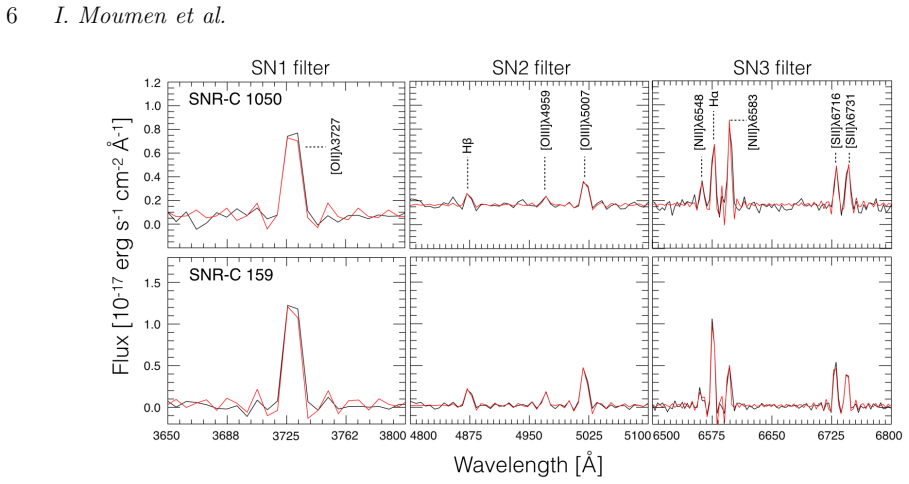
We present the first optical identification and confirmation of a sample of supernova remnants (SNRs) in the nearby galaxy NGC3344. Using high spectral and spatial resolution data, obtained with the CFHT imaging Fourier transform spectrograph SITELLE, we identified about 2200 emission line regions, many of which are HII regions, diffuse ionized gas regions, and also SNRs. Considering the stellar population and diffuse ionized gas background, that are quite important in NGC3344, we have selected 129 SNR candidates based on four criteria for regions where the emission lines flux ratio [S II]/H$\alpha$$\ge$0.4. Emission lines of [O II]$\lambda$3727, H$\alpha$, [O III]$\lambda\lambda$4959,5007, H$\alpha$, [N II]$\lambda\lambda$6548,6583, and [S II]$\lambda\lambda$6716,6731 have been measured to study the ionized gas properties of the SNR candidates. We adopted a self-consistent spectroscopic analysis, based on Sabbadin plots and BPT diagrams, to confirm the shock-heated nature of the ionization mechanism in the candidates sample. With this analysis, we end up with 42 Confirmed SNRs, 45 Probable SNRs, and 42 Less likely SNRs. Using shock models, the Confirmed SNRs seems to have a metallicity ranging between LMC and 2$\times$solar. We looked for correlations between the size of the Confirmed SNRs and their emission lines ratios, their galaxy environment, and their galactocentric distance: we see a trend for a metallicity gradient among the SNR population, along with some evolutionary effects.
Editorial analysis
A structured set of objections, weighed in public.
Referee Report
Summary. The manuscript reports the first optical identification of supernova remnants in NGC3344 using SITELLE integral-field spectroscopy. From ~2200 emission-line regions, 129 SNR candidates are selected via the [S II]/Hα ≥ 0.4 criterion (one of four selection criteria) and then classified using Sabbadin plots and BPT diagrams, yielding 42 confirmed SNRs, 45 probable SNRs and 42 less-likely SNRs. Shock-model comparisons indicate metallicities between LMC and 2×solar for the confirmed sample, with reported trends versus size, environment and galactocentric distance.
Significance. If the classification is robust, the work supplies a sizable, spectroscopically vetted SNR sample in a nearby spiral galaxy that exhibits strong DIG and stellar background, enabling studies of metallicity gradients and evolutionary effects with high-resolution IFU data.
major comments (2)
- [Abstract and candidate selection] Abstract (candidate-selection paragraph) and § on SNR confirmation: the paper states that stellar population and DIG background are “quite important” in NGC3344, yet supplies no quantitative test (dilution factors, mock spectra, or false-positive rates) demonstrating that the [S II]/Hα ≥ 0.4 threshold plus Sabbadin/BPT loci remain orthogonal to H II and DIG loci under these conditions. This is load-bearing for the final counts (42 confirmed SNRs) and the derived metallicity range.
- [Abstract] The manuscript invokes “four criteria” for candidate selection but only explicitly states the [S II]/Hα ≥ 0.4 ratio; the remaining three criteria are not enumerated, preventing independent verification of the 129-candidate list.
minor comments (2)
- Add uncertainty estimates or error bars to the line-ratio points plotted in the Sabbadin and BPT diagrams.
- Clarify whether the shock-model metallicity grid is interpolated or extrapolated for the observed line ratios.
Simulated Author's Rebuttal
We thank the referee for the constructive and detailed comments. We address each major comment below and indicate where revisions will be made to improve the manuscript.
read point-by-point responses
-
Referee: [Abstract and candidate selection] Abstract (candidate-selection paragraph) and § on SNR confirmation: the paper states that stellar population and DIG background are “quite important” in NGC3344, yet supplies no quantitative test (dilution factors, mock spectra, or false-positive rates) demonstrating that the [S II]/Hα ≥ 0.4 threshold plus Sabbadin/BPT loci remain orthogonal to H II and DIG loci under these conditions. This is load-bearing for the final counts (42 confirmed SNRs) and the derived metallicity range.
Authors: We agree that quantitative tests of the impact of stellar population and DIG background would strengthen the robustness of the classification. In the revised manuscript we will add a dedicated subsection that estimates dilution factors from the observed continuum and line fluxes, applies the selection criteria to a control sample of confirmed H II regions, and discusses the resulting false-positive rates. This will directly support the reliability of the 42 confirmed SNRs and the reported metallicity range. revision: yes
-
Referee: [Abstract] The manuscript invokes “four criteria” for candidate selection but only explicitly states the [S II]/Hα ≥ 0.4 ratio; the remaining three criteria are not enumerated, preventing independent verification of the 129-candidate list.
Authors: The abstract refers to four criteria without enumerating them. We will revise the abstract to list the four criteria explicitly while directing readers to the detailed description already present in the candidate-selection section. This change will enable independent verification without altering the scientific content. revision: yes
Circularity Check
No circularity; classification applies external literature diagnostics directly to observed fluxes
full rationale
The paper identifies SNR candidates by applying the standard [S II]/Hα ≥ 0.4 threshold (from external literature) to ~2200 emission-line regions, then uses Sabbadin plots and BPT diagrams (likewise imported) to classify 42 Confirmed SNRs. Shock-model metallicities are also taken from published grids. None of these steps involve fitting parameters inside the paper and then relabeling the fit as a prediction, self-defining quantities, or load-bearing self-citations whose validity reduces to the present work. The counts and metallicity range are therefore the direct, non-circular output of fixed external criteria applied to the SITELLE line measurements.
Axiom & Free-Parameter Ledger
axioms (2)
- domain assumption Emission line flux ratios such as [S II]/Hα ≥ 0.4 indicate shock-heated gas typical of SNRs
- domain assumption Sabbadin plots and BPT diagrams reliably distinguish shock ionization from photoionization in this galactic environment
Reference graph
Works this paper leans on
-
[1]
" write newline "" before.all 'output.state := FUNCTION fin.entry write newline FUNCTION new.block output.state before.all = 'skip after.block 'output.state := if FUNCTION new.sentence output.state after.block = 'skip output.state before.all = 'skip after.sentence 'output.state := if if FUNCTION not #0 #1 if FUNCTION and 'skip pop #0 if FUNCTION or pop #1...
-
[2]
" write newline "" before.all 'output.state := FUNCTION fin.entry write newline FUNCTION new.block output.state before.all = 'skip after.block 'output.state := if FUNCTION new.sentence output.state after.block = 'skip output.state before.all = 'skip after.sentence 'output.state := if if FUNCTION not #0 #1 if FUNCTION and 'skip pop #0 if FUNCTION or pop #1...
-
[3]
Baldwin J. A., Phillips M. M., Terlevich R., 1981, @doi [ ] 10.1086/130766 , http://adsabs.harvard.edu/abs/1981PASP...93....5B 93, 5
-
[4]
Blair W. P., Long K. S., 2004, @doi [ ] 10.1086/423958 , http://adsabs.harvard.edu/abs/2004ApJS..155..101B 155, 101
-
[5]
Cajko K. O., Crawford E. J., Filipovic M. D., 2009, @doi [Serbian Astronomical Journal] 10.2298/SAJ0979055C , http://adsabs.harvard.edu/abs/2009SerAJ.179...55C 179, 55
-
[6]
Calzetti D., Armus L., Bohlin R. C., Kinney A. L., Koornneef J., Storchi-Bergmann T., 2000, @doi [ ] 10.1086/308692 , http://adsabs.harvard.edu/abs/2000ApJ...533..682C 533, 682
work page internal anchor Pith review doi:10.1086/308692 2000
-
[7]
Drissen L., Bernier A.-P., Rousseau-Nepton L., Alarie A., Robert C., Joncas G., Thibault S., Grandmont F., 2010, in Ground-based and Airborne Instrumentation for Astronomy III. p. 77350B, @doi 10.1117/12.856470
-
[8]
R., 1991, , http://adsabs.harvard.edu/abs/1991A
Garcia Lario P., Manchado A., Riera A., Mampaso A., Pottasch S. R., 1991, , http://adsabs.harvard.edu/abs/1991A
work page 1991
-
[9]
Ghavamian P., Blair W. P., Long K. S., Sasaki M., Gaetz T. J., Plucinsky P. P., 2005, @doi [ ] 10.1086/431481 , http://adsabs.harvard.edu/abs/2005AJ....130..539G 130, 539
-
[10]
Gordon S. M., Kirshner R. P., Long K. S., Blair W. P., Duric N., Smith R. C., 1998, @doi [ ] 10.1086/313107 , http://adsabs.harvard.edu/abs/1998ApJS..117...89G 117, 89
-
[11]
Green D. A., 2014, Bulletin of the Astronomical Society of India, http://adsabs.harvard.edu/abs/2014BASI...42...47G 42, 47
work page 2014
-
[12]
Greenhouse M. A., et al., 1997, @doi [ ] 10.1086/303599 , http://adsabs.harvard.edu/abs/1997ApJ...476..105G 476, 105
-
[13]
Hyman S. D., Calle D., Weiler K. W., Lacey C. K., Van Dyk S. D., Sramek R., 2001, @doi [ ] 10.1086/320231 , http://adsabs.harvard.edu/abs/2001ApJ...551..702H 551, 702
-
[14]
Karachentseva V. E., 1973, Astrofizicheskie Issledovaniia Izvestiya Spetsial'noj Astrofizicheskoj Observatorii, http://adsabs.harvard.edu/abs/1973AISAO...8....3K 8
work page 1973
-
[15]
Lacey C. K., Duric N., 2001, @doi [ ] 10.1086/323048 , http://adsabs.harvard.edu/abs/2001ApJ...560..719L 560, 719
-
[16]
M., 1997, @doi [ ] 10.1086/312989 , http://adsabs.harvard.edu/abs/1997ApJS..109..417L 109, 417
Lacey C., Duric N., Goss W. M., 1997, @doi [ ] 10.1086/312989 , http://adsabs.harvard.edu/abs/1997ApJS..109..417L 109, 417
-
[17]
Leonidaki I., Boumis P., Zezas A., 2013, @doi [ ] 10.1093/mnras/sts324 , http://adsabs.harvard.edu/abs/2013MNRAS.429..189L 429, 189
-
[18]
R., Rosolowsky E., eds, Astronomical Society of the Pacific Conference Series Vol
Martin T., Drissen L., Joncas G., 2015, in Taylor A. R., Rosolowsky E., eds, Astronomical Society of the Pacific Conference Series Vol. 495, Astronomical Data Analysis Software an Systems XXIV (ADASS XXIV). p. 327
work page 2015
-
[19]
Martin T. B., Prunet S., Drissen L., 2016, @doi [ ] 10.1093/mnras/stw2315 , http://adsabs.harvard.edu/abs/2016MNRAS.463.4223M 463, 4223
-
[21]
Matonick D. M., Fesen R. A., 1997, @doi [ ] 10.1086/313034 , http://adsabs.harvard.edu/abs/1997ApJS..112...49M 112, 49
-
[22]
Matonick D. M., Fesen R. A., Blair W. P., Long K. S., 1997, @doi [ ] 10.1086/313061 , http://adsabs.harvard.edu/abs/1997ApJS..113..333M 113, 333
-
[23]
E., 1989, Astrophysics of gaseous nebulae and active galactic nuclei
Osterbrock D. E., 1989, Astrophysics of gaseous nebulae and active galactic nuclei
work page 1989
-
[24]
Pannuti T. G., Duric N., Lacey C. K., Goss W. M., Hoopes C. G., Walterbos R. A. M., Magnor M. A., 2000, @doi [ ] 10.1086/317238 , http://adsabs.harvard.edu/abs/2000ApJ...544..780P 544, 780
-
[25]
Pannuti T. G., Duric N., Lacey C. K., Ferguson A. M. N., Magnor M. A., Mendelowitz C., 2002, @doi [ ] 10.1086/337918 , http://adsabs.harvard.edu/abs/2002ApJ...565..966P 565, 966
-
[26]
Pannuti T. G., Schlegel E. M., Lacey C. K., 2007, @doi [ ] 10.1086/510718 , http://adsabs.harvard.edu/abs/2007AJ....133.1361P 133, 1361
-
[27]
Pence W. D., Snowden S. L., Mukai K., Kuntz K. D., 2001, @doi [ ] 10.1086/323240 , http://adsabs.harvard.edu/abs/2001ApJ...561..189P 561, 189
-
[28]
Rousseau-Nepton L., Robert C., Martin R. P., Drissen L., Martin T., 2018, @doi [ ] 10.1093/mnras/sty477 , http://adsabs.harvard.edu/abs/2018MNRAS.477.4152R 477, 4152
-
[29]
Sabbadin F., Minello S., Bianchini A., 1977, , http://adsabs.harvard.edu/abs/1977A
work page 1977
-
[30]
Sonba s E., Aky \"u z A., Balman S ., \"O zel M. E., 2010, @doi [ ] 10.1051/0004-6361/200913858 , http://adsabs.harvard.edu/abs/2010A\
-
[31]
Sonbas E., Akyuz A., Balman S., 2009, @doi [ ] 10.1051/0004-6361:200810690 , http://adsabs.harvard.edu/abs/2009A\
-
[32]
Tully R. B., et al., 2013, @doi [ ] 10.1088/0004-6256/146/4/86 , http://adsabs.harvard.edu/abs/2013AJ....146...86T 146, 86
work page internal anchor Pith review doi:10.1088/0004-6256/146/4/86 2013
-
[33]
Vucetic M. M., Arbutina B., Urosevic D., 2015, VizieR Online Data Catalog, http://adsabs.harvard.edu/abs/2015yCat..74460943V 744
work page 2015
-
[34]
Vu c eti \'c M. M., Arbutina B., Uro s evi \'c D., 2015, @doi [ ] 10.1093/mnras/stu2093 , http://adsabs.harvard.edu/abs/2015MNRAS.446..943V 446, 943
-
[35]
de Vaucouleurs G., de Vaucouleurs A., Corwin Jr. H. G., Buta R. J., Paturel G., Fouqu \'e P., 1991, Third Reference Catalogue of Bright Galaxies. Volume I: Explanations and references. Volume II: Data for galaxies between 0 ^ h and 12 ^ h . Volume III: Data for galaxies between 12 ^ h and 24 ^ h
work page 1991
-
[36]
Allen M. G., Groves B. A., Dopita M. A., Sutherland R. S., Kewley L. J., 2008, @doi [ ] 10.1086/589652 , http://adsabs.harvard.edu/abs/2008ApJS..178...20A 178, 20
-
[37]
Badenes C., Maoz D., Draine B. T., 2010, @doi [ ] 10.1111/j.1365-2966.2010.17023.x , http://adsabs.harvard.edu/abs/2010MNRAS.407.1301B 407, 1301
-
[38]
Blair W. P., Kirshner R. P., 1985, @doi [ ] 10.1086/162919 , http://adsabs.harvard.edu/abs/1985ApJ...289..582B 289, 582
-
[39]
Blair W. P., Kirshner R. P., Chevalier R. A., 1981, @doi [ ] 10.1086/159098 , http://adsabs.harvard.edu/abs/1981ApJ...247..879B 247, 879
-
[40]
Blair W. P., Kirshner R. P., Chevalier R. A., 1982, @doi [ ] 10.1086/159703 , http://adsabs.harvard.edu/abs/1982ApJ...254...50B 254, 50
-
[41]
Blair W. P., et al., 2014, @doi [ ] 10.1088/0004-637X/788/1/55 , http://adsabs.harvard.edu/abs/2014ApJ...788...55B 788, 55
-
[42]
A., Heiderman A., Gebhardt K., Evans II N
Blanc G. A., Heiderman A., Gebhardt K., Evans II N. J., Adams J., 2009, @doi [ ] 10.1088/0004-637X/704/1/842 , http://adsabs.harvard.edu/abs/2009ApJ...704..842B 704, 842
-
[43]
Booth C. M., Schaye J., 2013, @doi [Scientific Reports] 10.1038/srep01738 , http://adsabs.harvard.edu/abs/2013NatSR....E1738B p. 1738
-
[44]
Cardelli J. A., Clayton G. C., Mathis J. S., 1989, @doi [ ] 10.1086/167900 , http://adsabs.harvard.edu/abs/1989ApJ...345..245C 345, 245
-
[45]
Castaneda H. O., Vilchez J. M., Copetti M. V. F., 1990, @doi [ ] 10.1086/169466 , http://adsabs.harvard.edu/abs/1990ApJ...365..164C 365, 164
-
[46]
Chevalier R. A., 1977, @doi [Annual Review of Astronomy and Astrophysics] 10.1146/annurev.aa.15.090177.001135 , 15, 175
-
[47]
Chu Y.-H., Kennicutt Jr. R. C., 1986, @doi [ ] 10.1086/164755 , http://adsabs.harvard.edu/abs/1986ApJ...311...85C 311, 85
-
[48]
F., 1990, in Brinkmann W., Fabian A
Cioffi D. F., 1990, in Brinkmann W., Fabian A. C., Giovannelli F., eds, NATO Advanced Science Institutes (ASI) Series C Vol. 305, NATO Advanced Science Institutes (ASI) Series C. pp 1--16
work page 1990
-
[49]
Cox D. P., Raymond J. C., 1985, @doi [ ] 10.1086/163649 , http://adsabs.harvard.edu/abs/1985ApJ...298..651C 298, 651
-
[50]
Davies R. L., Kewley L. J., Ho I.-T., Dopita M. A., 2014, @doi [ ] 10.1093/mnras/stu1740 , http://adsabs.harvard.edu/abs/2014MNRAS.444.3961D 444, 3961
-
[51]
Dopita M. A., Binette L., Dodorico S., Benvenuti P., 1984, @doi [ ] 10.1086/161653 , http://adsabs.harvard.edu/abs/1984ApJ...276..653D 276, 653
-
[52]
Drissen L., et al., 2019, @doi [ ] 10.1093/mnras/stz627 , http://adsabs.harvard.edu/abs/2019MNRAS.485.3930D 485, 3930
-
[53]
Elwert T., Dettmar R.-J., 2005, @doi [ ] 10.1086/432899 , http://adsabs.harvard.edu/abs/2005ApJ...632..277E 632, 277
-
[54]
Ferrand G., Safi-Harb S., 2012, @doi [Advances in Space Research] 10.1016/j.asr.2012.02.004 , http://adsabs.harvard.edu/abs/2012AdSpR..49.1313F 49, 1313
-
[55]
Flores-Fajardo N., Morisset C., Stasi \'n ska G., Binette L., 2011, @doi [ ] 10.1111/j.1365-2966.2011.18848.x , http://adsabs.harvard.edu/abs/2011MNRAS.415.2182F 415, 2182
-
[56]
Franchetti N. A., et al., 2012, @doi [ ] 10.1088/0004-6256/143/4/85 , http://adsabs.harvard.edu/abs/2012AJ....143...85F 143, 85
-
[57]
Galarza V. C., Walterbos R. A. M., Braun R., 1999, @doi [ ] 10.1086/301113 , http://adsabs.harvard.edu/abs/1999AJ....118.2775G 118, 2775
-
[58]
Gallagher J. S., Hunter D. A., 1983, @doi [ ] 10.1086/161432 , http://adsabs.harvard.edu/abs/1983ApJ...274..141G 274, 141
-
[59]
A., 2017, VizieR Online Data Catalog, http://adsabs.harvard.edu/abs/2017yCat.7278....0G 7278
Green D. A., 2017, VizieR Online Data Catalog, http://adsabs.harvard.edu/abs/2017yCat.7278....0G 7278
work page 2017
-
[60]
Haberl F., et al., 2012, @doi [ ] 10.1051/0004-6361/201219758 , https://ui.adsabs.harvard.edu/#abs/2012A&A...545A.128H 545, A128
-
[61]
Haffner L. M., Reynolds R. J., Tufte S. L., 1999, @doi [ ] 10.1086/307734 , http://adsabs.harvard.edu/abs/1999ApJ...523..223H 523, 223
-
[62]
Hartigan P., Raymond J., Hartmann L., 1987, @doi [ ] 10.1086/165204 , http://adsabs.harvard.edu/abs/1987ApJ...316..323H 316, 323
-
[63]
Hewitt J. N., Haynes M. P., Giovanelli R., 1983, @doi [ ] 10.1086/113317 , http://adsabs.harvard.edu/abs/1983AJ.....88..272H 88, 272
-
[64]
Hoffmann T. L., Lieb S., Pauldrach A. W. A., Lesch H., Hultzsch P. J. N., Birk G. T., 2012, @doi [ ] 10.1051/0004-6361/200811512 , http://adsabs.harvard.edu/abs/2012A
-
[65]
Howard C., Pudritz R., Klessen R., 2017, @doi [ ] 10.3847/1538-4357/834/1/40 , http://adsabs.harvard.edu/abs/2017ApJ...834...40H 834, 40
-
[66]
Karachentsev I. D., Makarov D. I., Kaisina E. I., 2013, @doi [ ] 10.1088/0004-6256/145/4/101 , http://adsabs.harvard.edu/abs/2013AJ....145..101K 145, 101
-
[67]
Kauffmann G., et al., 2003, @doi [ ] 10.1111/j.1365-2966.2003.07154.x , http://adsabs.harvard.edu/abs/2003MNRAS.346.1055K 346, 1055
-
[68]
Kewley L. J., Dopita M. A., Sutherland R. S., Heisler C. A., Trevena J., 2001, @doi [ ] 10.1086/321545 , http://adsabs.harvard.edu/abs/2001ApJ...556..121K 556, 121
work page internal anchor Pith review doi:10.1086/321545 2001
-
[69]
Lee M. G., et al., 2015, @doi [ ] 10.1088/0004-637X/804/1/63 , http://adsabs.harvard.edu/abs/2015ApJ...804...63L 804, 63
-
[70]
Probing the properties of extragalactic Supernova Remnants
Leonidaki I., 2017, arXiv e-prints, https://ui.adsabs.harvard.edu/\#abs/2017arXiv170107840L p. arXiv:1701.07840
work page internal anchor Pith review Pith/arXiv arXiv 2017
-
[71]
Leonidaki I., Zezas A., Boumis P., 2010, @doi [ ] 10.1088/0004-637X/725/1/842 , https://ui.adsabs.harvard.edu/\#abs/2010ApJ...725..842L 725, 842
-
[72]
Long K. S., 2017, Galactic and Extragalactic Samples of Supernova Remnants: How They Are Identified and What They Tell Us . p. 2005, @doi 10.1007/978-3-319-21846-5_90
-
[73]
Long K. S., et al., 2010, @doi [ ] 10.1088/0067-0049/187/2/495 , http://adsabs.harvard.edu/abs/2010ApJS..187..495L 187, 495
-
[74]
Long K. S., Blair W. P., Milisavljevic D., Raymond J. C., Winkler P. F., 2018, @doi [ ] 10.3847/1538-4357/aaac7e , http://adsabs.harvard.edu/abs/2018ApJ...855..140L 855, 140
-
[75]
Maggi P., et al., 2016, @doi [ ] 10.1051/0004-6361/201526932 , https://ui.adsabs.harvard.edu/#abs/2016A&A...585A.162M 585, A162
-
[76]
Mathewson D. S., Clarke J. N., 1973a, @doi [ ] 10.1086/152002 , http://adsabs.harvard.edu/abs/1973ApJ...180..725M 180, 725
-
[77]
Mathewson D. S., Clarke J. N., 1973b, @doi [ ] 10.1086/152177 , http://adsabs.harvard.edu/abs/1973ApJ...182..697M 182, 697
-
[78]
Mathewson D. S., Healey J. R., 1963, @doi [ ] 10.1038/199681a0 , http://adsabs.harvard.edu/abs/1963Natur.199..681M 199, 681
-
[79]
McCall M. L., Rybski P. M., Shields G. A., 1981, @doi [ ] 10.1086/130821 , http://adsabs.harvard.edu/abs/1981PASP...93..273M 93, 273
-
[80]
McKee C. F., Ostriker J. P., 1977, @doi [ ] 10.1086/155667 , http://adsabs.harvard.edu/abs/1977ApJ...218..148M 218, 148
-
[81]
Medina A. A., Raymond J. C., Edgar R. J., Caldwell N., Fesen R. A., Milisavljevic D., 2014, @doi [ ] 10.1088/0004-637X/791/1/30 , https://ui.adsabs.harvard.edu/abs/2014ApJ...791...30M 791, 30
discussion (0)
Sign in with ORCID, Apple, or X to comment. Anyone can read and Pith papers without signing in.